1244 | P a g e
NON-SEPARABLE REGULARIZATION BASED
DE-CONVOLUTION
K. Rajitha, M.Tech
1, J. Sheshagiri Babu, M.Tech.(Ph.D)
21,2
ECE, Kakatiya Instistute of Technology and Science, Warangal, (India).
ABSTRACT
A standard convex approach for sparse one-dimensional de-convolution improves upon L1-norm regularization.
We propose a sparsity -inducing non-separable non-convex bivariate penalty function for this purpose. It is
designed to enable the convex formulation of ill- conditioned linear inverse problems with quadratic data
fidelity terms. The new penalty overcomes limitations of separable regularization. We show how the penalty
parameters should be set to ensure that the objective function is convex, and provide an explicit condition to
verify the optimality of a prospective solution. In this project, We present an algorithm (an instance of
forward-backward splitting) for sparse de-convolution using the new penalty terms.
Key Words-
De-Convolution, Convex Functions, Sparse Signal Estimation, Non-Convex Regularization.I.
INTRODUCTION
In this literature we are going to deal with sparse regularization. This sparse regularization can be categorized
into two types. One is convex and other one is non-convex. In this project we are using the term regularization
terms is called as penalty functions. In the convex approach, the regularization terms or penalty functions are
convex. The convex method consisting of both data fidelity and regularization terms. So that the objective
function is convex [1], [2]. By using this convex approach method we have several advantages i.e., the
objective function is free of extraneous (irrelevant) local minima, and globally convergent optimization
algorithms can be improved [3].
The Non-convex regularization has more advantages [4], [5], [6] comparative to convex regularization .
Classical and recent examples of non-convex method is edge preserving tomography [7], [8], [9], [10] and
compressed sensing [11], [12], [13], respectively. By using these techniques the non-convex approach performs
better than convex one’s. In the convex approach, penalty functions are convex. Because these non-convex functions are designed to induce sparsity more effectively than non-convex one’s. therefore the non-convexity of
the objective function is generally sacrificed. Non-convex regularization is having some complications that is
the objective function will generally posses many sub-optimal local minima in which optimization algorithms
can become entrapped.
It turns out, without giving up the convexity of the objective function and corresponding benefits. The
non-convex penalties can be utilized. This is achieved by carefully specifying the penalty in accordance with the data
1245 | P a g e
sparcity-inducing non-convex penalties has been developed to formulate convex objective functions and applied
to several signal estimation problems [16], [17], [18], [19], [20], [21], [22], [23], [24]. This approach maintains
the benefits of the convex framework (absence of spurious local minima, etc.), yet estimates sparse signals more
accurately than convex regularization (e.g., the
l
1norm) due to the sparsity –inducing properties of non-convexregularization. However , this previous work considers only separable (additive) penalties, which have
fundamental limitations.
In this paper, we introduce a parameterized sparsity-inducing non separable non-convex bivariate penalty
function. To enable the convex formulation of ill-conditioned linear inverse problems with quadratic data
fidelity terms the penalty function is designed. The new penalty overcomes the limitations of separable
non-convex regularization. In this paper, now we show how the penalty parameters should be set to ensure the
objective function is convex. And we also show how this bivariate penalty can be incorporated into linear
inverse problems of
N
variables(
N
2)
, and then we provide an explicit condition to verify the optimalityof a prospective solution. For sparse signal reconstruction using the new penalty we present an iterative
algorithm (as instance of forward-backward splitting), and we demonstrate it’s effectiveness for
one-dimensional sparse de-convolution.
A. Notation
We write the vector
x
R
Nasx
x x
1,
2,....,x
N
. Givenx
R
N, we definex
n
0
forn
{1, 2,...., }
N
. (This simplifies expressions involving summations overn
.) Thel
1norm ofx
R
Nis defined as1
|
n|
n
x
x
. If the matrixA
is positive semi definite, we writeA
0
. If theA B
is positive semidefinite, we write
A
B
.II.
SPARSE RECONSTRUCTION
In signal processing the practical problems are involve far more than two variables. Therefore, the proposed
bivariate penalty and convexity condition are of little practical use on their own. In this section we show how
they can be used to solve an
N
- point linear inverse problem (withN
2
). We consider the problem of estimating a signalx
R
N giveny
,y
Hx
w
(1)Where
H
is a known linear operator,x
is known to be sparse, andw
is additive white Gaussian noise(AWGN). we formulate the estimation of
x
as an optimization problem with bivariate sparse regularization1246 | P a g e
2
2 1
1
arg min{
,
;
}
2
2
N n n
x R n
x
F x
y
Hx
x
x
a
(2)Where
0
,a
a a
1,
2
and
:
R
2
R
is the proposed bivariate penalty. In the penalty term, the firstand last signal value pairs,
x x
0,
1
and
x
N,
x
N1
, straddle the end-points ofx
.C
, we definex
n
0
for{1, 2,..., }
n
N
, which simplifies subsequent notation.If
a
1
a
2, then the bivaiate penalty is separable, i.e.,
u a
;
u a
1;
1
u a
2;
1
, and theN
-pointpenalty term in (2) reduces to
n;
1
n
x a
. Hence, we recover the standard (separable) formulation ofsparse regularization. In particular, if
a
1
a
2
0
, then
u
;0
|
u
1|
|
u
2|
and theN
-point penalty termreduces to
x
1, i.e., the classical sparsity-inducing convex penalty.In order to induce sparsity more effectively, we allow
to be non-separable; i.e.,a
1
a
2. To thatend, the following section addresses the problem of how to set
a
1 anda
2 in the bivariate penalty
to ensureconvexity of the
N
- variate objective functionF
in (2).The lemma is proven in appendix D. According to the lemma, it is sufficient to restrict
so as to ensureconvexity of the bivariate function
f
in (3). Therefore , the allowed penalty parametersa
i can be determined from the tridiagonal matrix P. using lemma 1, we obtain theorem 1.A.
Optimality Condition
In this section, we derive an explicit condition to verify the optimality of a prospective minimize of the objective
function
F
in (2). The optimality condition is also useful for monitoring the convergence of an optimizationalgorithm (see the animation in the supplemental material).
The general condition to characterize minimiers of a convex function is expressed in terms of the sub
differential. If
F
is convex, thenx
opt
R
N is a minimizer if and only if0
F x
opt where
F
is the sub differential ofF
.We seek an expression for the sub differential of the objective function
F
. The functionF
in (2) has aregularization term that is non-differentiable, non-convex, and non-separable. But using , we may write the
1247 | P a g e
1
1
,
;
2
n n nx
x
a
(3)
1
1
11
[
,
;
,
]
2
n n n n nS
x
x
a
x
x
(4)= 1
1
1,
;
2
n n nx
S
x
x
a
(5)Where
x
n
0
forn
{1, 2,..., }
N
. We define:
NR
R
as
1
1
,
,
;
2
n n nx a
S
x
x
a
(6)The function
is twice continuously differentiable because it is the sum of twice differentiable functions.Using (5), we ,may express the objective function
F
in (2) as
1
22
;
12
F x
y
Hx
x a
x
(7)The benefit of (7) compared to (2) is that the regularization term ( which is non-differentiable, non-convex, and
non- separable ) is separated into a differentiable part and a convex separable part. The
term is differentiableand its gradient is easily evaluated. The
l
1norm is separable and convex and its sub differential is easilyevaluated.
The gradient of
is given by
;
1
1
,
1
;
1
2
1,
;
2
n n2
n nn
x a
S
x x
a
S
x
x
a
(8)Where
S
i is the partial derivative ofS
x x
1,
2
with respect tox
i. The sub differential of thel
1 norm is separable [11],1248 | P a g e
1 ,
0
: { 1,1 ,
0
1 ,
0
t
sign t
t
t
(10)
Since the first two terms of (7) are differentiable, the sub differential of
F
is
F x
H
T
Hx
y
x a
;
x
1. (11)Hence the condition
0
optF x
can be expressed as
1/
H
T
y
Hx
opt
x
opt;
a
x
opt
1 (12)Expressing this condition component-wise, we have the following result.
B.
Sparse Deconvolution
We apply theorem 1 to the sparse deconvolution problem. In this case, the linear operator
H
representsconvolution, i.e.,
n n k kk
Hx
h
x
(13)That is,
H
is a Toeplitz matrix. It represents a linear time-invariant (LTI) system with frequency responsegiven by the Fourier transform of
h
,
jwnn n
H w
h e
(14)Similarly, the matrix
P
in (2a) represents an LTL system with a real-valued frequency response,
1 0 1jw jw
P w
p e
p
p e
(15)0
2
1cos( )
p
p
w
(16)1249 | P a g e
III.
FIGURES
0 0.5 1 1.5 2 2.5 3
0 0.2 0.4 0.6 0.8 1
Frequency ()
|H()|2 P()
Fig.1. Filters
H w
andP w
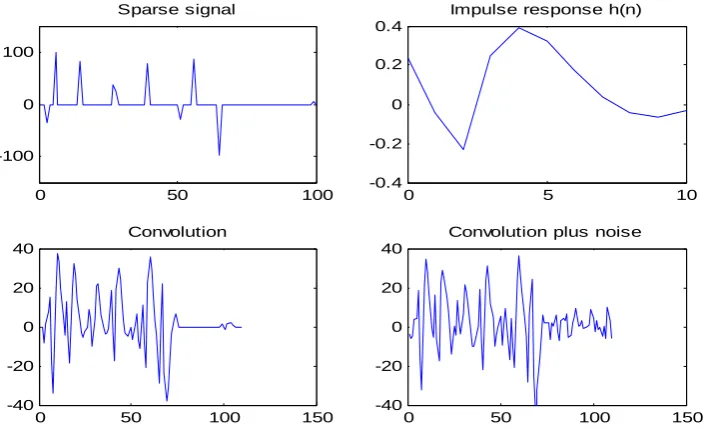
for example 2.0 50 100
-100 0 100
Sparse signal
0 5 10
-0.4 -0.2 0 0.2 0.4
Impulse response h(n)
0 50 100 150
-40 -20 0 20 40
Convolution
0 50 100 150
-40 -20 0 20 40
Convolution plus noise
1250 | P a g e
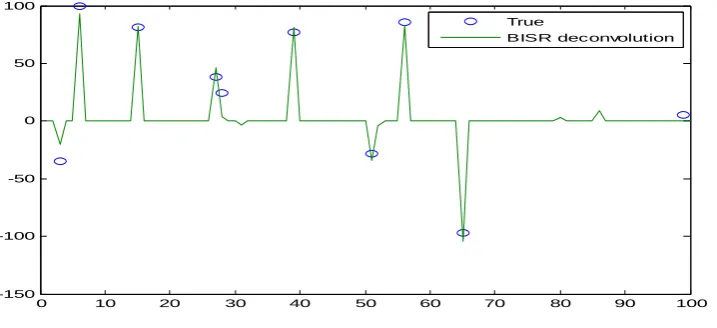
0 10 20 30 40 50 60 70 80 90 100
-150 -100 -50 0 50 100
True
BISR deconvolution
Fig .3. example 2 of sparse deconvolution using BISR.
IV.
COMPARISION TABLE
Algorithm RMSE No of iterations
1
l
norm De-convolution 4.70 32Proposed De-convolution 3.11 22
V.
CONCLUSION
The results and comparison table show that Proposed De-convolution gives RMSE value better than
l
1 normDe-convolution. The signal can be exactly or more approximated estimated using the proposed de-De-convolution.
REFERENCES
[1] F. Bach, R. Jenatton, J. Mairal, and G. Obozinski, “optimization with sparsity-indusing penalties,” Found.
Trends Mach. Learn., vol. 4, no. 1,pp. 1-106, 2012.
[2] Convex optimization in signal processing and communications, D. P. Palomar and Y. C. Eldar, Eds.
Cambridge, U.K.: Cambridge Univ. press, 2010.
[3] S. Boyd and L. Vandenberghe, Convex Optimization. Cambridge, U.K.: Cambridge Univ. Press, 2004.
[4] A.Bruckstein, D. Donoho, and M. Elad, “From sparse solutions of systems of equations to sparse modeling
of signals and images,” SIAM Rev., vol. 51, no. 1, pp. 34–81, 2009.
[5] A.Bruckstein, D. Donoho, and M. Elad, “From sparse solutions of systems of equations to sparse modeling
of signals and images,” SIAM Rev., vol. 51, no. 1, pp. 34–81, 2009.
[6] M. Nikolova, “Energy minimization methods,” in Handbook of Mathematical Methods in Imaging, O.
1251 | P a g e
[7] P. Charbonnier, L. Blanc-Feraud, G. Aubert, and M. Barlaud, “Deterministic edge-preserving regularization
in computed imaging,” IEEE Trans. Image Process., vol. 6, no. 2, pp. 298–311, Feb. 1997.
[8] D. Geman and G. Reynolds, “Constrained restoration and the recovery of discontinuities,” IEEE Trans.
Pattern Anal.Mach. Intel., vol. 14, no. 3, pp. 367–383, Mar. 1992.
[9] M. Nikolova, “Markovian reconstruction using a GNC approach,” IEEE Trans. Image Process., vol. 8, no.
9, pp. 1204–1220, 1999.
[10]M. Nikolova, M. K. Ng, and C.-P. Tam, “Fast nonconvex nonsmooth minimization methods for image
restoration and reconstruction,” IEEE Trans. Image Process., vol. 19, no. 12, pp. 3073–3088, Dec. 2010.
[11]R. Chartrand, “Fast algorithms for nonconvex compressive sensing: MRI reconstruction from very few
data,” in Proc. IEEE Int. Symp. Biomed. Imag. (ISBI), Jul. 2009, pp. 262–265.
[12]R. Chartland, E. Y. Sidky, and P. Xiaochuan,” Non convex compressive sensing for X-ray CT: An
algorithm comparision,” in proc. Asilomar conf, Signals, syst., comput., Nov. 2013, pp. 665-669.
[13]J. Trzasko and A. Manduca, “Highly under sampled magnetic resonance image reconstruction via homo
topic L0-minimization,” IEEE Trans. Med. Imag., vol. 28, no. 1, pp. 106-121, Jan. 2009.
[14]A. Blake and A. Zisserman, Visual Reconstruction. Cambridge, MA, USA: MIT Press, 1987.
[15]M. Nikolova, “Estimation of binary images by minimizing convex criteria,” in Proc. IEEE Int. Conf. Image
Process. (ICIP), 1998, vol. 2, pp. 108–112.
[16]I. Bayram, “penalty functions derived from monotone mappings,” IEEE Signal process. Lett., vol. 22,
no. 3, pp. 265-269, Mar.2015.
[17]I. Bayram, P.-Y. Chen, and I. Selesnick, “Fused lasso with a nonconvex sparsity inducing penalty,” in Proc.
IEEE Int. Conf. Acoust., Speech, Signal Process. (ICASSP), Florence, Italy, May 2014.
[18]P. Y. Chen and I. W. Selesnick, “Group-sparse signal denoising: Non-convex regularization, convex
optimization,” IEEE Trans. Signal Process., vol. 62, no. 13, pp. 3464–3478, Jul. 2014.
[19]Y. Ding and I. W. Selesnick, “ Artifact-free wavelet denoising: Non-convex sparse regularization, convex
optimization,” IEEE signal process. Lett., vol. 22, no. 9, pp. 1364-1368, Sept. 2015.
[20]A. Lanza, S. Morigi, and F. Sgallari, “Convex image denoising via non-convex regularization,” in Scale
Space and VariationalMethods in Computer Vision, ser. Lecture Notes in Computer Science, J.-F. Aujol,
M. Nikolova, and N. Papadakis, Eds. New York, NY, USA: Springer, 2015, vol. 9087 , pp. 666–677.
[21]A. Parekh and I. W . Selesnick, “Convex denoising using non-convex tight frame regularization,” IEEE
Signal Process. Lett., vol. 22, no. 10, pp. 1786-1790, Oct. 2015.
[22]A. Parekh and I. W . Selesnick, “Convex fused Lasso denoising with non-convex regularization and its use
for pulse detection,” Oct. 2015 [online] . Available: http://arxiv.org/abs/1509.02811.
[23]I. W. Selesnick and I. Bayram, “Sparse signal estimation by maximally sparse convex optimization,” IEEE
Trans. Signal Process., vol. 62, no. 5, pp. 1078–1092, Mar. 2014.