Highlights from the STAR experiment
AlexeyAparin1,∗for the STAR collaboration
1Joint Institute for Nuclear Research, Dubna, Russia
Abstract. We present an overview of the recent results obtained by the STAR
Collaboration at RHIC. We report the beam energy dependence of directed flow of strange particles. These results support the assumption, that directed flow is formed before hadronization and observed particles are formed via coales-cence of constituent quarks. First evidence of a non-zero directed flow ofD0
meson is reported. We present the precision measurement of elliptic flow ofD0
meson and the first measurement ofΛcbaryon in Au+Au collisions at √
sNN =200 GeV, which suggests thermalization of charm quarks. We report results of globalΛpolarization measurements in Au+Au collisions, together with the investigation of polarization dependence of centrality and transverse momen-tum pT. Results from the STAR fixed-target program show good agreement with previously obtained results. A precise measurement of the3
ΛHlifetime is
presented. Mesonic decay modes are used to reconstruct the3
ΛHfrom Au+Au
collisions. The measured lifetime is about 50% shorter than the one of a free Λ, indicating a strong hyperon-nucleon interaction in the hypernucleus system. Finally, we give an outlook to detector upgrades for the Beam Energy Scan phase II.
1 Azimuthal anisotropy measurements
One of the most important observables in heavy-ion experiments is the azimuthal anisotropic flow [1] that is usually quantified by the Fourier coefficients of the azimuthal distribu-tion of the final state particles relative to the collision symmetry planes Ed3N/d p3 =
1/2π·d2N/p
td ptdη·(1+ Σ2vncos[n(φ−Ψn)]). The first-order coefficient, called the
di-rected flow, is argued to be sensitive to the equation of state of the matter, and could serve as a possible signature of the QGP phase transition. STAR has recently performed directed flow measurements at mid-rapidity forΛ,Λ¯,K±,K0
s,andφat √
sNN =7.7, 11.5, 14.5, 19.6,
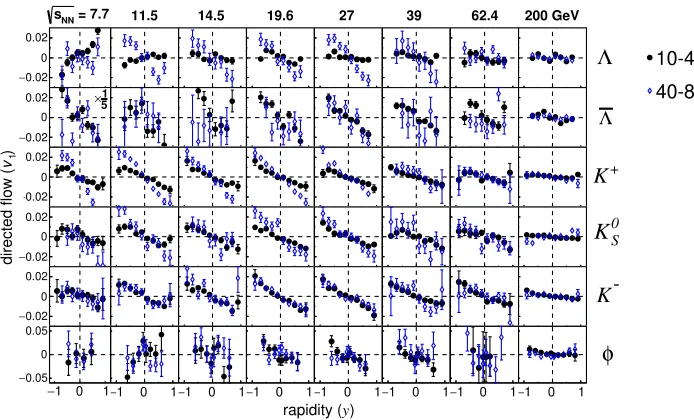
27, 39, 62.4 and 200 GeV in Au+Au collisions. Results show good sensitivity for testing a picture where the flow is assumed to be formed before hadron formation and the observed particles are assumed to form via coalescence of constituent quarks. Fig.1representsv1(y)
for indicated particles at two centralities. One can see that within errors, the plotted species have a near linearv1(y) over the acceptance of the STAR detector.
Directed flow slopedv1/dyversus beam energy forΛ,Λ¯,K±,Ks0, φwas also studied [2]
and compared with the data forπ±,pand ¯p[3]. Combined data for the ten particle species available allow one to carry out a detailed investigation of constituent quarkv1. Obtained
re-sults support the assumption called the coalescence sum rule [4]. In this scenario the directed
flowv1is formed at the pre-hadronic stage, specific types of quarks have the same directed
flow and the detected hadrons are formed via coalescence.
0.02
−
0 0.02
0.02
−
0 0.02 ×51
0.02
−
0 0.02
0.02
−
0 0.02
0.02
−
0 0.02
1 − 0 1
0.05
−
0 0.05
1
− 0 1 1− 0 1 1− 0 1 1− 0 1 1− 0 1 1− 0 1 1− 0 1
10-40%
40-80%
= 7.7
NN
s 11.5 14.5 19.6 27 39 62.4 200 GeV
Λ
Λ
+
K
S 0
K
-K
φ
)1v
directed flow (
)
y
rapidity (
Figure 1. Directed flow as a function of rapidity for the six indicated particle species in 10-40% (black) and 40-80% (blue) central Au+Au collisions at √sNN=7.7 to 200 GeV. The error bars include statistical uncertainties only. All panels for species other thanφuse the samev1scale with the exception
of ¯Λat√sNN=7.7 GeV, wherev1magnitudes are exceptionally large and require the measurements to
be divided by five
Direct measurements of charmed hadrons require a very good vertex detector due to their very short lifetimes. STAR had installed the Heavy Flavor Tracker (HFT) [5], the MAPS-based vertex detector for run years 2014-2016. This allowed one to perform precise measure-ments of the flow for heavy flavor particles [6].
Fig.2shows the first measurement of the directed flow for charmed mesonD0produced in
Au-Au collisions for 10–80% centrality. It is clear that within the error value ofv1(y) is
non-zero and follows the linear trend obtained previously for the light particle sector. The second harmonic of the charmed mesonD0has been recently studied using data from run years 2014
and 2016. The measuredD0 v
2 in 0–80% centrality Au+Au collisions can be described by
a viscous hydrodynamic calculation for transverse momentumpT less than 4GeV/c. TheD0
v2as a function of transverse kinetic energy (mT –m0, wheremT =
q
p2T +m2) is consistent
with that of light mesons in 10–40% centrality Au+Au collisions. These results suggest that charm quarks have achieved local thermal equilibrium with the medium produced in these collisions.
Figure 2. Directed flow as a function of rapidity forD0mesons in 10–80% centrality Au+Au collisions
at √sNN=200 GeV compared with directed flow ofK++K−
. Data points for ¯D0are slightly shifted
for visibility
2 Heavy flavor production
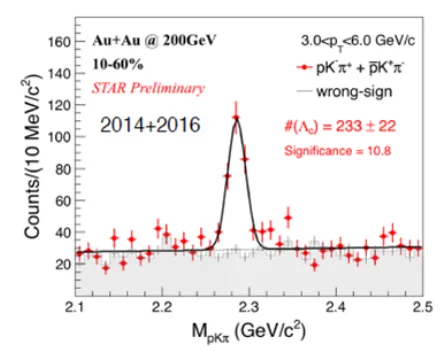
The excellent HFT resolution enabled a study of charmed hadrons with even smaller decay lengths thanD0, in particularΛc. Fig.3shows the reconstructed invariant mass of pKπin 10–60% Au+Au collisions at √sNN=200 GeV, with topological cuts optimized forΛc. A
peak at theΛc mass is observed clearly. STAR has performed the first measurements of centrality dependence ofΛcproduction in heavy ion-collisions. It has been found thatΛc/D0 ratio increases from peripheral to central, that indicates hot medium effects. The measured STAR data point was compared to model calculations with various levels of charm quark thermalization in the medium and different coalescence implementations of the coalescence mechanism.
The energy loss of charm and bottom quarks is of great interest since quarks are expected to exhibit different radiative energy losses depending on their mass. The nuclear modification factor RAA(pT) = σinpp/ < NcollAA > ·[d2NAA/d pTdη]/[d2σpp/d pTdη] of inclusive J/ψ via
the di-muon channel at midrapidity in 0-40% Au+Au collisions at √sNN =200 GeV was
compared to LHC results [7]. The strong suppression at highpT obtained at RHIC indicates
significantJ/ψdissociation.
STAR has shownΥRAAfor the 2S+3S states for Au+Au collisions at √
sNN=200 GeV
as a function of particles numberNpart, compared to CMS data. There are indications that the
suppression is weaker at √sNN=200 GeV than at √
sNN=2.76 TeV, which might be due to
the lower temperature at RHIC. Weaker suppression of the 1S state compared to the 2S+3S states in central collisions is consistent with the picture of sequential melting.
3 Global polarization measurements
STAR has recently reported measurements of global Λ polarization in Au+Au collisions [8,9]. The existence of alignment between the angular momentum of a non-central colli-sion and the spin of emitted particles was demonstrated for the first time, revealing that the fluid produced in heavy-ion collisions is by far the most vortical system ever observed. The measured effect forΛand ¯Λhyperons has shown positive polarization of the order of a few percent for energies of BES and of tens of percent for the highest RHIC energy. The sig-nal increases with decreasing collision energy, and systematic splitting betweenΛand ¯Λis observed which might indicate an additional magnetic component.
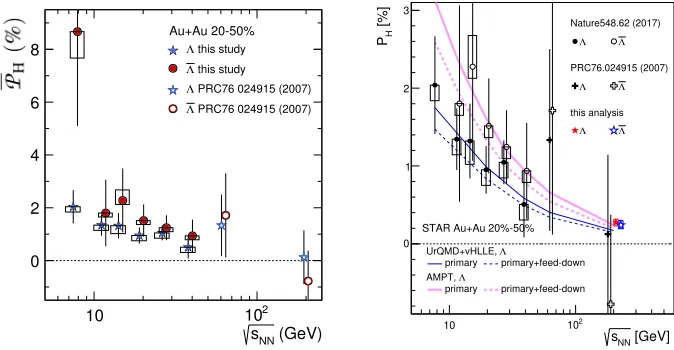
Spin-orbit coupling can generate a spin alignment, or polarization, along the direction of the vorticity which is on the average parallel to the overall angular momentum of the system. Fig.4shows the measured global polarization ofΛand ¯Λas a function of the collision energy for the 20–50% centrality bin in Au+Au collisions. A set of different theoretical models is argued to describe the measured polarization [10]-[12].
Calculations for primaryΛand allΛtaking into account the effect of feed-down, from a (3+1)D viscous hydrodynamic model vHLLE with the UrQMD initial state [10] are shown for comparison. The model calculations agree with the data over a wide range of collision en-ergy, including √sNN=200 GeV within the current accuracy of experimental measurements.
Calculations from a Multi-Phase Transport (AMPT) model [11] predict slightly higher po-larization than the hydrodynamic model, but are also in good agreement with the data within uncertainties.
Fig.5shows differential measurements of the polarization, versus the collision centrality, and hyperon’s transverse momentum. With the given large uncertainties, it is not clear if the polarization saturates or even starts to drop offin the most peripheral collisions (Fig.5, left). The polarization dependence on pT is weak or absent (Fig.5, right), considering the
large uncertainties, which is consistent with the expectation that the polarization is gener-ated by a rotation of the system. No significant dependence on pseudorapidity or transverse momentum was observed. The statistical uncertainties need to be improved to reach a defini-tive conclusion on the event-by-event charge asymmetry, which is consistent with a possible contribution to the global polarization from the axial current induced by the initial magnetic field.
4 Results from the fixed-target program
STAR has demonstrated the capability to operate at very low √sNN=4.5 GeV in the
(GeV)
NN
s
10 102
0 2 4 6 8
Au+Au 20-50%
this study Λ
this study Λ
PRC76 024915 (2007) Λ
PRC76 024915 (2007) Λ
[GeV]
NN
s
10 2
10
[%]
H
P
0 1 2 3
STAR Au+Au 20%-50%
Nature548.62 (2017)
Λ Λ
PRC76.024915 (2007)
Λ Λ
this analysis
Λ Λ
Λ UrQMD+vHLLE,
primary primary+feed-down
Λ AMPT,
primary primary+feed-down
Figure 4. Global polarization ¯PH (where H= Λor ¯Λ) ofΛand ¯Λas a function of the collision energy √sNNfor 20-50% centrality Au+Au collisions.Left.The results of the measurements for BES energy range (√sNN<40 GeV) are compared with the data previously calculated for 62.4 and 200 GeV collisions, for which only statistical errors are plotted. Boxes indicate systematic uncertainties.Right. Thin lines show calculations from a (3+1)D cascade+viscous hydrodynamic model (UrQMD+vHLLE) [10] and bold lines show the AMPT model calculations [11]. In the case of each model, primaryΛwith and without the feed-down effect are indicated by dashed and solid lines, respectively. Open boxes and vertical lines show systematic and statistical uncertainties, respectively. Data points at 200 GeV and for
¯
Λare slightly horizontally shifted for visibility
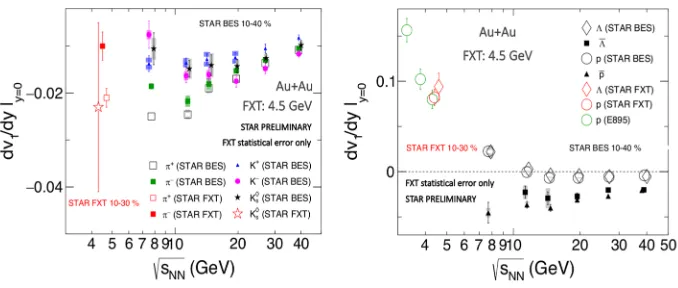
pipe has been done recently. During 3 minutes run 1M events of 0-30% centrality Au+Au were recorded. Fig.6shows energy dependence of the measured directed flow slope param-eterdv1/dy|y=0, comparing the data from the fixed-target mode to BES STAR [13] and AGS
results [14]. Within the uncertainties the data are consistent with those measured in a collider experiments. Fig.6, left, shows the slope parameter for the lightest mesons (π±, K±andKS0) and Fig.6, right, the same for lightest baryons (p, Λand ¯p).
Fig.7demonstrates STAR capabilities for particle identification in the fixed-target regime for strange particles. Spectra are plotted in dependence on transverse kinetic energy forKS0, left, andΛ, right.
5 Hypertriton lifetime measurements
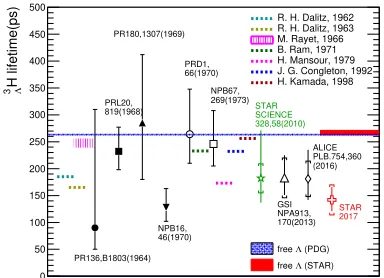
STAR has performed a precise measurement of the3
ΛH and3Λ¯H¯ lifetime. Mesonic decay
modes were used to reconstruct3ΛHfrom Au+Au collisions data. All3ΛHmeasurements, re-gardless of beam energy, were combined to increase the statistics. The hypertriton candidates were reconstructed from the invariant mass distributions of the daughters: 3He+π−for the
2-body, andd+p+π−for the 3-body decay channel of3
ΛHand3He¯ +π+for the 2-body, and ¯
d+p¯+π+for the 3-body decay channel for3
ΛHand3Λ¯H, respectively.¯
A minimumχ2estimation is used to determine the lifetime ofτ=142+24−21(stat.)±
Centrality [%]
20 40 60 80
[%]
H
P
0 0.5 1
Λ
Λ
= 200 GeV
NN
s STAR Au+Au
<6 GeV/c
T
|<1, 0.5<p η |
[GeV/c] T p
0 1 2 3 4
[%]
H
P
0 0.5 1
= 200 GeV NN s STAR Au+Au
|<1 η 20%-60%, |
Λ hydro, primary
UrQMD IC Glauber+tilt IC Λ
Λ
Figure 5. Left.Polarization ofΛand ¯Λas a function of the collision centrality in Au+Au collisions at √sNN=200 GeV.Right. Polarization ofΛand ¯Λas a function of transverse momentumpTfor the 20 – 60% centrality bin in Au+Au collisions at √sNN=200 GeV. Hydrodynamic model calculations forΛwith two different initial conditions are compared. Open boxes and vertical lines show systematic and statistical uncertainties. Data points for ¯Λare slightly shifted for visibility
Figure 6. Directed flow slope at mid-rapidity as a function of the center-of-mass energy √sNNfor the STAR fixed-target data. Left:dv1/dy|y=0for light mesons, compared to results obtained at STAR
BES-I.Right:dv1/dy|y=0for light baryons, compared to results obtained at AGS and STAR BES-I
The STAR experiment will collect large datasets for Au+Au collisions during BES phase II in years 2019-2020, which will further reduce experimental uncertainties on the3
ΛH life-time and will likely provide a new insight into its structure.
6 Detector upgrades for BES-II
BES phase II, planned to run in years 2019 and 2020, covers the energy range of √sNN <
Figure 7. Spectra of strange particles obtained in the fixed-target mode as a function of transverse kinetic energy.Left: Spectra ofK0
S.Right: Spectra ofΛ
H lifetime(ps)
3 Λ
0 50 100 150 200 250 300 350 400 450 500
PR136,B1803(1964) PRL20, 819(1968)
PR180,1307(1969)
NPB16, 46(1970)
PRD1, 66(1970)
NPB67, 269(1973)
STAR SCIENCE 328,58(2010)
GSI NPA913, 170(2013)
ALICE PLB.754,360 (2016)
STAR 2017
(PDG)
Λ
free
(STAR)
Λ
free R. H. Dalitz, 1962 R. H. Dalitz, 1963 M. Rayet, 1966 B. Ram, 1971 H. Mansour, 1979 J. G. Congleton, 1992 H. Kamada, 1998
Figure 8. A summary of worldwide3
ΛHlifetime experimental measurements and theoretical
calcula-tions. The two star markers are the STAR results published in 2010 and 2018
search for the QCD critical point and signatures of a phase transition between hadronic gas and QGP phases. In order to increase detector acceptance and particle identification capabili-ties, three major subsystem upgrades were proposed must be ready till the end of 2018: Event Plane Detector (EPD), the inner TPC upgrade (iTPC) and the endcap Time-Of-Flight detector (eTOF). The EPD was fully installed and became operational for the run year 2018, replacing the Beam-Beam Counter (BBC) as a minimum-bias trigger detector. EPD allows one to carry out forward measurements of both centrality and event plane determination reducing system-atic uncertainty due to autocorrelations for midrapidity analysis. This new detector consists of two disks that are placed on both sides of the STAR detector. EPD has pseudorapidity acceptance of 2.1< |η| <5.1 with 16 radial segments and 24 azimuthal segments.
improve thedE/dxresolution, and allow tracks to be reconstructed down topT of 60 MeV/c.
A single inner sector was installed for tests for the run year 2018 and the full complement of 24 will be installed for the run year 2019.
The eTOF will be installed on one side of STAR, which will extend PID capabilities at forward rapidity. Three modules of eTOF were installed behind one of the TPC sectors for the run year 2018 and the full complement of 36 will be installed for the run year 2019. Combining all three detector systems will reduce significantly the systematic uncertainties of many observables and improve the statistical precision of STAR BES measurements.
7 Summary
STAR has presented a variety of experimental results in a wide energy √sNN range from
4.5 GeV to 200 GeV obtained in the fixed-target and collider modes. A systematic study of collision energy dependence of strange particles indicates the constituent quark coalescence. Results on heavy flavor production measured with HFT include the directed and elliptic flows ofD0mesons and reconstruction ofΛcbaryons, which supports the idea of charm thermaliza-tion at RHIC energies. GlobalΛpolarization measurements in Au+Au collisions previously made for the energies of the BES now has been presented revealing a non-zero effect for the highest RHIC energy 200 GeV. These observations can provide a new insight on the vorticity in heavy-ion collisions. Three detector upgrades are expected to be ready prior to the run year 2019 for the upcoming Beam Energy Scan phase II. The iTPC, eTOF and EPD detec-tors will improve the acceptance, particle identification capabilities, and reduce systematic uncertainties for many observables.
References
[1] S. Voloshin and Y. Zhang, Z. Phys. C70, 665 (1996)
[2] L. Adamczyk et al. [STAR Collab.], Phys. Rev. Lett.120, 062301 (2018) [3] L. Adamczyk et al. [STAR Collab.], Phys. Rev. Lett.112, 162301 (2014) [4] J. C. Dunlop, M. A. Lisa and P. Sorensen, Phys. Rev. C84, 044914 (2011) [5] H. Qiu [STAR Collab.], Nucl. Phys. A931, 1141 (2014)
[6] L. Adamczyk et al. [STAR Collab.], Phys. Rev. Lett.118, 212301 (2017) [7] B. B. Abelev et al. [ALICE Collab.], Phys. Lett. B734, 314 (2014) [8] L. Adamczyk et al. [STAR Collab.], Nature548, 62 (2017) [9] J. Adam et al. [STAR Collab.], Phys. Rev. C98, 014910 (2018) [10] I. Karpenko and F. Becattini, Eur. Phys. J. C77, 213 (2017)
[11] H. Li, L. G. Pang, Q. Wang and X. L. Xia, Phys. Rev. C96, 054908 (2017) [12] O. Rogachevsky, A. Sorin and O. Teryaev, Phys. Rev. C82, 054910 (2010) [13] L. Adamczyk et al. [STAR Collab.], Phys. Rev. Lett.112, 162301 (2014) [14] H. Liu et al. [E895 Collab.], Phys. Rev. Lett.84, 5488 (2000)