472 | P a g e
ASSURING SECURE AND TRANSMISSION CLOUD
STORAGE SERVICES IN CLOUD COMPUTING
Kunisetty Arun Kumar
1, J A Paulson
2 1PursuingM.Tech (IT), 2Working as Professor of (IT), Nalanda Institute of Engineering& Technology (NIET), Kantepudi(V),
Sattenpalli(M), Guntur(D, Andhra Pradesh (India)
ABSTRACT
Cloud storage allows clients to remotely storing their information and enjoys the on request highly quality cloud
requestslacking theweight of local software management and hardware. However theadvantages are clear, such
kind ofservice is also surrenderingclient’s physicalpossession of their outsourced information, which
isinevitably, poses a new security risk towards the accuracy of the data in cloud storage server. In order
toaccess this new problem and future achieve a dependable and secure cloud storage service, here I am
proposing a flexibleshared storage integrity checking mechanism, by using theholomorphic token erasure-coded
and distributed data.The proposed modellicenses users to the data in cloud with verylow weight computation
cost and communication. The auditingoutcome not only protections strong cloud storage accuracy
guarantee,and also concurrentlyattains fast data fault localization, i.e., toIdentifying of mischievous
server.Considering the cloud information are powerful in nature, the proposed plan further backings secure and
proficient element operations on outsourced information, including piece alteration, erasure, and annex.
Investigation demonstrates the proposed plan is profoundly effective and strong against Byzantine
disappointment, malignant information change assault, and considerably server conniving assaults.
I. INTRODUCTION
Several trends are opening up the era of Cloud computing, which is an Internet-based development and use of
computer technology. The ever cheaper and more powerful processors, together with the software as a service
(SaaS) computing architecture, are transforming data centers into pools of computing service on a huge scale.
The expanding system transmission speed and hard yet flexible system relations make it even imaginable that
users can able to now subscribe superb administrations from information and programming that dwell singularly
on remote server farms. Moving information into the cloud offers awesome accommodation to clients since they
don't need to think about the complexities of direct equipment administration. Representative network
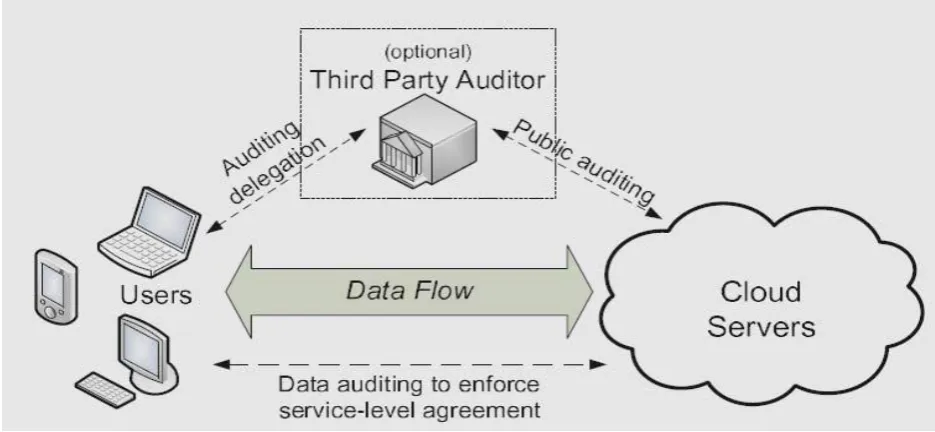
architecture for cloud storage service architecture is illustrated in Figure1
Three different network objects can be recognized as follows:
• User: user entity, who has store the data in the cloud and relies data on the cloud for data storage and
computation,can be either individual or enterprise customers.
473 | P a g e
• Third Party Auditor (TPA): an optional TPA,who has proficiency and abilities that users may not have,is important to measure and represent the risk of public cloud storageservices on instead of the client’sdemand. In
cloudstorage, a user saves his data over and done with a CSP into a set ofcloud servers, which are consecutively
in a concurrent, distributed andcooperated manner. Data redundancy canbe working with method of erasure
correcting code tosupplementary tolerate liabilities or server smash as user’s data growsin size and position.
Afterward, for applicationpurposes, the user communicates with the cloud servers through CSPto retrieve or
access his own data .In some times, the user maynecessity to perform mass level processes on his own data.
Fig 1: Cloud Storage Architecture
II. EXISTING SYSTEM
In existing model the significance of guaranteeing the remote data intigrity has been highlighted by the
accompanying research works under different framework and security models These procedures while can be
valuable to guarantee the capacity rightness without having clients having neighborhood information are all
concentrating on single server situation They may be valuable for nature of administration testing yet does not
ensure the information accessibility if there should be an occurrence of server disappointments Albeit direct
applying these methods to appropriated stockpiling various servers could be clear the came about capacity check
overhead would be straight to the quantity of servers.
III. PROBLEMS IN EXISTING SYSTEM
However, while providing efficient cross server storage verification and data availability insurance, these
schemes are all focusing on static or archival data.
As aoutcome, their capability of managing dynamic data rest unclear, which unavoidablyparameters their
474 | P a g e
IV. RELATEDWORK
Juels et al. depicted a formal "proof of retrievability" (POR) model for guaranteeing the remote information
uprightness. Their plan joins spot-checking and blunder adjusting code to guarantee both ownership and
retrievability of records on chronicle administration frameworks. Shacham et al. based on this model and
developed an arbitrary direct capacity based homomorphic authenticator which empowers boundless number of
difficulties and requires less correspondence overhead because of its use of generally little size of BLS mark.
Ateniese et al. characterized the "provable information ownership" (PDP) model for guaranteeing ownership of
document on untrusted stockpiles. Their plan used open key based homomorphic labels for inspecting the
information record. Notwithstanding, the pre-calculation of the labels forces substantial calculation overhead
that can be costly for a whole document. In their consequent work, Ateniese et al. depicted a PDP plan that uses
just symmetric key based cryptography. This technique has lower-overhead than their past plan and takes into
account square redesigns, cancellations and annexes to the put away document, which has likewise been
bolstered in our work. Be that as it may, their plan concentrates on single server situation and does not give
information accessibility ensure against server disappointments, leaving both the conveyed situation and
information blunder recuperation issue unexplored. The incremental cryptography work done by Bellare et al.
likewise gives an arrangement of cryptographic building squares, for example, hash, MAC, and mark works that
may be utilized for capacity uprightness check while supporting element operations on information. Schwarz et
al. proposed to guarantee static record trustworthiness over various conveyed servers, utilizing eradication
coding and square level document honesty checks. We received a few thoughts of their disseminated stockpiling
check convention. On the other hand, our plan further bolsters information progress and explicitly studies the
problem of misbehavingserver identification.
4.1 Challenge Token Pre-Computation
In order to achieve assurance of data storage correctness and data error localization simultaneously, our plan
totally depends on the pre-registered confirmation tokens. The primary thought is as per the following: before
document circulation the client pre-registers a sure total short confirmation marks on separate vector G (j) (j Є
{1 . . . n}), each and every token covering an asymmetrical subset of data. Later, when the client needs to verify
the capacity rightness for the information in the cloud, he challenges the cloud servers with an arrangement of
arbitrarily produced square lists. After getting test, every cloud server processes a short "mark" over the
predetermined pieces and returns them to the client. The estimations of these marks ought to coordinate the
relating tokens pre-registered by the client. In the interim, subset of the indices, the requested response values
for integrity check must also be a valid code word determined by secret matrix P.
Algorithm 1 Token Pre computation 1: procedure
2: Select parameters l, n and function f, Ø;
3: Selectthe number t of tokens;
4: Selectthe number rof indices per verification;
5: Generate master key KPRP and challenge key kchal;
475 | P a g e
7: for round i← 1, t do
8: Define αi = fkchal
(i)
and k(i)prp from KPRP .
9: Compute v(j) = Σrq=1 αqi*G(j)[Ø k(i)prp (q)]
10: end for
11: end for
12: Store all the vi’s locally.
13: end procedure
4.2 File Retrieval and Error Recovery
Since our layout of record framework is regular, the client can reconstruct the first document by downloading
the data vectors from the first m servers, accepting that they give back the right response values. Notice that our
validation plan depends on arbitrary spot-checking, so the storage rightness certification is a probabilistic one. In
any case, by picking system parameters (e.g., r, l, t) suitably and sufficiently leading times of confirmation, we
can promise the effective file recovery with high probability.
Algorithm 2 Error Recovery 1: procedure
% Assume the block corruptions have been detectedamong the specified r rows;
% Assume s .k servers have been identified misbehaving
2: Download r rows of blocks from servers;
3: Treat s servers as erasures and recover the blocks.
4: Resend the recovered blocks to corresponding servers.
5: end procedure
Then again, at whatever point the information corruption is distinguished, the examination of pre-computed
tokens and got response qualities can promise the recognizable proof of getting into misbehaving server(s) (yet
again with highlyprobability). Consequently, the client can simply ask servers to send back blocks from the r
columns indicated in the test and in Algorithm 2, the length of the quantity of identified making trouble servers
is not as much as k. (something else, there is no real way to recoup the ruined squares because of absence of
excess, regardless of the fact that we know the position of getting out of hand servers.) The recently recuperated
bits can then be reallocated to the construction trouble cloud servers to retain up the rightness of capacity.
V. CONCLUSION
To accomplish the affirmations of cloud information trustworthiness and accessibility and uphold the nature of
tried and true distributed storage administration for clients, we propose a compelling and adaptable appropriated
plan with unequivocal element information bolster, including piece upgrade, erase, and append. By using the
holomorphic token with appropriated check of deletion coded information, our plan accomplishes the mix of
capacity accuracy protection and information mistake confinement, i.e., at whatever point information
defilement has been distinguished amid the capacity rightness confirmation over the disseminated servers, we
can very nearly ensure the concurrent recognizable proof of the acting mischievously server(s). Considering the
476 | P a g e
proposed fundamental plan to bolster outsider inspecting, where clients can securely assign the honesty
checking errands to outsider evaluators and be effortless to utilize the distributed storage administrations.
Through detailed security and broad investigation results, we demonstrate that our plan is very effective
and versatile to Byzantine disappointment, malevolent information change assault, and considerably server
intriguing assaults.
REFERENCES
[1]. C. Wang, Q. Wang, K. Ren, and W. Lou, “Ensuring data storagesecurity in cloud computing,” in Proc. of
IWQoS’09, July 2009.
[2]. C. Wang, K. Ren, W. Lou, and J. Li, “Towards publicly auditablesecure cloud data storage services,” IEEE
Network Magazine, vol.24, no. 4, pp. 19–24, 2010.
[3]. http://eprint.iacr.org/
[4]. http://aws.amazon.com/
[5]. https://www.sun.com/offers/details/sun transparency.xml/
[6]. Q. Wang, C. Wang, J. Li, K. Ren, and W. Lou, “Enabling publicverifiability and data dynamics for storage
security in cloudcomputing,” in Proc. of ESORICS’09, volume 5789 of LNCS.
[7]. Springer-Verlag, Sep. 2009.
AUTHOR DETAILS
KunisettyArun Kumar pursuing M.Tech (IT) from Nalanda Institute Of Engineering & Technology(NIET), Kantepudi(V), Sattenpalli(M), Guntur(D)-522438, Andhra
Pradesh.
J A Paulson working as Professor (IT) fromNalanda Institute Of Engineering&
Technology(NIET), Kantepudi(V), Sattenpalli(M), Guntur(D)-522438, Andhra