ISSN(Online): 2319-8753 ISSN (Print): 2347-6710
I
nternational
J
ournal of
I
nnovative
R
esearch in
S
cience,
E
ngineering and
T
echnology
(A High Impact Factor & UGC Approved Journal) Website: www.ijirset.com
Vol. 6, Issue 8, August 2017
Analysis of Hindrances and Impact of Adoption
Rate of Cloud Computing in
IT Workforce
B.Dhivya1, K.Rajasekaran2
M.Phil Scholar, PG and Department of Computer Science, D.B.Jain College, Chennai, India1 Associate Professor, PG and Department of Computer Science, D.B.Jain College, Chennai, India2
ABSTRACT: Cloud computing created many new opportunities for organisations in the world. Presently, Cloud services are available at affordable prices and accessible for all parts of the businesses. The economic benefits of this acceptance for adopting Cloud computing are enormous and in many companies have embraced Cloud computing now. Over the years, technology emergence has helped to enhance the growth of Cloud computing, but the growth had not been as per expectations in the beginning era of the Cloud computing. This paper analyzes various factors that have affected the adoption rate of Cloud computing to be slower than expectations. This paper also identifies that the major factor behind the slower growth of Cloud computing is the controversial view about Cloud computing in the eyes of IT workforce. Based on the result of a survey of IT workforce at various organizational levels, this paper establishes that the identified factors such as Cloud computing awareness and the fear of job loss in IT workforce played a role in slow adoption of Cloud computing. Further, this paper presents recommendations to handle technology adoption and forecasting in a better way in future.
KEYWORDS:Cloud Computing, IT Workforce, Cost, Security,Survey
I INTRODUCTION
Cloud computing combines or integrates technologies or architectures to achieve a goal or offer a platform or build a solution. In Cloud computing, the hardware infrastructure is not seen but what the user or the clients see, is the application layer. Due to the use of Internet as a transportation unit or linking factor between applications and hardware, Cloud computing can be accessed at anytime and anywhere as far there is an Internet connection available. There are some factors that have hindered the growth of cloud computer over the years. In the beginning, most of the growth in Cloud computing is noticeable in small and medium enterprises as compared to large corporations. The major problem faced by Cloud providers to large organization was the serious controversial view of the IT workforce towards Cloud computing.
Over the years, the adoption of Cloud computing was slower due to various reasons such as mobility, bandwidth, the fear of losing control, security, privacy, data protection, performance and uptime, lack of Cloud business brokers, and unawareness. It took many years for people to adopt Cloud computing and the early adoption was at slower rate. After a number of years the inception of Cloud computing, the adoption of Cloud computing continues to grow and this change in adoption rate was noticed as a result of the improvements in the reasons that are described in the previous paragraph.
ISSN(Online): 2319-8753 ISSN (Print): 2347-6710
I
nternational
J
ournal of
I
nnovative
R
esearch in
S
cience,
E
ngineering and
T
echnology
(A High Impact Factor & UGC Approved Journal) Website: www.ijirset.com
Vol. 6, Issue 8, August 2017
II ANALYZING FACTORS AFFECTING ADOPTION RATE OF CLOUD COMPUTING
It is well known to IT experts in general and those with the knowledge of Cloud computing that the IT workforce had been in the past and are still a major hindrance to the adoption of Cloud computing. According to the definition of Cloud computing by National Institute of Standards and Technology (NIST) , Cloud computing is a model for enabling ubiquitous, convenient, on-demand network access to a shared pool of configurable computing resources (e.g., networks, servers, storage, applications, and services) that can be rapidly provisioned and released with minimal management effort or service provider's interaction. This notion of the minimal management effort has put the fear of being redundant in IT workforce. Most of the IT workforce thought that the Cloud computing was there to take over their jobs and it made marketing of Cloud services quiet difficult for Cloud providers. This paper investigates this fear through a survey of IT workforce and presents recommendations for dealing with such a problem.
The other major reasons behind the slow adoption of Cloud computing are described in the following paragraphs: Bandwidth is one of the hindrances to slow down the rate of adoption of Cloud computing. Bandwidth is one of the major tools in Cloud computing, because it serves as the transportation agency for the Cloud business. In the developed countries, the Internet took years of developing, the cost the system upgrades and maintenance was high to get to a better quality of service.A better quality of service of the Internet is a must for a better environment for Cloud computing.
The sense of losing control of the computing resources was hard to resist by most organizations and enterprises. The IT department might not want to give away some of their powers to a third party. For example on a usual day, if there is a problem with a hardware at anytime, an IT team can fix in a certain period of time, but if the hardware is on the organization premises, the in-house IT team will have to wait and depend on the third party to get it fixed. As a major factor in technology adoption, novelty surprised early adopters. People were not sure of the performance and uptime trends of the Cloud technology. An industry tries a new technology either phase by phase or waits until there are enough success stories. Many people were sceptical about the Cloud computing, because the Cloud providers in the business were small in numbers. So as the Cloud providers continued to increase so did the market of Cloud computing business.
The lack of regulatory agencies had an impact on the adoption rate of Cloud computing. Initially, the fear of the Cloud not being regulated soon enough made people too thoughtful to spend their money on Cloud services. By late 2000, was the beginning of the inception of such organizations that supported the use of Cloud computing. Agencies and organizations such as NIST also educated public about the use and advantages of the Cloud computing. They set down rules that must be followed in consideration of Cloud users, Cloud providers and people in general. There are many regulatory agencies in Cloud computing, for example, Cloud Security Alliance. Cloud Security Alliance was formed in December 2008 to help promote the Cloud computing business alongside NIST. Agencies also helped Cloud providers by creating publications and planning more events to promote Cloud computing. In 2010 in USA, the Federal Chief Information Officer tapped NIST to play a major role in accelerating the adoption of Cloud computing in the federal government. Since then, NIST has held meetings, started working groups and developed the U.S. Government Cloud Computing Technology Roadmap.
ISSN(Online): 2319-8753 ISSN (Print): 2347-6710
I
nternational
J
ournal of
I
nnovative
R
esearch in
S
cience,
E
ngineering and
T
echnology
(A High Impact Factor & UGC Approved Journal) Website: www.ijirset.com
Vol. 6, Issue 8, August 2017
and updated Internet Privacy laws have helped Canada to achieve the 9th position. The score card was based on data privacy, security, Cyber crime, intellectual property rights, infrastructure, promoting free trade and standards. Factors affecting Cloud computing in Canada are older Cyber crime laws and unavailability of breach notification law 3.
Security is the main issue behind the slower adoption of Cloud computing. Most people believe that the use of public Cloud that is generally used by a lot of customers might have a number of security vulnerabilities due to heavy access by Cloud users. It is well said that an increase in data stored at a single storage place will increase the number of hackers who want to get access to the data because it looks more like a honey pot to most hackers. The sense of data protection is different for different countries. Most organization takes it into consideration especially for those branching out or planning on branching out in the future. If it is known that the data over the Cloud will not be protected by the privacy laws of a country then it is not worth going into the Cloud computing business and most business decides to own their own servers and protect their documents.
Over the years, the slow adoption of Cloud computing started changing and there had been an increase in the rate of adoption of Cloud computing. The factors such as cost saving, security improvements, need of mobility and improved reliability has helped to improve the acceptance of Cloud computing.
Most of the small and medium enterprises that do not want to invest consistently on IT infrastructure decided to buy the idea of Cloud computing, which has helped to reduce the cost in the areas of procurement of hardware infrastructure, installation and maintenance.
For most of the small and medium enterprises, instead of bothering with the problem of system and network security, they directed the problem of handling security to the Cloud providers. The Cloud providers provide Cloud users redundancy, disaster safeguard, perimeter security, and hypervisor protection against attacks and distributed denial of service protection. Most of the Cloud providers know that the major problem hindering the adoption of Cloud computing is security, so they worked to achieve the best of security.
III RESEARCH METHODOLOGY
The research methodology consisted of face-to-face interviews and an online survey. A sample of IT professionals from academia and industry was interviewed. The outcome of these interviews was instrumental to narrow down the contents of a questionnaire. An inverted pyramid structure of interviews was used, where starting from a general discussion the opinion of each interviewee on each specific issue was narrowed down.
Relatively a larger sample that consisted of professionals from IT academia and industry (ranging from small to Enterprise level) was selected from various countries in North America, Europe, Asia, and Africa.
The use of the pragmatic approach of face-to-face interviews helped to narrow down the subject and the nature of the questions to be more focussed on the adoption of Cloud computing in the context of aligning the Cloud providers with the IT workforce. As mentioned earlier, the random sampling is limited to IT workforce with experience in the IT field and with or without the knowledge of Cloud computing. A distribution of the sample as per Figure 1 consisted of thirty percent from academia and seventy percent from industry. Out of seventy percent of sample from industry, thirty percent consisted of large enterprises, and twenty percent each from small and medium sized organizations.
ISSN(Online): 2319-8753 ISSN (Print): 2347-6710
I
nternational
J
ournal of
I
nnovative
R
esearch in
S
cience,
E
ngineering and
T
echnology
(A High Impact Factor & UGC Approved Journal) Website: www.ijirset.com
Vol. 6, Issue 8, August 2017
This survey is used to address three major concerns about Cloud computing to IT workforce: knowledge level of interviewees about Cloud computing, controversial view of IT workforce behind the growth of cloud computing, and the contributing factors towards the growth of the adoption of Cloud computing. Each question in the questionnaire responses was analyzed and each answer was collated. Incomplete questionnaire responses were disregarded. The result was displayed with respect to the areas of concentration in the questionnaire responses.
IV RESULT SUMMARY
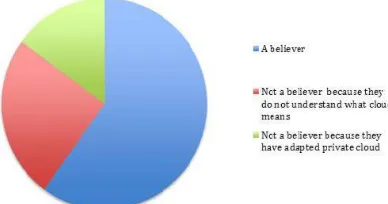
After analyzing the responses to the questionnaire, the result showed that sixty percent of the respondents of the questionnaire believed in the controversial view that the adoption of Cloud computing may be a threat to their job security. The remaining forty percent do not believe in this controversial view. Out of the forty percent who do not believe in the controversial view, fifteen percent do not have a very clear understanding of Cloud computing.The remaining twenty five percent of the forty percent of the correspondents simply believed that Cloud computing is all about storing data remotely and the organizations of this correspondent had not adopted Cloud computing yet. This evidence made the fact clear that the majority of the correspondents who were well aware of Cloud computing still consider adoption of Cloud computing a threat to their job security. Based on this fact, it is not difficult to estimate the intensity of this fear many years ago when Cloud computing was novice.These results are summarized in Figure 2.
Fig. 2 Issue awareness analysis of IT workforce
V. RECOMMENDATIONS
ISSN(Online): 2319-8753 ISSN (Print): 2347-6710
I
nternational
J
ournal of
I
nnovative
R
esearch in
S
cience,
E
ngineering and
T
echnology
(A High Impact Factor & UGC Approved Journal) Website: www.ijirset.com
Vol. 6, Issue 8, August 2017
Fig. 3 Analysis of hindrances in the adoption of Cloud computing
The responses from correspondents showed that the average year of the adoption of Cloud computing was the year 2012. Most large organizations which use Cloud computing make use of private cloud as compared to the small and medium enterprises that make use of the public Cloud which is due to the limited resources of SME for establishing and maintaining the Cloud infrastructure for a limited time. The correspondents that belongs to the organizations that are yet to adopt Cloud computing did not know precisely when they are likely to adopt Cloud computing and those correspondents who know they have an average time frame of five to six years to adopt Cloud computing
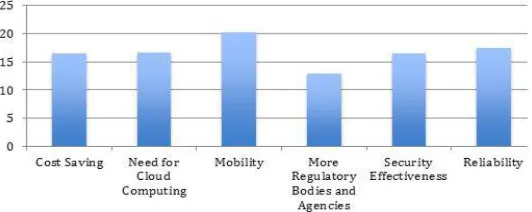
The response about the factors that have helped to improve the adoption rate of Cloud computing consisted of six factors: cost savings, the need of Cloud computing, mobility, regulatory bodies, effective security and reliability. The correspondents identified mobility as the major factor in improving the adoption rate of Cloud computing. As the development of regulatory bodies for Cloud computing had been slower, therefore, most of the correspondents considered it the least contributing factor towards the adoption rate of Cloud computing. Lower cost, an increasing need of Cloud computing in modern world, improvement in the security measures of Cloud computing, and recognized improvement in reliability and availability were equally acknowledged as the factors that have helped in improving the adoption rate of Cloud computing. Majority of the correspondents of this survey agreed to the fact that the IT workforce should embrace Cloud computing to knockout the fear of IT workforce of losing their job. Instead IT workforce would have to work alongside the Cloud providers to help their organizations in adopting Cloud computing. This can be accomplished by working positive minded with Cloud infrastructure.
Fig. 4 Factor that increased the adoption rate of Cloud computing
ISSN(Online): 2319-8753 ISSN (Print): 2347-6710
I
nternational
J
ournal of
I
nnovative
R
esearch in
S
cience,
E
ngineering and
T
echnology
(A High Impact Factor & UGC Approved Journal) Website: www.ijirset.com
Vol. 6, Issue 8, August 2017
then the security of other Cloud users under the same Cloud provider can also be at risk. It is interesting to analyse the use of individual public key for each Cloud users.
VI CONCLUSION
Based on face-to-face interviews and a survey of the IT work force from Academia and IT industry, this paper analyzed various factors that has affected the adoption rate of Cloud computing with leading factor of the lack of regulatory bodies in the early era of Cloud computing. This paper identified that the major factor behind the slower growth of Cloud computing was the controversial view of the fear of job loss in the minds of IT workforce. It is established that many in the industry did not still understand dynamism of Cloud computing and a need to educate or promote awareness of Cloud computing was identified. The factors that helped in improving the adoption rate of Clod computing were also identifies with leading factors of mobility. Recommendations such as increased training, and the need of industry certification in Cloud computing has been put forward.
REFERENCES
1. Qi Zhang, Lu Cheng, and Raouf Boutaba. Cloud computing: state-of-theart and research challenges. Journal of internet services and applications, 1(1):718, 2010.
2. Lothar Determann. Data privacy in the cloud: a dozen myths and facts. The Computer and Internet Lawyer, 28(11):18, 2011.
3. Fang Liu, Jin Tong, Jian Mao, Robert Bohn, John Messina, Lee Badger, and Dawn Leaf. NIST Cloud computing reference architecture. NIST special publication, 500:292, 2011.
4. Bernd Grobauer, Tobias Walloschek, and Elmar Stocker. Understanding cloud computing vulnerabilities. Security and privacy, IEEE, 9(2):5057, 2011.