Facial Expression Recognition at Different
Dimensional Subspace Feature Dataset
G.P.Hegde1, M. Seetha2
Research Scholar, Department of Information Science & Engineering, SDMIT, Ujire, Mangalore, India1
Professor, Department of Computer Science & Engineering, GNITS, Hyderabad, India2
ABSTRACT: In this paper, performance of subspace methods for achieving expression recognition and classification has been evaluated. Enhancement of Gabor magnitude and phase parts have been carried out by fusing Gabor filter with geometrical feature vectors. LDA based algorithms have been developed to recognize seven different facial expressions such as happy, neutral, angry, disgust, sad, fear and surprise using JAFFE database. Performance of subspace methods have been measured for different dimensions by proposing kernel local and global feature preserving symmetrical weighted discriminant analysis methods against dimensional reduction of fused dataset. Proposed algorithm yields better performance compared to state of art approaches.
KEYWORDS: Feature extraction, Gabor filter, subspace, class discrimination, expression recognition.
I. INTRODUCTION
Facial expressions deliver rich information about human emotion and play an essential role in human communications. There are many approaches have been proposed for facial expression analysis from both static images and dynamic images in the literature. Facial expression provides an important behavioral measure for studies of emotion, cognitive processes, and social interaction. Intuitive facial expression recognition constitutes the main theoretical contribution to the video processing application [1]. In the beginning of this work, face detection and pre-processing has been carried out by removing unwanted information from the static raw input face images. Geometrical and holistic features have been extracted from image dataset and feature level fusion has been carried on these extracted features. Several discriminative based face recognition methods are not able to solve the singularity matrix problems during dimensional reduction or projection of subspace in non linear region and also not able to preserve both global and local face features during class discrimination.
This research work optimizes the problem of singularity matrix of within scatter matrix by introducing symmetrical weights on principal components in intermediate dimensional reduction stage by equally distributing eigen vectors before projecting the subspace of Fisher discriminative feature space. Along with this goal this work also supports preservation of local and global discriminative features of the image dataset while projecting the face space into subspace for dimensional reduction under nonlinear region. Inially face detection has been carried out using static image face detection method. Section II presents related work, Section III describes proposed frame work. Section IV presents experimental results showing results of images tested. Finally, Section V presents conclusion.
II. RELATED WORK
if there is a not enough or good recognition rate for unencrypted domain. This method was applied to JAFFE and MUG database and achieved 94.37% and 95.24% recognition rates. Shih et al. [7] worked on 2DLDA and support vector machine and tested with JAFFE database and they were found 95.71% recognition accuracy using leave one out classification strategy and 94.13% using cross validation strategy. Yu and Yang [8] have developed a direct LDA algorithm (DLDA) for high dimensional data with application to face recognition that diagonalises simultaneously the two symmetric matrices. The key idea of their method is to discard the null space from scatter matrices. But DLDA is more scalable and more expensive for computation. As pointed out by Yu and Yang [8] the traditional LDA procedure takes the reverse order and consequently discards the null space of within scatter matrix which contains discriminative information. Ye and Li [9] proposed a two-stage LDA method, namely LDA/QR, which aims to overcome the singularity problems of classical LDA, while achieving efficiency and scalability simultaneously.
Vitomir Struc and Nikola Pavesi (2010) [12] defined about oriented Gabor phase congruency model by separating magnitude and phase parts of Gabor filter. These filters can serve as excellent band-pass filters for one-dimensional signals. Fasel et al. [13] presented a systematic analysis of Gabor filters banks for detection of facial landmarks. Dongcheng and Fang (2013) [14] worked on Gabor wavelets and extracted magnitude and phase parts features separately. In their approach both feature datasets were fused together. Principal Component Analysis (PCA) and 2DPCA methods were implemented for feature dimension reduction and they achieved 91% and 94% respectively for JAFFE dataset. Fazli et al. [15] presented a person independent facial expression recognition method based on Gabor wavelets and dimensional reduction was carried out by combining PCA and Linear Discriminant Analysis (LDA) methods. They got 89% accuracy for Cohn-Kanade database.
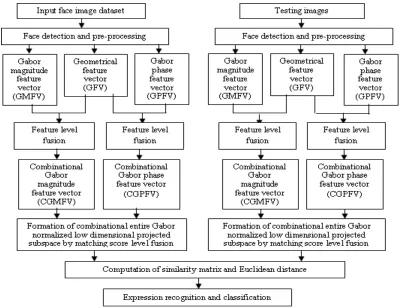
Abdulrahman et al. [16] introduced an approach which is implemented using Gabor wavelet transform with PCA and LBP. This hybrid approach resulted 90% average recognition rate for JAFFE database. Goyani et al. [17] proposed a PCA for face recognition and facial expression recognition. They found recognition rate is 81.36% for CSU dataset and 85.5% for ATT dataset. Jin and Ruan (2009) [18] did the work on combination of Gabor wavelets and supervised locality preserving projections (SLPP) for face recognition. They designed first Gabor filter to extract the features from the whole face images, and supervised locality preserving projections was used to train the labels and dimension reduction, which is improved by two-directional 2DPCA to eliminate redundancy among Gabor features and achieved 82% to 87.50% of recognition accuracy. Samad et al. [19] developed and focused on the algorithm to recognize the expressions using parameters used for Gabor filter design. They used Gabor filter for face recognition and down sampled the Gabor feature vectors. The dimensions of feature vector were reduced using principal component analysis. Classification using SVM claims 81.7% recognition rate for FEEDTUM database. Wang et al. [20] proposed an effective recognition technique using Principle Component Analysis and Support Vector Machine classifier. Liu and Wechsler [23] concluded that ICA outperforms PCA for face recognition, and Moghaddam [24] claims that there is no statistical difference in performance between the PCA and ICA. In a recent study with visible light and infra-red images, Socolinsky and Salinger [25] reported that ICA outperforms PCA on visible light images. Uddin et al. [26] have shown ICA and enhanced ICA recognizes the expression with 60.4% and 65.8% accuracy.He and Niyogi [27] introduced the Locality Preserving Projections (LPP) as when the high dimensional data lies on a low dimensional manifold embedded in the ambient space. Zheng et al. [28] proposed supervised locality preserving projection (SLPP), using class labels of data points to enhance its discriminant power in their mapping into a low dimensional space. Weiwe et al. [29] proposed two dimensional discriminate locality preserving projections (2D-DLPP), which benefits from three techniques, i.e., locality preserving projections (LPP), image based projection and discriminant analysis. All these subspace approaches not able to provide efficient class discrimination of images. Figure 1 shows the proposed framework.
III.PROPOSED FRAME WORK
1. In the beginning required face regions were detected from raw input images. Then all the images from JAFFE database have been resized and cropped. Image database have been created.
2. Texture features and geometrical feature have been extracted from train database images and fused together. Feature level fused dataset have been created. (Dimensions of both features are added.)
4. Subspace methods has been implemented on both trained and test database image sets. 5. SVM classifier has been used to classify the expressions.
6. During testing one test image was inputted from each expression and every time highest recognition rate have been noted. This procedure is repeated for each one expression image from each group of expression. Finally average value of overall recognition rate, classification time and correct and wrong recognition rates have been noted. Dimensional reduction value was chosen for higher overall recognition rate.
7. Steps 2 to 6 have been repeated for different values of Gabor filter parameters (m and n) for different dimensions of feature datasets.
8. MATLAB 8.1 (R2013a) version has been used to code the entire system of facial expression recognition.
Figure 1. Flow diagram of proposed frame work
IV.RESULTS AND DISCUSSIONS
Figure 2: Sample pre-processed JAFFE images
To analyze the performance of subspace approaches JAFFE, database have been tested. Approaches like CEGKPCA, CEGLPP, CEGFLDA, CEGLFDA, CEGKLFDA, CEGKLSWFDA and CEGKGLSWFDA has been compared. Baseline feature vector dimensional parameters used to evaluate the performance of subspace approaches are given in Table 1.
Table 1 Baseline feature vector dimensional parameters used to evaluate the performance of subspace approaches for JAFFE database
No. of scales (m)
No. of
orientations (n)
Gabor filter size (GFmn)
Image size (ab)
Gabor filter feature vector dimension (GFFVD)
Geometrical feature vector dimension (GFVD)
Combinational Gabor feature vector dimension (CEGFVD)
5 4 20 111×126 279720 16 279736
3 8 24 111×126 335664 16 335680
3 4 12 111×126 167832 16 167848
5 8 40 111×126 559440 16 559456
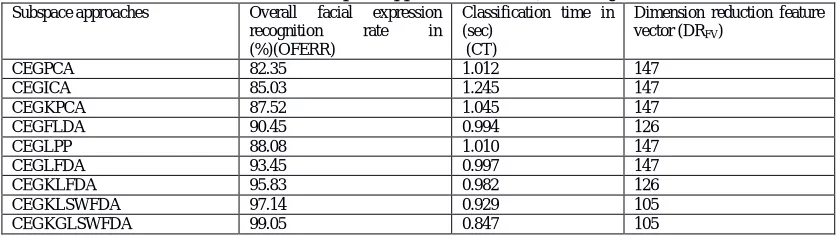
For CEGLPP, CEGKPCA CEGLFDA, CEGKLFDA, CEGKLSWFDA and CEGKGLSWFDA algorithms nearest neighbor number k has been set to 7. Where the value of was set to be 0.5. The overall expression recognition rates for JAFFE database is shown in Table 2.
Table 2 Performance of subspace approaches at m=5, n=8 for JAFFE database Subspace approaches Overall facial expression
recognition rate in (%)(OFERR)
Classification time in (sec)
(CT)
Dimension reduction feature vector (DRFV)
CEGPCA 82.35 1.012 147
CEGICA 85.03 1.245 147
CEGKPCA 87.52 1.045 147
CEGFLDA 90.45 0.994 126
CEGLPP 88.08 1.010 147
CEGLFDA 93.45 0.997 147
CEGKLFDA 95.83 0.982 126
CEGKLSWFDA 97.14 0.929 105
CEGKGLSWFDA 99.05 0.847 105
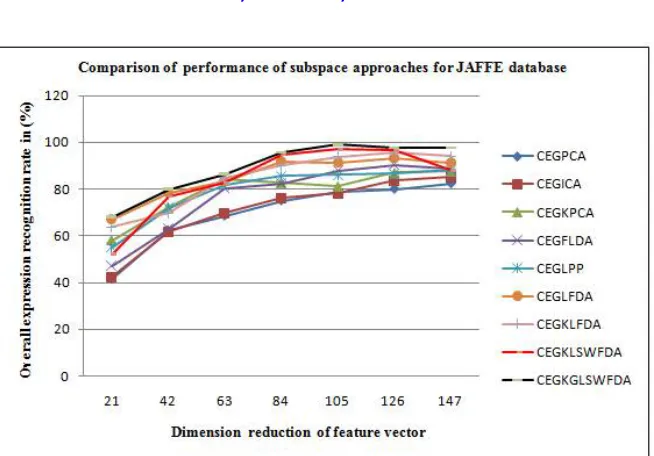
Overall expression recognition rate for JAFFE database is found to be 97.14% with dimensional reduction 105 for CEGKLSWFDA approach. It has been also noted that for JAFFE database the recognition accuracy is 99.05% with dimensional reduction 105 with less classification time for CEGKGLSWFDA approach.
Figure 3: Comparison of Overall facial expression recognition rate Vs Dimensional reduction of different linear and nonlinear subspace approaches at m=5 and n=8.
Table 3, Table 4 presents confusion matrix of JAFFE, databases for using CEGKLSWFDA and CEGKGLSWFDA subspace approach using SVM, “Leave One Out Technique” in (%) at m=5 and n=8 Gabor parameters. From Table 3, it is noted that anger, happy and fear expression recognition rate is 93.33% for CEGKLSWFDA approach. Probably it is due to confusion with sad and disgust expressions. For CEGKGLSWFDA subspace approach using SVM, “Leave One Out Technique” in (%) at m=5 and n=8 Gabor parameters, it has been also noted that from Table 4 for JAFFE database happy expressions recognition rate is 93.33%. But remaining expression recognition rate is 100%. Probably it is due to confusion with sad and disgust expressions.
Table 3 Confusion matrix of JAFFE database using CEGKLSWFDA subspace approach using SVM, “Leave One Out technique”.
Table 4 Confusion matrix of JAFFE database using CEGKGLSWFDA subspace approach using SVM, “Leave One Out technique”.
AN DI HA FE SA SU NE
AN 93.33% 6.67% 0 0 0 0 0
DI 0 100% 0 0 0 0 0
HA 0 0 93.33% 0 6.67% 0 0
FE 0 0 6.67% 93.33% 0 0 0
SA 0 0 0 0 100% 0 0
SU 0 0 0 0 0 100% 0
NE 0 0 0 0 0 0 100%
AN DI HA FE SA SU NE
AN 100% 6.67% 0 0 0 0 0
DI 0 100% 0 0 0 0 0
HA 0 0 93.33% 0 6.67% 0 0
FE 0 0 6.67% 100% 0 0 0
SA 0 0 0 0 100% 0 0
SU 0 0 0 0 0 100% 0
From the results it has been noted that proposed feature level fusion improves the recognition rate using CEGKLSWFDA and CEGKGLSWFDA approaches by consistently outperforming the CEGKPCA, CEGLPP, CEGFLDA, CEGLFDA and CEGKLFDA expression recognition approaches. This work clearly analyzes that CEGFLDA algorithm performs comparatively better than CEGLPP algorithm. It demonstrates that discriminative features make an efficient recognition using class label information. Although the CEGLFDA algorithm outperforms CEGKPCA, CEGFLDA, CEGLPP algorithms by using both local subspace structure and class label information, it is still a linear algorithm and is in adequate to describe the nonlinear face image space due to high variability of the image content and style. Therefore it performs worse and weak than the kernel based KLFDA algorithm. Confusion matrix was derived from SVM_RBF kernel based using “Leave One Out “strategy. It demonstrates the correct and misclassification of expressions.
V. CONCLUSIONS
The performance of all the subspace approaches are found to be better at m=5 and n=8, Gabor filter parameters. For other values of m and n overall recognition rate, correct recognition rate of expressions and classification time measures are found to be not good enough to improve the performance of recognition.
CEGKLSWFDA approach is tested with JAFFE dataset, the reduced dimensionality of feature vector is found to be 105 for 213 images, For JAFFE database over all accuracy rate of recognition is 97.14%. Another approach CEGKGLSWFDA finds improvement in performance of both recognition of expressions and dimensional reduction compare to other related approaches. Due to preservation of global and local structure of images, loss of information has been reduced. It would cause the improvement in global and local feature preservation for scatter matrices while discriminating the classes of different expressions. Dimensional reduction is found to be better compare to earlier approaches. For JAFFE database overall expression recognition rate using CEGKGLSWFDA approach is found to be 99.05%.
Individual correct expression recognition rates are also has been improved in both CEGKLSWFDA and CEGKGLSWFDA approaches as mentioned in our earlier work [32][33]. Preservation of global and local image content preservation has been carried out during dimensional reduction or projection of high dimensional space as well as discriminating the image features. Baseline approaches like CEGPCA and CEGICA preserves the global structure of the image space but not able to provide the discrimination of classes of different expressions. CEGFLDA baseline approach is not able store global information. CEGLPP approach is able to preserve the local structures of image space but not suitable for class discrimination of expressions. Compare to these approaches CEGLFDA and CEGKLFDA approaches finds significant role for preservation of local structures and but still not able to provide complete solution for efficient class discrimination due to problem of singularity in scatter matrices. Proposed approach improves the performance of CEGKLFDA approach regarding overall and correct recognition rate of expressions. Proposed approach also finds more effective for dimensional reduction and classification of expressions. Elimination of zero valued principal components by solving the problem of singularity scatter matrix proposed algorithms consistently outperforms the CEGLFDA and CEGKLFDA approaches. Although the CEGLFDA algorithm outperforms CEGKPCA, CEGFLDA, CEGLPP algorithms by using both local subspace structure and class label information, it is still a linear algorithm and is in adequate to describe the nonlinear face image space due to high variability of the image content and style. Therefore CEGLFDA performs worse and weak than the kernel based KLSWFDA algorithm.
REFERENCES
[1] St. George, B., Chang, C.C., Lin, C.J., “Facial expression recognition with SMS alert,” IEEE International Conference on Optical Imaging Sensor and Security (ICOSS), July 2013.
[2] P. Belhumeur, J. Hespanda, and D. Kiregeman, “Eigenfaces versus Fisherfaces: Recognition using class specific linear projection,” IEEE Transactions. Pattern Analysis. Machine. Intelligence. vol. 19, no. 7, pp. 711–720, Jul. 1997.
[3] Ziqiang Wang, Xia Sun, “Multiple kernel local Fisher discriminant analysis for face recognition,” International Journal of Signal Processing- Elsevier publishers, vol. 93, pp. 1496–1509, 2013.
[4] Yue Ming, Qiuqi Ruan, Xiaoli Li, Meiru Mu,” Efficient Kernel Discriminate Spectral Regression for 3D Face Recognition,” Proceedings Of ICSP 2010.
[6] Rahulamathavan, Yogachandran, RC-W. Phan, Jonathon A. Chambers, and David J. Parish, "Facial expression recognition in the encrypted domain based on local fisher discriminant analysis," Affective Computing, IEEE Transactions on 4, no. 1, 83-92, 2013.
[7] F. Y. Shih, C.-F. Chuang, and P. S. P. Wang, “Performance comparisons of facial expression recognition in JAFFE database,” International Journal of Pattern Recognition and Artificial Intelligence, vol. 22, no. 3, pp. 445–459, 2008.
[8] H. Yu and J. Yang, "A direct LDA algorithm for high dimensional data - with application to face recognition," Pattern Recognition, vol. 34, 2067-2070, 2001.
[9] Ye J and Li Q.,”A two-stage linear discriminant analysis via QR-decomposition”, IEEE Trans Pattern Analysis Machine Intelligence. 2005 Jun;27(6):929-41.
[10] Wangmeng Zuo, Kuanquan Wang and Hongzhi Zhang , “Subspace Methods for Face Recognition: Singularity, Regularization, and Robustness ,” Source: State of the Art in Face Recognition, Book edited by: Dr. Mario I. Chacon M., ISBN -3-902613-42-4, pp. 250, January 2009.
[11] L. Chen, H. Liao, M. Ko, J. Lin, and G. Yu, "A new LDA-based face recognition system which can solve the small sample size problem",
Pattern Recognition, 33 (10), pp. 1713-1726, 2000.
[12] Vitomir Struc and Nikola Pavesic, “The Complete Gabor–Fisher Classifier for Robust Face Recognition,” EURASIP Journals on Advances in Signal Processing, 2010.
[13] Fasel B. and Luettin J., “Automatic Facial Expression Analysis: a Survey,” IEEE Pattern Recognition, vol. 36, no. 1, pp. 259-275, 2003. [14] Shi Dongcheng , Cai Fang ,”Facial Expression Recognition Based on Gabor Wavelet Phase Features,” Image and Graphics (ICIG), Seventh
International Conference on 2013, pp 520 – 523.
[15] Fazli, S., Zanjan, Afrouzian, R. Seyedarabi, H. High, “Performance of facial expression recognition using Gabor filter and Probabilistic Neural Networks,” Intelligent Computing and Intelligent Systems, 2009. IEEE International Conference on (Volume:4 ) Nov. 2009.
[16] Abdulrahman, Muzammil, Tajuddeen R. Gwadabe, Fahad J. Abdu, and Alaa Eleyan. "Gabor wavelet transformation based facial expression recognition using PCA and LBP," In Signal Processing and Communications Applications Conference and Communications Applications 2014 22nd, pp. 2265-2268. IEEE, 2014.
[17] Mahesh Goyani, Akash Dhorajiya, Ronak Paun, "Performance Analysis of FDA Based Face Recognition Using Correlation, ANN and SVM," International Journal of Artificial Intelligence and Neural Networks, pp. 108-111, 2011.
[18] Yi Jin, Qiu-Qi Ruan, “Face recognition using Gabor-based improved supervised locality preserving projections computing and informatics, vol. 28, , 81–95. 2009.
[19] Samad, Rosdiyana, and Hideyuki Sawada. "Extraction of the minimum number of Gabor wavelet parameters for the recognition of natural facial expressions." Artificial Life and Robotics, 2011 Springer: pp. 21-31.
[20] Chengliang Wang, Libin Lan, Yuwei Zhang and Minjie Gu, "Face Recognition Based on Principle Component Analysis and Support Vector Machine", In IEEE Conference Intelligent Systems and Applications (ISA), 2011, pp.1-4.
[21] Guoxia Sun, Liangliang Zhang, ”Face Recognition Based on Symmetrical Weighted PCA,” IEEE conference, pp-2249-2252, 2011. [22] M. S. Bartlett, Face Image Analysis by Unsupervised Learning,” Kluwer Academic, 2001.
[23] C. Liu and H. Wechsler, Comparative Assessment of Independent Component Analysis (ICA) for Face Recognition,” International Conference on Audio and Video Based Biometric Person Authentication, Washington, DC, 1999.
[24] B. Moghaddam, Principal Manifolds and Bayesian Subspaces for Visual Recognition,” International Conference on Computer Vision, Corfu, Greece, 1999
[25] D. Socolinsky and A. Selinger, A Comparative Analysis of Face Recognition Performance with Visible and Thermal Infrared Imagery,” International Conference on Pattern Recognition, 2002.
[26] Uddin Z., Lee J., and Kim T., “An Enhanced Independent Component-Based Human Facial Expression Recognition from Video,” IEEE Transactions Consumer Electronics, vol. 55, no. 4, pp. 2216-2224, 2009.
[27] X. He and P. Niyogi, “Locality preserving projections, “In Advances in Neural Information Processing Systems. Cambridge, MA: MIT Press, 2003
[28] Zhonglong Zheng, Fan Yang, Wenan Tan, Jiong Jia and Jie Yang, “Gabor feature-based face recognition using supervised locality preserving projection,” Signal Processing Volume 87, Issue 10, , Pages 2473-2483, October 2007
[29] Yu Weiwe “Two-dimensional discriminant locality preserving projections for face recognition,” Pattern Recognition Letters Volume 30, Issue 15, 1 November 2009, Pages 1378-1383.
[30] C.W.Hsu,C.C. Chang and G.J.Lin. A practical guide to support vector classification :http//www.csie.ntu.edu.tw/cjlin/papers/guide/guide.pdf. [31] Yu-Jie Zheng, Zhi-Bo Guo, Jian Yang, Xiao-Jun Wu and Jing-Yu Yang,” DLDA/QR: A Robust Direct LDA Algorithm for Face
Recognition and Its Theoretical Foundation,” Advances in Knowledge Discovery and Data Mining.
[32] G.P. Hegde, , M. Seetha, Nagaratna Hegde, “Kernel Locality Preserving Symmetrical Weighted Fisher Discriminant Analysis based subspace approach for expression recognition”,Engineering Science and Technology, an International Journal13 April 2016