,
(1,
Charles H. Proctor
Institute of Statistics Mimeograph Series Number 2280 December 1995
North Carolina State University
Raleigh, NC 27695-8203
ABSTRACT
Surveys of households can be done by telephone or by mail or by personal
visit, while numerous calls or mailings or visits may be required' before getting
a response. If only one method is used and if an attempt is conducted i~ a
more or less standard way in all instances, then one can record results by the
number of attempts required and see whether there is a trend in the variable of
interest as more attempts have to be made. Such a trend can be used as a basis
to extrapolate to an unlimited number of attempts and thus to correct for
nonresponse caused by limiting attempts to just a few. We give details, for
the telephone survey case, of eight sets of model assumptions and how to decide
which one to work with. A further example of a mail survey is used to
illustrate estimation of a median.
The method is designed to furnish estimates of population proportions. The
population is defined as a large but finite realization under survey conditions
of values in a row by column array. The rows represent telephone numbers and
the columns represent minutes of the time period covered by the survey. The
notion of realization covers assignment of interviewer and other chance aspects
of the conduct of the survey. The values are whatever answer would have been
produced by calling that number at that minute. The values in any row are
called a temporal trajectory. Random numbers are used to select telephone
numbers and haphazard enumerator availability selects the times. These random
devices can then be expected to generate frequencies that will follow a
multinomial distribution. The population proportion, being one of the
parameters underlying this multinomial distribution, can thus be estimated.
1. INTRODUCTION
The method being considered here was introduced in an earlier, rather
wide-ranging, paper dealing with case nonresponse (Proctor 1978). Its possible
application to telephone surveys was mentioned there, but not explored
extensively. We propose here to consider more details of the telephone survey
'setting and to suggest how the m~thod might fit into current practices. In
brief, the method involves calling a random sample of telephone numbers and
setting a rather low maximum number of callbacks -- for example, three calls.
Data obtained from telephone conversations on the variables of interest are
tabulated separately by call. Whatever association exists between no-answer
proportion and level of the variable can thereby be detected and corrected by
extrapolating to a larger number of calls. We also illustrate how the method
cou1~ be used to estimate a median in a survey by mail. This second example
shows the method's flexibility.
It may be helpful at the outset to alert readers that using the method will
require strict adherence to uniformity of approach by the enumerators. While
an enumerator will choose when to signal readiness to make a call, the
telephone number to be called will be furnished at random from those in the
sample to be called. The probabilities in the model derive from the random
number tables and so long as the random numbers are honest and the enumerators
adhere to instructions the model will be correct.
It was in such a finite population setting that Deming (1953) noted the
serious biases that could arise from failure to obtain a response to mail and
'.
provided by Walter Hendricks (1949) might be adapted to reduce the bias by
developing some "new type of estimate." This is essentially what the method of
this paper affords.
Among the methods for handling case nonresponse that Cochran (1977)
reviews, all seem to have certain operational drawbacks. The Hansen-Hurwitz
(1946) follow-up method draws a subsample of nonrespondents to a first attempt
and subjects this relatively small group to whatever extensive effort seems to
be be needed to secure a response. The drawbacks are the possibility of
distorting the response by the effort required and the possibility of failing
to get a response even after expending the effort. When carried to a
successful completion, however, the estimate is unbiased.
Other methods such as recording times-at-home for use in weighting factors
(Politz-Simmons, 1949) or doing just one callback with a "level playing field"
by finding out for everyone when they are likely to be in (Bartholomew, 1961)
depend on a degree of careful and truthful information being provided by
informants that informants don't uniformly provide.
Other methods such as reassigning for interview in the present survey cases
found to be case nonrespondents in earlier surveys (Kish and Hess, 1959) or
using herculean efforts to reduce nonresponse (Dillman, 1978) are certainly
going to reduce bias, but it is difficult to know by how much.
In my experiences with application of the multi-attempt approach the main
difficulty was getting enumerators, or perhaps it was supervisors, to accept
reassigning the telephone numbers to enumerators for each attempt. I'm not
sure what is the source of the resistance. Perhaps the numbers could be dialed
of waiting 5 minutes, then dialing again when a busy signal is detected, could
also be incorporated into the attempt [see Groves and Lyberg (1988)]. Certainly,
by varying the calling times one may be able to increase somewhat the answering
rate, but this will come at the price of an unknown amount of bias. The size
of the bias is quite likely small, but not knowing it is unacceptable -- at
least I would find it so.
2. MULTI-ATTEMPT TELEPHONE SURVEY METHODS
The enumerators of the telephone survey are to make their calls with
temporal spacings entirely dictated by their convenience. The telephone
numbers they dial will be randomly assigned to them at each call without regard
to who the enumerator is or to any other features. Suppose that four calls
(r=4) is decided on. The n sampled numbers will all be called in some random
order. The no-answers will be randomly reordered and all called. The
remaining no-answer numbers will again be reordered randomly and all called and
finally the three-time no-answers will be randomly reordered and called a
fourth time, again in that re-randomized order. If, at any call, the
enumerator arranges to call again at a more convenient time, the follow-up call
is still considered part of the initial contact. If refusals are turned over
to a supervisor who attempts to convert them to responses, the final result is
attributed to the contact of the refusal.
The observed values obtained from the telephone conversations can be such
categories as "one household member says Yes and two say No" or "one male of 35
years, registered to vote, and one female of 7 years." The survey objective
such proportions can be furnished with an estimated covariance matrix and thus
standard errors for estimates of conditional proportions or of medians or of
other parameters based on the proportions can be calculated.
3. POPULATION NOTATION
The population subject to survey will be represented by a collection of all
possible telephone numbers, with each having its temporal trajectory. The
temporal trajectory of the ith number is denoted Yi(t) where t indexes, from
*
t = 1, to t = T , all the minutes of those days during which the survey is
being carried out. In general, Yi(t) for a given i will be a sequence of
recorded values of the survey variables that would be obtained if a call to the
*
ith telephone number were made at time t, for t
=
1, 2, ... , T. Forillustration, consider the following possible values of Yi(t).
Yilt) = "~," or not working, if the manner of ringing or a recorded
message from the telephone company indicates that the number is not
connected.
= "A," or no answer, as when 10 rings go by, an unconverted busy
signal sounds, or an answering machine comes on.
"R" if a refusal is encountered.
"E" if the number is ineligible or not a member of the population
of interest (such as a business if the survey is of residences).
= "aN" or someone answers "No" to the survey's query.
"aU" or someone answers "Undecided."
In most surveys it is possible to ignore the Q's and we will do so here.
In this example there are five possible values of Yi{t) aside from
A.
In thegeneral model below, K= 5 and k indexes these categories.
If there are N possible working telephone numbers that can be dialed and if
*
*
there are T minutes that are subject to survey, then NT is the size of the
finite population subject to survey. That is, each value of each trajectory
may be considered a separate population value. It is usually recognized that
the proportion of refusals and of item nonresponse, as well as respondent
burden, is likely to be high at nighttime and even in the mornings, so that a
decision may be made to make calls only during certain most propitious times of
certain non-holiday and non-weekend days. Let there be T such minutes during
which the enumerators are working. The NT values of Yi{t) are the surveyed
population.
Temporal trajectories, Yi{t), will be found to be a helpful conceptual
device, although it is difficult to see how to establish them empirically in
all their detail. Which people are at home at various times determines to a
great extent when
A
or R or even which answer will be recorded. Thequality of interviewing and the care with which questions are worded, in
particular, who is the enumerator, will determine ,the consi$tency of aY, aU
and aN through time. We can see that it would require careful questioning to
determine a complete temporal trajectory for anyone telephone number. There
are, however, many global features of such trajectories that can and probably
should be investigated. Recording time of call, by which enumerator, along with
the response, for example, could be made a routine feature of multi-attempt
reinterviewed, by a different or by the same enumerator, to ascertain response
consistency. This kind of information is, however, entirely inessential to the
operation of the multi-attempt method.
Notice that both the Yi(t) as well as the "stable" values, Yi(u) to be
defined below, are all random quantities. They are drawn from a hypothetical
infinite population of survey realizations, or, to be a bit more explicit, of
equivalent complete coverages. We may denote by ~ the parameter of interest
calculated from, say, the Yi(u) -- from all N of them. Let's say ~ is the
proportion of aV's among these N quantities. A given realization would pair
certain enumerators with certain telephone numbers, while eventually, over all
possible realizations, all enumerators would appear as having worked on all
telephone numbers. Considering the huge sizes of T and of N it is usually
clear that any particular ~ will be extremely close to E(#) where the
expectation is taken over all realizations.
A crude upper bound on the difference between a proportion # and its
expectation over realizations, E(#), can be computed as /1/4N. Even when N
counts only working numbers rather than all possible numbers, this difference
should be found to be inconsequential in practice. Derivation of this bound
may aid in understanding the method. The following illustration is constructed
with unrealistically small values for T and N so as to increase the realism.
Suppose the population to be surveyed is one exchange of 10,000 numbers,
and the time is one day from 2 p.m. to 8 p.m., so T = 360. Further suppose
there is a staff of 100 enumerators working at consoles during the survey.
Randomly permute the 10,000 numbers and as the enumerators signal they are
different realization would be obtained from a different permutation. If all
that is recorded is:
A
= no answer, aM = voice answering is judged as maleor aF
=
voice answering is judged as female, then diligent enumerators maymanage to get through all 10,000 numbers. We will suppose they did.
The ,proportion of aM among the 10,000 observations essentially constitutes
,~. Actually only 1/360th of the population values have so far been obtained so
the real ~'s will be somewhat less variable than the proportion (say
y)
basedon the 10,000 calls. For purposes of an upper bound we may roughly suppose the
10,000 observed values (the Yi say) were generated by an additive variance
components model as:
y.
=
~ + a. + ~. + e.·1 1 J lJ (3.1)
where ~ is a grand mean, the ai's are household (telephone number) effects, the
~J"s are enumerator effects and e .. are enumerator by household effects. lJ
The total variance (say a;) as well as the variance components (say
a~,
a~
anda~)
are each bounded above by .25=
1/4 since the range of Yi is fromzero to one and none of the component's range would dare to exceed this. In
fact we would definitely expect a~ to exceed zero and for most collections of
enumerators so would a~. A crucial finding is that, as realizations are
varied, the ai and the ~j stay roughly constant. That is, the
P
j areenumerator biases and, although a particular run of easy or difficult calls may
jar this bias a bit, it will not be much. The ai's derive from the single
person households and others in which answering the phone is assigned to one
person. Thus V(y) =
a;/N,
and V(y) « 1/4N, giving the above mentionedOftentimes, there is a preferred method of measurement. It may involve
record checks with personal visits and so forth. Let the parameter of interest
when calculated from results of preferred measurement methods be denoted p'.
If the survey measurements are biased then this will produce discrepancy
between p and p' .
It may also happen that the collection of persons reached through the N
telephone numbers is larger or smaller than some collection of persons of
interest. The survey times may also exclude nighttime hours that if included
might reduce the cases of YilT) =
A.
We will define the quantity p" toinclude the notion of coverage of the so called target population as well as
use of the preferred measurement method. Thus the difference (p' - p) will
reflect measurement bias while (p" - p') will represent coverage bias. These
notions are introduced just to make clear the limitations of our multi-attempts
method. It will not solve measurement biases nor coverage problems.
4. ASSUMPTIONS OF THE METHOD
A population parameter of interest could, perhaps, be described as the
proportion of aV's, among the NT values of Yilt), but .some care needs to be
taken here. One might suggest defining a summary value for each telephone
number depending on which value predominated over the survey period. These
values would constitute the vector Yi(a), say (with a standing for "stable").
Notice that there will also be some Rand
E
values among the YilT), as wellas some A only. Another approach would be simply to use the eXisting
proportions of aY's, of aU's, etc. over the survey period as the summary
values for the number. The vectors of proportions may be denoted Y.(T) where
each vector has K components. The K proportions based on the Yi(u) should be
very close to the means of the Yi(1). A third, rather refined, approach would
be to define the summary variable to be just aY, aN or aU, but to use any
time trend there might be in the trajectory to predict the answer which would
predominate in the month following the survey period. These quantities may be
denoted Yi(n), say (with n = "projected"). We anticipate that the differences
among such alternative population parameters would be insignificant in any
practical sense, although it is also important to be aware of possible
exceptions.
For simplicity's sake we will suppose responses for anyone trajectory are
all aY, all aN or all aU. We also suppose a refusal for i will be a consistent
case of Yilt) = R for all t, and
E
will also be consistent except whenYilt) = A, of course. Remember there may still be some A-only cases, the
hard-core no-answer. The outcome of the survey, i.e., how many respond at
each of the contacts and what they say, is determined basically by the
differing relative frequencies of A's to answers among the Yilt) values. One
would ordinarily expect these relative frequencies not to change in any
systematic way during the survey period. It will happen, however, that the
telephone numbers with the relatively more inaccessible aN's and aU's and aY's,
as well as E's and R's will be called more often as later waves focus on
nonresponders, and this will be taken into account.
The time from t = 1 to t =T
1, say, during which all n first attempts are
made will be denoted the first-calling period; that from t = T1 to t
=
T2during which a second call is made to the no-answers is the second calling
proportions of A within the periods and this would not upset distributional
assumptions sin~e the random reordering of numbers assigned to be called will
overcome this. If there are a few degrees of freedom left over from fitting
the observed frequencies to the theoretical ones, departures from such
assumptions can be detected if they are pronounced enough.
The many idiosyncratic events occurring to the enumerators, along with the
random ordering of the numbers to be called, should insure that the actual
times the calls are made will be roughly uniformly distributed over the
surveyed times -- as well as equally distributed over the numbers for that
wave. Both the total number of times T and the number of telephone numbers N
are finite and thus, although we will be supposing the observed frequencies to
have a multinomial distribution, the actual distribution is multivariate
hypergeometric. The number of minutes in an interval, even in the last calling
period from Tr -I to Tr , will generally be so large as to be effectively
infinite. For example, in one month there are about 10,000 survey minutes.
Sample sizes in most telephone surveys are but a very small proportion of the
working numbers and so finite population correction factors (fpc's) will not
be needed for N either. Since the actual population being sampled has TN
values there will be no' need to use an fpc.
Let PIN be the population number of telephone numbers giving the answer
aY, or "Yes," as based on Yi(a). Also, suppose that Q
I is the proportion of no-answers (A's) among the PINT values of their corresponding Yilt) quantities.
Similarly, we define P2 with Q
2 and P3 with Q3 to refer to those answering
"Undecided" and "No," respectively, while P4 with Q
4 and P
s
with QS refer tosay, is greater than zero, then there is a proportion 1 of numbers that are
consistent no-answers. The presence of nonworking numbers among the 1N can be
a problem, since a number where no one is ever at home during the survey period
cannot be distinguished from a not-connected number that rings normally.
5. MODEL EQUATIONS
The observed frequencies appear as in the Figure for a case where the
variable of interest is a trichotomy. Let us suppose the population number of
nonworking numbers is indeed known and our initial sample was of size nI. We
can thus ignore the number of known nonworking numbers and deal with a sample
of size n = nI - nW'
The population can now be visualized as an N by T matrix with entries aV,
aU, aN, t, R or
A.
In a given row all non A's are the same and areequal to Yi(a). The data collection process begins by the random selection of
a sample of n rows, say i 1i2... in' from the N. Next a selection of n times
(columns) t1 < t 2 < ... < t n is made in the interval 1 to t n
=
T1, and finallya random permutation of the selected n rows say i(I), i(2) ... i(n) is merged
with the times and the values Yi(£)(t£), 1 = 1, 2, ... , n are recorded. From
these data the frequencies in Figure 1 can be obt~ined by tally.
It should be clear by now how the realism of a multinomial model for the
frequencies depends not only on the honesty of the random numbers used to
sample rows (telephone numbers) but also on the independence of selections of
columns (times) from selection of rows achieved by random ordering of the
numbers to be called.
In a preliminary fashion we first suppose that, in any row where Vi(a)
=
theunderlying the frequency at the jth attempt in response category k, k
=
1, 2, ... ,K, is then given by the expression:
(5.1)
Although this multinomial model provides an interesting special case, it will
be strictly correct only if all trajectories in category k have ak as their
proportion of A's.
In order to accommodate to some heterogeneity of trajectories, ak will be
replaced by a three-point distribution with probabilities, W, 1-2W and Won
corresponding values a
k - A, ak and ak + A. Now (5.1) can be extended to:
The value of A is set as the minimum, over k, of the smaller of .95ak or .95(1-ak).
The quantity .95 has been varied from .50 to .99 for a number of examples and
the estimates appear to be unaffected.
The probability underlying the number of no-answers at the last call is just one
minus the sum of probabilities in (5.2), namely
(5.3)
There are Kr+l observed frequencies and, in addition to the value of n, there
are 2K+l parameters (K a's, (K-l) P's, 1 and W) to use in fitting to the
frequencies. Any method for fitting a multinomial model that seems convenient
may be used. The results should include estimates of the parameters, a
goodness of fit statistic, an estimated covariance matrix for the parameter
6. CALCULATION PROCEDURES
The program that was used in the following examples does iterative fitting
to a multinomial model in accord with Fisher scoring. First derivatives of the ~jk
are calculated :lumerically -- adding and subtracting 10-5 from each parameter
yalue in turn and then 'multiplying the difference in proportions from (5.3) by
5 x 104. Starting values for the class proportions are obtained as observed
proportions after pooling the data over all calls. The corresponding starting
values for nonresponse proportions come from the ratio of class frequencies at
the second call divided by those at the first call.
Let's just outline the basic calculations to be programmed, and for
simplicity we take the case where Whas been set to zero. Start with a column vector of (rK+1) observed frequencies,~. Put the probability quantities, the
nj , in the {rK+1)-by-1 column vector~. Their first derivatives appear in the
(rK+1)-by-2K matrix
o.
The 2K parameters are in 8. The efficient scores areobtained as s = (n #/n)'O where "#/" means to divide termwise. The entries of
the information matrix B are obtained as
(6.l)
where di and de are columns of
o.
The inverse of Bbecomes the covariance matrix V B- 1.We use the superscript (m) to refer to the mth step of iteration. For the
starting values one uses m=
o.
We have already described how to obtain 8(0) and thus how to calclJlate ~(o), 0(0), s{o), B{o) and V{o) . The mth iteration stepo(m) = O(m-I) + V(m-l)
*
s(m-l) , m= 1, 2, ... , M • (6.2)The iteration proceeds until O(m) and O(m-l) agree as closely as machine
rounding allows. Say this occurs at the Mth iteration.
A goodness of fit statistic, say X2; is calculated by squaring and adding the
quantities:
(6.3)
which are themselves a species of standardized residual and can serve to point
to lack of fit of various types. The statistic X2 is referred to the
chi-squared distribution on K(r-2) degrees of freedom. The diagonal entries of
V(M) are estimated variances of the parameter estimates.
Suppose we denote the first K entries in O(M) as PI' P2' •.. , PK' and also
suppose there is interest in the estimate PCl
=
Pl/(PI + P2 + P3)' In ourexample, this is the estimated proportion of Yeses among Yeses, Undecided and
Noes. To find an estimated standard error we extract the upper-left 3-by-3
submatrix of V(M) -- as VI say. Next compute a 3-component coefficient vector
C with entries the derivatives of PCl: (PI - l)/(Pl + P2 + P3)' Pl/(Pl + P2 + P3)
and Pl/(Pl + P2 + P3) and finally calculate C'VIC as an estimated variance for PCl'
7. NUMERICAL ILLUSTRATION
The following data are from a telephone survey that was done to inquire
about the effects of 4-H club membership among the US adult population. The
sample of telephone numbers was furnished by a survey research firm, Survey
Sampling, Inc., and the interviewing and tabulations were done at Texas A and M
statistical con5ultant. Three telephone attempts were made and the telephone
numbers were re-randomized among interviewers at each calling.
Before examining the responses to the various questionnaire items we first
looked at a basic three-way breakdown into Refusals, Non 4-H households, and
4-H households by the three calls. This was done separately by four regions of
the US. There were sizeable differences in parameter estimates among the
regions. The frequencies and parameter estimates are in Table 1 while fit
statistics are in Table 2.
Each set of frequencies is fit by eight models, designated as Model 1 to
Model 8. The first four cases use a single response propensity, while the last
four permit a separate response propensity (Qk) for each category. Models 1 and
2 as well as Models 5 and 6 set the proportion of consistent no-answers equal
to zero (1 = 0) while the other four models permit there to be some such. The
odd numbered models have the heterogeneity weight set at zero (W=O) and the
even numbered ones permit the three-point distribution of response propensity.
The chi-square goodness of fit statistics for each model and for the four sets
of data appear in Table 2. The results show that Model 6 with heterogeneity
but no consistent no-answers fits the best. We may believe there to be a few
consistent no-answers but getting a reasonable fit with Q = 0 suggests there
are only a few.
It can be seen from the fit statistics, and also from common sense, that
the assumption of response propensity heterogeneity is an alternative to the
assumption of the presence of consistent no-answers. That is, the presence
call to call. The presence of heterogeneity implies that the relatively more
accessible cases will respond earlier and that later calls will also see a
declining response rate. This relationship of alternatives between the two
parameters explains the poor showing of Models 4 and 8 in which both parameters
are allowed to va~. ' It may happen that one parameter is forced to its lower
boundary at zero. Our program shows poor fit whenever this occurs. It, also
may occur that a locally best fit inside parameter space may turn out not to be
as good as one on a boundary.
Notice in Table 2 the higher no-answer propensity among the Refusals than
among the Non 4-H in all regions and also among the 4-H members in the South
and Northeast regions. Heterogeneity is highest in the North Central and
lowest in the South Region. These findings are consistent with the nature of
regional differences that I would have expected. People who are harder to
contact may well be found in greater abundance among the refusers. Heterogeneity
is a mark of there being some appreciable number of always-answer cases as well
as fairly frequent never-answer cases. The South tends to avoid these
extremes. I visualize more housewives there but they are not always at home.
Although these findings are encouraging for the reasonableness of the
model they were not the'purpose of using the method. Our real interest was to
correct any bias in estimated proportions of questionnaire item response. The
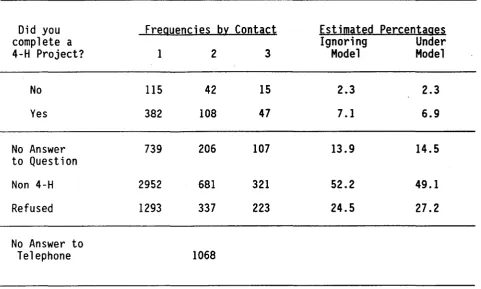
frequencies in Table 3 and 4 show two of these items and th~ proportions are
estimated both by applying the model (Model 6, that is) estimates of response
propensities and also by ignoring such differences. , The main finding is how
little difference there is between the raw sample percentages and the model
These results also serve to point out where are the major difficulties
caused by no-answering. The refusals and the did-not-answer-the-question cases
are numerous and are projected to be relatively a bit more numerous if calling
was to continue forever. About 27% of the called telephone numbers would
produce refusals and about 15% would not answer these questions. The
smaller, sample unadjusted percentages corresponding to these two are 24% and
14% so, even here, the change is relatively small. These findings of small
biases (if a 1% or 2% change can be called "small") are most welcome for this
survey since expanding the sample cases to give population estimates will be
tedious enough without having to carry along a correction for noncontacts.
If biases due to nonanswering cases are, in some survey, found to be rather
pronounced and the sample is from a complex design, then we would suggest
incorporating a simple multiplicative adjustment to the raising factors.
That is, each observation would be carrying whatever raising factor (or weight)
is needed to reflect the sample design. The additional multiplier would be
computed as the ratio of the estimated percentage from the model to the
percentage based on sample unweighted frequencies. Consider as an example the
conditional percentages for the first three answer categories for question 2G2
of Table 4. The model percentages would be 10.5, .35.4 and 53.1 with sample
percentages of 11.8, 33.3 and 54.8 so the multipliers are .89, 1.06 and .97.
These would be applied to the sample design raising factors to get the final
raising factors. Notice that the adjustment applies only to the one item. To
adjust a cross classification one would obtain separate multipliers for each
8. SECOND ILLUSTRATION
The following case illustrates a use of the multi-attempt model in the
sample design phase of a mail survey that also involves a parameter other than the
basic proportions. In studies of ratios of the recorded value of taxable
property to sale value there is interest in the median of the distribution.
The median is a reasonable choice of central value here in view of the rather
extreme swings that can be seen in this ratio. The model of multi-attempts can
be used to estimate proportions in classes of the ratio. The median would then
be calculated by straight line interpolation from the estimated cumulative
distribution function, while the standard error of the estimate can be judged
from the covariance matrix of the class proportions.
From past experiences, it was judged that nonresponse propensities of 80%
or 90% would not be unusual. A survey form is mailed to a sample of business
addresses and just the goodwill of the business determines if there will be a
forthcoming report on any sales of taxable property items. We also introduced
some inequalities in these propensities and furnished some evidence of a
slowing down of response rate by mailing. For a mail survey an attempt is
called a mailing and is defined by a time period such as three weeks.
Addresses not returning in three weeks are sent another questionnaire. Our
hypothetical data are in Table 5, where the total sample size was taken to be
1000. Class limits would generally be chosen so that the median falls into a
rather narrowly defined middle class, while the other two proportions would be
If the class limits are denoted a and b while the proportions are PI' P 2, and I-PI - P2 ' then the estimator of the median is
(8.1 )
From knowledge of the variances and covariances of the estimated proportions we
,can obtain, from a Taylor's series expansion, a variance for M. For the
normal distribution and random sampling this variance is found to be (wu2/2n).
The distribution of rat i os wi 11 be fairly well approximated by the normal in
A A
the neighborhood of the median. The variances of PI and P2, however, will
not be given by the familiar "pq/ n" formula as for random sampling, but will be
given by the multi-attempts model. In the random sampling or binomial case one
should perhaps use, as a value of sample size, the number of responses, which
is 257 in our example, rather than the initial sample size of n
=
1000 in ourexample.
When Model 6 is fitted to the data of Table 5 the estimated variances for
A A
PI = .432 and P2 .417 are .000953 and .000946 respectively. The
corresponding pq/n quantities with n
=
257 are .000955 and .000946 which showsan almost exact agreement. The unadjusted proportions are PI = .230 and
A A
Pz
.486 so the estimates PI = .432 and P2 = .417 would be expected to be
less biased. When Model 8 is fitted then the estimated proportion of hard core
nonrespondents is .09 and there may be some question as to the presence of such
cases.
Judging from past experiences we can expect the standard deviation of the
central or non-outlier distribution of ratios to be about 50% of the median
itself. This implies a 4% sampling coefficient of variation for Min the
S~~~~
= Sample CV of M= Population CVJw/2n=
50Jw/2 x 257= 3.9
A most conservative viewpoint on the 9% of hard core nonrespondents would be to
suppose they would all be above or all be below the observed median.. This
proportion (1 = .09 in this case) could affect the position of the median by the
amount 1~ a or, relative to the median itself, by 1~ x 50% K 11.3%. Notice
that this latter uncertainty is most unpalatable in that it does not diminish as
sample size increases, as well as being three times larger than sampling
uncertainty.
9. PARTING COMMENTS ON EFFICIENCY
In the 4-H survey cited above three attempts were made. This is the
minimum number required in order to estimate the parameters of the model.
Whether three or four or even more attempts should be made depends, of course,
on survey costs and on the model parameters. As in many such problems of
sampling design the optimum is flat. For example, four attempts may give least
variance for fixed cost but three or five or even six, seven, or eight will not
be much worse.
To illustrate these considerations we used the parameter estimates for the
data in Table 3 to project what would have been observed if four attempts had
been made. From these projected frequencies it can be determined that a sample
of size 8306 with four attempts rather than the actual 8636 with three
REFERENCES
Bartholomew, D. J. (1961). "A method for allowing for 'not at home' bias in
sample surveys," Applied Statistics, 10:52-59.
Cochran, W. G. (1977). Sampling Techniques. Third Edition, John Wiley and
Sons, New York NY.
Deming, W. E. (1953). "On a probability mechanism to attain an economic balance
between the resultant error of response and the bias of nonresponse,"
JASA 48:743-772.
Dillman, D. A. (1978). Mail and Telephone Surveys: The Total Design Method,
John Wiley and Sons, New York, NY.
Groves, R. M. and Lyberg, L. E., Chapter 12, Groves, R. M., et al., Editors,
Telephone survey methodology. John Wiley and Sons, New York, NY, pp. 191-211.
Hansen, M. H. and Hurwitz, W. N. (1946). "The problem of nonresponse in
Hendricks, W. A. (1949). "Adjustment for bias by nonresponse in mailed
surveys," Agricultural Economics Research 1:52-56.
Kish, L. and Hess, I. (1959). "A 'replacement' procedure for reducing the
bias of nonresponse," American Statistician, 13(4):17-19.
Politz, A. N. and Simmons, W. R. (1949). "An attempt to get the 'not at
•
homes' into the sample without callbacks," JASA 44:9-3l.
Proctor, Charles H. (1978). "Two direct approaches to survey nonresponse:
estimating a proportion with callbacks and allocating effort to raise
response rate," in Proceedings of the Social Statistics Section - American
Figure. Notation for Frequencies and Population Parameters
Known Not Undeci- Not
No-Call Working Yes ded No Refysal El ig1 bl e Answer
1 n
W
nU nI2 nI3 n14 n15 n16•
2 0 n2I n22 n23 n24 n25 n26
r 0 nrI nr2 nr3 nr4 nr5 nr6
Population Proportions PI
No-answer Proportions a
Tabl e 1. Sample Frequencies by First, Second or Third Attempt for Three Basic Types of Answer to a Telephone Interview with Parameter Estimates
for a Model of Multi-Attempt Surveys
Parameter Estimates
Sample Frequencies No-answer
Telephone by Attempt Estimated Proportion
Hetero-•
Answer Percent, A geneityType 1 2 3 100Pk tr
k Weight, W
Northeast
4-H 253 74 48 23.3 .52
Non 4-H 813 170 95 51.3 .30 .23
Refused 344 98 54 25.4 .39
No Ans. 292
South
4-H 292 115 57 27.9 .50
Non 4-H 617 156 90 43.9 .35 .15
Refused 339 89 76 28.1 .45
No Ans. 294
North Central
4-H 383 79 33 24.1 .27
Non 4-H 755 158 73 48.8 .29 .31
Refused 312 83 48 27.0 .45
No Ans. 238
West
4-H 308 88 31 22.1 .33
Non 4-H 767 197 63 51.6 .29 .25
~)
Refused 298 67 45 26.3 .48
Table 2. Fit Statistics for Eight Models Fitted to Data of Table 1.
Case OF Northeast South North Central West
1 6 164.6 106.3 178.6 152.0
•
W '" 0 2 5 16.3 29.3 9.4 14.1
Equal
Q "( '" 0 3 5 57.0 . 53.5 42.8 23.0
"( t 0; W '" 0 4 4 193.7 247.6 9.4 11.7
5 4 106.0 82.8 108.4 115.2
W '" 0 6 3 11.9 22.9 2.2 6.1
Unequal
Q
"( '" 0 7 3 43.6 42.7 30.5 16.4
W '" 0; "( '" 0 8 2 64.1 145.4 8.9 6.4
Sample Size 1141 2125 2162 2108
Table 3. Responses to Question 20 by First, Second or Third Call
Did you Frequencies by Contact Estimated Percentages
complete a Ignoring Under
4-H Project? 1 2 3 Model Model
No 115 42 15 2.3 2.3
Yes 382 108 47 7.1 6.9
No Answer 739 206 107 13.9 14.5
to Question
Non 4-H 2952 681 321 52.2 49.1
Refused 1293 337 223 24.5 27.2
No Answer to
..
Table 4. Response to Question 2G2 by First, Second or Third Call
Rate Usefulness Estimated Percentages
of Your Experi- Frequencies by Contact
ences with Ignoring Under
People in 4-H: 1 2 3 Model Model
Some 64 12 8 1.1 1.1
Useful 160 55 23 3.1 3.4
Extremely 273 83 31 5.1 5.1
Question Not
Answered 739 206 107 13.9 14.8
Non 4-H 2952 681 321 52.2 49.4
Refused 1293 337 223 24.5 26.3
Telephone
Table 5. Hypothetical Data for Planning a Survey to Estimate the Median of Ratios
Estimated Parameters for Case 6 Model
Contact A
C1 ass Limits Pk ak W
•
1 2 3Zero to a 21 20 18 .432 .951
a+ to b 50 40 35 .417 .881 .226
b+ 35 20 18 .152 .779