Experimental Analysis of LDPE Modified
Bituminous Mix with Partial Replacement of
Steel Slag as Aggregate
M. Mahalakshmi1, S. Nithin vageesh2, R. Raghu3, S. Praveen kumar4, C. Mahesh babu5
Asst. Professor, Department of Civil Engineering, Adhiyamaan College of Engineering, Hosur, Tamil Nadu, India1
U.G Student, Department of Civil Engineering, Adhiyamaan College of Engineering, Hosur, Tamil Nadu, India2
U.G Student, Department of Civil Engineering, Adhiyamaan College of Engineering, Hosur, Tamil Nadu, India3
U.G Student, Department of Civil Engineering, Adhiyamaan College of Engineering, Hosur, Tamil Nadu, India4
U.G Student, Department of Civil Engineering, Adhiyamaan College of Engineering, Hosur, Tamil Nadu, India5
ABSTRACT: Waste production is increasing day by day to a very large extent. Most of the wastes are not being reused, instead simply dumped in large areas of land, polluting the environment. Converting these wastes into usable products is a much needed technique but at the same time they must not have a drawback due to their usage. This study analyses the use of steel slag as a partial replacement for coarse aggregate in the production of bituminous mix for road construction wherein the aggregates are coated with Low Density Poly Ethylene (LDPE) such as carry bags and polyethylene covers during the preparation of the mix. Three different percentages (10%, 20% & 30%) of steel slag aggregate were used and shredded pieces of LDPE of about 12% the weight of bitumen were coated over the heated aggregates. The proposed mix designs for bituminous asphalt mix were conducted in accordance with Marshall Mix design. The Marshall Stability tests were conducted on the modified mixes. It has been observed that LDPE and steel slag modified bituminous mix show better stability, heat bearing capacity and more resistant to water. Hence, this method will not only strengthen the roads but also increases the road life as well as will help to improve the environment.
KEYWORDS: Low Density Poly Ethylene (LDPE), Steel Slag, Marshall Stability, Modified Mix, Coated Aggregates.
I. INTRODUCTION
promoting the nation’s transportation network to the next level of improvement for the future generation. In this project, attempt has been made to analyze the performance of modified bituminous mix with the utilization of plastic waste and partial use of steel slag as aggregate. It can be a better method for disposal of plastic wastes and steel slag and at the same time it enhances the performance of the pavement, reduces the road construction cost and protects the environment.
II. LITERATUREREVIEW
Dr. R. Vasudevan, S. K. Nigam, R. Velkennedy, A. Ramalinga Chandra Sekar, and B. Sundarakanna (2006) found innovative techniques to utilize the plastic wastes and the tyre waste for the construction of flexible pavement, for making pathway blocks, and for making laminated roof sheets. The major polymers namely polyethylene, polypropylene, polystyrene show adhesion property in the molten state.
Minakshi Singhal, Yudhvir yadav, Ranadip Mandal carried out a comparative study between the polymer modified bitumen blend and polymer coated aggregates. They found that the polymer coated aggregate bitumen mix form better material for the flexible pavement construction. The optimum content of plastic to be used is between the ranges 5% to 10%. It shows higher Marshall Stability value.
Yash Menaria, Rupal Sankhla states that the utilization of plastic upto 8% improves the binding property, stability and durability of the mix to a great extent. They also added waste fibre to improve the bitumen properties.
III.OBJECTIVESOFTHESTUDY
Our intention is to utilize the plastic waste and steel slag in flexible pavement construction effectively and to be beneficial to the society.
1. To prepare a LDPE modified bituminous mix.
2. To prepare a LDPE and steel slag modified bituminous mix with partial replacement of steel slag. 3. To identify the properties of the steel slag modified LDPE bituminous mix.
4.
To analyze and compare the results.IV.MATERIALSANDPROPERTIES
The materials used in this study are a) Aggregates
b) Bitumen c) Filler
d) LDPE (plastics) e) Steel Slag
a) Aggregates
Coarse aggregate sizes are larger than 4.75 mm, while fine aggregates form the portion below 4.75 mm. In this project 16mm, 12.5mm and 6.75mm retained coarse aggregates and 2.36mm, 1.18mm retained fine aggregates were used.
Table -1: Properties of Aggregates
S. No. Test Conventional aggregate Steel Slag aggregate MORTH Specifications
1. Crushing 25% 28% < 30%
2. Impact 26% 29% < 30%
3. Water Absorption 1% 10% <= 20%
4. Specific Gravity 2.78 2.8 2.68-2.98
Table 1 shows that the conventional aggregates and steel slag aggregates used in this study are within the MORTH limitation specifications.
b) Bitumen
Asphalt also known as bitumen, is a sticky, black, and highly viscous liquid or semi-solid form of petroleum. The primary use (70%) of asphalt is in road construction, where it is used as the glue or binder mixed with aggregate particles to create asphalt concrete.
60/70 grade of bitumen is used in this study. The properties of this bitumen are shown in Table-2 in which the obtained results are compared with the standard values.
Fig –1
Fig -1 shows the Bitumen 60/70 grade used in this study heating to the pouring consistency.
Table -2: Properties of Bitumen
S. No Test Result Standard Value
1. Specific Gravity 1.085 Min. 0.99
2. Penetration 61 mm 60-70 mm
3. Ductility 90 cm Min 40 cm
4. Softening point 62.5 °C Min.47 °C
5. Flash point 220 °C Min. 175 °C
6. Fire point 260 °C Min. 180 °C
7. Viscosity 78 secs Min. 70 secs
c) Filler
Quarry dust was used as filler material
Fig -2(a) Fig -2(b)
Fig – 2(a) shows IS Sieve300 retained Quarry Dust passing through IS Sieve 600 and Fig -2(b) shows IS Sieve150 retained Quarry Dust passing through IS Sieve 300 .
d) Low Density Poly Ethylene (Plastic carry bags)
Low Density Poly Ethylene (LDPE) in the form of carry bag was used. Plastic covers were shredded to sizes ranging from 5- 10 mm.
e) Steel Slag
Electric Arc Furnace Slag (EAF or steel furnace slag) produced when scrap metal and fluxes are oxidized by the use of an electric current.
Steel slag can be used by blending with many other products such as granulated slag, fly ash and lime to form pavement material, skid resistant asphalt aggregate and unconfined construction fill.
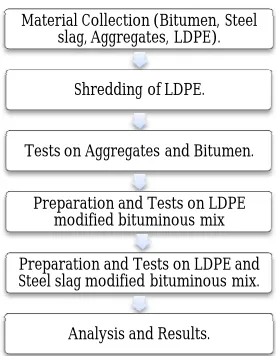
V. METHODOLOGY
Material Collection (Bitumen, Steel slag, Aggregates, LDPE).
Shredding of LDPE.
Tests on Aggregates and Bitumen.
Preparation and Tests on LDPE modified bituminous mix
Preparation and Tests on LDPE and Steel slag modified bituminous mix.
VI.PLASTICCOATEDAGGREGATES
1200 grams of aggregates were heated to a temperature 160°C-170 °C. The shredded plastic was added to the hot aggregates with constant mixing to have a uniform distribution. The plastic gets softened and coated over the conventional aggregates as well as steel slag aggregates. Its properties were tested and given in Table 3.
Fig -3
Fig -3 shows the process of adding shredded LDPE over the aggregates heated at 160-170C to get the LDPE coated aggregates.
Table -3: Properties of Plastic Coated Aggregates
S.No Test LDPE coated Conventional
aggregate
LDPE coated Steel Slag aggregate
Requirement as per Table 500-14 of MORTH (IV Revision)Specification
1. Crushing 24% 27.5% < 30%
2. Impact 24% 28% < 30%
3. Water Absorption 0.1% 2% <= 20%
4. Specific Gravity 2.8 2.85 2.68-2.98
Table -3 shows the properties of the LDPE coated Conventional aggregates and LDPE coated Steel slag aggregates in which it depicts that both the aggregates show good results within the MORTH specification. Plastic coated aggregates show improved properties than the conventional aggregates.
VII. MARSHALLMETHODOFMIXDESIGN
The mix design should aim at an economical blend, with proper gradation of aggregates and adequate proportion of bitumen so as to fulfill the proportion of mix.
Proportioning of aggregates and filler for mix
Total weight = 1200 g.
Table -4: Aggregates and Filler proportions in Mix without Steel Slag
Aggregates passing sieve sizes Aggregates retained on sieve sizes
Weight(g)
20 mm 16 mm
150
16 mm 12.5 mm
190
12.5 mm 6.7 mm
240
4.75 mm 2.36 mm
80
2.36 mm 1.18 mm
60
600 µ 300 µ 200
300 µ 150 µ
150
150 µ 75 µ 130
Table -4 shows the size of the conventional aggregates and weight of the aggregates taken for the study based on the Marshall Mix Design using the IS Sieves 20mm, 16mm, 12.5mm, 6.7mm, 4.75mm, 2.36mm, 1.18mm, 600µ, 300µ, 150µ, and 75µ.
2) LDPE Modified Bituminous Mix with Steel Slag
Table -5: Aggregates and Filler proportions in Mix with Steel Slag
Aggregates passing sieve sizes Aggregates retained on sieve sizes
Percentage of steel slag replacement in conventional aggregate
10% ( g )
20%
( g ) 30% ( g )
20 mm 16 mm 150 150
150
16 mm 12.5 mm 190 190
190
12.5 mm 6.7 mm 216 192
168 12.5 mm
(steel slag) 6.7 mm 24 48 72
4.75 mm 2.36 mm 80 80
80
2.36 mm 1.18 mm 60 60
60
600 µ 300 µ 200 200 200
300 µ 150 µ 150 150
150
150 µ 75 µ 130 130
130
VIII. MIXPREPARATIONANDTESTING
Aggregates including the steel slag of approximately 1200g is heated upto 160-170C. Shredded LDPE of 5-10mm size is added partly and slowly to the heated aggregates to form a uniformly coated aggregates. Bitumen is heated to 120C and mixed to the coated aggregates and heated. The mix is poured into the preheated moulds and 50 blows are given on the each side of the mix and kept undisturbed for 24hrs. After 24 hours the specimen is removed from the mould and kept in water bath at 60C for 30min. Then the specimen is tested immediately within 30 seconds in the Marshall Stability machine. The stability and flow value of the mix is noted from the proving ring and the dial gauges
.
Fig – 4 Fig – 5 Fig - 6 Fig – 7
Fig -4 shows the final stage of mix preparation which consists of the mixture of LDPE coated aggregates, bitumen, and dust. Fig – 5 shows the pouring of mix in the compaction setup for compaction. Fig- 6 shows the compaction process in which the blows are given on each side of the mix.
Fig -7 shows the casted briquettes which is undisturbed for 24hrs and demoulded.
IX. TEST RESULTS AND ANALYSIS
The results obtained from the Marshall Stability Test are shown in Table 6.
Table -6: Marshall Test Results
Percentage of Steel Slag in Mix Bitumen Content % Plastic Content % Stability Value ( KN ) Flow ( mm )
0 % 5.5 12 12.5 2.8
10 % 5.5 12 19.7 3.8
20% 5.5 12 19.95 3.5
30 % 5.5 12 21.5 2.35
According to IRC 29: 1988, Minimum Stability value = 6.4 KN Flow value = 2 – 4 mm
Chart – 1: Steel Slag content vs Stability
Chart – 2: Steel Slag content vs Flow value
Chart -1&2 is plotted by using the tabulated values from the table -6. In this chart-1, stability is plotted against the steel slag percentage. We can clearly observe that 30% of Steel slag replacement shows higher stability value. In chart -2, Flow value is plotted against the Steel slag percentage here 20% replacement of Steel slag shows higher flow value which is not within the permissible limit where 30% shows flow value within the permissible limit.
X. CONCLUSION
With a view to improve the properties of the LDPE modified bituminous mix using steel slag as a partial replacement for coarse aggregates, the following conclusions are made.
1. From the test results 30% usage of steel slag was found to be effective.
2. Use of steel slag showed a considerable increase in Marshall Stability value and less deformation. 3. Thus this modified bituminous mix can be used for laying roads.
5. Thus this method reduces the demand for natural aggregates and is a sustainable way to dispose plastic wastes and steel slag.
REFERENCES
[1] Ebenezer Akin Oluwasola, Mohd Rosli Hainin and Md Maniruzzaman A Aziz, “Evaluation of Rutting Potential and Skidding Resistance of Hot Mix Asphalt Incorporating Electric Arc Furnace Steel Slag and Copper Mine Tailing”, Indian Journal of Engineering and Materials Sciences | Vol. 22, October 2015, pp. 550-558.
[2] Ebenezer Akin Oluwasola, Mohd Rosli Hainin, Md. Maniruzzaman A. Aziz,“Characteristics and Utilization of Steel Slag in Road Construction”, jurnalteknologi, 70:7 (2014) 117–123 | www.jurnalteknologi.utm.my | eISSN 2180–3722 |.
[3] Mahalakshmi.M, Priyankaprakash.S, Shalini.T, Rajamanickam.R, Ramasamy.K, “Utilization of Waste Plastics in Bitumen”, International Journal of Engineering Research and Technology | Vol. 3 – Issue 2, February 2014.
[4] Manoj Kumar Tiwari, Samir Bajpai and Umesh Kumar Dewangan, “Steel Slag Utilization - Overview in Indian Perspective”, International Journal of Advanced Research (IJAR), ArticleDOI: 10.21474/IJAR01/1442, http://dx.doi.org/10.21474/IJAR01/1442.
[5] Minakshi singhal, Yudhvir Yadav, Ranadip Mandal, Use Of Modified Bitumen In Highway Construction, International Journal for Innovative Research in Science & Technology (IJIRST) | volume 2 | Issue 12| May 2016.
[6] Mohdrosli Hainin et al., “Steel Slag as an Aggregate Replacement in Malaysian Hot Mix Asphalt”, International Scholarly Research Network (ISRN) Civil Engineering volume 2012, Article ID 45901, 5 pages.
[7] S.Rajasekaran, Dr. R. Vasudevan, Dr. Samuvel Paulraj, “ Reuse of Waste Plastics Coated Aggregates-Bitumen Mix Composite For Road Application – Green Method”, American Journal of Engineering Research (AJER) e-ISSN : 2320-0847 p-ISSN : 2320-0936 Volume-02, Issue-11, pp-01-13.
[8] Sandhya Dixit, Deepak Rastogi, “Studies on the Improvement of Characteristics of Bitumen with Use of Waste Plastic”, International Journal of Emerging Technology and Advanced Engineering Website: www.ijetae.com (ISSN 2250-2459, ISO 9001:2008 Certified Journal, Volume 3, Issue 3, March 2013).
[9] Sanjay et al., ”A Study on Effect of Steel Slag as Partial Replacement in the Performance Of Bituminous Mix”, International Journal For Scientific Research & Development | Vol. 3, Issue 03, 2015 | ISSN (online): 2321- 0613.
[10] Shweta N. Rokdey, P. L. Naktode, M. R. Nikhar, “Use of Plastic Waste in Road Construction”, International Journal of Computer Applications (0975 – 8887) International Conference on Quality Up-gradation in Engineering, Science and Technology (ICQUEST2015).
[11] Yash Menaria & Rupal Sankhla, “Use of Waste Plastic in Flexible Pavements-Green Roads”, Open Journal of Civil Engineering, 2015, 5, 299-311 | http://www.scrip.org/journal/ojce | http://dx.doi.org/10.4236/ojce.2015.53030.