(Under the direction of Dr. Jason Swarts).
Typically, creativity and innovation are studied from the perspectives of the individual’s psychology, or management, where leaders are innovation visionaries or organizations use
innovation to increase market and revenue; both views neglect the site at which work occurs -- the collaborative, embedded workplace. To that end, this dissertation investigates
interpersonal communication and its effect on individual creativity and, more broadly, the
higher-level contextual issues (e.g. roles and division of labor, community knowledge and indoctrination, computer-mediated work and tools, etc.), which also effect team and
individual creativity. The methodology presented is a mixed-method study using quantitative models to survey practiced creativity, organizational support for creativity, support
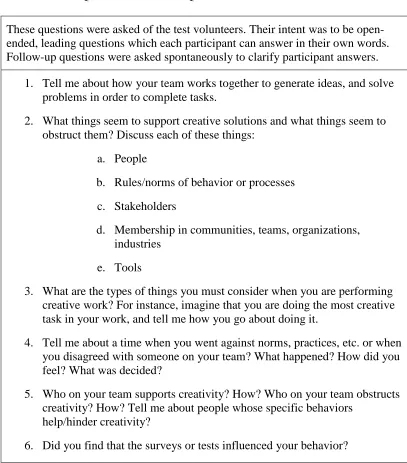
communication, and levels of intimacy. Qualitative interviews were based on categories
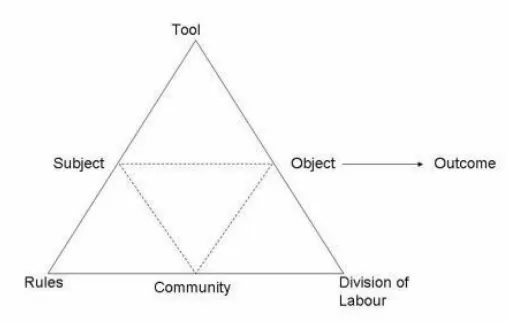
modeled from activity theory. The quantitative surveys are inconclusive and require further investigation. The qualitative textual analysis indicates the high influence of Rules,
Community and Subject on creative workplace activity. It is suggested that finding an optimal creative system is more akin to finding the right balance for a particular system and context than it is determining an objective, generalizable list of characteristics that apply
universally. This study may help us direct future research toward investigating interpersonal communication models in the workplace, as well as understand the ways that activity theory
by
Heidi Katherine Hess von Ludewig
A dissertation submitted to the Graduate Faculty of North Carolina State University
in partial fulfillment of the requirements for the degree of
Doctor of Philosophy
Communication, Rhetoric and Digital Media
Raleigh, North Carolina
2014
APPROVED BY:
_______________________________ ______________________________ Jason Swarts, Ph.D. Elizabeth Craig, Ph.D.
Committee Chair
DEDICATION For my parents:
For the one who encourages adventure, and reminds me to have fun and “enjoy the ride;” And for the one who supports curiosity, “thinking for myself” and learning from my mistakes; both of whom inspired my imagination.
And, for my husband, Jason, whose encouragement, support and enlightening discussions
BIOGRAPHY
Heidi K. Hess von Ludewig is an interdisciplinary scholar with interests at the intersection of
interpersonal communication, technical communication, professional communication, computer-mediated communication, and psychology and within the workplace context. She received her BS in Computer Science from Rensselaer Polytechnic Institute in 1995, after
which she worked as an internet developer and user interface designer. In 1998, she returned to Rensselaer Polytechnic Institute to pursue an MS in Technical Communication, focusing
on hypermedia, and an MS in Computer Science, focusing on human factors. After
completing the MS degrees in 2000, Heidi moved to Raleigh, NC to work for IBM Software Group in the strategy division where she performed various roles such as developer, tester,
team lead, and project manager. While working at IBM, she was accepted into the Communication, Rhetoric, and Digital Media Ph.D. program at North Carolina State
ACKNOWLEDGMENTS
If I do anything in this work, I hope I show that there is great interdependence in what
appears to be the simplest of things. Life itself is an interdependent system. By looking deeply, we can take a single, isolated event and see how it is preceded by innumerable lines of cause and effect. It is the same for this Ph.D. and the same for my dependence on my
teachers, and I use the term loosely. Of course, I want to thank my teachers who purposefully taught me, whose passion involves teaching, sharing knowledge, and helping others achieve
their potential. They saw my potential and cultivated it within me. Sometimes I could not move forward without the help of my professional teachers and those who patiently
supported my growth. My committee members are such people, as are those who taught me
in my classes. But the term “teacher” also applies to those people who gave me
encouragement, support or advice, a kind word or thought, or even who taught me something
about myself or the world even if I did not want to learn it and learning from these people is what made them my teachers.
The road to finish this degree has been lonely, long and laborious, as many people
know. What is important is that one grows the most when things are difficult, the way the lotus blooms from the mud, or the orchid blossoms on the rocky mountainside; the mud and
the mountainside become part of the flower, inseparable.
And so it is with deep admiration and gratitude that I thank all my teachers,
professional or not, intentional or not; you have all been generous and this Ph.D., this flower
TABLE OF CONTENTS
LIST OF TABLES ... ix
LIST OF FIGURES ...x
INTRODUCTION: THE IMPORTANCE OF CREATIVITY AND INNOVATION ...1
CHAPTER 1: CREATIVITY AND INNOVATION ...10
Introduction to Creativity and Innovation...12
Intelligence and Cognitive Ability ...19
Role of knowledge and expertise and mentors. ...22
Personal characteristics and temperament. ...26
Creativity across the ages: genetics, upbringing, and maturation. ...29
Classification...32
Measures of creativity and innovation. ...33
Summary. ...37
CHAPTER 2: SOCIAL CREATIVITY – RELATIONSHIPS BETWEEN INDIVIDUAL CREATIVITY AND SOCIAL NETWORKS ...39
Introduction ...39
Creativity and Interpersonal Social Networks ...45
Indirect Influences of Support Communication ...49
Trust. ...49
Safety and uncertainty management. ...51
Stress and emotion. ...52
Direct Influences on Creativity. ...54
Relational closeness. ...57
Summary. ...61
CHAPTER 3: GROUP WORK ON THE NETWORK – THE EFFECTS OF WORKPLACES AND WORKPLACE COMMUNICATION ON CREATIVITY ...63
Introduction ...63
Organizational factors ...66
Influences of the Macro-level Environmental (Network) Structures ...73
Contradictions within the Division of Labor – challenging power and roles. ...85
Contradictions within the Rules – testing community norms, and standards. ...88
Summary ...89
CHAPTER 4: MIXED-METHODOLOGY DESIGN AND IMPLEMENTATION ...90
Introduction ...90
Research hypotheses and questions ...91
Quantitative questions. ...91
Qualitative research questions. ...92
Sample population and data collection procedures. ...93
Quantitative survey instruments. ...96
Quantitative analysis. ...99
Qualitative methodology. ...100
Limitations. ...108
CHAPTER 5: QUANTITATIVE AND QUALITATIVE RESULTS...109
Introduction ...109
Quantitative Results ...109
Descriptive analysis. ...109
Composite measures. ...110
Correlational analysis...112
Hypothesis 1: Support communication. ...113
Hypotheses 2 and 3: Intimacy and Informational Intimacy in the workplace. ...114
Qualitative Results ...117
Descriptive analysis. ...119
Relative frequencies of codes by question. ...122
Rules, Community and Subject...123
Conclusion ...131
CHAPTER 6: CREATIVITY IN THE WORKPLACE: INTERPERSONAL AFFECTS AND CREATIVE CONTRADICTIONS AND CLOSURES...132
Introduction ...132
Quantitative discussion ...132
Hypothesis 1, 2 and 3. ...133
Creative work. ...135
Collaboration and network characteristics. ...140
The most common responses: Rules, Community and Subject. ...144
Rules ...145
Analysis of question 2: team and individual work integration ...147
Closures of Collaboration. ...158
Summary. ...161
Community ...162
Analysis of question 2d – community membership. ...164
Summary. ...179
Subjects ...181
Analysis of question 4: contradiction and closures. ...184
Summary. ...200
Chapter Conclusion ...201
Rules, Community and Subjects. ...203
Contradictions, Closures and Collaboration. ...205
Limitations and future work...208
Implications...211
For the academic audience. ...211
For the professional audience. ...214
REFERENCES ...217
APPENDICES ...227
Appendix A: Methods, Models and Code Definitions...228
Email request for study volunteers. ...228
Informed Consent Form ...228
Potential and practiced creativity survey. ...231
Social Intimacy Scale. ...232
Adapted Social Intimacy Scale ...232
Social Support Questionnaire. ...234
Adapted Social Support Questionnaire. ...234
LIST OF TABLES
Table 4-1. Qualitative Interview Questions ...………..….103
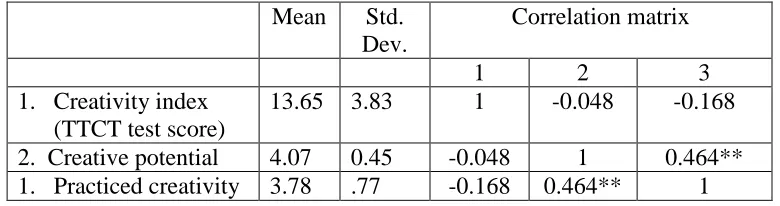
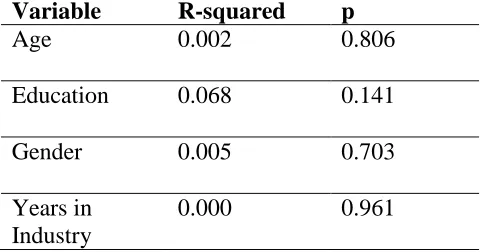
Table 4-2. Outline of the Primary Codes and Sub-codes ...………..…107 Table 5-1: Correlation Matrix for Creativity Measures ...………...112 Table 5-2: Analysis of Control Variables in the Prediction of Practiced Creativity ...…….114
LIST OF FIGURES
Figure 1-1. Diagram of the levels of investigation ………...………..……..7
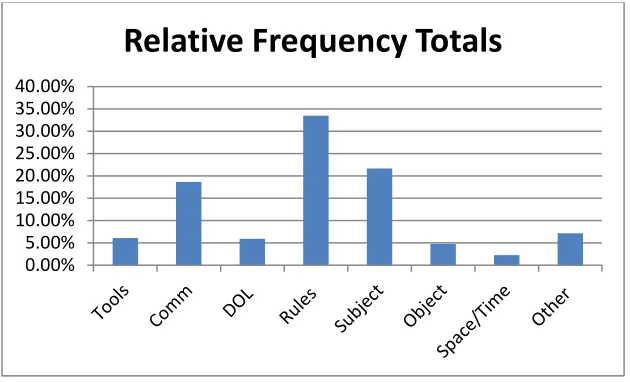
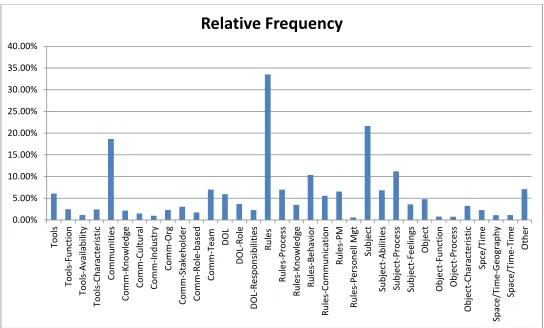
Figure 3-1. Activity System elements ..………..………78 Figure 5-1: Relative frequency totals across all questions and interviewees ...………...…120 Figure 5-2: Relative frequency of all categories across all questions and test participants ..121
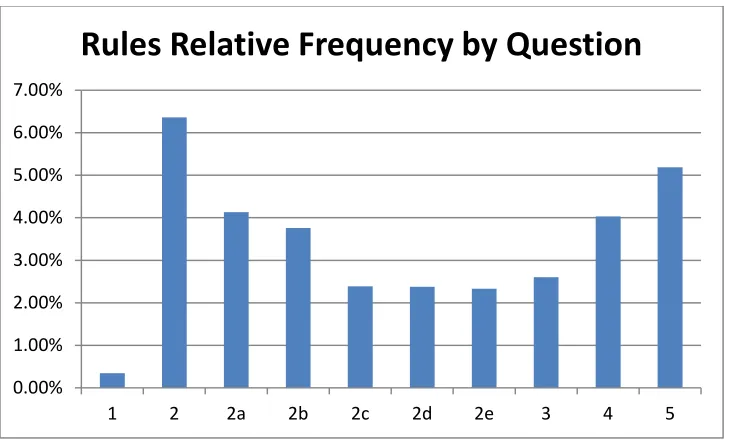
Figure 5-3: Relative frequency for Rules category across various questions ...………..…..121 Figure 5-4: Relative frequency for Community category across various questions ...…..…122
Figure 5-5: Relative frequency for Subject category across various questions ...……..…...122 Figure 5-6: Relative frequency of coded data segments for Question 2 ...…………..……..124 Figure 5-7: Relative frequency of coded data segments for Question 2d ...…………..……126
Figure 5-8: Relative frequency of coded data segments for Question 4 ...…………..……..128 Figure 6-1: The integration of contradiction, collaboration, and closure in an
activity network ...………..………...141 Figure 6-2: Boundary objects as mediating tools that are re-used by
INTRODUCTION: THE IMPORTANCE OF CREATIVITY AND INNOVATION Throughout human history, the ability to identify problems, think of and implement
solutions, and evaluate solutions for improvements seems to have urged technology forward, each idea building upon the last, from the wheel, lever and wedge through the agricultural and industrial revolutions, to the digital age of the microchip, microwave, lasers, and
nanotechnologies. This urging for the novel and inventive is even more pronounced in the digital era as the health and wealth of economies and countries are built upon the generation
of new things, processes, and markets particularly due to the competitive globalized marketplace. NCSU’s Institute for Emerging Issues (2010-a) describes how creativity is a counter to unsettling economic forces like automation (in manufacturing for example) and
outsourcing and a force for entrepreneurial business growth not to mention a way for communities to promote cultural tourism through art, museums, and other interests. Their
recent report (2010-b) on creativity and innovation programs in the U.S. outlines 16 state-funded or non-profit creativity programs often focusing on a city or region, eight of which started after the economic turn-down in 2008. In the current economic environment,
researchers find that three factors affect economic performance – creativity and innovation (or the generation and implementation of novel products and processes), imitation, and
efforts related to the commercial exploitation of technology (Fagerberg, 2005). (One
distinction to make is that innovation is the implementation of something creative, it relies on creativity, and it is a term often used by business to connote the production of something
aware of how creativity and innovation drives new products and, therefore, new markets for goods and services – one contemporary example is Apple’s iPod and iTunes store which
made both a product and a digital music service available to millions of people. A little known example is how Seiko’s research for a less expensive quartz technology led to a new consumer market for its watches (Tushman et al., 1997). Although imitation is a surprising
component of economic performance, it is a large one -- in the 1980s, the United States generated cutting edge micro-computer technology while Japan profited through the
imitation and innovative perfection of it, thereby developing its technological and economic stature throughout the world.
In order to stay competitive, business and industry must be creative and innovate both
their processes and products; creativity is absolutely required to grow and create more customers and new markets. New or radical business ideas can come from leadership
visionaries but there are many opportunities for employees to be creative and innovate. In fact, although visionaries often communicate the business strategy, they rely on employees to execute it which makes employee creativity and innovation as important as that of the
leadership. Perhaps, historically, the work employees performed has been largely guided by innovative leaders but that is changing – employees are not only at the level at which work
gets performed but that level is also where there is great opportunity for creativity. Often, employees are – simultaneously -- creative workers and consumers of creativity – producers and users of the products, and processes of innovation. What this means is that the workforce
due to a fundamental change of the type of economy of which we are a part. No longer are we in the industrial age -- which focused on manufacturing quantities of widgets at the
lowest cost – we are part of the knowledge economy, a system of exchange based on knowledge, skill, and problem-solving (also referred to as the Creative Economy (Florida, 2002). In this environment, the study of creativity (and innovation because it relies on
creativity) becomes important in order to understand the conditions under which it arises. Although significant research on creativity is available, to a certain extent its manifestation is
still somewhat mysterious. This goal is complicated in the modern workplace where the flow of people is more common than ever before, and where, in the technology fields, geo-spatial boundaries solve some issues while creating others.
The change in the type of economy has influenced business in an indirect way as well. One of the more immediate issues that businesses are facing is that the increase in the
aging workforce complicates the innovation problem because companies are pressed to find an immediate way for more mature employees to share knowledge, grow skills, and work collaboratively to solve problems with less experienced workers. In contrast to the
cooperation required for collaboration, understanding, developing and capitalizing on one’s own creative and innovative spirit is also important from the employee perspective as it can
be what sets an employee apart in a competitive environment and can yield promotions, bonuses or some degree of job security. It used to be that a solid education led to middle and upper-middle class jobs and life styles but that is no longer the case. As countries with rising
wages of their workforce low, businesses are using more off-shore labor to meet their human resource needs – thereby increasing employment competition in mature economies where
skilled labor has typically enjoyed more secure employment and high wages which have made collaboration and competition between employees less antagonistic.
In fact, in my own work experience over the last 9-10 years, I have witnessed
companies changing from a predominantly North American workforce to an Asian and Indian-Asian globalized workforce, and have worked for businesses in which approximately
70% of the employees were foreign or foreign-born (either the employees worked off-shore in their home countries or were hired in the U.S. on immigration visas; I call the former “in-shoring”). However, I witnessed the work culture in the businesses which relied less on
off-shore employees, or where their off-off-shore employees were expected to behave like American employees and even take American names as a way to indoctrinate themselves (I recognize,
and detest, the cultural imperialism that this implies), were more collaborative than the companies that relied heavily on off-shore employees.
As mentioned earlier, the economic system has changed from one focused on
industrial-manufacturing to one which relies on, and commoditizes, knowledge and creativity. The digitized, dispersed communication network also changes how we classify
different economic groups and how employees think about and perform their work. Rather than “middle class”, connoting a specific range of income, we are increasingly defined by the work we do rather than what we earn for the work. Florida’s work (2002) described the
ideas, new technologies or new creative content and includes engineers, scientists, architects, designers, educators, artists, musicians, entertainers, and others. People in this group share a
“creative ethos” whose ideals include creativity, independence or uniqueness, diversity, and merit. In addition, research has shown that creativity increases the meaning of work (Cohen-Meitar et al., 2009), job satisfaction (Gilson & Shalley, 2004) and stems from complex tasks
that inspire intrinsic motivation (Shalley et al., 2004). For this group, creativity and innovation are a way of life.
What this means for creativity research in the workplace is that there are
complications that are not being considered by current research. First, current research tends to focus on the individual (psychology research) or on non-relational aspects of teamwork
and creative collaboration (social creativity research). Yet teamwork is predominant in the workplace, and relationships inevitable form between people who work together so it is
important to understand those relationships and their influences on creativity – particularly because teams and employees are the level at which work gets done.
Second, there are significant contextual factors in the workplace that have the
potential to influence creativity – for example, more mature workers leaving the workplace, the unstable economic landscape, and the cultural and collaborative differences of
off-shore/in-shore workers. Despite business management research that investigates
organizational creativity, and leadership influence on creativity, contextual factors contribute to a multifaceted workplace which complicates the understanding of organizational or
investigation needed to consider the entirety of the workplace context and its effect on employee creativity.
If we look closely at the two gaps in research we can see they are at different levels of analysis. As we have discussed, nations recognize the importance of creativity and
innovation to create economic and other advantages, business needs creativity to create new
processes, products and markets, and business relies on creative employees whose economic value is in the collaborative and innovative performance. The importance of creativity and
innovation is significant at many levels -- from the macro-level of a country’s economy, to a meso-level business’ drive for maintaining or increasing profits and markets and the ability to compete globally, and to the micro-level employee working in a creative field and desiring
increased engagement with their workplace and the results of their labor. Therefore, research at all these levels is important – to leave out one level is to ignore the importance and
influence of the elements of that level.
Levels can be defined by the scope being viewed as in a telescope. Viewing
something very far away (zoomed out) will give it a wide scope but will decrease the detail;
this is be the macroscopic level. The moderate telescopic view narrows the scope but increases the detail (the mesoscopic level). Finally, decreasing the telescope to the smallest
level narrows the field of vision but increases the detail even more, as in the microscope. The smaller levels are contained by the next-largest levels. See Figure 1-1. For my purposes, the macro-level refers to the workplace context, and the meso-level is the team, and the
Figure 1-1. Diagram of the levels of investigation.
The boundaries erected to discuss and investigate creativity are permeable and virtual
– each level can influence the levels they contain (the smaller scopes) and the levels in which they are contained (the larger scopes). Said another way, each level is an influencer of and influenced by the other levels. If we accept that workplace creativity is an area of research
that needs some attention, and if we use the levels-perspective to organize the research, then it is important to understand creativity at these different levels, including how the levels
overlap and influence other levels.
At the micro-level, the creative individual is influenced by family environment, age, skills and development of expertise yet the individual also influences these things through
creative process. Although teams can be greatly influenced by single team members, team creativity can be influenced by the relationships that develop amongst team members as well.
Perhaps trustful supportive relationships would yield more creativity than antagonistic, distrustful relationships. In other words, there are social aspects which are not separable from the individual, and vice-versa. Communities, organizations, and industries are at the
macro-level and make up the workplace context. As teams are embedded within an organization and industry, the macro-level can influence the team through leadership messages, availability of
resources, diverse social networks, and information dispersion. Any of these levels can be examined in isolation, and often are; this research adds to our knowledge about creativity at different levels but a broader analysis using all the levels simultaneously would be useful for
generating a picture of creative activity within the larger system. The goal, then, is to fill research gaps at the individual levels and examine creative activity at the macro-level to see
how individuals act creatively in a particular social process and context.
This dissertation seeks to lay a foundation of knowledge about the contemporary state of creativity and innovation research in Chapter 1 by discussing the definition of creativity
and describing its many components, how they relate to the creative individual, and how they may be measured. The rest of this chapter examines the creative individual at the micro-level.
Chapter 2 continues this discussion by focusing on the social means of creativity – the meso-level -- particularly as it relates to team formation and the relationships which develop on teams that help or hinder creativity. Chapter 3 focuses on the workplace context and how
individuals are implanted. Both Chapters 2 and 3 outline research questions which are the basis for Chapter 4’s concentration on methodology. The results of the mixed-methodology
study are found in Chapter 5 and the last chapter discusses the study findings and future work.
Summarizing:
Chapter 1: The creative individual
Chapter 2 Social creativity, team relationships
Chapter 3: Workplace context Chapter 4: Mixed-methodology Chapter 5: Results
CHAPTER 1: CREATIVITY AND INNOVATION
Often, when we think of someone creative we think of a lone inventor or artist,
somewhat “misunderstood” or “ahead of her time”, who industriously works on some idea that no one, save herself, believes in but is eventually shown to be highly valuable, winning acclaim in addition to fortune and fame. Steve Jobs comes to mind as an example of such an
individual. These perspectives align with Guilford who, as one of the first creativity researchers, believed that creativity resided solely in the individual.
Creative abilities determine whether the individual has the power to exhibit creative behavior to a noteworthy degree. Whether or not the individual who has the requisite abilities will actually produce results of a creative nature will depend upon his motivational and temperamental traits (Guilford, 1950, p. 444).
It’s true that there are individuals who are more or less creative than others but despite the mythology of the unaided creative individual, contemporary researchers believe
that creativity has few tenets that are agreed upon save two: that no individual is responsible for creative ideas – rather than creating in a vacuum, creativity is an interactive and social
process -- and that creativity is a loose term that, in part, attempts to bind several
characteristics together like wriggly fish. At times, creativity is exemplified in the ideas or products that are its result and at other times we refer to creativity as the process by which
the ideas and products arise; it is both. In fact, it can and should be viewed as a multifaceted system:
styles, strategies, and metacognitive skills that work together to produce adaptive or creative behaviors (Goh & Feldhusen, 1995, p. 234).
The multidimensional nature of creativity makes it a simultaneously simple and
difficult concept -- just as we can judge someone or something as creative --the “we know it when we see it” syndrome -- it is difficult to define with a single construct which intersects the work of artists, scientists, engineers and designers, writers, inspirational leaders and
others (Sternberg, 2009; Mumford & Gustafson, 1988). In general, creativity is grounded in psychology research, spanning several of its disciplines, and is researched from four main
perspectives -- personality and behavior, environment, cognition and intelligence, and results [products]. This chapter offers the idea that creativity is comprised of all of those things and it influences and is influenced by those things as well. Most current research is based upon
this integrated approach. Guilford’s perspective more than 6 decades ago inaugurated creativity research, has remained an important basal contribution, and innocently but clearly
indicated the intricate requirements and dependencies upon which creativity relies. The chapter is organized in five sections, roughly guided by research in each area: intelligence, personality traits, creativity across the lifespan, classification, and measures. It is
intended to outline research on individual creativity, and the creative process and outcomes because it is important to understand the effects of the individual as well as how the
accounting of creative behavior or process is unreliable for studying collaborative work even though the study of the individual is necessary for a thorough investigation.
Introduction to Creativity and Innovation
Creativity research, which started in the 1950s, began by focusing on creativity as an aspect of intelligence. The theory suggested that a minimal level of intelligence was required
to be creative (Simonton, 2000) because, like creativity, intelligence is required to solve problems. However, intelligence is a multi-faceted construct and, over time, research led to
the development of a series of related types of intelligence, of which only some were related to creativity -- such as divergent thinking or the ability to think broadly about problems and solutions in a way that would elicit endless ideas and outcomes.
As the understanding of creativity grew its definition gained clarity through significant discussion. Guilford (1950) believed that original creative output must be
appropriate, relevant and “acceptable,” such that responses demonstrated logic rather than neuroticism or psychoses. By defining what creative output should look like, he essentially made the evaluation of creativity (the judgment of the creative product) part of the overall
definition of creativity. Other early researchers had competing definitions that covered describing creativity by the number of ideas, the number of possibilities, typifying
personality traits and response style, or on problem-solving ability (Mumford and Gustafson, 1988). The contemporary definition attempts to combine these while centering on two important criteria: production and evaluation. As it is typically defined, creativity is an idea,
(Simonton, 2000; Amabile, 1996; Sternberg, 2009). Close examination reveals that the definition includes un-instantiated, perhaps even unspoken parts, (ideas), as well as
implemented objects (process or products) which are then judged as novel or useful suggesting that creativity can be private (to an individual), or made public and reviewed (group-based social evaluation). Another important note about this definition is that it can
encompass a process: there is an idea that may or may not be implemented and then may or may not be evaluated. The next few sections will examine novelty, then production and
evaluation and discuss how creativity relates to innovation.
Although the definition is converging to the above description, in general researchers have some unanswered but important questions. For instance, if we define creativity as
something novel and useful to a person or group, one crucial issue becomes what is meant by "novel." We know from self-organization theory in physics that novelty is hard to define and
presents an ongoing dispute because a novelty to one person can be old and usual to the next. In addition, novelty seems to be a multidimensional property and a (time-dependent) process-related phenomenon – something novel today may not have been novel a century ago.
Another debate is whether the new has to mean unique or pre-eminent. Batey and Furnham (2006) discuss the issues of defining new only for the creator, or new to society-at-large and,
since ideas build on former ones, whether it is even possible to generate anything really “new” in the first place; perhaps we simply modify prior solutions (Marsh, Landau, & Hicks, 1996). While novel thoughts to the individual are certainly important, the social judgment of
one’s effort recognized as legitimate and worthwhile because the contribution is not appreciated by the group or the social setting in which it is to be used. This is discussed
further in the section regarding measures.
Another concern is the focus on the production and evaluation aspects of creativity which yields several issues. Mumford and Gustafson (1998) point out that if we accept
creativity that relies on production and evaluation then who creates and evaluates is the central question because the necessities of creative products will vary according to who
makes them and who evaluates them – this could be based on discipline, or culture, and led to inconsistent, shifting criteria. In addition, the question of generalizing creative definitions and behavior would rest on determining those characteristics and processes that are common
to all creative work and there are studies which show different traits, abilities and processes are used for different types of creative work. This sticky area has not deterred researchers
from investigating the use of evaluation to develop creativity measures based on instantiated creativity. Focusing on assessment of creative products is “low hanging fruit” -- after all, with un-instantiated creativity, no one can know, let alone judge, what is in someone else’s
head making it desperately difficult to quantify. Once a creative product exists, Amabile’s Consensual Technique (1996) showed that subjective judges with disciplinary expertise were
surprisingly adept at judging creativity within their field with reliability consistently above 0.70.
Discussion and research has led researchers to realize that creativity is a process, or
creative output (Mumford & Gustafson, 1988). The “syndrome” should be comprised of traits, behavior, abilities, contexts, the integration of information, and, likewise, creative
output should be evaluated using all these factors (Batey & Furnham, 2006). The “syndrome” definition does two things: it defines creativity as a dynamic interaction and process, and it starts to combine the definitions of creativity and innovation in one sweep. This is a
departure from initial creativity research which was concerned with creativity as the production of novel and useful ideas – whether or not those ideas were instantiated in any
way was not the point. In this way, invention was more soundly based on the inexact use of creativity – to be an inventor meant to inexhaustibly try things, whether or not anything was produced, or was produced according to expectations. Understanding this gap, researchers
sought to update the definition to include that the creative ideas had to be put to use (Martindale 1989, in DiLiello and Houghton, 2008) at about the same time that innovation
studies, generally situated in business management schools, began to investigate creativity from the business (production, capitalist) perspective. At that point, the definition of innovation expounded upon the idea of creativity by adding the dimensions the
organizational value of using the ideas for actual production, in other words, innovation is the implementation of creative ideas (DiLiello, 2008; Pirola-Merlo & Mann, 2004), or, as one
would say in industry, “innovation is the operationalizing of creativity.”
The broader concern is what this would mean to creative thought that is not
instantiated, an idea that is unspoken or unshared – does it go unappreciated? Is its usefulness
definition favors production, it also equalizes processes. For instance, creative things that are unintentionally realized are as useful as creative things which are doggedly invented because
the result is a highly creative product but from varying “recipes.” In fact, thinking about creativity as a syndrome is very much like a recipe which includes some attributes and
abilities (ingredients) as well as a process which uses them to achieve a result; thus, creativity
can only be known through its instantiation in some way. Syndrome means it’s on a continuum where not all people have the same set of creative “symptoms” in the same
amount. There may be common symptoms (perhaps even normally distributed) but there may be other symptoms that are not. One person may be highly original (and a social
non-conformist) but another may be better at abstracting knowledge and applying it to different
areas. In addition, as part of the systems-perspective, individuals can react to factors in the meso- or macro-levels as well.
If ideas build on each other then simply having a creative idea is an end in itself because it is as valuable as something that is instantiated. Unlike real-world recipes, where cooks hope to generate the same taste over and over, each creative recipe will hopefully yield
something new each time. A creative idea can endlessly transform until it gets instantiated in a “recipe” and may even appear to skip steps from one recipe to the next. Ideas are not
something to be overlooked.
The absolute use, practice, or implementation of a creative idea is where the definition between creativity and innovation differ and it is important to unpack these
not. Although at many times things are invented in one’s mind, they may not be practiced, but innovations, on the other hand, are intentionally commercialized inventions (Fagerberg,
2005). Often times, this distinction is overlooked and the terms are used synonymously yet we need to understand these fundamental differences even if researchers and authors do not. The reason this is important to distinguish is that innovation relies squarely upon creativity
but not the other way around; indeed, creativity is the root of innovation and the root of what researchers like to call “Basic Research” – research conducted as pure investigation, to see
what could be found and seen from the doing of it, historically done in academia -- as opposed to “Research and Development” which connotes a process that starts with investigation and ends conclusively with production. The commodification of creativity
through the processes of innovation is echoed in many parts of industry and government – in an NSF Report based on a workshop, Schunn et al. (2006) surmise that the NSF should focus
on funding social, cognitive, and engineering research gaps as a way to benefit the American economy suggesting that creative exploration can be, if it isn’t already, systemized and commoditized as innovation. What this means is that innovation, as “commercially
intentional inventions” is guided by something other than inquiring investigation, and possibly steered by what “makes sense” or by profitability making it more akin to “directed
development” than basic, curiosity-driven research.
The point here is not to vilify either creativity or innovation but to make a distinction between the two concepts, to show how similar and intertwined they are yet illustrate how
that, typically, these terms are used interchangeably when they should not be. For instance, business literature discusses innovation far more than it addresses creativity yet innovation
counts on creativity; they are not the same thing.
So, while creativity, as a set of necessities and processes, starts to address the complexity of determining what is creative and how it becomes creative, it comes
dangerously close to meshing concepts with innovations’ production-centric definition. Focusing only on instantiating means that innovation is more important than creativity even
though creativity is the foundation of innovation. When it comes to creativity there is, after all, some validity in thinking differently even if those thoughts are not implemented, or even if they are not socially judged to be creative. Closing off part of the process, the initial
idea-centric creative part, means that the world of ideas is demoted to the unimportant. In fact, one could say that the desire to harness productivized innovation creates only things that “make
sense” and things that we (for the most part) know we can create. Creativity can be exploration. It can be mysterious, elusive, and wholly rebellious, and as we move forward then we need to ensure we retain all the nuances and forms of manifestation and conditional
arising. If we only allow room for what is profitable, and possible, are we being creative or are we merely “directing development”? This is an intersection with the social, with the
meso- and macro-levels mentioned earlier. If an idea is not produced into something then it is more difficult to judge, and more difficult to move forward however valuable, useful and novel it is. Lastly, the distinction between the definitions of innovation and creativity also
cognitive styles and development environment of the creative individual who is embedded within particular social contexts like the workplace. Now we turn to discussing the multitude
of characteristic patterns which have emerged to identify creative individuals; researchers make sense of them by linking the characteristics into four general categories: intelligence and cognitive style, personality and personal characteristics, development and practice of
creativity across the lifespan, and environment or social context (Simonton, 2000). Intelligence and Cognitive Ability
From its early days, Western-based creativity research focused on traits of the individual, which were seen as a normally distributed, partially genetic gift rather than the Eastern-view of creativity as a form of discovery, a manifestation of personal growth on the
process toward enlightened understanding and the Western approach has been the dominant perspective in research and literature (Batey & Furnham, 2006). At first, believing creativity
related to intelligence and knowledge, researchers in the late 1800s and early 1900s found that intellectuals did not provide the most imaginative responses, that there was no link between intelligence and inventiveness, and there was no correlation between performance
on IQ tests and modern divergent thinking tests (Batey & Furnham, 2006). Batey and
Furnham (2006) also highlight a study in the late 1920s by Terman who study gifted children
and found that, for IQs above 140, there was no correlation between superior intellect and achievement, mentioning that not one of the more than 1500 study participants went on to make significant creative achievement whereas two of the children excluded from the study
was largely determined by emotional stability, social adjustment and ambition. These and other deductions led to the development of creativity as a construct separate from
intelligence, yet still somewhat reliant upon it, spurring further definition of the differences between creativity and intelligence most notably in knowledge and skill acquisition
(expertise) and Guilford’s work on divergent thinking.
It’s hard to argue that creativity doesn’t need some level of intelligence for us to learn, process, and employ new skills and experiences. Stated simply, individual intelligence
is a person’s ability to create and use abstract concepts (Humphreys, 1979 and Tyler, 1965; in Mumford & Gustafson, 1988). Intelligence includes perception, learning, encoding memory and reasoning and, as such, includes adaptive information processing,
domain-relevant knowledge, and flexible procedural knowledge (Glynn, 1996). (Tacit knowledge is not usually differentiated from general knowledge by psychology research although it is an
important concept in the study of epistemology.) Fundamental to creativity is expertise, the development of knowledge to solve problems and includes both declarative knowledge (facts) and procedural knowledge (strategies and rules for managing declarative knowledge)
(Cantor & Kihlstrom, 1989, in Glynn, 1996). To Simonton (2000), it is insightful problem solving, or how “eureka” moments occur using intuitive information processing.
Guilford’s work on divergent thinking marked a turn away from the study of conventional intelligence to an understanding of cognitive ability by investigating the
construct of intelligence, dividing it into three dimensions 1) operations (brain processes like
(relationships, categories, transformations) thereby allowing specific brain operations to be considered part of creativity (Batey & Furnham, 2006). This eventually led to the
development of divergent thinking as a construct comprised of 1) flexibility 2) fluency, 3) sensitivity to problems, 4) originality and 5) elaboration (Paulus, 2000; Batey & Furnham, 2006). Tests of the relation of divergent thinking to creativity led to support for Guilford’s
model for student and adult populations but do not help explain differences between
moderately and highly creative individuals (Batey & Furnham, 2006) making it necessary for
creativity but insufficient by itself. Contemporary researchers more specifically characterize divergent thinking as the ability to break cognitive sets; understand complexity; delay closure of responses; delay or suspend judgment; use broad categories when understanding
information; have an accurate memory; perceive creatively; and break out of performance scripts, algorithms, or stereotypes (Amabile, 1996). These discrete assemblages can overlap
and interact with each other, lending support to the syndrome definition; for instance,
cognitive style may influence how one uses knowledge in a discipline in order to be creative (Shalley, Zhou & Oldham, 2004) as well as how much knowledge may be needed. In fact,
knowledge deserves special mention because without a base of information and
understanding it would be very difficult to find problems, and brainstorm and implement
Role of knowledge and expertise and mentors.
Early notions of creativity were related to ideation and the number of responses
generated by creative people. The more responses a person gave, the more creative they were. Although this line of inquiry does not encapsulate the entire span of creative thinking and behavior, it helped frame investigations into what divergent thinking required: one such
requirement is knowledge.
Because having ideas is an important aspect of creativity, then more ideas are thought
to be even better since the evaluation of ideas, and the use of an idea in a solution will provide more exacting limits so the more ideas there are in the beginning the more likely the chance that one of them will provide fruitful during the later phases. In order to generate the
expansive set of possible responses, creativity relies on the encapsulation of knowledge, otherwise, the pool from which ideas could be combined would be shallow and deplete
quickly or simply based on dumb luck. In addition, it’s not just the ideas that are important but the associative relationship between ideas is important as well. Mednick (1962, in Batey and Furnham, 2006) studied how associations between ideas influenced creativity to find that
conceptually distant concepts combined to make creative results. Creative people structure their knowledge differently too, preferring flat hierarchies which aid associative relationships
vs. less creative people who structure their knowledge in more traditional hierarchies where associative thinking is reduced because higher-level concepts cannot be paired with lower-level concepts, or concepts of a different lower-level. Flat hierarchical thinking works best in
associations will be valuable, as where groundbreaking knowledge and experimentation is occurring.
Knowledge.
Intelligence and knowledge are tightly intertwined, nearly inseparable concepts as it seems each relies on the other. Batey and Furnham (2006) use Catell (1943, 1971) to outline
two types of intelligence that sound similar to those we have discussed before – procedural and factual intelligence. They define procedural, or fluid, intelligence as the process side of
knowledge –activities which pertain to information processing and logical reasoning ability. Fluid intelligence is measured by tests of abstract reasoning and is closely akin to “tacit knowledge” in that it is hard to explain or demonstrate how one knows. Factual intelligence
is akin to crystallized intelligence, which centers on the ability to gain, process, remember, organize, and access facts. Interestingly, crystallized intelligence is measured by general tests
of knowledge, meaning that crystallized intelligence is not just the activities of getting knowledge but can be seen as the knowledge itself. Crystallized intelligence seems to be the traditional measure of intelligence which, as we have seen, is probably not as important as
fluid intelligence (Batey & Furnham, 2006) although a minimal amount of knowledge is needed with too much knowledge leading to automated thinking. (The theory is that knowing
a great deal can people to think they know everything even when they don’t.)
Expertise and mentors.
One way to increase knowledge is through relationships with experts in a field.
field to solve, understand the current solutions or perspectives on solving them, and sharing experiential knowledge. The hope of the mentor-mentee relationship is to provide a nurturing
learning environment. In general, mentors matter because creative individuals actively seek out other creative individuals for training meaning that creative people train other people to be creative. So while novices learn professional behavior and standards the learning
experiences produce feelings of achievement, confidence, and an understanding of excellence in their field (Mumford & Gustafson, 1988) This is helpful during the social judgment of
novelty and usefulness, which can be field-specific, because mentors are able to provide guidance on framing initial problems as well as evaluating accomplishment. Although mentors can impact the knowledge, information and process of work and creative behavior,
the mentor-mentee relationship is a definitively social influence. It is a complex relationship, however, because while mentors can benefit by having a new perspective brought to them
through the newcomers untainted standpoint, mentors can provide poor guidance, or guidance that is entrenched in a particular view of the field, thereby moderating mentee’s creativity just as field-specific influences would (Simonton, 1984 in Mumford & Gustafson,
1988) decreasing the changes of mentees creativity. So although deeper understandings and cognitive processes within a discipline may emerge faster and deeper for a mentee within a
mentor-mentee relationship, the practical application of these principles has not been
One of the difficult things about the research to date is its lack of explanation about how intelligence and knowledge relate to each other. Instead, they seem to overlap and the
concepts seem interchangeable and muddied. This area needs further explanation and investigation particularly because not to do so could give implicit support to the idea that they are the same thing which, when discussing creativity, could meant that creativity can be
learned. In addition, studying intelligence and knowledge in an isolated manner ignores the social dimensions of how intelligence develops, or how knowledge is shared, by whom, and
when.
Simonton (2000) blurs the line between intelligence and knowledge as he discusses expertise acquisition which is based on knowledge, intense practice and learning to develop
world class proficiency (popular author Malcolm Gladwell (2008) calls it “the 10,000-hour rule” because success is a matter of practicing a specific knowledge set for at least 10,000
hours.) Simonton’s thesis sounds a great deal like intelligence and its integration of factual and procedural knowledge: he believes that ideas are born from well-developed skills and a foundational body of knowledge which suggests that creativity can be learned. The
outstanding question is “how much can we learn to be creative?” – is it like any other skill? And, if creativity can be learned, then it is essentially a type of programming to perform on
people, a switch to turn on and off, which is dangerously close to sounding like the operationalization of skills and talent.
There are ways to induce aspects of creativity, for instance there are brainstorming
Having participated in these methods, I can state that if the cross-ideas don’t directly help then they indirectly help by alleviating the stress of lacking ideas and help suggest a possible
course forward. The areas of creativity that cannot be learned are part of understanding individual traits and disposition. As before, it is difficult for researchers to quantify just how much individual characteristics influence creativity, as it may vary depending on situation,
relationships, context, and goal, but they are an important component to the equation
nonetheless. The next section describes the common makeup of the most creative individuals.
Personal characteristics and temperament.
One of the ways researchers try to make sense of what creativity is, and how
creativity “works”, is by focusing on people who behave creatively. To that end, considerable
research has focused on producing a list of personal traits by which we can identify creative people. One of the earliest was by Barron and Harrington (1981) who concluded the
characteristics of people who were creative across fields include intellectual and artistic values, variety of interests, attraction to complexity, high energy, ambition for work and achievement, independence of judgment, autonomy, intuition, self-confidence, ability to
tolerate and address conflict, a creative self-image and often rejection of convention. The most well-known personality trait research, called “the Big Five” or the Five
Factor Model (FFM), was performed by MacRae and Costa in 1992. The five factors they found related to personality were neuroticism, agreeableness, conscientiousness,
extraversion, and openness to experience. The FFM has been used to examine which traits
examined, some proved and disproved as being more important to creativity, the FFM
characteristic most strongly correlated with creative personalities is openness to experience –
those people who are broadminded, curious, and untraditional (Shalley et al., 2004). Some factors may increase creativity in some people but inhibit creativity in others (Batey & Furnham, 2006). For instance, the Myers-Briggs Type Indicator (MBTI) personality test has
been used to determine which psychological types suit different career paths the best
(Johnston et al., 2009). Extroversion may be useful for technology entrepreneurs but not for
academics or Intuition may be beneficial for visual artists but not for scientists.
Other researchers have uncovered similar characteristics across creative individuals. Generally, people who are seen as creative have more education, have higher social status
and achievement motivation, greater intelligence and likelihood of holding leadership roles, and are better networkers (Mayer & Davidson, 2000). Creative individuals have varied
interests, are independent and autonomous, non-conforming to social standards, and are bold and risk taking, (Simonton, 2000; Amabile, 1996; Barron & Harrington, 1981). They have self-discipline, a lack of sex-role stereotyping, a high level of self-initiated task-oriented
striving and are able to delay gratification, persevere through frustrating situations, tolerant of ambiguity (Amabile, 1996). Creative types bring existing ideas into new contexts (Fischer
et al., 2005); they are better able to manage and resolve conflict, are self-confident (Barron & Harrington, 1981) and possess self-efficacy in their belief in their creative ability and that they can produce creative outcomes (Tierney and Farmer, 2002, in DiLiello & Houghton,
are a loose-linking of common traits which are often found in varying degrees of people who are judged to be creative. In other words, there may not be a single set of creative
characteristics but instead creative types exist on continuums of related characteristics: more or less likely to take risks, see problems, or to think inter-disciplinarily, etc. (This is also the same for the social aspects of creativity as well as the contextual; because of the relationships
among team members, or contextual influences like organizational culture, teams can be more or less open to change, willing to take risks, or able to take time and resources to
implement ideas.)
Motivation.
Motivation is a quality of the creative individual which has several facets and
influences several internal processes. Motivation to learn is a factor of the individual which is very important in the development of knowledge and expertise because it is an intrinsic
quality which can guide the amount of time and effort someone spends on learning a discipline. Because learning at the adult level is a self-regulated process, it necessitates a high-degree of self-direction and discipline that is often driven by a core curiosity or passion.
Motivation to overcome obstacles is another facet of this quality because ideas that break new ground are typically more difficult to produce, discuss, and solve so a high degree of
perseverance is required in these cases. Ambition, or motivation to achieve, is another feature of this quality that drives the individual. One line of research examines the differences
between intrinsic and extrinsic motivation within the individual. Simonton (2000) notes a
perform a task for which they have some intrinsic enjoyment over those they perform for an extrinsic reason. This doesn’t mean that only intrinsically motivated activity will yield
greater creative output -- there are situations in which extrinsic motivation will aid creative performance. Team relationships, for example, and competition for performance could influence an individual’s motivation level. However, since team relationships are part of the
social context they will be discussed in Chapter 2.
Creativity across the ages: genetics, upbringing, and maturation.
Before we continue to the next section, another facet of creativity deserves mention. Development of creativity across the lifespan includes the genetic basis (“nature”) of creativity, as well as the familial environment (“nurture”) which may lead to creative
individuals (Simonton, 2000); this is different from the social context in which creative work is embedded although the two may overlap (for example, the creative child whose social site
is the family environment versus the creative employee who was brought up in a particular family and is now operating within a different social context.) The genetic disposition of creative individuals has gotten some attention in research due to the advancements in genetic
sequencing and gene isolation techniques but this research is in its infancy and, as such, no one can say with clarity just whether there is, if at all, a minimal “nature” threshold for
creativity or of what genes that threshold is comprised; instead, researchers have focused on the “nurture” aspect of creative individuals and the family environments and circumstances which seem to foster creative individuals. Contrary to expectations, a nurturing environment
which weaken norms and standards of behavior as well as challenging experiences that strengthen a person’s resiliency and perseverance. In fact, Berry (1981) investigated Nobel
prize winners to find they tend to come from a business or professional family, those who are born into academic families tend to achieve more in the sciences, and that 30% of Nobel Literature laureates have experienced some loss of a parent (through death, divorce, or
abandonment) or childhood financial crisis whereas Nobel Science laureates rarely had these disturbing experiences (Berry, 1981). Although considered tentative research, these
observations may help support the theory that some of the most creative people can come from the most adverse childhoods (the family social context) and there may be significant differences between creative types in the sciences and the arts.
One way that maturation may influence creative achievement is through changes in creative contribution over time. Lehman (1953) studied age and achievement across a variety
of disciplines and proposed a distinction between “major” and “minor” contributions. Major contributions are those which have the greatest influence in a particular field and contribute or change the field in a key way; likewise, minor contributions are more incremental changes
and contributions, and often continue to support major contributions. Lehman theorized that major contributions are most likely to occur in young adulthood but the ability falls sharply
over time, whereas minor contributions and overall net productivity happen around middle age and after, remaining flat over time until gradually declining in the 60s. In one example, Lehman found that renowned chemists had, in most cases, made their greatest input by the
decreases of contributions downward for fields reliant on natural ability (for instance, boxing) and increases of contribution for fields dependent on life experience (for instance,
literature or business management).
Although we can recognize that as we age our cognitive abilities often decrease, it doesn’t necessarily mean that maturation leads to a drying-up of creative behavior. There are
traits of creative persons that help keep their minds active and engaged so that they continue learning throughout their lives. Researchers remind us that young adults are not the only ones
who can challenge existing knowledge and process structures – older adults are fully capable of regenerating knowledge and adapting cognitive structures when intellectual aptitude and openness to change is continued (McLeish, 1976, Taylor and Sacks, 1981 in Mumford and
Gustafson, 1988). This may help to explain the rise of new businesses and career changes in middle-age that trigger the development of new cognitive structures and challenge patterns of
factual and procedural knowledge perhaps mimicking the foundation so often found in the development of groundbreaking contributions. This is an example of how the mature individual can change the social context through their faculties, and vice-versa with the
support for such new businesses. The creation of new business during mid-life often occurs because of established expertise and confidence, as well as resources and support,
intersecting with desire.
In the second part of this chapter, we have discussed how an assortment of individual characteristics can lead to distinguishing someone as creative. Viewing creativity as a
come together in diverse strengths to specify a creative person; in other words, the creative individual is not pre-defined with a pre-determined checklist of traits but is a dynamic system
of oscillating qualities. This means that it’s hard to definitely determine who is, or will be, creative because creativity can itself be creative – surprising and novel, and cropping up in the most unpredictable places. Also, research that has focused on creative individuals still
demonstrates influences of the social relationships and context in which they live and work; the social contexts are also influenced by the creative individual as well. In chapter 2 we will
discuss how the social context adds to the complexity of studying creativity by introducing several environmental factors which influence individual creativity or augment group
creativity. But before starting a deeper discussion on the social aspects of creativity, we need
to discuss how researchers currently classify and measure individual creativity and the influences that lead them to choose different techniques.
Classification.
One last distinction to make about creativity and innovation is its classification – or how we describe different levels of creative output. In the prior section on creativity and
aging, Mumford and Gustafson (1988) had made a distinction between minor and major contributions. This is similar to the contemporary classification used for innovation which
designates between incremental and radical innovation (Fagerberg, 2005). Incremental innovations are those which create small-to-moderate improvements on a process or product – this would be like improving the performance of a microchip; radical innovations are
An example of this would be the invention of the microwave (the “popcorn button” on the microwave would be an incremental innovation.)
Measures of creativity and innovation.
Measuring the level of creativity in a person or product can be a complex endeavor. The earliest measures were based on intelligence and creativity measures were created which
would correspond to this focus but this meant they were measuring the creative potential of the individual or the possibility of creativity. Often, this may not even be realized. Being
creative depends on developing a creative idea or product that others can judge to be creative. Therefore, investigators create a separation between potential and practice -- creative potential belongs to the individual and measures the possible capacity to be creative
whereas practiced creativity is the demonstrated utilization of skills and abilities (DiLiello & Houghton, 2006, in DiLiello & Houghton, 2008). Therefore, practiced creativity is more like
innovation because practiced creativity relies on instantiated output and subjective judgment of the output.
Measuring potential creativity.
Some of the most common ways to measure individual potential creativity is using the Torrance Test of Creative Thinking (TTCT), or the Five Factor Model. The Torrance Test
of Creative Thinking (TTCT) was developed by Torrance in 1966 and renormalized several times, most recently in 2008 (Kim, 2011). Originally developed to qualify gifted and talented children, Torrance (1966) meant for it to help children at any creativity level through
creativity at levels from kindergarten through adulthood. It focuses on measuring divergent thinking including fluency, originality, elaboration, abstractness and psychological and
openness. Many researchers attest to its reliability and validity (Kim, 2006; Kim, 2008). The Five Factor Model, developed by McCrae and John (1992) measures personality factors such as
• Extraversion (active, assertive, energetic and enthusiastic),
• Agreeableness (appreciative, forgiving, generous, kind, sympathetic, trusting),
• Conscientiousness (efficient, organized, reliable, responsible, plan oriented,,
thorough),
• Neuroticism (anxious, tense, self-pitying, touchy, unstable, and worrying),
• Openness to experience (artistic, curious, imaginative, insightful, original, wide
interests)
some of which are more related to creativity than others and vary across occupation. McCrae (1987, in Batey & Furnham, 2006) found that divergent thinking was most
associated with Openness but not with the other factors. Openness was associated across many types of creativity and occupations (Batey & Furnham, 2006). For instance, it is
integral to verbal creativity, related to creative accomplishment, and demonstrated by those in the design fields; scientists who are deemed creative also have more Openness. Overall, Openness is well accepted as a personality characteristic of creative individuals. This is
is defined as an inability to filter irrelevant information (Batey & Furnham, 2006) which can contribute to the use of information in the creative process.
Measuring practiced creativity.
Practiced creativity measurements judge overt production of innovative products and there are several common ways to perform this:
1. frequency of accomplishment --counting number of patents, or publications
2. professional recognition—the number of awards given within an occupational field
3. social recognition criteria -- judgments by knowledgeable others in a field (higher
creativity means more people who judge you as creative).
Measuring creativity through frequency of accomplishments is a quick and easy way to
measure practiced creativity but it sidesteps measuring the value of the creative output within a field which is how most of us judge someone to be creative or determine what makes one
product more creative than another.
Subjective judges.
Another way to evaluate the creative product is using people who have an unbiased
view of its value within a particular discipline. This model is similar to what many of us do to judge something as creative – we tap into what we already know about a field and gauge
whether a creative product is different and useful within that domain. Amabile (1996) extended this idea to develop the Consensual Assessment Technique by which a group of subjective judges rate creative products from a particular field against each other. The judges
understanding of “creativity.” They are asked to rate the creative products in random order, relative to one another (rather than an ideal), and according to technical creative, and stylistic
criteria. Her studies showed a high degree of reliability (greater than 0.70 in three studies) noting that “…creativity may be something that is difficult for people to describe, but it is relatively easy for them to identify with a good degree of reliability.” (Amabile, 1996, p. 62)
People who are in a discipline have shown a high reliability of being able to rate their own practiced creativity. Although one would think that self-ratings are necessarily biased,
DiLiello & Houghton (2008) found that creative people were reliable in assessing their own creativity. Silvia (2008) studied two-way creativity ratings (self and judge) and found that people who are high in ideation skills tend to be high in evaluation skills indicating that not
only can creative people generate good ideas but they can tell the good ideas from the bad. These developments are helpful for triangulating supervisor and peer ratings as well as to rate
those creative outputs that are not manifest in a product.
In all, creativity researchers have developed some strong measures to help determine potential creativity as well as instantiated, practiced creativity yet there are some limitations.
Although Amabile’s studies using subjective judges (1996) are highly reliable, they don’t mimic how people judge creativity in the workplace or on a daily basis, and they may
misjudge creativity out of bias or habit. Oftentimes, judgment of creativity is based on one person’s experience (rather than a panel of judges) and often those judging creativity may not be considered “experts” in the field. For instance, a single manager may have more expertise