ISSN(Online): 2319-8753 ISSN (Print): 2347-6710
I
nternational
J
ournal of
I
nnovative
R
esearch in
S
cience,
E
ngineering and
T
echnology
(An ISO 3297: 2007 Certified Organization)
Website: www.ijirset.com
Vol. 6, Issue 6, June 2017
Underwater Image Enhancement using
Generalized Histogram Equalization, Discrete
Wavelet Transform & KL-Transform
Prashant Narayan Badgujar
1, Jitendra Kumar Singh
2P.G. Student, Department of Electronics & Telecommunication Engineering, VACOE, Ahmednagar, Maharashtra,
India1
Asst. Professor, Department of Electronics & Telecommunication Engineering, VACOE, Ahmednagar, Maharashtra,
India 2
ABSTRACT: Light scattering and color change are two major sources of distortion for underwater photography. Light
scattering is caused by light incident on objects reflected and deflected multiple times by particles present in the water before reaching the camera. This in turn lowers the visibility and contrast of the image captured. Color change corresponds to the varying degrees of attenuation encountered by light traveling in the water with different wavelengths, rendering ambient underwater environments dominated by a bluish tone. Any underwater image will have one or more combinations of the Inadequate range visibility, Poor contrast, Non uniform illumination, Haziness, Dull color, Inharent noise, Motion blur effect due to turbulence in the flow of water, Scattering of light from different particles of various sizes, Diminished intensity and change in colour level due to poor visibility conditions, Suspended moving particles and so on. This paper proposes an efficient systematic approach to enhance underwater images using generalized histogram equalization, discrete wavelet transform, KL transform.
KEYWORDS: Discrete Wavelet Transform, Underwater Image Enhancement, KL Transform.
I. INTRODUCTION
Image enhancement is used to improve the overall quality of an image, so that the result is more suitable than the original image for a specific application. Image enhancement often used to increase the contrast in images that are overly dark or light. Image enhancement is the process by which we try to improve an image so that it looks subjectively better. There are two categories of enhancement techniques. Image enhancement techniques can be divided into two broad categories:
1.Spatial domain : It means the direct manipulation of pixels in an image. When we are operating on pixels directly using x and y co-ordinates, we are operating in spatial domain (also called as space). Spatial domain operation is less expensive computationally. Due to the computational simplicity of processing an image in the spatial domain, many image processing algorithms are easily implemented in specialized digital hardware. Therefore it provides real time digital image processing. But these techniques have difficulty in providing sufficient robustness and imperceptibility requirements. Spatial domain enhancement method can be done either by point processing or by using mask.
2.Frequency domain : Modifying the Fourier transform of an image is called as frequency domain processing. In this Discrete Fourier Transform (DFT) is most commonly used. Also, to reduce the computational time Fast Fourier Transform (FFT) can be used.
ISSN(Online): 2319-8753 ISSN (Print): 2347-6710
I
nternational
J
ournal of
I
nnovative
R
esearch in
S
cience,
E
ngineering and
T
echnology
(An ISO 3297: 2007 Certified Organization)
Website: www.ijirset.com
Vol. 6, Issue 6, June 2017
techniques, then quantitative measures can determine which techniques are most appropriate. All methods cannot simultaneously enhance all parts of image in good manner and it is also difficult to automate the image enhancement procedure. There are some enhancement techniques based on various combinations of methods from these two categories. Digitalcameras may be a good choice for high resolution images where detection of objects is a simple task. Underwater image enhancement is one of the challenging tasks in the field of marine species. Light can penetrate only twenty meters in clear water and few meters in turbid water. While dealing to work in the marine class, the researchers face some problems related to the underwater images. As the depth of water increases, the problems related to clear image capturing becomes more. The problems vary according to the type of water, amount of light, depth of water, the distance between camera and object, etc. The underwater image suffers from two main problems. The first is light absorption and the second is the losing colors. These two problems cause losing the basic features of images.
This paper evaluates underwater image enhancement techniques based on generalized histogram equalization, discrete wavelet transform and KL transform.
II. LITERATURE REVIEW
G. Saravanan, G. Yamuna, R. Vivek[2013]proposed that an image enhancement scheme using wavelet transform, smooth and sharp approximation of a piecewise non-linear filter technique after converting the RGB (Red, Green, and Blue) values of each pixel of the original image to HSV (Hue, Saturation, and Value). Wavelet transform is then applied to the luminance value of V component, it decomposes the input image into the four sub-bands by using Discrete Wavelet Transform (DWT).The low frequency sub-band is smoothened and the high frequency sub-bands are sharpened by using non-linear piecewise filter. The inverse DWT to the smoothened low frequency sub-band and sharpened high frequency sub-bands. 1-level decomposition is used in this system. The saturation components are enhanced by histogram equalization; the H components are not changed, if it changes in the H components could cause the color balance between the HSV components. The enhanced S and V combined with H are converted back to RGB values. The method has effectively achieved a successful enhancement of colorimages.*1
Aswathy Mohan, Mary Linda P A[2014]proposed a technique based on the Discrete Wavelet Transform (DWT), Singular Value Decomposition (SVD) and Discrete Cosine Transform (DCT). There are 3 parts involved. First one is dividing the image into 4 blocks so that the operation can be done on each block. i.e DWT- DCT-SVD domain for enhancement of low-contrast images. As the block decomposition approach is used each block is processed separately thus providing more local enhancement. The basic enhancement occurs due to scaling of singular values of the DCT coefficients of the lower Sub-band of DWT. This algorithm is effective in enhancing low contrast images and the visibility improvement. The results of the proposed technique gives better performance in terms of contrast (variance) as well as brightness (mean) of the enhanced image.*2
Ali A. Yassin, Rana M. Ghadban, Salah F. Saleh, Hikmat Z. Neima[2013] proposed a technique for underwater image enhancement using DWT. This method depends Discrete Wavelet Transform (DWT), Hue saturation value color space (HSV), and Slide Stretching. Firstly the underwater image is transformed to the HSV color space, then DWT is applied on the layer H of this image which divides this layer to the four parts according to the importance of the data. Secondly, the part which has much data (called Low-Low (LL)) is used with the slide stretching to increase the clarity of color( lostcolor compensation ), on the other hand it provides a suitable solution for the light absorption. This approach has accomplished high processing performance time through focusing on the important part of image by using the DWT. This approach did an enhancement in the image that had lost its data and at the same time there are no sources of the image to compare with it. Along with this the amount of compensation up to its highest level i.e. gain of high ratio of the image enhancement which succeeds up to 98.08%. In addition, the performance time decreases and the compensation ratio of the enhanced image is increases.*3
ISSN(Online): 2319-8753 ISSN (Print): 2347-6710
I
nternational
J
ournal of
I
nnovative
R
esearch in
S
cience,
E
ngineering and
T
echnology
(An ISO 3297: 2007 Certified Organization)
Website: www.ijirset.com
Vol. 6, Issue 6, June 2017
[CES-DWT]. The CES technique is found to be simple but more effective than some of the existing enhancement techniques suggested earlier. The novelty of the CES technique is that it treats the chromatic components, while previous techniques treated only the luminance component. The CES-DWT utilizes the advantages of the wavelet transform and is found to be capable of improving both global and local contrast as well as preserving colour consistency. The CES-DWT technique is found to provide better enhancement compared to other compressed domain based approaches and is computationally more efficient than the spatial domain based method.*4
Yashu Rajput, Vishwashvar Singh Rajput, Anita Thakur, Garima Vyas[2012] proposed a method of Advanced
Image Enhancement Based on Wavelet & Histogram Equalization. This method is using the Simple non-linear histogram equalization, Discrete wavelet transform & the pre-processed histogram equalization technique. so we got better results using pre-processed histogram equalization technique prior to DWT. DWT is mainly using for de-noising. Result of experiment shows that this algorithm is not only enhancing the image contrast, but can preserving the original image quality.*5
Saurabh Rai, Anand Vardhan Bhalla [2016]studied a method of an efficient image denoising system which involves
use of wavelet transform, KL transform and adaptive filter. In the results PSNR and MSE parameters of this system are compared with that of WT alone, KLT alone and combination of WT and KLT systems. It has been found that the proposed system is better than the other systems under consideration.*6
Aarti Namdeo, Anand Khare[2015]has studied Review of Wavelet Transform and KLT for image enhancement and
denoising. According to the study, Denoising plays a very important role in the field of the image processing. It is often done before the image data is to be analyzed. Denoising is mainly used to remove the noise that is present and retains the significant information, regardless of the frequency contents of the signal. Denoising has to be performed to recover the useful information. The main purpose of an image-denoising algorithm is to eliminate the unwanted noise level while preserving the important features of an image. The WT shows an excellent performance in the denoising field while KLT shows a good performance in the signal reconstructed ability. WT has been widely used; KLT is not as popular as WT, the reason caused by its different mathematical structures.*7
Underwater Image Enhancement is the most challenging task in an image processing. The quality of the
ISSN(Online): 2319-8753 ISSN (Print): 2347-6710
I
nternational
J
ournal of
I
nnovative
R
esearch in
S
cience,
E
ngineering and
T
echnology
(An ISO 3297: 2007 Certified Organization)
Website: www.ijirset.com
Vol. 6, Issue 6, June 2017
Figure1 :Light Penetration in Clear water Histogram Equalization
Histogram equalization method generally used to increase the contrast of many images, especially when the important data of that image is represented by close contrast values. Through this adjustment, the intensity can be better distributed across the histogram. Histogram equalization effectively spreading out the most frequent intensity values . This method is useful for both bright & dark regions in medical imaging. This method is simple, fast and we get acceptable results for many applications, these are the main advantages of this method. Disadvantage of this method is, it may increase the contrast of background noise, while it decreases the usable signal.
Wavelet Transform
WT is well known for its denoising ability. it is better than other transforms like Fourier transform, Hilbert transform etc. due to following reasons
It provides the frequency representation of raw signal at any given time interval.
Wavelet transform can capture the localized feature which is the frequency spectrum of a small time segment.
The computation time which is N for the WT and N(log N) for the DFT.
It has the properties of multiresolution, sparsity and edge detection.
Use of both frequency domain field & spatial field in the wavelet transform gives better enhanced image and we can also reduce the noise in these high frequency sub-bands.
K-L Transform
Karhunen-Loeve Transform (KLT) which was built on statistical-based properties. The outstanding advantage of KLT is a good de-correlation. In the MSE (Mean Square Error) sense, it is the best transform, and it has an important position in the data compression technology. KLT has 4 characteristics:
De-correlation: After transform the weight if vector signal Y unrelated.
Energy concentration: After transform of N-dimensional vector signal, the maximum variance is in the former of M lower sub-vector.
Under measuring of the MSE: The distortion is less than other transform. It is the sum of the sub-vectors which were omitted.
No quick algorithm and the different signal sample collection has different transformation matrix. (it is the shortcoming of KLT)
III.OBJECTIVES OF THE STUDY
To perform histrogram equalization on underwater image.
ISSN(Online): 2319-8753 ISSN (Print): 2347-6710
I
nternational
J
ournal of
I
nnovative
R
esearch in
S
cience,
E
ngineering and
T
echnology
(An ISO 3297: 2007 Certified Organization)
Website: www.ijirset.com
Vol. 6, Issue 6, June 2017
To perform KL transform on low freq. part of an image and optimize high freq. part of an DWT transformed image.
To reconstruct underwater image using Inverse Discrete Wavelet Transform.
To analyze results using various performance measures like Mean, MSE, PSNR etc.
IV.PROPOSED METHODOLOGY
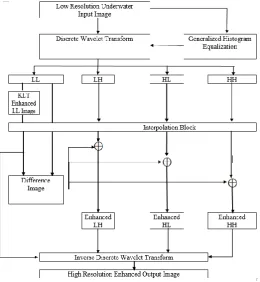
The underwater images commonly suffer due to light scattering and color change effect. These effects degrade the contrast and resolution of the underwater image. The proposed system works on these blurred images using certain image processing operations like Histogram Equalization, Discrete Wavelet Transform (DWT), KL Transform and Inverse Discrete Wavelet Transform (IDWT) to enhance its quality. Fig. 2 shows the flow diagram of proposed underwater image enhancement technique.
The proposed system consists of two significant parts. The first part is applying the DWT to the low resolution underwater image which is enhanced by using generalized histogram equalization and decomposing it into four subbands namely LL, HL, LH and HH. The LL subband corresponds to the low frequency contents which is also called as coarse details. The other three subbands i.e. LH, HL, HH represent the high frequency components such as veritical, horientaland diagonal edges. As these subbands contain different details, enhancement is done on all these components. The second part of the proposed work is applying the KL transform over the LL subband and preserving the details in turn reducing the random noise. The difference image is obtained by subtracting the KLT enhanced LL subband with the interpolated LL component obtained from DWT. For enhancement in other sub-bands, the high frequency subbandsi.e HL, LH, HH are upsampled by the factor of two using the bicubic interpolation technique. The original LH, HL, HH are interpolated with difference image obtained. The bicubic interpolation technique uses cubic convolution technique which gives more sharper images. Now all the components are enhanced and the high resolution image is obtained by applying the inverse discrete wavelet transformation on all of the enhanced subbands.
ISSN(Online): 2319-8753 ISSN (Print): 2347-6710
I
nternational
J
ournal of
I
nnovative
R
esearch in
S
cience,
E
ngineering and
T
echnology
(An ISO 3297: 2007 Certified Organization)
Website: www.ijirset.com
Vol. 6, Issue 6, June 2017
V. RESULTS
a) Qualitative Results
Original Test Image 1 Histogram Equalized Image
Discrete Wavelet Transform Image
KL Enhanced Image
High Resolution IDWT Image
Original Test Image 2 Histogram Equalized Image
Discrete Wavelet Transform Image
KL Enhanced Image
High Resolution IDWT Image
b) Quantitative Results
Following are the qualitative results of the test images.
Test Image - 1
Parameter MSE PSNR in dB
With DWT & KLT 1256.17 17.14
With GHE, DWT & KLT 1236.34 17.21
Test Image - 2
Parameter MSE PSNR in dB
With DWT & KLT 8516.36 8.82
With GHE, DWT & KLT 8479.05 8.85
VI.CONCLUSION
A new image enhancement technique that uses Generalized Histogram Equalization, Discrete wavelet transform and K-L transform is proposed for low resolution underwater images. From the results, it is cleared that the proposed system gives properly enhanced underwater image output. The quality of the image is up to the mark regarding contrast and resolution. The PSNR value of the image is higher than other methods like DWT-KLT, DWT-SVD and GHE. On comparing both qualitative and quantitatively results, we get better results with proposed algorithm.
REFERENCES
ISSN(Online): 2319-8753 ISSN (Print): 2347-6710
I
nternational
J
ournal of
I
nnovative
R
esearch in
S
cience,
E
ngineering and
T
echnology
(An ISO 3297: 2007 Certified Organization)
Website: www.ijirset.com
Vol. 6, Issue 6, June 2017
2. Aswathy Mohan, Mary Linda P A, “Image Enhancement Using DWT DCT and SVD”, Int. Journal of Engineering Research and Applications, ISSN : 2248-9622, Vol. 4, Issue 4( Version 1), April 2014, pp.36-40
3. Ali A. Yassin, Rana M. Ghadban, Salah F. Saleh1, Hikmat Z. Neima, ,“Using Discrete Wavelet Transformation To Enhance Underwater Image”, IJCSI International Journal of Computer Science Issues ISSN (Print): 1694-0814 | ISSN (Online): 1694-0784, Vol. 10, Issue 5, No 2, September 2013
4. Sengar, P.S.; Rawat, T.K.; Parthasarathy, H., "Colour image enhancement by scaling the discrete wavelet transform coefficients," Emerging Research Areas and 2013 International Conference on Microelectronics, Communications and Renewable Energy (AICERA/ICMiCR). 5. Yashu Rajput, Vishwashvar Singh Rajput, Anita Thakur, Garima Vyas, “Advanced Image Enhancement Based on Wavelet & Histogram
Equalization”,IOSR Journal of Electronics and Communication Engineering (IOSRJECE) ISSN : 2278-2834, Volume 2, Issue 6 (Sep-Oct 2012), PP 12-16.
6. Saurabh Rai, Anand Vardhan Bhalla, “An Efficient Image Denoising System”, International Journal of Advanced Research in Computer Science and Software Engineering, ISSN: 2277 128X, Volume 6, Issue 1, January 2016.
7. Aarti Namdeo, Anand Khare, “ Review of Wavelet Transform and KLT”, International Journal of Emerging Technologies in Engineering Research (IJETER), Volume 3, Issue 2, November (2015).
8. Pooja Sahu, Neelesh Gupta, Neetu Sharma, "A Survey on Underwater Image Enhancement Techniques", International Journal of Computer Applications, Vol. 87 - No. 13, February 2014.