Characterization of the Hyperrecombination Phenotype of the
pol3-t
Mutation
of
Saccharomyces cerevisiae
Alvaro Galli,* Tiziana Cervelli* and Robert H. Schiestl
†,1*Laboratory of Gene and Molecular Therapy, Institute of Clinical Physiology, CNR, 56124 Pisa, Italy and†Department of Pathology and Environmental Health, UCLA School of Medicine, Los Angeles, California 90095
Manuscript received June 12, 2002 Accepted for publication January 15, 2003
ABSTRACT
The DNA polymerase␦(Pol3p/Cdc2p) allelepol3-tofSaccharomyces cerevisiaehas previously been shown to increase the frequency of deletions between short repeats (several base pairs), between homeologous DNA sequences separated by long inverted repeats, and between distant short repeats, increasing the frequency of genomic deletions. We found that thepol3-tmutation increased intrachromosomal recombina-tion events between direct DNA repeats up to 36-fold and interchromosomal recombinarecombina-tion 14-fold. The hyperrecombination phenotype ofpol3-twas partially dependent on the Rad52p function but much more so on Rad1p. However, in the double-mutantrad1⌬rad52⌬, thepol3-tmutation still increased spontaneous intrachromosomal recombination frequencies, suggesting that a Rad1p Rad52p-independent single-strand annealing pathway is involved. UV and␥-rays were less potent inducers of recombination in thepol3-t mutant, indicating that Pol3p is partly involved in DNA-damage-induced recombination. In contrast, while UV- and␥-ray-induced intrachromosomal recombination was almost completely abolished in the rad52 or the rad1 rad52 mutant, there was still good induction in those mutants in the pol3-tbackground, indicating channeling of lesions into the above-mentioned Rad1p Rad52p-independent pathway. Finally, a heterozygouspol3-t/POL3mutant also showed an increased frequency of deletions and MMS sensitivity at the restrictive temperature, indicating that even a heterozygous polymerase␦mutation might increase the frequency of genetic instability.
R
ECOMBINATION between repeated DNA se- out on the mechanism of reversion of a duplication of a 400-bp internal fragment of theHIS3gene separated quences can occur in meiosis and in mitosis (Petesand Hill 1988; Klein 1995). Mitotic recombination by theLEU2gene (Schiestlet al.1988). Intrachromatid exchange occurs as reciprocal crossing over between between DNA repeats on the same chromosome, called
the direct repeats, which leaves a single copy of the gene intrachromosomal recombination, can lead to deletion
on the chromosome and on the excised DNA fragment of sequences located between the repeats, to gene
con-bearing the second copy of the gene. Schiestlet al. inves-version events that retain the duplication, or to
triplica-tigated the contribution of this mechanism to the fre-tions (Klein1995). Genome rearrangements associated
quency of such intrachromosomal recombination with recombination between homologous sequences
events by placing an origin of replication onto the inte-can cause genetic disease and inte-cancer and they increase
grated plasmid to recover both reciprocal products of in frequency by exposure to cancer-causing chemicals
an intrachromatid crossing-over event (Schiestl et al. (BishopandSchiestl2000,2001). It is thus important
1988). They found that only a minority of events (ⵑ1%) to identify the genetic and environmental factors
lead-could be explained by this mechanism. With a different ing to an increased frequency of such rearrangements,
system that forced amplification of the excised circle, as well as to study the interaction between these factors.
Santos-Rosa andAguilera(1994) found that⬍10% Homologous intrachromosomal recombination events
of the deletion events produced circles. These results between duplicated sequences resulting in deletions
indicate that the majority of deletion events do not may occur by several different mechanisms, such as
in-happen by intrachromatid crossing over, but rather by trachromatid exchange, single-strand annealing (SSA),
a nonconservative mechanism. SSA is initiated by a DNA one-sided invasion, unequal sister chromatid exchange,
double-strand break (DSB) in the nonhomologous re-or sister chromatid conversion (Schiestl et al. 1988;
gion between the repeats. DNA degradation of single Haber1992;BelmaazaandChartrand1994; Galli
strands from the exposed 5⬘ends of the DSB leads to and Schiestl 1995). Studies were previously carried
single-strand regions that can anneal once the degrada-tion has proceeded to the repeated sequences. The 3⬘ tails are processed and nicks are ligated, giving rise to
1Corresponding author:UCLA Schools of Medicine and Public Health
a deletion. Another mechanism yielding deletion events
71-295 CHS, 650 Charles E. Young Dr. S., Los Angeles, CA 90095.
E-mail: [email protected] is one-sided invasion, which is initiated by a DSB in one
of the duplicated homologous sequences followed by inverted repeats (Gordeninet al.1992). The molecular analysis of the recombinants of the excision events of 5⬘–3⬘degradation (BelmaazaandChartrand1994).
Invasion of the 3⬘ single strand occurs in the homolo- the transposon indicates that DNA replication slippage most likely is responsible for these deletion events gous region, leading to D-loop formation and to DNA
synthesis. Resolution occurs by continuation of 5⬘degra- (Tran et al. 1995; Gordenin and Resnick 1998). In agreement with this model, it has been shown thatpol3 dation, single-strand nick formation, and DNA repair
synthesis. mutations increase the frequency of additions and/or
deletions of units of microsatellites (defined as repeat Intrachromosomal recombination leading to
dele-tions can also be explained by recombination between units from 1 to 13 bp) as well as minisatellites (⬎15 bp; Tran et al. 1995, 1996, 1999; Kokoska et al. 1998). sister chromatids as unequal sister chromatid exchange
(SCEs) or sister chromatid conversion. Unequal SCEs Furthermore, the frequency of deletions between dis-tant short repeats within the LYS2or the CAN1genes give rise to a duplication of the disrupting sequence
(Schiestlet al.1988;GalliandSchiestl1995). The is also increased many fold (Tranet al.1995;Kokoska
et al. 2000). Finally, it has been shown that the same contribution of SCE events was determined by assaying
for reciprocal products (Schiestl et al. 1988). Only mutator phenotype as observed in the pol3 mutations exists after repression of thePOL3gene, indicating that ⵑ4% of the recombination events gave such a
triplica-tion. This suggests that the majority of events are not the mutator phenotype may be due to low levels of Pol3p rather than to any other faulty effect of the Pol3p due to unequal SCEs.
Intrachromatid exchange, SSA, and one-sided inva- mutant proteins.
Here we report the effect of the temperature-sensitive sion can take place in any phase of the cell cycle,
includ-ing G1. SCE and sister chromatid conversion events, allele pol3-t on intrachromosomal deletion and inter-chromosomal recombination, reverse and forward mu-on the other hand, require the presence of the sister
chromatid and thus they can occur in the S-phase or tation. Moreover, we studied the influence of Rad1p and Rad52p in thepol3-tbackground to characterize the in G2but not in G1. Intrachromosomal deletion
recombi-nation events are induced by a site-specific DSB in G1 genetic control of intrachromosomal recombination. Finally, to better understand the role of DNA polymer-and G2to the same extent. Moreover, DNA single-strand
breaks induce intrachromosomal deletion events in di- ase␦on DNA-damage-induced recombination, we also studied the effects of Rad1p and Rad52p on UV-,␥-ray-, viding but not in cell-cycle-arrested cells (Galli and
Schiestl1998b). This suggests that DNA DSBs are in- and methyl methanesulfonate (MMS)-induced intra-chromosomal deletion recombination in thepol3-t back-volved and that SSA is the main mechanism by which
intrachromosomal deletion events occur (Galli and ground. Schiestl 1998b). Mutations in RAD1, RAD10, and
RAD52are involved in these intrachromosomal deletion
MATERIALS AND METHODS events (SchiestlandPrakash1988,1990) and Rad1p
has been shown on a molecular level to catalyze the Media, genetic, and molecular techniques:Complete media excision of the nonhomologous DNA between the re- (YPAD), synthetic complete (SC), and drop-out (SD) media were prepared according to standard procedures (Kaiseret combining duplicated alleles needed for the SSA
path-al.1994). Magic Column (Promega, Madison, WI) was used way (Fishman-Lobell and Haber 1992; Ivanov and
for preparation of small-scale DNA. Other general molecular Haber1995).
techniques were carried out according to Maniatis et al. Several mutants with elevated spontaneous intrachro- (1989). Yeast transformation was performed using the proce-mosomal recombination frequencies have been isolated dure described inGietzet al.(1992, 1995).
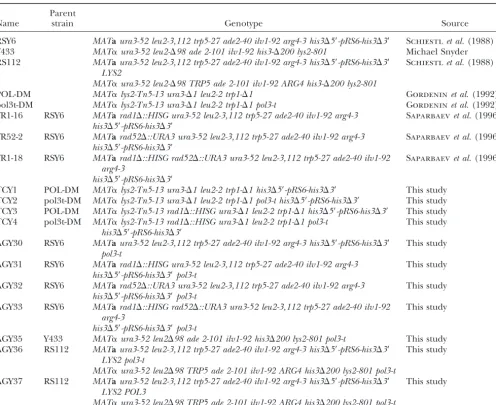
Yeast strains:The names and genotypes of the strains ofS. in Saccharomyces cerevisiae (Aguilera and Klein 1988;
cerevisiaeused are listed in Table 1. Because pol3-tconfers a Klein 1995). Among them, an allele of CDC2/POL3,
temperature-sensitive phenotype, allpol3-tstrains were grown which encodes the catalytic subunit of the DNA
polymer-at 25⬚(Gordeninet al.1992). Strains TCY1 and TCY2 were ase␦, increases deletion events but not gene conversions constructed by transformation of strains POL-DM and pol3-(AguileraandKlein1988). Pol␦p, together with Pol␣p t-DM with plasmid pRS6, which contains an internal fragment ofhis3and aLEU2marker (Schiestlet al.1988). This gener-and Polεp, is an essential function gener-and required for
ates duplication within theHIS3gene, resulting in two incom-DNA replication. Pol␣p has a primase activity and is
pletehis3alleles (see below). involved in initiation of both the leading- and the
lag-Strains TCY3 and TCY4, carrying a deletion from position ging-strand syntheses (BrooksandDumas1989). Both ⫹40 to ⫹3211 ofRAD1, were constructed by two-step gene Pol␦p and Polεp can extend the primers formed by replacement using theEcoRI-SalI fragment of plasmid pR1.6 (kindly provided by Louise Prakash; Saparbaevet al.1996) Pol␣p (Burgers1991;PodustandHubscher 1993).
and subsequent 5-fluoroorotic acid (5-FOA) selection (Boeke
Thepol3-tmutant allele, initially isolated astex1
mu-et al.1984). Strains AGY30, AGY31, AGY34, and AGY35 were tant because it increased the rate of excision of a
mined as follows: single colonies of RSY6 (ARG4) and AGY30 containing thepol3-tallele (Kokoskaet al.1998). The cells
were transformed withHpaI-linearized p171. Temperature- (ARG4) were inoculated in 5 ml YPAD and incubated for 17 hr at 25⬚ or 30⬚. Then cells were washed and counted and sensitive Ura⫹colonies that contained the full-lengthpol3-t
allele and a truncatedPOL3allele flanking theURA3 gene appropriate numbers were plated onto SC and SC-ARG⫹ CAN (60 mg/liter) to score for the surviving fraction and were isolated. Ura⫺temperature-sensitive strains carrying just
thepol3-tallele were selected after selection on medium con- mutants. Plates were incubated at 25⬚until colonies formed.
Determination of the effect of cell division on the
recombi-taining 5-FOA (Kokoska et al. 1998). Strains AGY32 and
AGY33 carrying the rad52-9 deletion (henceforth called nation phenotype in thepol3-tmutant:We tested the effect of rad52⌬) were constructed by digestion of plasmid pSM22 cell division on the recombination phenotype ofpol3-tafter (from David Schield and R. Mortimer via Louise Prakash) growth at 25⬚ and 30⬚. Single colonies of AGY30 and RSY6 withBamHI and transformation of yeast cells with theBamHI were grown in SC-LEU at 25⬚ for 20 hr. Cells were washed fragment in which theBglII-ClaI fragment in the open reading and inoculated for 5 hr in SC-URA to achieve cell-cycle arrest at frame of theRAD52gene had been replaced by aBamHI-ClaI G0/G1since they carry theura3-52allele (GalliandSchiestl fragment containing theURA3gene (SchiestlandPrakash 1995). Cell-cycle arrest was checked by counting unbudded 1990). cells under the microscope as previously described (Galli
Diploid strains AGY36 and AGY37, isogenic to RS112, were andSchiestl1995). A total of 250–300 cells were counted constructed by mating AGY30 with AGY35 and RSY6 with per tube and 96.1⫾0.7% were unbudded. Thereafter, cell AGY35, respectively. cultures were divided into two aliquots; one aliquot was kept
Recombination assays: All strains used carry the same in- in SC-URA medium at 25⬚and the other one was incubated
trachromosomal recombination substrate as strain RSY6 at 30⬚for 24 hr. Intrachromosomal recombination was mea-(Schiestlet al.1988). This substrate consists of twohis3al- sured at the 0 time point and after 24 hr of incubation. leles, one with a deletion at the 3⬘end and the other with a Data comparison and statistical evaluation:The data were deletion at the 5⬘end, which share 400 bp of homology. These compared either as fold induction compared to the control two alleles are separated by the LEU2 marker and by the or as “change in average frequency,” which indicates the num-plasmid DNA sequence. An intrachromosomal recombination ber of recombination events after exposure to a certain dose event leads toHIS3reversion and loss ofLEU2(Schiestlet of a genotoxin after subtraction of the spontaneous frequency al.1988). These two copies readily undergo intrachromosomal (Kadyk and Hartwell 1992, 1993; Galli and Schiestl recombination, resulting in wild-typeHIS3 at a frequency of 1998a;Paulovichet al.1998). Results were statistically
ana-ⵑ10⫺4(Schiestlet al.1988). Diploid strains RS112 and AGY36
lyzed using the Student’st-test. are also heteroallelic forade2-40andade2-101. An
interchro-mosomal gene-conversion event producesADE2reversions.
To determine the frequency of spontaneous intrachromoso- RESULTS mal recombination, single colonies were inoculated into 5 ml
of SC-LEU and incubated at 25⬚or 30⬚for 17 hr. Thereafter, Effect of pol3-t on spontaneous mitotic
recombina-cultures were washed twice and counted and appropriate num- tion:To investigate effects ofpol3-ton mitotic recombi-bers were plated onto SC and SC-HIS plates to determine nation we constructed the haploid strains TCY1, TCY2, the surviving fraction and the frequency of intrachromosomal
and AGY30 and the diploid strain AGY36 (Table 1). All recombination, respectively. Single colonies of the diploid
these strains contain an intrachromosomal recombina-strains RS112 and AGY36 were incubated as above and in
addition plated onto SC-ADE plates to determine the fre- tion substrate that resulted from integration of plasmid quency of interchromosomal gene conversion. Plates were pRS6 at theHIS3locus (seematerials and methods; incubated at 25⬚for 4 days and colonies were counted
thereaf-Schiestlet al.1988). Intrachromosomal recombination ter. AllHIS3 andADE2 recombinants were checked for the
between the two his3 alleles, which share 400 bp of presence of thepol3-tallele by replica plating and incubation
homology, leads to HIS3 reversion and loss of LEU2
at 37⬚.
Intrachromosomal recombination was also measured fol- (Schiestlet al. 1988). The diploid strains RS112 and lowing UV,␥-rays, and MMS exposure. For UV exposure, sin- AGY36 are heteroallelic forade2and can also be used gle colonies were inoculated into SC-LEU at 25⬚ for 17 hr.
to measure interchromosomal recombination events Thereafter, cells were washed and resuspended in fresh
SC-(Table 1). Thepol3-tmutation confers a temperature-LEU for 4 hr at 30⬚. Aliquots of 10 ml containing 3 ⫻ 107
cells/ml were irradiated in distilled water using a UV source sensitive phenotype and growth arrest at 37⬚; thus, we at the dose rate of 3.5 erg/m2/sec. The same number of cells
studied effects ofpol3-tmutation on mitotic recombina-were exposed to␥-rays using a60Co␥-ray source at 9.1 cGy/
tion after growth at 25⬚and 30⬚(Gordeninet al.1992). sec (GalliandSchiestl1995,1998b). Following irradiation,
Single colonies of TCY1, TCY2, RSY6, AGY30, RS112, cells were plated as described above. For MMS exposure, single
and AGY36 were incubated in SC-LEU for 17 hr at 25⬚ colonies were inoculated into SC-LEU at 25⬚for 17 hr.
There-after, cells were washed, resuspended in 5 ml of fresh SC-LEU and 30⬚. During this incubation period, TCY1, RSY6, at the concentration of 3⫻106cells/ml, and exposed to MMS
and RS112 underwent four to five cell divisions at both for 4 hr at 30⬚. Then cells were washed, counted, and plated
temperatures. TCY2, AGY30, and AGY36 underwent as described.
three to four cell divisions at 25⬚and two to four cell
Reverse and forward mutation assay:To measure the
spon-divisions at 30⬚. Appropriate aliquots were plated and taneous frequency of reverse mutations atilv1-92andarg4-3,
single colonies of RSY6 and AGY30 were inoculated into 5 ml incubated.HIS3 leu2colonies revealed deletion recom-YPAD and incubated for 17 hr at 25⬚or 30⬚. Then cells were bination frequencies. At 25⬚,pol3-tincreased intrachro-washed and counted and appropriate numbers were plated
mosomal recombination 8-fold in the diploid strain onto SC, SC-ILV, and SC-ARG to score for the surviving
frac-AGY36, 15- and 4-fold, respectively, in the haploid tion and mutants. Plates were incubated at 25⬚until colonies
TABLE 1
S. cerevisiaestrains
Parent
Name strain Genotype Source
RSY6 MATaura3-52 leu2-3,112 trp5-27 ade2-40 ilv1-92 arg4-3 his3⌬5⬘-pRS6-his3⌬3⬘ Schiestlet al.(1988) Y433 MAT␣ura3-52 leu2-⌬98 ade 2-101 ilv1-92 his3-⌬200 lys2-801 Michael Snyder RS112 MATaura3-52 leu2-3,112 trp5-27 ade2-40 ilv1-92 arg4-3 his3⌬5⬘-pRS6-his3⌬3⬘ Schiestlet al.(1988)
LYS2
MAT␣ura3-52 leu2-⌬98 TRP5 ade 2-101 ilv1-92 ARG4 his3-⌬200 lys2-801
POL-DM MAT␣lys2-Tn5-13 ura3-⌬1 leu2-2 trp1-⌬1 Gordeninet al.(1992) pol3t-DM MAT␣lys2-Tn5-13 ura3-⌬1 leu2-2 trp1-⌬1 pol3-t Gordeninet al.(1992) YR1-16 RSY6 MATarad1⌬::HISG ura3-52 leu2-3,112 trp5-27 ade2-40 ilv1-92 arg4-3 Saparbaevet al.(1996)
his3⌬5⬘-pRS6-his3⌬3⬘
YR52-2 RSY6 MATarad52⌬::URA3 ura3-52 leu2-3,112 trp5-27 ade2-40 ilv1-92 arg4-3 Saparbaevet al.(1996) his3⌬5⬘-pRS6-his3⌬3⬘
YR1-18 RSY6 MATarad1⌬::HISG rad52⌬::URA3 ura3-52 leu2-3,112 trp5-27 ade2-40 ilv1-92 Saparbaevet al.(1996) arg4-3
his3⌬5⬘-pRS6-his3⌬3⬘
TCY1 POL-DM MAT␣lys2-Tn5-13 ura3-⌬1 leu2-2 trp1-⌬1 his3⌬5⬘-pRS6-his3⌬3⬘ This study TCY2 pol3t-DM MAT␣lys2-Tn5-13 ura3-⌬1 leu2-2 trp1-⌬1 pol3-t his3⌬5⬘-pRS6-his3⌬3⬘ This study TCY3 POL-DM MAT␣lys2-Tn5-13 rad1⌬::HISG ura3-⌬1 leu2-2 trp1-⌬1 his3⌬5⬘-pRS6-his3⌬3⬘ This study TCY4 pol3t-DM MAT␣lys2-Tn5-13 rad1⌬::HISG ura3-⌬1 leu2-2 trp1-⌬1 pol3-t This study
his3⌬5⬘-pRS6-his3⌬3⬘
AGY30 RSY6 MATaura3-52 leu2-3,112 trp5-27 ade2-40 ilv1-92 arg4-3 his3⌬5⬘-pRS6-his3⌬3⬘ This study pol3-t
AGY31 RSY6 MATarad1⌬::HISG ura3-52 leu2-3,112 trp5-27 ade2-40 ilv1-92 arg4-3 This study his3⌬5⬘-pRS6-his3⌬3⬘pol3-t
AGY32 RSY6 MATarad52⌬::URA3 ura3-52 leu2-3,112 trp5-27 ade2-40 ilv1-92 arg4-3 This study his3⌬5⬘-pRS6-his3⌬3⬘pol3-t
AGY33 RSY6 MATarad1⌬::HISG rad52⌬::URA3 ura3-52 leu2-3,112 trp5-27 ade2-40 ilv1-92 This study arg4-3
his3⌬5⬘-pRS6-his3⌬3⬘pol3-t
AGY35 Y433 MAT␣ura3-52 leu2⌬98 ade 2-101 ilv1-92 his3⌬200 lys2-801 pol3-t This study AGY36 RS112 MATaura3-52 leu2-3,112 trp5-27 ade2-40 ilv1-92 arg4-3 his3⌬5⬘-pRS6-his3⌬3⬘ This study
LYS2 pol3-t
MAT␣ura3-52 leu2⌬98 TRP5 ade 2-101 ilv1-92 ARG4 his3⌬200 lys2-801 pol3-t
AGY37 RS112 MATaura3-52 leu2-3,112 trp5-27 ade2-40 ilv1-92 arg4-3 his3⌬5⬘-pRS6-his3⌬3⬘ This study LYS2 POL3
MAT␣ura3-52 leu2⌬98 TRP5 ade 2-101 ilv1-92 ARG4 his3⌬200 lys2-801 pol3-t
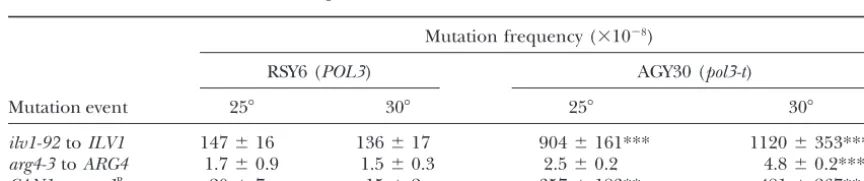
22-fold in AGY30, and 18-fold in TCY2 (Table 2). The vertants, whereas it caused a small but significant 3-fold increase in reversion frequency at 30⬚ (Table 3). The pol3-t mutation did not significantly increase the
fre-quency of interchromosomal recombination at 25⬚ in frequency of forward mutation, determined as fre-quency of canavanine-resistant (can1R) mutants, in-the diploid strain AGY36, whereas it caused a significant
14-fold increase at 30⬚. creased 18-fold at 25⬚ and 32-fold at 30⬚ in the pol3-t strain (Table 3). Thus, pol3-t, like other pol3 mutants,
Effect of thepol3-tmutation on spontaneous mutation
frequencies: Another temperature-sensitive mutant of causes both hyperrecombination and mutator
pheno-types. DNA polymerase ␦ geneCDC2, namedhpr6, has been
shown to have both hyperrecombination and mutator Sincepol3-thad a more pronounced effect on intra-chromosomal recombination than on interchromo-phenotypes (Aguilera andKlein1988). In addition,
it has been shown that other pol3 alleles increase the somal recombination, we decided to further focus our study on intrachromosomal recombination.
mutation frequency at different loci (Morrison and
Sugino 1994; Giot et al. 1997; Kokoska et al. 2000). Dependence of thepol3-thyperrecombination
pheno-type on DNA replication: In yeast, mRNA transcript
Therefore, we tested the effects ofpol3-ton spontaneous
mutation frequencies in our strain backgrounds. As levels of CDC2/POL3 increase at the boundary of the G1/S phase of the cell cycle (Wang1991) and return shown in Table 3, the frequency ofILV1 reverse
muta-tion increased in AGY30 6-fold at 25⬚and 8-fold at 30⬚. to a low level during or after the S-phase (Campbell andNewlon1991).
re-Effect ofpol3-ton spontaneous intrachromosomal and interchromosomal recombination frequencies
Intrachromosomal recombination Interchromosomal recombination (⫻10⫺4) (⫻10⫺5)
Strain Genotype 25⬚ 30⬚ 25⬚ 30⬚
RS112 POL3 0.74⫾0.1 0.86⫾0.09 0.78⫾0.48 0.34⫾0.24 AGY36 pol3-t 6.2⫾1.5** 31⫾0.41*** 1.1⫾0.21 4.7⫾0.83*** RSY6 POL3 2.1⫾1.4 3.5⫾0.87
AGY30 pol3-t 32⫾16** 76⫾14*** TCY1 POL3 2.5⫾0.5 2.4⫾0.99
TCY2 pol3-t 11⫾6.0* 42⫾15**
Results are reported as the mean of five or more experiments⫾standard deviation. Strain RS112 is isogenic with AGY36, RSY6 with AGY30, and TCY1 with TCY2. The probabilities refer to the comparison between the POL3strain and thepol3-tmutant. *P⬍0.05, **P⬍0.01, ***P⬍0.001.
pol3-tstrains showed a pronounced hyperrecombina- Effect of mutations in rad1and rad52 on the pol3-t
hyperrecombination phenotype: The excision repair
tion phenotype following growth at the semipermissive
temperature of 30⬚. We tested the effect of cell division geneRAD1is involved in intrachromosomal recombina-tion (Klein 1988; Schiestl and Prakash 1988) and on the hyperrecombination phenotype of pol3-t after
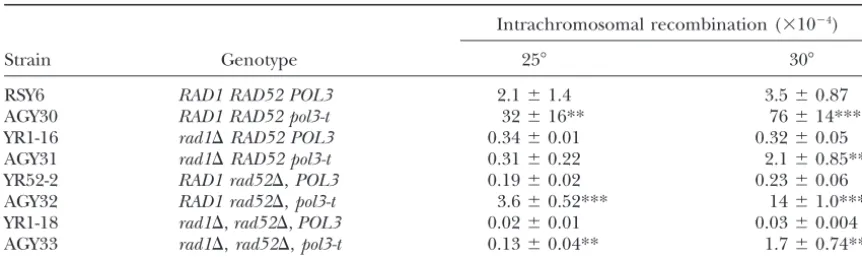
growth at 25⬚and 30⬚(seematerials and methods). affects DNA DSB-induced recombination (Ivanovand Haber1995). To study the effect ofRAD1on thepol3-t Intrachromosomal recombination was measured at the
0 time point and after 24 hr of incubation. At time 0, hyperrecombination phenotype, we constructed strain AGY31 containing thepol3-tmutation and therad1 dele-the frequency of intrachromosomal recombination was
2.34⫾0.79⫻10⫺4in thePOL3strain and 24.5⫾6.6⫻ tion. Single colonies of AGY30 and YR1-16 were incu-bated at 25⬚or 30⬚. Cells were counted and plated as 10⫺4in thepol3-tstrain. After 24 hr at 25⬚in G0/G1, the
frequency was 2.3⫾0.85⫻10⫺4in thePOL3strain and described. In strain YR1-16 POL3 wild type, the rad1 deletion decreased intrachromosomal recombination 16.51⫾8.27⫻10⫺4in thepol3-tstrain, and after 24 hr
in G0/G1 at 30⬚, the frequency of intrachromosomal frequencies 6- to 11-fold (Table 4). In strain AGY31 rad1⌬, thepol3-tmutation did not significantly increase recombination was 1.79 ⫾ 0.77 ⫻ 10⫺4 in the POL3
strain and 21.69⫾2.8⫻10⫺4in thepol3-tstrain. Thus, intrachromosomal recombination at 25⬚, while at 30⬚ intrachromosomal recombination increased 6.5-fold intrachromosomal recombination frequencies did not
change after 24 hr of postincubation at 30⬚as compared (Table 4). Thus, therad1mutation decreased the pol3-t-mediated hyperrecombination phenotype 100-fold at to 25⬚in the absence of cell divisions. In contrast,
recom-bination frequencies ofpol3-tcells grown in parallel at 25⬚ and 36-fold at 30⬚. Similar results were obtained with TCY1, TCY2, TCY3, and TCY4, another set of wild-30⬚for the same amount of time were at least 2.5-fold
higher than those at 25⬚, similar to the data in Table 2. type,pol3-t,rad1, andrad1 pol3-tstrains (data not shown). Thus, thepol3-thyperrecombination phenotype in most Thus, DNA replication is most likely required for the
development of thepol3-thyperrecombination pheno- part is dependent on Rad1p.
Intrachromosomal recombination is also dependent type.
TABLE 3
Effect ofpol3-ton reverse and forward mutation
Mutation frequency (⫻10⫺8)
RSY6 (POL3) AGY30 (pol3-t)
Mutation event 25⬚ 30⬚ 25⬚ 30⬚
ilv1-92toILV1 147⫾16 136⫾17 904⫾161*** 1120⫾353***
arg4-3toARG4 1.7⫾0.9 1.5⫾0.3 2.5⫾0.2 4.8⫾0.2***
CAN1tocan1R 20⫾7 15⫾2 357⫾183** 481⫾267**
TABLE 4
Effect ofRAD1andRAD52on the hyperrecombination phenotype ofpol3-t
Intrachromosomal recombination (⫻10⫺4)
Strain Genotype 25⬚ 30⬚
RSY6 RAD1 RAD52 POL3 2.1⫾1.4 3.5⫾0.87
AGY30 RAD1 RAD52 pol3-t 32⫾16** 76⫾14***
YR1-16 rad1⌬RAD52 POL3 0.34⫾0.01 0.32⫾0.05
AGY31 rad1⌬RAD52 pol3-t 0.31⫾0.22 2.1⫾0.85***
YR52-2 RAD1 rad52⌬,POL3 0.19⫾0.02 0.23⫾0.06 AGY32 RAD1 rad52⌬,pol3-t 3.6⫾0.52*** 14⫾1.0*** YR1-18 rad1⌬,rad52⌬,POL3 0.02⫾0.01 0.03⫾0.004 AGY33 rad1⌬,rad52⌬,pol3-t 0.13⫾0.04** 1.7⫾0.74**
Results are reported as the mean of five or more independent experiments⫾standard deviation. All strains are isogenic. The probabilities refer to the comparison between thePOL3strain and thepol3-tmutant in the different backgrounds. *P⬍0.05, **P⬍0.01, ***P⬍0.001.
on theRAD52 gene function (SchiestlandPrakash first at 25⬚and then for 4 hr at 30⬚and irradiated with UV and␥-rays or exposed to MMS as described in mate-1988;Klein1995;Ivanovet al.1996). The deletion of
rad52in thePOL3strain decreased the intrachromoso- rials and methods.
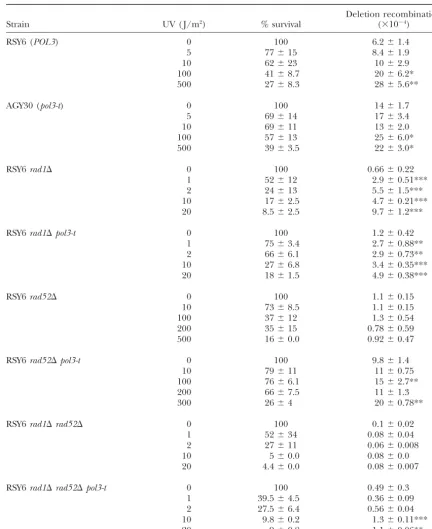
UV irradiation induced a significant increase in in-mal recombination frequency 11- to 15-fold (Table 4).
In the rad52⌬ pol3-t strain AGY32, intrachromosomal trachromosomal recombination at doses of 100 and 500 J/m2in both the wild-type (RSY6) and thepol3-t(AGY30) recombination frequencies are 11- and 60-fold higher
than those in therad52 POL3strain YR52-2 at 25⬚and strains (Table 5). At 500 J/m2, intrachromosomal re-combination increased 4.5-fold (P ⬍ 0.01) in the wild 30⬚ (Table 4). Compared to AGY30, the RAD52
wild-type pol3-t strain, the rad52⌬ mutation decreased the type and 1.6-fold (P⬍0.05) in thepol3-tstrain (Table 5). Since the spontaneous frequency differs greatly between intrachromosomal recombination frequency 9- and 5-fold
at 25⬚and 30⬚(Table 4). Thus, thepol3-thyperrecombi- the two strains, it seems justified to also base the compar-ison on the average number of additional recombinants nation phenotype is partially dependent on Rad52p. In
summary, the dependence of thepol3-thyperrecombina- due to the radiation effect. At 500 J/m2, there was an average of 22 added events in the wild type compared tion phenotype on Rad1p is much greater than that on
Rad52p. to an average of 8 added events in thepol3-tstrain. This
indicates that the pol3-tstrain shows a mild deficiency The simultaneous deletion of the rad1 and rad52
genes led to a synergistic decrease in intrachromosomal in UV-induced intrachromosomal recombination. The pol3-t mutation did not lower the survival after recombination⬎100-fold in the YR1-18POL3strain
(Ta-ble 4), which has been seen before (SchiestlandPra- UV exposure of the RAD wild type and the rad1⌬, rad52⌬, and rad1⌬ rad52⌬ strains, suggesting that in kash1988). In the AGY33 strain, which israd1⌬rad52⌬
pol3-t, intrachromosomal recombination frequencies these mutants UV-induced DNA-damage repair in the pol3-t mutant is as efficient as in the wild type (Table are 6.5- and 57-fold higher than those in YR1-18 at 25⬚
and 30⬚ (Table 4). Thus, the rad1mutation, together 5). If anything, thepol3-tmutant by itself, as well as in any of the double- and triple-mutant combinations, is with therad52mutation, decreases thepol3-t-mediated
hyperrecombination phenotype 246-fold and 45-fold at slightly more UV resistant compared to thePOL3 geno-type. Therad1mutant shows a dose-dependent, signifi-25⬚and 30⬚ (Table 4). However, this is due mostly to
therad1mutations since therad1⌬rad52⌬pol3-tmutant cant UV induction of intrachromosomal recombination starting at doses as low as 1 J/m2, regardless of thePOL3 showed a frequency similar to that of therad1⌬ pol3-t
mutant. In summary, thepol3-tmutation still elevates the genotype. This dose is 100-fold lower than the dose resulting in significant induction in theRADwild type. recombination frequency in therad1⌬rad52⌬mutant
background. The pol3-tmutant still shows some minor defect in
in-duced recombination since the dose of 20 J/m2resulted
Effect ofpol3-ton UV-induced intrachromosomal
re-combination:Some alleles ofPOL3are deficient in DNA- in an average of 9 added recombination events in the
rad1mutant vs. an average of 3.7 added events in the damage-induced mutagenesis and interchromosomal
recombination (Giotet al.1997). Thus, we determined rad1 pol3-tmutant (Table 5).
The rad52mutant as well as the rad1 rad52 mutant the effects ofpol3-ton intrachromosomal recombination
induced by UV, ␥-rays, and MMS and the effects of were both completely defective in UV-induced intra-chromosomal recombination. Both theRAD1 and the mutationsrad1andrad52and of the double mutation
Effect ofpol3-ton UV-induced intrachromosomal recombination inRADⴙ,rad1⌬,rad52⌬, andrad1⌬rad52⌬strains
Deletion recombination
Strain UV ( J/m2) % survival (⫻10⫺4)
RSY6 (POL3) 0 100 6.2⫾1.4
5 77⫾15 8.4⫾1.9
10 62⫾23 10⫾2.9
100 41⫾8.7 20⫾6.2*
500 27⫾8.3 28⫾5.6**
AGY30 (pol3-t) 0 100 14⫾1.7
5 69⫾14 17⫾3.4
10 69⫾11 13⫾2.0
100 57⫾13 25⫾6.0*
500 39⫾3.5 22⫾3.0*
RSY6rad1⌬ 0 100 0.66⫾0.22
1 52⫾12 2.9⫾0.51***
2 24⫾13 5.5⫾1.5***
10 17⫾2.5 4.7⫾0.21***
20 8.5⫾2.5 9.7⫾1.2***
RSY6rad1⌬pol3-t 0 100 1.2⫾0.42
1 75⫾3.4 2.7⫾0.88**
2 66⫾6.1 2.9⫾0.73**
10 27⫾6.8 3.4⫾0.35***
20 18⫾1.5 4.9⫾0.38***
RSY6rad52⌬ 0 100 1.1⫾0.15
10 73⫾8.5 1.1⫾0.15
100 37⫾12 1.3⫾0.54
200 35⫾15 0.78⫾0.59
500 16⫾0.0 0.92⫾0.47
RSY6rad52⌬pol3-t 0 100 9.8⫾1.4
10 79⫾11 11⫾0.75
100 76⫾6.1 15⫾2.7**
200 66⫾7.5 11⫾1.3
300 26⫾4 20⫾0.78**
RSY6rad1⌬rad52⌬ 0 100 0.1⫾0.02
1 52⫾34 0.08⫾0.04
2 27⫾11 0.06⫾0.008
10 5⫾0.0 0.08⫾0.0
20 4.4⫾0.0 0.08⫾0.007
RSY6rad1⌬rad52⌬pol3-t 0 100 0.49⫾0.3
1 39.5⫾4.5 0.36⫾0.09
2 27.5⫾6.4 0.56⫾0.04
10 9.8⫾0.2 1.3⫾0.11***
20 9⫾0.8 1.1⫾0.06**
Results are reported as the mean of five or more independent experiments⫾standard deviation. All strains are isogenic. The probabilities refer to the comparison between the exposure and the untreated control. *P⬍ 0.05, **P⬍0.01, ***P⬍0.001.
crease in spontaneous recombination, as previously pol3-tmutation resulted in a UV-induced recombination increase of about twofold.
found (SchiestlandPrakash1988). The present
re-sults indicate that only the Rad52p, but not the Rad1p, Effect of pol3-t on ␥-ray-induced intrachromosomal
recombination: Irradiation with␥-rays induced
signifi-pathway is involved in UV-induced recombination. In
TABLE 6
Effect ofpol3-ton␥-ray-induced intrachromosomal recombination inRADⴙ,rad1⌬,rad52⌬, andrad1⌬rad52⌬strains
Deletion recombination
Strain ␥-Rays (Gy) % survival (⫻10⫺4)
RSY6 (POL3) 0 100 2.4⫾0.1
50 65⫾25 6.2⫾0.9**
500 29⫾4.6 18⫾2.3***
1000 5⫾2.4 39⫾7.1***
AGY30 (pol3-t) 0 100 8.3⫾0.5
50 60⫾11 12⫾1.5*
500 14⫾2.5 23⫾6.5*
1000 3.8⫾2.3 31⫾9.7*
RSY6rad1⌬ 0 100 0.5⫾0.05
50 64⫾17 1.1⫾0.51*
500 7.9⫾2.5 2.2⫾0.17***
1000 0.2⫾0.004 16⫾3.6***
RSY6rad1⌬pol3-t 0 100 0.66⫾0.07
50 64⫾6.3 0.89⫾0.19*
500 14⫾2.5 3.49⫾1.26**
1000 3.8⫾2.3 6.9⫾0.7***
RSY6rad52⌬ 0 100 0.14⫾0.02
1 43⫾4.5 0.18⫾0.03
10 19⫾1.2 0.2⫾0.07
50 7.3⫾4 0.35⫾0.1**
RSY6rad52⌬pol3-t 0 100 0.99⫾0.41
1 51⫾8.2 1.4⫾0.19
10 32⫾3.8 2.0⫾0.26**
50 13⫾4.6 3.3⫾1.02**
RSY6rad1⌬rad52⌬ 0 100 0.014⫾0.003
1 57⫾16 0.014⫾0.004
10 36⫾10 0.015⫾0.003
50 10⫾5.7 0.036⫾0.017
RSY6rad1⌬rad52⌬pol3-t 0 100 0.10⫾0.03
1 51⫾11 0.14⫾0.04
10 31⫾9 0.21⫾0.07*
50 11⫾4.4 0.42⫾0.05***
See legend for Table 5.
all doses used in both wild-type andpol3-tstrains (Table tion in both backgrounds, in the pol3-t mutant there was significant induction at higher doses. In therad52⌬ 6). At 1000 Gy, intrachromosomal recombination
in-creased 16-fold (P⬍0.001) in the wild type and 3.7-fold pol3-tmutant, there was an average of 2.3 added events at a dose of 50 Gyvs.an average of 0.2 added events in (P⬍0.05) in thepol3-tmutant (Table 6). At that dose
there was an average of 37 added events in the wild type therad52mutant. Similarly, in therad1⌬rad52⌬pol3-t mutant at the same dose, there was an average of 0.32 and an average of 23 added events in thepol3-tmutant,
which is somewhat less in the mutant but rather similar. added events vs. an average of 0.022 added events in therad1⌬rad52⌬strain.
In therad1⌬strain,␥-ray exposure elevated
recombi-nation frequencies in a dose-dependent manner with- Effect of pol3-t on MMS-induced intrachromosomal
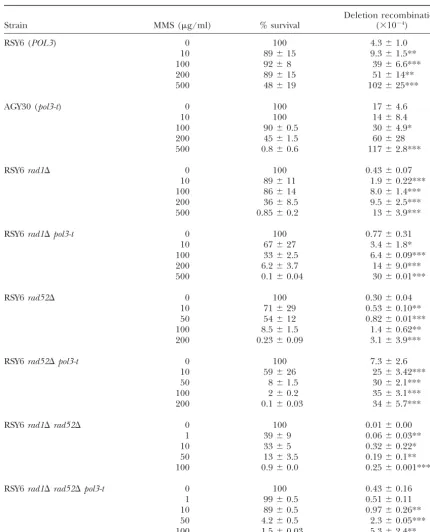
recombination:At higher doses of MMS thepol3-t
muta-out any effect ofpol3-t, while exposure resulted in a very
moderate increase only at the highest dose in therad52⌬ tion in the RAD wild type, the rad1⌬, and, to a lesser extent, therad52⌬backgrounds were much more sensi-and no significant induction in therad1⌬rad52⌬strain
Effect ofpol3-ton MMS-induced intrachromosomal recombination inRADⴙ,rad1⌬,rad52⌬, andrad1⌬rad52⌬strains
Deletion recombination
Strain MMS (g/ml) % survival (⫻10⫺4)
RSY6 (POL3) 0 100 4.3⫾1.0
10 89⫾15 9.3⫾1.5**
100 92⫾8 39⫾6.6***
200 89⫾15 51⫾14**
500 48⫾19 102⫾25***
AGY30 (pol3-t) 0 100 17⫾4.6
10 100 14⫾8.4
100 90⫾0.5 30⫾4.9*
200 45⫾1.5 60⫾28
500 0.8⫾0.6 117⫾2.8***
RSY6rad1⌬ 0 100 0.43⫾0.07
10 89⫾11 1.9⫾0.22***
100 86⫾14 8.0⫾1.4***
200 36⫾8.5 9.5⫾2.5***
500 0.85⫾0.2 13⫾3.9***
RSY6rad1⌬pol3-t 0 100 0.77⫾0.31
10 67⫾27 3.4⫾1.8*
100 33⫾2.5 6.4⫾0.09***
200 6.2⫾3.7 14⫾9.0***
500 0.1⫾0.04 30⫾0.01***
RSY6rad52⌬ 0 100 0.30⫾0.04
10 71⫾29 0.53⫾0.10**
50 54⫾12 0.82⫾0.01***
100 8.5⫾1.5 1.4⫾0.62**
200 0.23⫾0.09 3.1⫾3.9***
RSY6rad52⌬pol3-t 0 100 7.3⫾2.6
10 59⫾26 25⫾3.42***
50 8⫾1.5 30⫾2.1***
100 2⫾0.2 35⫾3.1***
200 0.1⫾0.03 34⫾5.7***
RSY6rad1⌬rad52⌬ 0 100 0.01⫾0.00
1 39⫾9 0.06⫾0.03**
10 33⫾5 0.32⫾0.22*
50 13⫾3.5 0.19⫾0.1**
100 0.9⫾0.0 0.25⫾0.001***
RSY6rad1⌬rad52⌬pol3-t 0 100 0.43⫾0.16
1 99⫾0.5 0.51⫾0.11
10 89⫾0.5 0.97⫾0.26**
50 4.2⫾0.5 2.3⫾0.05***
100 1.5⫾0.03 5.3⫾2.4**
See legend for Table 5.
Table 7). Since the differentradmutant backgrounds viability in thepol3-tstrain. In comparison, 200g/ml MMS exposure in therad1⌬strain had a viability of 36% caused MMS sensitivity to different degrees, one way to
compare thepol3-teffect is to compare sensitivities at a compared to a 6-fold lower viability in therad1⌬pol3-t strain. At a dose of 50g/ml MMS, therad52⌬strain dose giving ⵑ40–50% viability in the POL3 wild-type
TABLE 8
Effect of RAD1, RAD52 deletion on thepol3-ttemperature-sensitive phenotype
% survivors
Time (hr) pol3-tRAD pol3-t rad1 pol3-t rad52 pol3-t rad1 rad52
0 100 100 100 100
1 71.6⫾15.1 65.5⫾9.7 50.6⫾2.5 51.4⫾2.5
2 62.2⫾10.0 36.9⫾4.9* 31.4⫾1.0** 33.5⫾1.9**
4 29.9⫾4.9 11.8⫾1.2** 7.1⫾1.9** 11.2⫾0.9**
6 3.4⫾1.5 1.1⫾0.7 0.5⫾0.07* 0.9⫾0.2*
8 0.4⫾0.2 0.05⫾0.02* 0.15⫾0.03* 0.09⫾0.03*
Single colonies were inoculated in 5 ml YPAD and grown at 25⬚for 17 hr. Cells were washed, resuspended in 5 ml prewarmed (37⬚) YPAD at the cell concentration of 3⫻107/ml, and incubated at 37⬚. At time points 0, 1, 2, 4, 6, and 8 hr after the incubation, cells were counted and plated in YPAD to score survivors. For better comparison, the viability at time point 0 was set at 100%. The actual viability percentages at the 0 time point were not⬍95% for any of the strains. Colonies were counted after 3 days at 25⬚. Cell counts went down no more than 15% compared to those at time point 0. After 1 hr at 37⬚, cells were arrested as small budded cells, and then cells elongated.The probabilities refer to the comparison between thepol3-t RAD⫹strain and the differentradmutants. *P⬍0.05, **P⬍0.01, ***P⬍0.001.
ml MMS, therad1⌬rad52⌬strain had a viability of 39% to 0.24 induced events for therad1⌬rad52⌬strain (Ta-ble 7).
compared to an ⵑ3-fold higher viability in the rad1⌬
rad52⌬pol3-tstrain. Thus, thepol3-t-mediated MMS sen- Effect ofrad1and rad52mutations on the
tempera-ture-sensitive phenotype of pol3-t: Since the rad1and
sitivity was diminished in both the rad1and the rad52
background and absent in therad1 rad52background. rad52mutations partially reduced the hyperrecombina-tion phenotype of thepol3-tmutant, we determined the At the lowest dose of MMS (10g/ml),
intrachromo-somal recombination increased 2-fold (P⬍0.01) in the effect of mutations in these DNA repair pathways on the temperature-sensitive phenotype ofpol3-t. Thepol3-t wild type while no increase was seen in thepol3-tmutant
(Table 7). At equitoxic doses at the same survival level mutant and all combinations of double and triple mu-tants were incubated at the restrictive temperature, and of 40–50%, at a dose of 500 g/ml in the wild type
and of 200g/ml in thepol3-tmutant, MMS increased viability was determined after different time points up to 8 hr. After 1 hr, the cells were already arrested and intrachromosomal recombination 24-fold (P ⬍ 0.001)
in the wild type and 3.5-fold (nonsignificant) in the did not grow further. The control POL3 rad mutants were incubated in the same way but kept dividing rapidly pol3-t mutant. At these doses, there was an average of
98 added events in the wild type and an average of 43 at 37⬚. Thus, the viability must have been high in these strains. After 8 hr, the pol3-t mutant had 0.4% viable added events in thepol3-tmutant. This would allow the
conclusion that for all three DNA-damaging agents, the cells. At all time points the survival of the double and triple mutants was lower than that of the pol3-tsingle results indicate that the level of DNA-damage-induced
recombination is lower in the pol3-t mutant than in mutant and at almost all time points starting at the 2-hr point this difference was significant (Table 8). This the RAD wild type, indicating that Pol3p is partially
responsible for DNA-damage-induced intrachromoso- indicates that both the Rad1p and the Rad52p pathway are partially involved in the repair of lethal DNA lesions mal recombination. If, however, the same dose rather
than equitoxic doses of MMS is evaluated, there is an in thepol3-tstrain at the restrictive temperature.
Effect ofpol3-theterozygosity on recombination and
equal level of induction of intrachromosomal
recombi-nation in thepol3-tmutant. MMS sensitivity:A decrease in the expression ofPOL3 under theGAL1promoter is sufficient to cause a muta-In the rad1⌬, rad52⌬, and rad1⌬ rad52⌬
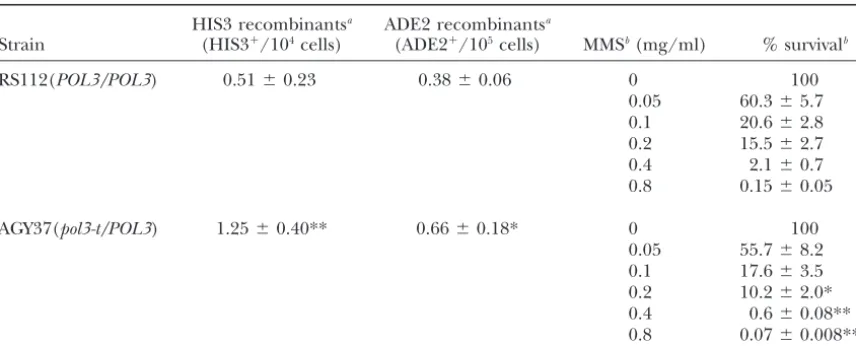
double-mutant background, MMS induced recombination at all tor phenotype and MMS sensitivity (Kokoska et al. 2000). Thus, we determined whether apol3-t/POL3 het-doses regardless of thePOL3status (Table 7). However,
again as for UV- and ␥-ray-induced recombination, in erozygous strain showed any effect on recombination efficiency or on MMS sensitivity at the restrictive temper-both backgrounds thepol3-tmutant showed higher
in-ducibility. At a dose of 100g/ml MMS, there was an ature of 37⬚. There was a significant difference for both intrachromosomal and interchromosomal recombina-average of 27.7 added events in therad52⌬pol3-tstrain
compared to an average of 1.1 added events in the tion at the restrictive temperature in the pol3-t/POL3 heterozygous mutant (Table 9). The heterozygous strain rad52⌬ strain. At the same dose in the rad1⌬ rad52⌬
Effect ofpol3-t/POL3heterozygosity on recombination and MMS sensitivity
HIS3 recombinantsa ADE2 recombinantsa
Strain (HIS3⫹/104cells) (ADE2⫹/105cells) MMSb(mg/ml) % survivalb
RS112(POL3/POL3) 0.51⫾0.23 0.38⫾0.06 0 100
0.05 60.3⫾5.7 0.1 20.6⫾2.8 0.2 15.5⫾2.7 0.4 2.1⫾0.7 0.8 0.15⫾0.05
AGY37(pol3-t/POL3) 1.25⫾0.40** 0.66⫾0.18* 0 100 0.05 55.7⫾8.2 0.1 17.6⫾3.5 0.2 10.2⫾2.0* 0.4 0.6⫾0.08** 0.8 0.07⫾0.008***
The probabilities refer to the comparison between thePOL3/POL3 wild-type strain and the pol3-t/POL3 heterozygous mutant. *P⬍0.05, **P⬍0.01, ***P⬍0.001.
aThree independent colonies of strains RS112 (POL3/POL3) and seven cultures of AGY37 (pol3-t/POL3) were grown at 37⬚for 17 hr and deletion and interchromosomal recombination frequencies were determined. This experiment was done in duplicate. RS112 cells grew on average for 4.8 generations and AGY37 for 4.0 generations.
bFrom overnight cultures grown in YPAD at 25⬚, 1⫻108cells/ml were inoculated in 5 ml YPAD at 37⬚for 6 hr. Then cells were counted and 107cells/ml were further inoculated in 5 ml prewarmed YPAD containing the indicated concentrations of MMS for 17 hr at 37⬚. Cells were washed, counted, plated onto YPAD plates, and incubated at 25⬚for 3 days. Each data point represents the mean⫾standard deviation of four independent experiments.
at a dose of 0.2 mg/ml (Table 9), this increase was grounds as well as the effects of exposure to UV, ionizing significant. Thus, thepol3-t/POL3heterozygous mutant radiation, and MMS on deletion recombination in the at the restrictive temperature showed an increase in different DNA repair mutants. In addition, we show that recombination frequency as well as an MMS-sensitive the pol3-t-mediated hyperrecombination phenotype is
phenotype. dependent on DNA replication and that even thepol3-t/
POL3heterozygous mutation increased recombination and MMS sensitivity.
DISCUSSION Moreover, we found thatpol3-tincreased both reverse and forward mutation frequencies. Most interestingly, In this study, we found that the pol3-t allele of the
thepol3-01mutant has abnormal cell-cycle progression POL3/CDC2gene ofS. cerevisiae, which encodes the
cata-due to activation of the S-phase checkpoint, and inacti-lytic subunit of the DNA polymerase␦, increased
intra-vation of the S-phase checkpoint suppressed the cell-and interchromosomal recombination in a diploid cell-and
cycle progression defect as well as the mutator pheno-intrachromosomal recombination in two haploid
type (Dattaet al.2000). This indicates that activation strains. Previous studies reported that mutations in
of the checkpoint might have resulted in the accumula-POL3/CDC2genes increased intrachromosomal
recom-tion of the mutarecom-tions. bination between homologous and homeologous DNA
The pol3-t-mediated hyperrecombination phenotype
sequences (AguileraandKlein1988;Tranet al.1997)
requires DNA replication: To determine whether cell
and increased interchromosomal recombination (
Hart-division and/or DNA replication affect the hyperrecom-wellandSmith1985;Giotet al.1997). The elevated
bination phenotype, we monitored intrachromosomal frequency of recombination in thepol3-tmutant could
recombination during a prolonged G1 arrest. The fre-be mechanistically similar to the events in thePOL3wild
quency of intrachromosomal recombination did not type but just occur more frequently. Thus, we sought to
change during the cell-cycle arrest and did not increase further characterize thepol3-t-mediated
hyperrecombi-in G1-arrested cells at 30⬚. Thus, cell division or DNA nation phenotype. The present study adds to the
pre-replication is necessary to increase recombination in viously published findings by the characterization of
pol3-tstrains. effects ofrad1andrad52mutations on the pol3-t
deletions are due mainly to DNA DSBs (Galli and hand, long stretches of single-strand DNA on the lag-ging-strand template in thepol3-tmutant (Gordeninet
Schiestl1995,1998b). Single-strand breaks in the
re-al.1992;Kokoskaet al.1998) could potentially invade gion between theHIS3duplication or exposure to
alkyl-the second copy of alkyl-theHIS3duplication in our recombi-ating agents or UV light did not increase deletion
re-nation substrate, leading to Rad52p-dependent, one-combination unless DNA replication occurred (Galli
sided invasion-like events. andSchiestl1998b,1999). Thus, single-strand breaks
The low level of recombination went up significantly may be converted into DNA DSBs by DNA replication
in therad52mutant in the presence of thepol3-t muta-on a single-strand or chemically damaged DNA template
tion. In addition, ionizing radiation induced recombina-(Kaufmann and Paules 1996; Galli and Schiestl
tion to much higher levels in the pol3-t rad52 double 1998b). These DSBs could induce SSA or one-sided
mutant than in therad52single mutant. This indicates invasion.
thatpol3-tchannels lesions into a Rad52p-independent
The hyperrecombination phenotype in pol3-t strains
pathway, like the Rad1p pathway.
depends partially on Rad52p but much more so on
Most of thepol3-t-induced recombination events were
Rad1p: Intrachromosomal recombination events
lead-dependent on Rad1p or Rad52p; however, the pol3-t ing to deletions between repeated sequences can occur
mutation still increased the frequency in the absence by several mechanisms: by recombination between the
of Rad1p and Rad52p. Other hyperrecombination phe-two repeats within one chromatid as intrachromatid
notypes differ in their dependence on the Rad1p- and/ exchange; by SSA; by one-sided invasion events; or,
alter-or Rad52p-mediated pathways. A mutation in hpr1 in-natively, by recombination between sister chromatids as
creases recombination between DNA repeats up to 2000-unequal sister chromatid exchange or sister chromatid
fold (Aguilera and Klein 1988; Santos-Rosa and conversion (Schiestl et al. 1988; Haber 1992;
Bel-Aguilera1994). Sincehpr1mutants also show 100-fold maaza and Chartrand 1994; Galli and Schiestl
elevated frequencies of chromosome loss, it has been 1995,1998b;Klein1995). Previous studies on
cell-cycle-suggested that the hyperrecombination phenotype is arrested cells suggested that SSA and/or one-sided
inva-due to DNA breaks (Santos-RosaandAguilera1994). sion are the preferential mechanisms by which such
This increased recombination frequency is completely deletions occur (GalliandSchiestl1998b).
abolished in a rad1 rad52 double-mutant background Deletion ofRAD1andRAD52greatly reduces the
fre-(Santos-Rosa and Aguilera 1994), which makes it quencies of intrachromosomal deletion events between
different from thepol3-teffect. DNA transcription also repeats (Schiestl and Prakash 1988; Thomas and
induces recombination (Voelkel-Meiman et al.1987; Rothstein 1989; Liefshitz et al. 1995;Saparbaev et
Thomasand Rothstein 1989). Both systems of tran-al.1996). Different types of intrachromosomal
recombi-scription stimulated recombination. In theGAL10assay nation events are controlled by Rad1p and Rad52p.
as well as in the HOT1 assay, most events are Rad52p Deletion events occurring by SSA events are dependent
dependent and fewer events Rad1p dependent on the Rad1p function (Fishman-Lobelland Haber
(Thomas and Rothstein 1989; Zehfus et al. 1990), 1992;Prado andAguilera1995;Paques andHaber
which makes it different from thepol3-tgenetic control. 1999) whereas conversion events or deletion events
oc-In both assays, a small proportion of the transcription-curring by one-sided invasion are probably Rad52p de- induced recombination events are Rad1p Rad52p inde-pendent (Klein 1988; Schiestl and Prakash 1988; pendent (ThomasandRothstein1989;Zehfuset al. Prado andAguilera1995). 1990). Among mutations isolated in a screen for an SSA, one of the mechanisms for the deletion recombi- increase in recombination in a rad1⌬ rad52⌬ double-nation events, requires Rad1p and Rad10p if the dis- deletion mutant strain, therfa1-D228Ymutant has been tance between interacting repeats is ⬎60 bp (Paques found to stimulate intrachromosomal deletion events and Haber 1999). It has been argued that deletions between repeats up to the wild-type level (Smithand ⬍60 bp may be due to polymerase slippage (Kokoskaet Rothstein1995). The hyperrecombination phenotype al.2000). It seems, however, inconceivable that slippage of therfamutation is much more dependent on Rad1p could occur over a distance of 6 kb in the absence of than on Rad52p and, out of several possible recombina-inverted repeats as would be required for the deletions tion events between repeats, DNA deletions display the in our construct. Thus, it is more likely that the events greatest stimulation in the rad1 rad52 double-mutant happen by SSA or by one-sided invasion. DNA DSBs background (SmithandRothstein 1999). Thus, the could be generated by replication of a single-strand authors proposed that therfa-mediated hyperrecombi-break or single-strand interruption that would be ex- nation phenotype is most likely caused by a Rad1p pected to be more prevalent or longer lasting in the Rad52p-independent SSA mechanism (Smithand
Roth-pol3-t mutant. Such DSBs could initiate Rad1p-depen- stein1999). In a similar way, the weak hyperrecombina-dent SSA events. Since mostpol3-t-induced recombina- tion phenotype we observed in therad1⌬rad52⌬pol3-t tion events are Rad1p mediated, this pathway could strain may occur by a Rad1p Rad52p-independent SSA
MMS sensitivity at the restrictive temperature. This
mosomal recombination in strains of different POL3
status:Thepol3-tmutant was slightly more UV resistant could be due to the fact that the pol3-tallele may have
some dominant effect, such as binding to a multi-enzyme in all genotypes compared to thePOL3wild type. This
might be due to the somewhat longer time available to complex as an inactive component, or that just a lower level of Pol3p leads to the recombinagenic effect. Since repair the lesions by excision repair in thepol3-tmutant
since the cells grew at 30⬚for 4 hr prior to UV exposure. a lower level of Pol3p obtained by repressing the gene under theGAL1promoter resulted in a mutator as well There was no such difference in survival for␥-rays or
MMS. Thepol3-tmutant was MMS sensitive as previously as in an MMS-sensitive phenotype (Kokoskaet al.2000), it is likely that a lower amount of Pol3p in the heterozy-reported for other pol3 mutants (Blank et al. 1994).
This MMS sensitivity was diminished in both therad1 gous mutant at the restrictive temperature is responsible for the effect in our experiment. In agreement with our and therad52background and absent in therad1 rad52
double mutant, which may indicate that Pol3p may be finding, it has also been shown that the homozygous as well as the heterozygouspol3-01mutation is inviable in important for both the excision repair and the
recombi-nation repair pathway of MMS repair. combination with a mutation in RAD27 (Gary et al. 1999). Our results indicate that a mutation in DNA poly-Thepol3-tstrain was partially defective in UV- and␥
-ray-induced intrachromosomal recombination in agree- merase␦ even in a heterozygous combination might in-crease the frequency of genetic instability, which might ment with findings by others (Fabreet al. 1991;Giot
et al. 1997). DNA polymerase ␦ is required for both be a risk factor for cancer.
DNA replication and base excision repair (Budd and This research was supported by Research Career Development Campbell 1993, 1995; Blank et al. 1994; Morrison award no. ES00299 from the National Institutes of Health to R.H.S.
and Sugino 1994). Recently, a new role of the DNA polymerase␦in the DNA DSB repair and DSB-induced
mitotic gene conversion has been reported (Holmes LITERATURE CITED andHaber1999). According to all models of
recombi-Aguilera, A., andH. L. Klein, 1988 Genetic control of
intrachro-nation (Orr-WeaverandSzostak1985), DNA replica- mosomal recombination in Saccharomyces cerevisiae. I. Isolation
and genetic characterization of hyper-recombination mutations.
tion is involved in processes such as extension of strand
Genetics119:779–790.
displacement and repair of gaps.
Belmaaza, A., andP. Chartrand, 1994 One-sided invasion events
DNA-damage-induced intrachromosomal deletion re- in homologous recombination at double-strand breaks. Mutat.
Res.314:199–208.
combination events are under different genetic control
Bishop, A. J., andR. H. Schiestl, 2000 Homologous recombination
than spontaneous events, suggesting a difference in
as a mechanism for genome rearrangements: environmental and
mechanism. UV and␥-rays induced recombination in genetic effects. Hum. Mol. Genet.9:2427–2434.
Bishop, A. J., andR. H. Schiestl, 2001 Homologous recombination
therad1⌬strain, but not at all or very little in therad52⌬
as a mechanism of carcinogenesis. Biochim. Biophys. Acta1471: and the rad1⌬ rad52⌬ strains. This demonstrated that
M109–M121.
UV- and ␥-ray-induced intrachromosomal recombina- Blank, A., B. KimandL. A. Loeb, 1994 DNA polymerase delta is
required for base excision repair of DNA methylation damage
tion required Rad52p but not Rad1p in aPOL3
back-in Saccharomyces cerevisiae. Proc. Natl. Acad. Sci. USA91:9047–
ground, whereas spontaneous recombination is
depen-9051.
dent on both Rad1p and Rad52p functions (Schiestl Boeke, J. D., F. LaCrouteandG. R. Fink, 1984 A positive selection
for mutants lacking orotidine-5⬘-phosphate decarboxylase activity
andPrakash1988;ThomasandRothstein1989;
Lief-in yeast: 5-fluoro-orotic acid resistance. Mol. Gen. Genet. 197: shitz et al. 1995; Saparbaev et al. 1996). Thus, it is
345–346.
possible that different pathways of recombination might Brooks, M., andL. B. Dumas, 1989 DNA primase isolated from the
yeast DNA primase-DNA polymerase complex. Immunoaffinity
be preferred in spontaneousvs.DNA-damage-induced
purification and analysis of RNA primer synthesis. J. Biol. Chem.
recombination. Interestingly, in thepol3-tbackground,
264:3602–3610.
UV- and ␥-ray-induced intrachromosomal recombina- Budd, M. E., andJ. L. Campbell, 1993 DNA polymerases delta and
epsilon are required for chromosomal replication in
Saccharo-tion was Rad52p independent. Both pathways of
hyper-myces cerevisiae. Mol. Cell. Biol.13:496–505.
recombination potentially operable in thepol3-tstrain,
Budd, M. E., andJ. L. Campbell, 1995 DNA polymerases required
involving DSB formation on a single-strand break or for repair of UV-induced damage in Saccharomyces cerevisiae.
Mol. Cell. Biol.15:2173–2179.
gap template as well as invasion of homologous DNA
Burgers, P. M., 1991 Saccharomyces cerevisiae replication factor
by long stretches of single-strand DNA on the
lagging-C. II. Formation and activity of complexes with the proliferating
strand template, could be more prevalent after addi- cell nuclear antigen and with DNA polymerases delta and epsilon.
J. Biol. Chem.266:22698–22706.
tional DNA damage. As much of thepol3-t
hyperrecom-Campbell, J. L., andC. S. Newlon, 1991 Chromosomal DNA
repli-bination pathway was independent of Rad52p so was
cation, pp. 41–146 inGenome Dynamics, Protein Synthesis, and
Ener-the UV- or ␥-ray-induced recombination in the pol3-t getics, edited by J. R.Broach, J. R.Pringleand E. W.Jones.
Cold Spring Harbor Laboratory Press, Cold Spring Harbor, NY.
mutant.
Datta, A., J. L. Schmeits, N. S. Amin, P. J. Lau, K. Myunget al.,
Pol3-t heterozygosity results in hyperrecombination
2000 Checkpoint-dependent activation of mutagenic repair in
and MMS-sensitive phenotypes:Our data indicate that Saccharomyces cerevisiae pol3–01 mutants. Mol. Cell6:593–603.
Fabre, F., A. BouletandG. Faye, 1991 Possible involvement of
re-the yeast gene encoding DNA polymerase delta or by decreases Mol. Gen. Genet.229:353–356.
Fishman-Lobell, J., andJ. E. Haber, 1992 Removal of nonhomolo- in the cellular levels of DNA polymerase delta. Mol. Cell. Biol.
20:7490–7504. gous DNA ends in double-strand break recombination: the role
of the yeast ultraviolet repair gene RAD1. Science258:480–484. Liefshitz, B., A. Parket, R. MayaandM. Kupiec, 1995 The role of DNA repair genes in recombination between repeated
se-Galli, A., andR. H. Schiestl, 1995 On the mechanism of UV and
gamma-ray-induced intrachromosomal recombination in yeast quences in yeast. Genetics140:1199–1211.
Maniatis, T., J. SambrookandE. F. Fritsch, 1989 Molecular
Clon-cells synchronized in different stages of the cell cycle. Mol. Gen.
Genet.248:301–310. ing: A Laboratory Manual. Cold Spring Harbor Laboratory Press, Cold Spring Harbor, NY.
Galli, A., andR. H. Schiestl, 1998a Effect of Salmonella assay
negative and positive carcinogens on intrachromosomal recombi- Morrison, A., andA. Sugino, 1994 The 3⬘→5⬘ exonucleases of both DNA polymerases delta and epsilon participate in correcting nation in S-phase arrested yeast cells. Mutat. Res.419:53–68.
Galli, A., andR. H. Schiestl, 1998b Effects of DNA double-strand errors of DNA replication in Saccharomyces cerevisiae. Mol. Gen. Genet.242:289–296.
and single-strand breaks on intrachromosomal recombination
events in cell-cycle-arrested yeast cells. Genetics149:1235–1250. Orr-Weaver, T. L., andJ. W. Szostak, 1985 Fungal recombination. Microbiol. Rev.49:33–58.
Galli, A., andR. H. Schiestl, 1999 Cell division transforms
muta-genic lesions into deletion-recombinamuta-genic lesions in yeast cells. Paques, F., andJ. E. Haber, 1999 Multiple pathways of recombina-tion induced by double-strand breaks in Saccharomyces cerevis-Mutat. Res.429:13–26.
Gary, R., M. S. Park, J. P. Nolan, H. L. Cornelius, O. G. Kozyreva iae. Microbiol. Mol. Biol. Rev.63:349–404.
Paulovich, A. G., C. D. ArmourandL. H. Hartwell, 1998 The
et al., 1999 A novel role in DNA metabolism for the binding of
Fen1/Rad27 to PCNA and implications for genetic risk. Mol. Saccharomyces cerevisiaeRAD9, RAD17, RAD24 and MEC3 genes are required for tolerating irreparable, ultraviolet-induced DNA Cell. Biol.19:5373–5382.
Gietz, D., A.St. Jean, R. A.Woodsand R. H.Schiestl, 1992 Im- damage. Genetics150:75–93.
Petes, T. D., andC. W. Hill, 1988 Recombination between repeated proved method for high efficiency transformation of intact yeast
cells. Nucleic Acids Res.20:1425. genes in microorganisms. Annu. Rev. Genet.22:147–168.
Podust, V. N., andU. Hubscher, 1993 Lagging strand DNA
synthe-Gietz, R. D., R. H. Schiestl, A. R. WillemsandR. A. Woods, 1995
Studies on the transformation of intact yeast cells by the LiAc/ sis by calf thymus DNA polymerases alpha, beta, delta and epsilon in the presence of auxiliary proteins. Nucleic Acids Res.21:841– SS-DNA/PEG procedure. Yeast11:355–360.
Giot, L., R. Chanet, M. Simon, C. FaccaandG. Faye, 1997 Involve- 846.
Prado, F., andA. Aguilera, 1995 Role of reciprocal exchange, one-ment of the yeast DNA polymerase delta in DNA repairin vivo.
Genetics146:1239–1251. ended invasion crossover and single-strand annealing on inverted and direct repeat recombination in yeast: different requirements
Gordenin, D. A., andM. A. Resnick, 1998 Yeast ARMs (DNA
at-risk motifs) can reveal sources of genome instability. Mutat. Res. for theRAD1,RAD10, andRAD52genes. Genetics139:109–123.
Santos-Rosa, H., andA. Aguilera, 1994 Increase in incidence of
400:45–58.
Gordenin, D. A., A. L. Malkova, A. Peterzen, V. N. Kulikov, Y. I. chromosome instability and non-conservative recombination be-tween repeats in Saccharomyces cerevisiae hpr1 delta strains.
Pavlovet al., 1992 Transposon Tn5 excision in yeast: influence
of DNA polymerases alpha, delta, and epsilon and repair genes. Mol. Gen. Genet.245:224–236.
Saparbaev, M., L. PrakashandS. Prakash, 1996 Requirement of Proc. Natl. Acad. Sci. USA89:3785–3789.
Haber, J. E., 1992 Exploring the pathways of homologous recombi- mismatch repair genesMSH2andMSH3in the RAD1-RAD10 pathway of mitotic recombination inSaccharomyces cerevisiae. Ge-nation. Curr. Opin. Cell Biol.4:401–412.
Hartwell, L. H., andD. Smith, 1985 Altered fidelity of mitotic netics142:727–736.
Schiestl, R. H., andS. Prakash, 1988 RAD1, an excision repair chromosome transmission in cell cycle mutants ofS. cerevisiae.
Genetics110:381–395. gene of Saccharomyces cerevisiae, is also involved in recombina-tion. Mol. Cell. Biol.8:3619–3626.
Holmes, A. M., andJ. E. Haber, 1999 Double-strand break repair in
yeast requires both leading and lagging strand DNA polymerases. Schiestl, R. H., andS. Prakash, 1990 RAD10, an excision repair gene of Saccharomyces cerevisiae, is involved in the RAD1 path-Cell96:415–424.
Ivanov, E. L., andJ. E. Haber, 1995 RAD1 and RAD10, but not way of mitotic recombination. Mol. Cell. Biol.10:2485–2491.
Schiestl, R. H., S. IgarashiandP. J. Hastings, 1988 Analysis of other excision repair genes, are required for double-strand
break-induced recombination in Saccharomyces cerevisiae. Mol. Cell. the mechanism for reversion of a disrupted gene. Genetics119:
237–247. Biol.15:2245–2251.
Ivanov, E. L., N. Sugawara, J. Fishman-LobellandJ. E. Haber, Smith, J., andR. Rothstein, 1995 A mutation in the gene encoding the Saccharomyces cerevisiae single-stranded DNA-binding pro-1996 Genetic requirements for the single-strand annealing
pathway of double-strand break repair inSaccharomyces cerevisiae. tein Rfa1 stimulates a RAD52-independent pathway for direct-repeat recombination. Mol. Cell. Biol.15:1632–1641. Genetics142:693–704.
Kadyk, L. C., and L. H. Hartwell, 1992 Sister chromatids are Smith, J., andR. Rothstein, 1999 An allele of RFA1 suppresses RAD52-dependent double-strand break repair inSaccharomyces
preferred over homologs as substrates for recombinational repair
inSaccharomyces cerevisiae. Genetics132:387–402. cerevisiae. Genetics151:447–458.
Thomas, B. J., andR. Rothstein, 1989 The genetic control of
direct-Kadyk, L. C., andL. H. Hartwell, 1993 Replication-dependent
sister chromatid recombination inrad1mutants ofSaccharomyces repeat recombination in Saccharomyces: the effect of rad52 and rad1 on mitotic recombination at GAL10, a transcriptionally
regu-cerevisiae. Genetics133:469–487.
Kaiser, C., S. MichaelisandA. Mitchell, 1994 Methods in Yeast lated gene. Genetics123:725–738.
Tran, H. T., N. P. Degtyareva, N. N. Koloteva, A. Sugino, H.
Genetics.Cold Spring Harbor Laboratory Press, Cold Spring
Har-bor, NY. Masumotoet al., 1995 Replication slippage between distant short repeats in Saccharomyces cerevisiae depends on the
direc-Kaufmann, W. K., andR. S. Paules, 1996 DNA damage and cell
cycle checkpoints. FASEB J.10:238–247. tion of replication and the RAD50 and RAD52 genes. Mol. Cell. Biol.15:5607–5617.
Klein, H. L., 1988 Different types of recombination events are
con-trolled by theRAD1andRAD52genes ofSaccharomyces cerevisiae. Tran, H. T., D. A. GordeninandM. A. Resnick, 1996 The preven-tion of repeat-associated delepreven-tions inSaccharomyces cerevisiaeby Genetics120:367–377.
Klein,H. L., 1995 Genetic control of intrachromosomal recombina- mismatch repair depends on size and origin of deletions. Genetics
143:1579–1587. tion. Bioessays17:147–159.
Kokoska, R. J., L. Stefanovic, H. T. Tran, M. A. Resnick, D. A. Tran, H., N. Degtyareva, D. GordeninandM. A. Resnick, 1997 Altered replication and inverted repeats induce mismatch
repair-Gordeninet al., 1998 Destabilization of yeast micro- and
mini-satellite DNA sequences by mutations affecting a nuclease in- independent recombination between highly diverged DNAs in yeast. Mol. Cell. Biol.17:1027–1036.
volved in Okazaki fragment processing (rad27) and DNA
poly-merase delta (pol3-t). Mol. Cell. Biol.18:2779–2788. Tran, H. T., D. A. GordeninandM. A. Resnick, 1999 The 3⬘→5⬘ exonucleases of DNA polymerases delta and epsilon and the