Effect of Polypropylene Fiber on Engineering
Properties of Expansive Soils
Dr.MD.Subhan 1
Professor, Department of Civil Engineering, AVNIET, Hyderabad, India1
ABSTRACT: Soil reinforcement is defined as a technique to improve the engineering characteristics of soil. In this way,using natural fibers to reinforce soil is an old and ancient idea.The effect of randomly distributed polypropylene fibers on Maximum dry density (MDD),Optimum moisture content (OMC), unconfined compressive strength (UCS), soaked Californiabearing ratio (CBR), hydraulic conductivity and swelling pressure of an expansive soilstabilised with rice husk ash and lime has been discussed in this paper.
KEYWORDS: Rice husk ash, lime, polypropylene fiber, soaked CBR, hydraulicconductivity, swelling pressure.
I. INTRODUCTION
Soil can often be regarded as a combination of four basic types:gravel, sand, clay, and silt. It generally has low tensile and shearstrength and its characteristics may depend strongly on the environmental conditions (e.g. dry versus wet) [1]. On the other hand,reinforcement consists of incorporating certain materials withsome desired properties within other material which lack thoseproperties [2]. Therefore, soil reinforcement is defined as a technique to improve the engineering characteristics of soil in orderto develop the parameters such as shear strength, compressibility,density; and hydraulic conductivity [3]. Soil reinforcement canconsist of stone columns, root piles or micro-piles, soil nailingand reinforced earth [4–6]. Mainly, reinforced earth is a compositematerial consisting of alternating layers of compacted backfill andman-made reinforcing material [6].
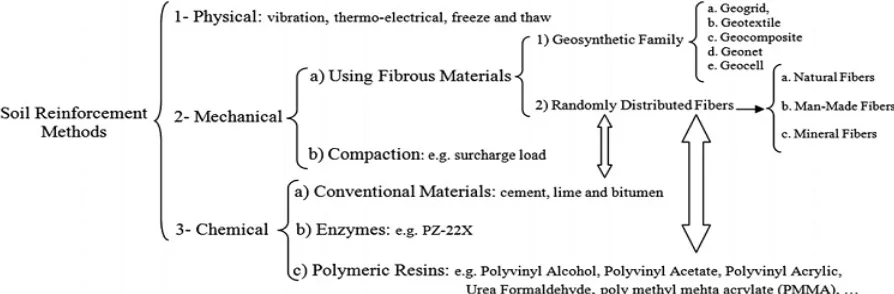
As it was mentioned, soil reinforcement is a procedure wherenatural or synthesized additives are used to improve the propertiesof soils. Several reinforcement methods are available for stabilizing, problematic soils. Therefore, the techniques of soil reinforcementcan be classified into a number of categories with different pointsof view. However, on the basis of reinforcing performance, Fig. 1presents a state of art review of different procedures of soil reinforcement prepared by the authors.
All the researchers have found varied success in improving theengineering properties of expansive soil.The effects of polypropylene fiber on MDD, OMC, UCS, soaked CBR, hydraulicconductivity and swelling pressure of expansive soil stabilized with rice husk ash and lime hasbeen found to be limited in literature. The objective of this paper is to study the effects ofpolypropylene fiber on MDD, OMC, UCS, soaked CBR, hydraulic conductivity and swellingpressure of an expansive soil stabilized with optimum percentage of rice husk ash and lime. Theeffects of 7 and 28 days of curing on UCS, soaked CBR, hydraulic conductivity and swellingpressure have also been studied.
II. RELATEDWORK
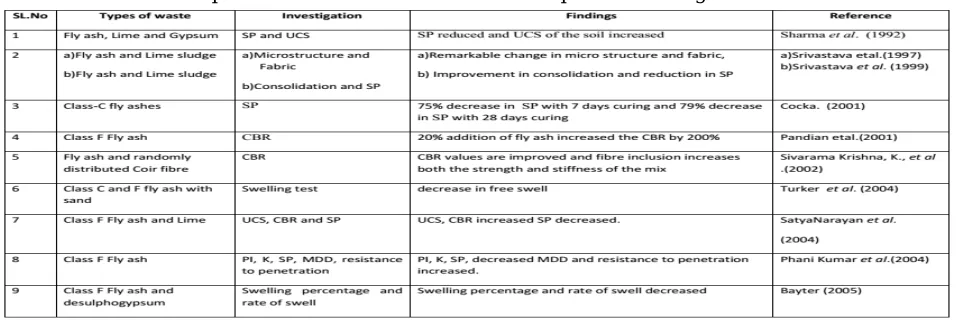
Stabilization is one of the methods of treating the expansive soils to make them fit for construction. Variety of stabilizers may be divided into three groups (Petry 2002): (a) traditional stabilizers (lime, cement etc.), (b) by-product stabilizers (fly ash, quarry dust, phosphor-gypsum, slag etc.) and (c) non-traditional stabilizers (sulfonated oils, potassium compounds, polymer, enzymes, ammonium chlorides etc.). Disposal of large quantities of industrial by products as fills on disposal sites adjacent to industries not only requires large space but also create a lot of geo-environment problems. Attempts are being made by various organizations and researchers to use them in bulk at suitable places. Stabilization of expansive soil is one way of utilization of these by products. Some of the research work conducted by earlier researchers on the above has been described below.
Srivastava et al. (1997) studied the change in micro structure and fabric of expansive soil due to addition of fly ash and lime sludge from SEM photograph and found changes in micro structure and fabric when 16% fly ash and 16% lime sludge were added to expansive soil. Srivastava et al. (1999) have also described the results of experiments carried out to study the consolidation and swelling behaviour of expansive soil stabilized with lime sludge and fly ash and the best stabilizing effect was obtained with 16% of fly ash and 16% of lime sludge.
Muntohar and Hantoro (2000) used rice husk ash and lime for stabilization of expansive soilby blending them together. The RHA used were 7.5%, 10% and 12.5% and lime as 2%, 4%,6%, 8%, 10% and 12% as replacement of expansive soil. Their PI (plasticity index) decreasedfrom 41.25% to 0.96% and swell potential decreased from 19.23% to insignificant with 12-12.5% of RHA-lime mixture. There was also increase in CBR value (3 % to 16 %), internalfriction angle (5 0 to 240) and cohesion (54.32 kN/m2 to 157.19 kN/m2), there by increasedbearing capacity to 4131 kN/m2 from 391.12 kN/m2
Kumar et al. (2007) studied the effects of polyester fiber inclusions and lime stabilization onthe geotechnical characteristics of fly ash-expansive soil mixtures. Lime and fly ash wereadded to an expansive soil at ranges of 1–10% and 1–20%, respectively. The samples withoptimum proportion of fly ash and lime content (15% fly ash and 8% lime) based oncompaction, unconfined compression and split tensile strength, were added with 0, 0.5, 1.0,1.5, and 2% plain and crimped polyester fibers by weight. The MDD of soil-fly ash-limemixes decreased with increase in fly ash and lime content. The polyester fibers (0.5–2.0%)had no significant effect on MDD and OMC of fly ash-soil-lime-fiber mixtures. However, theunconfined compressive strength and split tensile strength increased with addition of fibers.
III. CASE STUDIES OF FIBERS
Coconut (coir) fiber: The outer covering of fibrous material of a matured coconut,termed coconut husk, is the reject of coconut fruit. The fibers arenormally 50–350 mm long and consist mainly of lignin, tannin, cellulose, pectin and other water soluble substances. However, due toits high lignin content, coir degradation takes place much moreslowly than in other natural fibers. So, the fiber is also very longlasting, with infield service life of 4–10 years. The water absorptionof that is about 130–180% and diameter is about 0.1–0.6 mm [7].
Coir retains much of its tensile strength when wet. It has lowtenacity but the elongation is much higher [8]. The degradationof coir depends on the medium of embedment, the climatic conditions and is found to retain 80% of its tensile strength after6 months of embedment in clay. Coir geo-textiles are presentlyavailable with wide ranges of properties which can be economically utilized for temporary reinforcement purposes [9]. Mainly,coir fiber shows better resilient response against synthetic fibersby higher coefficient of friction. For instance, findings show thatcoir fiber exhibits greater enhancements (47.50%) in resilient modulus or strength of the soil than the synthetic one(40.0%).
Lime increases the strength of clayey soil.Soil stabilization occurs when lime is added to areactive soil to generate long-term strength gainthrough a pozzolanic reaction. The strength of limemixture depends to a great extent on the quantity oflime added above lime fixation point. It is generallyfound that beyond a certain % of lime the increasein strength ceases & in fact a lowering strength mayresult due to present of unreacted free limeindicating that there exists optimum lime content formaximum strength grain. So after a certain limit oflime content no development of strength but costincreases.
IV. DISCUSSIONS & TEST RESULTS
The materials used in the experiments are expansive soil, Rice husk ash, lime andPolypropylene fiber.
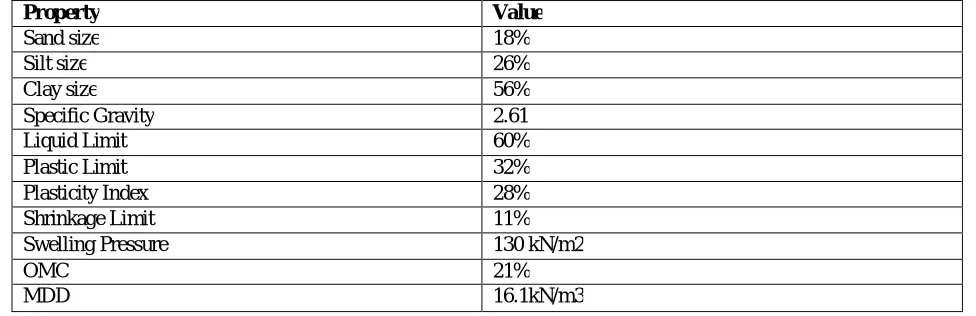
Expansive soil: The expansive soil used in the experimental work was brought from Bhubaneswar. Thegeotechnical properties of the expansive soil are:
Property Value
Sand size 18%
Silt size 26%
Clay size 56%
Specific Gravity 2.61
Liquid Limit 60%
Plastic Limit 32%
Plasticity Index 28%
Shrinkage Limit 11%
Swelling Pressure 130 kN/m2
OMC 21%
MDD 16.1kN/m3
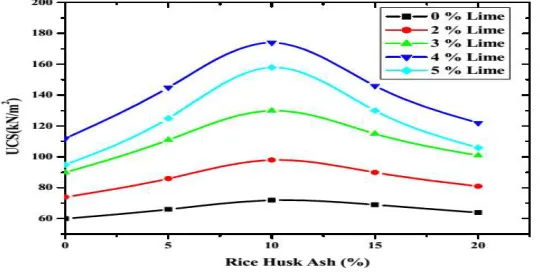
and soils.Addition of lime beyond 4% decreased the UCS .The strength decreases resulting in carbonationreactions, due to addition of excess lime to react with insufficient amorphous silica and aluminapresent in rice husk ash and expansive soil.
Figure 2: Variation of UCS with Rice husk ash and Lime at 7 days curing
Figures 3 (a) and (b) shows the variation of MDD and OMC with different percentage ofpolypropylene fiber (fiber) respectively. The MDD of soil decreases to 14 kN/m3 from 16.1kN/m3and OMC increased to 25.8% from 21% when stabilized with optimum percentage of rice huskash and lime. With increase in percentage of fiber the MDD of rice husk ash-lime stabilizedexpansive soil goes on decreasing, decreases to 13.3 kN/m3 when 2 % fiber was added which isattributed to the lower value of specific gravity of fiber as compared to soil. The OMC goes onincreasing irrespective of percentage of addition of fiber .The OMC increases to a value of 26.6%when 2% fiber was added. Similar observations were made by Kumar et al. (2007) when polysterfibers were added to Fly ash- lime stabilized expansive soil.
(a) Variation of MDD with percentage of Fiber(b) Variation of OMC with percentage of Fiber
Figure 3: Variation of MDD and OMC with percentage of Fiber
curing period irrespective of fiber content. The UCS increased to avalue of 501 kN/m2 at 28 days of curing at 1.5 % addition of fiber, which is 8.35 times that of thevirgin soil.
Figure 4: Variation of UCS with percentage of Fiber and Curing period
V. CONCLUSION
Following conclusions are drawn from this study: (i) The addition of rice husk ash and lime decreases the MDD and increases the OMC of theexpansive soil. MDD goes on decreasing and OMC goes on increasing, with increase inpercentage of poly propylene fiber in the rice husk ash-lime stabilized expansive soil.(ii) The addition of rice husk ash and lime increases the UCS and soaked CBR of theexpansive soil. With the addition of polypropylene fiber to rice husk ash-lime stabilizedexpansive soil, the UCS and soaked CBR increases, up to 1.5 % addition of polypropylene fiber,and decreases with further increase in polypropylene fiber content. The UCS and soaked CBRincreases with increase in curing period irrespective of the percentage of addition ofpolypropylene fiber in rice husk ash-lime stabilized expansive soil.
REFERENCES
[1] Ling I, Leshchinsky D, Tatsuoka F. Reinforced soil engineering: advances inresearch and practice. Marcel Dekker Inc.; 2003. [2] Jones M. Mechanics of composite materials. 2nd ed. Taylor and Francis; 1999.
[3] Kazemian S, Huat K, Prasad A, Barghchi M. A review of stabilization of softsoils by injection of chemical grouting. Aust J Basic Appl Sci 2010;4:5862–8.
[4] Abtahi M, Allaie H, Hejazi M. An investigative study on chemical soilstabilization. In: 8th Int cong civ eng, Shiraz, Iran; 2009.
[5] Abtahi M, Sheikhzadeh M, Hejazi M, Hassani Y. Compressive behavior ofcomposite soils reinforced with recycled waste tire cords and poly propylenefibers. In: 1st Int and 7th nat conf text eng, Rasht, Iran; 2009.
[6] Ola A. Stabilization of lateritic soils by extensible fiber reinforcement. EngGeol 1989;26:125–40.
[7] Rowell M, Han S, Rowell S. Characterization and factors effecting fiberproperties. Nat Polym Agr Compos 2000:115–34. [8] Babu S, Vasudevan K. Strength and stiffness response of coir fiber-reinforcedtropical soil. J Mater Civil Eng ASCE 2008;20:571–7.