A Multivalent Pairing Model of Linkage Analysis in Autotetraploids
Samuel S. Wu,*
,1Rongling Wu,*
,1Chang-Xing Ma,*
,†Zhao-Bang Zeng,
‡Mark C. K. Yang*
and George Casella*
*Department of Statistics, University of Florida, Gainesville, Florida 32611,†Department of Statistics, Nankai University, Tianjin 300071,
People’s Republic of China and‡Department of Statistics, North Carolina State University, Raleigh, North Carolina 27695
Manuscript received May 2, 2001 Accepted for publication August 29, 2001
ABSTRACT
Polyploidy has been recognized as an important step in the evolutionary diversification of flowering plants and may have a significant impact on plant breeding. Statistical analyses for linkage mapping in polyploid species can be difficult due to considerable complexities in polysomic inheritance. In this article, we develop a novel statistical method for linkage analysis of polymorphic markers in a full-sib family of autotetraploids. This method is established on multivalent pairings of homologous chromosomes at meiosis and can provide a simultaneous maximum-likelihood estimation of the double reduction frequencies of and recombination fraction between two markers. The EM algorithm is implemented to provide a tractable way for estimating relative proportions of different modes of gamete formation that generate identical gamete genotypes due to multivalent pairings. Extensive simulation studies were performed to demonstrate the statistical properties of this method. The implications of the new method for understanding the genome structure and organization of polyploid species are discussed.
P
OLYPLOIDY is an important evolutionary force in For allopolyploids derived from the chromosome combination of distinct genomes and subsequent chro-flowering plants (Stebbins1971;Grant1981;BeverandFelber1992;Jackson andJackson1996;Soltis mosome doubling (SoltisandSoltis2000), statistical
methods developed for molecular linkage mapping by
andSoltis2000). It is estimated that as much as 30–80%
of angiosperms are polyploids or have experienced one estimating recombination fractions between different loci in diploid species (LanderandGreen 1987) will or more episodes of polyploidization (Stebbins1971;
Grant1981;Masterson1994). Evidence for the cre- also apply. However, these methods cannot be used in
autopolyploids that are formed due to the chromosome ative role of polyploidy in evolution is well synthesized in
doubling of the same genome by fusion of unreduced a recent review byOttoandWhitton(2000), although
gametes (SoltisandSoltis2000). Autopolyploids may they estimated that only 2–4% of speciation events in
undergo either bivalent (two chromosomes pair) or flowering plants involve polyploidization. The
fre-multivalent pairing (more than two chromosomes pair) quency of polyploidy in domesticated plant taxa is also
or both, at meiosis, in which a gene has more than high (75%); alfalfa, banana, canola, coffee, cotton,
po-one possible partner (or set of partners). Polysomic tato, soybean, strawberry, sugarcane, sweet potato, and
inheritance could result from the multivalent forma-wheat represent excellent examples of polyploids of
eco-tion. Most of the available statistical methods for auto-nomic importance (Hilu1993). To study the
evolution-polyploid linkage analysis assume bivalent pairings (Wu ary consequences of polyploidy on genome organization
et al.1992;Hackettet al.1998;Ripolet al.1999;Luoet and develop superior varieties of polyploid plant
spe-al.2000, 2001). Statistical analysis assuming multivalent cies, a number of genome projects have now been
pairings has not been explored thoroughly because of launched to construct genetic linkage maps using
mo-the complexity of polysomic inheritance. lecular markers and identify genes responsible for
eco-Double reduction is a phenomenon that two sister nomically important traits in polyploid populations
chromatids of a chromosome sort into the same gamete ranging from tetraploid (potato) to octoploid
(sugar-(Darlington 1929; de Winton and Haldane 1931; cane;Wuet al.1992;da Silvaet al.1993;YuandPauls
Mather 1936;Fisher 1947). It may be generated due
1993;Grivet et al. 1996;Hackett et al. 1998;Meyer
to multivalent pairings in autopolyploids. Figure 1 shows et al. 1998; Brouwer and Osborn 1999; Ripol et al.
how different types of gametes are formed. At anaphase 1999).
I, chromatids located on a chromosome may migrate either to the same pole (reductional separation) or to different poles (equational separation). The type of sep-Corresponding author:Samuel S. Wu, Division of Biostatistics, P. O.
aration depends on the number and the type of cross-Box 100212, University of Florida, Gainesville, FL 32610.
overs located between the centromere and the locus E-mail: [email protected]
1These authors contributed equally to this work. under consideration. We consider the segregation of
Figure1.—A diagram displaying the segregation patterns of loci A and B during meiosis in an autopolyploid (modified from
Mather1936 andBeverandFelber1992). Locus A having no crossover with the centromere undergoes path X of reductional separation (no double reduction), whereas locus B displaying a crossover with the centromere undergoes either path Y of equational separation with no double reduction or path Z of equational separation with double reduction. Gametes having undergone double reductions are underscored.
two loci A and B in autotetraploid demonstrating quad- In this article, we use Fisher’s model to devise a maxi-mum-likelihood method for simultaneously estimating rivalent formation during meiosis. Locus A is so close
the frequency of double reduction and the recombina-to the centromere that no crossover happened between
tion fraction between different markers in autopoly-them. The first division for this locus is reductional and
ploids whose gamete formation is predominately due double reduction never occurs (path X). Locus B has
to multivalent pairings. The method relied on an expec-one crossover with the centromere and, thus, undergoes
tation-maximization (EM) algorithm (Dempster et al. equational separation. If the four homologous
chromo-1977). Mathematically, we prove that the difference in somes segregate randomly, they may migrate to the same
the frequency of double reduction between two loci is cell in two different ways. In the first way, chromosomes
bounded by two times the recombination fraction in 1 and 2 and their respective homologues migrate to
tetraploid. Our linkage analysis here is based on fully the same cells, and therefore alleles located on sister
informative codominant markers of eight different al-chromatids reach different gametes and double
reduc-leles at each marker between the two autotetraploid tion never occurs (path Y). In the second way,
chromo-parents. Statistical properties of this autopolyploid meth-somes 1 and 2 and chromometh-somes 3 and 4 migrate to
od are examined using a simulation study. the same cells, which may cause double reduction when
chromatids segregate randomly.
Fisher (1947) formulated a pioneering theoretical
AUTOTETRAPLOID MODEL model for analyzing two linked loci in an autotetraploid
undergoing quadrivalent pairings during meiosis. Al- A quadrivalent pairing model for two linked markers: though Fisher elegantly described the modes of gamete Consider two linked markersMkandMl on the same
formation in terms of the recombination number be- chromosome in an autotetraploid. At markerMk, four
tween the two loci and the frequency of double reduc- alleles, each assigned to one of the four homologous tion at each locus, he was not able to provide a tractable chromosomes, are labeled byPk
1,Pk2,Pk3, andPk4for parent
Pand byQk
1,Q2k,Q3k, andQk4for parentQ.Accordingly,
four different alleles at markerMl are labeled by Pl
1, Each gamete has two chromosomes and these will be
of1⁄
2⫻16⫻17⫽136 different possible types. For one
Pl
2,Pl3, and Pl4 for parent Pand by Q1l,Q2l,Q3l, and Q4l
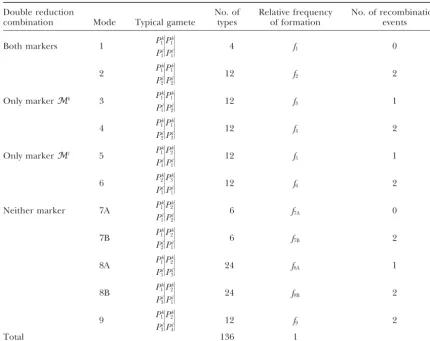
for parentQ.The recombination fraction between the parent, all these types of gametes can be classified into 11 basic modes according to double reduction and the two markers is denoted by P for parent P andQ for
parentQ.For the two autotetraploid parents used for number of recombination events (Mather1936; Table 1):
the cross, there are a total of 576 allelic configurations or linkage phase assignments between the two markers,
1 and 2: The first two modes of gametic formation shown one of which is schematically expressed as
in Table 1 involve double reduction at both markers MkandMl. Of the two modes, the first has no recom-Pk 1 Pl 1
兩
Pk 2 Pl 2兩
Pk 3 Pl 3兩
Pk 4 Pl 4兩
⫻Q1k
Ql 1
兩
Qk 2 Ql 2兩
Qk 3 Ql 3兩
Qk 4 Ql 4兩
, (1) bination between the chromosomes and thus entails only four parental types of gamete:
where lines indicate the individual homologous
chro-Pk 1 Pl 1
兩
Pk 1 Pl 1兩
,P k 2 Pl 2兩
Pk 2 Pl 2兩
,P k 3 Pl 3兩
Pk 3 Pl 3兩
,P k 4 Pl 4兩
Pk 4 Pl 4兩
. mosomes on which the two markers are located. Therecombination fractionsPandQare estimated on the
basis of the segregation of the two-marker joint geno- The second mode has 12 possibilities as a result of types observed in the progeny of the family. However, recombination between a pair of the four chromo-the observations of chromo-the joint marker genotypes are con- somes:
founded by the models of meiotic pairings (bivalent or
quadrivalent) and parental linkage phases of different Pk 1 Pl 2
兩
Pk 1 Pl 2兩
,P k 1 Pl 3兩
Pk 1 Pl 3兩
,P k 1 Pl 4兩
Pk 1 Pl 4兩
;P k 2 Pl 1兩
Pk 2 Pl 1兩
,P k 2 Pl 3兩
Pk 2 Pl 3兩
,P k 2 Pl 4兩
Pk 2 Pl 4兩
; alleles across the two maternally and two paternallyde-rived chromosomes. To make accurate estimates forP
andQ, therefore, it is essential to select a most likely P k 3 Pl 1
兩
Pk 3 Pl 1兩
,P k 3 Pl 2兩
Pk 3 Pl 2兩
,P k 3 Pl 4兩
Pk 3 Pl 4兩
;P k 4 Pl 1兩
Pk 4 Pl 1兩
,P k 4 Pl 2兩
Pk 4 Pl 2兩
,P k 4 Pl 3兩
Pk 4 Pl 3兩
. pairing model and linkage phase configuration over thetwo parents.
3 and 4: The second two modes include double reduc-In this article, we proposed a model for fully
informa-tion only at marker Mk. For mode 3, one parental
tive codominant markers,i.e., those of eight different
chromosome is unchanged, but the other is made up alleles between the two autotetraploid parents at each
by all possible types of recombination between this marker. We assume that the four homologous
chromo-chromosome and the remaining three. There are 12 somes form quadrivalents. Thus, for a particular marker
possibilities and typical gametes are like Mk, we must consider the full chromatid complement
that may be represented as gametesPk
1Pk1, Pk2P2k, Pk3Pk3, Pk
1 Pl 1
兩
Pk 1 Pl 2兩
,P k 1 Pl 1兩
Pk 1 Pl 3兩
,P k 1 Pl 1兩
Pk 1 Pl 4兩
. andPk4Pk4 for parent Pand gametesQ1kQ1k, Q2kQ2k, Q3kQ3k,
andQk
4Q4kfor parentQ.The generation of these gametes
is typical of the four-strand model in which both chro- And for mode 4, both chromosomes are derived from matids of a single chromosome may be passed to the recombination between the four parental chromo-same gamete, forming the so-called double reduction somes. There are also 12 possibilities such as (Darlington1929;Mather1936;Fisher1947). The
frequency of double reduction is a constant for any Pk
1 Pl 2
兩
Pk 1 Pl 3兩
,P k 1 Pl 2兩
Pk 1 Pl 4兩
,P k 1 Pl 3兩
Pk 1 Pl 4兩
. given locus, depending on its distance from thecentro-mere. We denote the frequencies of double reduction
5 and 6: The next two modes involve double reduction atMkby␣
Pfor parentPand␣Qfor parentQ.Similarly,
only at markerMland have classifications similar to
Pand Qare denoted for marker Ml. Following the
the second two modes. classification inFisher (1947), with two linked loci in
Other 5: The last five modes (7A, 7B, 8A, 8B, and 9), tetrasomics there are four different combinations in
in which neither markerMknorMlhas double
reduc-terms of the existence of double reduction:
tion, can be sorted into three types. In the first type, 1. Both markers display double reductions; mode 7, two gametic chromosomes are derived from 2. only markerMkdisplays double reductions;
two of the parental chromosomes either without recom-3. only markerMldisplays double reductions; and
bination (mode 7A) or with recombination (mode 7B). 4. none of the markers display double reductions. There are six possibilities for each group. Typical
gamete types are Since there are four sources for the allele at any given
locus, a gametic chromosome with two loci can be made Pk 1 Pl 1
兩
Pk 2 Pl 2兩
and P k 1 Pl 2兩
Pk 2 Pl 1兩
. up 16 ways:Because the same genotype is represented, 7A and Pk
r
Pl s
兩
(r,s⫽1, 2, 3, 4).
TABLE 1
The model of quadrivalent formation for a diploid gamete in a tetrasomic parent with two linked markersMkandMl
Double reduction No. of Relative frequency No. of recombination
combination Mode Typical gamete types of formation events
Both markers 1 P
k 1
Pl 1
兩
Pk 1
Pl 1
兩
4 f1 0
2 P
k 1
Pl 2
兩
Pk 1
Pl 2
兩
12 f2 2
Only markerMk 3 P1k
Pl 1
兩
Pk 1
Pl 2
兩
12 f3 1
4 P
k 1
Pl 2
兩
Pk 1
Pl 3
兩
12 f4 2
Only markerMl 5 P1k
Pl 1
兩
Pk 2
Pl 1
兩
12 f5 1
6 P
k 2
Pl 1
兩
Pk 3
Pl 1
兩
12 f6 2
Neither marker 7A P
k 1
Pl 1
兩
Pk 2
Pl 2
兩
6 f7A 0
7B P
k 1
Pl 2
兩
Pk 2
Pl 1
兩
6 f7B 2
8A P
k 1
Pl 1
兩
Pk 2
Pl 3
兩
24 f8A 1
8B P
k 1
Pl 3
兩
Pk 2
Pl 1
兩
24 f8B 2
9 P
k 1
Pl 3
兩
Pk 2
Pl 4
兩
12 f9 2
Total 136 1
There are 136 different gametes with the two linked markers Pk
r1
Pl s1
兩
Pk r2
Pl s2
兩
(r1,r2,s1,s2⫽1, 2, 3, 4).
We use a singlef7to denote the mixed frequency with which both 7A and 7B occur at meiosis;i.e.,f7⫽f7A⫹
f7B. For the same reason, the mixed frequency of 8A and 8B is denoted byf8.
phenotypes. The second type (mode 8) of nondouble Because gametes for fully informative markers are unique to the two parents and because the two parents reduction is that two gametic chromosomes are
de-rived from three of the parental chromosomes with are assumed to behave independently in terms of double reduction and recombination, gamete genotypes can one event of recombination (8A, 24 possibilities) or
two events of recombinations (8B, 24 possibilities). provide adequate information for linkage analysis as much as zygote genotypes. Therefore, to simplify our Gamete examples for modes 8A and 8B are
treatments, we base our linkage analysis on the segrega-tion of the gamete genotypes in each parent. Thereafter, Pk
1
Pl 1
兩
Pk 2
Pl 3
兩
and P
k 1
Pl 3
兩
Pk 2
Pl 1
兩
.
only parent P is considered because a symmetrical in-ference can be made for parent Q. We refer to the They arealso indistinguishablebecause they have
iden-frequencies of double reduction and recombination tical genotypes. The third type (mode 9) of
nondou-fraction between the markers for parentPby␣,, and ble reduction includes recombination between all
without the subscript P, unless otherwise specified. four different chromosomes such as
Parameter estimation:For markerMk, assume a fixed
assignment for the four alleles of parentPin the order Pk
1
Pl 3
兩
Pk 2
Pl 4
兩
. Pk
1, Pk2, Pk3, and Pk4. Given such a fixed assignment for
markerMk, we randomly assign the four observed alleles
of marker Ml, Pl
1, Pl2, Pl3, and Pl4, with a total of 24
different possibilities. One of the possibilities should Pk 1 Pl 1
兩
Pk 2 Pl 2兩
and P k 1 Pl 2兩
Pk 2 Pl 1兩
present a correct assignment for the alleles of the two markers among the four homologous chromosomes.
The estimates of the frequencies of double reduction are two reciprocal assignments, but they have the same and the recombination fraction between the two mark- genotype and are mixed in the same cell at row 5 and ers should be based on their best, but unknown, allelic column 5.
assignment across the parental chromosomes. For link- Because formation mode 7 is a mixture of double age analysis in autotetraploid populations, therefore, a recombinants and nonrecombinants, the determina-vector of unknown parameters can be denoted by⫽ tion of the expected number of recombination events (A, ␣, , )T, where A is the th allelic assignment under this mode requires information about the relative
for marker Ml relative to the fixed allelic assignment
proportions of these two types of offspring. Given the of markerMk.
relative proportion of double recombinants in mode 7 Given a particular allelic assignment for parent Pas (φ ⫽ f
7B/f7, see appendix), the expected number of
shown in expression (1), four double reduction gametes recombination events is 2φ. Similarly, for mode 8, which and six nondouble reduction gametes generated by is a mixture of single recombinants and double recombi-marker Mk can be arrayed in the order {Pk
1Pk1,Pk2Pk2, nants, the expected number of recombination events is
Pk
3Pk3,Pk4Pk4,Pk1Pk2,Pk1Pk3,Pk1Pk4,Pk2Pk3,Pk2Pk4,P3kPk4} and {Pl1P1l,Pl2Pl2, calculated as 1 · (1⫺ )⫹2 · ⫽1⫹ , where is
Pl
3Pl3,Pl4Pl4,P1l Pl2,Pl1Pl3,Pl1Pl4,Pl2Pl3,Pl2Pl4,Pl3Pl4} at markerMl. the proportion of double recombinants in mode 8
Thus, we can identify 10⫻10⫽100 two-marker gamete
( ⫽ f8B/f8; seeappendix). The expected numbers of
genotypes for parentP. Following notation inFisher
recombination events between the two markers can be (1947), we definef, the relative frequencies of the 11
expressed in matrix notation as different modes of gamete formation, which must sum
to unity (Table 1). However, because the marker pheno- D⫽{Dr1r2 s1s2}10⫻10
types of 7A and 7B cannot be distinguished, we use a singlef7to denote the mixed frequency with which both
7A and 7B occur at meiosis. For the same reason, the mixed frequency of 8A and 8B is denoted byf8. It is not
difficult to express the joint relative frequencies of two-marker diploid gametes in matrix notation:
H⫽{Hr1r2
s1s2}10⫻10
⫽
Pl
1Pl1
Pl
2Pl2
Pl
3Pl3
Pl
4Pl4
Pl
1Pl2/Pl2Pl1
Pl
1Pl3/Pl3Pl1
Pl
1Pl4/Pl4Pl1
Pl
2Pl3/Pl3Pl2
Pl
2Pl4/Pl4Pl2
Pl
3Pl4/Pl4Pl3
Pk1Pk1Pk2Pk2Pk3Pk3Pk4Pk4 Pk1Pk2 Pk1Pk3 Pk1Pk4 Pk2Pk3 Pk2Pk4 Pk3Pk4
0 2 2 2 1 1 1 2 2 2
2 0 2 2 1 2 2 1 1 2
2 2 0 2 2 1 2 1 2 1
2 2 2 0 2 2 1 2 1 1
1 1 2 2 2φ 1⫹ 1⫹ 1⫹ 1⫹ 2
1 2 1 2 1⫹ 2φ 1⫹ 1⫹ 2 1⫹
1 2 2 1 1⫹ 1⫹ 2φ 2 1⫹ 1⫹
2 1 1 2 1⫹ 1⫹ 2 2φ 1⫹ 1⫹
2 1 2 1 1⫹ 2 1⫹ 1⫹ 2φ 1⫹
2 2 1 1 2 1⫹ 1⫹ 1⫹ 1⫹ 2φ
.The above information allows us to express the
recom-⫽
Pl
1Pl1
Pl
2Pl2
Pl
3Pl3
Pl
4Pl4
Pl
1Pl2/Pl2Pl1
Pl
1Pl3/Pl3Pl1
Pl
1Pl4/Pl4Pl1
Pl
2Pl3/Pl3Pl2
Pl
2Pl4/Pl4Pl2
Pl
3Pl4/Pl4Pl3
Pk1Pk1Pk2Pk2Pk3Pk3Pk4Pk4Pk1Pk2Pk1Pk3Pk1Pk4Pk2Pk3Pk2Pk4Pk3Pk4 1⁄
4f1 1⁄12f2 1⁄12f2 1⁄12f2 1⁄12f5 1⁄12f5 1⁄12f5 1⁄12f6 1⁄12f6 1⁄12f6 1⁄
12f2 1⁄4f1 1⁄12f2 1⁄12f2 1⁄12f5 1⁄12f6 1⁄12f6 1⁄12f5 1⁄12f5 1⁄12f6 1⁄
12f2 1⁄12f2 1⁄4f1 1⁄12f2 1⁄12f6 1⁄12f5 1⁄12f6 1⁄12f5 1⁄12f6 1⁄12f5 1⁄
12f2 1⁄12f2 1⁄12f2 1⁄4f1 1⁄12f6 1⁄12f6 1⁄12f5 1⁄12f6 1⁄12f5 1⁄12f5
1⁄
12f3 1⁄12f3 1⁄12f4 1⁄12f4 1⁄6f7 1⁄24f8 1⁄24f8 1⁄24f8 1⁄24f8 1⁄6f9 1⁄
12f3 1⁄12f4 1⁄12f3 1⁄12f4 1⁄24f8 1⁄6f7 1⁄24f8 1⁄24f8 1⁄6f9 1⁄24f8 1⁄
12f3 1⁄12f4 1⁄12f4 1⁄12f3 1⁄24f8 1⁄24f8 1⁄6f7 1⁄6f9 1⁄24f8 1⁄24f8 1⁄
12f4 1⁄12f3 1⁄12f3 1⁄12f4 1⁄24f8 1⁄24f8 1⁄6f9 1⁄6f7 1⁄24f8 1⁄24f8 1⁄
12f4 1⁄12f3 1⁄12f4 1⁄12f3 1⁄24f8 1⁄6f9 1⁄24f8 1⁄24f8 1⁄6f7 1⁄24f8 1⁄
12f4 1⁄12f4 1⁄12f3 1⁄12f3 1⁄6f9 1⁄24f8 1⁄24f8 1⁄24f8 1⁄24f8 1⁄6f7
. bination fractionand the two double reduction param-eters,␣at markerMkandat markerMl, in terms of f1, . . . ,f9andφ,. We have
␣ ⫽f1⫹f2⫹f3⫹f4;
 ⫽f1⫹f2⫹f5⫹f6;
2 ⫽(f3⫹f5)⫹2(f2⫹f4⫹f6⫹f9)⫹2φf7⫹(1⫹ )f8.
(2)
From the above equations, it follows that |␣ ⫺ |⫽|f3⫹
However, as illustrated earlier, there are as many as 136
f4 ⫺ f5 ⫺ f6) ⱕ f3 ⫹ f4 ⫹ f5 ⫹ f6 ⱕ 2. Therefore the
gamete formations for any two linked markers. The 36
difference in the frequency of double reduction be-“extra” gamete formations are each due to a reciprocal
tween two loci is bounded by two times the recombina-allelic assignment of markerMland are located in the
tion fraction in tetraploid. This inequality is consistent 6 ⫻ 6 ⫽ 36 cells of the above matrix’s bottom-right
with the fact that when two markers are close, their corner, in which neither of the two markers displays
double reduction rates tend to be similar. We believe double reduction (Table 1). Of these 36 formations, 6
similar inequalities exist for other ploidy levels. How-are under mode 7, 24 How-are under mode 8, and the
re-ever, due to complexity of gamete types for those cases, maining 6 are under mode 9. For example, gamete
For a fully informative marker, every gamete genotype
⫽ 1
2N[N3⫹N5⫹2(N2⫹ N4⫹ N6⫹ N9) can be well distinguished. Thus, N offspring in a
full-sib family can be sorted into the nine distinguishable
gamete formation modes of sizeN1,N2, . . . ,N9, respec- ⫹ 2 2
22⫺18 ⫹9N7⫹
3⫺
3⫺2N8]. (6) tively (see Table 1). It is not difficult to derive the
ex-plicit expressions of the maximum-likelihood estimates Since this a fourth-order polynomial of, closed-form for the frequencies of these nine formation modes f1, solutions exist and can be calculated very easily.
f2, . . . ,f9in terms of the corresponding sample frequen- The characterization of linkage phase: We derived
ciesN1,N2, . . . ,N9on the basis of the following likelihood statistical procedures for estimating ␣, , and when
function given the observed marker data (M): the allelic assignment as shown in expression (1) is assumed. The estimates of parameters (␣,,) for any
ᐉ(f|M)⫽
冢
NN1 . . .N9冣
兿
9i⫽1
fNi
i . one of the other 23 assignments can be similarly
ob-tained by changing the positions of the corresponding elements in matricesHandD. One remaining issue is From the above matrixH, which indicates where double
how to determine the best assignment,i.e., one corre-reduction has occurred for each of the markers, the
sponding to a most likely parental linkage phase of two double-reduction parameters,␣and, can be
esti-the two markers. The most likely linkage phase can be mated in terms of the corresponding frequencies of
determined using the posterior probability of⫽(A, formation modes;i.e.,␣ˆ ⫽(N1⫹N2⫹N3⫹N4)/Nand
␣,,)Tconditional on the marker dataM, whereA
ˆ ⫽ (N1 ⫹ N2 ⫹ N5 ⫹ N6)/N. Since these are simply
is theth allelic assignment for markerMlrelative to
estimates of binomial proportions, the variances of ␣ˆ
the fixed allelic assignment of markerMk. From Bayes’
andˆ are␣(1⫺ ␣)/N and(1⫺ )/N, respectively.
theorem: Suppose we could distinguish the twof7modes and
the twof8modes; the likelihood function given complete
P(|M)⫽ P()P(M|)
R24
⫽1P()P(M|)
. data (N1,N2, . . . ,N6,N7A,N7B,N8A,N8B,N9) is
These posterior probabilities for all possible
assign-ᐉ(f|M)⫽
冢
NN1. . .N9冣 冢
兿
6i⫽1
fNi
i
冣
fN7A7AfN7B7Bf8AN8AfN8B8BfN99. (3)ments depend on the prior probabilitiesP(). In prac-tice, the prior distribution can be assumed to be uniform On the basis of the observed incomplete dataN1,N2, . . . ,
among all 24 assignments and, in this case, the posterior N7, N8, N9, the EM algorithm is used to estimate the
probabilities are proportional to the likelihoods recombination fraction by maximizing the likelihood
L()⫽ P(M|). The final MLEs for the parameters Equation 3 (Dempsteret al.1977;LanderandGreen
(␣,,) are based on the most likely assignment with 1987). The general equations formulating the iteration
the highest posterior probability. of the ⫹1)th EM step are given as follows:
Sved (1964) demonstrated that, unless they solely E step: Calculate the expected number of recombina- form bivalents, autotetraploids have a recombination
tion events between markers MkandMlfor all
off-fraction bounded by 1 ⫺ 1/x, where x is the level of spring with no occurrence of double reduction. This ploidy. Thus, for autotetraploids undergoing quadriva-is equivalent to estimating φ for mode 7 and for lent pairings, the maximum value of recombination mode 8, respectively, by fraction is ⫽0.75. The test of whether or not the two given markers are linked is based on the log-likelihood-ratio test statistic under the full model (Equation 3), φˆ()⫽ [()]2
2[()]2⫺18()⫹9, ˆ
()⫽ ()
3⫺2(). (4)
which corresponds to the parameter estimators derived from the most likely assignments, and the reduced M step: Maximize the expected log-likelihood of .
model with the restraint of ⫽ 0.75. The likelihood-This gives an updated estimate for the recombination
ratio test (LRT) statistic calculated in this way has a
fraction and is obtained as 2
-distribution with1⁄
2 d.f. under the null hypothesis
(SelfandLiang1987). Thus, two markersMkandMl
ˆ(⫹1)⫽ 1
2N[N3 ⫹N5 ⫹2(N2⫹N4⫹N6⫹N9) can be declared to be linked if the LRT is ⬎ 21/2,␦for
an appropriate choice of the type I error rate ␦ (for
⫹2φˆ()N
7⫹(1⫹ ˆ())N8]. (5) example,21/2,0.05⫽2.42).
These two steps are repeated until the estimate of
converges to a stable value. Such a stable value is the SIMULATION maximum-likelihood estimate (MLE) of.
Analysis of a simulated data set: We illustrate the autotetraploid model through analyzing a simulated ex-If we plugφandfrom Equations 4 into 5, we can
we consider analysis only on the segregation of the ga- Pk 1
Pl 1
兩
Pk 3
Pl 4
兩
mete genotypes in parentP, which is assumed to have frequencies of double reduction (0.05, 0.1) and
recom-bination fraction 0.05. These parameters correspond to should be in mode 7 instead of mode 8. The counts for all nine gamete formation modes, under the new relative frequencies of the nine different gamete
forma-tion modes f ⫽ (0.04071, 0.00130, 0.00446, 0.00353, assignments, areN1 ⫽7,N2⫽7,N3⫽ 2,N4⫽1,N5⫽
5,N6⫽5,N7⫽53,N8⫽123,N9⫽0. Consequently, we
0.04301, 0.01498, 0.88221, 0.00736, 0.00245), which give
the joint relative frequencies of two-marker diploid ga- can obtain the MLE (␣ˆ,ˆ,ˆ)⫽ (0.07, 0.105, 0.46436) with log-likelihood llA ⫽ ⫺758.50. Similar to the first
metes in the matrixH. A random sample of N ⫽200
gametes was simulated from multinomial distribution assignment, we also have MLE (␣ˆ,ˆ,ˆ)⫽(0.118, 0.208, 0.75) with log-likelihood llN⫽ ⫺786.47 under the null
with probabilities given byH.The marker dataM,e.g.,
the counts of all gamete types, can be presented in the hypothesis.
This procedure needs to be repeated for all of the following matrix form:
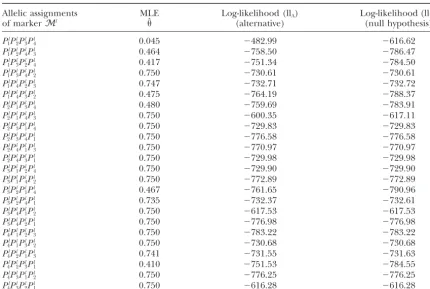
other 22 assignments. In Table 2, we present MLEs and log-likelihood for all 24 different allelic assignments. Figure 2 (top left) plotted the log-likelihood values against the 24 assignments of markerMlwith a
diction-ary order 1234, 1243, . . . , 4321. Estimates of the recom-bination fraction for different assignments are indicated by different insets in the figure. It shows that a true assignment has the largest log-likelihood value. Pl
1Pl1
Pl 2Pl2
Pl 3Pl3
Pl 4Pl4
Pl 1Pl2/Pl2Pl1
Pl 1Pl3/Pl3Pl1
Pl 1Pl4/Pl4Pl1
Pl 2Pl3/Pl3Pl2
Pl 2Pl4/Pl4Pl2
Pl 3Pl4/Pl4Pl3
Pk
1Pk1Pk2Pk2Pk3Pk3Pk4Pk4Pk1Pk2Pk1Pk3Pk1Pk4Pk2Pk3Pk2Pk4Pk3Pk4
3 0 0 0 1 2 0 0 0 0
0 4 0 0 1 0 0 1 0 0
0 0 3 0 1 0 0 1 0 0
0 0 0 1 0 0 1 0 2 0
0 2 0 0 22 0 1 0 0 0
0 0 0 0 0 16 0 0 0 0
0 0 0 0 0 0 33 1 0 0
0 0 0 0 1 0 0 35 0 0
0 0 0 1 0 0 0 0 36 0
0 0 0 0 0 0 0 0 0 31
.
Since assignment 1 has the largest log-likelihood, we choose the final MLEs for the parameters on the basis of the first assignment; e.g., (␣ˆ, ˆ, ˆ) ⫽ (0.07, 0.105, 0.453) with log-likelihood llA⫽ ⫺482.98. However,
un-der the null hypothesis, the final MLE comes from the last assignment with log-likelihood llN⫽ ⫺616.28. Thus
the LRT statistic equals⫺2 ⫻ (⫺616.28⫹ 482.98) ⫽ Suppose parentP has alignment 266.60, which is much larger than the cut point value
2
1/2,0.05⫽2.42, implying that there is very strong
evi-dence that the two markers are linked. Pk
1
Pl 1
兩
Pk 2
Pl 2
兩
Pk 3
Pl 3
兩
Pk 4
Pl 4
兩
;
More simulations: Extensive simulation studies were performed to investigate the properties of our statistical then there are 11 offspring in the first gamete formation method by evaluating the effectiveness of determining mode (N1⫽3⫹ 4⫹ 3⫹ 1). Similarly, counts for the a correct allelic assignment, the precision of the
parame-other eight modes areN2⫽0,N3⫽3,N4⫽0,N5⫽9, ter estimates, and the power to detect linkage. A number
N6⫽1,N7⫽ 173,N8⫽ 2, andN9⫽ 1. Hence we have of genetic scenarios are designed to explore the effects
MLEs of the relative frequencies of the nine different
of different parameter values on their estimation from gamete formation modes fˆ ⫽ (11/200, 0, 3/200, 0,
this new method. A segregating full-sib family of size 9/200, 1/200, 173/200, 2/200, 1/200), which
corre-N⫽80, 200, 400, or 800 is simulated by hypothesizing spond to␣ˆ⫽(N1⫹N2⫹N3⫹N4)/N⫽0.07,ˆ⫽(N1⫹ different recombination fractions ranging from tight
N2 ⫹ N5 ⫹ N6)/N ⫽ 0.105, andˆ ⫽ 0.0453 with log- linkage to free recombination, ⫽0.05, 0.15, 0.25, 0.50,
likelihood (ll)A⫽ ⫺482.98. Furthermore, under the null 0.65, and 0.75, and different pairs of double reduction
hypothesis ⫽0.75, the MLEs of mode frequencies are rates with various degrees of difference between two fˆ⫽(0.01396, 0, 0.00757, 0, 0.02272, 0.25448, 0.43679, markers, (␣, )⫽ (0.05, 0.1), (0.15, 0.2), (0.25, 0.3), 0.01, 0.25448), and the parameter estimates are ␣ˆ ⫽ (0.1, 0.2) and (0.05, 0.3). For ⫽0.05, however, only 0.022,ˆ ⫽ 0.291 with llN⫽ ⫺616.62. the first three pairs of (␣, ) are considered because
For a second assignment the other two combinations are impossible (recall |␣ ⫺
|ⱕ2). The simulation is repeated 1000 times for each Pk
1
Pl 1
兩
Pk 2
Pl 2
兩
Pk 3
Pl 4
兩
Pk 4
Pl 3
兩
, scenario. For each replication, the maximum-likelihood
estimates (ˆ,␣ˆ,ˆ) and the log-likelihood value are ob-tained for all 24 possible assignments. In addition, the gamete classification is different. For example, gamete
LRT was calculated for each simulation to test for the significance of linkage.
Pk 3
Pl 4
兩
Pk 3
Pl
4
兩
In Figure 2, the log-likelihood values are plottedagainst the 24 different allelic assignments of marker has no recombination and should be classified into Mlwith a dictionary order 1234, 1243, . . . , 4321. For
TABLE 2
Maximum-likelihood estimatesˆ of the recombination fraction with all 24 different allelic assignments of markerMlfor the simulated example
Allelic assignments MLE Log-likelihood (llA) Log-likelihood (llN)
of markerMl ˆ (alternative) (null hypothesis)
Pl
1Pl2Pl3Pl4 0.045 ⫺482.99 ⫺616.62
Pl
1Pl2Pl4Pl3 0.464 ⫺758.50 ⫺786.47
Pl
1Pl3Pl2Pl4 0.417 ⫺751.34 ⫺784.50
Pl
1Pl3Pl4Pl2 0.750 ⫺730.61 ⫺730.61
Pl
1Pl4Pl2Pl3 0.747 ⫺732.71 ⫺732.72
Pl
1Pl4Pl3Pl2 0.475 ⫺764.19 ⫺788.37
Pl
2Pl1Pl3Pl4 0.480 ⫺759.69 ⫺783.91
Pl
2Pl1Pl4Pl3 0.750 ⫺600.35 ⫺617.11
Pl
2Pl3Pl1Pl4 0.750 ⫺729.83 ⫺729.83
Pl
2Pl3Pl4Pl1 0.750 ⫺776.58 ⫺776.58
Pl
2Pl4Pl1Pl3 0.750 ⫺770.97 ⫺770.97
Pl
2Pl4Pl3Pl1 0.750 ⫺729.98 ⫺729.98
Pl
3Pl1Pl2Pl4 0.750 ⫺729.90 ⫺729.90
Pl
3Pl1Pl4Pl2 0.750 ⫺772.89 ⫺772.89
Pl
3Pl2Pl1Pl4 0.467 ⫺761.65 ⫺790.96
Pl
3Pl2Pl4Pl1 0.735 ⫺732.37 ⫺732.61
Pl
3Pl4Pl1Pl2 0.750 ⫺617.53 ⫺617.53
Pl
3Pl4Pl2Pl1 0.750 ⫺776.98 ⫺776.98
Pl
4Pl1Pl2Pl3 0.750 ⫺783.22 ⫺783.22
Pl
4Pl1Pl3Pl2 0.750 ⫺730.68 ⫺730.68
Pl
4Pl2Pl1Pl3 0.741 ⫺731.55 ⫺731.63
Pl
4Pl2Pl3Pl1 0.410 ⫺751.53 ⫺784.55
Pl
4Pl3Pl1Pl2 0.750 ⫺776.25 ⫺776.25
Pl
4Pl3Pl2Pl1 0.750 ⫺616.28 ⫺616.28
The last two columns are the log-likelihood (llA) under alternative hypothesis and (llN) under null hypothesis
( ⫽0.75).
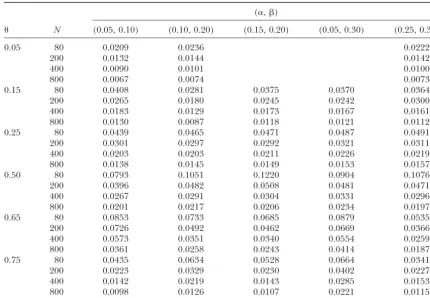
bination fraction are obtained, as indicated by different depends on true double reduction rates (␣,) with two tendencies (Table 3). First, the RMSEs tend to be larger insets in the figure. It is shown that a true assignment
usually corresponds to the largest log-likelihood value. when there are larger double reduction rates. Second, the RMSEs tend to increase when the difference of There is a distinct difference between the largest and
the second-largest log-likelihood values, especially when double reduction between the two markers increases. For example, the RMSEs ofˆ⫽0.5 or above are larger
is small. This implies that our method can well be used
to characterize the marker linkage phase in parents. In for (␣,)⫽(0.10, 0.20) than (0.25, 0.30), although the latter combination has larger double reduction rates. some cases, the second-largest log-likelihood value is
The power to detect a significant linkage is examined associated with the estimate of ⬎0.75, so it is easy to
on the basis of 1000 replicates (Figure 3). Obviously, avoid the assignment corresponding to such an
esti-the power of esti-the test increases with increasing sample mate.
sizes. However, the effect of sample size depends on the We did not report simulation results about double
double reduction rates and recombination fraction. For reduction rate estimates␣ˆ andˆ because we have
closed-example, the effect is larger for (␣,)⫽(0.1, 0.2) than form formulas for their variances. To evaluate the
preci-for (␣, ) ⫽ (0.15, 0.2) when ⫽ 0.65, but this is sion of the recombination fraction estimates,
square-reversed for ⫽0.5. rooted mean square errors (RMSEs) are calculated for
all simulation scenarios (Table 3). As expected, the RMSEs decrease with increasing sample sizes. However,
DISCUSSION sample size effects also decrease with increasing sample
Figure
2.—Plot
of
the
log-likelihood
(ll)
vs.
24
assignments
for
18
sets
of
parameters
(
,
␣
,

)
from
one
simulation
with
sample
size
N
⫽
200.
The
x
-axes
are
the
24
assignments
in
d
ictionary
order,
i.e.
,
1
234,
1243,
.
.
.
,
4321.
D
ifferent
symbols
used
in
the
plots
indicate
the
range
of
MLE
ˆfor
e
ach
assignment:
circles
for
ˆin
(0,
1/8];
crosses
for
(1/8,
3/8];
stars
for
(3/8,
5/8];
diamonds
for
(5/8,
3/4];
and
squares
for
o
thers.
The
MLE
ˆ ’s
corresponding
to
the
m
ost
likely
assignment
are
indicated
in
each
TABLE 3
Square-rooted mean square error (RMSE) for the estimatorˆ of the recombination fraction for all 28 combinations of parameters (,␣,) and four sample sizesN
(␣,)
N (0.05, 0.10) (0.10, 0.20) (0.15, 0.20) (0.05, 0.30) (0.25, 0.30)
0.05 80 0.0209 0.0236 0.0222
200 0.0132 0.0144 0.0142
400 0.0090 0.0101 0.0100
800 0.0067 0.0074 0.0073
0.15 80 0.0408 0.0281 0.0375 0.0370 0.0364
200 0.0265 0.0180 0.0245 0.0242 0.0300
400 0.0183 0.0129 0.0173 0.0167 0.0161
800 0.0130 0.0087 0.0118 0.0121 0.0112
0.25 80 0.0439 0.0465 0.0471 0.0487 0.0491
200 0.0301 0.0297 0.0292 0.0321 0.0311
400 0.0203 0.0203 0.0211 0.0226 0.0219
800 0.0138 0.0145 0.0149 0.0153 0.0157
0.50 80 0.0793 0.1051 0.1220 0.0904 0.1076
200 0.0396 0.0482 0.0508 0.0481 0.0471
400 0.0267 0.0291 0.0304 0.0331 0.0296
800 0.0201 0.0217 0.0206 0.0234 0.0197
0.65 80 0.0853 0.0733 0.0685 0.0879 0.0535
200 0.0726 0.0492 0.0462 0.0669 0.0366
400 0.0573 0.0351 0.0340 0.0554 0.0259
800 0.0361 0.0258 0.0243 0.0414 0.0187
0.75 80 0.0435 0.0634 0.0528 0.0664 0.0341
200 0.0223 0.0329 0.0230 0.0402 0.0227
400 0.0142 0.0219 0.0143 0.0285 0.0153
800 0.0098 0.0126 0.0107 0.0221 0.0115
ysis in autopolyploids, many earlier methods assume a bounded by two times their recombination fraction in tetraploid.
pure bivalent pairing model between homologous
chro-mosomes during meiosis (Wuet al.1992; Hackett et With these underpinning mechanisms of quadriva-lent pairings, Fisher (1947) formulated a pioneering al.1998;Ripolet al.1999;Luoet al.2001). Although the
statistical merits of these methods were demonstrated by genetic model to count all possible modes of gamete formation in autotetraploids. But, in his time, he could extensive simulations, their underlying assumption may
significantly deviate from biological reality. For an auto- not separate and further estimate two different modes generating the same gamete genotypes (e.g., mode 7A polyploid, multivalent pairings during gametogenesis
may result in double reduction (Darlington1929;de vs. 7B or mode 8A vs. 8B; Table 1). Thanks to the development of the maximum-likelihood method
im-Winton and Haldane 1931; Mather 1936; Fisher
1947), a phenomenon that adds extra complexity in plemented with the EM algorithm (Dempster et al. 1977), we are now able to well discriminate and estimate the establishment of a workable model for polysomic
linkage analysis. the proportions of these different modes by viewing
them as a missing data problem. In this article, we derive a statistical method for
simul-taneously estimating the linkage and linkage phase be- The advantage of the EM algorithm is that it resulted in closed-form solution for the recombination fraction. tween different markers in a full-sib family of
autotetra-ploids undergoing quadrivalent pairings at meiosis. This However, if we forego this, it is also possible to perform a Bayesian analysis. We may assign a Dirichlet prior for method based on quadrivalent pairings is not a simple
extension of the existing models on bivalent pairing. the frequencies of the nine formation modesf⫽(f1,f2,
. . . ,f9), which yields a Dirichlet posterior distribution
Rather, the method has incorporated the cytological
mechanisms underlying gamete formation derived from offgiven the sample frequenciesN1,N2, . . . ,N9. Thus
we can easily sample from the posterior offand obtain multivalent pairings, some of which (i.e., double
reduc-tion) are unique and do not happen with bivalent pair- a posterior sample of (␣,,) by letting␣ ⫽f1⫹f2⫹
f3⫹f4, ⫽f1⫹f2⫹f5⫹f6and solvingusing Equation
ings. We also showed that the difference in the
Figure 3.—The size and power of the likelihood-ratio test of linkage using2
1/2,0.05⫽
2.42 on the basis of 1000 repli-cates. The power (or size) of the test vs. true for all five sets of double reduction rates was plotted.
this to the 11 basic gamete modesf*⫽(f1,f2, . . . ,f6, gote genotypes, because the segregation at the gamete
level cannot provide adequate information for linkage f7A, f7B, f8A, f8B, f9), then a Gibbs sampler could be set
up to obtain posterior samples (Robert andCasella analysis.
Second, our method is based on a single pairing 2000).
Although we have devised a statistical method for model—quadrivalent. Chromosome pairings in auto-polyploids indeed are a function of the homology resolving a fundamentally important problem in
auto-polyploid linkage analysis, one that has puzzled geneti- between the genomes involved, with a propensity in pairing between homologous over homeologous chromo-cists for over one-half century, there is still much room
for improvement. First, our model is proposed for fully somes, which is defined as the preferential pairing factor (Sybenga1994). Such a preferential pairing factor de-informative codominant markers,i.e., those of eight
dif-ferent alleles between the two autotetraploid parents at termines the relative importance of bivalentvs. multiva-lent pairings in autopolyploids and, therefore, can be each marker. For these markers, an explicit expression
exists for the MLE of the frequency of double reduction, used to model the frequency of double reduction and recombination fraction when both bivalent and multiva-although the estimate of the recombination fraction
must rely upon EM iterations. In a practical full-sib map- lent pairings happen simultaneously during meiosis. Last, our method is developed for autotetraploids, but ping population, other types of markers, such as
domi-nant or partially informative, may be common. For auto- its extension to autohexaploid, autooctoploid, and auto-dexaploid species is important because many important polyploids, dominant markers derived from randomly
amplified polymorphic DNA or amplified fragment plant species have such high ploidy levels (Soltisand
Soltis2000). For an autohexaploid plant, for instance,
length polymorphism technologies typically cannot be
distinguished among simplex (single dose), duplex triploid gametes are generated at meiosis, including three gamete types of pure double reduction, partial (double dose), and multiplex (multiple dose) types,
because they present an identical genotype (Wuet al. double reduction, and no double reduction.
The statistical method proposed in this article de-1992;Yu andPauls 1993;Luo et al. 2000). For these
dominant or partially informative markers, gametes scribes a mapping framework for studying the genome structure and organization in complex autopolyploid formed with double reduction may have the same
geno-types as those formed without double reduction. Thus, species, providing a sophisticated model for linkage analysis in autopolyploids. It provides a necessary plat-estimating the frequency of double reduction will have
zy-Masterson, J., 1994 Stomatal size in fossil plants—evidence for important traits in autopolyploids. Although some
pre-polyploidy in majority of angiosperms. Science264:421–424. liminary studies have been reported for QTL mapping Mather, K., 1936 Segregation and linkage in autotetraploids. J.
Genet.32:287–314. in autopolyploids, assuming pure bivalent pairings
Meyer, R. C., D. Milbourne, C. A. Hackett, J. E. Bradshaw, J. W. (DoergeandCraig2000;XieandXu2000), all of these
McNicholandR. Waugh,1998 Linkage analysis in tetraploid should be viewed as premature until a comprehensive potato and association of markers with quantitative resistance to late blight (Phytophthora infestans). Mol. Gen. Genet.259:150–160. model is framed to take both bivalent and multivalent
Otto, S. P.,andJ. Whitton,2000 Polyploid incidence and evolu-pairings into account.
tion. Annu. Rev. Genet.34:401–437.
Ripol, M. I., G. A. Churchill, J. A. G. da SilvaandM. Sorrells, We are grateful to Dr. S. Xu and Dr. M. Gallo-Meagher for
stimulat-1999 Statistical aspects of genetic mapping in autopolyploids. ing discussions regarding this project. The authors thank the associate
Gene235:31–41. editor, referee Dr. R. Deborah Overath, and one anonymous referee
Robert, P. C.,andG. Casella,2000 Monte Carlo Statistical Methods for their constructive comments. This manuscript was approved as
(Springer Texts in Statistics). Springer-Verlag, New York. Journal Series R-08464 by the Florida Agricultural Experiment Station.
Self, S. G.,andK. Y. Liang,1987 Asymptotic properties of maximum likelihood estimators and likelihood ratio tests under nonstan-dard condition. J. Am. Stat. Assoc.82:605–610.
Soltis, P. S.,andD. E. Soltis,2000 The role of genetic and genomic LITERATURE CITED attributes in the success of polyploids. Proc. Natl. Acad. Sci. USA
97:7051–7057. Bever, J. D.,andF. Felber,1992 The theoretical population
genet-Stebbins, G. L.,1971 Chromosomal Evolution in Higher Plants. Addi-ics of autopolyploidy. Oxf. Surv. Evol. Biol.8:185–217.
son-Wesley, Reading, MA. Brouwer, D. J.,andT. C. Osborn,1999 A molecular marker linkage
Sved, J. A.,1964 The relationship between diploid and tetraploid map of tetraploid alfalfa (Medicago sativaL.). Theor. Appl. Genet.
recombination frequencies. Heredity19:585–596. 99:1194–1200.
Sybenga, A.,1994 Preferential pairing estimates from multivalent Darlington, C. D.,1929 Chromosome behaviour and structural
frequencies in tetraploids. Genome37:1045–1055. hybridity in the Tradescantiae. J. Genet.21:207–286.
Wu, K. K., W. Burnquist, M. E. Sorrells, T. L. Tew, P. H. Moore da Silva, J., M. E. Sorrells, W. L. BurnquistandS. D. Tanksley, et al., 1992 The detection and estimation of linkage in polyploids
1993 RFLP linkage map and genome analysis ofSaccharum
spon-using single-dose restriction fragments. Theor. Appl. Genet.83: taneum.Genome36:782–791.
L294–300. Dempster, A. P., N. M. LairdandD. B. Rubin,1977 Maximum
Xie, C. G.,andS. H. Xu,2000 Mapping quantitative trait loci in likelihood from incomplete data via EM algorithm. J. Stat. Soc.
tetraploid populations. Genet. Res.76:105–115.
Ser. B39:1–38. Yu, K. F.,andK. P. Pauls,1993 Segregation of random amplified de Winton, D.,andJ. B. S. Haldane,1931 Linkage in the tetraploid polymorphic DNA markers and strategies for molecular mapping
Primula sinensis.J. Genet.24:121–144. in tetraploid alfalfa. Genome36:844–851. Doerge, R. W.,andB. A. Craig,2000 Model selection for
quantita-tive trait locus analysis in polyploids. Proc. Natl. Acad. Sci. USA Communicating editor:J. B. Walsh 97:7951–7956.
Fisher, R. A.,1947 The theory of linkage in polysomic inheritance. Philos. Trans. R. Soc. Ser. B233:55–87.
APPENDIX Grant, V.,1981 Plant Speciation, Ed. 2. Columbia University Press,
New York.
Among the 16 possible allele configurations, 4 have Grivet, L., A. D’Hont, D. Roques, P. Feldmann, C. Lanaudet al.,
no recombination and 12 have one recombination. If 1996 RFLP mapping in cultivated sugarcane (Saccharum spp):
genome organization in a highly polyploid and aneuploid inter- we form gametes with two chromosomes by selecting, specific hybrid. Genetics142:987–1000. with replacement, from the 16 alleles twice, this yields Hackett, C. A., J. E. Bradshaw, R. C. Meyer, J. W. McNicol, D.
16⫻16⫽256 possibilities (16 with no recombination, Milbourneet al., 1998 Linkage analysis in tetraploid species:
a simulation study. Genet. Res.71:143–154. 96 with one recombination, and 144 with two). Hilu, K. W.,1993 Polyploidy and the evolution of domesticated Recall that φ and are the proportions of gamete
plants. Am. J. Bot.80:1491–1499.
types that have two recombination events under modes Jackson, R. C.,andJ. W. Jackson,1996 Gene segregation in
autotet-raploids: prediction from meiotic configurations. Am. J. Bot.83: 7 and 8, respectively. Note that f7A contains 12 out of
673–678. 16 gametes with no recombination andf
7Bcontains 12
Lander, E. S.,andP. Green,1987 Construction of multilocus
ge-out of 144 gametes with two recombinations; thus the netic linkage maps in human. Proc. Natl. Acad. Sci. USA 84:
2363–2367. relative proportions should be 12(1 ⫺ )2/16:122/
Luo, Z. W., C. A. Hackett, J. E. Bradshaw, J. W. McNicoland 144⫽ 9(1⫺ )2:2. Similarly, f
8Acontains 48 out of 96
D. Milbourne,2000 Predicting parental genotypes and gene
gametes with one recombination and f8B contains 48
segregation for tetrasomic inheritance. Theor. Appl. Genet.100:
1067–1073. out of 144 gametes with two recombinations; thus the
Luo, Z. W., C. A. Hackett, J. E. Bradshaw, J. W. McNicolandD. relative proportions should be 48⫻2(1⫺ )/96:48⫻ Milbourne,2001 Construction of a genetic linkage map in
2/144⫽3(1⫺ ):. Consequently, we may assumeφ⫽
tetraploid species using molecular markers. Genetics157:1369–