ISSN(Online): 2319-8753 ISSN (Print): 2347-6710
I
nternational
J
ournal of
I
nnovative
R
esearch in
S
cience,
E
ngineering and
T
echnology
(An ISO 3297: 2007 Certified Organization)
Website: www.ijirset.com
Vol. 6, Issue 3, March 2017
Virtual Trial Room Using 3D Modelling
Jayesh Jaykar1, Shubham Kalpande1, Gaurav Kasambe1, Prof. N.A. Mhetre2
BE Student, Department of Computer Engineering, Smt. Kashibai College of Engineering, Vadgaon(Bk.), Savitribai
Phule Pune University, Pune, India1
Professor, Department of Computer Engineering, Smt. Kashibai College of Engineering,
Vadgaon(Bk.), Savitribai Phule Pune University, Pune, India2
ABSTRACT: This paper presents a Virtual Trial Room application using Augmented Reality which allows a user to try on virtual clothes. The user pose and depth is tracked using the Microsoft Camera and virtual clothes are aligned with the tracked user. The clothing moves and folds realistically and the lighting intensity of the cloth render is adapted to match ambient lighting conditions. The presented application improves on related augmented reality application by adding full user pose tracking and by using 3D clothing models combined with cloth simulation instead of 2D images.
KEYWORDS: Virtual Trial Room, 3D Modeling, Virtual Cloth.
I.INTRODUCTION
1.1 Problem Definition
A lot of shoppers have encountered a lot of problems while shopping at a high-end place for readymade garments, especially during peak hours, such as weekends. Tiresome lines, numerous restrictions, enormous crowds make it quite an unpleasant experience. Huge number of customers, and minimum numbers of trial rooms results in quite a lot of waiting time for customers, ultimately resulting in dissatisfaction. Due to security reasons, there is also a restriction on the number of garments that can be taken at one instance of time for trial. It increases the overall shopping time due to multiple trips from the shelves to the trial rooms. From the boutique’s point of view, a large percentage of thefts happen because of sneaking in garments while in the trial room. Also they are unable to show the customers the fresh stock that is supposed to be delivered to the shop in the coming few days. To overcome these problems, we propose a Virtual Trial Room.
1.2 Project Goals
This project aims to create an augmented reality dressing room. This requires real-time tracking of the user pose as well as realistic virtual clothing. For the pose tracking the Microsoft camera is used which gives more complete and accurate tracking of the user pose than the marker based or image feature based tracking which is traditionally used in augmented reality applications [1]. For the clothing we created a set of 3D models that can be rendered into the scene. The focus of this project is on realistic interaction between the user and the virtual clothing.
To achieve this, the clothing needs to:
Be aligned correctly with the user position andpose. Move and fold realistically.
ISSN(Online): 2319-8753 ISSN (Print): 2347-6710
I
nternational
J
ournal of
I
nnovative
R
esearch in
S
cience,
E
ngineering and
T
echnology
(An ISO 3297: 2007 Certified Organization)
Website: www.ijirset.com
Vol. 6, Issue 3, March 2017
1.3 Pre Work
Due to the growing interest in Augmented Reality, the idea of virtual clothes is not new[2][3]. Most of the early applications attempted to do this by overlaying a static image of clothing over an image of the user captured by a camera or any digital camera. But, like any other idea, the virtual trial room involved from very basic solutions to more advanced solutions which were more in sync with actual reality. This is in fact, the basic motivation behind any Augmented Reality application. These advancements in virtual trial room were done in mainly two sectors: the alignment of clothing with the user, and the realism of the clothing.
1.4 Alignment of Clothing
The first attempt at Virtual Trial Room focused on alignment of the user, rather than its reverse. In this very primitive application, just a fixed static rendering of clothing was displayed on the screen. In order to gain a visual experience of the wearing the garment, the user had to align himself to the clothing image. A more appropriate technique to align the clothing would be to adjust the position, rotation and scale of the garment to the tracked user. With the use of hand-held markers by the user, and combining video tracking and image identification techniques, it was possible to receive some 3D information from RGB images using a normal webcam. Position, rotation and scale were adjusted by moving the marker, as shown in Figure1[4].
Figure 1 Depth sensing using markers
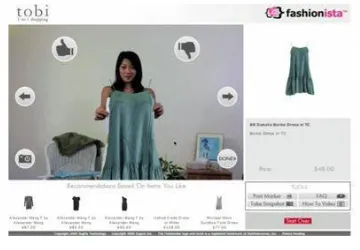
The introduction of the Camera made it relatively easy and cheap to get access to a depth sensor. Using the depth sensor with open source middleware such as OpenNI Framework made it possible to track the user’s pose quite accurately [5]. One such application was that of Fitting Reality which used the Camera to create a Shape ID of the user. The Shape ID would store the measurement and size of the user. And finally static clothing would be rendered on the user [Figure 2].
ISSN(Online): 2319-8753 ISSN (Print): 2347-6710
I
nternational
J
ournal of
I
nnovative
R
esearch in
S
cience,
E
ngineering and
T
echnology
(An ISO 3297: 2007 Certified Organization)
Website: www.ijirset.com
Vol. 6, Issue 3, March 2017
1.5 Realism of Clothing
One of the primary goal of a virtual dressing room is to give a realistic visual experience of trying on different garments. Beside the alignment of the clothing, the realism of the clothing movement is an important aspect in providing this experience. Different materials have a different feel to them. For example, silk will move much for freely as compared to leather. In the first versions the clothes were just static 2D images [6]. It was only possible to see how the clothes looked from the front. In more advanced dressing rooms such as the one created by FaceCake multiple 2D images of the clothing from different angles provided a more realistic experience, as it was possible to turn around and have a look from different sides. However, the clothing is still static and there is completely no interaction with the clothes besides changing its location, rotation and scale.Compared to our approach which uses 3D models of clothes designed using Blender [Figure 3], the current approach of using 2D images is limited in several ways. Since the clothing is photographed from a limited number of angles it does not rotate smoothly, but in fixed intervals, while a 3D model can be rotated freely. Furthermore, cloth simulation can be performed on a 3D model making it move and fold as a reaction to the user's movement and thus allowing physical interaction between the virtual clothing and the user avatar, something which is not possible with 2D images.
Figure 3 - 3D Mesh
II. SETTING UP THE TRIAL ROOM
For this project we have created an augmented reality application in which the user can try on virtual clothes. We use the Camera to pose the user’s pose tracking and depth sensing, which is described in section 4.1. For rendering the clothes in the user's environment we use the Unity 3D game engine. For accurate fitting of clothes on the user, the size estimation technique is illustrated in section 4.2. The virtual clothes and the way they are rendered is described in section 4.3. The following section 4.4 describes our solution for the ambient light conditions.
2.1 User Tracking
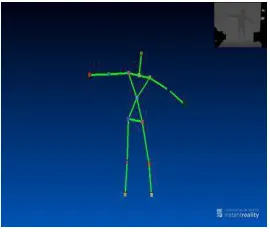
The camera is bundled with a depth sensor as well as a RGB sensor. When the user stands in front of the Camera in calibration pose the user tracker finds the Camera finds the user’s skeleton outlining the bones and joints as shown in Figure. The joints tracked are of two types:
Visible joints : These joints are visibly seen by the Camera
Implied joints: These joints are currently hidden from the Camera, but the sensor can predict/imply the hidden
ISSN(Online): 2319-8753 ISSN (Print): 2347-6710
I
nternational
J
ournal of
I
nnovative
R
esearch in
S
cience,
E
ngineering and
T
echnology
(An ISO 3297: 2007 Certified Organization)
Website: www.ijirset.com
Vol. 6, Issue 3, March 2017
Figure 4 Skeleton Tracking
The joints tracked are joined with lines which represent the major bones of the tracked skeleton. The depth map uses the input from the IR cameras; the texture map is the RGB color map of the scene that can be recorded just like any RGB cameras. The user map is an output of binary images that would include the detected people in the scene.
2.1.1 Size Estimation
When the user calibrates himself to the Camera, his size and girth is estimated. This information is used to achieve a better fit of the virtual clothing. The length of each limb is taken by computing the distance between each joint from the skeleton. The size of the body is taken by estimating the girth of the chest on a number of points.
The girth of the user can be measured by two methods:
Computing the distance between each point on the line
Taking 3 points (outer left, center and outer right) and compute the distance between those
Although the first solution seems more appropriate and easy to calculate, it is susceptible to a noisy sensor and cloth folding. Even the slightest fold will drastically hamper the users estimated girth. The second option, although not ideal, proved more accurate than the first method. To calculate the estimated size of the user, an average over 20 frames is taken for better approximation.
2.2 Virtual Clothes
The next step in our implementation is to dress the tracked user. 3-D meshes of clothing are designed in Blender and imported to Unity. As per our research, Unity provides two different cloth components that can be added to a mesh: interactive cloth and skinned cloth [7] [8]. Both components have features such as stretch, damping and thickness to give a real clothing experience.
2.2.1 Interactive cloth
ISSN(Online): 2319-8753 ISSN (Print): 2347-6710
I
nternational
J
ournal of
I
nnovative
R
esearch in
S
cience,
E
ngineering and
T
echnology
(An ISO 3297: 2007 Certified Organization)
Website: www.ijirset.com
Vol. 6, Issue 3, March 2017
2.2.1 Skinned Cloth
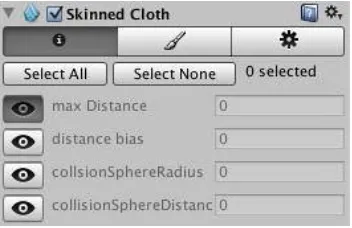
The skinned cloth component adds cloth simulation to a skinned mesh. The bone structure is taken and each vertex in the mesh is tied to one or more of the bones with a certain weight. When a transformation is applied to one of the bones, it is also applied to each of the vertices connected to the bone scaled by the corresponding weight. A volume move.
Figure 5 Skinned Clothing Properties
of space is defined for each vertex using a set of co-efficient which determines how freely the simulated cloth can The fact that this cloth component is based on a bone structure makes it very suitable for our virtual trial room, as the user tracker supplies a skeleton of the user.
Drawback is the absence of further interaction with the user and environment. The skinned cloth does not interact with colliders. On the other hand, this makes skinned cloth computationally simple in comparison with interactive cloth. We have selected skinned cloth for clothing simulation in our implementation, as it was more consistent at the moment.
2.2.3 Light Conditions
To create a more realistic environment we measure the light conditions of the RGB image. This is done by converting the image to an HSV image and taking an average of the intensity from the user. A point light in Unity recreates the light conditions.
III. PRODUCT DESCRIPTION
The user will stand in front of the Camera, which has an RGB sensor and a depth sensor. Using these sensors, the user will be calibrated and his skeleton will be tracked.The OpenNI framework, which acts as a middleware for the Camera, tracks the gestures of the user. The gestures are deciphered, and their corresponding semantics are given to the Unity engine. The Unity engine takes two inputs. First, is a cloth mesh which is imported from Blender. Unity 3D engine uses the PhysX drivers to apply physics properties to the rendered garments.The VTR engine is responsible to render the selected item on the calibrated user, and track his movements and gestures. All this is then displayed on a screen, which can be a projector canvas, a TV screen or even a laptop.
IV.CONCLUSION & FUTURE SCOPE
ISSN(Online): 2319-8753 ISSN (Print): 2347-6710
I
nternational
J
ournal of
I
nnovative
R
esearch in
S
cience,
E
ngineering and
T
echnology
(An ISO 3297: 2007 Certified Organization)
Website: www.ijirset.com
Vol. 6, Issue 3, March 2017
be added, such as sharing on social networking platforms, e-mailing a snapshot to a friend or uploading the snapshot somewhere for friends and family to comment. Also, to expand upon the clothing created to try out, accessories such as hats, shoes, jewelry, bags etcetera can be included. One final enhancement can be to use two Cameras simultaneously to get a 360 degrees view of the user, and render clothes that are completely wrapped around the body so that the user can check his front as well as back and sides.
REFERENCES
[1] C. G. Martin and E. Oruklu, "Human Friendly Interface Design for Virtual Fitting Room Applications on Android Based Mobile Devices," Journal of Signal and Information Processing, p. 10, 2012.
[2] D. N.Pughazendi, G.Madankumar, R.Rajkumar and R.Ramsuraj, "Design and Implementation of Interactive Augmented Trial Room," SSRG International Journal of Computer Science and Engineering (SSRG-IJCSE), vol. 2, no. 3, p. 5, 2015.
[3] Z. shaobin, L. yunting, X. Yihua and Z. lixin, "Research and Im-plementation of 3D Modelling Algorithm Based on Image," In-ternational Conference on Signal Processing Systems, p. 4, 2009.
[4] S. Kamani, N. Vasa and K. Srivastava, "VIRTUAL TRIAL ROOM USING AUGMENTED REALITY," International Jour-nal of Advanced Computer Technology (IJACT) , vol. 3, no. 6, p. 5.
[5] J. Upadhyay, D. Shukla, N. Patel and S. Nangare, "Virtual Makeover and Virtual Trial Dressing," International Journal of Innovative Research in Computer and Communication Engineer-ing , vol. 3, no. 3, p. 5, 2015.
[6] X.-D. LUAN, Y.-X. XIE, L. YING and L.-D. WU, "Research and Development of 3D Modeling," IJCSNS International Journal of Computer Science and Network Security, vol. 8, no. 1, p. 5, 2008.
[7] Mujahid, " Modeling Virtual Apparel to Display Realistic Shape and Force Based on Physical Data," Transactions of the Institute of Systems Control and Information Engineers, vol. 16, no. 4, p. 5, 2003.
[8] A. Albin-Clark and T. Howard, "Automatically Generating Vir-tual Humans using Evolutionary Algorithms," Theory and Prac-tice of Computer Graphics, 2009.
[9] M. Popa, "Hand Gesture Recognition Based on Acceler- ome-ter Sensors," International Conference on Networked Computing and Advanced Information Management, pp. 115-120, 2011.
[10] T. Hanusch, "A NEW TEXTURE MAPPING ALGORITHM FOR PHOTOREALISTIC RECONSTRUCTION OF 3D OB-JECTS," The International Archives Of Photogrammetry, Re-mote Sensing And Spatial Information Sciences, vol. 37, no. 5, p. 8, 2008.
[11] Protopsaltou D., Luible C., Arevalo-Poizat M., Magnenat-Thalmann N., "A body and garment creation method for an internet-based virtual tting room," Proceedings of computer graphics international (CGI '02). Berlin: Springer, p. 10522, 2002.
[12] Zhang W., Matsumoto T., Liu J., Chu M., Begole B., "An in-telligenttting room using multi-camera perception," Proceedings of the 13th international conference on intelligent user interfaces (IUI '08), New York, NY, USA: ACM, p. 609, 2008.
[13] Matyunin S., Vatolin D., Berdnikov Y., Smirnov M., "Temporal ltering for depth maps generated by kinect depth camera", Pro-ceedings of the 3DTV conference: the true visioncapture, trans-mission and display of 3D video (3DTV-CON), p. 14, 2011.
[14] Giovanni S., Choi Y.C., Huang J., Tat K.E., Yin K., "Virtual try-on using kinect and HD camera," Proceedings of the fth in-ternational conference on motion in games (MIG'12), Lecture notes in computer science, Berlin: Springer, vol. 7660, p. 5565, 2012.
[15] Tong J., Zhou J., Liu L., Pan Z., Yan H., "Scanning 3D full human bodies using Kinects," IEEE Trans Vis Comput Graph, vol. 18, no. 4, p. 643-650, 2012.
[16] Yasseen Z., Nasri A., Boukaram W., Volino P., Magnenat-Thalmann N., "Sketchbased garment design with quad meshes," Comput Aid Des, vol. 45, no. 2, p. 562-567, 2013.