DOI: 10.1534/genetics.105.047217
Estimating Selection on Nonsynonymous Mutations
Laurence Loewe,
1Brian Charlesworth, Carolina Bartolome´
2and Ve´ronique No
¨el
Institute of Evolutionary Biology, School of Biological Sciences, University of Edinburgh, Edinburgh EH9 3JT, United Kingdom
Manuscript received June 23, 2005 Accepted for publication November 5, 2005
ABSTRACT
The distribution of mutational effects on fitness is of fundamental importance for many aspects of evolution. We develop two methods for characterizing the fitness effects of deleterious, nonsynonymous mutations, using polymorphism data from two related species. These methods also provide estimates of the proportion of amino acid substitutions that are selectively favorable, when combined with data on between-species sequence divergence. The methods are applicable to species with different effective population sizes, but that share the same distribution of mutational effects. The first, simpler, method assumes that diversity for all nonneutral mutations is given by the value under mutation-selection balance, while the second method allows for stronger effects of genetic drift and yields estimates of the parameters of the probability distribution of mutational effects. We apply these methods to data on populations of
Drosophila mirandaandD. pseudoobscuraand find evidence for the presence of deleterious nonsynonymous mutations, mostly with small heterozygous selection coefficients (a mean of the order of 105for seg-regating variants). A leptokurtic gamma distribution of mutational effects with a shape parameter between 0.1 and 1 can explain observed diversities, in the absence of a separate class of completely neutral nonsynonymous mutations. We also describe a simple approximate method for estimating the harmonic mean selection coefficient from diversity data on a single species.
S
URVEYS of DNA sequence polymorphisms in many species have revealed substantial variation in the aminoacid sequences of proteins, although the non-synonymous nucleotide site diversity is usually much less than that for silent variants (Li1997). This iscon-sistent with the action of purifying selection on protein sequences, removing deleterious amino acid mutations from the population while neutral or nearly neutral silent variants can persist (Kimura 1983; Li 1997). It
is clearly important to characterize the distribution of fitness effects of new nonsynonymous mutations. This distribution is relevant to a broad range of problems in evolutionary genetics, and a variety of methods have been used to characterize it, including direct estimates from mutation-accumulation experiments and indirect estimates from comparisons of DNA sequences among related species (Keightleyand Eyre-Walker1999). The
extent, nature, and magnitude of selection on amino acid variants are also relevant to understanding the re-lation between human disease and genetic variation (Sunyaevet al.2001; Wrightet al.2003).
Several methods have been used to detect purifying selection from data on variability in natural populations
and to estimate the parameters describing such selec-tion. An important method was introduced by Sawyer
and Hartl(1992), based on the McDonald-Kreitman
test (McDonaldand Kreitman1991). It compares the
ratio of the number of within-species nonsynonymous polymorphisms to the number of synonymous poly-morphisms and the corresponding ratio for fixed differ-ences between a pair of related species. This ratio of ratios is called the ‘‘neutrality index’’ (Randand Kann
1996). It is expected to be greater than one if there is pre-dominantly purifying selection against nonsynonymous variants, since selection is less effective in reducing the level of polymorphism for deleterious variants than in preventing their fixation (Kimura1983). This approach
can be incorporated into maximum-likelihood or Bayesian methods for estimating Nes, where Ne is the effective population size andsis the selection coefficient against nonsynonymous mutations. The selective effects of muta-tions are usually assumed to be codominant (in the case of nuclear genes), and constant across sites within a gene (e.g., Nachman1998; Bustamanteet al.2002).
Re-cent extensions allow for a distribution of selection co-efficients at different sites (Piganeauand Eyre-Walker
2003) or varying degrees of dominance (Williamson
et al.2004).
Overall, this method has been more successful in de-tecting and estimating purifying selection on nonsynon-ymous variants in mitochondrial genomes than in the nuclear genome (Nachman1998; Randand Kann1998;
Weinreichand Rand2000), with a few exceptions such 1Corresponding author: Institute of Evolutionary Biology, School of
Biological Sciences, Ashworth Laboratories, University of Edinburgh, King’s Bldgs., Edinburgh EH9 3JT, United Kingdom.
E-mail: [email protected]
2Present address:Unidade de Xene´tica Evolutiva, Instituto de Medicina Legal, Facultade de Medicina, Universidade de Santiago de Compostela, 15782 Santiago de Compostela, Spain.
asArabidopsis thaliana (Bustamante et al. 2002),
Dro-sophila miranda(Bartolome´ et al. 2005), and humans
(Bustamante et al. 2005). The fixed selection
coeffi-cient model was fitted by Nachman(1998) to 17 animal
mitochondrial DNA data sets with neutrality index values .1 and gave Nes estimates predominantly be-tween 1 and 3; Bustamanteet al.(2002) estimatedNes
on a gene-by-gene basis and obtained a mean value of
1 for 12 nuclear genes inA. thaliana(in both cases,Ne is the haploid effective population size, as is appropriate for the ploidy and breeding systems in these cases). A modification of this approach, allowing a normal dis-tribution ofNes values across different genes, was ap-plied to data onD. melanogaster, indicating a meanNes of 3.5 (Sawyer et al. 2003). The fits of a gamma
distribution of selection coefficients across individual nonsynonymous sites to animal mitochondrial data sets (Piganeauand Eyre-Walker2003) gave much larger
but noisier estimates of meanNes.
An alternative approach is to fit the observed frequency spectra of nonsynonymous and silent/synonymous var-iant frequencies to the distributions expected under mutation-selection-drift equilibrium (Sawyer 1994;
Sawyeret al.1987). Variants of this approach have been
developed by Hartlet al. (1994), Akashi(1999), Fay
et al.(2001), Bustamanteet al.(2003), and Williamson
et al.(2004, 2005). Either a fixed given Nes value or a distribution ofNesvalues across loci is assumed.
These studies have yielded large differences among estimates of the scaled selection parameterNes(or its arithmetic mean) for nonsynonymous sites under puri-fying selection, ranging from values of the order of 1 to several hundred, depending on the methods and species used. Varying conclusions about the propor-tion of sites subject to positive, as opposed to purifying selection, have also been reached; for example, com-pare Sawyer et al. (2003) with Bierne and Eyre
-Walker (2004), who estimated that 94 and 25% of
nonsynonymous mutations distinguishing D. simulans and D. melanogaster were fixed by positive selection, respectively.
Methods that fit details of frequency spectra to equi-librium models are clearly highly vulnerable to depar-tures from equilibrium, and there is increasing evidence that many of the model systems used for the study of natural variation, as well as human populations, are sub-ject to such effects (Andolfatto and Przeworski
2000; Williamsonet al.2005). Incorporating even the
simplest model of demographic change into selec-tion models is computaselec-tionally extremely demanding (Williamson et al. 2005). Methods that ignore the
details of the distribution of variant frequencies may thus be preferable to potentially more powerful meth-ods that exploit all the features of the data. Another problem is that many of the methods outlined above assume that amino acid mutations in a given gene are unidirectionally from wild type to selectively deleterious
or vice versa. However, unless the magnitude ofNesfor all mutations is much greater than one, there will be a flux of amino acid substitutions over evolutionary time, such that some fraction of sites will be fixed for selectively deleterious alleles and can therefore back mutate to create fitter variants, as in models of codon usage bias (Li 1987; Bulmer 1991; McVean and
Charlesworth 1999). Only the model of Piganeau
and Eyre-Walker (2003) has explicitly incorporated
this possibility.
In this article, we develop a model of nonsynonymous site variation and evolution that includes reversible mutation, as in the standard models of codon usage evolution. We use this to estimate the strength of selec-tion on amino acid variants, by exploiting the difference in the responses of nonsynonymous and synonymous/ silent variants to differences in effective population sizes between related species. The basic idea is that variants subject to sufficiently strong purifying selection will not increase much in abundance as effective population size increases, whereas neutral or nearly neutral diversity is expected to increase in proportion toNe. The extent to which nonsynonymous diversity differs between species with different synonymous diversity values should thus shed light on the prevalence and strength of purifying selection. We also show how to provide useful bounds on selection parameters when data on only one species are available.
MATERIALS AND METHODS
Source of data: We used published DNA sequence infor-mation onX-linked and autosomal genes forD. miranda(Yi
et al.2003; Bartolome´et al.2005), removing genes for which
there was either evidence for departure from neutrality (Annx,
swallow) from the HKA test or no sequence data fromD. affinis, the outgroup species used to estimate interspecific divergence fromD. mirandaandD. pseudoobscura(Bartolome´et al.2005).
Polymorphism data onD. pseudoobscurawere compiled from published population surveys; the gene exu2 was not used, since it showed evidence for selection on the basis of haplotype structure (Yiet al.2003) and the HKA test (this study; data not
shown). These data were obtained from GenBank accessions, and sequences were aligned using the program SeAl (http:// evolve.zoo.ox.ac.uk/). Details of the genes used and the relevant references are provided in supplemental material at http://www.genetics.org/supplemental/.
In total, 17D. mirandagenes (13,309 nonsynonymous sites and 9077 silent sites, 51% in introns) and 14D. pseudoobscura
genes (10,828 nonsynonymous sites and 10,245 silent sites, 65% in introns) were used. Sample sizes were 11 or 12 alleles per gene forD. mirandaand 7–139 per gene forD. pseudoobs-cura. No adjustments for different effective population sizes forX-linkedvs.autosomal genes were made, as mean diver-sities are similar for these two categories in both species, consistent with the action of sexual selection on males (see supplementary material at http://www.genetics.org/ supplemental/ and Yiet al. 2003; Bartolome´ et al. 2005).
from D. affinis for the D. miranda loci were obtained from Bartolome´et al.’s (2005) Table 3. Unfortunately, only three
loci are in common between the two data sets, so that we have to treat the two sets of genes as representing more or less independent random samples from the genomes of the two species.
Computational methods: The case of ‘‘arbitrary purifying selection’’ described intheoretical framework(Equations
5) requires integration of the formulas for the nonsynon-ymous nucleotide site diversitiespAand rates of substitution
KA, over an assumed distribution of selection coefficients,
f(s). The relevant expressions involve integrals represent-ing the sojourn times of codominant autosomal mutations, given the heterozygous selection coefficients, the breeding adult population size N, the effective population size Ne, and the mutation rate per nucleotide site per generation
u. These were obtained from the known solutions to the relevant diffusion equations (Kimura and Ohta 1969b;
McVeanand Charlesworth1999). To predictp
S, we used similar equations as forpA, but settings¼0. All computations were implemented in the statistical programming language ‘‘R’’ (version 1.9) (Ihaka and Gentleman1996; R-Project
2005).
Most mutations generated by a givenf(s) distribution have effects that can be handled by the diffusion methods em-ployed here. However, for very strongly or weakly selected mutations, the formulas require more numerical accuracy than the 15 digits available in double-precision floating var-iables. The standard approximations for fixation probabilities and sojourn times of mutations, for the respective cases of ei-ther neutrality or strong selection, were then used (Haldane
1924, 1927; Kimura1962; Kimuraand Ohta1969a,b).
To integrate over the distribution of selection coefficients, we partitioned the range of mutational effects of interest, from effectively neutral (s¼1010) to lethal (s$1), intoIgroups small enough to assume constant mutational effects within each group. We found thatpAandKAvalues computed from I¼ 30, 100, and 300 equidistant steps on a log scale were accurate to2, 0.2, and 0.02% relative error, respectively. For each bin, we then independently computed (i) the probability
Pithat a mutation will have an effect that belongs to bini, obtained by integratingf(s) from the lower to the upper limit of the bin, and (ii) all interesting quantities of the model, given the average mutational effect characterizing that bin. To get the overall result for a parameter of interest, we summed the corresponding results for the parameter over all bins, weighting the value for each bin byPi.
Experimenting with differentf(s) functions, two special cases became obvious. Some mutations have effects smaller than the lower integration limit (s¼ 1010). We added the probability mass of these mutations to the first bin. Since these are effectively neutral mutations, this amounts to full in-tegration of thef(s) down to neutrality. The distribution of
swas truncated ats$1, keeping a record of the fraction of mutations that fall into this category; this represents dominant lethal mutations caused by amino acid substitutions, which are probably extremely rare.
For each quantity involved in the model, a plot over the whole range of values ofsgenerated from a givenf(s) was produced, and the smoothness of transitions to neutrality and to strong selection equilibrium was used to verify the accuracy of the computations. At statistical equilibrium under drift, mutation, and selection at each site, we expect equal rates of substitution between preferred and unpreferred amino acids at sites with a givens, which was confirmed in our plots.
The fit of the nucleotide site diversity from the two species to a given set of assumed parameters was assessed, using the numerical criterion
d¼log10 10
501jpˆS1
ˆ
pA1
p¯S1
¯
pA1
j1jpˆS2 ˆ
pA2
p¯S2
¯
pA2
j
;
where ˆpA1is the predicted nonsynonymous diversity value for
species 1,pA1is the corresponding observation, and the other
corresponding values are for silent diversity and for species 2, using Equation 5a below.
Thedfunction was chosen to make small differences look large, a property needed for the simplex optimization routine (Amoeba) that we used (Nelder and Mead 1965),
imple-mented in R. All ratios were rounded to at least six digits to ensure that bad fits were detectable. An optimization attempt was considered as successful if the data could be predicted with six-digit accuracy, using I ¼ 100 integration steps; this ex-cluded cases where optimization stopped without getting close to the data, wrongly suggesting that the data had been fitted. In all cases, the estimates resulting from the first Amoeba run were used as starting values for a second run, to make sure that the first result was not simply a local optimum. The parameter values that satisfied the optimization criterion after the second run were used to compute the results reported here, with an increased accuracy (I¼300).
To simplify the calculations using Equations 5 below, we assumed that the effective population sizeNeis equal to the size of the breeding population, N. To obtain the relevant numerical values, we used Equation 1a below to estimateNe from the observed mean silent diversity, assuming a mutation rateu.We mostly usedu¼1.53109in the calculations, a value widely used for Drosophila (Powell1997). Since this is
not firmly established, analyses with other mutation rates were also done, to check sensitivity tou.
Once the parameters determining variability from Equa-tions 5a were estimated, they were used in Equation 5b to predict the rate of amino acid substitutions arising from sites under purifying selection, assuming an arbitrary value for the unknown ancestralNe. This in turn may be used to estimate the fraction of selectively advantageous amino acid substitu-tions, by comparing the prediction from Equation 5b with the observed divergence between species, similarly to Equation 4b.
Statistical analyses:Preliminary analyses of the data showed that D. pseudoobscura had much greater silent diversity than
D. miranda. Its genes also consistently show an excess of rare variants over neutral expectation (Machadoet al.2002;
Schaeffer2002), in contrast to what is seen in D. miranda
(Yiet al.2003; Bartolome´et al.2005). This suggests thatD.
pseudoobscura has undergone a recent period of population expansion and is therefore not likely to have reached its final level of neutral or nearly neutral diversity. The measure of neutral variability provided by Watterson’suwestimator, based on the number of segregating sites for silent diversities (Watterson 1975), is probably closer to the equilibrium
value than the pairwise nucleotide site diversity estimatorp, since new variants arising after an increase in N are pre-dominantly rare (Tajima 1989). We therefore expect u
w to
provide a better estimate of the equilibrium neutral/nearly neutral diversity forD. pseudoobscurathanpand have accord-ingly useduwfor silent sites for both species. For sites under selection, there is no cogent reason to useuw, and so we usedp as the diversity measure for nonsynonymous variants. We obtained very similar results if uw is used for both types of sites. For simplicity, we use the symbolpto denote diversity estimates for both cases in what follows.
evolutionary variances of diversity as the weight for a given gene, obtained from the standard formulas under neutrality and free recombination (different formulas apply to the Watterson and pairwise diversity estimators as described in Chapter 10 of Nei 1987). This procedure is heuristic, given
that there is some linkage disequilibrium among sites within genes and that nonsynonymous mutations are known to be subject to selection, but it provides a simple approximate way of accounting for different levels of noise across genes. Divergence values,K, were weighted by the number of sites involved. Their means across genes were then used to estimate
KA/KS. For comparison, unweighted means of diversities and divergence were also computed and used for parameter estimation.
To assess the variability of our estimates for both methods of weighting, we generated 1000 ‘‘observations’’ by bootstrap-ping the diversity and divergence data across loci, as described by Bartolome´ et al.(2005). The upper and lower fifth
per-centiles of the distribution of each parameter were used as approximate 90% confidence intervals for the parameters in question; this provides a convenient basis for assessing 5%
P-values for the null hypothesis that this parameter has a value of zero, in a one-tailed test.
THEORETICAL FRAMEWORK
General framework: We assume that the sequences
of population samples of many different genes are known, giving reliable estimates of diversities for non-synonymous and silent or non-synonymous sites in each of two species and corresponding divergences from a third (Figure 1). Differences inNeexist between the two spe-cies for which diversity data are available; the effective population size of speciesi(i¼1 or 2) is denoted byNei,
where the smalleridenotes the species with the smaller Ne. We assume an infinites-sites model with autosomal
inheritance (Kimura 1971). Silent mutations are
as-sumed to be selectively neutral or sufficiently close to neutrality that their evolutionary fates are well described by the neutral model. Each site is assumed to evolve independently; i.e., recombination is sufficiently fre-quent that Hill-Robertson interference effects can be neglected. Mutation rates and selection coefficients at each site are assumed to be independent, and random mating is assumed for both species.
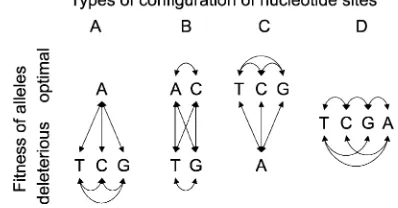
To keep our model simple, we assume that there are at most two types of amino acid at a given nucleotide site: ‘‘preferred’’ and ‘‘unpreferred,’’ with at most one of the four possible nucleotides corresponding to the pre-ferred state (our methods do not require us to identify preferred and unpreferred states from the data). At some sites, all possible variants may be effectively neutral, meaning in practice that variants are subject to a similar level of selection to silent mutations (Figure 2D). The fraction of such ‘‘neutral’’ nonsynonymous mutations is denoted by cn. We treat other sites as in Figure 2A, where nonsynonymous nucleotide site muta-tions can result in a change to a selectively deleterious amino acid (if the nucleotide in question codes for the preferred state), to a favorable amino acid (if the site is fixed for an unpreferred amino acid, and the mutation leads back to the preferred state), or else to a selectively neutral variant (if the site is fixed for an unpreferred amino acid, and the mutation causes a change to a different but selectively equivalent deleterious variant). Because some mutations at such sites are deleterious, we refer to these sites as undergoing purifying selection.
The selection coefficientsfor selectively deleterious variants refers to the reduction in fitness of hetero-zygotes; this may vary according to the site and amino
Figure1.—Basic three-species setting. We assume fixed
val-ues for all three effective population sizesNe, despite uncer-tainty concerning the sizes of ancestral populations. The shaded areas indicate the availability of neutral and selected polymorphism data from the two more closely related species with differentNe. The dotted line to the third species indi-cates that our method for inferring the strength of purifying selection also applies to cases where only polymorphism data for two species exist.
Figure 2.—All possible fitness-relevant configurations for
acid in question. For convenience of calculation, dom-inance is assumed to be intermediate. As in standard models of codon usage bias (Li 1987; Bulmer 1991;
McVeanand Charlesworth1999), if selection at these
sites is sufficiently weak, unpreferred mutations can become fixed and then mutate back to the preferred state, contributing to a flux of amino acid substitutions as well as to polymorphism. This model is not com-pletely general (see Figure 2, B and C), but should suffice as a guide to the basic processes involved, especially when selection is fairly strong in relation to drift.
Occasionally, a new adaptive mutation (distinct from a back mutation at a site fixed for a deleterious mu-tation) may arise at a nonsynonymous site, perhaps in response to a change in the environment. This is assumed to spread rapidly to fixation if it survives initial stochastic loss. The substitution rate per generation per site for mutations that fall into this category is denoted by cau, where u is the expected mutation rate per nucleotide site, and ca measures the substitution rate as a fraction of all mutations.ca is the product of the frequency of adaptive mutations and their fixation prob-ability, integrated over all advantageous effects. We assume thatca>1, since favorable mutations are likely to be rare.
These assumptions lead to the following general equations for the expectations of the silent and non-synonymous nucleotide site diversities in speciesi,pSi
andpAi, and the rates of substitution per site per
gen-eration for silent and nonsynonymous mutations, KSi
and KAi (second-order terms in small quantities are
ignored):
pSi ¼4Neiu ð1aÞ
pAi ¼4cnNeiu1ð1cnÞHPi ð1bÞ
KSi ¼u ð1cÞ
KAi ¼cnu1ð1cnÞKPi1cau; ð1dÞ where HPi is the mean equilibrium diversity at sites
subject to purifying selection, and KPi is the mean
substitution rate at such sites.
Strong purifying selection:These equations become
greatly simplified if Nes . 1 for all nonneutral non-synonymous mutations in both species. The equilibrium diversity contributed by sites subject to purifying selec-tion with selecselec-tion coefficient s is then well approxi-mated by the deterministic expression, 2u/s, as can be shown by numerical solutions of the general equations (McVeanand Charlesworth1999). We then have
pAi ¼cnui12ð1cnÞ
u sh
; ð2aÞ
whereui¼4Neiu, andshis the harmonic mean of the
selection coefficients for all mutations that are not ef-fectively neutral (this is the same for both species, since we assume that nearly neutral mutations are absent).
For Nes . 2, KPi is negligibly small, so that we can
replace Equation 1d by
KAi ¼cnu1cau: ð2bÞ With just two species for which diversity data are avail-able, Equations 1a and 2a lead to the following formula forcn:
cn¼
ðpA2pA1Þ
ðpS2pS1Þ: ð3aÞ
Substituting this into Equation 2a and using Equation 1a, we obtain
2Ne1sh¼
pS1ðpA11pS2pA2pS1Þ
fpA1ðpS2pS1Þ pS1ðpA2pA1Þg: ð3bÞ
From Equations 1c and 2b,cais given by
ca¼
KA
KS
cn; ð4aÞ
assuming that species 1 and 2 have the same mean di-vergences for silent and nonsynonymous sites from the third species, so that subscripts can be dropped. This is necessarily the case with strong selection, since species 1 and 2 are equally close to species 3, and only neutral non-synonymous mutations can become fixed (there is no reason in principle why divergence between species 1 and 2 could not be used in the absence of data on a third species, but in the present case the level of divergence between D. mirandaandD. pseudoboscurais so low that estimates based on this would be very unreliable).
The proportion of nonsynonymous substitutions that are caused by the fixation of advantageous mutations is
Pa¼
KSca
KA
: ð4bÞ
Given the above assumptions, all the parameters of the model can be estimated by equating expectations to observed values.
Arbitrary purifying selection: The validity of the
assumption thatNes. 1 for all nonneutral nonsynon-ymous mutations is, however, questionable. If this as-sumption is relaxed, the formulas for the equilibrium diversity at nonsynonymous sites become more com-plex, and the possibility of a contribution to KA from sites subject to purifying selection must also be consid-ered, using a probability distributionf(s) of selection coefficients for mutations subject to selection. We now consider this problem in detail.
equal, the probability of back mutation to the original state would be 1
3; in general, however, inequalities in
mutation rates are likely to make this probability different from1
3, and so we represent it as 1/k.
kis the ratio of the forward and backward mutation rates for mutations creating deleterious amino acids, a measure similar to the mutational bias parameter used in models of codon usage bias (Li1987; Bulmer1991;
McVeanand Charlesworth1999). At a site fixed for a
deleterious amino acid, there will thus be a mutation rateu/kback to the preferred amino acid; there will also be a neutral mutation rateu(k1)/k, if all deleterious amino acids at this site are selectively equivalent. These should be taken into account in the contribution to net diversity. Using the argument that led to Equations 6 and 7 of McVeanand Charlesworth(1999), we then
find thatHPi in Equation 1b is given by
HPi ¼2Niu
ð
2ðNei=NiÞðk1Þ1H0ðsÞ
k
3m0ðsÞ1H1ðsÞm1ðsÞ
fðsÞds; ð5aÞ
where Ni is the total number of breeding individuals
in species i; H0(s) and H1(s) are the expected total heterozygosities that are contributed during their so-journ in the population by new mutations to preferred and unpreferred amino acids, respectively, for a selec-tion coefficients;m0(s) andm1(s) are the fractions of sites fixed for unpreferred and preferred amino acids, respectively, among sites with selection coefficients; and
f(s) is the probability density function for the distribu-tion of selecdistribu-tion coefficients. Formulas for theHand mfunctions are given by McVeanand Charlesworth
(1999), Equations 5 and 10.
Similarly,KPi in Equation 1d is given by
KPi ¼2Niu
ð ðk
1Þ=ð2NiÞ1U0ðsÞ
k
3m0ðsÞ1U1ðsÞm1ðsÞ
fðsÞds; ð5bÞ
whereU0(s) andU1(s) are the fixation probabilities for new mutations to preferred and unpreferred amino acids, respectively, given a selection coefficients, using the standard diffusion equation formula (Kimura1962).
Even if the distributionf(s) is described by only two parameters, such as the arithmetic mean and standard deviation, there are too few degrees of freedom in the data to estimate all the parameters of interest by equat-ing observed and expected values of diversities and di-vergence, unless we are prepared to assume that there are no nonsynonymous sites with neutral effects (cn¼0). These equations do, however, provide a means of eval-uating the sensitivity of the results to our assumptions aboutcnor the properties of the distribution, as is de-scribed below. Following convention (Piganeau and
Eyre-Walker2003), we use the gamma distribution for
f(s),
fðsÞ ¼s
a1
expðs=bÞ
baGðaÞ ; ð6Þ
whereais the shape parameter,bis the scale parameter,
Gis the gamma function,abis the arithmetic mean, and
ab2is the variance ofs(R-Project2005).
RESULTS
We now present the results of applying these methods to the diversity data onD. mirandaandD. pseudoobscura described in materials and methods(D. miranda is
designated as species 1 andD. pseudoobscuraas species 2 in what follows). In view of such problems as the lack of overlap between the genes used in the two species, and the disparity in sample sizes between studies, the results based on these data should be regarded as merely provisional and illustrative of the methods.
Strong purifying selection:We first present the results
of applying the expectations for the case of strong purifying selection. Divergence values from D. affinis (species 3) were estimated for the 17 genes surveyed in D. miranda; the divergence values for these genes be-tweenD. affinisandD. pseudoobscurawere almost iden-tical (Bartolome´et al.2005), so that only theD. miranda
results were used here. Both weighted and unweighted estimates of mean diversities were obtained, as de-scribed in materials and methods; statistical
uncer-tainty was assessed by bootstrapping across genes. The results are displayed in Table 1. The main con-clusion is that an estimate ofNe1shsubstantially greater
than one is supported by the bootstrapping results, even using the unweighted estimators, which yield lower values than the weighted estimators. The distribution ofNe1shis, however, very wide, and infinite values were
sometimes generated for the weighted data. The esti-mate of Nesh for D. pseudoobscura was, of course, pro-portionately larger, corresponding to the largeNe-value estimated from silent site diversities (these suggested a 5.8-fold higherNeforD. pseudoobscura).
The estimated proportion of neutral sites was smaller with the unweighted estimates than with the weighted ones, but both suggested a value of a few percent. There was a very wide distribution of values of the proportion of fixations due to adaptive mutations in both cases, and a zero value could not be ruled out by the data, although the value estimated from the data exceeded 50% for the unweighted estimate.
Arbitrary purifying selection: We now relax the
unweighted data, respectively. With values ofcn$7.5% we rarely, if ever, found parameters for a gamma dis-tribution that fitted the data, and the fraction of bad fits for cn ¼ 5% was 48.5% for 1000 bootstraps from the weighted data, whereas the mean of the unweighted data could not be fitted assuming cn $ 5%. With the gamma distribution, a significant fraction of mutations had such small selection coefficients that Nes , 1 or even 0.5. The results of McVeanand Charlesworth
(1999) suggest that, withNes,0.5, both diversities and substitution rates are nearly equivalent to those for neutral sites; in addition, the intensity of selection on synonymous mutations that change codon usage from preferred to unpreferred codons inD. mirandaseems to be close toNes¼0.5 (Bartolome´ et al.2005). It thus
seems reasonable to use this value as the boundary for designating mutations as effectively neutral; the sum of cn and the fraction of effectively neutral mutations generated by the fitted gamma distribution is denoted bycnein Tables 2 and 3. For completeness, we also show results usingNes¼1 as the boundary.
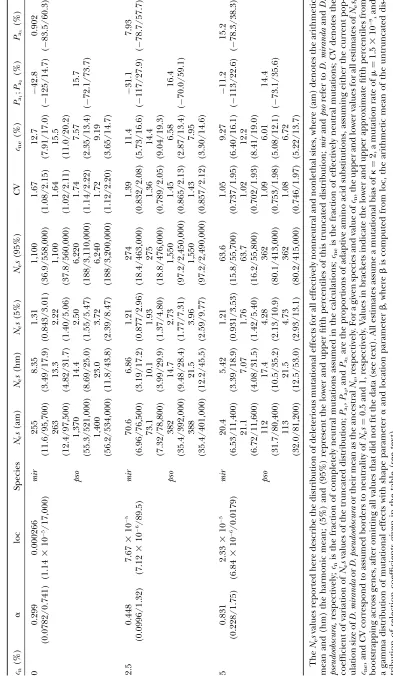
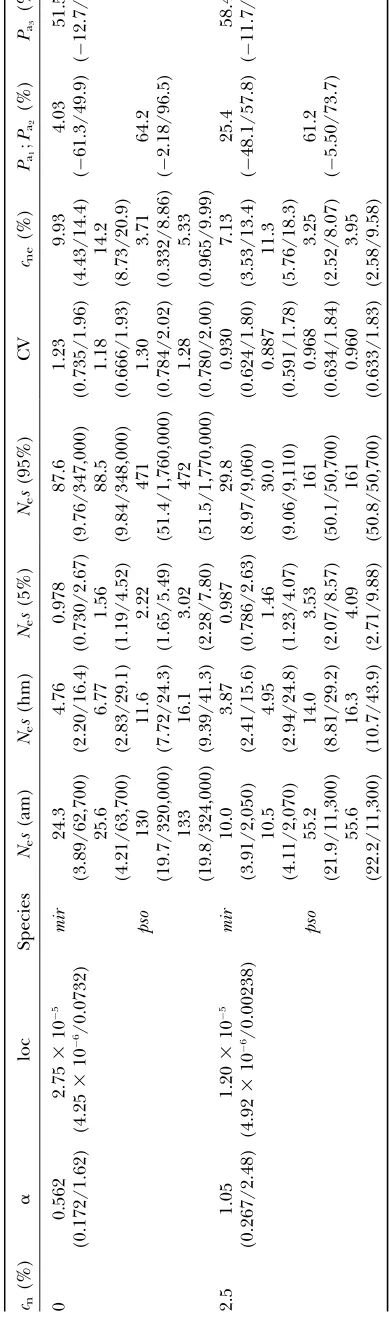
Despite the time-consuming nature of the multiple integrations involved in implementing this model, we attempted 1000 bootstrap replications to assess the reli-ability of our parameter estimates. Out of these boot-strap computations for the weighted or unweighted data in Table 2 or 3, only 80.3 and 90.1%, respectively, could be fitted assumingcn¼0%; 75.6 and 65.6% could be fitted assumingcn¼2.5%. Technically, our estimates of the distributions of mutational effects involve only the shape and the location parameter for the gamma dis-tribution ofs, together with values forNei. However, in
Tables 2 and 3 we also report more intuitively meaning-ful measures of the underlying distribution of all selection coefficients at sites capable of mutating to nonlethal mutations that fall above the threshold of effective neutrality, scaled by Ne. These include the arithmetic and harmonic means, the coefficient of variation, and the lower and upper fifth percentiles of the distribution ofs-values for these mutations.
As reviewed in more detail in the discussion, the
bulk of the nonneutral mutations segregating in the
population come from the more weakly selected tail of the distribution (Sunyaevet al.2001). The arithmetic
mean of the distribution of selection coefficients among these polymorphic variants is much closer to the har-monic than to the arithmetic mean of the distribution for new mutations, and so the harmonic means in Tables 2 and 3 are more relevant than the arithmetic means to the properties of mutations found in populations. It is notable from Tables 2 and 3 that the means for D. pseudoobscurawere smaller than might be expected from the ratio of effective population sizes and the corre-sponding means for D. miranda; this reflects the lower fraction of mutations that fall into the effectively neutral class when the effective population size is larger, re-ducing the average selection coefficients for mutations in the other class.
Given an ancestral Ne-value, we can also predict the substitution rate for mutations under purifying selec-tion. This can be compared with the observed rate to estimate the proportion of adaptive substitutions, using Equation 4. We report three alternative values:Pa1,Pa2,
andPa3, which assume ancestralNe-values equal to the
estimated currentNeforD. miranda, the currentNeof D. pseudoobscura, and the mean of these, respectively. For each value, we give the approximate lower and up-per fifth up-percentiles obtained by bootstrapping.
The main result of Tables 2 and 3 is solid support for the conclusion that 90% or more of all amino acid mutations have significantly deleterious effects. It is also remarkable that the estimates of the biologically im-portant harmonic mean selection coefficient are close to those using the strong selection assumption, taking into account the statistical noise and the uncertainty regardingcnfor the arbitrary purifying selection model. Similar conclusions can be drawn for comparisons between cne in the arbitrary purifying selection model and cnin the strong selection model. Comparing the weighted and unweighted estimates shows that the weighting procedure influences the estimates, but the noise in the data is larger than the noise from un-certainty about the best weighting procedure. While our definitions of effective neutrality (Nes,0.5 or,1) have
TABLE 1
Summary of the data and estimates from the strong purifying selection model
Estimate pA1 uS1 pA2 uS2 KA KS Ne1sh cn Pa
Weighted 0.086 (0.041/0.136)
0.502 (0.340/0.710)
0.294 (0.196/0.400)
2.86 (2.02/3.43)
2.11 (1.28/2.80)
23.0 (20.4/24.9)
5.41 (2.84/‘)
8.79 (3.91/16.5)
3.99 (123/57.5) Unweighted 0.088
(0.044/0.141)
0.478 (0.342/0.626)
0.206 (0.124/0.300)
2.73 (2.31/3.14)
2.48 (1.30/3.76)
22.2 (19.9/24.8)
3.58 (1.80/29.8)
5.24 (0.923/10.3)
52.9 (28.9/93.3) All values except forNe1share expressed as percentages. An ‘‘infinite’’ value ofNe1shcorresponds to a zero or negative
little influence on the arithmetic mean and the upper fifth percentile of the distribution of mutational effects, their influence on the harmonic mean and the lower fifth percentile is greater. In no case, however, did the
1–3% of mutations that fall in the range 0.5,Nes,1 change our conclusions regarding the prevalence of deleterious mutations.
To visualize the gamma distributions of mutational effects estimated from the weighted data, we plotted our best-fitting estimates with assumed values ofcn¼0, 2.5, and 5% (Figure 3). This involved estimating effective population size from Equation 1a, using the ‘‘standard’’ mutation rate of 1.5 3 109. The distributions for the
two smaller values ofcnpeaked at selection coefficients
104, fairly close to the arithmetic means obtained from
Table 2 for mutations that are not effectively neutral, whereas the harmonic mean was about one-tenth of this.
DISCUSSION
Robustness of the strong purifying selection model:
We found quite good agreement between the results of the strong purifying selection model and the model with a gamma distribution of selection coefficients for the estimates of the harmonic mean of the selection coefficient. This suggests that estimates of the magni-tude of this important parameter are robust to the assumptions used, providing that a sizeable fraction of nonsynonymous polymorphisms is nonneutral. Some approximations that relax the assumptions of the strong purifying selection model, but that do not depend on the details of the distribution, are explored in the
appendix. These provide very general methods for
estimatingNeshand again suggest that the magnitudes of the estimates of the main parameters of interest are fairly robust to details of the assumptions.
T ABLE 3 Estimates of the distribution of mutational ef fects for unweighted data fr om D. miranda and D. pseudoobscura cn (%) a loc Species Ne s (am) Ne s (hm) Ne s (5%) Ne s (95%) CV cne (%) Pa 1 ; Pa 2 (%) Pa 3 (%) 0 0.562 (0.172/1.62) 2.75 3 10 5 (4.25 3 10 6/0.0732) mir 24.3 (3.89/62,700) 4.76 (2.20/16.4) 0.978 (0.730/2.67) 87.6 (9.76/347,000) 1.23 (0.735/1.96) 9.93 (4.43/14.4) 4.03 ( 61.3/49.9) 51.5 ( 12.7/91.1) 25.6 (4.21/63,700) 6.77 (2.83/29.1) 1.56 (1.19/4.52) 88.5 (9.84/348,000) 1.18 (0.666/1.93) 14.2 (8.73/20.9) pso 130 (19.7/320,000) 11.6 (7.72/24.3) 2.22 (1.65/5.49) 471 (51.4/1,760,000) 1.30 (0.784/2.02) 3.71 (0.332/8.86) 64.2 ( 2.18/96.5) 133 (19.8/324,000) 16.1 (9.39/41.3) 3.02 (2.28/7.80) 472 (51.5/1,770,000) 1.28 (0.780/2.00) 5.33 (0.965/9.99) 2.5 1.05 (0.267/2.48) 1.20 3 10 5 (4.92 3 10 6/0.00238) mir 10.0 (3.91/2,050) 3.87 (2.41/15.6) 0.987 (0.786/2.63) 29.8 (8.97/9,060) 0.930 (0.624/1.80) 7.13 (3.53/13.4) 25.4 ( 48.1/57.8) 58.4 ( 11.7/73.6) 10.5 (4.11/2,070) 4.95 (2.94/24.8) 1.46 (1.23/4.07) 30.0 (9.06/9,110) 0.887 (0.591/1.78) 11.3 (5.76/18.3) pso 55.2 (21.9/11,300) 14.0 (8.81/29.2) 3.53 (2.07/8.57) 161 (50.1/50,700) 0.968 (0.634/1.84) 3.25 (2.52/8.07) 61.2 ( 5.50/73.7) 55.6 (22.2/11,300) 16.3 (10.7/43.9) 4.09 (2.71/9.88) 161 (50.8/50,700) 0.960 (0.633/1.83) 3.95 (2.58/9.58) See T able 2 for explanation.
Figure3.—Gamma distributions of mutational effects
esti-mated from the variance-weighted data, assumingcn¼0, 2.5, and 5% (curves 1, 2, and 3, respectively). The spike belows¼
To simplify even further, one could assume that all polymorphic nonsynonymous sites are effectively under purifying selection;i.e.,cn¼0. The mean frequency of such deleterious mutations is given by q ¼ u/sh (see Equation 2a), whereuis the mutation rate per site per generation andshis the harmonic mean of the hetero-zygous selection coefficients. Sinceqis small, we have
sh2u=pA: ð8aÞ
UsingpS¼4Neu, we obtain
NeshpS=ð2pAÞ: ð8bÞ
This result is remarkably robust, since we do not need to knowNe,u,sh, or dominance coefficients. However, caution is necessary if Equation 8b gives values near 1, since this suggests that drift is probably too strong to be neglected. In this case, the true strength of selection for the deleterious mutations will be larger than predicted by this approach. The values estimated from this method areNesh2.9 and 4.9 for D. miranda andD. pseudoobscura, as estimated for the respective weighted data. These values are little more than a third of the respective values estimated from the most precise meth-ods and lie outside the confidence intervals for the latter. This very simple formula is therefore too crude for precise estimates, but seems to work reasonably well as a rough first estimate for the lower bound ofNesh. It can be applied only when there is evidence that a substantial proportion of segregating nonsynonymous variants experience purifying selection, as in the present case (Bartolome´ et al.2005).
One caveat should be noted concerning the estimates ofNeforD. pseudoobscurathat we have been using. This assumes that silent sites are effectively neutral, which we have taken to mean that Nes is of the order of
#0.5 McVean and Charlesworth (1999). While D.
mirandasynonymous sites seem to satisfy this condition (Bartolome´ et al.2005), this condition clearly cannot
apply toD. pseudoobscura, given that mean silent diversity is four to five times higher than that inD. miranda, unless selection on synonymous sites is much weaker in D. pseudoobscura. Akashiand Schaeffer(1997) estimated
Nes against unpreferred codons to be 4.6 (95% con-fidence interval 2.4–12.1) for Adh plus Adhr in D. pseudoobscura, (although selection for preferred codons was negligible); this result may be in part confounded by the effects of population expansion. IfNesfor syn-onymous sites inD. pseudoobscurais indeed higher than that inD. miranda, then mean silent site diversity (which includes a large contribution from synonymous sites) will yield an underestimate of 4Neu for this species. Accordingly,Nesfor nonsynonymous sites will be under-estimated and the proportion of effectively neutral non-synonymous mutations overestimated, since the ratio of nonsynonymous diversity relative to effectively neutral diversity will be overestimated for this species.
Sensitivity to mutation rates, mutational bias, and
recombination rates: Estimates derived from the
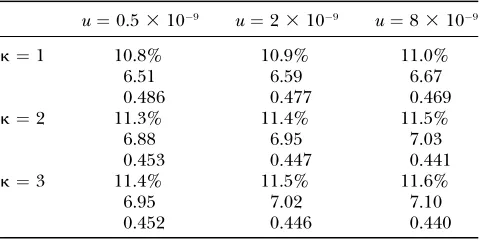
arbi-trary purifying selection model are surprisingly insensi-tive to plausible changes in mutational bias and mutation rate. Drake et al.(1998, p. 1673) estimated from
lab-oratory experiments that 8.53109mutations per base
per generation happen in D. melanogaster. Powell
(1997, p.369–371) reported rates between 0.673 109
and 3.33109, estimated from divergence between the
D. melanogaster and D. obscura groups, assuming that divergence happened 30 MYR ago and that each year represents10 generations. McVeanand Vieira(2001)
estimated a rate of 1.53109(95% C.I.¼1.03109–
2.53109), assuming 2–4 MYR divergence betweenD.
melanogasterandD. simulans. Others (Andolfattoand
Przeworski2000; Przeworskiet al.2001) found rates
of between 0.63109and 4.753109. Thus 0.53109
and 83 109appear to be reasonable choices for the
most extreme lower and upper credible limits for mu-tation rates in Drosophila. As can be seen in Table 4, whencn¼2.5%, a mutational bias ofk¼1 leads to the largest differences from our other estimates, while large changes in mutation rate seem to have only minor effects. Other assumed values ofcnyield the same con-clusion, although the resulting estimates differ because of the strong influence ofcn(see Tables 2 and 3).
Three genes in our D. pseudoobscuradata set (Amy1, eve, and exu1) are located on Muller’s C, a genomic region that is segregating for paracentric inversions (Dobzhanskyand Powell1975) and therefore has a
highly reduced recombination rate. These three genes violate the assumption of independence of sites much more than the other genes. We ran 500 bootstraps for a variance weighted data set without these genes under the assumption of cn ¼ 0%. Results indicate that the inclusion of these genes does not strongly affect our
TABLE 4
The influence of mutation rateuand mutational biaskon estimates ofcne,Ne1sh anda
u¼0.53109 u¼23109 u¼83109
k¼1 10.8% 10.9% 11.0%
6.51 6.59 6.67
0.486 0.477 0.469
k¼2 11.3% 11.4% 11.5%
6.88 6.95 7.03
0.453 0.447 0.441
k¼3 11.4% 11.5% 11.6%
6.95 7.02 7.10
0.452 0.446 0.440
The top value in each row givescne(in percent). The mid-dle value givesNe1sh[comparable toNes(hm) in Table 2]. The
parameter estimates, as the confidence intervals of our estimates for the reduced data set mostly overlap our es-timates for the full data set (data not shown).
The reliability of estimates of the proportion of
adaptive mutations:As can be seen from Figure 4, there
is a large influence of the value of the (unknown) ancestral Ne on the estimate of the proportion of adaptive mutations. As expected from the fact that more slightly deleterious mutations can be fixed in smaller populations, fewer adaptive mutations are inferred with smaller ancestralNe-values (Eyre-Walker
2002). Again, the mutation rate and mutational bias do not greatly affect the estimates. The combination of Figure 4 with the wide confidence intervals forPafrom Tables 1–3 raises the question of whether this approach can determine the presumably small fraction of adap-tive mutations with any precision. Larger data sets and the use of the same sets of genes in the two species being compared may help to narrow the error bounds on the estimates.
However, potential difficulties still remain. One is the assumption of free recombination among variants. Linkage increases the rate of fixation of deleterious mutations while decreasing that for advantageous mu-tations (Birkyand Walsh1988); close linkage can have
important effects even with weak selection (McVean
and Charlesworth2000; Kim2004). But this
assump-tion seems reasonable for D. pseudoobscura and its rel-atives, with their high rates of recombination and lack of linkage disequilibrium within genes (Dobzhanskyand
Powell 1975; Schaeffer and Miller 1993; Yi et al.
2003). In addition, departures from equilibrium due to demographic effects may introduce errors into the esti-mates. As discussed in materials and methods, our
choice of uW instead of p as a synonymous diversity estimator is intended to minimize the effects of the population expansion that seems to have occurred in
D. pseudoobscura (Machado et al. 2002; Schaeffer
2002). However, we cannot exclude population bottle-necks in the distant past that could have led to a higher contribution of deleterious mutations to KA/KS rel-ative to pA/pSand thus have elevated the estimate of the proportion of adaptive substitutions (Eyre-Walker
2002), a problem common to all methods used to date.
The reliability of estimates of parameters of the
dis-tribution of mutational effects: Methods of estimating
selection parameters for deleterious mutations that assume a distribution of selection coefficients make in-ferences about the distribution for new mutations prior to the action of selection, on the basis of the properties of mutations that are segregating in populations; these have been exposed to a long history of selection. The arithmetic meansfor segregating mutations is obtained by summing the products of the selection coefficient at each site i by the corresponding frequency of hetero-zygotespAiand normalizing by the summed frequencies
of heterozygotes (sseg ¼PsipAi=
Pp
Ai). For strong
selection, Equation 2a implies that this is equal to the harmonic mean of the distribution of s-values for new mutations (Orrand Kim1998; Sunyaevet al.2001).
Tables 2 and 3 show that the mean of the prior gamma distribution can be much larger than the harmonic mean for mutations above the effective neutrality threshold, indicating that much of the probability mass of the gamma distribution is far from the s-values representative of segregating mutations. This raises a serious issue concerning the meaning of inferences concerning the parameters of the gamma distribution; these are based on the properties of mutations that have little relation to the bulk of the mutations in the prior distribution.
With this caveat in mind, one of the strongest results from our arbitrary purifying selection model is not the exact set of parameter values themselves, but rather the exclusion of the large number of parameter combina-tions that are not compatible with the data. Our difficulties fitting distributions of mutational effects for cn$ 5%, for example, probably suggest that,5% of all nonsynonymous mutations stem from a small set of mutational effects distinct from the continuous distribution, which behave as neutral. Similarly, Tables 2 and 3 allow us to restrict the credible range for the shape parameter of a gamma distribution to shapes
.0.1 and usually ,1, where 1 is equivalent to an exponential distribution; not many credible estimates have less leptokurtic shapes. This agrees with results for mitochondrial genes, based on a different approach (Piganeauand Eyre-Walker2003).
If our estimates of the arithmetic and harmonic means of the distribution of sare even approximately correct (of the order of 104and 105, respectively; see results), they imply that most deleterious nucleotide
substitutions affecting protein sequences in our two species are subject to very weak selection. This seems
Figure4.—Dependence of estimates of the proportion of
adaptive mutations (Pa) on ancestralNe. All values were com-puted from the variance-weighted data and assumeu¼1.53 109;k¼2; andc
n¼0, 2.5, and 5% for the solid, dashed, and dotted curves, respectively. The smallest and largest values of
inconsistent with the classical estimates of harmonic mean heterozygous selection coefficients of the order of 1% inD. melanogaster, obtained by comparing inbreeding loads for viability with the mutational decline in mean viability, as well as with estimates of mean homozygous selection coefficients of the order of $10% obtained from mutation-accumulation experiments (Crow1993;
Charlesworth and Hughes 2000; Charlesworth
et al. 2004). The former are, however, biased upward by being weighted by the selection coefficients them-selves, and the latter are known to be biased upward when there is a wide distribution of homozygous se-lection coefficients (Crow 1993). In addition, it is
likely that insertional mutations that effectively knock out gene function, like those caused by transposable elements, contribute substantially to these estimates (Keightley and Eyre-Walker 1999; Charlesworth
et al.2004). In contrast, the estimates of heterozygous selection coefficients of the order of 103, obtained
from a population screen for null alleles at enzyme loci inD. melanogasterby Langleyet al.(1981), are
consis-tent with our estimates, assuming that they represent the effects of loss of function at nonvital loci. As pointed out to us by Allen Orr (A. Orr, personal
communica-tion), it is difficult to reconcile the results of the null allele screen with the classical estimates of average selec-tion coefficients for deleterious mutaselec-tions.
Perspectives for the future:An obvious way to narrow
the confidence intervals is the compilation of data sets with more genes. This does not, however, solve the conceptual problem that more degrees of freedom are needed to estimate more parameters. One way of obtaining additional degrees of freedom is to use shared polymorphisms to obtain an estimate of ancestral Ne (Wakeley and Hey 1997). Since 3% of the
poly-morphisms inD. mirandaandD. pseudoobscuraseem to be shared by both species (Charlesworthet al.2005),
this is in principle possible. In the present study, we have ignored this approach, due to limited statistical power (only three suitable loci have been surveyed in both species). Another possibility for estimating additional parameters is to use sets of three species where significant differences can be observed inKA/KSas well as inpA/pS. This might eventually allow simultaneous estimation of Pa and cn as well as of the shape and location parameters of the distribution of mutational effects. We also deliberately did not classify amino acid changes according to conservative, radical, etc., to keep the model simple. There is no reason why this could not be done with larger data sets, by dividing observations of
pAinto several classes according to ana priori classifica-tion of their effects on protein funcclassifica-tion (Sunyaevet al.
2001; Williamsonet al.2005).
We thank Deborah Charlesworth, Stephen Schaeffer, and two anonymous reviewers for comments on the manuscript. This work was supported by grants from the Biotechnology and Biological Sciences Research Council, the Leverhulme Trust, and the Royal Society.
LITERATURE CITED
Akashi, H., 1999 Inferring the fitness effects of DNA mutations
from polymorphism and divergence data: statistical power to de-tect directional selection under stationarity and free
recombina-tion. Genetics151:221–238.
Akashi, H., and S. W. Schaeffer, 1997 Natural selection and the
frequency distributions of ‘‘silent’’ DNA polymorphism in
Dro-sophila. Genetics146:295–307.
Andolfatto, P., and M. Przeworski, 2000 A genome-wide
depar-ture from the standard neutral model in natural populations
of Drosophila. Genetics156:257–268.
Bartolome´, C., X. Maside, S. Yi, A. L. Grantand B. Charlesworth,
2005 Patterns of selection on synonymous and nonsynonymous
variants inDrosophila miranda.Genetics169:1495–1507.
Bierne, N., and A. Eyre-Walker, 2004 The genomic rate of
adap-tive amino acid substitution in Drosophila. Mol. Biol. Evol.21:
1350–1360.
Birky, Jr., C. W., and J. B. Walsh, 1988 Effects of linkage on rates of
molecular evolution. Proc. Natl. Acad. Sci. USA85:6414–6418.
Bulmer, M., 1991 The selection-mutation-drift theory of
synony-mous codon usage. Genetics129:897–908.
Bustamante, C. D., R. Nielsen, S. A. Sawyer, K. M. Olsen, M. D.
Puruggananet al., 2002 The cost of inbreeding in Arabidopsis.
Nature416:531–534.
Bustamante, C. D., R. Nielsenand D. L. Hartl, 2003 Maximum
likelihood and Bayesian methods for estimating the distribution of selective effects among classes of mutations using DNA
poly-morphism data. Theor. Popul. Biol.63:91–103.
Bustamante, C. D., A. Fledel-Alon, S. Williamson, R. Nielsen,
M. T. Hubiszet al., 2005 Natural selection on protein-coding
genes in the human genome. Nature437:1153–1157.
Charlesworth, B., and K. A. Hughes, 2000 The maintenance
of genetic variation in life-history traits, pp. 369–392 in
Evolution-ary Genetics: From Molecules to Morphology, edited by R. S. Singh
and C. B. Krimbas. Cambridge University Press, Cambridge, UK.
Charlesworth, B., H. Borthwick, C. Bartolomeand P. Pignatelli,
2004 Estimates of the genomic mutation rate for detrimental
al-leles inDrosophila melanogaster.Genetics167:815–826.
Charlesworth, B., C. Bartolome´and V. Noe¨l, 2005 The detection
of shared and ancestral polymorphisms. Genet. Res.86:149–157.
Crow, J. F., 1993 Mutation, mean fitness, and genetic load, pp. 3–42
inOxford Surveys in Evolutionary Biology, edited by D. Futuymaand
J. Antonovics. Oxford University Press, Oxford.
Dobzhansky, T., and J. R. Powell, 1975 Drosophila pseudoobscura
and its American relatives,Drosophila persimilisandDrosophila
mi-randa, pp. 537–587 inHandbook of Genetics: Invertebrates of Genetic Interest, edited by R. C. King. Plenum Press, New York.
Drake, J. W., B. Charlesworth, D. Charlesworth and J. F.
Crow, 1998 Rates of spontaneous mutation. Genetics 148:
1667–1686.
Eyre-Walker, A., 2002 Changing effective population size and the
McDonald-Kreitman test. Genetics162:2017–2024.
Fay, J. C., G. J. Wyckoffand C. I. Wu, 2001 Positive and negative
selection on the human genome. Genetics158:1227–1234.
Haldane, J. B. S., 1924 The mathematical theory of natural and
artificial selection. Part I. Trans. Camb. Philos. Soc.23:19–41.
Haldane, J. B. S., 1927 The mathematical theory of natural and
artificial selection. Part V: selection and mutation. Proc. Camb.
Philos. Soc.23:838–844.
Hartl, D. L., E. N. Moriyamaand S. A. Sawyer, 1994 Selection
in-tensity for codon bias. Genetics138:227–234.
Ihaka, R., and R. Gentleman, 1996 R: a language for data analysis
and graphics. J. Comput. Graph. Stat.5:299–314 (http://www.
r-project.org/).
Keightley, P. D., and A. Eyre-Walker, 1999 Terumi Mukai and the
riddle of deleterious mutation rates. Genetics153:515–523.
Kim, Y., 2004 Effect of strong directional selection on weakly
selected mutations at linked sites: implication for synonymous
codon usage. Mol. Biol. Evol.21:286–294.
Kimura, M., 1962 On the probability of fixation of mutant genes in
a population. Genetics47:713–719.
Kimura, M., 1971 Theoretical foundation of population genetics at
the molecular level. Theor. Popul. Biol.2:174–208.
Kimura, M., 1983 The Neutral Theory of Molecular Evolution.
Kimura, M., and T. Ohta, 1969a The average number of
genera-tions until extinction of an individual mutant gene in a finite
population. Genetics63:701–709.
Kimura, M., and T. Ohta, 1969b The average number of
genera-tions until fixation of a mutant gene in a finite population.
Genetics61:763–771.
Langley, C. H., R. A. Voelker, A. J. Brown, S. Ohnishi, B. Dickson
et al., 1981 Null allele frequencies at allozyme loci in natural
populations ofDrosophila melanogaster.Genetics99:151–156.
Li, W. H., 1987 Models of nearly neutral mutations with particular
implications for nonrandom usage of synonymous codons.
J. Mol. Evol.24:337–345.
Li, W. H., 1997 Molecular Evolution.Sinauer Associates, Sunderland,
MA.
Machado, C. A., R. M. Kliman, J. A. Markert and J. Hey,
2002 Inferring the history of speciation from multilocus DNA
sequence data: the case ofDrosophila pseudoobscuraand close
rel-atives. Mol. Biol. Evol.19:472–488.
McDonald, J. H., and M. Kreitman, 1991 Adaptive protein
evolu-tion at the Adh locus in Drosophila. Nature351:652–654.
McVean, G. A. T., and B. Charlesworth, 1999 A population
ge-netic model for the evolution of synonymous codon usage:
pat-terns and predictions. Genet. Res.74:145–158.
McVean, G. A. T., and B. Charlesworth, 2000 The effects of
Hill-Robertson interference between weakly selected mutations on
pat-terns of molecular evolution and variation. Genetics155:929–
944.
McVean, G. A. T., and J. Vieira, 2001 Inferring parameters of
mu-tation, selection and demography from patterns of synonymous
site evolution in Drosophila. Genetics157:245–257.
Nachman, M. W., 1998 Deleterious mutations in animal
mitochon-drial DNA. Genetica102/103:61–69.
Nei, M., 1987 Molecular Evolutionary Genetics.Columbia University
Press, New York.
Nelder, J. A., and R. Mead, 1965 A simplex algorithm for function
minimization. Comput. J.7:308–313.
Orr, H. A., and Y. Kim, 1998 An adaptive hypothesis for the
evolu-tion of the Y chromosome. Genetics150:1693–1698.
Piganeau, G., and A. Eyre-Walker, 2003 Estimating the distribution
of fitness effects from DNA sequence data: implications for the
molecular clock. Proc. Natl. Acad. Sci. USA100:10335–10340.
Powell, J. R., 1997 Progress and Prospects in Evolutionary Biology: The
Drosophila Model.Oxford University Press, New York.
Przeworski, M., J. D. Wall and P. Andolfatto, 2001
Recom-bination and the frequency spectrum in Drosophila melanogaster
andDrosophila simulans.Mol. Biol. Evol.18:291–298.
Rand, D. M., and L. M. Kann, 1996 Excess amino acid
polymor-phism in mitochondrial DNA: contrasts among genes from
Dro-sophila, mice, and humans. Mol. Biol. Evol.13:735–748.
Rand, D. M., and L. M. Kann, 1998 Mutation and selection at silent
and replacement sites in the evolution of animal mitochondrial
DNA. Genetica102/103:393–407.
Rozas, J., J. C. Sanchez-DelBarrio, X. Messeguerand R. Rozas,
2003 DnaSP, DNA polymorphism analyses by the coalescent
and other methods. Bioinformatics19:2496–2497.
R-Project, 2005 R: A Language for Data Analysis and Graphics.
(http://www.r-project.org/).
Sawyer, S. A., 1994 Inferring selection and mutation from DNA
sequences: the McDonald-Kreitman test revisited, pp. 77–87 in Non-Neutral Evolution: Theories and Molecular Data, edited by B. Golding. Chapman & Hall, New York.
Sawyer, S. A., and D. L. Hartl, 1992 Population genetics of
poly-morphism and divergence. Genetics132:1161–1176.
Sawyer, S. A., D. E. Dykhuizenand D. L. Hartl, 1987 Confidence
interval for the number of selectively neutral amino acid
poly-morphisms. Proc. Natl. Acad. Sci. USA84:6225–6228.
Sawyer, S. A., R. J. Kulathinal, C. D. Bustamanteand D. L. Hartl,
2003 Bayesian analysis suggests that most amino acid
replace-ments in Drosophila are driven by positive selection. J. Mol. Evol.
57:S154–S164.
Schaeffer, S. W., 2002 Molecular population genetics of sequence
length diversity in the Adh region of Drosophila pseudoobscura.
Genet. Res.80:163–175.
Schaeffer, S. W., and E. L. Miller, 1993 Estimates of linkage
dis-equilibrium and the recombination parameter determined from segregating nucleotide sites in the alcohol dehydrogenase region ofDrosophila pseudoobscura.Genetics135:541–552.
Sunyaev, S., V. Ramensky, I. Koch, W. Lathe, III, A. S. Kondrashov
et al., 2001 Prediction of deleterious human alleles. Hum. Mol.
Genet.10:591–597.
Sunyaev, S. R., W. C. Lathe, III, V. E. Ramensky and P. Bork,
2000 SNP frequencies in human genes an excess of rare
al-leles and differing modes of selection. Trends Genet.16:335–
337.
Tajima, F., 1989 The effect of change in population size on DNA
polymorphism. Genetics123:597–601.
Wakeley, J., and J. Hey, 1997 Estimating ancestral population
parameters. Genetics145:847–855.
Watterson, G. A., 1975 On the number of segregating sites in
genetical models without recombination. Theor. Popul. Biol.7:
256–276.
Weinreich, D. M., and D. M. Rand, 2000 Contrasting patterns of
nonneutral evolution in proteins encoded in nuclear and
mito-chondrial genomes. Genetics156:385–399.
Williamson, S., A. Fledel-Alonand C. D. Bustamante, 2004
Pop-ulation genetics of polymorphism and divergence for diploid
selection models with arbitrary dominance. Genetics168:463–
475.
Williamson, S. H., R. Hernandez, A. Fledel-Alon, L. Zhu,
R. Nielsen et al., 2005 Simultaneous inference of selection
and population growth from patterns of variation in the human
genome. Proc. Natl. Acad. Sci. USA102:7882–7887.
Wright, A., B. Charlesworth, I. Rudan, A. Carothers and
H. Campbell, 2003 A polygenic basis for late-onset disease.
Trends Genet.19:97–106.
Yi, S., D. Bachtrogand B. Charlesworth, 2003 A survey of
chro-mosomal and nucleotide sequence variation in Drosophila
mi-randa.Genetics164:1369–1381.
Communicating editor: S. W. Schaeffer
APPENDIX: EXTENDING THE STRONG PURIFYING SELECTION MODEL
We can extend the strong purifying selection model as follows, to lighten the assumptions involved. The aim is to place bounds on the estimates of the fraction of nearly neutral mutations and the harmonic mean ofs, for the species with the lower effective population size,i.e., species 1. We use the approximate formula for the equilibrium diversity at sites under selection given by Equation 15 of McVeanand Charlesworth(1999). A simple extension to this, using
the formulation that led to Equation 5a, yields the following expression for species 1,
pA1
pS1
cne1ð1cneÞ ð
s.s9
2
g1
ðeg11Þ1ð1=2Þðk1Þg 1
ðk1eg1Þ
cðsÞds; ðA1Þ
where g1 ¼ 4Ne1s is the scaled measure of selection intensity for species 1, c(s) is the probability density of s,
conditional onsfalling outside the domain of effective neutrality (defined by the relationg1#4Ne1s9¼2), andcneis
shown that Equation A1 typically predicts diversity patterns with a relative error of5–10% when compared to our more accurate method.
A similar relation can be written for species 2 (the species with largerNe), retaining the same values ofs9andc(s). The only change is thatNe2is substituted forNe1when specifyingginside the integral, andcnein the first term on the
right-hand side of the equation is replaced bycnea, wherea,1. Theaparameter reflects the fact that a larger fraction of mutations withs,s9do not behave as effectively neutral in species 2, so thats9does not constitute the border of effective neutrality in this species.
For our purposes, the term in braces is just a nuisance parameter, since we are interested only inNe1sh, the harmonic
mean of selection coefficientss.s9for species 1. Using the mean-value theorem, we can replace the integrals for the two species by
1
ð2NeishÞ
ðeg¯i 1Þ1ð1=2Þðk1Þg¯
i
ðk1e¯giÞ ¼ Ii
ð2NeishÞ
;
where ¯giis a value ofgiin the domain of integration aboves9, andshis the harmonic mean ofswith respect toc(s) over this domain,i.e., the harmonic mean ofsfor amino acid mutations other than effectively neutral ones in our focal species, species 1.
Iiis an increasing function of ¯gifork $0 and ¯gi$0, so that a lower bound is obtained by setting ¯gitogi9¼4Neis9.
The upper bound is 1; in the present case, this is very close to the actual value ofI2and is used in its place. By the same argument that led to Equations 2a and 3a, and using the lower bound ofI1and the upper bound ofI2, together with the fact thata,1, after some algebra we obtain a lower bound to the estimate ofcne,
^
cne¼
2ðI11Þ=ðg19ðr1ÞÞ1c^n
f112ðI11Þ=ðg19ðr1ÞÞg
; ðA2Þ
whereˆcnis the estimate ofcnfrom Equation 3a, andris the ratio of silent diversity for species 2 to that for species 1. This expression can in turn be used to yield a lower-bound estimate forNe1shby using Equations 1a and 1b:
2Ne1sh$
I1ð1^cneÞ
fðpA1=pS1Þ c^neg
: ðA3Þ
Similarly, approximate estimates ofcaandPaare obtained by substituting (A2) into Equations 4.
This approach provides a conservative method for improving on the assumption of strong purifying selection, without having to make specific assumptions about the distribution of mutational effects. Application of this method to the weighted data onD. mirandaandD. pseudoobscura, assumingg19¼2 and a mutational bias of 2, gave estimates of cneof 4.5% (1.6%/11.6%),Ne1shof 3.00 (1.76/16.7), and an estimate ofPaof 51% (60%/117%) forD. miranda(the
terms in parentheses give the approximate lower and upper bootstrap fifth percentiles). The assumptions used to derive (A2) mean that this approach cannot be used for the species with the largerNe.
Use of Equation 3a of the text provides an upper-bound estimate of cne, since it assumes that all deleterious mutations outside the effectively neutral range haves-values sufficiently large that the deterministic expression in Equation 2a is valid, ignoring mutations with very smalls-values. 1/shin Equation 2a must therefore be smaller than the values allowing for a wider distribution ofs-values, and socnmust be larger. The true value ofcneis thus likely to lie between the estimates from Equations 3a and A2.
Given the uncertainties involved, the degree of concordance between the estimates ofNe1shfrom this approximate
method and those in Tables 1–3 is encouraging, supporting the conclusion that there must be sufficiently strong selection against deleterious amino acid substitutions for the harmonic mean ofNesto be substantially.1, even inD. mirandawith its relatively low effective population size. Unfortunately, the percentile intervals forPaare so wide that no confidence can be placed in the relevant estimates.
An even more conservative lower bound onNe1shfor nonsynonymous mutations above the threshold of effective
neutrality is given by settingcneto zero in expression (A3); this has the advantage of using polymorphism data on only one species, which makes it widely applicable. With a neutrality threshold ofg1¼2 and withk¼2,I1¼0.787, so we get Ne1sh$2.15 (Ne2sh $12.5) in the present case.
This estimate can be applied to any suitable data set on coding sequence polymorphisms, as long as a credible assumption aboutcnecan be made. For example, Sunyaevet al.(2000) reported an estimate of 0.33 for the ratio of diversity at nondegenerate coding sites to fourfold degenerate sites, in a large-scale survey of EST-based human SNPs. Withk¼2 andI¼0.787, we getNesh$1.18 forcne¼0. With an effective population size for humans of10,000, this suggests a harmonic mean selection coefficient for nonneutral amino acid variants of at least 1.183 104. Other
studies have suggested that20% of amino acid variants in humans are effectively neutral (Fayet al.2001; Sunyaev