A Self-Adaptive Honey Bee Inspired
Load-Balancing Algorithm in Cloud Data-Centre
Chandrakanta Korat1, Daxa Vekariya2
PG Student, Dept. of CE, Noble Group of Institute, Junagadh, Gujrat, India1 Assistant Professor, Dept. of CE, Noble Group of Institute, Junagadh, Gujrat, India2
ABSTRACT: Load balancing is one of the keyissues in cloud computing. Scalability which is one of the very important features of cloud computing is enabled by load balancing Honey bee inspired load balancing algorithm is one of the dynamic approach. Bees Algorithm is a population-based search algorithm which uses the concept of swarm intelligence. The Honeybee algorithm is inspired by the "behaviour of a colony of honeybees foraging and harvesting food.” This approach works well under heterogeneous types of resources but it does not show equivalent improvement in throughput while increasing number of resources. To overcome the above limitations, many researchers have put forward many improvement methods. Here proposed method uses the concept of Multi objective optimization for selecting the best solution with pre-emptive task scheduling which considers Time, Cost and Fault-rate for selecting optimal VM. For calculating the exact weight of each QoS parameter The Eigen Vector Method is used.This proposed system will be implemented in CloudSim as an virtual environment that will consider Multiple parameters of QoS value to choose the best virtual machine for task migration. It considers the task’s priority while migrating the task from one virtual machine to another. Result shows that this approach reduces the overall-time and waiting time of task. So it increases the system-performance and reduces the makespan.
KEYWORDS: Cloud computing , Load balancing, Honey bee foraging behaviour, pre-emptive task scheduling
I. INTRODUCTION
Cloud computing brings benefits in "cost, flexibility and availability of service users" Those benefits makes the demand of Cloud services.[17] This demand raises many technical issues, like high availability and scalability. Load balancing is one of the keyissue in cloud environment. This mechanism distributes the dynamic local workload evenly across all the available nodes in the cloud. This will avoid the condition where some of the nodes are loaded heavily while others are idle or having little work. This helps to achieve a higher degree of resource utilization ratio and user satisfaction.[21] Hence, This will improve the resource utility and overall performance of the system. It also confirms that each computing resource is distributed fairly and efficiently. As a key concern in these issues, cloud load balancing allows cloud to "scale up to increasing loads” by efficiently assigning dynamic local workload fairly across all the available nodes. Scalability which is one of the most important characteristic of cloud computing, which is also enabled by load balancing. Hence, improving the performance and resource utility of a distributed system in such a way will decrease the carbon footprints and energy consumption to reach Green computing. Static load balancing algorithms generally don’t consider the dynamic changes of these characteristics at the run-time. In addition, these static load balancing algorithms cannot adjust to load changes during the run-time. [2] Honey bee behavior inspired load balancing is one of the dynamic approach that improves the overall throughput of system and priority based load balancing attentions on falling the amount of time a task has to wait on a queue of the VM. Hence, it decreases the response of time of VMs
.
II. RELATED WORK
increasing the throughput and minimizing the response time. Load balancing is one of the key factors to amplify the performance. Load balancing of virtual machines evenly that means any available machine is not partially loaded or lazy while others are heavily loaded. One important issue of cloud computing is to divide the workload at run-time. The advantage of workload distribution includes increased overall performance and resource utilization ratio and thereby attaining maximum client satisfaction.
Many researchers have put their attention on honey bee inspired load balancing techniques. Some of them are as follows.
1 In [4] authors presents a Priority based dynamic load balancing .It works better for heterogeneous cloud computing systems and is for balancing non-preemptive self-governing tasks . But considers just priority as the key QoS parameter
2 In [5] author used Random sampling method to choose VMs and iteration formulation to select better VM .It makes sure the system is under the balanced circumstance and finishing time is less.
3 In [1]. Pareto dominance principle is used.Not suitable for pre-emptive dependent tasks.
4. In [2] Pre-emptive Task Scheduling is used.The algorithm cannot work with dependent tasks and there is a QoS uncertainty.
5. In [7] Proposed algorithm uses the knowledge of previous solutions to look for better solutions. But it ignores the inactive condition of a Virtual machine even after the completion of jobs assigned to it
6. In [8] authors presents Random stealing method by which Idle time of Virtual machine is being saved.
7. In[6] authors presents a method which uses AntNet and Distributed Genetic Algorithm (DGA). It removess the requirement for having an entry for each destination node in the routing table.
8. In [3] proposed methods uses approach of submitting the tasks to the virtual machine till the machine gets overloaded. There is improvement in execution time and also reduction in waiting time of tasks
III. HONEYBEE’S BEHAVIOUR
The main steps of the Artificial Bee Colony algorithm are as below [22]: Initialize the Population
REPEAT
Assign the employed bees on the food sources
Assign the onlooker bees on food sources depending on the quantity of nectar Direct the scout bees to the site area for searching new food sources
Memorize the best or optimal food source found so far
UNTIL requirements are met
In this algorithm, every cycle of the discovery contains this three steps, to send the employed bees to their food sources and identifying their nectar quantity and quality, after sharing the information of nectar of food sources, the finale selection of the best food source regions by the onlooker bees and evaluating the nectar amount of the food sources, defining the scout bees and then sending them randomly towards possible new food sources. At the first stage, a set of food sources is randomly selected by the bees and their nectar suitability are determined.
IV. PROPOSED SYSTEM
objective optimization for selecting optimal VM for load balancing and for assigning priorities to the task. Results can be evaluated in CloudSim[14].
Multi-objective –optimization
Multi-objective optimization is a part of multicriteria decision making problem, which involves more than one objective function that can be optimized at the same time. The multi-objective optimization problem can be stated as , min[f1(x),f2(x),...,fn(x)], x∈S,
where the integer n is the total number of objectives and the set x is the feasible set of decision vectors. The feasible set is generally assigned by constraint functions.
Pareto Dominance
In multi-objective optimization, most of the times there does not exists a feasible solution which minimizes all of the objective functions at the same time. [1] Therefore, Pareto optimal solutions are used , Pareto dominance means a vector J1 = (j1, j2…jn) is said to dominate J2 = (k1, K2 ….kn) if and only if J1 is partially less than or equal to J2. That is J1i<=J2ifor all i ϵ{1, 2, 3…k}[1].There are many methods of finding pareto optimal solution and one of them is weighted sum method.
Weighted Sum manner/Scalaraization method
The weighted sum process to resolve the multi criteria optimization is as follows , [1]
U =∑ WiFi(x)
Here Wi is the weight and ∑ Wi = 1 where Wi >0, i=1,...,n. Fi(x) are the objective function. For example, if k=3 then,
U=w1F1(x) + w1F1(x) + w1F1(x),
Here , w1 + w2 +w3 = 1.This technique is the simplest approach and possibly the most widely used traditional method. What should be the value of the weights ? It depend on the relative importance of each objective.[2] Preemptive and non preemptive task scheduling[3]
To preempt means to act to prevent something or to replace something. On preemptive task scheduling characteristics are (1)Once in running state, task will continue to run.
(2)Potential to monopolize the CPU (3)f higher priority task arrives than task will be put in queue and it has to wait. Preemptive task scheduling is exactly opposite with non preemptive task scheduling. Their characteristics are (1)Currently running process may be interrupted and put into ready state if higher priority task arrives (2) Preemption takes place only when priority of removed task is higher than running task.
The weighted sum method is used 1) To select optimal VM. 2) To calculate priority of a task 1) For selecting optimal VM
U=w1T(i,j) + w2C(i,j) + w3F(j) ---(1)
Here w1,w2 and w3 presents the weight of the function.
w1,w2,w3> 0 and w1 + w2 + w3 = 1
So w1,w2,w3ϵ [0,1]
w1,w2,w3 shows the importance or weights of functions T(i,j), C(i,j) and F(i,,j) respectively
The Functions T(i,j),C(i,j) and F(i,j) denote efficiency ratios of time ,cost and fault respectively.
C(i, j) = ( , ) (1.2)
F(j) = ( ) (1.3)
o Where tmin and tmax denotes the minimum and maximum execution time respectively. Similarly, Cmax
and Cmindenotes maximum and minimum cost of the task. And likewise Fmin and Fmax are the
minimum and maximum fault rate among all VM. And Assign task ti to VM, mj which has less
minimization function value.
o Where PT(ti,mj) is the required processing time of task ti on VM mj. It strictly depends on its own
processing time and the processing time of higher priority task than ti .C(ti,mj) denotes the cost of
executing task ti on VM mj[1].
o C (ti,mj)= ϭ * PT(ti,mj) * Vco * Cmj/Cclcap ……..(1.2.1)
o Clcap represents the capacity of the VM having less capacity and Vco is the cost of that VM which is
calculated through fixed price allocation scheme. The Symbolϭ is the random variable.Most of the cloud providers assign virtual machine instances to the users by applying technique of fixed-price allocation schemes. It means that users has to pay flat prices per unit time for deploying that instances. They categorize different types of VM instances by their memory range ,number of processors, the bandwidth allotment, speed of processors, etc.[1]
o F(mj) is the fault rate.
2) For calculating priority of a task
We compute the priority of tasks by this equation:
P(i) = w1* TUi + w2* TPi + w3* TLi + w4* LTi ……….(2)
o Where P(i) stands for task Ti’s priority
o w1,w2,w3,w4 Є[0,1] are weights of priority
o w1+w2+w3+w4=1.
o TUi, TPi, TLi, LTi are the task user type, task expected priority, task length and latency time of task Ti respectively.
EIGEN VECTOR METHOD
The most common and popular method to evaluate a priority vector is that proposed by Saaty, according to which the priority vector must be the principal eigenvector of A. Taking a matrix A whose entries are accurately determined as ratios between weights and multiplying it by w so we get
w1/w1w1/w2...w1/wn w1nw1
Aw= w2/w1 w2/w2...w2/wn = = . = nw
. . . . . . . .
where λmaxis the principal eigenvalue. Now, for the arbitrary positive reciprocal matrix A the value λmaxis always
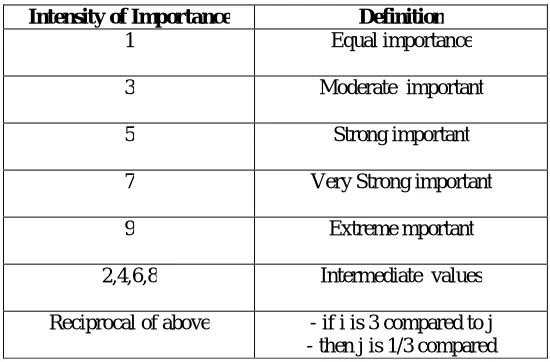
real, unique and not smaller than n.If the entries of A are ratios between weights, then the weight vector is the eigenvector of A related with the Eigen value n. What is the relative importance? They are asked to choose whether cost or any objective is very strong important, more important, as important, and so on down to very much less important. Each of these decisions is assigned a number on a scale. One common scale is shown in below Table 1. This is generally known as 1 to 9 scales.
For example, here for choosing the optimal VM, There is a minimization function which has 3 QoS parameter Cost, Time and Fault rate and w1,w2,w3 shows its weights or importance respectively. So, for getting w1,w2 and w3
mainly 3 comparison is needed for matrix comparisons:
1. Time to Cost
2. Time to Fault rate 3. Cost to fault-rate
Suppose time has strong importance than cost, so Time to cost comparison is 5
Table: 4.5 1 to 9 scale
Intensity of Importance Definition
1 Equal importance
3 Moderate important
5 Strong important
7 Very Strong important
9 Extreme mportant
2,4,6,8 Intermediate values
Reciprocal of above - if i is 3 compared to j
- then j is 1/3 compared
LOAD BALANCUNG ALGORITHM
o Step1: Find the load and capacity of all VMs. Then check the value of ‘ϭ ’ and define if the system is balanced or not. If balanced then exit.
o Step2: Take load balancing decision based on load. If load>max.capacity then exit.
o Step3: Group VMs based on loads.
o Step4:Apply Load balancing
Find out demand of each VM in OVM
Sort VMs in OVM
Sort VMs in UVM
If more than one VMs are in UVM
VMd=Call Pareto optimal VM finding -A Preemptive scheduling of the tasks- ---B
o Step5:Update the no. of tasks assigned to VMd
FIG 4.6 shows the flow of the algorithm step by step. First it checks the system’s overall load to check that whether the system is balanced or not. If it is not balanced than the load balancing will be carried out.
Step 1 in detail
Capacity of a VM, m is[1],
Ci=Pni×Pmpi+VMbwi ………(A)
Where ,Pni is the number of processors in VMi,Pmpi is millions of instructions per second of all
processors in VMi,VMbwi is the communication bandwidth ability of VMi Capacity of all VMs,
C = C1+C2+...Cn ………..(B)
Load on a VM m is, Total length of tasks that are assigned to a VM is called load, [1] The processor load is given by the number of tasks simultaneously running on that processor.[20]Load of a VM at time t can be calculated as the Number of tasks at time t on service queue of VMi divided by the
service rate of VMi at time t.
Lvmi, t = ( , )
( , ) . ………..(C)
Loads of all Vms,
L = Lvm1+Lvm2+...Lvmn ………(D)
Processing time of a VM m is,
PTi =Lvmi/ci …….,………..(E)
Processing time of all VMs:
PT=L/C …… ……….(F)
Standard deviation of load: 1/m∑ (PTi−PT)) …………(3)
If the standard deviation of the load of VM ϭ is under or equal to the threshold condition, whose value is in [0–1] then the system is balanced. Otherwise system is in an imbalance state, overloaded or under loaded.
When the current workload of VM group beats the maximum capacity of group which is predefined by threshold value, then the group is overloaded. Load balancing is not possible in this case. This condition is checked in Step 2.
Sub Algorithm A- Pareto optimal VM Finding
Step1: Identify the cost of all VMs using Fixed Price Allocation Scheme. Step2: For each VM mj, For each task ti,
Calculate execution cost of ti on VM mj using (1.2.1).
Calculate the minimization function U Select mj having minimum U
Step3: Return mj.
Sub Algorithm B- Preemptive task scheduling
For each task T in VMs , search machine VMdЄ UVM.
If (Incoming task priority > =priority of task running on VM
Return
Load Balancung Algorithm
o Step1: Find capacity and load of all VMs. Then check the value of ‘ϭ ’ and determine whether the system is balanced or not. If balanced then exit.
o Step2: Take load balancing decision based on load. If load>max.capacity then exit.
o Step3: Group VMs based on loads.
o Step4:Apply Load balancing
Find demand of each VM in OVM
Sort VMs in OVM
Sort VMs in UVM
If there are more than one VM in UVM
VMd=Call Pareto optimal VM finding --- A Preemptive scheduling of the tasks- ---B
o Step5:Update the no. of tasks assigned to VMd
o Step6:Update sets OVM,BVM and LVM
FIG 01 shows the flow of the algorithm syep by step.Firstiy checks the systems overall load to check that whether the system iis balanced or not.If it is not balanced than the load balancing will be carried out.
Step 1 in detail
Capacity of a VM, m is[1], Ci=Pni×Pmpi+VMbwi
Where ,Pni is the number of processors in VMi,Pmpi is millions of instructions per second of all processors in VMiVmbwi is the communication bandwidth ability of VMi Capacity of all VMs, C = C1+C2+...Cn
Load on a VM m is, Total length of tasks that are assigned to a VM is called load, [1] The processor load is given by the number of tasks simultaneously running on that processor.[20]Load of a VM at time t can be calculated as the Number of tasks at time t on service queue of VMi divided by the service rate of Vmi at time t. Lvmi, t = ( , )
( , ) . Loads of all Vms, L = Lvm1+Lvm2+...Lvmn
Processing time of a VM m is, PTi =Lvmi/ci ,Processing time of all VMs:PT=L/C
Standard deviation of load: 1/m∑ (PTi−PT)) (3)
If the standard deviation of the VM load ϭ is under or equal to the threshold condition , whose value is in [0–1] then the system is balanced. Otherwise system is in an imbalance state, overloaded or under loaded
When the current workload of VM group exceeds the maximum capacity of the group which is predefined by threshold value, then the group is overloaded. Load balancing is not possible in this case. This condition is checked in Step 2.
Sub Algorithm A- Pareto optimal VM Finding
Step1: Find cost of all VMs using Fixed Price Allocation Scheme. Step2: For each task ti, For each VM mj,
Calculate cost of executing ti on mj using (1.2.1). Calculate the minimization function F
Select mj having minimum F Step3: Return mj.
For each task T in VMs find machine VMd Є UVM such as T is preemptive.
If (Incoming task priority > =priority of task running on VM
If (Remaining expected completion time of incoming task <Task currently running on VM) -Save the state of currently running task and
-Preempt it
-Allocate incoming task to VM and execute it Return
V. RESULT AND DISCUSSION
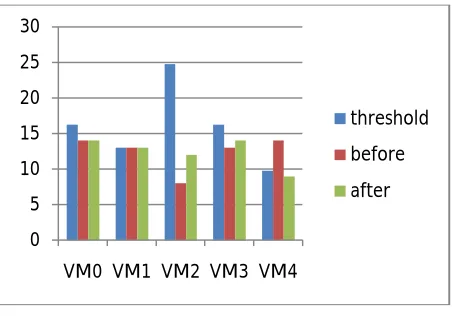
The proposed algorithm is implemented using cloudSim simulator which runs on NetBeans IDE 7.2.1.CloudSim is a latest, widespread, and extensible simulation framework that allows faultless modeling, simulation, and testing of emerging Cloud computing infrastructures . By using CloudSim, researchers can check the performance of a newly developed application service in a restricted and easy to set-up surroundings. Based on the evaluation results reported by CloudSim, they can then advance fine tune the service performance .It simulation of large-scale Cloud computing environments, including data centers, on a single physical computing node.It allows to tune the performance bottlenecks before real-world deployment on commercial clouds.The proposed algorithm works better with multiple qos parameters. Here we consider fault rate of VM. So the system become more fault tolerant by using this algorithm.Figure Shows the that proposed algorithm shows the fair distribution of load.
Fig 1. Load Distribution
VI. CONCLUSION AND FUTURE SCOPE
In Cloud computing unbalanced load results in degradation of the system performance. Performance of the system can be improved by bringing the overloaded VMs to balanced state and effectively utilizing the underloaded and idle VMs. Here the proposed algorithm follows the foraging behaviour of honey bees for allocating VMs to the tasks and uses pre-emptive task scheduling. Pareto dominance concept is used for both selecting optimal VM and for setting priorities to the tasks. Here, the proposed algorithm uses the Eigen Vector method to calculate the weight of each QoS value. The priority of the independent tasks is considered while pre-empting the tasks to achieve minimum makespan and maximum throughput. When pre-empting tasks remaining expected completion time of the tasks and priority is considered so that the waiting time of the tasks can be reduced this will also lead to improve the performance of the datacenters.
0 5 10 15 20 25 30
VM0 VM1 VM2 VM3 VM4
threshold
before
REFERENCES
[1] Sheeja Y S, Jayalekshmi S Cost Effective Load Balancing Based on honey bee Behaviour in Cloud Environment. IEEE 2014 First International Conference on Computational Systems and Communications (ICCSC) | 17-18 December 2014 | Trivandrum
[2] G.Shobana, M.Geetha, Dr.R.C.SugantheNature Inspired Preemptive Task Scheduling for Load Balancing in Cloud Datacenter . IEEE ICICES2014 - S.A.Engineering College, Chennai, Tamil Nadu, India
[3] Harshit Gupta, KalicharanSahu,Honey Bee Behavior Based Load Balancing of Tasks in Cloud Computing International Journal of Science and Research (IJSR) Volume 3 Issue 6, June 2014
[4] L.D. DhineshBabu, P. VenkataKrishna,Honey bee behavior inspired load balancing of tasks in cloud computing environments, Appl. Soft Comput. J. (2013)
[5] Jeng-Shyang Pan, Haibin Wang, Hongnan Zhao, and Interaction Artificial Bee Colony Based Load Balance Method in Cloud Computing, Springer Advances in Intelligent Systems and Computing 329,2015
[6] Kamlesh Kumar Pathak, Prasant Singh Yadav, RameshwaramTiwari, Dr.Tarun Kr. GuptaA Modified Approach for Load Balancing in Cloud Computing Using Extended Honey Bee Algorithm, IJRREST: International Journal of Research Review in Engineering Science and Technology (ISSN 2278- 6643) | Volume-1 Issue-3, December 2012
[7] Ms. Anna Baby,Improved Honey Bee inspired load balancing of tasks with position updation, International Journal for Research in Applied Science & Engineering Technology (IJRASET) Volume 3 Issue IV, April 2015
[8] Ms. Anna Baby, Dr. Joshua Samuel Raj,An efficient load balancing using Bee foraging technique with Random stealing , IOSR Journal of Computer Engineering (IOSR-JCE)e-ISSN: 2278-0661,p-ISSN: 2278-8727, Volume 17, Issue 2, Ver. V (Mar – Apr. 2015), PP 97-104 [9] RajkumarBuyyaet. el., Cloud Computing: Principles and Paradigms, Wiley India Edition
[10] PriyadarashiniAdyashaPattanaik , Sharmistha Roy ,Performance Study of Some Dynamic Load Balancing Algorithms in Cloud Computing Environment, 2nd International Conference on Signal Processing and Integrated Networks (SPIN),2015
[11] Timothy Marler·Jasbir S. AroraThe weighted sum method for multi-objectiveoptimization: new insights, springer Struct Multidisc Optim (2010) 41:853–862
[12] Giuseppe Narzisi, Classic Methods for Multi-Objective OptimizationCourant Institute of Mathematical SciencesNew York University31 January 2008
[13] Operating Systems – Scheduling ECE 344 – Week