Mining of Top-K High Utility Itemsets from
Transaction Database using a Single Phase
Algorithm (TKSA) and an Algorithm ACE for
Customer Evaluation
G.Gayathri1, J.Nagamuneiah2
P.G. Student, Department of CSE, Chadalawada Ramanamma Engineering College, Tirupati, India1
Professor, Department of CSE, Chadalawada Ramanamma Engineering College, Tirupati, India2
ABSTRACT: Utility mining is a rising research domain in the data mining. High utility itemsets (HUIs) mining refers to discovering all itemsets having a utility meeting a user-specified minimum utility threshold min_util. Setting a appropriate value for min_util is a difficult problem for users. Also, finding an appropriate minimum utility threshold value is a tedious process for users. If min_util is set too low, too many HUIs will be generated, which may cause the mining process to be very inefficient. On the other hand, if min_util is set too high, it is likely that no HUIs will be found. To address this limitation an algorithm TKSA is proposed for mining top k-HUIs in a single phase without candidate generation. Also another algorithm ACE is proposed for mining HUIs which is completely based on Customer frequency.
KEYWORDS : Utility Mining, High Utility Itemset, Frequent Itemset Mining, Top –k pattern Mining.
I. INTRODUCTION
Data Mining is an inter-disciplinary subject applied by many businesses such as health care, retail, manufacturing etc. for retrieving valuable information from the large amount of data which are used to make better business decisions. Finding interesting patterns has been an important data mining task, and has a variety of applications, for example, genome analysis, condition monitoring, cross marketing, and inventory prediction, where interestingness measures play an important role. With frequent pattern mining, a pattern is regarded as interesting if its occurrence frequency exceeds a user specified threshold. For example, mining frequent patterns from a shopping transaction database refers to the discovery of sets of products that are frequently purchased together by customers.
The traditional Frequent Itemset Mining(FIM) may discover a large amount of frequent but low-value itemsets and lose the information on valuable itemsets having low selling frequencies. Hence, it cannot satisfy the requirement of users who desire to discover itemsets with high utilities such as high profits. To address these issues, utility mining emerges as an important topic in data mining. In utility mining, each item is associated with a utility (e.g. unit profit) and an occurrence count in each transaction (e.g. quantity). The utility of an itemset represents its importance, which can be measured in terms of weight, value, quantity or other information depending on the user specification. An itemset is called high utility itemset (HUI) if its utility is no less than a user-specified minimum utility threshold min_util.
Although many studies have been devoted to HUI mining, it is difficult for users to choose an appropriate minimum utility threshold in practice. Depending on the threshold, the output size can be too small or too large. Besides, the choice of the threshold greatly influences the performance of the algorithms. If the threshold is set too low, too many HUIs will be presented to the users and it is difficult for the users to comprehend the results. On the contrary, if the threshold is set too high, no HUI will be found. To find an appropriate value for the min_util threshold, users need to try different thresholds by guessing and re-executing the algorithms many times until being satisfied with the results. This process is both inconvenient and time-consuming.
Most of the prior utility mining algorithms with the itemset share framework does not address the above challenges and adopt a two-phase, candidate generation approach. They first find candidates of high utility patterns in the first phase, and then scan the raw data one more time to identify high utility patterns from the candidates in the second phase. The challenge is that the number of candidates can be huge, which is the scalability and efficiency bottleneck. To effectively control the output size and discover the itemsets with the highest utilities without setting the thresholds, a promising solution is to redefine the task of mining HUIs as mining top-k high utility itemsets (top-k HUIs). The idea is to let the users specify k, i.e., the number of desired itemsets, instead of specifying the minimum utility threshold. Setting k is more intuitive than setting the threshold because k represents the number of itemsets that the users want to find whereas choosing the threshold depends primarily on database characteristics, which are often unknown to the users. Therefore a novel Algorithm named TKSA is proposed which identifies the complete set of top-k HUIs in single phase without the need to specify the min_util threshold. For TKSA, the novel strategy RUC (Raising the threshold by the Utilities of Candidates)for pruning the search space is integrated. In addition to TKSA, another algorithm named ACE which is completely based on Customer frequency is proposed for mining HUIs.
The rest of the paper is organized as follows. Section II presents related works and problem definition. Section III presents the proposed system. Section IV presents the TKSA which is completely profit oriented and the ACE algorithm which is based on customer frequency and Section V presents Experimental Evaluation followed by conclusion and future work.
II. RELATED WORKS
In recent years, high utility itemset mining has received lots of attention and many efficient algorithms have
been proposed. Some prior techniques introduced for mining High Utility Itemsets are briefly listed.
Philippe Fournier-Viger, Cheng-Wei Wu, Souleymane Zida, Vincent S.Tseng [3] proposed an algorithm named FHM which reduces the number of join operations by introducing a novel structure named EUCS(Estimated Utility Co-occurrence Structure). However FHM supports only static databases and it is time-consuming.
Vincent S. Tseng, Bai-En Shie, Cheng-Wei Wu, and Philip S. Yu, proposed an efficient algorithm for mining high utility itemsets from transactional databases. In this work, two algorithms, namely utility pattern growth (UP-Growth) and UP-Growth+, is proposed for mining high utility itemsets with a set of effective strategies for pruning candidate itemsets. The information of high utility itemsets is maintained in a tree-based data structure named utility pattern tree (UP-Tree) such that candidate itemsets can be generated efficiently with only two scans of database. Since this framework requires multiple phases to scan the database it is highly complex.
Sen Su, Shengzhi Xu, Xiang Cheng, Zhengyi Li, and Fangchun Yang proposed a private FP-growth algorithm, which is referred to as PFP-growth. The PFP-growth algorithm consists of a pre-processing phase and a mining phase. In the pre-processing phase, to improve the utility and privacy trade off, a novel smart splitting method is proposed to transform the database. For a given database, the pre-processing phase needs to be performed only once. In the mining phase, to offset the information loss caused by transaction splitting, we devise a run-time estimation method to estimate the actual support of itemsets in the original database. The limitation is that if itemsets of the same length are generated simultaneously, the number of FP-trees stored in memory will grow at an exponential rate.
structure used in HUI-Miner allows directly computing the utility of generated itemsets in main memory without scanning the original database.
Although the above studies may perform well in some applications, they are not developed for top-k high utility itemset mining and they still suffer from the subtle problem of setting appropriate thresholds.
III. PROBLEM DEFINITION
Let be a finite set of distinct items I* = {I1, I2, …, IN}, such that each item Ii∈I* is associated with a positive number called its external utility (e.g. unit profit). A transactional database D = {T1, T2, …, TM} is a set of transactions, where each transaction Tr∈D is a subset of I* and has an unique identifier r, called its Tid. In a transaction Tr, each item Ii∈I* is associated with a positive number called its internal utility in Tr (e.g. purchase quantity). An itemset X = { I1, I2, …, Ik } is a set of k distinct items, where Ii∈I* (1 ≤ i ≤ k) and k is the length of X. A k-itemset is an itemset of length k.
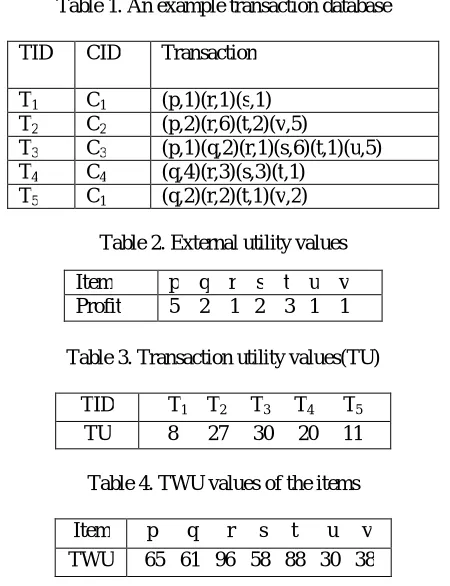
Table 1. An example transaction database
TID CID Transaction
T1 C1 (p,1)(r,1)(s,1) T2 C2 (p,2)(r,6)(t,2)(v,5)
T3 C3 (p,1)(q,2)(r,1)(s,6)(t,1)(u,5) T4 C4 (q,4)(r,3)(s,3)(t,1)
T5 C1 (q,2)(r,2)(t,1)(v,2)
Table 2. External utility values
Table 3. Transaction utility values(TU)
TID T1 T2 T3 T4 T5 TU 8 27 30 20 11
Table 4. TWU values of the items
Item p q r s t u v TWU 65 61 96 58 88 30 38
Let Table 1 be an example database containing five transactions. Each row in Table 1 represents a transaction,
where each letter represents an item and has a purchase quantity (i.e., internal utility). CID represents customer IDs. The unit profit (i.e., external utility) of each item is shown in Table 2.
Definition 1 (Absolute utility of an item). The absolute utility of an item Ijɛ I* in a transaction Tr is denoted as EU(Ij,Tr) and defined as the product of internal and external utility.
Definition 2 (Absolute utility of an itemset in a transaction). The absolute utility of an itemset X in a transaction Tr is defined as EU(X, Tr)=ƩIjɛX (Ij,Tr )
Definition 3 (Transaction utility and total utility). The transaction utility (TU) of a transaction Tr is defined as TU
(Tr) = EU(Tr,T r). The total utility of a database D is denoted as TotalUDB and defined as Ʃ TrɛD TU(Tr). Table 3 shows
transaction utility values calculated for each transaction.
Definition 4 (Utility of an itemset in a database). The (relative) utility of X is defined as U(X)=EU(X)/ TotalUDB.
Definition 5 (High utility itemset). An itemset X is called high utility itemset (HUI) iff U(X) is no less than a user-specified minimum utility threshold min_util (0% ≤ min_util < 100%). Otherwise, X is a low utility itemset. Also an itemset X is high utility iff EU(X) ≥ abs_min_util, where abs_min_util=min_util × TotalUDB.
Definition 6 (High utility itemset mining). Let δ (0% < δ < 100%) be the minimum utility threshold, the complete set
of HUIs in D is denoted as fHUI(D, δ). The goal of HUI mining is to discover fHUI (D, δ).
Because the utility of an itemset may be equal to, higher or lower than that of its supersets and subsets, we cannot directly use the anti-monotone property (also known as downward closure property) to prune the search space. To facilitate the mining task, Liu et al. introduced the concept of transaction-weighted downward closure property.
Definition 7: (Transaction-weighted utilization). The transaction-weighted utilization of an itemset X is the sum of the transaction utilities of all the transactions containing X. Table 4. shows TWU values for each item in the database.
Definition 8: (High TWU itemset). An itemset X is a high TWU itemset iff TWU(X) ≥abs_min_util.
Property 1:(TWDC property). The TWDC (Transaction Weighted Utilization Downward Closure) property states that for any itemset X if its TWU(X) is less than min_util, all supersets of X are low utility.
Property 2: Let KH be the complete set of top-k HUIs in D. KH may contain less than k itemsets when |fHUI(D, 0) | < k. Besides, KH may contain more than k HUIs when some itemsets have the same utility.
IV. PROPOSED SYSTEM
The algorithm TKSA (Top-K High utility Itemset Mining in single phase) can discover top-k HUIs in only one phase. It utilizes the basic search procedure of HUI-Miner and its utility-list structure. Whenever an itemset is generated by TKO, its utility is calculated by its utility-list without scanning the original database. The proposed algorithm consists of two parts: (1) construction of initial utility-lists and (2) generation of top-k HUIs using the utility-lists.
Construction of Utility-List Structure:
The utility-lists of items are called initial utility-lists, which can be constructed by scanning the database twice. In the first database scan, the TWU and utility values of items are calculated. During the second database scan, items in
each transaction are sorted in order of TWU values and the utility-list of each item is constructed.
Table 5. Transactions rearranged according to TWU values
TID CID Transaction Transaction Utility (TU) T1
T2 T3 T4 T5
C1 C2 C3 C4 C1
(s,1)(p,1)(r,1) (v,5)(p,2)(t,2)(r,6)
(u,5)(s,6)(q,2)(p,1)(t,1)(r,1) (s,3)(q,4)(t,1)(r,3)
(v,2)(q,2)(t,1)(r,2)
8 27 30 20 11
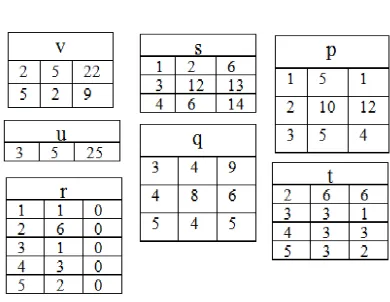
Fig 1. Initial utility-lists
Table 5 shows the example database where items in each transaction are arranged in ascending order of TWU values. Fig.1 shows the utility-lists of items for the database in Table 5. Each element in the utility-list of itemset X contains three fields: <tid, iutil, and rutil>. Field tid indicates a transaction T containing X. Field iutil is the utility of X in T, i.e., u(X, T). Field rutil is the remaining utility of X in T, i.e., ru(X, T) which is defined as follows.
Definition 9: The remaining utility of itemset X in transaction T, denoted as ru(X, T), is the sum of the utilities of all the items after X in T, denoted as ru(X, T) = Ʃi∈(T /X) u(i, T). [ T/X denotes items after X in T]
The utility-list of 2-itemset {xy} can be constructed by the intersection of the utility list of {x} and that of {y}. The algorithm identifies common transactions by comparing the tids in the two utility-lists. Suppose the lengths of the utility-lists are m and n respectively, and then (m + n) comparisons are enough for identifying common transactions, because all tids in a utility-list are ordered.
To construct the utility-list of k-itemset {i1···i(k−1)ik} (k≥3), we can directly intersect the utility-list of
{i1···i(k−2)i(k−1)} and that of {i1· ··i(k−2)ik} as we do to construct the utility-list of a 2-itemset. Generally, to calculate the
utility of {i1·· ·i(k−2)i(k−1)ik} in T, the following formula holds: u({i1·· ·i(k−2)i(k−1)ik }, T) = u({i1··· i(k−2)i(k−1)}, T) +
u({i1···i(k−2)ik}, T) - u({i1···i(k−2)}, T).
Property 3: Given the utility-list of itemset X, if the sum of all the iutils and rutils in the utility-list is less than a given minutil, any extension of X is not high utility.
V. TKSA ALGORITHM
The TKSA algorithm takes as input the parameter k and a transactional database D transformed into vertical format such as initial utility-lists. The minimum utility threshold min_util is initially set to 0 and a min-heap structure TopK-CL-List is initialized for maintaining the current top-k HUIs during the search. In this algorithm items are sorted in transaction-weighted-utility-ascending order and processed in the same order.
Mining of top k-HUI patterns by using RUC strategy
PROCEDURE: TKSA
Input: (i) u(P) utility-list for some prefix P
(ii) ItemsP: set of itemsets containing the prefix P (iii) ULSP: set of utility-lists containing the prefix P (iv) min_util: minimum utility threshold
(v) TopK-CL-List: list for storing candidate itemsets Result: Top-K-CL List gives the top K HUIs
1. For each utility-list X in ItemsP do 2. If (SUM(X.iutils) ≥ min_util )then // Raise the min_util by the RUC strategy
3. min_util = RUC( X, TopK-CL-List) 4. End
5. If ((SUM(X.iutils) + SUM(X.rutils)) ≥ min_util) 6. ItemsP= NULL ; ULSP= NULL
7. For each utility list Y after X do
8. Construct the utility list for the itemset XY
9. Append the constructed utility list to be the new ULSP 10. Append the itemset XY to ItemsP
11. End
12. //Call Recursive procedure
13. TKSA(X, ItemsP, ULSX, min_util, TopK-CL-List) 14. End
15. End
Fig 2: Pseudo code of TKSA algorithm
RUC STRATEGY
Input: X, Current min-heap TopK-CL-List Output: Rearranged min-heap tree
1. Check if HUI List is full or not 2. If NO, then add X with Utility List 3. If YES,
4. Compare utility value with the root of the min- heap tree
5. If utility value greater than the root value, 6. Remove lowest utility item value from the root 7. Add the new value and rearrange the min-heap tree 8. Set threshold = new root value
9. Add X with Utility 10. Return
Fig 3. Implementation of RUC Strategy
of all the 1-extensions of itemset Px is recursively processed. Given a database and a minutil, after the initial utility-lists are constructed, the algorithm can mine all high utility itemsets. Fig 3 shows the implementation of RUC strategy in the min-heap tree for pruning search space.
During the search, TKO updates the list of current top-k HUIs in Top K-List and gradually raises the min_util threshold by the information of Top K-List. When the algorithm terminates, the Top K-List captures the complete set of top-k HUIs in the database.
ACE ALGORITHM
The present algorithm aims to study the customer pattern ie., the customers who have purchased the high utility itemsets and how often. The frequency of customer visits are also studied. Finally the customers are listed on the decreasing order of purchase quantity of high utility itemsets(HUIs).
Architecture:
The Item Entry Table include item name, item number and selling price. The sales Entry Table includes Transaction number TID, items sold, CID (customer ID), quantity and profit associated are entered. Multiple transactions are possible for the same customer. Customer accounts are created using CID, phone number and such details.
PROCEDURE : ACE
Input : (i) Transactional database D
(ii) min–heap tree TopK-CL-List and minimum utility threshold min_util calculated earlier
Result : List of customer IDs along with frequency count in CUST-LIST
1. Read a tuple from the transaction database
2. Check whether the transaction has HUIs contained within it 3. If true
4. Append the CID in CUST-LIST
5. If the CID is already in the list increase its frequency count.
6. Read the next tuple and continue from step 2 until all transactions are read completely. 7. End
VI. EXPERIMENTAL EVALUATION
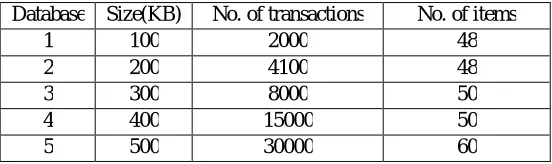
Four different sizes of datasets were used in the experiments. Databases 1, 2, 3 4 and 5 were generated by Synthetic Data Generation Code. The databases do not provide item utility (external utility) and item count for each transaction (internal utility). Here internal utilities for items are generated randomly ranging from 1 to 10 and unit profit of items are generated randomly from 1 to 5 by transaction utility values Generation code. Table 6 shows the statistical information about these databases, including the size on disk, the number of transactions, the number of distinct items.
Table 6: Statistical information about the database Database Size(KB) No. of transactions No. of items
1 100 2000 48
2 200 4100 48
3 300 8000 50
4 400 15000 50
We evaluate the performance of the proposed algorithm TKSA against REPT[16] and UP-Growth+. The results show that the proposed algorithm performs better than the existing algorithms.
Fig 4. Experimental results for different algorithms
The running time of the proposed algorithm is better than the other algorithms for almost all database sizes. The memory consumption of all the algorithms is proportional to the number of candidate itemsets they generate. The proposed algorithm comsumes less memory because the number of candidate itemsets that are generated and stored in the memory are less. Also the proposed algorithm scales better for different database sizes.
VII. CONCLUSION AND FUTURE WORK
This paper presents Mining Top K-HUI patterns by using two algorithms namely TKSA which is a single phase algorithm and ACE which is based on customer frequency. The TKSA utilizes the basic search procedure of HUI-Miner and its utility-list structure. Utility is calculated by its utility-list without scanning the original database. In ACE, the purchasing power of the customers are studied using the top-k HUIs calculated earlier.
As a future work the two Algorithms, TKSA and ACE can be combined for pruning the search space. Top K-HUI mining task can be extended to discover different types of top-k high utility patterns such as top-k high utility episodes, top-k high utility web access patterns and top-k mobile high utility sequential patterns. The work can be extended to handle data streams and negative utility values also.
REFERENCES
[1] R. Agrawal et al., “Mining association rules between sets of items in large databases”, in proceedings of the ACM SIGMOD International Conference on Management of data, page no: 207-216.
[2] R. Agrawal and R. Srikant, ―Fast Algorithms for Mining Association Rules, in Proc. of Int'l Conf. on Very Large Data Bases, pp. 487-499, 1994. [3] J. Han, J. Pei, Y. Yin, “Mining frequent patterns without candidate generation”, in Proceedings of the ACMSIGMOD Int'l Conf. on Management of Data, pp. 1-12.
[4] R. Chan, Q. Yang, and Y. Shen, “Mining high utility Itemsets,” The Third IEEE International Conference on Data Mining, pp. 19-26, 2003. [5] Y. Liu, W. Liao and A. Choudhary, “A fast high utility itemsets mining algorithm”, in Proceedings of the Utility-Based Data Mining Workshop. [6] Philippe Fournier-Viger, Cheng-Wei Wu, Souleymane Zida, Vincent S.Tseng, 2014, ‘FHM: Faster High-Utility Itemset Mining using Estimated Utility Co-occurrence Pruning’, Proc.21st international Symposium on Methodologies for intelligent Systems(ISMIS 2014), Springer, LNAI, pp.83-92.
[7] Vincent S. Tseng, Bai-En Shie, Cheng-Wei Wu, and Philip S. Yu, Fellow, IEEE,’ Efficient Algorithms for Mining High Utility Itemsets from Transactional Databases’.
[8 ] G. Liu, H. Lu, J. X. Yu, W. Wang, and X. Xiao, “ An efficient implementation of pattern growth approach”, in proceedings of IEEE Int’l Conf. Data Mining Workshop Frequent Itemset Mining Implementations, 2003.
[9] Junqiang Liu, Ke Wang, Benjamin C.M. Fung, 2016, ‘Mining High Utility Patterns in One Phase without Generating Candidates’ IEEE Transactions on Knowledge and Data Engineering.
[10] S. Krishnamoorthy, “Pruning strategies for mining high utility itemsets,” Expert Syst. Appl., vol. 42, no. 5, pp. 2371–2381, 2015.
[11] P. Fournier-Viger, C. Wu, V. S. Tseng, ―Mining Top-K Association Rules, in Proc. of Int’l Conf. on Canadian conference on Advances in Artificial Intelligence, pp. 61–73, 2012.
[12] P. Fournier-Viger, V. S Tseng, ―Mining Top-K Sequential Rules, in Proc. of Int’l Conf. on Advanced Data Mining and Applications, pp. 180-194, 2011. [9]
[13] Mengchi Liu and JunfengQu, “Mining high utility itemsets without candidate generation”, in Proceedings of the 21st ACM international conference on Information and knowledge management, page no: 55–64.
[15] T. Quang, S. Oyanagi, and K. Yamazaki, “ExMiner: An efficient algorithm for mining top-k frequent patterns,” in Proc. Int. Conf. Adv. Data Mining Appl., 2006, pp. 436 – 447.
[16]H. Ryang and U. Yun, “Top-k high utility pattern mining with effective threshold raising Strategies,” Knowl.-Based Syst., vol. 76, pp. 109–126, 2015.