A Monthly Double-Blind Peer Reviewed Refereed Open Access International Journal
International Journal in IT & Engineering
http://www.ijmr.net.in email id- [email protected]
Page 1
On-To-Methodology: Ontology Development Methodology
Magendra Singh
M.Tech Software Engineering Department of Computer Engineering
Delhi Technological University, India
Dr. Daya Gupta
Professor & Head of Department Department of Computer Engineering
Delhi Technological University, India
Abstract:
Ontologies are used to represent the domain knowledge. But the ontologies created by different creators are different and inconsistent. Huge difference exists between domains and currently there exists no single defined methodology for ontology development. In this work, we propose an ontology development methodology called On-To-Methodology that is comprehensive & generic. We elicit the domain knowledge in a structured manner and employ various documents to support the development process. We have also developed a tool that automates the development process.
Keywords: Ontology, Knowledge representation, Development methodology, Ontology design process, Ontology construction
1. Introduction
The American Heritage Dictionary defines “ontology” as “the branch of metaphysics that deals with the nature of being.” Ontology, as a formal specification of a shared conceptualization [1], defines the thesaurus of the concept, relations between concepts and properties even relations between properties. Moreover, it describes axioms and individuals and relations between them, and provides sharing knowledge [2]. More specifically, it is an explicit specification of a conceptualization [3, 4].
Initial application of ontologies in computer science was that it acted as a means of providing the semantics for the semantic web i.e. web 2.0. By use of ontologies, the information retrieval could then be done based on the context (/meaning) rather than just simple string matching mechanisms.
The Ontologies created by different creators are different and inconsistent. There is a huge difference between different domains and currently there is no defined methodology for constructing Ontologies [5, 6, 7]. And inspite much being written in literature about Ontologies, the number and quality of actual, “non-toy” ontologies available on the Web today is remarkably low [7, 8].
A Monthly Double-Blind Peer Reviewed Refereed Open Access International Journal
International Journal in IT & Engineering
http://www.ijmr.net.in email id- [email protected]
Page 2
work by focusing on healthy housing [11]. Jia et. al. put forward “Automatic ontology construction approaches and its application on military intelligence” [12]. Chen et. al proposed Concept feature based ontology construction and maintenance which was backed up by a detailed framework [13]. A structured ontology construction by using data clustering and pattern tree mining was proposed by Yao-Tang et. al. [6].
All these proposals seem to suffer from following drawbacks [7]: (i) Inconsistency of domain cognition: this relates to the point that people have no consistent definition of the scope of the domain and about the contents of the domain. (ii) Inconsistency of viewpoint: ontologies of same scope and built by domain experts with the same background knowledge still have essential dissimilarities due to the differences in their viewpoint. (iii) Ontology construction is affected by subjective factors: Even in the same field with viewpoints, ontologies may be different from one another due to creators’ interests, tastes, preferences, ideas, abilities etc. (iv) Lexical inconsistency: Conceptualization is independent from vocabulary, but ontology is language-related. Even if the language is unified, inconsistencies may still occur because the languages suffer from the problem of "polysemy" and "thesaurus".
Martin Hepp [8] classifies the ontology-related tasks into two main groups: building or contributing to the development of ontologies and committing to a particular ontology. Committing to a given ontology, explicitly or implicitly, means agreeing that it properly represents the domain’s conceptual elements.
So to solve the aforesaid problems with ontology engineering, in this work, we propose a method called On-To-Methodology, that is comprehensive, generic and makes it easy to commit and construct ontologies of various domains specifically transportation like bikes, cars, planes etc. We aim to produce documents similar to the documents in Software Engineering. Also, we provide a computer based toolwhich can automate the construction process. The proposed methodology will have following features:
Better domain cognition
As listed in above, there exists inconsistency in domain cognition. Our method handles this problem by adapting group oriented activities thus enabling experts and users to define the domain in better terms.
Unification of viewpoints
Inconsistency in viewpoints arises as different people have different perspectives and due to this contrary conclusions may be obtained. Our methodology resolves this problem by instrumenting the development process with evaluation activities after each phase of the development process. Also, the unification is achieved due to the adaptation of group oriented development activities.
Exhaustive documentation
On-To-Methodology provides an extensive and exhaustive documentation support thus making the development process more formal and helps in achieving traceability across phases. Documentation also simplifies the maintenance of the ontology by providing the backward traceability of various components of the ontology.
Extensive Verification & Validation
A Monthly Double-Blind Peer Reviewed Refereed Open Access International Journal
International Journal in IT & Engineering
http://www.ijmr.net.in email id- [email protected]
Page 3
We shall apply On-To-Methodology to domain of Automobile, specifically Bikes. The intended ontology of Bikes will be representation of bikes in the domain of ontology. The purpose of this ontology is to provide information on bikes based on the criteria specified by the users.
The ontology would hold information to answer queries of customers based on single (/combination of) parameter(s) which are Make, Engine capacity, Power, Price, Fuel tank capacity, Mileage, Brake type, Weight, Wheel type, Ignition and Number of gears.
Bike manufacturing organizations can use this ontology to identify the bike configurations that are suitable for a particular market and can also use it to analyze current sales and make future predictions. This will guide them to plan their production & inventory.
This ontology can prove to be beneficial for bike retailers as they can use it to plan their inventory and analyze their sales.
The advantage that this ontology would provide is its capability to answer the queries of the customers across a large information base of different bikes, based on multiple search criteria with complex inter-relations.
The rest of the paper is organized as follows. Section 2, proposes the methodology for ontology construction. Section 3, illustrates our methodology by constructing an Ontology of Bikes. In section 4, we evaluate the Ontology of Bikes for various competency questions and compare our approach with other existent methodologies. Section 6 concludes the thesis and proposes future work.
2. ON-TO-METHODOLOGY: Proposed methodology for ontology construction
A Monthly Double-Blind Peer Reviewed Refereed Open Access International Journal
International Journal in IT & Engineering
http://www.ijmr.net.in email id- [email protected]
Page 4
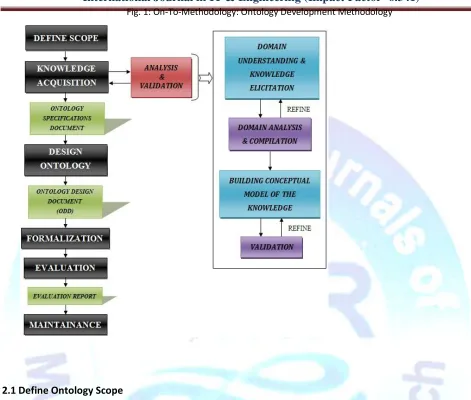
2.1 Define Ontology Scope
The target of this phase is to establish the scope of the ontology in terms of purpose that the ontology would serve with associated advantages. It should provide an objective description of the intended users, various scenarios in which it would be used and the end users.
2.2 Knowledge Acquisition
This activity would require the identification of knowledge source from where the knowledge is to be acquired. It can include the following: Books, Experts, Figures, Tables, Files, Webpages, Other ontologies etc. The output of this phase is an Ontology Specification Document.
A Monthly Double-Blind Peer Reviewed Refereed Open Access International Journal
International Journal in IT & Engineering
http://www.ijmr.net.in email id- [email protected]
Page 5
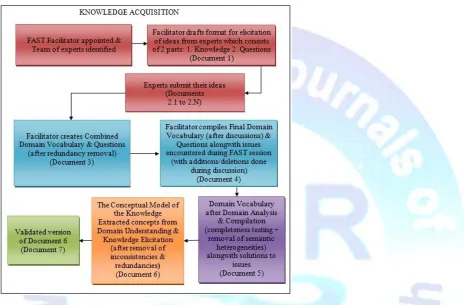
acquire the required knowledge. Figure 2 illustrates the various forms that we have generated during the Knowledge Acquisition activity.
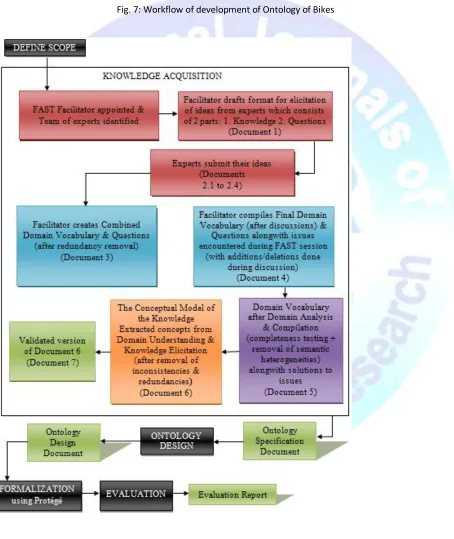
As presented in figure, in the first phase a facilitator & team of experts are identified. The facilitator controls the various activities of the FAST session and prepares an informal agenda to encourage the free flow of ideas. The facilitator drafts a form (Document 1) to elicit ideas from the experts which consists of two parts which are required to be filled by the experts. The two parts are Knowledge and Questions. This form is filled by the various experts and submitted back to the facilitator (Documents 2.1 to 2.N where N is the number of experts). The facilitator then compiles the ideas from these forms into a separate document (Document 3). The consolidated ideas are then discusses within the team and a final document i.e. document 4 is created which consists of the domain vocabulary and questions alongwith the issues encountered during the FAST session. The domain vocabulary listed in document 4 is analyzed for the given domain and thus document 5 is created after compilation. The concepts are then extracted from the Domain Understanding & Knowledge Elicitation as a result document 6 is obtained which is then validated and the final document consisting of the Conceptual model of the knowledge is obtained in the form of document 7.
We consider this activity consisting of four main tasks as described below. All these activities are carried out in a formal manner with the support of forms generated.
A Monthly Double-Blind Peer Reviewed Refereed Open Access International Journal
International Journal in IT & Engineering
http://www.ijmr.net.in email id- [email protected]
Page 6
2.2.1 Domain Understanding & Knowledge Elicitation
In this phase, the basic elements of the ontology are identified and enumerated. The elements of ontology are Class, Relationships, Constraints, Forms, Instances, Constants, and Instance attributes. These are explained as follows [14]:
Class or concepts for a domain such as location, city, travel, destination etc. Relationships are the properties between two classes such as ‘isa’.
Constraints are conditions that must be satisfied during the design. Instance is values for particular categories in ontology.
Here we don’t categorize the domain keywords according to the above categories but the focus is on comprehensive list of constituents without worrying about redundancies or overlaps.
Competency questions are also elicitated in this phase. These questions are queries related to specific situations from real life problems that the ontology would help provide a solution. The competency questions are therefore used to evaluate the ontology thus developed.
2.2.2 Domain Analysis & Compilation
An expert for particular domain can easily examine the ontology in better way and changes suggested by expert will remove some of the inconsistencies at the earlier stage to make the design phase simpler. The expert review makes knowledge acquisition evolutionary [14].
So after drafting the basic model as described above as document 4, it is reviewed by the experts for following rules: [10]
I. Consistency rule: various defects are analyzed for example usage of different names for a same concept. II. Completeness rule: the defects such as omission of domain resources and the omission of relationship
are diagnosed. The issues encountered during FAST sessions are also resolved here.
If any consistency or completeness check fails, it is refined by the expert and the output is called as document 5.
2.2.3 Building Conceptual Model of the Knowledge
A Monthly Double-Blind Peer Reviewed Refereed Open Access International Journal
International Journal in IT & Engineering
http://www.ijmr.net.in email id- [email protected]
Page 7
The definition of class hierarchy can be done in different ways [16] as following:
Top-down development process begins with the definition of the concept of the field of the most common, followed by characterization of the concept.
Bottom-up development process begins with the definition of the most specific classes, namely, class hierarchy the leaves, and then grouped into these classes more general concept.
Combination of the two- defining more clearly the concept of the first, followed by their proper places generalization and characterization, it is the easier process.
The final result is document 6 which we call as the conceptual model of the ontology.
2.2.4 Validation
The conceptual model of the knowledge, developed in the last step is reviewed here. Expert review is again used here. An expert for particular domain will examine the ontology for the following rules and the changes suggested will be incorporated [10]:
I. Correctness rule: The use of incorrect relationship, aggregation & specialization of classes and cardinality of relationship are tested.
II. Rule for Semantic heterogeneities: Semantic heterogeneities are also determined and dissolved in this step.
III. Constraints: Constraints on domain and range values of each object property and datatype property are also verified in the testing activity.
The result of this activity is document 7 which is the validated version of document 6.
2.3 Design Ontology
A Monthly Double-Blind Peer Reviewed Refereed Open Access International Journal
International Journal in IT & Engineering
http://www.ijmr.net.in email id- [email protected]
Page 8
2.3.1 Design
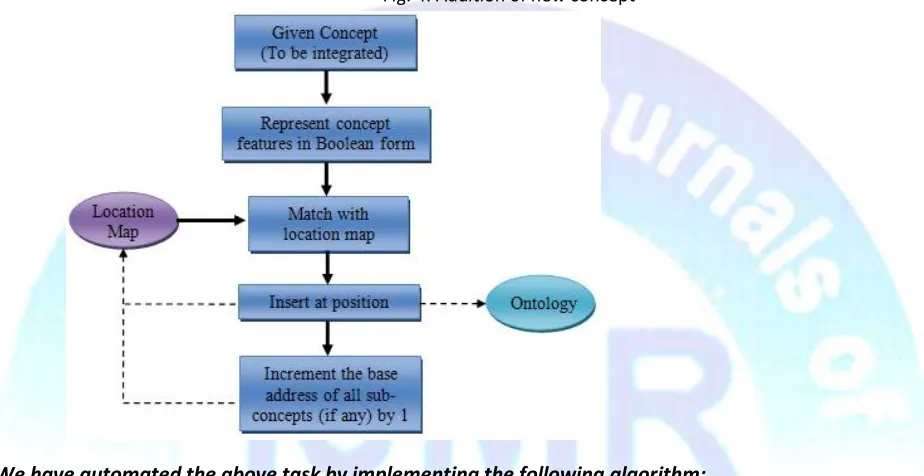
This is the core task of building ontology. We have adapted an algorithm for this and apply the technique [13] as shown in figure 4 below:
We have automated the above task by implementing the following algorithm:
i. Given an Ontology structure with a concept Thing which is super concept of all concepts. ii. A concept with from Conceptual model of the knowledge is selected. Let it be X.
iii. All features for that concept are identified and labeled with a feature number as follows: {X} f+ <feature no. from 1 to n>
iv. The concept is then represented in the Boolean form as follows: C (X): { f+ 1 • f+ 2 • … • f+ n }
v. The concept represented in Boolean form is compared to other concepts in the location map one by one. Say the concept currently chosen from the Ontology structure be Y with address in location map as (a, b). Following cases can happen:
a. If {Y}: { f+ 1 • f+ 2 • … • f+ (n-k) } where k<n, and we have {X}: { f+ 1 • f+ 2 • … • f+ (n-k) • … • f+ n }
In this case there is match between X and Y for f+ 1 to f+ (n-k). This means that X is a child of Y with f+ (n-k+1) to f+ n as additional features. Thus X is inserted in the Location map with address (a+1, xx).
b. If {Y}: { f+ 1 • f+ 2 • … • f+ m }, and we have {X}: { f+ 1 • f+ 2 • … • f+ n }
If there exists a feature in Y that is not present in X, then X is not a sub-concept of Y thus it is either a brother concept of this concept or a sub-concept of some other concept.
A Monthly Double-Blind Peer Reviewed Refereed Open Access International Journal
International Journal in IT & Engineering
http://www.ijmr.net.in email id- [email protected]
Page 9
vi. Steps ii to v are repeated for all concepts in the conceptual model and the end result is the complete ontology structure.
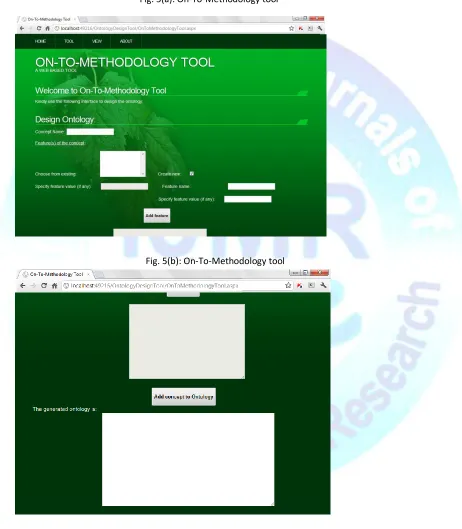
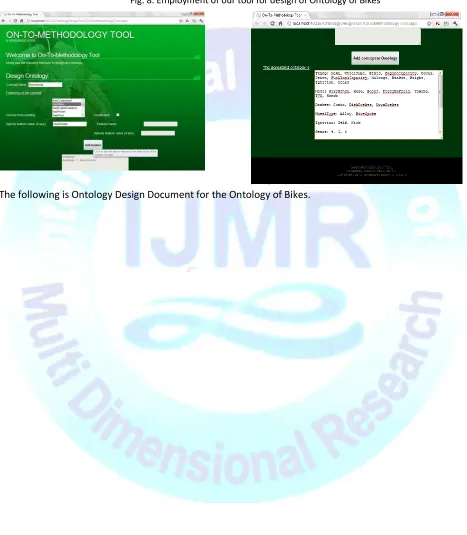
The following are the snapshots of our tool, fig 5(a) and fig 5(b):
Fig. 5(a): On-To-Methodology tool
A Monthly Double-Blind Peer Reviewed Refereed Open Access International Journal
International Journal in IT & Engineering
http://www.ijmr.net.in email id- [email protected]
Page 10
2.3.2 Ontology Design Document
The output of this phase is the Ontology Design Document (ODD). This document is a formal record of the ontology structure and consists of the Location map alongwith the graphical representation of the ontology structure. The format for ODD is as follows [13]:
ONTOLOGY DESIGN DOCUMENT
The location map is as below:
CONCEPT ADDRESS CONCEPT FEATURE
Thing (0, 1) X
A (a1, a2) f+ 1 • f+ 2• …
B (b1, b2) f+ x • f+ y • …
… …
The graphical representation of ontology structure is as follows:
2.4 Formalization
The main aim behind ontology development is to make the information to be understood by the machines. Thus, the ontology is finally formalized using the selected ontology languages and tools.
A Monthly Double-Blind Peer Reviewed Refereed Open Access International Journal
International Journal in IT & Engineering
http://www.ijmr.net.in email id- [email protected]
Page 11
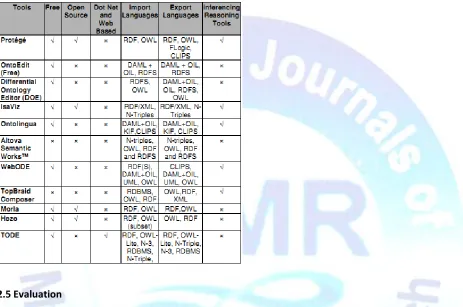
concepts. OWL ontologies may be categorized into three sub languages: Lite, DL and OWL-Full. Islam et. al. [18] have compared several editing tools as shown in Table 1 below.
2.5 Evaluation
After the ontology has been drafted, it should be checked for quality and knowledge representation efficiency. If any constraints are violated then they are corrected. The ontology engineers also verify the developed ontology against the requirement document. The term ‘Evaluation’ encompasses both- verification & validation. Based on [11], we identify following two ways of evaluation:
Relation Evaluation: Relation evaluation infers the new individual based on constructed rule set, and judges whether the relation is coincident with the professionals’ knowledge. This is done using the
Reasoner that comes inbuilt in the tool, like Fact++ in Protégé.
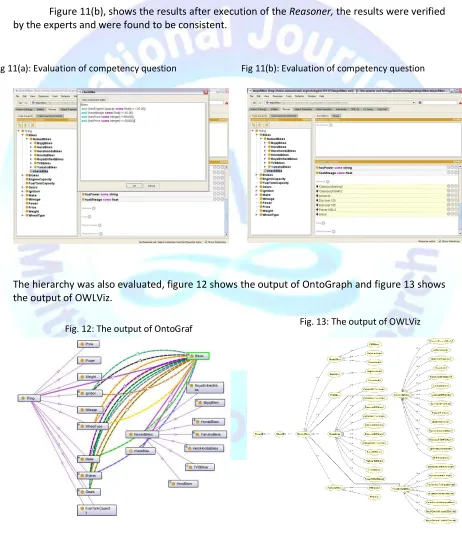
Evaluation of hierarchy: Evaluation of hierarchy develops limits definition of created class and individual properties, makes use of ontology tool (like OntoGraf, OWLViz) to infer and create Ontology Graph automatically, and judge whether Subordination between the class and individual in the graph are coincident.
Also, in above steps, the answers to competency questions are verified by the experts. The output of this phase is the Evaluation Report. It consists of following:
I. Evaluation of competency questions by the experts to check if the results are as per the expectation. II. Evaluation of hierarchy using OntoGraf & OWLViz.
A Monthly Double-Blind Peer Reviewed Refereed Open Access International Journal
International Journal in IT & Engineering
http://www.ijmr.net.in email id- [email protected]
Page 12
2.6 Maintenance
Ontologies need to adapt to the changing specifications to become more mature. This can be accomplished by adding, updating and removing concepts/ parts of the ontology. For this, following techniques can be employed:
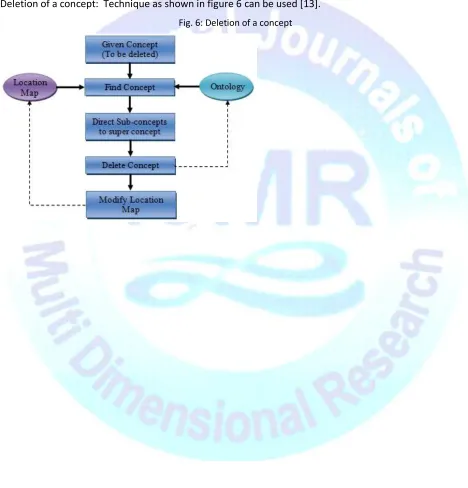
Addition of new concept: Technique as used in ontology design can be used. Deletion of a concept: Technique as shown in figure 6 can be used [13].
A Monthly Double-Blind Peer Reviewed Refereed Open Access International Journal
International Journal in IT & Engineering
http://www.ijmr.net.in email id- [email protected]
Page 13
3. Case Study
Here we illustrate our methodology by working out an Ontology of Bikes. The purpose of this ontology is to represent information related to bikes for parameters like Make, Engine capacity, Power, Price, Fuel Tank capacity, Mileage etc. Following is the workflow of the Bikes Ontology development process (figure 7):
A Monthly Double-Blind Peer Reviewed Refereed Open Access International Journal
International Journal in IT & Engineering
http://www.ijmr.net.in email id- [email protected]
Page 14
We employed our tool in the Ontology Design activity to design the ontology automatically. Following snapshots show the working of our tool in the designing process:
The following is Ontology Design Document for the Ontology of Bikes.
A Monthly Double-Blind Peer Reviewed Refereed Open Access International Journal
International Journal in IT & Engineering
http://www.ijmr.net.in email id- [email protected]
Page 15
CONCEPT ADDRESS CONCEPT FEATUREThing (0, 1) X
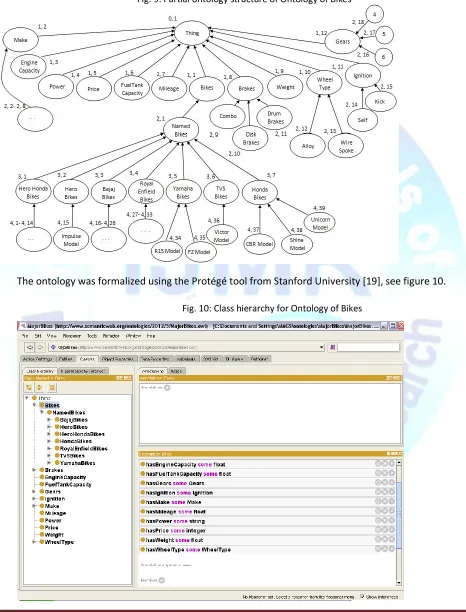
Bikes (1, 1) f+ 1 • f+ 2 • f+ 3 • f+ 4 • f+ 5 • f+ 6 • f+ 7 • f+ 8 • f+ 9 • f+ 10 • f+ 11 • f+ 12
Make (1, 2) f+ 2
EngineCapacity (1, 3) f+ 3
Power (1, 4) f+ 4
Price (1, 5) f+ 5
FuelTankCapacity (1, 6) f+ 6
Mileage (1, 7) f+ 7
Brakes (1, 8) f+ 8
Weight (1, 9) f+ 9
WheelType (1, 10) f+ 10
Ignition (1,11) f+ 11
Gears (1 ,12) f+ 12
NamedBikes (2, 1) f+ 1 • f+ 2 • f+ 3 • f+ 4 • f+ 5 • f+ 6 • f+ 7 • f+ 8 • f+ 9 • f+ 10 • f+ 11 • f+ 12
HeroHonda (2, 2) f+ 2 • f+ 13
Hero (2, 3) f+ 2 • f+ 14
Bajaj (2, 4) f+ 2 • f+ 15
A Monthly Double-Blind Peer Reviewed Refereed Open Access International Journal
International Journal in IT & Engineering
http://www.ijmr.net.in email id- [email protected]
Page 16
Yamaha (2, 6) f+ 2 • f+ 17
TVS (2, 7) f+ 2 • f+ 18
Honda (2, 8) f+ 2 • f+ 19
HeroHondaBikes (3, 1) f+ 2 • f+ 3 • f+ 4 • f+ 5 • f+ 6 • f+ 7 • f+ 8 • f+ 9 • f+ 10 • f+ 11 • f+ 12 • f+ 13
HeroBikes (3, 2) f+ 2 • f+ 3 • f+ 4 • f+ 5 • f+ 6 • f+ 7 • f+ 8 • f+ 9 • f+ 10 • f+ 11 • f+ 12 • f+ 14
BajajBikes (3, 3) f+ 2 • f+ 3 • f+ 4 • f+ 5 • f+ 6 • f+ 7 • f+ 8 • f+ 9 • f+ 10 • f+ 11 • f+ 12 • f+ 15
RoyalEnfieldBikes (3, 4) f+ 2 • f+ 3 • f+ 4 • f+ 5 • f+ 6 • f+ 7 • f+ 8 • f+ 9 • f+ 10 • f+ 11 • f+ 12 • f+ 16
YamahaBikes (3, 5) f+ 2 • f+ 3 • f+ 4 • f+ 5 • f+ 6 • f+ 7 • f+ 8 • f+ 9 • f+ 10 • f+ 11 • f+ 12 • f+ 17
TVSBikes (3, 6) f+ 2 • f+ 3 • f+ 4 • f+ 5 • f+ 6 • f+ 7 • f+ 8 • f+ 9 • f+ 10 • f+ 11 • f+ 12 • f+ 18
HondaBikes (3, 7) f+ 2 • f+ 3 • f+ 4 • f+ 5 • f+ 6 • f+ 7 • f+ 8 • f+ 9 • f+ 10 • f+ 11 • f+ 12 • f+ 19
Combo (2, 9) f+ 8 • f+ 20
DiskBrakes (2, 10) f+ 8 • f+ 21
DrumBrakes (2, 11) f+ 8 • f+ 22
Alloy (2, 12) f+ 10 • f+ 23
WireSpoke (2, 13) f+ 10 • f+ 24
Self (2, 14) f+ 11 • f+ 25
Kick (2, 15) f+ 11 • f+ 26
6 (2, 16) f+ 12 • f+ 27
A Monthly Double-Blind Peer Reviewed Refereed Open Access International Journal
International Journal in IT & Engineering
http://www.ijmr.net.in email id- [email protected]
Page 17
4 (2, 18) f+ 12 • f+ 29
Karizma(Normal)Model
(4, 1)
f+ 2 • f+ 3 • f+ 4 • f+ 5 • f+ 6 • f+ 7 • f+ 8 • f+ 9 • f+ 10 • f+ 11 • f+ 12 • f+ 13 • f+ 20 • f+ 23 • f+ 25 • f+ 28
Karizma(ZMR)Model
(4, 2)
f+ 2 • f+ 3 • f+ 4 • f+ 5 • f+ 6 • f+ 7 • f+ 8 • f+ 9 • f+ 10 • f+ 11 • f+ 12 • f+ 13 • f+ 21 • f+ 23 • f+ 25 • f+ 28
Splendor(Plus)Model
(4, 3)
f+ 2 • f+ 3 • f+ 4 • f+ 5 • f+ 6 • f+ 7 • f+ 8 • f+ 9 • f+ 10 • f+ 11 • f+ 12 • f+ 13 • f+ 22 • f+ 24 • f+ 26 • f+ 29
Splendor(NXG)Model
(4, 4)
f+ 2 • f+ 3 • f+ 4 • f+ 5 • f+ 6 • f+ 7 • f+ 8 • f+ 9 • f+ 10 • f+ 11 • f+ 12 • f+ 13 • f+ 23 • f+ 23 • f+ 26 • f+ 29
Splendor(Super)Model
(4, 5)
f+ 2 • f+ 3 • f+ 4 • f+ 5 • f+ 6 • f+ 7 • f+ 8 • f+ 9 • f+ 10 • f+ 11 • f+ 12 • f+ 13 • f+ 22 • f+ 23 • f+ 25 • f+ 29
Splendor(Pro)Model
(4, 6)
f+ 2 • f+ 3 • f+ 4 • f+ 5 • f+ 6 • f+ 7 • f+ 8 • f+ 9 • f+ 10 • f+ 11 • f+ 12 • f+ 13 • f+ 22 • f+ 23 • f+ 25 • f+ 29
PassionProModel
(4, 7)
f+ 2 • f+ 3 • f+ 4 • f+ 5 • f+ 6 • f+ 7 • f+ 8 • f+ 9 • f+ 10 • f+ 11 • f+ 12 • f+ 13 • f+ 20 • f+ 23 • f+ 25 • f+ 29
CD-DawnModel
(4, 8)
f+ 2 • f+ 3 • f+ 4 • f+ 5 • f+ 6 • f+ 7 • f+ 8 • f+ 9 • f+ 10 • f+ 11 • f+ 12 • f+ 13 • f+ 22 • f+ 24 • f+ 26 • f+ 29
CD-DeluxeModel
(4, 9)
f+ 2 • f+ 3 • f+ 4 • f+ 5 • f+ 6 • f+ 7 • f+ 8 • f+ 9 • f+ 10 • f+ 11 • f+ 12 • f+ 13 • f+ 22 • f+ 23 • f+ 26 • f+ 29
A Monthly Double-Blind Peer Reviewed Refereed Open Access International Journal
International Journal in IT & Engineering
http://www.ijmr.net.in email id- [email protected]
Page 18
Glamour(Normal)Model
(4, 10)
f+ 2 • f+ 3 • f+ 4 • f+ 5 • f+ 6 • f+ 7 • f+ 8 • f+ 9 • f+ 10 • f+ 11 • f+ 12 • f+ 13 • f+ 20 • f+ 23 • f+ 25 • f+ 29
Glamour(PGMFi)Model
(4, 11)
f+ 2 • f+ 3 • f+ 4 • f+ 5 • f+ 6 • f+ 7 • f+ 8 • f+ 9 • f+ 10 • f+ 11 • f+ 12 • f+ 13 • f+ 20 • f+ 23 • f+ 25 • f+ 29
AchieverModel
(4, 12)
f+ 2 • f+ 3 • f+ 4 • f+ 5 • f+ 6 • f+ 7 • f+ 8 • f+ 9 • f+ 10 • f+ 11 • f+ 12 • f+ 13 • f+ 20 • f+ 23 • f+ 25 • f+ 28
CBZXtremeModel
(4, 13)
f+ 2 • f+ 3 • f+ 4 • f+ 5 • f+ 6 • f+ 7 • f+ 8 • f+ 9 • f+ 10 • f+ 11 • f+ 12 • f+ 13 • f+ 20 • f+ 23 • f+ 25 • f+ 28
HunkModel
(4, 14)
f+ 2 • f+ 3 • f+ 4 • f+ 5 • f+ 6 • f+ 7 • f+ 8 • f+ 9 • f+ 10 • f+ 11 • f+ 12 • f+ 13 • f+ 21 • f+ 23 • f+ 25 • f+ 28
ImpulseModel
(4, 15)
f+ 2 • f+ 3 • f+ 4 • f+ 5 • f+ 6 • f+ 7 • f+ 8 • f+ 9 • f+ 10 • f+ 11 • f+ 12 • f+ 14 • f+ 20 • f+ 23 • f+ 25 • f+ 28
CT100Model
(4, 16)
f+ 2 • f+ 3 • f+ 4 • f+ 5 • f+ 6 • f+ 7 • f+ 8 • f+ 9 • f+ 10 • f+ 11 • f+ 12 • f+ 15 • f+ 22 • f+ 24 • f+ 26 • f+ 29
Pulsar135LSModel
(4, 17)
f+ 2 • f+ 3 • f+ 4 • f+ 5 • f+ 6 • f+ 7 • f+ 8 • f+ 9 • f+ 10 • f+ 11 • f+ 12 • f+ 15 • f+ 20 • f+ 23 • f+ 25 • f+ 28
Pulsar150DTS-iModel
(4, 18)
f+ 2 • f+ 3 • f+ 4 • f+ 5 • f+ 6 • f+ 7 • f+ 8 • f+ 9 • f+ 10 • f+ 11 • f+ 12 • f+ 15 • f+ 20 • f+ 23 • f+ 25 • f+ 28
A Monthly Double-Blind Peer Reviewed Refereed Open Access International Journal
International Journal in IT & Engineering
http://www.ijmr.net.in email id- [email protected]
Page 19
(4, 19)
Pulsar220DTS-iModel
(4, 20)
f+ 2 • f+ 3 • f+ 4 • f+ 5 • f+ 6 • f+ 7 • f+ 8 • f+ 9 • f+ 10 • f+ 11 • f+ 12 • f+ 15 • f+ 21 • f+ 23 • f+ 25 • f+ 28
Avenger220DTS-iModel
(4, 21)
f+ 2 • f+ 3 • f+ 4 • f+ 5 • f+ 6 • f+ 7 • f+ 8 • f+ 9 • f+ 10 • f+ 11 • f+ 12 • f+ 15 • f+ 20 • f+ 23 • f+ 25 • f+ 28
Discover135Model
(4, 22)
f+ 2 • f+ 3 • f+ 4 • f+ 5 • f+ 6 • f+ 7 • f+ 8 • f+ 9 • f+ 10 • f+ 11 • f+ 12 • f+ 15 • f+ 20 • f+ 23 • f+ 25 • f+ 29
Discover125Model
(4, 23)
f+ 2 • f+ 3 • f+ 4 • f+ 5 • f+ 6 • f+ 7 • f+ 8 • f+ 9 • f+ 10 • f+ 11 • f+ 12 • f+ 15 • f+ 22 • f+ 23 • f+ 25 • f+ 28
Discover100Model
(4, 24)
f+ 2 • f+ 3 • f+ 4 • f+ 5 • f+ 6 • f+ 7 • f+ 8 • f+ 9 • f+ 10 • f+ 11 • f+ 12 • f+ 15 • f+ 22 • f+ 23 • f+ 25 • f+ 29
Platina100Model
(4, 25)
f+ 2 • f+ 3 • f+ 4 • f+ 5 • f+ 6 • f+ 7 • f+ 8 • f+ 9 • f+ 10 • f+ 11 • f+ 12 • f+ 15 • f+ 22 • f+ 23 • f+ 26 • f+ 29
Duke200Model
(4, 26)
f+ 2 • f+ 3 • f+ 4 • f+ 5 • f+ 6 • f+ 7 • f+ 8 • f+ 9 • f+ 10 • f+ 11 • f+ 12 • f+ 15 • f+ 21 • f+ 23 • f+ 25 • f+ 27
BulletElectraTwinspark
Model
(4, 27)
f+ 2 • f+ 3 • f+ 4 • f+ 5 • f+ 6 • f+ 7 • f+ 8 • f+ 9 • f+ 10 • f+ 11 • f+ 12 • f+ 16 • f+ 20 • f+ 24 • f+ 25 • f+ 28
A Monthly Double-Blind Peer Reviewed Refereed Open Access International Journal
International Journal in IT & Engineering
http://www.ijmr.net.in email id- [email protected]
Page 20
(4, 28)
Bullet Electra EFI Model
(4, 29)
f+ 2 • f+ 3 • f+ 4 • f+ 5 • f+ 6 • f+ 7 • f+ 8 • f+ 9 • f+ 10 • f+ 11 • f+ 12 • f+ 16 • f+ 20 • f+ 24 • f+ 25 • f+ 28
Bullet Electra Deluxe Model
(4, 30)
f+ 2 • f+ 3 • f+ 4 • f+ 5 • f+ 6 • f+ 7 • f+ 8 • f+ 9 • f+ 10 • f+ 11 • f+ 12 • f+ 16 • f+ 20 • f+ 24 • f+ 25 • f+ 28
Royal Enfield Classic 500 Model (4, 31)
f+ 2 • f+ 3 • f+ 4 • f+ 5 • f+ 6 • f+ 7 • f+ 8 • f+ 9 • f+ 10 • f+ 11 • f+ 12 • f+ 16 • f+ 20 • f+ 24 • f+ 25 • f+ 28
Royal Enfield Classic 350 Model (4, 32)
f+ 2 • f+ 3 • f+ 4 • f+ 5 • f+ 6 • f+ 7 • f+ 8 • f+ 9 • f+ 10 • f+ 11 • f+ 12 • f+ 16 • f+ 20 • f+ 24 • f+ 25 • f+ 28
Thunderbird Twinspark Model (4, 33) f+ 2 • f+ 3 • f+ 4 • f+ 5 • f+ 6 • f+ 7 • f+ 8 • f+ 9 • f+ 10 • f+ 11 • f+ 12 • f+ 16 • f+ 20 • f+ 24 • f+ 25 • f+ 28
R15Model (4, 34) f+ 2 • f+ 3 • f+ 4 • f+ 5 • f+ 6 • f+ 7 • f+ 8 • f+ 9 • f+ 10 • f+ 11 • f+ 12 • f+ 17 • f+ 21 • f+ 23 • f+ 25 • f+ 27
FZModel (4, 35) f+ 2 • f+ 3 • f+ 4 • f+ 5 • f+ 6 • f+ 7 • f+ 8 • f+ 9 • f+ 10 • f+ 11 • f+ 12 • f+ 17 • f+ 20 • f+ 23 • f+ 25 • f+ 28
VictorModel (4, 36) f+ 2 • f+ 3 • f+ 4 • f+ 5 • f+ 6 • f+ 7 • f+ 8 • f+ 9 • f+ 10 • f+ 11 • f+ 12 • f+ 18 • f+ 22 • f+ 24 • f+ 26 • f+ 29
CBRModel (4, 37) f+ 2 • f+ 3 • f+ 4 • f+ 5 • f+ 6 • f+ 7 • f+ 8 • f+ 9 • f+ 10 • f+ 11 • f+ 12 • f+ 19 • f+ 21 • f+ 23 • f+ 25 • f+ 27
ShineModel (4, 38) f+ 2 • f+ 3 • f+ 4 • f+ 5 • f+ 6 • f+ 7 • f+ 8 • f+ 9 • f+ 10 • f+ 11 • f+ 12 • f+ 19 • f+ 22 • f+ 23 • f+ 25 • f+ 29
UnicornModel (4, 39) f+ 2 • f+ 3 • f+ 4 • f+ 5 • f+ 6 • f+ 7 • f+ 8 • f+ 9 • f+ 10 • f+ 11 • f+ 12 • f+ 19 • f+ 20 • f+ 23 • f+ 25 • f+ 28
A Monthly Double-Blind Peer Reviewed Refereed Open Access International Journal
International Journal in IT & Engineering
http://www.ijmr.net.in email id- [email protected]
Page 21
The ontology was formalized using the Protégé tool from Stanford University [19], see figure 10.
Fig. 9: Partial ontology structure of Ontology of Bikes
A Monthly Double-Blind Peer Reviewed Refereed Open Access International Journal
International Journal in IT & Engineering
http://www.ijmr.net.in email id- [email protected]
Page 23
4. Evaluation
The developed ontology was evaluated by experts by querying it with competency questions and verifying the results. Figure 11(a) shows the following query:
“ Average >=40 & price should be between Rs. 50000 & Rs. 60000, and engine capacity should be >=125”
Figure 11(b), shows the results after execution of the Reasoner, the results were verified by the experts and were found to be consistent.
The hierarchy was also evaluated, figure 12 shows the output of OntoGraph and figure 13shows the output of OWLViz.
Fig 11(a): Evaluation of competency question Fig 11(b): Evaluation of competency question
A Monthly Double-Blind Peer Reviewed Refereed Open Access International Journal
International Journal in IT & Engineering
http://www.ijmr.net.in email id- [email protected]
Page 23
Table- 3 presents the mapping of main concepts of our On-To-Methodology to notions used by previously presented Ontology engineering methods.
5. CONCLUSION & FUTURE WORK
The work carried out in this report provides with strong base in Ontology Engineering. Here we have presented the theories and principles for construction of ontology according to various currently existent methodologies. We also noted the various issues related to the field of ontology development.
Since there exists no one methodology that can be applied in all scenarios of ontology development, our main emphasis here is on building a methodology that can be used as a standard method for ontology construction under various domains. For this we have proposed a method namely On-To-Methodology. Then we illustrated our methodology by working out an Ontology of bikes.
The future work entails development of a tool that will automatically generate the Conceptual model of the knowledge. Another future direction is to develop software that would
A Monthly Double-Blind Peer Reviewed Refereed Open Access International Journal
International Journal in IT & Engineering
http://www.ijmr.net.in email id- [email protected]
Page 24
work on the ontology of Bikes that we created and has simpler graphical user interface so that it could be operated by non-technical users.
6. REFERENCES
[1] Guarino, N., Formal ontology in information systems. 1998, IOS Pr.
[2] Borst, P., H. Akkermans,and J. Top, “Engineering ontologies”, International Journal of Human Computer Studies, 1997. 46: p. 365-406.
[3] Gruber T R., “A Translation Approach to Portable Ontology Specifications. Knowledge Acquisition”, 1993,5(2): 199-220
[4] Gruber T R, 1993, “Towards principles for the design of ontologiesused for knowledge sharing”, International Workshop on Formal Ontology in Conceptual analysis and Knowledge Representation, eds. G N & P R, Kluver Academic Publishers, Deventer, The Netherlands, Padova, Italy
[5] Zhang Qing,Tian Yuexin, "Requirements capturement and analysis",In China Science and Technology Information,Feb,2009:1-2.
[6] Yao-Tang Yu, Chien-Chang Hsu, “A structured ontology construction by using data clustering and pattern tree mining”, Proceedings of the 2011 International Conference on Machine Learning and Cybernetics, Guilin, 10-13 July, 2011, 45-50
[7] Gaoyun J, Jianliang W, Shaohua Y, “A Method for Consistent Ocean Ontology Construction”, IEEE 201O 2nd International Conference on Industrial and Information Systems, 37-42
[8] Hepp M, “Possible Ontologies- How Reality Constrains the Development of Relevant Ontologies”, 2007
[9] Fernández M, Gómez-Pérez A, Juristo N, “METHONTOLOGY: From Ontological Art Towards Ontological Engineering”, AAAI Technical Report SS-97-06, available at
http://www.aaai.org/Papers/Symposia/Spring/1997/SS-97-06/SS97-06-005.pdf
[10] Farooq A, Shah A, Asif K H, “Design of Ontology in Semantic Web Engineering Process”
[11] Zhang Y, tan L, Liu J, Yu CC, “A Domain Ontology Construction Method Towards Healthy Housing”, 2010 IEEE
[12] Jia M, Zheng D, Liu L, Yang B, Sun W, Yang J, “Automatic Ontology Construction Approaches and its Application on Military Intelligence”, 2009 Asia-Pacific Conference on Information Processing, 348-351
[13] Chen Y J, Chen Y M, Huang C Y, Chao C Y, “Concept Feature-based Ontology Construction and Maintenance”, 2010 IEEE, 28-32
[14] Gupta D, Jat K, “Knowledge representation with Ontology and Relational database to RDF converter”
A Monthly Double-Blind Peer Reviewed Refereed Open Access International Journal
International Journal in IT & Engineering
http://www.ijmr.net.in email id- [email protected]
Page 25
[16] Wei QUI, “Development and Application of Knowledge Engineering Based on Ontology”, 2010 Third International Conference on Knowledge Discovery and Data Mining, 518-521
[17] N. F. Noy, and D. L. McGuinness, “Ontology Development 101: A guide to creating your first ontology”, Technical Report SMI-2001-0880, Stanford Medical Informatics, 2001
[18] Islam N, Siddiqui MS, Shaikh ZA, “TODE : A Dot Net Based Tool for Ontology Development and Editing”, 2010 2nd International Conference on Computer Engineering and Technology.