Using a student centred approach to explore issues
affecting student transition
Romana Morda
Victoria University, Melbourne, Australia [email protected]
Christopher Sonn
Victoria University, Melbourne, Australia [email protected]
Lutfiye Ali
Victoria University, Melbourne, Australia [email protected]
Keis Ohtsuka
Victoria University, Melbourne, Australia [email protected]
Student attrition in the first year of university is an issue of concern for many universities. Many factors influence attrition including academic preparedness and social adjustment difficulties. In this project we sought clarify factors that influence transition from the
perspective of students and to implement strategies to address this issue. During first semester 2006, a series of strategies were implemented with the aim of better supporting first year psychology students' adjustment to university. These strategies included identifying students' concerns and challenges, structured orientation activities, curriculum reforms and learning support workshops. Students found the structured orientation activities and curriculum reforms beneficial in that they allowed them to reflect upon, share and validate their concerns with others which in turn helped foster their adjustment to university life. However,
evaluation of the effectiveness of the learning support workshops revealed that a more systematic approach to academic support was needed, such as embedding this support into the curriculum.
Student retention, academic support, social cohesion
Introduction
that sought to investigate and address issues of transition and attrition in first year psychology at a Victorian University. Specifically, we will describe the phases of the project and discuss the key lessons about social and academic support that emerged in each phase.
Approach
The two specific aims of this project were to improve understanding of the transition challenges faced by students and development and trialling of a program to facilitate academic and social adjustment of students. We adopted an action-orientated approach (McKernan, 1991; Owen & Rogers, 1999) involving problem identification, intervention, reflection and evaluation. Throughout the project we focussed on incorporating and responding to student voices regarding their needs and concerns. There were three phases; Phase 1 involved review of literature and identification of the transition challenges faced by past students. The findings of Phase 1 informed Phase 2. Phase 2 involved the implementation of strategies to identify, validate and address current students’ transition and attrition issues. The focus of these strategies was on facilitating students’ social and academic adjustment. Evaluation of Phase 2 outcomes led to the implementation of embedded curriculum support in Phase 3 of the project. The efficacy of this strategy in addressing students’ academic needs was systematically evaluated at the end of Phase 3.
Phase 1: Problem Identification
During this initial phase relevant literature on student attrition was reviewed to help inform the project team regarding factors leading to attrition and strategies that have been developed to enhance student transition and retention. In addition, focus group interviews were
conducted in order to specifically understand the issues faced by first year psychology students. The findings from the review and focus groups are discussed next.
Literature on attrition and retention programs
Tinto (1993) categorised three levels of factors leading to attrition including: Individual disposition, experiences at university and external forces. Individual dispositional factors encompass student’s intention and commitment to study, student interests, expectations and study preparedness (Koutoukidis, 2003; Tinto). Experiences at a university fall into two broad systems: 1) Within the academic system that focuses on student acquisition of knowledge and competency; and 2) the social system. When the experiences within these systems are
negative, for example, exposure to an unsupportive academic culture, it is likely to lead to the diminishment of academic and/or social integration and as a result increases the chances of attrition. The final factor, external forces, encapsulates for example, work and family commitments, health and personal concerns, finances and location of the university (Koutoukidis, 2003; Pitkethly & Prosser, 2001; Tinto)
Although all three categories of factors are important in better understanding student attrition, a student’s experience at the university is a key element in the design of retention programs (Tinto, 1993). Universities can actively target this area of student attrition as they have control over the quality of education and can foster students’ connectedness in the academic and social community of the university. For example, Graunke, Woosley and Sherry (2005) found that positive student interaction with peers and staff was related to higher levels of satisfaction with the university, fostered a sense of belongingness, strengthened commitment to the
Other university level strategies that have been developed to enhance academic success and social integration of new students have focused on providing opportunities for positive staff and student interaction within and outside the classroom (Graunke et al., 2005; Krause, 2001; Peat, Dalziel & Grant, 2001; Pitkethly & Prosser, 2001; Tinto, 1993). Transition programs at the University of Sydney (Peat et al.) and La Trobe University (Pitkethly & Prosser, 2001) have focussed on both academic and social adjustment of students. The University of Sydney offers a transition workshop that facilitates student transition through a number of strategies. Students are offered advice on how to adjust to university life, they are given opportunities to meet with past students and share their experiences of transition to university life and they were also introduced to students that they were to sharing classes with, followed by a campus tour. The authors reported that the students who attended the transition workshop displayed better academic performance, had stronger social bonds with other students, which enhanced their study and motivation. These students also thought less about dropping out and had a positive view of the university (Peat et al.).
La Trobe University also adopted several strategies to facilitate student transition and enhance student learning. To familiarise students with the university setting, strategies such as
developing a lecture addressing what to expect at university and having a treasure hunt to introduce students to the physical environment were adopted. To develop student sense of purpose and direction careers information and detailed information about the subjects was made available to students. In order to facilitate student engagement, a study group was established and students were contacted if they missed three consecutive classes. Academic and research skills were incorporated into curriculum and staffs were also available for student consultation to enhance students’ learning (Pitkethly & Prosser, 2001).
Although the strategies implemented by these two universities were reported to have positive outcomes on student attrition and transition it is difficult to ascertain the true efficacy of these strategies due to the correlative nature of such studies. Further evaluative information was needed to draw more definitive conclusions regarding the impact of the strategies.
Transition programs have extended beyond student integration and introduction to university life to assess the nature of student’s academic skills and preparedness in order to identify at risk students (Tinto, 1993). Early identification of at risk students is important because appropriate education interventions can then be applied which will help decrease the
likelihood of student attrition. At academic risk students may be identified through a number of means and in doing so the student can be supported academically and interaction between student and staff is also fostered (Tinto, 1993).
Focus group interviews
In addition to reviewing past literature, focus group interviews were conducted in order to understand the issues faced by first year psychology students at our university. Psychology students who had completed first year in 2005 were invited to attend interview/focus groups aimed at understanding the issues and challenges they faced in their first year of study. The group comprised six students who were representative of the wider student population; males and females, mature age and younger students and full time and part time students. Focus group questions included “What was most challenging about first year?” and “How supported did you feel throughout your first year?”
helping students adjust to university. It was found that developing social bonds with peers was an important factor in transition, particularly for younger students. The following quotation illustrates the role of other students in the transition process:
Sue: Orientation day for me was a waste of time. I didn’t like the way it was handled. We were going from one building to the other after that we didn’t remember anything.
Int: Soyou didn’t feel like you benefited much from the orientation day?
Sue: No, I found the university by myself and my friends the people that I met on orientation day. The mentor walked us around but wasn’t really helpful. So when she finished we (students) met up and walked around the university.
Int: Based on your experience what advice would you give to first year students to be successful and enjoy university life?
Mike: Basically, get involved and networking. Having those friends in classes does help. You could always swap and share notes. You can always get a second opinion on
assignments.
Int: How did you cope with these challenges that you faced?
Kay: My colleagues, my friends. I found we all got into groups and we got over it. Yeah, that is how. If I didn’t have the peers with me I probably would have left.
Students were not just concerned about the social relationships with fellow students, but also with lecturers and tutors. The following quotation shows the positive impact of supportive staff:
Adam: It (transition) was all fairly smooth. In my particular situation I just can’t thank Harry (lecturer pseudonym) enough. I didn’t know where I was going to go school. I knew I wanted to do psychology. And I just started ringing universities. To say that Harry was the most helpful person I came across is an understatement because he was just magnificent. Just making it all smooth and making sure that I had his phone number if I’ve any queries in the first couple of weeks.
Int:You talked about leaving at one point that was mainly due to…
Kay: Commuting, stress as well. Being away from home, like being away from my area, being thrown into an area and people that I am not familiar with at all. It was awful.
Int:What kept you going through that period?
Kay: I basically had a teacher in my arts department. He did like an icebreaker in class. And I said I am from Geelong and I said that I don’t know if I want to stay in this class or in this school. He approached me and said “give it six months, try your best and we will try and get you a transfer at six months to Deakin”. So I went the rest of the six months and by six months I loved the course so I had just had to stay.
These excerpts show the importance of social relationships and networking between students and with academic staff and the role social networks plays in fostering commitment to the university. Interviews also revealed that students were experiencing difficulties with academic writing and with developing effective study skills. This highlighted the need to provide
targeted academic support in addition to social support:
academic essay for 15 years. That was a big learning curve. Twelve months and nineteen months in and I still haven’t got very good study habits.
Mike: What did I find challenging? Um, well coming from a business background I found the, um, the report writing style a lot different. Just the whole format and the style of writing is just a lot different from business reports that I am used to writing and I found that
challenging.
Phase 2: Implementing social and academic support
The findings of past research and the focus group interviews highlighted the importance of both social and academic factors in the student transition experience. Consistent with Tinto (1993) we also wanted to put in place strategies for the early identification of ‘at risk’ students. These findings informed Phase 2, the intervention phase of the project. This phase involved implementation of strategies to facilitate student transition, reflection upon and evaluation of strategies and subsequent modification of strategies. Three specific strategies were
implemented with the aim of addressing student attrition by fostering students’ social and academic adjustment to university. These strategies included:
(1) Orientation activities to foster student networking and validation of transitional concerns.
(2) Curriculum reform of the first semester psychology unit to identify student issues, at risk students, support student learning and engagement with fellow students.
(3) Academic support workshops for students.
Orientation activities
A number of actions were undertaken to facilitate student orientation to university life. In week 1 lectures, the psychology 1 coordinators provided an overview of the psychology course and outlined the course requirements and expectations. The Head of School sent an email to the first year psychology cohort that consisted of 334 students. This email welcomed them to the course and provided them with information regarding the roles and contact details of subject and course coordinators. Students were encouraged to contact their coordinator with any issues relating to their study in psychology or their overall course.
In addition, orientation strategies were implemented in week 1 laboratories to facilitate student transition. There were 18 first year labs run by a teaching staff of six. The tutors were both full time staff and post-graduate students. Each lab class consisted of approximately 20 students. In the first week lab students were asked to form small discussion groups, in which they discussed and recorded their initial impressions of university and transition issues. The aim of the activity was to allow students the opportunity to share their experiences, feelings and the challenges they faced in their first week at university. Some groups gave themselves a name and this helped foster a sense of connectedness between group members. They were also asked to note down group members’ names as the groups were to be reformed in week 4 classes.
Psychology 1 tutors reported that these small group activities and discussions helped validate students’ feelings about their transition to university and the challenges they were
experiencing. Together students brainstormed possible ‘solutions’ to the identified issues. Tutors also welcomed the opportunity to provide students timely guidance and support and to help students resolve identified issues.
collated and qualitatively analysed using both a theory driven and inductive thematic
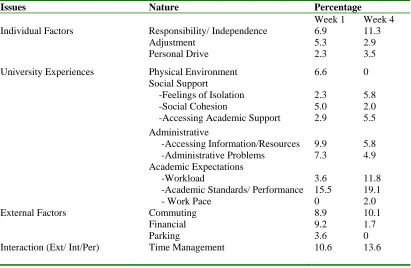
approach (Hayes, 2000). Analysis was partially theory driven in that it was guided by Tinto’s (1993) model of attrition. An inductive approach was also employed to explore emergent themes. Through a process of triangulation researchers coded data into thematic categories according to the nature of the issue or concern. Consistent with Tinto’s model, broad thematic categories included Individual factors, Experiences at University and External factors (see Table 1).
Table 1: Student issues and concerns from week 1 group discussions and week 4 reflective journals
Issues Nature Percentage
Week 1 Week 4
Individual Factors Responsibility/ Independence 6.9 11.3
Adjustment 5.3 2.9
Personal Drive 2.3 3.5
University Experiences Physical Environment 6.6 0
Social Support
-Feelings of Isolation -Social Cohesion
-Accessing Academic Support
2.3 5.0 2.9 5.8 2.0 5.5 Administrative
-Accessing Information/Resources 9.9 5.8
-Administrative Problems 7.3 4.9
Academic Expectations -Workload
-Academic Standards/ Performance - Work Pace
3.6 15.5 0 11.8 19.1 2.0
External Factors Commuting 8.9 10.1
Financial 9.2 1.7
Parking 3.6 0
Interaction (Ext/ Int/Per) Time Management 10.6 13.6
Table 1 indicates that students experienced a range of issues and concerns during their first week at university. Some of these related to students feeling anxious about being independent learners and free to make choices about attendance and submission of work. Students also expressed concerns about ‘feeling lost’ in terms of locating rooms, contacting lecturers or tutors, building friendships, and feeling unsure about the administrative processes at
university. External factors such as time taken to commute to university, financial costs, and difficulties finding parking were also identified. In addition, a fourth factor was identified which encapsulated time management or more specifically balancing university, work and family commitments. Academic concerns were identified by a number of students. Specific concerns included academic performance, study skills and clarification of assessment requirements.
Curriculum Reforms
As part of the intervention plan, a new hurdle task was introduced into the Psychology 1 curriculum. This task involved submission of a short journal report. The journal was used to assess students’ writing skills in order to help identify students ‘at academic risk’ and to provide students with an opportunity to reflect upon the first few weeks of university study.
attrition. Students who did not submit the journal were tracked throughout the semester. Analysis of their enrolment records showed that the majority of these students subsequently withdrew not only from psychology, but also from their overall courses.
In order to help ascertain how students were feeling and adjusting to university study,
students were asked to reflect on specific questions in their journal entries, including: “When did you first decide you wanted to study psychology?” and “What challenges have you faced since being at university?”
Journals were submitted in week 4 classes and students were given the opportunity to reform into their groups from week 1 to discuss their journal responses. These group discussions once again allowed students the opportunity to share and validate how they were feeling about the first three weeks of university and to brainstorm ideas about how they could address the identified issues. Tutors collected journals and project team members thematically analysed journal content and reflected on these using the procedure employed to analyse week 1 data.
In comparison to week 1 data (see Table 1), it appeared that as students settled into the semester and assessment requirements become clearer they felt increasingly pressured to become self-motivated and independent learners. Although there was a slight decline in the percentage of students reporting that ‘making friends’ was an area of concern, some students were still feeling somewhat isolated. As unit assessment demands intensified, students appeared to identify workloads, academic concerns, such as study skills and access to academic support and performance as increasingly important issues. Sense of manageability continued to be an area of concern as students settled into the semester.
Academic support
In order to help address these academic issues and to foster students’ academic adjustment, a series of actions were undertaken. Students were informed of the time and location of
academic support workshops that were being run by the university. These academic support workshops included a weekly statistical drop in session that students were encouraged to attend.
A stand-alone academic skills workshop was run by the University Student Learning Unit and psychology staff to help address specific student issues such as time management and study skills. Of the 334 first year psychology students, 32 students expressed via email their interest in attending this workshop, but only six students actually attended. Following this workshop, it was recognised that a more systematic form of academic support was required in order to ensure that as many students as possible were given the opportunity to further develop their academic skills. These findings are consistent with others who argued that although academic skills could be facilitated through separate stand-alone classes the most successful forms of support are integrated into the course (Tinto, 1993; Yorke & Thomas, 2003).
Phase 3: Embedding curriculum support
students the opportunity to practice writing an essay plan. Lab tutors were provided with a powerpoint presentation to facilitate the consistent delivery of curriculum material. Students also had the opportunity to ask their tutors questions regarding the essay topics and essay format.
Evaluation of the essay writing lecture and lab was also conducted. Both the quantitative and qualitative evaluations support the usefulness of the laboratory and lecture. Students wrote that the session was “as useful and gave direction” and “analysis of essay question useful”. Students also made recommendations regarding how the essay writing workshops could be improved including the provision of sample essays and additional support in finding relevant literature.
Conclusion
We set out to clarify student attrition and to develop strategies to contribute to the reduction in student attrition rates. We adopted an action research approach with an emphasis on using student voices to inform the development of strategies that will facilitate student transition. Our research concurs with previous work recognising the complexity of student transition concerns, including acknowledging the importance of both academic and social concerns in the experience (Peat et al., 2001; Pitkethly & Prosser, 2001; Tinto, 1993). Importantly, from our vantage point, transition and settlement experiences are continuous, and transition to university reflects one context within which students must negotiate new systems and cultural practices. If viewed in this way, it becomes clear that as students develop competencies over time, their transition needs also change. In our case, social network development was
important initially and, as assessment demands intensified, the focus shifted to developing knowledge and skills to respond to academic demands.
Our project shows that a multifaceted approach incorporating structured orientation class activities, curriculum reforms such as a reflective journal and the embedding of academic support were efficient and effective strategies in addressing student transitional concerns. Students appeared to welcome opportunities to discuss and validate their concerns and experiences. The tutors were able to provide timely guidance and support through class discussions, and this did not focus solely on academic concerns, but also provided
opportunities to breakdown real and perceived social barriers (such as status) that may be reflected in student/teacher relationships within university contexts.
The research also showed that stand-alone workshops are not ideal and that it may be better to embed curriculum support into core curricula. Although, this is evident in the literature (Tinto, 1993; Yorke & Thomas, 2003), this is not always possible because of disciplinary
particularities, including external accreditation of courses and subjects. The challenge for us has been and will be in the future to continue to redevelop curriculum that is responsive to students’ needs and in line with good teaching and learning practices while recognising accreditation and discipline based requirements.
References
Graunke, S. S., Woosley, S. A. & Sherry, A. (2005). An exploration of factors that affect the academic success of college sophomores. College Student Journal 39(2), 367-376.
Hayes, N. (2000). Doing Psychological Research. Buckingham: Open University Press.
Krause, K-L. (2001). The university essay writing experience: A pathway for academic integration during transition. Higher Education Research & Development 20(2), 147-168.
McInnis, C. (2001). Researching the first year experience: Where to from here? Higher Education Research & Development 20(2), 106-114.
McKernan, J. (1991). Curriculum Action Research: A Handbook of Methods and Resources for Reflective Practitioners. New York, NY: St Martin’s Press.
Owen, J. M. & Rogers, P. J. (1999). Program Evaluation: Forms and Approaches (2nd ed.). Crows Nest, Australia: Allan & Unwin.
Peat, M., Dalziel, J., & Grant, A. M. (2001). Enhancing the first year student experience by facilitating the development of peer networks through a one-day workshop. Higher Education Research & Development 20(2), 199-215.
Pitkethly, A. & Prosser, M. (2001). The first year experience project: A model for university-wide change. Higher Education Research & Development 20(2), 185-198.
Price, D., Harte J. & Cole, M. (1991). Student Progression in Higher Education: A Study of Attrition at Northern University. Canberra: A. G. P. S.
Tinto, V. (1993). Leaving College: Rethinking the Causes of Student Attrition. London: Chicago University Press.
Yorke, M. & Thomas, L. (2003). Improving the retention of students from lower socio-economic groups. Journal of Higher Education 25 (1), 63 -74.
Acknowledgements
This project was funded by a Victoria University student transition grant. The project team gratefully
acknowledges the support of the transition coordinator at Victoria University Dr Kanchana Jayasuriya.
Copyright statement