IJEDR1601079
International Journal of Engineering Development and Research (www.ijedr.org)477
Exploiting MIMO Technology in Wireless
Communication
Shaika Mukhtar
________________________________________________________________________________________________________ Abstract - Better communication is the need of the generation. No stone is left unturned in making the communication services better and better with each passing day, but the hostile environment poses new challenges with every new development making the earlier technologies obsolete. MIMO technology is one of the technologies promising to provide better and reliable communication. It has been employed in various modern technologies with the hope that it will also support the future genre. This paper analyses MIMO technology and its characteristics. An analytical MIMO system model is also explained to give an insight view of MIMO communication system.
IndexTerms - Multiple-input multiple-output (MIMO), Space-Time Block Code (STBC), Spatial Multiplexing (SM), Digital Subscriber Line (DSL), Long Term Evolution (LTE)
________________________________________________________________________________________________________
I.INTRODUCTION
AWireless is one of the most rapidly developing technologies in our time, with a plethora of dazzling new products and services emerging with time. These developments present open challenges for communications engineers which need radical approach. The main technical issue in wireless communications is that of multipath-induced fading [1]. This multipath scattering is considered as impairment to wireless communication. But it can now also be seen as providing an opportunity to significantly improve the capacity and reliability of such systems. One such technology is MIMO technology where by using multiple antennas at the transmitter and receiver in a wireless system, the rich scattering channel can be exploited to create a multiplicity of parallel links over the same radio band, and thereby to either increase the rate of data transmission through multiplexing or to improve system reliability through the increased antenna diversity [3]. MIMO technology is a wireless networking technology which plays a vital role in increasing the range, capacity and throughput of a wireless communication system. It was in 2001 that the MIMO technology was first used in cellular systems by Iospan, Inc. Since then, various standards have evolved which are based on MIMO technology, for example, WiFi (IEEE802.11n), WiMAX (IEEE 802.16e), Enhanced HSPA, LTE (3.9G), LTE-Advanced (4G) etc. All these standards have implemented MIMO technique in different ways, but the underlying concept of MIMO is same in all these standards [10]. It actually includes various signal processing techniques which enhance the system performance by placing multiple antennas at the transmitter and receiver. MIMO technology basically exploits the concept of multipath propagation by using the idea of spatial multiplexing where the multiple data streams are transmitted using different spatial channels. In order to have reliable communication, the need is to combat the fading which is experienced by the transmitted signals [12].
IJEDR1601079
International Journal of Engineering Development and Research (www.ijedr.org)478
II.MIMO TECHNOLOGYThe use of multiple antennas at the transmitter and receiver in wireless systems is known as MIMO (input multiple-output) technology. It has rapidly gained in popularity over the past decade due to its powerful performance-enhancing capabilities. Communication in wireless channels is impaired predominantly by multi-path fading [3]. Multi-path is the arrival of the transmitted signal at an intended receiver through differing angles or differing time delays or differing frequency (i.e., Doppler) shifts due to the scattering of electromagnetic waves in the environment. Consequently, the received signal power fluctuates in space (due to angle spread) or frequency (due to delay spread) or time (due to Doppler spread) through the random superposition of the impinging multi-path components [7]. This random fluctuation in signal level, known as fading, can severely affect the quality and reliability of wireless communication. Additionally, the constraints posed by limited power and scarce frequency bandwidth make the task of designing high data rate, high reliability wireless communication systems extremely challenging [8]. MIMO technology constitutes a breakthrough in wireless communication system design. The technology offers a number of benefits that help meet the challenges posed by both the impairments in the wireless channel as well as resource constraints. In addition to the time and frequency dimensions that are exploited in conventional single-antenna (single-input single-output) wireless systems, the leverages of MIMO are realized by exploiting the spatial dimension (provided by the multiple antennas at the transmitter and the receiver) [9].
The first commercial MIMO system was developed in 2001 by Iospan Wireless Inc. Since 2006, several companies such as Broadcom and Intel have introduced a novel communication technique based on the MIMO technology for improving the performance of wireless Local Area Network (LAN) systems. The new standard of wireless LAN systems is named IEEE 802.11n. Nowadays, MIMO systems are implemented in many advanced technologies such as various standard proposals for the Fourth Generation (4G) of wireless communication systems and LTE. MIMO technology was shown to boost the communication system capacity and to enhance the reliability of the communication link since it uses several diversity schemes beyond the spatial diversity [12].
III.MIMO SYSTEM MODEL
MIMO system model is depicted in Figure 1. We present a communication system with NT transmit antennas and NR receive antennas. Antennas 𝑇𝑥1 …….. , 𝑇𝑥𝑁𝑇respectively send signals 𝑥1, . . . , 𝑥𝑁𝑇to receive antennas 𝑅𝑥1, . . . , 𝑅𝑥𝑁𝑅. Each receive antenna combines the incoming signals which coherently add up. The received signals at antennas 𝑅𝑥1, . . . ,𝑅𝑥𝑁𝑅 are respectively denoted by 𝑦1 . . . ,𝑦𝑁𝑅. We express the received signal at antenna 𝑇𝑥𝑞 where q = 1, . . . , 𝑁𝑅as:
𝑦𝑞 = ∑ ℎ𝑞𝑝
𝑁𝑇
𝑝=1 . 𝑥𝑝+ 𝑏𝑞 where q=1,………NR The flat fading MIMO channel model is described by the input-output relationship as:
y = H . x + b
where H is the (NR × NT) complex channel matrix given by: H = (
ℎ11ℎ12 ⋯ ℎ1𝑁𝑇
⋮ ⋮ ⋱ ⋮
ℎ𝑁𝑅1ℎ𝑁𝑅2 ⋯ ℎ𝑁𝑅𝑁𝑇 )
ℎ𝑞𝑝 where p = 1, . . . , NT and q = 1, . . . , NR is the complex channel gain which links transmit antenna 𝑇𝑥𝑝 to receive antenna 𝑅𝑥𝑞.
Here 𝑥 = [𝑥1, … … … . , 𝑥𝑁𝑇] 𝑇
is the (NT × 1) complex transmitted signal vector. 𝑦 = [𝑦1, … … . . 𝑦𝑁𝑟]
𝑇
is the (NR × 1) complex received signal vector. 𝑏 = [𝑏1, … … . . 𝑏𝑁𝑅]
𝑇
is the (NR × 1) complex additive noise signal vector.
The continuous time delay MIMO channel model of the (NR × NT) MIMO channel H associated with time delay 𝜏and noise signal b(t) is expressed as:
𝑦(𝑡) = ∫ 𝐻(𝑡, 𝜏) 𝑥(𝑡 − 𝑥)𝑑𝜏
IJEDR1601079
International Journal of Engineering Development and Research (www.ijedr.org)479
Fig.1 MIMO system modelMIMO technology has been shown to improve the capacity of the communication link without the need to increase the transmission power. MIMO system capacity is mainly evaluated according to the following scenarios:
When no Channel State Information (CSI) is available at the transmitter, the power is equally split between the NT transmit antennas, the instantaneous channel capacity is then given by:
𝐶(𝐻) = log2[det (𝐼𝑁𝑅+ 𝛾 𝑁𝑇 . 𝐻𝐻
∗)] bits/s/Hz
where 𝛾 denotes SNR , (.)* denotes conjugate transpose operator
When CSI is available at the receiver, Singular Value Decomposition (SVD) is used to derive the MIMO channel capacity which is given by:
𝐶𝑆𝑉𝐷(𝐻) = 𝑅 log2[det (1 + γ NT . HH
∗)] bits/s/Hz
where R = min(NR, NT) is the rank of the channel matrix H
When CSI is available at both the transmitter and the receiver, the channel capacity is computed by performing the water-filling algorithm. The instantaneous channel capacity is then:
𝐶𝑊𝐹(𝐹) = ∑ log2[(
𝜆𝐻,𝑝.𝜇 𝜎𝑏2 )
+ ] 𝑅
𝑝=1 bits/s/Hz
where a+=max(a,0) , λ
H,p is the p − th singular value of the channel matrix H , 𝜇 is a constant scalar which satisfies the total power constraint, σb2 is the noise signal power [7].
IV.CHARACTERISTICS OF MIMO TECHNOLOGY
MIMO technology helps in providing reliable and secure communication by focusing on the following two important techniques:
Spatial diversity to combat fading effects by creating spatial diversity through the use of baseband space-time coding techniques;
Spatial multiplexing to use spatial multiplexing techniques to exploit multipath in order to achieve higher data rates than are possible with conventional systems having the same bandwidth.
Spatial diversity
Diversity techniques may exploit the multipath propagation resulting in a diversity gain. In space diversity (antenna diversity), the signal is transmitted over several different propagation paths [8]. Here no additional bandwidth or power is needed in order to take advantage of spatial diversity. Based on whether diversity is applied to the transmitter or to the receiver , space diversity can be further classified as in the following sub-headings.
IJEDR1601079
International Journal of Engineering Development and Research (www.ijedr.org)480
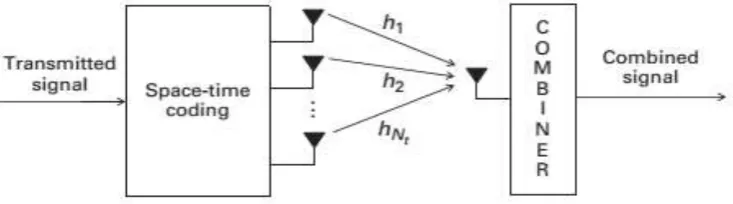
Fig 2. Architecture of a communication system with receive diversity combining. Transmit diversity: Transmit spatial diversity is a newer phenomenon than receive diversity and has become widely implemented only in the early 2000s. Because the signals sent from different transmit antennas interfere with one another, processing is required at both the transmitter and the receiver in order to achieve diversity while removing or at least attenuating the spatial interference [11]. It is an attractive choice due to its simple implementation, good performance, and no feedback requirement. It is used mainly for downlink transmission. In this approach, delayed versions of a signal are sent at the transmit antennas. It converts spatial diversity into frequency diversity by transmitting the data signal from the first antenna and a delayed replica thereof from the second antenna. The delay process at the transmitter results in a frequency selectivity in the received channel response [12]. The figure 3 shows the architecture of a communication system with transmit diversity combining.
Fig. 3 Architecture of a communication system with transmit diversity combining.
Space-time block coding is a simple yet ingenious transmit diversity technique in MIMO technology. The combination of coding with spatial diversity has proved very useful in wireless communications by helping in realizing reliable high-speed wireless communication links. Space-time block coding is a simple and effective form of achieving transmit diversity [3]. To have a proper coding design is the need for a digital communication system which takes into account several design factors like coding gain, channel characteristics, source coding requirements, modulation, etc. MIMO technology with the block of space time coding (STBC) represents an interesting candidate for communication systems due to its ability to withstand high speeds, high capacity and robustness to multipath fading [4]. Spatial diversity technique in terms of the technique designed to encode multiantenna transmissions is referred to as Space-Time Coding (STC). STC schemes map the source symbols to the transmit antennas. These schemes were popularized with the discovery of Space-Time Block Code (STBC). Orthogonal STBs are an important subclass of linear STBCs that guarantee that the ML detection of different symbols is decoupled [6]. An OSTBC is a linear space-time block code S that has the following unitary property:
SHS = ∑ |𝑠
𝑛|2𝐼 𝑁 𝑛=1
The orthogonality enables us to achieve full transmit diversity and at the same time, it allows the receiver to do simple ML decoding. The antennas are separated in such a way the individual signals are uncorrelated. Therefore, coding over MIMO systems is fundamental to the realization of the promises offered by MIMO systems in terms of reliability and achievable transmission rates [15].
Spatial multiplexing
IJEDR1601079
International Journal of Engineering Development and Research (www.ijedr.org)481
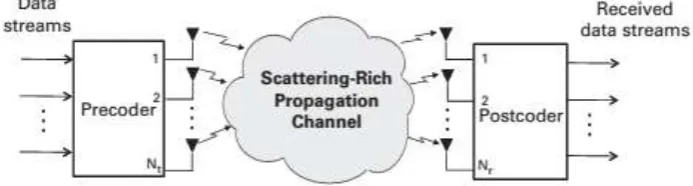
Fig 4. Generic diagram of a MIMO communication system that uses spatial multiplexingFigure 4 shows a high-level block diagram of a MIMO system that uses spatial multiplexing. There are three main components of a spatial multiplexing system. The first component is precoder whose purpose is to map the multiple input streams of data that are to be transmitted onto the set of transmit antennas. The second component of an SM system is the postcoder, which processes the signals from the receive antennas and generates estimates of the original input data streams that originally went into the precoder at the transmitter [8]. The third component of an SM system is the communications channel itself. In order for spatial multiplexing to work, the channel must have a significant amount of multipath scattering. This may seem odd since multipath is normally regarded as the enemy by communications engineers since it degrades the performance of conventional communication systems. However, since spatial multiplexing exploits multipath, its presence is necessary for SM techniques to work [11].
V.BENEFITS OF MIMO TECHNOLOGY
The benefits of MIMO technology that help achieve such significant performance gains which are given as under [11]
Array gain :Array gain is the increase in receive SNR that results from a coherent combining effect of the wireless signals at a receiver. The coherent combining may be realized through spatial processing at the receive antenna array and/or spatial pre-processing at the transmit antenna array. Array gain improves resistance to noise, thereby improving the coverage and the range of a wireless network[11].
Spatial diversity gain:Spatial diversity gain mitigates fading and is realized by providing the receiver with multiple (ideally independent) copies of the transmitted signal in space, frequency or time. With an increasing number of independent copies (the number of copies is often referred to as the diversity order), the probability that at least one of the copies is not experiencing a deep fade increases, thereby improving the quality and reliability of reception. A MIMO channel with MT transmit antennas and MR receive antennas potentially offers MT ×MR independently fading links, and hence a spatial diversity order of MT ×MR
Spatial multiplexing gain :MIMO systems offer a linear increase in data rate through spatial multiplexing i.e., transmitting multiple, independent data streams within the bandwidth of operation. Under suitable channel conditions, such as rich scattering in the environment, the receiver can separate the data streams. Furthermore, each data stream experiences at least the same channel quality that would be experienced by a single-input single-output system, effectively enhancing the capacity by a multiplicative factor equal to the number of streams. In general, the number of data streams that can be reliably supported by a MIMO channel equals the minimum of the number of transmit antennas and the number of receive antennas, i.e., min [MT ,MR ]. The spatial multiplexing gain increases the capacity of a wireless network [9].
Interference reduction and avoidance:Interference in wireless networks results from multiple users sharing time and frequency resources. Interference may be mitigated in MIMO systems by exploiting the spatial dimension to increase the separation between users. Interference reduction and avoidance improve the coverage and range of a wireless network [15].
In general, use of MIMO technology will result in improved capacity, coverage and reliability in communication. It is because of the above said reasons that MIMO technology finds its applications in many areas and is nowadays exploited in 3GPP LTE, Release 8 of LTE ,Release 9 of LTE,LTE advanced, Multiple-cell networks, Digital Subscriber Line (DSL) ,etc [12] [14].
VI.CONCLUSION
MIMO technology is one of the technologies which have the potential to raise the bar of communication services. It provides array gain, spatial multiplexing gain, spatial diversity gain and helps in interference mitigation. This paper provides a brief description of MIMO technology with its system model and characteristics. The need is to incorporate MIMO technology with other communication technologies so as to provide better constructive results.
REFERENCES
[1] Ezio Biglieri et al., “MIMO Wireless Communications”, Cambridge University Press 2007
[2] Tim Brown et al., “Practical guide to MIMO radio channel with MATLAB examples”, Wiley Publications
[3] Bliss D.W., Forsythe K.W.,Chan A.M.,“MIMO Wireless Communication” Lincoln Laboratory Journal, Vol. 15, No. 1, 2005
IJEDR1601079
International Journal of Engineering Development and Research (www.ijedr.org)482
Sreco Plevel et al., “MIMO: Wireless Communications”, Taylor & Francis, Encyclopedia of Wireless and Mobile Communications,2008[10]Lajos Hanzo et al., “MIMO-OFDM for LTE, Wi-Fi and WiMAX”, Wiley Publications, 2011
[11]Yong Soo Cho et al.,“MIMO-OFDM Wireless Communications with MATLAB”, Wiley Publications, 2010
[12]Miang Jiang et al., “ Multi user MIMO-OFDM for Next Generation Wireless Systems”, Proceeding of IEEE, Vol.95 , No.7, July 2007
[13] Rui Zhang & Ying-Chang Liang , “ Exploiting Multi-Antennas for Opportunistic Spectrum Sharing in Cognitive Radio Networks”, IEEE International Symposium on Personal, Indoor and Mobile Radio Communication, September 2007 [14]Erik G. Larsson et al.,“Massive MIMO for Next GenerationWireless Systems”,IEEE Communications Magazine ,
February 2014
[15]Mohinder Jankiraman “Space-Time Codes and MIMO Systems”, Artech House, 2004