IJEDR1502161
International Journal of Engineering Development and Research (www.ijedr.org)918
Improving the Energy Efficiency of Leach Protocol
Using VCH in Wireless Sensor Network
Sasikala S.D1, Sangameswaran.N2 ,Aravindh.P3
________________________________________________________________________________________________________
Abstract -A Wireless Sensor Network is the collection of large number of sensor nodes, which are economically feasible
and measure the ambient condition in the environment surrounding them. The difference between ordinary wireless networks and WSNs is that sensors are sensitive to energy utilization. Energy saving is the essential issue in designing the wireless sensor networks. In this paper the protocol called Kmedoids-LEACH protocol (K-LEACH) for clustered WSN is aimed to prolonging the lifetime of sensor networks by balancing the energy consumption of the nodes. The protocol uses the Kmedoids clustering algorithm for uniform clustering. Euclidean distance and Maximum Residual Energy (MRE) is used to select the Cluster Head (CH).This protocol is used to enhance the lifetime of the network. To address the problem of how to control the failure of Cluster Head (CH) in network, the proposed work carries Vice Cluster Head (VCH) selection algorithm to allow the node that will become a VCH of the cluster in case of CH dies. By doing this, cluster nodes data will always reach base station in an efficient way and no need to elect a new CH at each time if the CH dies. This will extend the overall network life time.
Keywords -LEACH, WSN, Routing protocols, K-LEACH, VCH
_______________________________________________________________________________________________________
I.INTRODUCTION
A sensor network is defined as being composed of a large number of nodes with sensing, processing and communication facilities which are deployed either inside the phenomenon or very close to it. Each of these nodes collects data and route the information back to a sink [5]. In Current years, Wireless sensor networks becomes the furthermost exciting networking technologies to offer the sensed collected data to the base station with restricted power ability . Sensor nodes are battery driven devices with restricted energy resources. Once installed, the minor sensor nodes are usually unapproachable to the operator, and thus auxiliary of the energy source is not practicable. Stretching network lifespan for these nodes is a vital issue [7].
Sensor networks may consist of many different types of sensors such as seismic, low sampling rate magnetic, thermal, visual, infrared, acoustic and radar. Applications of the WSNs include to
monitor a wide variety of ambient conditions like temperature, humidity, vehicular movement, lightning condition, pressure, soil makeup, noise levels, In Military for target field imaging, Earth Monitoring, Disaster management. Fire alarm sensors, Sensors planted underground for precision agriculture, intrusion detection and criminal hunting [5].In general, routing in WSNs can b e divided into flat-based routing (data-centric routing), hierarchical-based routing, and location-based routing depending on the network structure. In hierarchical-based routing, nodes will play different roles in the network. The main aim of hierarchical routing is to efficiently maintain the energy consumption of sensor nodes by involving them in multi-hop communication within a particular cluster. Here data aggregation and fusion is performed in order to decrease the number of transmitted messages to the sink. Here all nodes get a chance to become cluster head for the cluster period [2]. LEACH is one of the widely used dynamic clustering hierarchical routing protocol for sensors networks [2]. In the following section, we will describe LEACH protocol and it’s shortcomings. To avoid the shortcomings of LEACH here new K-LEACH protocol is to reduce average energy consumption of network and enhance the network lifetime which ensures high availability of sensor nodes and so high reliability of data transmission to sink node which ultimately makes the entire network reliable. But failure of Cluster Head(CH) leads to not transmit of data to base station. So the proposed protocol Vice Cluster Head (VCH) selection algorithm is used to collect data from cluster nodes and transmit data to base station at the time of CH fails. It will enhance the lifetime of whole network.
II.RELATEDWORK
Here a brief overview of LEACH protocol and it’s advantages and shortcomings are described.
A. Low-Energy Adaptive Clustering Hierarchy (LEACH)
Low Energy Adaptive Cluster Hierarchy protocol is a type of hierarchical clustering algorithm for sensor networks. The idea is to form clusters of the sensor nodes based on the received signal strength and use local cluster heads (CHs)as routers to the sink. This decision is made by the node by choosing a random number between 0 and 1. The node becomes a CH for the current round if the number is less than the following threshold:
(1)
IJEDR1502161
International Journal of Engineering Development and Research (www.ijedr.org)919
from [3] shows the clustering in LEACH protocol.Fig.1 : Clustering in LEACH
LEACH protocol provides a conception of round. LEACH protocol runs with many rounds. Each round contains two states: cluster setup state and Steady state. In cluster setup state, it forms clusters and select CHs, in steady state, it transfers data. The time of second state is usually longer than the time of first state to minimize the overhead. LEACH is based on rounds & system repeats clustering & transmission for each round.
There are two phases of the round [1] [3] :
1. Set-up phase - Based on T(n), threshold , CHs are selected. All CHs broadcast ADV message to all non- CH nodes. All non-CH nodes select their CHs, based on RSSI of ADV message After selecting cluster, it (non-CH node) sends Join-REQ back to CH Now, CHs create TDMA schedule & send it to the all non-CH nodes.
2. Steady-state phase - Sensor nodes begin sensing & transmitting data to CHs as per their TDMA Schedule After receiving data, CHs aggregates data to the BS in one-hop manner, thus reducing the no. of transmissions & hence saving energy After certain time, N/W goes back to set-up phase again & enters another round. Each cluster communication, using different CDMA codes to reduce the interference from other cluster nodes.
B. Advantages of LEACH Protocol [1]:
(1) LEACH achieves over a factor of 7 reduction in energy dissipation compared to direct communication and a factor of 4-8 compared to the minimum transmission energy routing protocol .
(2) The nodes die randomly and dynamic clustering increases lifetime of the system. (3) LEACH is completely distributed and requires no global knowledge of network.
C. Shortcomings of LEACH Protocol [1] [10] [13]:
(1) It assumes that nodes always have data to send & the nodes including CH are started with the same initial energy No. of CHs are predefined i.e. 5% or 10% of total nodes. It might not be sufficient to cover entire area when sensor nodes are not uniformly distributed.
(2) The CHs are randomly selected rotationally and Residual Energy of the node is not considered for cluster formation. (3) CHs in the network are not uniformly distributed, so sometimes elected CHs will be concentrated in one part of n/w,
hence some nodes in the n/w will not have any CH in their vicinity, so it not provides proper location of CH .
(4) CHs send aggregated data to BS in single hop manner so LEACH is not applicable to networks deployed in large regions.
(5) It consist of rounds while in each round, all sensor nodes take part in reconstructing new clusters and this action consumes a lot of energy.
There are several updated variants of LEACH like E-LEACH, LEACH-C,TL-LEACH, M-LEACH, V-LEACH etc. For details of these protocols , refer [3][10].
LEACH-Centralized (LEACH-C) uses a centralized clustering algorithm and same steady-state protocol. During the set-up phase of LEACH-C, each node sends information about current location and energy level to base station (BS) [3] [7]. The BS will determine clusters, CH and non-CHs of each cluster. The BS utilizes its global information of the network to produce better clusters that require less energy for data transmission. As long as optimal energy consumption is concerned, it is not desirable to select a cluster head node randomly and construct clusters.
IJEDR1502161
International Journal of Engineering Development and Research (www.ijedr.org)920
proposed in LEACH has been an inspiration for many hierarchical routing protocols [12]. LEACH is a hierarchical protocol in which most nodes transmit to cluster heads, and the cluster heads aggregate and compress the data and forward it to the base station. At the end of each round, each node that is not a cluster head selects the closest cluster head and joins that cluster. The cluster head then creates a schedule for each node in its cluster to transmit its data.In LEACH protocol the formation of cluster is in non-uniform manner. The selection of cluster head is very difficult based on energy level. In below section the existing system uses K-LEACH protocol as form the cluster in uniform manner and it will used to elect the cluster head in an efficient way based on energy level. Based on energy level cluster head used to send data to the basestation.
III.EXISTINGSYSTEM
A Wireless Sensor Network is the collection of large number of sensor nodes, which are technically or economically feasible and measure the ambientcondition in the environment surrounding them. The difference between usual wireless networks and WSNs is that sensors are sensitive to energy consumption. Energy saving is the crucial issue in designing the wireless sensor networks. In Existing System the protocol named as “Kmedoids-LEACH protocol (K LEACH) for clustered WSN” is aimed at prolonging the lifetime of the sensor networks by balancing the energy consumption of the nodes. The proposed protocol uses the Kmedoids clustering algorithm for uniform clustering, Euclidean distance and maximum residual energy (MRE) is used to select the cluster head (CH).
To avoid the shortcomings of LEACH protocol here new K-LEACH protocol is proposed to reduce average energy consumption of network and enhance the network lifetime which ensures high availability of sensor nodes and so high reliability of data transmission to sink node which ultimately makes the entire network reliable. The K-LEACH protocol improves the clustering and cluster head selection procedure.
For the first round of communication, in setup phase use the Kmedoids algorithm for cluster formation, which ensures uniform clustering. The cluster formation by Kmedoids algorithm ensures best clustering and selection of cluster head using Euclidian distance at the nearer or at the center of cluster always gives most energy efficient solution in WSN. From second round onwards cluster heads are selected based on the next nearest node to the first round cluster head and so on.
Low-Energy Adaptive Clustering Hierarchy or LEACH is a Time Division Multiple Access (TDMA-based) MAC protocol with clustering features. A cluster consists of one cluster head and a number of ordinary nodes. All the ordinary nodes communicate with the cluster head directly. On the other hand, there is a single base station which communicates with all the cluster heads. Direct communication with high transmission power is used in order to ensure the cluster heads can reach the base station. The K-LEACH protocol is organized in rounds and each round is subdivided into a setup phase and a steady-state phase. The setup phase begins with the self selection of nodes to become cluster heads.
K-LEACH is divided into many rounds, and each round contains Cluster formation phase and Steady state phase.
Cluster formation phase: For the first round clusters are formed using Kmedoids cluster formation algorithm and cluster heads are selected as a node which lies at the center or nearer to the center of cluster using Euclidian distance. For rest of the rounds nodes nearest to the cluster head of the first round selection is chosen as cluster head.
Some nodes that turn into cluster heads as per above conditions send their cluster head announcement information to inform other nodes. The other nodes turn up as non cluster head nodes send cluster joining information to cluster head. Cluster heads prepare their TDMA schedule.
Steady state phase: Nodes in a cluster, sends their data according to TDMA schedule, and cluster head receives, and aggregates the data. The cluster heads will send their data directly to the base station. K-LEACH is a Time Division Multiple Access (TDMA-based) MAC protocol with clustering features. This way the limitation of random clustering of LEACH protocol is addressed by uniform clustering to balance the Load of entire network among all the nodes.
The K-LEACH protocol improves the clustering and cluster head selection procedure. For the first round of communication, in setup phase use the Kmedoids algorithm for cluster formation, which ensures uniform clustering.
The cluster formation by Kmedoids algorithm ensures best clustering and selection of cluster head using Euclidian distance at the nearer or at the center of cluster always gives most energy efficient solution in WSN. From second round onwards cluster heads are selected based on the next nearest node to the first round cluster head and so on.
Figure 2 shows the architecture of existing system, in which how the clusters are formed in the network based on Kmedoids protocol and the selection of cluster head in the network. The data from cluster nodes are aggregated and it be get by cluster head. Finally the aggregated data be send to the base station in an efficient way. It consist of rounds while in each round, all sensor nodes take part in reconstructing new clusters and this action consumes a lot of energy.
A. Disadvantages of Existing System
Existing algorithm works with homogenous wireless sensor networks.
IJEDR1502161
International Journal of Engineering Development and Research (www.ijedr.org)921
Fig 2. Architecture of K-LEACH ProtocolIV.PROPOSEDWORK
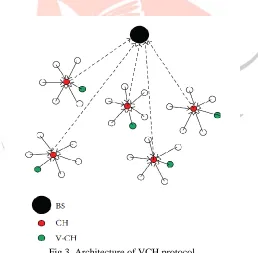
In proposed system, Vice Cluster Head (VCH) is proposed to achieve high energy efficiency of nodes in the network. VCH tends to propose a modification to the cluster head selection method to reduce energy consumption. CHs will consume more energy than member nodes because of the heavy tasks so in order to avoid making the CHs die early, Vice Cluster Head (VCH) is to be implement to aggregate all the data from the member nodes and transmit them to the Base Station (BS).Figure 3 shows the architecture of VCH protocol.
Fig 3. Architecture of VCH protocol
VCH is divided into many rounds, and each round contains Setup phase and Steady state phase.
Setup phase: If there are too many selected cluster heads in the deployed area then it will cause some unnecessary energy consumption. For limiting the cluster heads’ number to a reasonable range, tend to develop the simulated annealing algorithm to form appropriate numbers of cluster heads which is about 4%-5% of the overall sensor nodes. Once finishing the choice of cluster heads within the set-up phase by using the improved equation and simulated annealing algorithm.
Steady state phase: In the steady-state phase of LEACH protocol, the cluster heads will consume more energy than member nodes. As a result they need to take the responsibility of aggregating and relaying data to remote BS for their member nodes. So as to avoid making the cluster heads die early when undergoing certain amount of communication time, a new replacement round begins to reorganize the nodes into clusters and reselect the cluster heads based on vice cluster head.
Thus the network call the member node which is appointed by the CH as a vice cluster (VCH). So as to make the rest of member nodes get the VCH’s id, the CH broadcast this message containing the VCHs id to various other member nodes. Then from that,
CN
CN CN CN
CH CN
CN
CN CN CN
CH CN
Base Station
CH
Cluster Head
IJEDR1502161
International Journal of Engineering Development and Research (www.ijedr.org)922
the CH itself will become a standard member node because of the too much energy consumption and the establishment of VCH in a cluster. Since then, all the member nodes can send their data to VCH, which send the compressed data to the BS.In the proposed protocol, used to measure of choosing a VCH for every cluster in the later period of the steady-state phase in a round by using the energy information achieved by CH, which may diminish the frequency of reclustering and extend the time in the network. Establishing VCH is easy and speedy comparing with the generation and cooperation of random numbers within the set-up phase. Thus all of them have a good benefit to the saving of energy in the whole network.
A . Advantages of Proposed System
Transmission of data to BS be very efficient. Network lifetime be high.
Lower Energy Consumption.
A new version of LEACH protocol called VLEACH which aims to reduce energy consumption within the wireless network. Compare to LEACH protocol VLEACH provides better performance in wireless network. Energy plays an important role in wireless sensor networks because nodes are battery operated. Many protocols have been proposed in order to minimize the energy consumption of these sensor nodes in a networks. In LEACH protocol which contains Cluster Head (CH) for receiving data from cluster members and aggregate these all data and send it to the Base Station(BS).
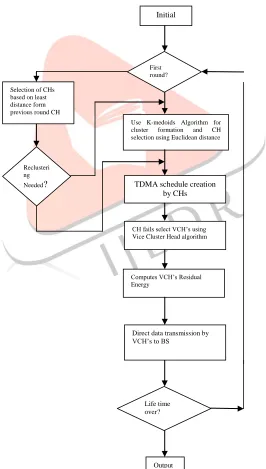
If CH dies, data can’t be received from cluster members so to overcome this problem here in this paper using a proposed concept as version of LEACH protocol called as VLEACH, which contains vice-CH that takes a role of the CH. While doing this,cluster nodes data will always reach Base station(BS),without electing a new CH each time the CH dies.
Fig 4 Flow diagram for Proposed System
First round?
Use K-medoids Algorithm for cluster formation and CH selection using Euclidean distance
TDMA schedule creation by CHs
CH fails select VCH’s using Vice Cluster Head algorithm
Computes VCH’s Residual Energy
Direct data transmission by VCH’s to BS
Life time over?
Output
Selection of CHs based on least distance form previous round CH
Reclusteri ng Needed?
?
Initial
IJEDR1502161
International Journal of Engineering Development and Research (www.ijedr.org)923
V.DESIGNANDIMPLEMENTATION
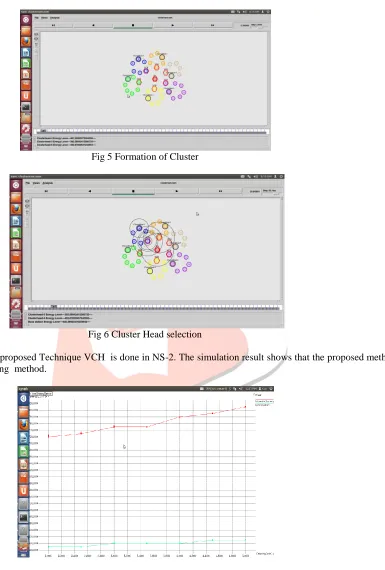
Fig 5 Formation of Cluster
Fig 6 Cluster Head selection
The simulation work for the proposed Technique VCH is done in NS-2. The simulation result shows that the proposed method is more efficient than the existing method.
To reduce the number of rounds in K-LEACH, the proposed protocol VCH is used by the tool NS2. The parameter used in this paper are given in the table 1.
TABLE 1-Parameter Used
Parameter Name Value
No. of nodes 40
No. of clusters 06
No. of rounds 24
IJEDR1502161
International Journal of Engineering Development and Research (www.ijedr.org)924
VI.CONCLUSION
Wireless sensor networks are increasingly being used for health care, transportation, manufacturing, and much more. Routing in sensor networks is an emerging area of research. In this paper we present a Vice Cluster Head (VCH) is proposed to achieve high energy efficiency of nodes in the network. VCH tends to propose a modification to the cluster head selection method to reduce energy consumption. CHs will consume more energy than member nodes because of the heavy tasks so in order to avoid making the CHs die early, Vice Cluster Head (VCH) is to be implement to aggregate all the data from the member nodes and transmit them to the Base Station (BS). Finally this will leads to improve the energy efficiency in the sensor network.
VII.REFERENCES
[1] W. Heinzelman, A. Chandrakasan, and H. Balakrishnan, "Energy-efficient communication protocol for wireless sensor networks," in the
Proceeding of the Hawaii International Conference System Sciences, Hawaii,January 2000.
[2]Jamal N. Al-Karaki, The Hashmite University Ahmed E. Kamal, Lowa state University, “Routing techniques in WSN: A survey”, IEEE Wireless communication, 2004
[3] M. Bani Yassein, A. Al-zou'bi, Y. Khamayseh, W. Mardini , “Improvement on LEACH Protocol of Wireless Sensor Network (VLEACH)”, International Journal of Digital Content Technology and its Applications Volume 3, Number 2, June 2009 [4]Vivek Katiyar, Narottam Chand, Gopal Chand Gautam, Anil Kumar, “Improvement in LEACH Protocol for Large-scale Wireless Sensor Networks”, IEEE 2011
[5]Parul Bakaraniya , Sheetal Mehta , “Features of WSN and Various Routing Techniques for WSN : A Survey”, International Journal Of Research in Engineering and Technology, ISSN: 2319 - 1163 , Volume 1(Issue-3), 348 -354, NOV 2012
[6] Rajesh Patel, Sunil Pariyani, Vijay Ukani, “ Energy and Throughput Analysis of Hierarchical Routing Protocol (LEACH) for Wireless Sensor Network”, International Journal of Computer Applications(0975-8887), Volume 20-No.4, April 2011
[7] Naveen Kumar, Mrs. Jasbir Kaur, “Improved LEACH (I-LEACH) Protocol for Wireless Sensor Networks” , IEEE 2011 [8]K. Padmanabhan, Dr. P. Kamalakkannan ,“Energy Efficient Adaptive Protocol for Clustered Wireless Sensor Networks” , IJCSI International Journal of Computer Science Issues, Vol. 8, Issue 5, No 1, September 2011 ISSN (Online): 1694-0814 www.IJCSI.org
[9]Hasan Al-Refai, Ali Al-Awneh, Khaldoun Batiha, Amer Abu Ali, Yehia M. El. Rahman, “Efficient Routing LEACH (ER-LEACH) Enhanced on LEACH Protocol in Wireless Sensor Networks”, International Journal of Academic Research, Vol. 3. No. 3. May, 2011, I Part
[10]Muhammad Haneef, Zhongliang Deng, “Comparative analysis of classical routing protocol LEACH and its updated variants that improved network life time by addressing shortcomings in Wireless Sensor Network”, 2011 IEEE
[11]K. Kishan Chandl, P Vijaya Bharati and B. Seetha Ramanjaneyulu, Member, IEEE, “Optimized Energy Efficient Routing Protocol for Life-Time Improvement in Wireless Sensor Networks”, IEEE-International Conference On Advances In Engineering, Science And Management (ICAESM -2012) March 30, 31, 2012
[12]Said BEN ALLA, Abdellah EZZATI,Abderrahim BENI HSSANE, Moulay Lahcen HASNAOUI, “Hierarchical Adaptive Balanced energy efficient Routing Protocol (HABRP) for heterogeneous wireless sensor networks”, 2010 IEEE
[13]JIAN-FENG YAN, YUAN-LIU LIU, “Improved LEACH Routing Protocol For Large Scale Wireless Sensor Networks Routing”, 2011 IEEE
[14]Prof Ankit Thakkar and Dr K Kotecha, “CVLEACH: Coverage based energy efficient LEACH Algorithm”, International Journal of Computer Science and Network (IJCSN)Volume 1, Issue 3, June 2012 www.ijcsn.org ISSN 2277-5420