Undirected
Graphs:
I
s
the
Shift-
E
nabled
Condition
Trivial
or
Necessary?
LiyanChen1,† ,SamuelCheng1,3,†*,KanghangHe4,LinaStankovic4andVladimirStankovic4 1 College of Electronic and Information Engineering, Tongji University; [email protected]
2 Key Laboratory of Oceanographic Big Data Mining & Application of Zhejiang Province, Zhejiang Ocean
University
3 the School of Electrical and Computer Engineering, University of Oklahoma 4 the Department of Electronic and Electrical Engineering, University of Strathclye
* Correspondence: [email protected] † 4800 Caoan Road, Shanghai, P.R. China
1
2
3
4
5
6
7
8
9
10
Abstract: Ithasrecentlybeenshownthat,contrarytothewidebeliefthatashift-enabledcondition
(necessaryforanyshift-invariantfiltertoberepresentablebyagraphshiftmatrix)canbeignored
becauseanynon-shift-enabledmatrixcanbeconvertedtoashift-enabledmatrix,suchaconversion
ingeneralmaynotholdforadirectedgraphwithnon-symmetricshiftmatrix.Thispaperextends
thispriorwork,focusingonundirectedgraphswheretheshiftmatrixisgenerallysymmetric.We
showthatwhile,inthiscase,theshiftmatrixcanbeconvertedtosatisfytheoriginalshift-enabled
condition,theconvertedmatrixisnotassociatedwiththeoriginalgraph,thatis,itdoesnotcapture
anymorethestructureofthegraphsignal.Weshowviaacounterexample,thatanon-shift-enabled
matrixcannotbeconvertedtoashift-enabledoneandstillmaintainthetopologicalstructureofthe
underlyinggraph,whichisnecessarytofacilitatelocalizedsignalprocessing.
Keywords: graphsignalprocessing;shift-enabledgraphs;shift-invariantfilter;undirectedgraph
11
1. Introduction
12
Graph signal processing (GSP) extends classical digital signal processing (DSP) to signals on
13
graphs, and provides a prospective solution to numerous real-world problems that involve signals
14
defined on topologically complicated domains, such as social networks, point clouds, biological
15
networks, environmental and condition monitoring sensor networks [1]. However, there are several
16
challenges in extending classical DSP to signals on graphs, particularly related to the design and
17
application of graph filters.
18
In classical, one-dimensional DSP, any linear, time-invariant, or shift-invariant, filter that
19
commutes with time shift operator z−1 can be represented as a polynomial of z−1 leading to
20
Z-transform of the filter. Conversely, if a linear filter can be represented as a polynomial ofz−1,
21
the filter is linear and shift-invariant. Unfortunately, this concept does not simply generalize to
22
GSP, partly because the definition of a “shift" for a graph is not obvious [2]. Commonly, in the GSP
23
literature, a graph is uniquely described by a “shift” matrix or a “shift" operator1,S[3–5], which has
24
been extensively used for time/vertex-domain filter design (see [1], [2] and references therein for
25
frequency-domain and time/vertex-domain filtering). For example, adjacency matrix, for general
26
graphs, and Laplacian matrix, for undirected graphs, are some popular choices for the shift matrix.
27
In order to make graph filtering feasible, even for very large graphs, it is necessary to perform the
28
filtering operation locally. For example, consider a sensor network represented by a graph, where the
29
edges and edge weights of the graph depend on the distance between the sensors. In this case, efficient
30
1 The term “shift” comes from the analogy withz−1operator inZ−transform of classical DSP.
filtering boils down to merely mixing the signals acquired by a sensor with those of the nearest sensors.
31
Otherwise, if the filter output at any graph vertex is a linear combination of inputs atallvertices,
32
filtering will be practically infeasible for “big data" graphs [5]. Therefore, in practice, we expect that a
33
node can only impose direct influence to an adjacent node through the shift operator. For practical
34
design purposes, it is advantageous to be able to decompose filters in a form of polynomial of such a
35
shift matrix. The importance of this polynomial representation has been reiterated in a recent survey
36
paper (see Section II.F of [1]).
37
Although a nice, but loose, analogy betweenSandz−1can be established [1], unlike classical
38
DSP, if a graph filter is shift-invariant (the shift matrix commutes with the target filter), this does not
39
automatically imply that a polynomial representation of the filter exists [6]. Ref. [3] argues that, for
40
any shift matrixS, there exists a converted shift matrix ˜Ssuch that graph filterHis a polynomial in
41
˜
S. However, it is not sufficient just to haveHto be represented as a polynomial of any arbitrary ˜S.
42
One should also ensure thatS indeed describes the same graph as S˜ (see details in Definition2), that is, the
43
converted graph shift should keep the same topological structure as the original one.
44
1.1. Contribution
45
It was shown in [3] that any filter commuting with shift matrix S can be represented as a
46
polynomial in S provided that the characteristic and minimal polynomial of the shift matrix are
47
equal (in the rest of this paper, as in [7], we will refer to this condition asshift-enabled condition, see also
48
Definition1). However, in [3], this condition was immediately disregarded, surmising that one may
49
convert any shift matrix that does not satisfy the shift-enabled condition into one that does. Based on
50
this conclusion, most researchers currently assume that the shift-enabled condition simply holds or
51
ignore the condition completely. However, it was proved in [7], through a counterexample, that such a
52
conversion may not hold for a directed graph with asymmetric shift matrix.
53
In this paper, we focus on undirected graphs, which have wider applications [2], and illustrate
54
with examples that when the symmetric shift matrix of an undirected graph is non-shift-enabled, the
55
conversion suggested in [3] could lead to a very different graph that does not necessarily capture the
56
structure of the original graph signal. Namely, though the conversion would provide a shift-enabled
57
graph that facilitates polynomial representation of the shift-invariant filters, the newly designed graph
58
might no longer capture the structure of the graph signal it was originally designed to model2, and
59
does not facilitate performing filtering locally.
60
Referring to our wireless sensor network example in the introduction, in the original graph the
61
output of the filtering at each vertex only involves inputs of the vertex’s immediate neighborhoods.
62
However, in the converted graph, sensors that are far apart might be strongly connected, that is, each
63
output at a vertex could be a linear combination of inputs at almost all vertices, thus filtering in such
64
converted graph will be computationally unaffordable for “big data” graphs in practice which further
65
emphasizes the importance of the shift-enabled condition [7].
66
The outline of the paper is as follows. Section2describes the basic concepts and key properties of
67
a shift-enabled graph. Section3provides counterexamples to prove that the shift-enabled condition is
68
essential for the symmetric graph. Section4concludes the paper.
69
2. Basic Concepts and Properties of Shift-enabled Graphs
70
In this section, we briefly review the concepts of shift-enabled graphs and their properties relevant
71
to this paper. For more details, see [2–5].
72
LetG= (V,A)be a graph, whereV={v0,v1,· · ·,vn−1}is a set of vertices and A∈Cn×nis the
73
adjacency matrix of the graph. Letx= (x0,x1,· · ·,xn−1)Tbe agraph signal, where each samplexi∈x
74
corresponds to a vertexvi∈V.
75
In particular, ifGis a directed circular graph, then the corresponding adjacency matrix is given by:
76
A=
0 0··· 0 1 1 0··· 0 0
..
. ... ... ...
0 0··· 1 0
. Then Ax= (xn−1,x0,· · ·,xn−2)T, that is, multiplication byAshifts each signal
77
sample to the next vertex. Thus,Ais often called shift operator or shift matrix, which is similar to
78
time shift operatorz−1in DSP. In practice, adjacency matrix can be replaced by other matrices which
79
reflect the structure of the graph, such as the Laplacian matrix and the normalized Laplacian matrix
80
for undirected graphs, and the probability transition matrix. Here, we useSto denote the general shift
81
matrix, whether it isA, (normalized) Laplacian matrix, or the probability transition matrix.
82
In classical 1-D DSP, a shift-invariant filterFhas aZ-transform (polynomial representation in
z−1), that is
F(z−1) =
+∞
∑
k=−∞fkz−k,
where fkis polynomial coefficient. Moreover, from the shift-invariance property, it follows that the
83
filtered output of a shifted input is equal to the shifted filtered output of the original input. In other
84
words, the shift operation and the filter commute. That is,Fz−1=z−1F, which directly follows from
85
the above polynomial representation (see, e.g., [6]).
86
Extending this concept to GSP, we also define a shift-invariant filterHas the one that commutes
87
with the shift matrix, i.e.,HS=SH. However, unlike in the classical DSP case, a shift-invariant filter
88
does not necessarily have a polynomial representation in terms of the shift operatorS. Yet,Hcan be
89
represented as a polynomial inSif the shift matrixSsatisfies the following condition.
90
Definition 1(Shift-enabled graph [7]). A graphGis shift-enabled if its corresponding shift matrix S satisfies
91
pS(λ) =mS(λ), where pS(λ)and mS(λ)are the minimum polynomial and the characteristic polynomials of
92
S, respectively. We also say that S is shift-enabled when the above condition is satisfied. Otherwise, S and the
93
corresponding graph, are non-shift-enabled.
94
For shift-enabled graphs, the following theorem is the basis of linear, shift-invariant filter design.
95
Theorem 1. The shift matrix S is shift-enabled if and only if every matrix H commuting with S is a polynomial
96
in S[3].
97
Note that this theorem implies that as long as the shift matrixSdoes not satisfy the shift-enabled
98
condition (i.e.,mS(λ)6=pS(λ)), there will always be some shift-invariant filters (and thus some filters)
99
that cannot be represented as a polynomial ofS. Ref [3] de-emphasized the shift-enabled condition by
100
suggesting that we may work around it with the following theorem.
101
Theorem 2(Theorem 2 in [3]). For any shift matrix S, there exists a converted matrixS and matrix polynomial˜
102
r(·), such that S=r(S˜)and mS˜(λ) =pS˜(λ).
103
While the above theorem is correct, it does not take into account that the target filterHmay not
104
be shift-invariant with respect to the converted shift matrix. In particular, for a directed graph, in
105
general,Sis not symmetric, and thus not jointly diagonalized withH. Consequently, one can show
106
that generally there exists no converted shift-enabled ˜Sthat can maintain shift-invariance with the
107
target filter when the graph is directed andSis asymmetric [7].
108
However, the conversion method suggested in [3] does hold for undirected graphs when H
109
can be jointly diagonalized withS. Yet, as we will show in the following, the converted ˜Smay not
110
describe the same graph as the originalS. This makes the whole conversion process moot. Hence, the
shift-enabled condition is important regardless of whether the graph is directed or not (i.e., the shift
112
matrix is asymmetric or not).
113
3. The Necessity of Shift-enabled Condition for Undirected Graphs
114
Before giving a concrete example, let us first review the conversion process described in [3]. As
115
mentioned earlier, even though the conversion process does not hold for arbitrary shift matrices, it can
116
be applied to symmetric shift matrices.
117
According to LemmaA2in Appendix A, two symmetric and commuting matricesSandHare
118
simultaneously diagonalizable. Thus, there exists an invertible matrixTsuch thatS=TΛST−1and
119
H= TΛHT−1, whereΛSandΛHare composed of the eigenvalues ofSandH, respectively. Then,
120
a new matrixΛperturb with distinct diagonal elements can be generated by slightly perturbing the
121
values ofΛS. The new shift matrix is calculated as ˜S =TΛperturbT−1. According to LemmaA1and
122
LemmaA2, the restructured shift matrix ˜Ssatisfies pS˜(λ) = mS˜(λ)andHS˜ = SH˜ . Hence, from
123
Theorem1,His a polynomial in ˜S.
124
However, it is not sufficient to haveHrepresented as a polynomial of any arbitrary ˜S. A natural
125
and basic constraint is that the converted ˜Sshould facilitate “local processing”, that is, it should
126
describe topologically the same graph, which is essential in virtually all GSP applications, such as filter
127
design [8], sampling [9], denoising [10], and classification [11], otherwise, the conversion is meaningless.
128
To ensure that the converted graph facilitates “local processing”, that is, an implementation of an
129
L-th order polynomial filter requiresLdata exchanges between neighbouring nodes [6], we introduce
130
Definition2. In fact, the definition of a matrix describing a graph (see details in Definition2) is not new
131
in spectral graph theory. In particular, the matrix of “loose description” is widely used in the context of
132
inverse eigenvalue problem and zero-forcing problem [12,13]. We introduce “strict description” since
133
we would like to accommodate graphs with self-loops. In a nutshell, two shift matrices describe the
134
same graph if the conversion from one to another preserves the graph topological structure, implying
135
that filtering under the converted graph can be performed locally. The precise definition is specified as
136
follows.
137
Definition 2([12–14]). Shift matrices S andS strictly describe the same graph if 1) S˜ i,j 6=0if and only if
138
˜
Si,j 6=0for any i and j, and 2)S is symmetric if and only if S is symmetric. And we will say S and˜ S loosely˜
139
describe the same graph if the first condition is relaxed to 1’) Si,j6=0if and only ifS˜i,j 6=0only for i6=j. That
140
is, we allow some i where only Si,iorS˜i,iequal to0.
141
Given this additional constraint that ˜SandSshould describe the same graph structure, we can
142
show that it is impossible to guarantee the following three conditions to be satisfied simultaneously:
143
• S˜is shift-enabled (i.e.,pS˜(λ) =mS˜(λ)).
144
• His shift-invariant on ˜S(i.e.,HS˜=SH˜ ).
145
• S˜andSstrictly or loosely describe the same graph.
146
3.1. A counter-example thatS can loosely but not strictly describe the original graph˜
147
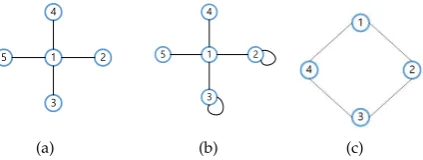
Let us start with a non-shift-enabled graph as shown in Figure.1(a). The shift matrix3of the
148
undirected graph isS=
0 1 1 1 1 1 0 0 0 0 1 0 0 0 0 1 0 0 0 0 1 0 0 0 0 !
. It is clear that pS(λ) =λ3(λ−2) (λ+2)6=λ(λ−2) (λ+2) =
149
mS(λ)and henceSis non-shift-enabled. Since shift-enabled condition is not just sufficient but also
150
necessary [7], there must exist a shift-invariant filter not representable as a polynomial ofS. Indeed,
151
1
5 2
4
3
(a)
1
5 2
4
3
(b) (c)
Figure 1.Graph topology used in the examples. (a) Original graph with shift matrixS. (b) Converted shift matrix ˜Swhich loosely describes the same graph asS. (c) Cycle graph with shift matrixS0.
one example for such a filter isH=
0 0 0 0 0 0 1 −1 0 0 0−1 1 0 0 0 0 0 0 0 0 0 0 0 0
. It can be readily verified thatHS=0=SHand
152
thus the filter is shift-invariant, and it is impossible to find polynomial representation ofHin terms of
153
S. Note thatSn
2,3=Sn2,44for alln∈N. Thus for any polynomialh(S), we must haveh(S)2,3=h(S)2,4.
154
But sinceH2,3=−16=0=H2,4,H6=h(S)for any polynomial functionh(·).
155
3.1.1. Extension ofHto a Class of Filters
156
Note that we can extendH to the following class of filters that all cannot be represented as
polynomials ofS:
H={αH+q(S)|α∈R,q(S)is a polynomial ofS}. (1)
Since apparentlyq(S)S=Sq(S)for any polynomialq(S)andHS=SHas discussed above, any
157
filterαH+q(S)∈Hcommutes withSas well. Thus any filter inHis shift-invariant. However, since
158
His not representable as a polynomial ofS, as discussed above, so doesαH+q(S).
159
From the examples presented above, we note that when the shift-enabled condition is violated,
160
we may find an infinite number of shift-invariant filters that are not representable as polynomials ofS.
161
3.1.2. Shift-enabled ˜SThat Strictly Describes the Original Graph Does Not Exist
162
First, let us restrict the converted shift matrix ˜Sto strictly describe the same graph asS. Thus ˜S
could be written as
˜
S=
0 S˜1,2S˜1,3S˜1,4 S˜1,5 ˜
S1,2 0 0 0 0 ˜
S1,3 0 0 0 0 ˜
S1,4 0 0 0 0 ˜
S1,5 0 0 0 0
(2)
with non-zeros ˜S1,2, ˜S1,3, ˜S1,4, and ˜S1,5. We can readily verify that the characteristic polynomial is
163
pS˜(λ) =λ3(λ2−S˜212−S˜132 −S˜214−S˜215)and 0 is the triple eigenvalue of ˜S. According to LemmaA1, a
164
shift-enabled real symmetric shift matrix has to have unique eigenvalues and thus ˜Sis not shift-enabled.
165
Therefore, all graphs which have the same structure as Figure1(a)are non-shift-enabled.
166
3.1.3. Shift-enabled ˜SThat Loosely Describes the Original Graph Exists
167
Next, let us relax ˜Sso that it may just loosely describe the original graph. In other words, we
allow the diagonal elements to be non-zero which maintains most of the topological structure of the original graph. In applications where diffusion or state transition matrices are treated as shift matrices,
4 Note thatSk
the diagonal elements can be interpreted as the returning probabilities of the current state to itself. Thus, the converted shift matrix ˜Scan be written as
˜
S=
˜
S1,1 S˜1,2S˜1,3S˜1,4S˜1,5 ˜
S1,2 S˜2,2 0 0 0 ˜
S1,3 0 S˜3,3 0 0 ˜
S1,4 0 0 S˜4,4 0 ˜
S1,5 0 0 0 S˜5,5
. (3)
Many solutions that satisfy shift-enabled and shift-invariant conditions can be found. For instance,
168
˜
S=
0 1 1 1 1 1 1 0 0 0 1 0 1 0 0 1 0 0 0 0 1 0 0 0 0 !
is one such solution, where the original graph structure is only slightly modified as
169
shown in Figure1(b). One can verify that the eigenvalues(−1.8136, 0, 0.4707, 1, 2.3429)of ˜Sare distinct
170
and thus ˜Sis shift-enabled. Moreover, one can also readily verify thatHS˜=SH˜ . By Theorem 1, the
171
above two conditions ensure thatHis a polynomial in ˜S.
172
Remark 1. Note that the example from the previous section can be extended to a star graph with more than five vertices. In this case, the shift matrix of a star graph with N vertices is SN =
0 1··· 1 1 0··· 0 .. . ... ... 1 0··· 0
. Consider a
filter HN =
0 0 0 0 ··· 0 0 1 −1 0··· 0 0−1 1 0 ··· 0 0 0 0 0 ··· 0 ..
. ... ... ... ... ... 0 0 0 0 ··· 0
, and based on Equation2shift operator that strictly describing the original
graph satisfiesS˜N(strict)=
0 S˜1,2S˜1,3 ··· S˜1,N
˜
S1,2 0 0 ··· 0 ˜
S1,3 0 0 ··· 0 ..
. ... ... ... ... ˜
S1,N 0 0 ··· 0
. Repeating the similar argument as before, we can readily
verify that the following five conclusions still hold simultaneously: (i) SNis not shift-enabled for pSN(λ) =
λN−2(λ2−(N−1)). (ii) HN is shift-invariant, i.e., HNSN = 0 = SNHN. (iii) HN 6= h(SN)for any polynomial function hN(·). (iv) HNcan be extended to the following class of filters that none can be represented as polynomials of SN:
HN={αHN+q(SN)|α∈R,q(SN)is a polynomial of SN}. (v) Shift-enabledS˜N(strict)that strictly describes the original graph does not exist. 173
3.2. A Counter Example When the Converted Shift Matrix Can Neither Strictly Nor Loosely Describe the
174
Original Graph
175
Note that there are situations where no shift-enabled ˜S exists even after we relax the graph
176
structure constraint as in the earlier example. Consider shift matrixS0 =
0 1 0 1 1 0 1 0 0 1 0 1 1 0 1 0
as shown in
177
Figure1(c).
178
It can easily be seen that the eigenvalues of S0, (0, 0, 2,−2), are not unique. Thus S0 is
179
non-shift-enabled according to LemmaA1. So we do expect that there exists shift-invariant filter
180
not representable byS0. Indeed, we can easily show that filterH0 =
0 0 −1 1 0 −1 1 0 −1 1 0 0 1 0 0 −1
!
is such a filter.
181
First, note thatH0S0 = S0H0 and thus H0 is shift-invariant underS0. Furthermore, note that
182
(S0)n1,2 = (S0)n1,4 for alln ∈ N, and soh(S0)1,2 = h(S0)1,4for any polynomialh(S0). But sinceH1,20 =
183
06=1=H1,40 ,H0 =6 h(S0)for any polynomial functionh(·).
184
Let us prove that it is impossible to find a converted shift matrix ˜S0which is shift-enabled and
185
commutes withH0by only changing the weights of nonzero and diagonal elements.
Consider a general symmetric matrix
˜
S0 =
˜
S01,1 S˜01,2 0 S˜01,4 ˜
S0
1,2 S˜02,2S˜02,3 0 0 S˜0
2,3S˜03,3S˜03,4 ˜
S0
1,4 0 S˜03,4S˜04,4
(4)
which has arbitrary weights on nonzero and diagonal elements. That is, ˜S0loosely describes the same
187
graph asS0.
188
H0=h(S˜0)clearly implies thatH0commutes with ˜S0, namely,H0S˜0=S˜0H0is a necessary condition forH0 =h(S˜0). It follows fromH0S˜0=S˜0H0that ˜S0
1,1 =S˜02,2=S˜03,3=S˜04,4and ˜S01,2=S˜01,4=S˜02,3=
˜
S03,4, i.e.,
˜
S0 =
˜ S0
1,1S˜01,2 0 S˜01,2 ˜
S0
1,2S˜01,1 S˜01,2 0 0 S˜0
1,2 S˜01,1S˜01,2 ˜
S0
1,2 0 S˜01,2S˜01,1
. (5)
Following Cayley-Hamilton Theorem [15], if H0 is a polynomial in ˜S0, then H0 = h(S˜0) =
189
h0I+h1S˜0+h2S˜0 2
+h3S˜0 3
, whereIas the identity matrix. In fact, it is easy to prove that(S˜0)k
1,2= (S˜0)1,4k ,
190
fork=0, 1, 2, 3. Hence,h(S˜0)1,2 =h(S˜0)1,4which contradicts withH1,20 6= H1,40 . Thus, for this example,
191
the filterH0cannot be represented as a polynomial in the converted shift matrix ˜S0which even just
192
loosely describes the original graph.
193
Remark 2. Just as in Remark 1, the above example can be extended to cycle graphs with more vertices.
194
In this case, the shift matrix of cycle graph with N vertices is S0N =
0 1 0··· 0 1 1 0 1··· 0 0 0 1 0··· 0 0 ..
.... ... ... ... ... 1 0 0··· 1 0
. Consider the filter
195
H0N=
0 0 ··· 0 −1 1 0 0 ··· −1 1 0 0 0 ··· 1 0 0 ..
. ... ... ... ... −1 1··· 0 0 0 1 0 ··· 0 0 −1
, and similar to Equation4, the shift operators loosely describing the original graph
196
should satisfyS˜0N(loose) =
˜ S0
1,1 S˜01,2 0 ··· S˜01,N
˜ S0
1,2 S˜02,2S˜02,3 ··· 0 0 S˜0
2,3S˜03,3 ··· 0 ..
. ... ... ... ... ˜
S0
1,N 0 0 ··· S˜0N,N
. With the similar argument as before, one can show
197
thatS˜0N(shi f t−invariant)=
˜ S0
1,1 S˜01,2 0 ··· S˜01,2 ˜
S0
1,2 S˜01,1S˜01,2 ··· 0 0 S˜01,2S˜01,1 ··· 0 ..
. ... ... ... ... ˜
S0
1,2 0 0 ··· S˜01,1
. Consequently, one can readily verify the following four
198
conclusions in Section3.2are still valid: (i) S0Nis not shift-enabled, since it has repeated eigenvalues, that
199
is,λk = 2cos(2πk/N)for k = 0, 1, 2,· · ·,N−1. (ii) H0Nis shift-invariant, i.e., H0NS0N = S0NHN0 . (iii)
200
H0N6=h(S0N)for any polynomial function hN(·). (iv) The shift matrix that loosely describes the original graph
201
and commutes with HN0 must have the form ofS˜0
N(shi f t−invariant), and such a shift-enabled matrix does not 202
exist.
203
4. Conclusions
204
For a non-shift-enabled graph, even if we can easily “transform" the symmetric shift matrixS
205
into one that satisfies the shift-enabled condition, the new ˜Smay be irrelevant since it describes a
206
very different graph fromS. That is, the operator ˜Son a graph signal may involve mixing inputs far
207
beyond its neighborhood and become impractical for huge graphs. Combined with the necessity of
208
the shift-enabled condition for directed graph [7], we demonstrated in this paper that the shift-enabled
209
condition is essential for any graph structure. A good future direction is to explore a shift that
“approximately" describes the original graph as the conversion is quite different. In particular, if it is
211
already known that one such shift does not exist, one possible direction to explore shift “approximately"
212
describe the original graph instead (some non-zero off diagonal element may not correspond to an
213
actual edge). But we will leave this to future study.
214
Note that even though we consider the adjacency matrix as the shift matrix in our examples, the
215
conclusion applies to other shift matrices. In particular, one can readily verify that the conclusion still
216
holds if we use the Laplacian matrix as the shift matrix in the example in Section3.2.
217
Author Contributions: writing–original draft preparation, Liyan Chen and Samuel Cheng; writing–review and
218
editing, Lina Stankovic and Vladimir Stankovic; methodology, Kanghang He.
219
Funding:This research was funded by the European Union‘s Horizon 2020 research and innovation programme
220
under the Marie Sklodowska-Curie grant agreement number 734331, the Fundamental Research Funds for
221
the Central Universities number 0800219369 and National Key Research and Development Project number
222
2017YFE0119300.
223
Acknowledgments:The authors thank B. Zhao for helpful discussions.
224
Appendix A
225
It is easily determined whether a graph is shift-enabled by the following lemmas.
226
Lemma A1. If shift matrix S is a real symmetric matrix, then S is shift-enabled, if and only if all eigenvalues of
227
S are distinct [1].
228
LemmaA1indicates that an undirected graph is shift-enabled if and only if its eigenvalues are all
229
distinct.
230
As both shift matrixSand filter matrixHare symmetric, we can obtain the following lemma.
231
Lemma A2. If shift matrix S and filter matrix H are diagonalizable (this condition always holds for symmetric
232
matrix) then S and H are simultaneously diagonalizable (by an invertible matrix) if and only if HS=SH(see
233
Theorem 1.3.12 in [16]).
234
References
235
1. Ortega, A.; Frossard, P.; Kovaˇcevi´c, J.; Moura, J.M.; Vandergheynst, P. Graph signal processing: Overview,
236
challenges, and applications. Proceedings of the IEEE2018,106, 808–828.
237
2. Shuman, D.I.; Narang, S.K.; Frossard, P.; Ortega, A.; Vandergheynst, P. The emerging field of signal
238
processing on graphs: Extending high-dimensional data analysis to networks and other irregular domains.
239
IEEE Signal Proc. Magazine2013,30, 83–98.
240
3. Sandryhaila, A.; Moura, J.M. Discrete signal processing on graphs. IEEE Trans. Signal Processing2013,
241
61, 1644–1656.
242
4. Sandryhaila, A.; Moura, J.M. Discrete Signal Processing on Graphs: Frequency Analysis. IEEE Trans. Signal
243
Processing2014,62, 3042–3054.
244
5. Sandryhaila, A.; Moura, J.M. Big data analysis with signal processing on graphs: Representation and
245
processing of massive data sets with irregular structure.IEEE Signal Processing Magazine2014,31, 80–90.
246
6. Teke, O.; Vaidyanathan, P. Linear systems on graphs. 2016 IEEE Global Conference on Signal and
247
Information Processing (GlobalSIP). IEEE, 2016, pp. 385–389.
248
7. Chen, L.; Cheng, S.; Stankovic, V.; Stankovic, L. Shift-enabled graphs: Graphs where shift-invariant filters
249
are representable as polynomials of shift operations.IEEE Signal Processing Letters2018,25, 1305–1309.
250
8. Hammond, D.K.; Vandergheynst, P.; Gribonval, R. Wavelets on graphs via spectral graph theory. Applied
251
and Computational Harmonic Analysis2011,30, 129–150.
252
9. Gadde, A.; Anis, A.; Ortega, A. Active semi-supervised learning using sampling theory for graph signals.
253
Proc. 20th ACM SIGKDD Intl. Conf. Knowledge Discovery & Data Mining, 2014, pp. 492–501.
254
10. Yang, C.; Cheung, G.; Stankovic, V. Estimating heart rate and rhythm via 3D motion tracking in depth
255
video.IEEE Transactions on Multimedia2017,19, 1625–1636.
11. He, K.; Stankovic, L.; Liao, J.; Stankovic, V. Non-Intrusive Load Disaggregation Using Graph Signal
257
Processing. IEEE Transactions on Smart Grid2018,9, 1739–1747.
258
12. Hogben, L. Spectral graph theory and the inverse eigenvalue problem of a graph. Electronic Journal of
259
Linear Algebra2005,14, 3.
260
13. Trefois, M.; Delvenne, J.C. Zero forcing number, constrained matchings and strong structural controllability.
261
Linear Algebra and its Applications2015,484, 199–218.
262
14. Fallat, S.M.; Hogben, L. The minimum rank of symmetric matrices described by a graph: a survey. Linear
263
Algebra and its Applications2007,426, 558–582.
264
15. Lancaster, P.; Tismenetsky, M.The theory of matrices: with applications; Elsevier, 1985.
265
16. Horn, R.A.; Johnson, C.R.Matrix analysis; Cambridge University Press, 2012.