RELATIONSHIP BETWEEN SOCIAL FUNCTIONING OF SCHOOL PRINCIPALS AND INTERACTIONAL JUSTICE AS PERCEIVED BY SECONDARY SCHOOL TEACHERS
Mr. Ankush S. Kamble,Research Scholar
Department of Education, Maulana Abul Kalam Azad Bhavan University of Mumbai, Vidyanagari, Santacruz (East)
Mumbai, Maharashtra, India- 400098
Prof. (Dr) Indu Garg Former Head Department of Education Maulana Abul Kalam Azad Bhavan,
University of Mumbai, Vidyanagari, Santacruz (East), Mumbai, Maharashtra, India- 400098
ABSTRACT
The aim of this research is to ascertain relationship between perceived social functioning of secondary school principals and interactional justice as perceived by secondary school teachers. Survey correlational method was employed. 597 secondary school teachers from Mumbai were the respondents. For gathering data rating scales were used. The obtained data were analysed using the MS Excel and Vassar stats.The findings from the research revealed that there is a direct positive relation between social functioning and interactional justice as perceived by of secondary school teachers on the basis of school type and gender.
Key Words: Social Functioning, Interactional Justice, Aided and Unaided School.
INTRODUCTION
The issue of justice is a dominant theme in organizational life and has been researched frequently in the field of organizational behavior (Cohen-Charash & Spector, 2001).Organizational justice perceptions focuses on how the perceptions of fairness in the workplace affect the attitude of workers such as job satisfaction, turnover intentions, organizational commitment (Greenberg, 1990). citizenship behavior (Saunders & Thornhill, 2004). An emerging area within this topic is that justice is an issue relevant to supervisors and organizational leaders (Tyler, 1987). Employees have greater trust in their managers when they hey have more participation in decision making (Driscoll, 1978) and control sharing is an indicator of trust and respect for the employees (Rosen and Jerdee, 1977). Another important factor is manager’s concern for the employees. Manager should be concerned about the employee needs and sensitivities as well (Lind, 1992), be there to help them and not exploiting them. Managers through their relationships can establish interactional justice and promote it through the entire organisation as a best practice. As an investigator a need arose to ascertain the relationship between social functioning and interactional justice.
REVIEW OF THE RELATED LITERATURE
interactional justice and their manager trust. Kamile, D. (2016) suggested that, organizational justice positive correlated with job satisfaction. According to Shrivastav, U. M. (2015) among the four dimensions of justice, only procedural justice and relational justice significantly positively predicted job satisfaction of employees and informational justice was the only dimension that had significantly and positively predicted organizational commitment. After reviewing the relevant literature the researcher observed that there were no studies done on perceived social functioning in relation with interactional justice. Therefore there was a need to conduct a study of this kind.
STATEMENT OF THE PROBLEM
“Relationship between Social Functioning of School Principals and Interactional Justice as Perceived by Secondary School Teachers.”
This study aims to ascertain relationship between social functioning of school principals and interactional justice as perceived by secondary school teachers of aided and unaided schools as well as by male and female teachers.
OPERATIONAL DEFINITIONS OF THE IMPORTANT TERMS
I. Social Functioning: Social functioning is operationalised as the importance an educational manager gives to the interpersonal relation and interactions which could be verbal or non-verbal,service orientation, developing others, team building, and conflict management, cultural awareness.
II. Interactional Justice: Interactional justice is operationalised as the educational manager’s or principal’s quality of being fair and treating others with politeness, dignity, respect and convey information about specific and correct events, procedures and outcomes on time.
III Aided School: School receiving one half of its maintenance costs from public funds (Government Fund). The curriculum, study materials, syllabus, examinations, etc. for each class of education are done according to the government rules.
IV Unaided School: These schools are not government funded. These schools are fully owned and controlled by the private management. But these institutions are still subject to the government rules to some extent, especially in the monetary respects, curriculum, syllabus, examination.
SCOPE OF THE STUDY
The present study investigates the relationship among perceived social functioning of secondary school principals and interactional justice on the basis of teachers gender and school type.
There are three different types of boards for secondary schools in India. These are Central Board of Secondary Education (CBSE), Indian Certificate of Secondary Education (ICSE) and Secondary School Certificate Board (SSC). The study is confined to the teachers of English and Marathi medium school affiliated to Secondary School Certificate (SSC) board schools of Maharashtra State Board and did not include those teachers in any other school board like IB, ICSE, and CBSE.
The field of working is limited only to secondary schools in Greater Mumbai and does not include schools coming under the jurisdiction of Thane and Navi Mumbai. The respondents were from English and Marathi medium schools of SSC board. The study excluded the other vernacular medium such as Urdu and Gujarati. The present study is limited to secondary schools and it does not include primary or pr-primary schools.
SIGNIFICANCE OF THE STUDY
The application and utilization of study is the significance of that study.
to management to improve the perception of justice. Justice is in the centre of all humanistic relations. Thus the study could be helpful to the educational managers to enhance the quality of interactional justice by integrating it with social functioning.
OBJECTIVE OF THE STUDY
The objective was to ascertain the relationship between social functioning of secondary school principals and interactional justice in secondary schools as perceived by secondary school teachers.
NULL HYPOTHESIS
It was hypothesised that there is no significant relationship between social functioning of secondary school principals and interactional justice as perceived by secondary school teachers on the basis of
a) School Types. (Aided and Unaided) b) Gender. (Male and Female)
RESEARCH DESIGN OF THE STUDY
The Methodology of the present study is co-relational.
Sample used for the study, comprise of 597 secondary school teachers of 49 schools affiliated to Maharashtra State Board of Secondary and Higher Secondary Education in Greater Mumbai from North, Central and South zone.
Tools to study these variables were administered to secondary school teachers from Greater Mumbai North, Central and South zone.
Following tools were used by the researcher for the purpose of the present study 1. Social Functioning Rating Scale was developed by Researcher,
2. Interactional Justice Rating Scale (Neihoff and Moorman (1993)).
Techniques of data analysis statistical technique used were coefficient of correlation.
TESTING OF HYPOTHESIS
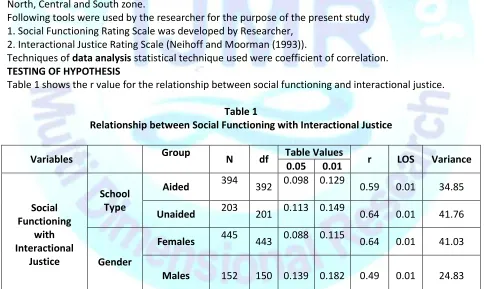
Table 1 shows the r value for the relationship between social functioning and interactional justice.
Table 1
Relationship between Social Functioning with Interactional Justice
Variables Group N df Table Values r LOS Variance
0.05 0.01
Social Functioning
with Interactional
Justice
School Type
Aided 394 392 0.098 0.129 0.59 0.01 34.85
Unaided 203 201 0.113 0.149 0.64 0.01 41.76
Gender
Females 445 443 0.088 0.115 0.64 0.01 41.03
Males 152 150 0.139 0.182 0.49 0.01 24.83
Findings and Conclusions
social functioning of school principal in terms of team building, inter personal relationship, developing others, conflict management, service orientation and cultural awareness, as perceived by school teachers is better, better would be the interactional justice. The relationship between social functioning of secondary school principals and interactional justice in school on the basis of school type, gender, educational qualification of teachers and years of experience of teachers is significant at 0.01 levels indicating that out of 100 trials; 99 times the results will be similar. The strength of the relationships between perceived social functioning and interactional justice are moderate to substantial for all groups. This indicates that when principal functions in a manner to improve interpersonal relations, conflicts management, team building, service orientation and cultural awareness. This leads to perception of justice among all.
DISCUSSION
There is a direct positive relationship between social functioning of secondary school principals and interactional justice in secondary school for all groups. Thus the null hypothesis is rejected and it can be concluded that there is significant relationship between social functioning of secondary school principals and interactional justice in the school. This indicates that if social functioning of school principal in terms of team building, inter personal relationship, developing others, conflict management, service orientation and cultural awareness, as perceived by school teachers is better, better would be the interactional justice. This may be because now days majority of tasks has to be completed through team-work and in team work which creates frequently opportunities for disputes between colleagues thus proper conflict management along with the treatment of fairness can reduce such issues. This may be the reason for positive relationship between perceived social functioning and interactional justice of secondary school teachers. The study conducted by Mahmud, R. et al (2015) called Impact of Organizational Justice on Employee Job Satisfaction: An Empirical Investigation, findings demonstrate significant impact of distributive justice and interactional justice on job satisfaction. A researcher (Seyad Ameri, 2010) showed in his research that there is a significant relationship between application of conflict management styles and job satisfaction and quality of the morale in sport coaches. Dimitri, V. M. ;Mieke; V. H. , (2015) finds that principal-teacher relationships are especially good at combating the effects of emotional burnout of teachers. Thus better the social functioning of the principal better would be the interactional justice in the school.
REFERENCES
1. Cohen-Charash, Y., & Spector, P.E. (2001). The role of justice in organization: a metaanalysis. Organizational Behavior and Human Decision Process, 86(2), 278-321.
2. Greenberg, J. (1990). Employee theft as a reaction to underpayment inequity: the hidden cost of pay cuts. Journal of Applied Psychology, 75, 561-568.
3. Saunders, M.N.K., & Thornhill, A. (2004). Trust and mistrust in organizations: an exploration using an organizational justice framework. European Journal of Work and Organizational Psychology, 13(4), 493-515.
4. Tyler, T.R. (1987). Procedural justice research. Social Justice Research, 1(1), 41-65.
5. Driscoll, J.W. (1978). Trust and participation in organizational decision making as predictors of satisfaction. Acad. Manag. J. 21:44-56.
6. Rosen B, Jerdee TH (1977). Influence of subordinate characteristics on trust and use of participative decision strategies in a management simulation. J. Appl. Psychol. 62(5):628-631.
8. Bana, Z. and Khaki, J. (2015). Exploring Leadership Practices of Principals of Government Elementary Colleges of Education in Pakistan. International journal of Leadership in Education, v18 n4 p464-486 2015
9. Mette, I. M. and Range, B. G. and Anderson, J. and Hvidston, D. J. and Nieuwenhuizen, L. (2015). Teachers' Perceptions of Teacher Supervision and Evaluation: A Reflection of School Improvement Practices in the Age of Reform. Education Leadership Review, v16 n1 p16-30 Apr 2015
10. Swapnisha, P. K. (2013).A Study on Managerial Effectiveness of Service Sector Managers with Special Reference to Emotional Intelligence. Journal of the Indian Academy of Applied Psychology, 35, 71-77
11. Demet, Y., Cevat, E.(2017), conducted study on The Relationship among Interactional Justice, Manager Trust and Teachers' Organizational Silence Behavior. Universal Journal of Educational
Research 5(3): 325-333, 2017. Retrieved from:
http://www.hrpub.org/download/20170228/UJER4-19508134.pdf on April 11, 2017
12. Kamile, D. (2016),Relations between teachers’ organizational justice perceptions and organizational commitment and job satisfaction in the school: A meta-analysis.Journal of Human Sciences. Vol 13, No 1 (2016). Retrieved from:
https://www.j-humansciences.com/ojs/index.php/IJHS/article/view/3396 on April 11,2017
13. Mahmud, R., Mahbubul, H., Farzana, E., Wafie, M. (2015) Impact of Organizational Justice on Employee Job Satisfaction: An Empirical Investigation. American Journal of Business and Management Vol. 4, No. 4, 2015,162-171 DOI: 10.11634/216796061504714.
14. Seyad Ameri Mir Hussein, 2010. Explaining the relationship between conflict management styles (interpersonal) with the morale and job satisfaction of sport coaches in Physical Education Department of Uremia, research in sport science. 22,80-67.
15.Dimitri, V. M. ;Mieke; V. H. , (2015),"Trust in school: a pathway to inhibit teacher burnout?",Journal of Educational Administration, Vol. 53 Iss 1 pp. 93 – 115
16. Best, J.W. & Kahan, J.V. (2010).Research in Education (10th Edition). New Delhi: PH, Learning Private Ltd.
17. Dr. Pandya, S.R. (2011).Educational Research. New Delhi: APH Publishing.