1
Factors associated with the institutionalization of a physical activity program in
1
Australian elementary schools
23
Matthew Bourke, BAppSc(HM)(Hons)
4Institute for Health and Sport (IHES), Victoria University, PO BOX 14428, Melbourne,
5Victoria, 8001, Australia.
[email protected]
67
Toni A. Hilland, PhD
8School of Education, College of Design and Social Context, RMIT, PO BOX 71, Melbourne,
9Victoria, 3083, Australia.
[email protected]
1011
Melinda Craike, PhD, Corresponding author
12Institute for Health and Sport (IHES), and Mitchell Institute, Victoria University, PO BOX
1314428, Melbourne, Victoria, 8001, Australia.
[email protected]
14
15 16
Funding Sources: This project was supported in part by the Bluearth Foundation and
17Victoria University.
1819
Conflicts of Interest:
All authors declare that they have no conflicts of interest.
20
21
Human Rights:
All procedures performed in studies involving human participants were in
22accordance with the ethical standards of the institutional and Department of Education research
23committees and with the 1964 Helsinki declaration and its later amendments or
24comparable ethical standards.
25
26
Informed Consent:
Informed consent was obtained from all individual participants included in
27the study.
2829
30
31
32
33
34
35
36
37
2 Abstract
39
Background: The health benefits of classroom based physical activity programs may only be
40
sustained if programs are continually implemented over time. Despite the importance of instituting
41
physical activity programs to ensure their continued implementation, little is known about factors
42
associated with institutionalization of programs at a school level.
43
Purpose: To examine how school context, principal characteristics, and program attributes are
44
associated with the institutionalization of Bluearth Foundation’s Active Schools program in
45
Australian elementary schools. 46
Methods: Current principals from schools who participated in the Active Schools program between
47
2015-2017 reported the level of institutionalization of the program, school context, principal
48
characteristics, and perceived attributes of the program. Univariate associations were calculated using
49
Pearson’s correlation coefficient, independent sample t-tests and one-way ANOVA. Linear regression
50
using backward deletion was used to calculate significant or marginally significant (p<0.1)
51
multivariate associations.
52
Results: Thirty of the 211 eligible principals participated in the study. School capacity (r=.617,
53
p<.001); perceived student behavioral (r=.577, p<.001), health (r=.499, p<.001), and enjoyment
54
benefits (r=.529, p<.001), relative advantage (r=.417, p=.022), observability (r=.385, p=.036), and
55
having the program delivered by a Bluearth coach at the time of the study (η2=.426, p<.001), all had a 56
significant positive univariate association with institutionalization. School capacity (β=1.802, p=.001),
57
observability (β=0.902, p=.061) and having the program delivered by a Bluearth coach at the time of
58
the study (β=2.580, p=.003) remained significant in the final multivariate model.
59
Conclusions: Results suggest schools which have someone who can provide support implementing a
60
program are more likely to institute the program into policies and practices. It is also important school
61
administrators have the tools to evaluate the benefits of physical activity programs and to perceive
62
them as being beneficial for their students. However, schools may struggle to institutionalize physical
63
activity programs after formal program delivery has concluded.
3 Keywords: sustainability, physical activity, school, health promotion, implementation
65
Background 66
Classroom based physical activities include the integration of physical activities into academic
67
lessons, or short bouts of physical activity completed between the delivery of academic content.
68
Classroom based physical activity may also take the form of structured physical activity sessions
69
beyond those routinely delivered as part of the Physical Education curriculum. Research has
70
demonstrated the potential of classroom based physical activity interventions to increase levels of
71
physical activity in elementary school students [1, 2]. Additionally, there may be added benefits of
72
combining mindfulness and physical activity components in interventions on physical activity
73
behaviors [3]. There are several physical, mental and cognitive benefits associated with the
74
engagement in physical activity in children [4]. Evidence also suggests classroom based physical
75
activities may have positive effects on elementary school student’s classroom behavior, cognitive
76
functioning and academic achievement [2, 5]. However, the public health benefits of school based
77
physical activity programs may only be achieved if effective programs are maintained within a school
78
over a sustained period of time [6, 7].
79
The sustained implementation of physical activity programs may depend on the degree to which the
80
program is institutionalized at a school [8]. Institutionalization is the degree to which a program is
81
routinized and incorporated into an organization’s policies and practices [9]. For example, classroom
82
teachers from schools which institute policies and guidelines for the implementation of physical
83
activity programs are significantly more likely to continually implement the program in their
84
classroom [10]. Additionally, classroom teachers who have physical activity scheduled into their
85
timetables are more than twice as likely to implement physical activity sessions with their students
86
[11]. Whether administrators support a program and provide resources, such as suitable equipment,
87
facilities, space and time to deliver the program, may also be important in ensuring the sustained
88
implementation of physical activity programs in schools [7, 12].
4
Although institutionalization of physical activity programs in schools’ policies and practices may be
90
important to ensure its sustained implementation, little is known about factors associated with
91
institutionalization of physical activity programs in elementary schools. However, research on the
92
scaling up of health promotion interventions has highlighted organizational, policy maker, and
93
program factors are likely to act as facilitators and barriers to institutionalizing programs into policy
94
and practice [13]. For example, contextual factors that may be associated with whether a program is
95
institutionalized include whether a program is compatible with existing organizational (i.e., school)
96
structures and accepted by employees (i.e., teachers) [14]. Program institutionalization may also
97
depend on whether an organization has the necessary human and financial resources to continually
98
implement the program [13]. Additionally, policy makers (i.e. principals), determine priorities and
99
make decisions about what to institutionalize into policy and practice [15]. Therefore, principal
100
characteristics such as the degree to which they value physical activity may be associated with the
101
institutionalization of a physical activity program in their school. Considering attributes of the
102
program, programs that address a need, are simple to implement, and are able to be monitored and
103
evaluated are more likely to be institutionalized [13, 16]. Therefore, the present study aims to examine
104
how principal characteristics, school context, and attributes of the program are associated with the
105
institutionalization of an evidence-based physical activity program in elementary schools.
106
Bluearth Active School’s Program 107
The present study investigated Bluearth Foundation’s Active Schools program.. The Active Schools
108
program is a real-world word (i.e., non-researcher led), elementary school focused, evidence-based
109
program that improves student’s physical activity, health outcomes, and academic performance [17,
110
18]. The Active Schools program includes dedicated physical activity sessions, mindfulness-based
111
activities, movement-based activities incorporated into academic lessons, and active breaks during
112
academic lessons. Physical activity sessions are delivered in schools on a weekly basis for 60 minutes,
113
alternating between Bluearth coaches and classroom teachers. The program seeks to develop a
114
positive school movement ethos and culture, and school principals are encouraged to develop formal
115
policies and timetabling to support physical activity inside and outside of the classroom. The program
5
also seeks to build the capacity of teachers to deliver all aspects of the program with their students.
117
Teacher training includes professional development workshops, online support materials, and weekly
118
training with a Bluearth coach during the physical activity sessions. More information about the
119
Active Schools program can be found on the Bluearth Foundation’s website [19].
120
Participants 121
Participants eligible for this study were current principals from schools which had been involved with
122
the Active Schools program at any time from 2015-2017. Eligible participants were principals at the
123
school at the time of the current study, regardless of whether they were employed by the school when
124
the Active Schools program was last delivered there by the Bluearth Foundation. Bluearth provided
125
details of schools that were involved in Bluearth’s Active Schools program between 2015-2017.
126
Participant recruitment occurred in three stages. First, approval was requested from the relevant
127
school jurisdiction ethics committees; second, Bluearth Foundation’s CEO sent emails addressed to
128
principals to inform them the study was taking place; finally, study researchers invited principals to
129
participate in the study, initially via mail and then email follow-up for those who did not respond to
130
the mail invitation. Principals were asked to provide email consent to the research team for their
131
school to participate in the study and complete an online questionnaire.
132
Procedures 133
Data were collecting using an online questionnaire from March to September 2018, administered
134
using Qualtrics (Provo, UT) software. Several evidence-based strategies were used to increase
135
response rates, including initially contacting principals via mail, providing principals the opportunity
136
to go in to the draw to win a $100 gift voucher in jurisdictions with ethical approval to do, and
137
sending two reminder emails to non-respondents [20].
138
Measures 139
Institutionalizationof the Bluearth Program was assessed using a modified version of the Level of
140
Institutionalization Scale for Health Promotion Programs [9]. The measure included 9 items;
141
examples of items include: “Have goals and objectives for the continual implementation of the
6 Bluearth program by the teachers at your school been put in writing?”; “Has a timetable or schedule
143
for the implementation of the Bluearth program by teachers at your school been mandated?”; and
144
“Does your school have permanent physical spaces assigned where the Bluearth program can be 145
conducted by teachers?”. Reponses options were no = 0 and yes = 1, which were summed to give a
146
total program institutionalization score between 0-9. A higher institutionalization score indicates a
147
school has taken more formal steps to embed the Bluearth Active Schools program into their
148
curriculum and practices.
149
Demographics that were measured included the principal’s age, gender, number of years’ experience
150
as a principal, and their country of birth. At a school level, principals reported school type (1=public
151
school, 0=not a public school), whether the school had a specialist Physical Education teacher,
152
whether the Bluearth program was currently being delivered in their school at the time of the study.
153
Additionally, the school’s Index of Community Socio-Educational Advantage (ICSEA) was recorded
154
from an online database (https://www.myschool.edu.au/).
155
School context was operationalized as the school climate, subjective norms and general school
156
capacity. School climate was operationalized as the prioritization of physical activity in the school,
157
measured using a single item developed by Mâsse, McKay, Valente, Brant and Naylor [10]. Principals
158
were asked to indicate how much they agree physical activity is a priority for their school (1=strongly
159
disagree, 5=strongly agree). Subjective norms were measured using a scale modified from Martin and
160
Kulinna [21]. Subjective norms were determined by assessing principals’ perceptions of the beliefs of
161
different social groups (i.e. fellow administrators, teachers, parents, and students) towards the
162
importance of including the Bluearth Program in the curriculum (1=strongly disagree, 7=strongly
163
agree), and their motivation to comply with these beliefs (1=not at all motivated, 7=extremely
164
motivated). Subjective norm was calculated as the product of the set of questions for each social
165
group. These four composite scores were averaged to create a subjective norm score. General school
166
capacity was operationalized as the extent to which there is support for program implementation,
167
measured using a single item adapted from Carlson et al. [22], which asked how strongly principals
7
agree there is at least one person who can provide teachers with guidance for implementing Bluearth
169
activities at the school (1=strongly disagree, 4=strongly agree).
170
Principal characteristics that were measured were attitudes towards physical activity promotion, level
171
of physical activity, and perceived benefits of the program. The School Physical Activity Promotion
172
Attitudes Questionnaire (SPAPAQ) [23] was used to measure attitudes towards physical activity
173
promotion. An example of the items include “Primary school classroom teachers should provide 174
physical activity for students daily as part of the school day.” Items were measured on a 4-point
175
Likert scale from 1 = Strongly Disagree to 4 = Strongly Agree. The principal’s level of physical
176
activity was measured using a single item measuring the number of days in the last week they did a
177
total of 30 minutes or more of moderate-to-vigorous physical activity for recreation or transport in the
178
last week [24]. Perceived benefits of the program were measured using 7-item instrument developed
179
by Carlson et al. [22]. The items assessed how strongly principals agreed the program improved
180
student behavior, enjoyment and health. An example of the items include “Students stay on task more
181
after they participate in the Bluearth program.” All items were measured on a 4-point Likert scale
182
from1=strongly disagree to 4=strongly agree.
183
Attributes of the program were measured based on an instrument developed from Rogers’ diffusion of
184
innovations theory [25]. The 9-items used assessed the relative advantage of the Bluearth program
185
over Physical Education, the simplicity of understanding and teaching the program, and the
186
observability of the outcomes of the program. An example of items included “The Bluearth program
187
is better than Physical Education classes for physical activity promotion.” All items were measured
188
on a 4-point Likert scale from1=strongly disagree to 4=strongly agree.
189
Data Analysis 190
Univariate associations with standardized continuous variables were calculated using Pearson’s
191
correlation coefficient and associations with categorical variables were calculated using independent
192
sample t-tests and one-way ANOVA. Predictor variables with a significant (p<0.05) univariate
193
association with institutionalization were entered into a single multiple linear regression model. Next,
8
backwards deletion was conducted to delete all predictor variables until only variables significant at
195
p<0.10 remained in the model. The sample size was considered large enough to estimate accurate
196
regression coefficients for the number of predicator variables in the linear regression model [26].
197
Results 198
Descriptive statistics 199
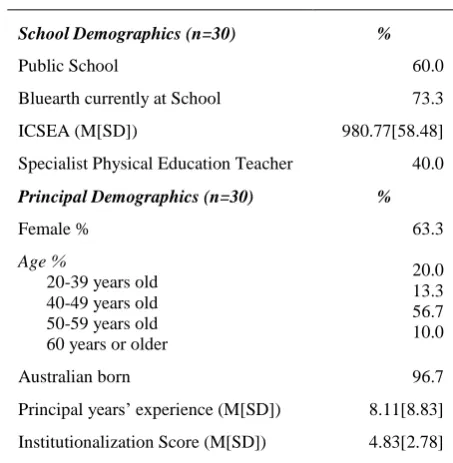
Overall, 30 of the 211 eligible principals participated in the study (14% response rate). Schools that
200
participated in the study on average had the program delivered more recently by a Bluearth coach than
201
schools that did not participate (p=0.002). There was no significant association between participation
202
in the study and school type (i.e., government or non-government) or level of socio-educational
203
advantage. Descriptive statistics for participants are displayed in Table 1.
204
*Table 1 about here
205
Bivariate and multivariate associations with institutionalization 206
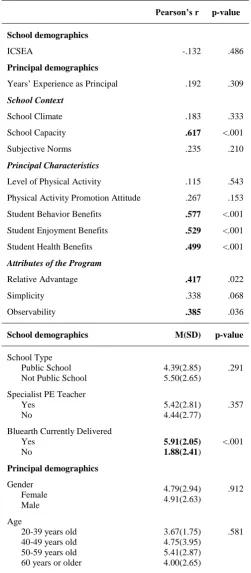
Results from univariate analyses on level of institutionalization are displayed in Table 2. Results show
207
having the Bluearth program delivered in the school by a Bluearth coach at the time of the study was
208
significantly positively related to institutionalization (η2=.426, p<.001). None of the principal 209
demographics were associated with institutionalization of the Bluearth program. Of the hypothesized
210
institutionalization factors, 6 of 11 had significant positive associations with institutionalization. From
211
school context, only general school capacity (r=.617, p<.001) was significantly associated with
212
institutionalization. From principal characteristics, perceived behavioral benefits (r=.577, p<.001),
213
enjoyment benefits (r=.529, p<.001), and health benefits (r=.499, p<.001) all had a significant
214
association with institutionalization. From attributes of the program, relative advantage (r=.417,
215
p=.022) and observability (r=.385, p=.036) had significant positive associations with
216
institutionalization of the Bluearth program
217
*Table 2 about here
9
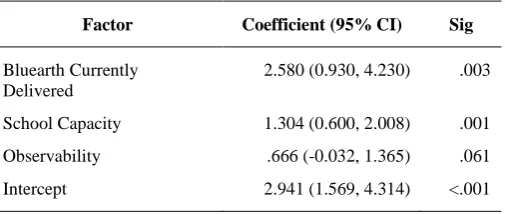
The results from the multivariate analysis are displayed in table 3. Having Bluearth delivered at the
219
time of the study remained significant (β=2.580, p=.003) in the multivariate analysis. Of the five
220
institutionalization factors that had a significant univariate association, only general school capacity
221
(β=1.802, p=.001) was significantly positively associated with institutionalization in the multivariate
222
model. Additionally, observability (β=0.902, p=.061) almost reached significance.
223
*Table 3 about here
224
Discussion 225
The present study examined associations between the school context, principal characteristics and
226
attributes of the program and institutionalization of a physical activity program in Australian
227
elementary schools. Identifying factors associated with institutionalization of physical activity
228
programs is important because schools that institutionalize physical activity programs are more likely
229
to sustain program elements at their school [10] To the authors’ knowledge, this is the first study to
230
examine factors associated with institutionalization of a classroom based physical activity program
231
into school policies and curriculum.
232
The results from this study show school capacity is associated with the institutionalization of a
233
classroom based physical activity program. Having at least one person who can provide teachers with
234
guidance on implementing a physical activity program is associated with taking more formal steps to
235
institutionalize the program into the schools policy and practices. This suggests having a staff member
236
at the school take an active role in championing the program may motivate principals to institute a
237
program into school policies and curriculum. However, these results could also be a result of reverse
238
causation whereby schools identify or appoint a staff member at their school whose role it is to
239
support the continued implementation of a program as a consequence of institutionalizing the
240
program. Nevertheless, it appears identifying and supporting a program champion to take a leadership
241
role may increase the likelihood health programs are sustained [27, 28]. Therefore, schools should
242
identify a staff member who can take an active role in advocating and supporting physical activity
243
programs.
10
This research also showed that observability of the program benefits were positively related to
245
program institutionalization. Therefore, principals should be made cognisant of tools and techniques
246
that allow them to evaluate the effectiveness of physical activity programs at their school. Having
247
tools to evaluate the program allows principals to make informed decisions about whether it is
248
worthwhile continuing to implement a program [14]. In univariate analyses, principal’s perceptions of
249
the relative advantage of the Bluearth program, and perceived student behavior, health, and enjoyment
250
benefits were also associated with program institutionalization. Collectively, these findings suggest
251
principals take more steps to institutionalize a physical activity program when they are able to
252
evaluate the outcomes of the program and believe it provides valuable and tangible benefits for their
253
students above those of Physical Education.
254
The present study also found schools which reported not having the Active Schools program delivered
255
by the Bluearth Foundation at their school at the time of the study had significantly lower levels of
256
institutionalization than those who did have the program at their school at the time of the study. This
257
shows schools may struggle to institutionalize physical activity programs once the formal program is
258
no longer delivered at their school. Therefore, physical activity programs might be unsustainable
259
beyond the formal implementation of the program by researchers or, in the case of this study, an
260
external provider.
261
Considering many schools were unable to institutionalize the Bluearth Active Schools program into
262
their policies and practices, it appears continued investment in program delivery by an external
263
provider might be necessary to sustain a program and its associated benefits. Given the costs
264
associated with outsourcing the delivery of a physical activity program, it is likely this would impact
265
schools with limited financial resources who may be unable to afford the sustained implementation of
266
the program. Unfortunately, schools with the least financial resources are likely to be those in greatest
267
need of increased physical activity during the school day [29]. Although opportunities to apply for
268
funding and grants to deliver physical activity programs in schools do exist [30], these often involve
269
detailed application processes that in themselves are resource intensive, highly competitive, and are
270
short term in nature. Given the substantial evidence of the health and educational benefits of
11
based physical activity, it seems imperative governments at all levels provide leadership in school
272
physical activity promotion and adequately resource schools to implement and sustain physical
273
activity programs [31]. Historically, we have seen that government commitment and investment is
274
necessary to have a meaningful impact on population levels of physical activity [32].
275
Although this study contributes to the understanding of factors associated with the institutionalization
276
of physical activity programs at schools, it has some limitations that must be considered when
277
interpreting the results. First, although the sample size was large enough to estimate accurate
278
regression coefficients, the small sample size means the study may not sufficiently powered to detect
279
medium or small effect sizes. Secondly, this study employed a cross-sectional and quantitative study
280
design and therefore could only infer association not causation, and was limited in its ability to
281
provide an in-depth understanding of the influence of contextual factors. Thirdly, this study only
282
achieved a response rate of 14%, and those who responded were more likely to have the Bluearth
283
program delivered in their school by a Bluearth coach more recently. It is possible principals who
284
have not taken steps to institutionalize the program may not be motivated to participate in the study.
285
Finally, we could not verify whether the principal who completed the questionnaire was the principal
286
who was at the school at the time of the delivery of the Bluearth program.
287
Conclusion 288
Although instituting physical activity programs within schools may ensure sustainability, very little is
289
known about what factors are associated with program institutionalization. The findings of this study
290
showed schools who have someone who can provide support for implementing the program take more
291
steps to institute the program into policies and practices. Our findings also highlight that it is
292
important principals have the tools to evaluate the benefits of physical activity programs and perceive
293
that such programs are beneficial for their students for institutionalization to occur. However, schools
294
in this study which had taken more steps to formally institutionalize the program at the school had the
295
program delivered by the Bluearth Foundation at the time of the study. This indicates it may be
296
difficult for schools to embed the program into their policies and practices after the formal completion
297
of the program. Therefore, further research is needed to understand factors which may contribute the
12
institutionalization of evidence based physical activity programs in schools after the formal
299
completion of the program. The field would also benefit from future quantitative research to develop
300
an in-depth understand the influence of contextual factors on the institutionalization of physical
301
activity programs in schools. Additionally, research should identify ways to support schools to
302
institutionalize physical activity programs to ensure programs and their associated benefits are
303
sustained.
304
Declaration 305
Acknowledgments: We would like to acknowledge and thank the participants in the study. This
306
project was supported in part by the Bluearth Foundation and Victoria University. Bluearth
307
Foundation provided school contact details and made initial contact with schools to introduce the
308
study but had no role in school or teacher recruitment beyond this. The funding bodies had not role in
309
the design of the study, analysis, and interpretation of data or in writing the manuscript.
310
Conflicts of Interest: None to declare.
311
Primary Data: The authors have full control of the primary data. Request to access data sets can be
312
made to the corresponding author. Applicants will be required to gain ethics approval from the
313
Victoria University Human Research Ethics Committee and the applicable educational jurisdictions
314
human research ethics committees prior to being granted access to data.
315
Authors Contribution: Author 1 contributed to the design of the study, conducted data collection,
316
analysis and interpretation and contributed to the write-up of the manuscript;Author 2 contributed to
317
the design of the study, assisted with data collection, interpretation of data and write up of the
318
manuscript; Author 3 conceptualized the study, managed the project and contributed to all aspects of
319
the study.
320
Ethics Approval: Ethics approval was received from the Victoria University HREC (HRE18‐016)
321
and all educational jurisdictions involved in the study. All participants provided consent to be
322
involved in the study.
13 References
324
1. Norris E, Shelton N, Dunsmuir S, Duke-Williams O, Stamatakis E. Physically active lessons
325
as physical activity and educational interventions: a systematic review of methods and results.
326
Prev Med. 2015;72:116-25.
327
2. Kibbe DL, Hackett J, Hurley M, McFarland A, Schubert KG, Schultz A, et al. Ten Years of
328
TAKE 10!®: integrating physical activity with academic concepts in elementary school
329
classrooms. Prev Med. 2011;52:S43-S50.
330
3. Schneider J, Malinowski P, Watson PM, Lattimore P. The role of mindfulness in physical
331
activity: a systematic review. Obes Rev. 2019;20:448-63.
332
4. Poitras VJ, Gray CE, Borghese MM, Carson V, Chaput J-P, Janssen I, et al. Systematic
333
review of the relationships between objectively measured physical activity and health
334
indicators in school-aged children and youth. Appl Physiol Nutr Metab. 2016;41:S197-S239.
335
5. Watson A, Timperio A, Brown H, Best K, Hesketh KD. Effect of classroom-based physical
336
activity interventions on academic and physical activity outcomes: a systematic review and
337
meta-analysis. Int J Behav Nutr Phys Act. 2017;14:114.
338
6. Pate RR, Saunders R, Dishman RK, Addy C, Dowda M, Ward DS. Long-term effects of a
339
physical activity intervention in high school girls. Am J Prev Med. 2007;33:276-80.
340
7. Dowda M, Sallis JF, McKenzie TL, Rosengard P, Kohl HW. Evaluating the sustainability of
341
SPARK Physical Education. Res Q Exerc Sport. 2005;76:11-9.
342
8. Reis RS, Salvo D, Ogilvie D, Lambert EV, Goenka S, Brownson RC. Scaling up physical
343
activity interventions worldwide: stepping up to larger and smarter approaches to get people
344
moving. Lancet. 2016;388:1337-48.
345
9. Goodman RM, McLeroy KR, Steckler AB, Hoyle RH. Development of level of
346
institutionalization scales for health promotion programs. Health Educ Q. 1993;20:161-78.
347
10. Mâsse LC, McKay H, Valente M, Brant R, Naylor P-J. Physical activity implementation in
348
schools: a 4-year follow-up. Am J Prev Med. 2012;43:369-77.
349
11. Allison KR, Vu-Nguyen K, Ng B, Schoueri-Mychasiw N, Dwyer JJM, Manson H, et al.
350
Evaluation of Daily Physical Activity (DPA) policy implementation in Ontario: surveys of
351
elementary school administrators and teachers. BMC Public Health. 2016;16:746.
352
12. Naylor P-J, Nettlefold L, Race D, Hoy C, Ashe MC, Wharf Higgins J, et al. Implementation
353
of school based physical activity interventions: a systematic review. Prev Med.
2015;72:95-354
115.
355
13. Milat AJ, Bauman A, Redman S. Narrative review of models and success factors for scaling
356
up public health interventions. Implement Sci. 2015;10:113.
14
14. Milat AJ, Bauman AE, King L, Redman S. The concept of scalability: increasing the scale
358
and potential adoption of health promotion interventions into policy and practice. Health 359
Promot Int. 2012;28:285-98.
360
15. Milat AJ, King L, Newson R, Wolfenden L, Rissel C, Bauman A, et al. Increasing the scale
361
and adoption of population health interventions: experiences and perspectives of policy
362
makers, practitioners, and researchers. Health Res Policy Syst. 2014;12:18.
363
16. Yamey G. Scaling Up Global Health Interventions: A Proposed Framework for Success.
364
PLOS Med. 2011;8:e1001049.
365
17. Telford RD, Cunningham RB, Telford RM, Daly RM, Olive LS, Abhayaratna WP. Physical
366
education can improve insulin resistance: the LOOK randomized cluster trial. Med Sci Sports 367
Exerc. 2013;45:1956-64.
368
18. Telford RD, Cunningham RB, Fitzgerald R, Olive LS, Prosser L, Jiang X, et al. Physical
369
education, obesity, and academic achievement: a 2-year longitudinal investigation of
370
Australian elementary school children. Am J Public Health. 2012;102:368-74.
371
19. Bluearth Foundation. The Bluearth Approach. Availiable at https://www.bluearth.org/the-372
bluearth-approach/. Accessed July 4, 2019.
373
20. Millar MM, Dillman DA. Improving response to web and mixed-mode surveys. Public Opin 374
Q. 2011;75:249-69.
375
21. Martin JJ, Kulinna PH. Self-Efficacy Theory and the Theory of Planned Behavior: teaching
376
physically active Physical Education classes. Res Q Exerc Sport. 2004;75:288-97.
377
22. Carlson JA, Engelberg JK, Cain KL, Conway TL, Geremia C, Bonilla E, et al. Contextual
378
factors related to implementation of classroom physical activity breaks. Transl Behav Med.
379
2017;7:581-92.
380
23. Webster C, Monsma E, Erwin H. The role of biographical characteristics in preservice
381
classroom teachers’ school physical activity promotion attitudes. J Teach Phys Educ.
382
2010;29:358-77.
383
24. Milton K, Clemes S, Bull F. Can a single question provide an accurate measure of physical
384
activity? Br J Sports Med. 2013;47:44-8.
385
25. Steckler A, Goodman RM, McLeroy KR, Davis S, Koch G. Measuring the diffusion of
386
innovative health promotion programs. Am J Health Promot. 1992;6:214-24.
387
26. Austin PC, Steyerberg EW. The number of subjects per variable required in linear regression
388
analyses. J Clin Epidemiol. 2015;68:627-36.
389
27. Scheirer MA. Is sustainability possible? A review and commentary on empirical studies of
390
program sustainability. Am J Eval. 2005;26:320-47.
391
28. Ward D, Saunders R, Felton G, Williams E, Epping J, Pate R. Implementation of a school
392
environment intervention to increase physical activity in high school girls. Health Educ Res.
393
2006;21:896-910.
15
29. Kern BD, Graber KC, Shen S, Hillman CH, McLoughlin G. Association of school-based
395
physical activity apportunities, socioeconomic status, and third-grade reading. J Sch Health.
396
2018;88:34-43.
397
30. Australian Sports Commision. Grants and funding. n.d. Availiable at
398
https://www.sportaus.gov.au/grants_and_funding. Accessed March 21, 2019.
399
31. Hills AP, Dengel DR, Lubans DR. Supporting public health priorities: recommendations for
400
Physical Education and physical activity promotion in schools. Prog Cardiovasc Dis.
401
2015;57:368-74.
402
32. Pratt M, Perez LG, Goenka S, Brownson RC, Bauman A, Sarmiento OL, et al. Can
403
population levels of physical activity be increased? Global evidence and experience. Prog 404
Cardiovasc Dis. 2015;57:356-67.
405
Table 1- Descriptive statistics
406
School Demographics (n=30) %
Public School 60.0
Bluearth currently at School 73.3
ICSEA (M[SD]) 980.77[58.48]
Specialist Physical Education Teacher 40.0
Principal Demographics (n=30) %
Female % 63.3
Age %
20-39 years old 40-49 years old 50-59 years old 60 years or older
20.0 13.3 56.7 10.0
Australian born 96.7
Principal years’ experience (M[SD]) 8.11[8.83]
Institutionalization Score (M[SD]) 4.83[2.78]
407
408
409
410
411
412
413
16
Table 2- Univariate associations with institutionalization of Bluearth Foundation’s Active Schools
415
program
416
Pearson’s r p-value
School demographics
ICSEA -.132 .486
Principal demographics
Years’ Experience as Principal .192 .309
School Context
School Climate .183 .333
School Capacity .617 <.001
Subjective Norms .235 .210
Principal Characteristics
Level of Physical Activity .115 .543
Physical Activity Promotion Attitude .267 .153
Student Behavior Benefits .577 <.001
Student Enjoyment Benefits .529 <.001
Student Health Benefits .499 <.001
Attributes of the Program
Relative Advantage .417 .022
Simplicity .338 .068
Observability .385 .036
School demographics M(SD) p-value
School Type Public School Not Public School
4.39(2.85) 5.50(2.65)
.291
Specialist PE Teacher Yes
No
5.42(2.81) 4.44(2.77)
.357
Bluearth Currently Delivered Yes
No
5.91(2.05) 1.88(2.41)
<.001
Principal demographics
Gender Female Male
4.79(2.94) 4.91(2.63)
.912
Age
20-39 years old 40-49 years old 50-59 years old 60 years or older
3.67(1.75) 4.75(3.95) 5.41(2.87) 4.00(2.65)
.581
Bolded figures significant at p<.05
417
17
Table 3- Significant multivariate associations with institutionalization of Bluearth Foundation’s
419
Active Schools program
420
Factor Coefficient (95% CI) Sig
Bluearth Currently Delivered
2.580 (0.930, 4.230) .003
School Capacity 1.304 (0.600, 2.008) .001
Observability .666 (-0.032, 1.365) .061
Intercept 2.941 (1.569, 4.314) <.001