Segmentation of Textured Images Using
Region Growing and Phase Correlation
Algorithm
S. Kinge1, P. Sangamnere2
Assistant Professor, Dept. of ECE, MIT College of Engineering, Pune, Maharashtra, India1
PG Student [VLSI & Embedded Systems], Dept. of ECE, MIT College of Engineering, Pune, Maharashtra, India2
ABSTRACT: This paper presents texture image segmentation based on the combination of phase correlation and region growing algorithm. Image segmentation is an integral part of image analysis. In image processing different processes are done on images to enhance it at different parameters. These processes are not directly applied on images but before that it needs to be segmented or divided in smaller parts called pixels or small blocks of pixels. So segmentation becomes an integral and basic part in image analysis and error at this stage can influence other processing techniques. As in this paper three algorithm are developed on two different dimensions for two class images. Phase correlation is used to find similarities in the windows of pixels which are of size 16x16. Similar and different pixel or pixel blocks are decided by the threshold value of the phase correlation result to find out which pixel falls into the same segments and which is not.
KEYWORDS: Phase correlation, region growing, image segmentation, seed points.
I.INTRODUCTION
When texture images are considered there is no formal mathematical definition for texture images. It is considered to be a complex visual patterns, composed of spatially organized entities that have characteristics like brightness, color, shape, size. Simply it is considered to be a regular repetition of an element or pattern on a surface. Data for texture image can be taken from natural texture, material texture etc [9]. Some of the pictorial representation of natural and material texture is shown in figure 1.
(a) Material Texture
Image segmentation is a process of partitioning digital image into multiple segments that is set of pixels also known as superpixels. In image segmentation the goal is to simplify or change representation of image into something that is more meaningful and easier to analyze [3]. Image segmentation is typically used to locate objects and boundaries (lines, curves, etc.) in images. Image segmentation is the process of assigning a label to every pixel in an image such that pixels with the same label share certain characteristics[8]. Each of the pixels in a region are similar with respect to some characteristic or computed property, such as color, intensity, or texture. Adjacent regions are significantly different with respect to the same characteristic [9].
Recently, it is shown that the phase correlation of subsampled images can be effectively used to discriminate similar and dissimilar images and, therefore, provides a competent approach for hard-cut detection in archive film sequences affected by noise and other artifacts, and the subsampling of images improves robustness against noise as well as global and local variations[1].
Phase correlation is applied to determine the similarity between pixels. The phase correlation has a built in whitening effect so that global variations are automatically compensated during this process[5]. Similar and dissimilar pixels are decided according to the peak value of the phase correlation result to determine pixels that fall into the same segments and the number of resulting segments is determined automatically by this process[2].
Along with phase correlation region growing algorithm is also used. The concept is simple. A small numbers of seed point to represent the property which is required, then grow the region. Any seed point can be selected with any criteria or property which helps to distinguish the region[10].
II. RELATED WORK
As segmentation is very important and basic step in image processing lot of work has been done in segmentation. Also different approaches are followed like Geometrical methods, Structural methods, Statistical methods, Model based approach. In these models there are different methods. Like markov random field comes under model based approach. Under markov random field also different authors have proposed different methods with one common intention to improve image segmentation process by considering different parameters[12].
The authors A. K. Qin and David A. Clausi have proposed multivariate image segmentation approach. Multivariate image segmentation is influenced by large intraclass variation that reduces class distinguishability and solution space complexity imposes computational cost and degrade algorithmic robustness. To deal with these problems, a Markov random field (MRF) based multivariate segmentation algorithm called multivariate iterative region growing using semantics (MIRGS) is presented. In MIRGS, the impact of intraclass variation and computational cost are reduced using the MRF spatial context model incorporated with adaptive edge penalty. But MIRGS is highly sensitive to initial conditions. To suppress initialization sensitivity, it employs a region-level K-means (RKM) based initialization method, which consistently provides accurate initial conditions at low computational cost[12].
Xiaojie Lian, Yan Wu, Wei Zhao, Fan Wang, Qiang Zhang, and Ming Li have proposed Conditional Triplet Markov Field (CTMF) for SAR image segmentation. Conditional random field (CRF) has been widely used in optical image and remote sensing image segmentation because of the advantage of directly modeling the posterior distribution and capturing arbitrary dependencies among observations. However, for nonstationary SAR images, applications of CRF often fail because of their nonstationary property. The triplet Markov field (TMF) model is well appropriate for nonstationary SAR image processing. So author has proposed an unsupervised SAR image segmentation algorithm based on a CTMF framework which combines the advantages of both CRF and TMF. CTMF can suppress speckle noise well and achieve better regional consistency and edge locations in SAR image segmentation. In results CTMF is compared with MRF and TMF models on basis of their accuracy and Kappa parameters and it looks better than MRF and TMF[12].
III. IMAGE SEGMENTATION USING PC AND RGA
into 16x16 window size which is considered to be more suitable in such kind of processes. There are two parameters based on which the results of these three algorithms are compared and they are percentage accuracy and time. To check the robustness of these algorithms they are applied on two different dimension of image i.e. 128x128 and 256x256. Phase correlation is an important aspect in the algorithm. Equal and different pixels are decided by the threshold of the phase correlation result to find out which pixel fall into the same segments and which is not. Phase correlation can be used for template matching [1]. The ratio R between two images img1 and img2 is calculated as follows[4]:
= F(img1) × conj(F(img2))
| F(img1) × conj F(img2) | (1)
where F is the fast fourier transform, and conj is the complex conjugate. The inverse Fourier transform of R is the phase correlation[4].
In the first algorithm phase correlation is used and threshold is selected by observation of the pc val i.e. phase correlation value which is coming as output of formula mentioned above. And secondly the seed point selected is from first row and first column. So seed point selected is very first window of an image.
In second algorithm threshold selection is same as that of first algorithm. But in region growing algorithm most of the times initial seed selected is always a middle one from where the region grows. Also when an image has dissimilar pattern it is better to choose a middle one as an initial seed. So in this algorithm instead of considering first window as seed, the middle window is considered as seed to carry out the segmentation. Experimental results shows effectiveness of second algorithm compared to first one.
As in first two algorithms while selecting the threshold there is need to check that phase correlation value and decide which value will be more suitable for threshold. This automatically put some error in the output as the threshold is selected only by observation of the phase correlation value.
So in the third algorithm instead of selecting the threshold by observation new concept of taking an average of all that phase correlation values is applied and the resulting average value is considered to be a threshold. As average of some numbers is more accurate than the value taken just by observation, the accuracy in the third algorithm is high compared to first two algorithms. Along with that region growing algorithm is also used. In this initial seed is selected and then the region grows from it and then another seed is selected and process continues till all the windows get scanned.
IV. ALGORITHMS
Phase Correlation 1. Read the image from the database.
2. If image in color then convert into grayscale. 3. Choose first window as a seed window.
4. Apply phase correlation of all windows of image with this seed window. 5. Median is applied to pick middle value.
6. Stored the result in the database database. 7. Find percent accuracy and required time.
PC with mid seed 1. Read the image from the database.
2. If image in color then convert into grayscale. 3. Choose middle window as a seed window.
4. Apply phase correlation of all windows of image with this seed window. 5. Median is applied to pick middle value.
6. Stored the result in the database database. 7. Find percent accuracy and required time.
RGA with PC 1. Read the image from the database.
2. If image in color then convert into grayscale. 3. Choose initial seed window neighbor window.
6. Stored the result in the database. 7. Find percent accuracy and required time.
V. EXPERIMENTAL RESULTS
According to the concept of averaging, an average of more number of readings give more accurate and error free output. So concept of averaging is used in the algorithm along with phase correlation and region growing algorithm. In the region growing algorithm after selection of the seed point the region grows by comparing the surrounding pixels or block of pixels with the seed point. But for comparison it needs some criteria which will be taken with the help of phase correlation. First phase correlation applied on the window to find out it’s phase correlation value and then similar and dissimilar pixels are decided according to the threshold. And based on that the region should be merged or it should be exlcluded has been decided.
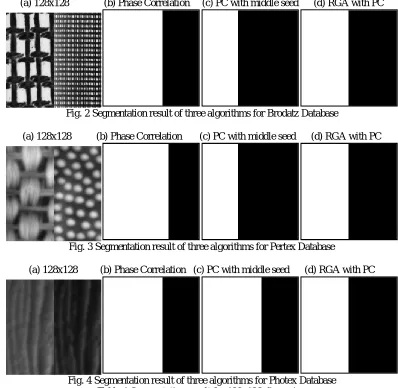
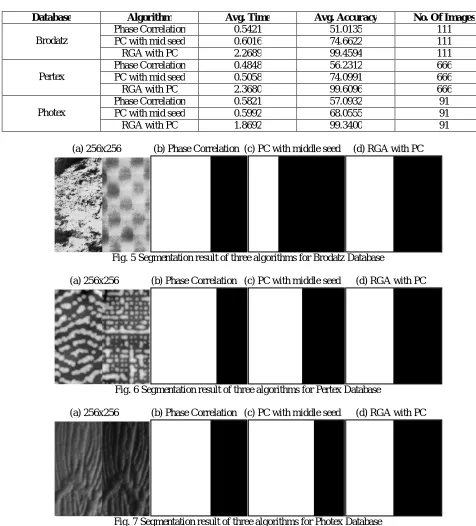
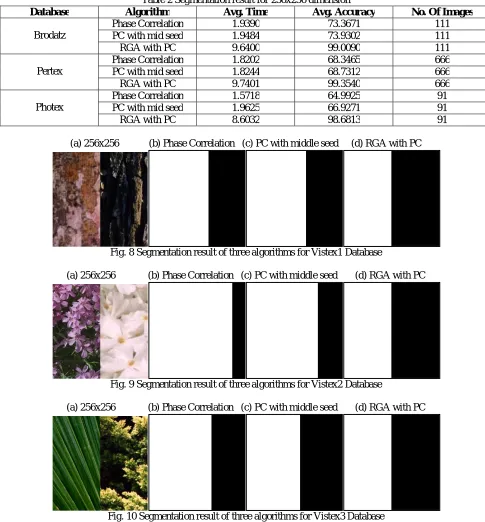
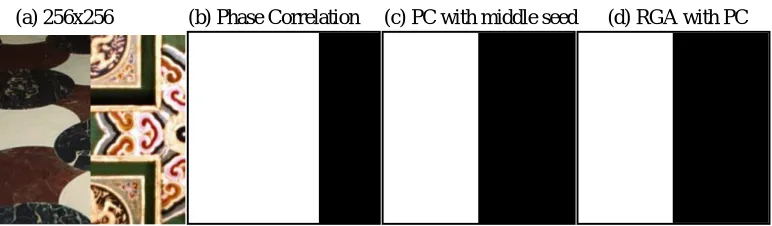
As mentioned earlier the algorithm is applied on different database and on different dimension. Different database has different kinds of textured images. To check robustness of these algorithms, along with grayscale image these algorithms are also applied on some color images of different textures as well as on different dimension of 128x128 and 256x256. The results are shown for the database with their average accuracy and average time required for each figure. So the pictorial and tabular results are shown below.
(a) 128x128 (b) Phase Correlation (c) PC with middle seed (d) RGA with PC
Fig. 2 Segmentation result of three algorithms for Brodatz Database
(a) 128x128 (b) Phase Correlation (c) PC with middle seed (d) RGA with PC
Fig. 3 Segmentation result of three algorithms for Pertex Database
(a) 128x128 (b) Phase Correlation (c) PC with middle seed (d) RGA with PC
Database Algorithm Avg. Time Avg. Accuracy No. Of Images
Brodatz
Phase Correlation 0.5421 51.0135 111 PC with mid seed 0.6016 74.6622 111 RGA with PC 2.2689 99.4594 111
Pertex
Phase Correlation 0.4848 56.2312 666 PC with mid seed 0.5058 74.0991 666 RGA with PC 2.3680 99.6096 666
Photex
Phase Correlation 0.5821 57.0932 91 PC with mid seed 0.5992 68.0555 91 RGA with PC 1.8692 99.3400 91
(a) 256x256 (b) Phase Correlation (c) PC with middle seed (d) RGA with PC
Fig. 5 Segmentation result of three algorithms for Brodatz Database
(a) 256x256 (b) Phase Correlation (c) PC with middle seed (d) RGA with PC
Fig. 6 Segmentation result of three algorithms for Pertex Database
(a) 256x256 (b) Phase Correlation (c) PC with middle seed (d) RGA with PC
Table 2 Segmentation result for 256x256 dimension
Database Algorithm Avg. Time Avg. Accuracy No. Of Images
Brodatz
Phase Correlation 1.9390 73.3671 111 PC with mid seed 1.9484 73.9302 111 RGA with PC 9.6400 99.0090 111
Pertex
Phase Correlation 1.8202 68.3465 666 PC with mid seed 1.8244 68.7312 666 RGA with PC 9.7401 99.3540 666
Photex
Phase Correlation 1.5718 64.9925 91 PC with mid seed 1.9625 66.9271 91 RGA with PC 8.6032 98.6813 91
(a) 256x256 (b) Phase Correlation (c) PC with middle seed (d) RGA with PC
Fig. 8 Segmentation result of three algorithms for Vistex1 Database
(a) 256x256 (b) Phase Correlation (c) PC with middle seed (d) RGA with PC
Fig. 9 Segmentation result of three algorithms for Vistex2 Database
(a) 256x256 (b) Phase Correlation (c) PC with middle seed (d) RGA with PC
(a) 256x256 (b) Phase Correlation (c) PC with middle seed (d) RGA with PC
Fig. 11 Segmentation result of three algorithms of color images for Vistex4 Database
Table 3 Segmentation result for 256x256 dimension
Database Algorithm Avg. Time Avg. Accuracy No. Of Images
Vistex 1
Phase Correlation 1.5969 67.1038 224 PC with mid seed 2.5807 64.5089 224 RGA with PC 14.2770 99.4196 224
Vistex 2
Phase Correlation 2.3401 65.3523 298 PC with mid seed 1.9110 59.5638 298 RGA with PC 14.0761 99.4630 298
Vistex 3
Phase Correlation 2.8015 68.2033 503 PC with mid seed 3.2301 71.8067 503 RGA with PC 19.4017 99.2644 503
Vistex 4
Phase Correlation 3.3436 69.6461 272 PC with mid seed 2.9617 74.6783 272 RGA with PC 15.2685 99.4485 272
VI. CONCLUSION
A texture based image segmentation approach using phase correlation and region growing algorithm is presented in this paper. In region growing algorithm initially seed windows are selected one by one and phase correlation is performed on it along with its neighboring windows to classify similar and dissimilar windows depending on the threshold. As this algorithm is performed on textured images, so it has huge application in real life like in medical imaging, machine vision, natural texture, object detection, etc. This algorithm has a limitation for its region growing algorithm as it requires to provide initial seed window. So it can be considered as a future work to make the region growing algorithm fully automatic so that it can start automatically by deciding initial seed window and stops when entire region gets scanned.
REFERENCES
[1] Alp Erturk and Sarp Erturk, ”Unsupervised Segmentation of Hyperspectral Images Using Modified Phase Correlation,” IEEE geoscience and remote sensing letters, vol. 3, no. 4, october 2006.
[2] Tamas Sziranyi and Maha Shadaydeh, ”Segmentation of Remote Sensing Images Using Similarity-Measure-Based Fusion-MRF Model,” IEEE geoscience and remote sensing letters, vol. 11, no. 9, september 2014.
[3] A.K. Qin, David A. Clausi, ”Multivariate Image Segmentation Using Semantic Region Growing With Adaptive Edge Penalty,” IEEE transactions on image processing, vol. 19, no. 8, august 2010.
[4] Saiqa Khan, Arun Kulkarni, ”Robust Method for Detection of Copy-Move Forgery in Digital Images,” IEEE geoscience and remote sensing letters, 2010 IEEE.
[5] Chaobing Huang, Quan Liu, Xiaopeng Li, ”Color Image Segmentation by Seeded Region Growing and Region Merging,” 2010 Seventh International Conference on Fuzzy Systems and Knowledge Discovery, 978-1-4244-5934-6/10/2010 IEEE.
[6] Chen Zheng, Leiguang Wang, Rongyuan Chen, and Xiaohui Chen, ”Image Segmentation Using Multiregion-Resolution MRF Model,” IEEE geoscience and remote sensing letters, vol. 10, no. 4, july 2013.
[7] Zhi-hvi Li, Meng zhang, Haibo Liv, ”A fast algorithm of image segmentation based on markov random field,” 978-1-4673-4685-6112/ 2012, IEEE.
[9] Vaijinath V. Bhosle, Vrushsen P. Pawar, ”Texture Segmentation: Different Methods,” International Journal of Soft Computing and Engineering (IJSCE), ISSN: 2231-2307, Volume-3, Issue-5, November 2013.
[10] Shilpa Kamdi, R.K.Krishna, ”Image Segmentation and Region Growing Algorithm” International Journal of Computer Technology and Electronics Engineering (IJCTEE), Volume 2, Issue 1, January 2012.