On Security Arguments of the Second Round SHA-3 Candidates
Elena Andreeva · Andrey Bogdanov · Bart Mennink · Bart Preneel · Christian Rechberger
March 19, 2012
Abstract In 2007, the US National Institute for Standards and Technology (NIST) announced a call for the design of a new cryptographic hash algorithm in response to vulner-abilities like differential attacks identified in existing hash functions, such as MD5 and SHA-1. NIST received many submissions, 51 of which got accepted to the first round. 14 candidates were left in the second round, out of which 5 candidates have been recently chosen for the final round. An important criterion in the selection process is the SHA-3 hash function security. We identify two important classes of security arguments for the new designs: (1) the possible re-ductions of the hash function security to the security of its underlying building blocks, and (2) arguments against dif-ferential attack on building blocks. In this paper, we com-pare the state of the art provable security reductions for the second round candidates, and review arguments and bounds against classes of differential attacks. We discuss all the SHA-3 candidates at a high functional level, analyze and summarize the security reduction results and bounds against differential attacks. Additionally, we generalize the well-known proof of collision resistance preservation, such that all SHA-3 candidates with a suffix-free padding are covered.
Keywords SHA-3 competition·hash functions· classifi-cation·security reductions·differential attacks
A preliminary version of this paper appeared at ISC 2010 [2].
E. Andreeva·A. Bogdanov·B. Mennink·B. Preneel
Dept. Electrical Engineering, ESAT/COSIC and IBBT Katholieke Universiteit Leuven, Belgium
Tel.: +32-16-321800 Fax: +32-16-321969
E-mail: [email protected]
C. Rechberger Institut for Matematik
Danmarks Tekniske Universitet, Denmark
1 Introduction
Hash functions serve a crucial foundation of numerous cryp-tographic applications, ranging from key derivation func-tions over various security protocols to digital signatures. In 2004, a series of differential attacks by Wang et al. [81, 82] have exposed security vulnerabilities in the design of the most widely adopted and deployed SHA-1 hash func-tion. As a result, the US National Institute for Standards and Technology (NIST) recommended the replacement of SHA-1 by the SHA-2 hash function family and announced a call for the design of a new SHA-3 hashing algorithm. The SHA-3 hash function must allow for message digests of length 224,256,384 and 512 bits, it should be efficient, and most importantly it should provide an adequate level of security. In the second round, 14 candidate hash functions were considered, 5 candidates remaining in the race for the selection of the SHA-3 hash function in the current third round.
As a result of the performed comparative analysis, sev-eral classifications of the SHA-3 candidates, mostly focused on hardware performance, appeared in the literature [43, 46, 59, 79]. A classification based on the NIST-specified secu-rity criteria is however still due.
NIST Security Requirements. NIST specifies a number of security requirements [70] to be satisfied by the future SHA-3 function:(i)at least one variant of the hash function must securely support HMAC and randomized hashing. Fur-thermore, for alln-bit digest values, the hash function must provide(ii)preimage resistance of approximatelyn bits,
(iii)second preimage resistance of approximatelyn−L
bits, where the first preimage is of length at most 2Lblocks,
(iv)collision resistance of approximatelyn/2 bits, and(v)
taking a fixed subset of m bits of the function’s output is required to satisfy properties(ii)-(v)withnreplaced by
m.
Our Contribution.In this work we provide a survey of the 14 second round SHA-3 candidates including the 5 finalists, in which we compare their security reductions, and their sistance against differential attacks. Regarding security re-ductions, we consider preimage, second preimage and col-lision resistance (security requirements(ii)-(iv)) for the
n=256 andn=512 variants. Most of this security analysis is realized in the ideal model, where one or more of the un-derlying integral building blocks (e.g., the unun-derlying block cipher or permutation(s)) are assumed to be ideal, i.e. ran-dom primitives. To argue collision resistance we extend the standard proof of Merkle-Damg˚ard collision resistance [38, 68] to coverallsecond round SHA-3 candidate hash func-tion with a suffix-free padding (App. B). Notice that the ba-sic Merkle-Damg˚ard proof does not suffice in the presence of a final transformation and/or a chopping. Additionally, we consider the indifferentiability of the candidates. Informally, indifferentiability guarantees that a design has no structural design flaws [32], and in particular (as formally proven in App. A) an indifferentiability result renders upper bounds on the advantage of finding preimages, second preimages and collisions. The provable security analysis in this contri-bution extends to the findings of Andreeva et al. [2].
Recent substantial progress in the differential attacks against SHA-1 [81] is the main motivation for the SHA-3 competition [29], and many of the first round candidates fell victim to differential attacks as well, due to their well-elaborated and advanced toolbox. Hence we survey known bounds against classes of these attacks. Note that, to the best of current knowledge, informative bounds exist only for a subset of relevant differential properties. Also only a sub-set of all second round SHA-3 candidates allow for such bounds by design, which excludes e.g. all ARX-based con-structions from the analysis. Therefore, in this work, we will be mainly considering upper bounds on the expected dif-ferential trail probability (EDTP) of hash function building blocks such as underlying permutations and block ciphers which are based on substitution-permutation networks. Al-though EDTP proved to be highly informative in predicting the power of differential cryptanalysis for keyed block ci-phers, for most attacks on hash functions all inputs to the function’s building blocks are known and can often even be chosen by the adversary. However, at some point in most major attack techniques against hash functions, the adver-sary cannot control the difference propagation any more and relies on the differential trails, EDTP becoming again a good predictor of the attack complexity. Thus, due to the lack of a better universal evaluation tool with respect to differential attacks on the one hand, and because of the ability of the
dif-ferential trails to reflect at least some important features of such attacks on the other, we have opted to use upper bounds on EDTP in our comparative analysis.
Section 2 briefly covers the notation, and the basic prin-ciples of hash function design. In Sect. 3, we consider all candidates, both from a provable security point of view, and from a cryptanalysis view. We give a high level algorithmic description of each hash function, and discuss the existing security results. All results are summarized in Table 1 and Table 2. We conclude the paper with Sect. 4 and give some final remarks on the security comparison.
2 Preliminaries
For a positive integer valuen∈N, we denote byZn2the set
of bit strings of lengthn, and by(Zn
2)
∗the set of strings of
length a positive multiple ofnbits. We denote byZ∗2the set of bit strings of arbitrary length. Ifx,yare two bit strings, their concatenation is denoted byxky. By|x|we denote the length of a bit stringx, and form,n∈Nwe denote byhmin
the encoding ofmas ann-bit string. The functionchopn(x) chops off thenrightmost bits of a bit stringx.
Throughout, we use a unified notation for all candidates. The valuendenotes the output size of the hash function,lthe size of the chaining value, andmthe number of message bits compressed in one iteration of the compression function. A padded message is always parsed as a sequence of k≥1 message blocks of lengthmbits:(M1, . . . ,Mk).
2.1 Reductionist Security Notions
In this section we investigate the reductionist security of hash functions in the ‘ideal model’ and the more classical ‘generic’ security.
maximum is taken over all adversaries that make at most
qqueries to their oracles.
Additionally, we consider the indifferentiability of the SHA-3 candidates. The indifferentiability framework intro-duced by Maurer et al. [67] is an extension of the classi-cal notion of indistinguishability, and ensures that a hash function has no structural defects. We denote the indiffer-entiability security of a hash function HbyAdvproH, max-imized over all distinguishers making at mostq queries of maximal lengthK≥0 message blocks to their oracles. We refer to [32] for a formal definition. An indifferentiability bound guarantees security of the hash function against spe-cific attacks. In particular, one can obtain a bound onAdvatkH, for any security notion atk:AdvatkH ≤PratkRO+AdvproH, where PratkRO denotes the success probability of a generic attack against H under atk. This bound is proven in Thm. 1 (App. A).
Generic security.Thegeneric collision resistance security
in the context of this work deals with analyzing the collision resistance of hash functions in the standard model. A hash functionHis called generically(t,ε)collision resistant if no adversary running in time at mosttcan find two different messages M,M0such thatH(M) =H(M0)with advantage more thanε. We denote byAdvgcolH the generic collision re-sistance security of the functionH, maximized over all ‘ef-ficient’ adversaries. We refer the reader to [4, 73, 74] for a more formal discussion.
To argue generic collision resistance security of the hash functionH(as domain extenders of fixed input length com-pression functions) we use the composition result of Merkle and
Damg˚ard [38, 68] and extend it to a wider class of suffix-free hash functions (App. B). This result concludes the col-lision resistance of the hash functionHassuming collision resistance security guarantees from the underlying compres-sion functions. We then translate ideal model collicompres-sion re-sistance security results on the compression functions via the latter composition to ideal model collision results on the hash function (expressed by AdvcolH). A generic colli-sion result, generally speaking, applies to a wider class of schemes for which no bounds on the collision resistance se-curity of the underlying compression functions is known, e.g. for BLAKE and BMW.
If a compressing function F outputs a bit string of length
n, one expects to find collisions with high probability af-ter approximately 2n/2queries (due to the birthday attack). Similarly, (second) preimages can be found with high prob-ability after approximately 2n queries1. Moreover, finding
1 Kelsey and Schneier [56] describe a second preimage attack on
the Merkle-Damg˚ard hash function that requires at most approximately
2n−Lqueries, where the first preimage is of length at most 2Lblocks.
second preimages is provably harder than finding collisions, and similar for preimages (depending on the specification ofF) [74]. Formally, we haveΩ(q2/2n) =AdvcolF =O(1), Ω(q/2n) = AdvsecF ≤AdvcolF , and Ω(q/2n) =Adv
pre
F ≤
AdvcolF +ε, where ε is negligible if F is a variable input length compressing function. In the remainder, we will con-sider these bounds for granted, and only include security re-sults that improve either of these bounds. A bound is called
tightif the lower and upper bound are the same up to a con-stant factor, andoptimalif the bound is tight with respect to the original lower bound.
2.2 Compression Function Design Strategies
A common way to build compression functions is to base it on a block cipher [25, 72, 77], or on a (limited number of) permutation(s) [24, 75, 76]. Preneel et al. [72] analyzed and categorized 64 block cipher based compression functions. Twelve of them were formally proven secure by Black et al. [25]. These results have been recently generalized by Stam [77]. Interestingly, the latter result implies security bounds for some compression functions that do not fit in the PGV-model, like ECHO, Hamsi and SIMD. In the ideal model, everywhere second preimage resistance of the com-pression function can be proven similar as the preimage re-sistance, up to a constant (the security analysis differs only in that we give the adversary one query for free). Through-out, by ‘PGVx’ we denote the xthtype compression function
of [72]. We note that PGV1, PGV3 and PGV5 are better known as the Matyas-Meyer-Oseas, the Miyaguchi-Preneel and the Davies-Meyer compression functions, respectively.
In the context of permutation based compression func-tions, Black et al. [24] analyzed 2l- to l-bit compression functions based onone l-bit permutation, and proved them insecure. This result has been generalized by Rogaway and Steinberger [75], Stam [76] and Steinberger [78] to com-pression functions with arbitrary input and output sizes, and an arbitrary number of underlying permutations. Their bounds indicate the number of queries required to find colli-sions or preimages for permutation based compression func-tions.
2.3 Hash Function Design Strategies
In order to allow the hashing of arbitrarily long strings, all SHA-3 candidates employ a specific mode of operation. Central to all designs is theiterated hash function principle
[62]: on input of an initialization vectorIV, the iterated hash
functionHf based on the compression function f proceeds
a padded message(M1, . . . ,Mk)as follows:
Hf(IV;M
1, . . .,Mk) =hk, where:
h0=IV,
hi= f(hi−1,Mi)fori=1, . . . ,k.
This principle is also called the plain Merkle-Damg˚ard (MD) design [38, 68]. Each of the 14 remaining candidates is based on this design, possibly followed by a final trans-formation (FT), and/or achop-function2.
The padding functionpad:Z∗2→(Zm
2)
∗
is an injective map-ping that transforms a message of arbitrary length to a mes-sage of length a multiple of m bits (the number of mes-sage bits compressed in one compression function iteration). Most of the candidates employ a sufficiently strong padding rule (cf. Fig. 2). Additionally, in some of the designs the message blocks are compressed along with specific counters or tweaks, which may strengthen the padding rule. We dis-tinguish between ‘prefix-free’ and/or ‘suffix-free’ padding.
A padding rule is calledsuffix-free, if for any distinct
M,M0, there exists no bit string X such that pad(M0) =
Xkpad(M). The plain MD design with any suffix-free pad-ding (also called MD-strengthening [62]) preserves colli-sion resistance [38, 68]. We generalize this result in Thm. 2 (App. B): informally, this preservation result also holds if the iteration is finalized by a distinct compression function and/or the chop-function. Other security properties, like preimage resistance, are however not preserved in the MD design [4]. It is also proven that the MD design with a suffix-free padding need not necessarily be indifferentiable [32]. However, the MD constructionisindifferentiable if it ends with a chopping function or a final transformation, both when the underlying compression function is ideal or when the hash function is based on a PGV compression function [32, 52, 66].
A padding rule is calledprefix-free, if for any distinct
M,M0, there exists no bit string X such that pad(M0) =
pad(M)kX. It has been proved that the MD design, based on ideal compression function or ideal PGV construction, with prefix-free padding is indifferentiable from a random ora-cle [30, 32, 52, 66]. Security notions like collision-resistance, are however not preserved in the MD design with prefix-free only padding.
HAIFA design.A concrete design based on the MD princi-ple is the HAIFA construction [21]. In HAIFA the message is padded in a specific way so as to solve some deficiencies
2 A functiongis a final transformation if it differs from f, and is
applied to the final state, possibly with the injection of an additional
message block. Thechop-function is not considered to be (a part of) a
final transformation.
of the original MD construction: in the iteration, each mes-sage block is accompanied with a fixed (optional) salt ofs
bits and a (mandatory) counterCi oftbits. The counterCi
keeps track of the number of message bits hashed so far, and equals 0 by definition if theithblock does not contain any message bits. Partially due to the properties of this counter, the HAIFA padding rule is suffix- and prefix-free. As a con-sequence, the construction preserves collision resistance (cf. Thm. 2) and the indifferentiability results of [32] carry over. For the HAIFA design, these indifferentiability results are improved in [19]. Furthermore, the HAIFA construction is proven secure against second preimage attacks if the un-derlying compression function is assumed to behave like an ideal primitive [27].
Wide-pipe design.In the wide-pipe design [65], the iterated state size is significantly larger than the final hash output: at the end of the iteration, a fraction of the output of a con-struction is discarded. As proved in [32], the MD construc-tion with a distinct final transformaconstruc-tion and/or chopping at the end is indifferentiable from a random oracle.
Sponge functions. We do not explicitly consider sponge functions [16] or their generalization [3] as a specific type of construction: all SHA-3 candidates known to be sponge(-like) functions, CubeHash, Fugue, JH, Keccak and Luffa, can be described in terms of the chop-MD construction (pos-sibly with a final transformation before or instead of the chopping).
2.4 Concrete Security of Hash Functions and Differential Cryptanalysis
All security notions and design approaches mentioned so far substantially assume the underlying primitives of hash func-tions (such as compression funcfunc-tions, permutafunc-tions or block ciphers) to behave in an idealized way, where the primitive is randomly drawn from the corresponding class of primi-tives. However, any practical setting requires the primitives to be efficiently implementable, their representation being compact. As a matter of fact, this does not comply to the random procedure of choice assumed, since it is extremely improbable to select a compactly implementable primitive at random. Thus, once the rule of domain extension has been proven sound assuming the idealness of the underlying primitive, the problem of evaluating the concrete primitive with respect to real-world attacks arises.
In this paper, we choose to employ the toolbox of differ-ential cryptanalysis [23] to address the latter problem, par-ticularly because this analysis approach is also responsible for the attacks on MD5 and SHA-1, that are the main moti-vation for the SHA-3 competition.
resis-tance can be reformulated in terms of the input and out-put differences of the underlying primitives. A large propor-tion, though not all, of second-round SHA-3 candidates fol-low design approaches alfol-lowing one to efficiently argue the resistance of their primitives (compression functions, per-mutations, ciphers) to differential cryptanalysis. These are mainly those candidates relying on the substitution-diffusion networks (often similar to AES [44] or even reusing its com-ponents) which make proofs of some relevant properties in the domain of differential cryptanalysis possible [34].
Differentials, DP, EDP.Strictly speaking, for some prim-itive φ mapping ton bits, we do not want the differential probability (DP) of any non-trivial differential(∆,∇)over φ to significantly deviate from 2−n(see [35] for a compre-hensive statistical study of this parameter for idealized per-mutations and functions). The differential(∆,∇)for prim-itiveφ consists of input difference∆ and output difference
∇. Once the parameters of φ are fixed (keys, salts, initial vectors, etc.), one speaks about the differential probability DP as the probability for(∆,∇) to hold averaged over all
inputs. The expected DP (EDP) is the DP averaged over all sets of parameters forφ.
Differential trails, DTP, EDTP. For most practical con-structions, however, it is often impossible to derive any tight (and, thus, informative) upper bounds on DP or even EDP. That is why, to simplify the analysis, one frequently has to revert to differential trails and their probabilities for the evaluation of designs with respect to differential cryptanal-ysis [23, 34]. A differential can be seen as the set of all dif-ference propagation paths from∆ to∇through intermedi-ate differences corresponding to the iterations of an iterative construction. Each of these paths is called a differential trail. The probability that a differential trail holds is referred to as differential trail probability (DTP). Similarly to differen-tials, the expected DTP averaged over all parameters will be denoted as EDTP.
For substitution-diffusion networks, a common belief is that keeping the number of active S-boxes (those involved into the difference propagation) high is correlated with lower values of EDTPs and EDPs which gave rise to the wide trail design strategy [37] and resulted in the successful design of AES [34]. However, formally speaking, the number of active S-boxes and their local DPs do not directly translate to EDP over several rounds of primitives, being only adequate for deriving bounds on single-round EDP. Attempts have been made to compute informative upper bounds on EDP over several rounds of AES: though it has been possible to com-pute the exact maximum EDP for two rounds of AES [55], the problem persists for 4 rounds [33]. However, one can still prove some upper bounds on EDP over more than two rounds, which has been done e.g. to evaluate the security of
SHAvite-3 and ECHO by their respective designers. As ap-plied to SHA-3 candidates, we will talk about EDTP when-ever the results deal with more rounds than one could cover by a tight upper bound on EDP.
Depending on a concrete hash function among the sec-ond round SHA-3 candidates, the respective designers deal with distinct definitions of a differential trail to derive a bound on EDTP for the building blocks. Such definitions range from the S-box level (e.g. Fugue, Grøstl, and JH) to several AES rounds (e.g. ECHO and SHAvite-3). As a rule, going from the S-box level to the level of several rounds re-sults in bounds on EDTP closer to EDP.
Throughout the paper, we refer to the upper bounds on EDP and EDTP (attained or not attained) as MEDP and MEDTP, respectively.
3 SHA-3 Hash Function Candidates
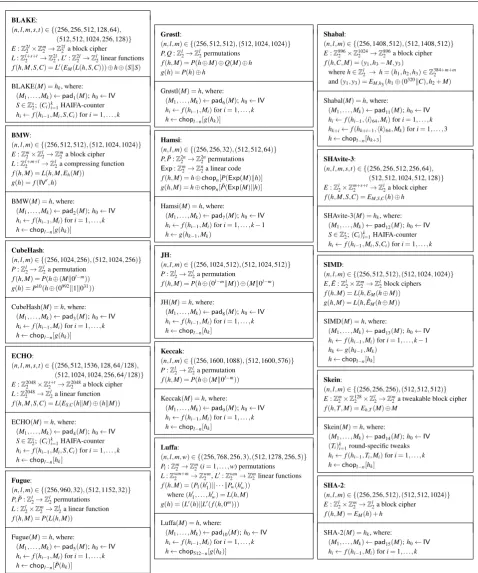
In this section, we analyze the security of the 14 remaining SHA-3 candidates in more detail, from a provable security perspective as well as with respect to the security against classes of differential attacks. Each paragraph contains an informal discussion for each candidate, its reductionist se-curity results, and its sese-curity against differential attacks. The mathematical descriptions of the (abstracted) designs are given in Fig. 1, and the candidates’ padding functions are summarized in Fig. 2.
With respect to the reductionist security, for simplicity we only consider the proposals of the SHA-3 candidates that output digests of 256 or 512 bits. Observe that in many candidate SHA-3 hash function families, the algorithms out-putting 224 or 384 bits are the same as the 256- or 512-bits algorithms, except for an additional chopping at the end. Particularly, the results of [32] and Thm. 2 carry over in most of the cases. The same remark applies to requirement(vi)
of NIST.
Requirement(i). All designers claim that their proposal can safely be used in HMAC mode [12] or for random-ized hashing [54], and we do not discuss it here; Requirements(ii)-(iv). Preimage, second preimage and
collision resistance of each hash function are discussed in this section. Additionally, we also consider the indif-ferentiability of the candidates;
Requirement(v). All hash function candidates are secure against the length extension attack, and thus we do not discuss it further.
The reductionist security results for all current candidate hash functions are summarized in Table 1.
BLAKE:
(n,l,m,s,t)∈ {(256,256,512,128,64),
(512,512,1024,256,128)}
E:Z22l×Z
m
2→Z2
l
2a block cipher L:Zl2+s+t→Z2
l
2,L
0:
Z22l→Z
l
2linear functions f(h,M,S,C) =L0(E
M(L(h,S,C)))⊕h⊕(SkS)
BLAKE(M) =hk, where: (M1, . . . ,Mk)←pad1(M);h0←IV S∈Zs2;(Ci)ki=1HAIFA-counter hi←f(hi−1,Mi,S,Ci)fori=1, . . . ,k
BMW:
(n,l,m)∈ {(256,512,512),(512,1024,1024)}
E:Zm
2×Zl2→Zm2a block cipher L:Zl2+m+l→Z
l
2a compressing function f(h,M) =L(h,M,Eh(M))
g(h) =f(IV0,h)
BMW(M) =h, where:
(M1, . . . ,Mk)←pad2(M);h0←IV hi←f(hi−1,Mi)fori=1, . . . ,k
h←chopl−n[g(hk)]
CubeHash:
(n,l,m)∈ {(256,1024,256),(512,1024,256)}
P:Zl2→Zl2a permutation f(h,M) =P(h⊕(Mk0l−m))
g(h) =P10(h⊕(0992k1k031))
CubeHash(M) =h, where: (M1, . . . ,Mk)←pad3(M);h0←IV hi←f(hi−1,Mi)fori=1, . . . ,k
h←chopl−n[g(hk)]
ECHO:
(n,l,m,s,t)∈ {(256,512,1536,128,64/128),
(512,1024,1024,256,64/128)}
E:Z20482 ×Z
s+t
2 →Z20482 a block cipher L:Z2048
2 →Zl2a linear function f(h,M,S,C) =L(ES,C(hkM)⊕(hkM))
ECHO(M) =h, where:
(M1, . . . ,Mk)←pad4(M);h0←IV S∈Zs2;(Ci)ki=1HAIFA-counter hi←f(hi−1,Mi,S,Ci)fori=1, . . . ,k
h←chopl−n[hk]
Fugue:
(n,l,m)∈ {(256,960,32),(512,1152,32)}
P,P˜:Zl2→Z
l
2permutations L:Zl2×Zm2→Zl2a linear function f(h,M) =P(L(h,M))
Fugue(M) =h, where:
(M1, . . . ,Mk)←pad5(M);h0←IV hi←f(hi−1,Mi)fori=1, . . . ,k
h←chopl−n[P˜(hk)]
Grøstl:
(n,l,m)∈ {(256,512,512),(512,1024,1024)}
P,Q:Zl2→Z
l
2permutations f(h,M) =P(h⊕M)⊕Q(M)⊕h g(h) =P(h)⊕h
Grøstl(M) =h, where:
(M1, . . . ,Mk)←pad6(M);h0←IV hi←f(hi−1,Mi)fori=1, . . . ,k
h←chopl−n[g(hk)]
Hamsi:
(n,l,m)∈ {(256,256,32),(512,512,64)}
P,P˜:Z2n
2 →Z22npermutations
Exp:Zm2→Z
n
2a linear code f(h,M) =h⊕chopn[P(Exp(M)kh)]
g(h,M) =h⊕chopn[P˜(Exp(M)kh)]
Hamsi(M) =h, where:
(M1, . . . ,Mk)←pad7(M);h0←IV hi←f(hi−1,Mi)fori=1, . . . ,k−1
h←g(hk−1,Mk)
JH:
(n,l,m)∈ {(256,1024,512),(512,1024,512)}
P:Zl
2→Zl2a permutation
f(h,M) =P(h⊕(0l−mkM))⊕(Mk0l−m)
JH(M) =h, where:
(M1, . . . ,Mk)←pad8(M);h0←IV hi←f(hi−1,Mi)fori=1, . . . ,k
h←chopl−n[hk]
Keccak:
(n,l,m)∈ {(256,1600,1088),(512,1600,576)}
P:Zl2→Z
l
2a permutation f(h,M) =P(h⊕(Mk0l−m))
Keccak(M) =h, where:
(M1, . . . ,Mk)←pad9(M);h0←IV hi←f(hi−1,Mi)fori=1, . . . ,k
h←chopl−n[hk]
Luffa:
(n,l,m,w)∈ {(256,768,256,3),(512,1278,256,5)}
Pi:Zm2→Zm2(i=1, . . . ,w) permutations L:Zwm2 +m→Z
wm
2 ,L
0:
Zwm2 →Z
m
2linear functions f(h,M) = (P1(h01)k · · · kPw(h0w))
where(h0
1, . . . ,h0w) =L(h,M)
g(h) = (L0(h)kL0(f(h,0m)))
Luffa(M) =h, where:
(M1, . . . ,Mk)←pad10(M);h0←IV hi←f(hi−1,Mi)fori=1, . . . ,k
h←chop512−n[g(hk)]
Shabal:
(n,l,m)∈ {(256,1408,512),(512,1408,512)}
E:Z896
2 ×Z10242 →Z8962 a block cipher f(h,C,M) = (y1,h3−M,y3)
whereh∈Zl2→h= (h1,h2,h3)∈Z384+
m+m
2
and(y1,y3) =EM,h3(h1⊕(0320kC),h2+M)
Shabal(M) =h, where:
(M1, . . . ,Mk)←pad11(M);h0←IV hi←f(hi−1,hii64,Mi)fori=1, . . . ,k
hk+i←f(hk+i−1,hki64,Mk)fori=1, . . . ,3
h←chopl−n[hk+3]
SHAvite-3:
(n,l,m,s,t)∈ {(256,256,512,256,64),
(512,512,1024,512,128)}
E:Zl
2×Zm2+s+t→Zl2a block cipher f(h,M,S,C) =EM,S,C(h)⊕h
SHAvite-3(M) =hk, where: (M1, . . . ,Mk)←pad12(M);h0←IV S∈Zs2;(Ci)ki=1HAIFA-counter hi←f(hi−1,Mi,S,Ci)fori=1, . . . ,k
SIMD:
(n,l,m)∈ {(256,512,512),(512,1024,1024)}
E,E˜:Zl2×Z
m
2→Z
l
2block ciphers f(h,M) =L(h,EM(h⊕M))
g(h,M) =L(h,E˜M(h⊕M))
SIMD(M) =h, where:
(M1, . . . ,Mk)←pad13(M);h0←IV hi←f(hi−1,Mi)fori=1, . . . ,k−1
hk←g(hk−1,Mk)
h←chopl−n[hk]
Skein:
(n,l,m)∈ {(256,256,256),(512,512,512)}
E:Zm2×Z1282 ×Z
l
2→Z
m
2a tweakable block cipher f(h,T,M) =Eh,T(M)⊕M
Skein(M) =h, where:
(M1, . . . ,Mk)←pad14(M);h0←IV
(Ti)ki=1round-specific tweaks hi←f(hi−1,Ti,Mi)fori=1, . . . ,k
h←chopl−n[hk]
SHA-2:
(n,l,m)∈ {(256,256,512),(512,512,1024)}
E:Zl
2×Zm2→Zl2a block cipher f(h,M) =EM(h) +h
SHA-2(M) =hk, where:
(M1, . . . ,Mk)←pad15(M);h0←IV hi←f(hi−1,Mi)fori=1, . . . ,k
Fig. 1 The padding rules employed by the functions are summarized in Fig. 2. In all algorithm descriptions,IVdenotes an initialization vector,
hdenotes state values,Mdenotes message blocks,Sdenotes a (fixed) salt,Cdenotes a counter andTdenotes a tweak. The functionsL,L0,Exp
BLAKE : pad1(M) =Mk1k0−|M|−t−2 modmk1kh|M|it,
BMW : pad2(M) =Mk1k0−|M|−65 modmkh|M|i64,
CubeHash : pad3(M) =Mk1k0−|M|−1 modm,
ECHO : pad4(M) =Mk1k0m−1−(|M|+144 modm)khni16kh|M|i128,
Fugue : pad5(M) =Mk0−|M|modmkh|M|i64,
Grøstl : pad6(M) =Mk1k0−|M|−65 modlkhd(|M|+65)/lei64,
Hamsi : pad7(M) =Mk1k0−|M|−1 modmkh|M|i64,
JH : pad8(M) =Mk1k0383+(−|M|modm)kh|M|i128,
Keccak : pad9(M) =Mk1k0−|M|−2 modm1,
Luffa : pad10(M) =Mk1k0(−|M|−1 modm)+256,
Shabal : pad11(M) =Mk1k0−|M|−1 modm,
SHAvite-3 :pad12(M) =Mk1k0−|M|−t−17 modmkh|M|itkhni16,
SIMD : pad13(M) =Mk0−|M|modmkh|M|im,
Skein : pad14(M) =M0k0(−|M
0|modm)+m
,whereM0=
(
Mif|M| ≡0 mod 8,
Mk1k0−|M|−1 mod 8otherwise.
SHA-2 : pad15(M) =
(
Mk1k0−|M|−65 modmkh|M|i64,forn=224,256,
Mk1k0−|M|−129 modmkh|M|i128,forn=384,512.
Fig. 2 The padding rules of all SHA-3 hash function candidates and SHA-2 are summarized. All padding functions output bit strings parsed as
sequences ofm-bit blocks, wheremis the message block length of the corresponding function. For the hash functions BLAKE, ECHO, Shabal,
SHAvite-3 and Skein, the complete padding rule of the corresponding hash function is additionally defined by a counter or tweak (as explained in Sect. 3). Particularly, all hash functions employ an injective padding rule.
3.1. TheBLAKE hash function [8] is a HAIFA construc-tion. The message blocks are accompanied with a HAIFA-counter, and more generally, the function employs a suffix-and prefix-free padding rule. The compression function f is block cipher based3. It moreover employs an injective linear functionL, and a linear functionL0that XORs the first and second halves of the input.
Reductionist security of BLAKE.The compression func-tion of BLAKE is proven optimally collision, second preim-age and preimpreim-age resistant [5]. As the mode of operation of BLAKE is based on the HAIFA structure, all security prop-erties regarding this type (cf. Sect. 2.3) hold [21], provided the compression function is assumed to be ideal. However, as independently shown by Andreeva et al. [5] and Chang et al. [31], the BLAKE compression function shows non-random behavior: it is differentiable from a non-random com-pression function in about 2n/4queries, making the above-mentioned security properties invalid. Still, Thm. 2 applies to BLAKE, and as a consequence we obtain AdvcolH =Θ(q2/2n). Additionally, a preimage for BLAKE implies a preimage for its final transformation, and we ob-tain AdvpreH =Θ(q/2n). The hash function is moreover proven optimally second preimage resistant in the ideal ci-pher model by Andreeva et al. [5], which gives AdvsecH = Θ(q/2n). Furthermore, the BLAKE hash function is proven indifferentiable from a random oracle if the underlying block cipher is ideal [5, 31].
3 As observed in [8, Sect. 5], the core part of the compression
func-tion can be seen as a permutafunc-tion keyed by the message, which we view here as a block cipher.
Bounds on DTP for BLAKE.No informative bounds on DTP are known for BLAKE.
3.2.TheBlue Midnight Wish(BMW) hash function [51] is a chop-MD construction, with a final transformation before chopping. The hash function employs a suffix-free padding rule. The compression functionfis block cipher based4, and the final transformationgconsists of the same compression function with the chaining value processed as a message, and with an initial value as chaining input. The compres-sion function employs a functionL which consists of two compression functions with specific properties as specified in [51].
Reductionist security of BMW.The compression function of BMW shows similarities with the PGV3 compression function [25], but no security results are known for this vari-ant. Theorem 2 applies to BMW, where the final transfor-mation has no message block as input, and as a consequence we obtainAdvcolH =Θ(q2/2n)(if f is assumed ideal).
Ad-ditionally, a preimage for BMW implies a preimage for its final transformation, and we obtainAdvpreH =Θ(q/2n). Fur-thermore, albeit no indifferentiability proof for the BMW hash function is known, we note that BMW can be seen as a combination of the HMAC- and the chop-construction, both proven indifferentiable from a random oracle [32]. We re-mark that a distinguisher for the compression function of BMW is derived in [7].
4 As observed in [51], the compression function can be seen as a
generalized PGV3 construction, where the functionf0of [51] defines
Bounds on DTP for BMW.No informative bounds on DTP are known for BMW.
3.3.TheCubeHashhash function [15] is a chop-MD con-struction, with a final transformation before chopping. The compression function f is permutation based, and the final transformationgconsists of flipping a certain bit in the state and applying 10 more compression function rounds on zero-messages.
Reductionist security of CubeHash. The compression function of CubeHash is based on one permutation5, and collisions and preimages for the compression function can be found in one query to the permutation [24]. The Cube-Hash hash function is as parazoa design proven indifferen-tiable from a random oracle if the underlying permutation is assumed to be ideal [3]. Using Thm. 1, this indifferen-tiability bound additionally renders an optimal collision re-sistance bound for CubeHash,AdvcolH =Θ(q2/2n), as well
as an improved upper boundO2qn+
q2
2l−n
on the preimage and second preimage resistance. Note that these bounds are optimal for then=256 variant.
Bounds on DTP for CubeHash.No informative bounds on DTP are known for CubeHash.
3.4.The ECHOhash function [14] is a chop-HAIFA con-struction. The message blocks are accompanied with a HAIFA-counter, and more generally, the function employs a suffix- and prefix-free padding rule. The compression func-tion f is block cipher based6. It moreover employs a linear functionLthat chops the state in blocks of lengthlbits, and XORs these.
Reductionist security of ECHO. The compression func-tion of ECHO is a ‘chopped single call Type-I’ compres-sion function in the categorization of [77]. Therefore, the results of [77, Thm. 15] carry over, yielding optimal security bounds for the compression function. Observe that these re-sults can easily be adjusted to obtain boundAdvcolchop◦f = Θ(q2/2n). ECHO is a combination of HAIFA and chop-MD, but it is unclear whether all HAIFA security properties hold after chopping. Still, Thm. 2 applies to ECHO, and as a consequence we obtainAdvcolH =Θ(q2/2n). Additionally, a preimage for ECHO implies a preimage for its last com-pression function, and we obtain AdvpreH =Θ(q/2n). Fur-thermore, the ECHO hash function would be indifferentiable from a random oracle if the underlying compression func-tion is assumed to be ideal, due to the chopping funcfunc-tion at the end [32]. However, the compression function of ECHO
5 Effectively, this permutation consists of one simpler permutation
executed 16 times iteratively.
6 As observed in [14], the core part of the compression function can
be seen as a permutation keyed by the salt and counter, which we view here as a block cipher. This cipher is AES-based.
is easily differentiable from a random oracle [48], and we cannot directly apply the results of [32].
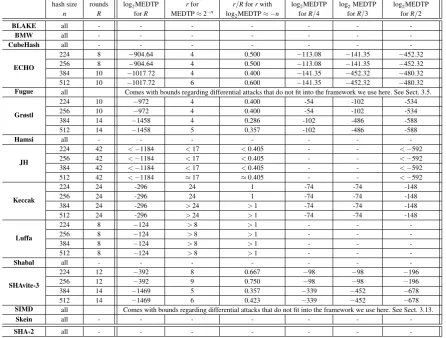
Bounds on DTP for ECHO.The primitive for all versions of ECHO is ECHO.AES with a 2048-bit block size, having 8 and 10 rounds for hash sizes up to 256 and 512 bit, respec-tively. One underlying function of ECHO.AES is given by the application of two AES rounds. The exact value of the MEDP for two rounds of AES is about 2−28.27. One round of ECHO.AES provides one active function. Two rounds pro-vide an upper bound on MEDP of about 2−4·28.27, an
equiv-alent of four active functions. Similarly, the bound on the MEDP over 4 rounds yields an equivalent of 16 active func-tions. MEDP for ECHO is considered averaged over salt and counter. Combining the above results, one obtains up-per bounds on the differential trail probability over up to 10 rounds, outlined in Table 2. Note that a differential trail in this case is defined as a concatenation of either 1, 2 or 4 rounds of ECHO.AES. Correspondingly, the MEDTP is computed under the consideration of the above MEDP val-ues for 1, 2 or 4 rounds of ECHO.AES.
3.5.TheFuguehash function [53] is a chop-MD construc-tion, with a final transformation before chopping. The hash function employs a suffix-free padding rule. The compres-sion function f is permutation based, and the final transfor-mation consists of a permutation ˜Pwhich differs fromPin the parametrization. The compression function employs a linear functionLfor message injection (TIX of [53]). Reductionist security of Fugue.The compression function of Fugue is based on one permutation, and collisions and preimages for the compression function can be found in one query to the permutation [24]. As a consequence, the re-sult of Thm. 2 is irrelevant, even though the padding rule of Fugue is suffix-free. The Fugue hash function is as parazoa design proven indifferentiable from a random oracle if the underlying permutations Pand ˜P are assumed to be ideal [3]. Using Thm. 1, this indifferentiability bound addition-ally renders an optimal collision resistance bound for Fugue, AdvcolH =Θ(q2/2n), as well as an improved upper bound
O2qn + q 2
2l−m−n
on the preimage and second preimage re-sistance. Note that these bounds are optimal for then=256 variant. We remark that a distinguisher for the final round of Fugue is derived in [9, 49].
the probability that such message inputs exist is bounded by 2−168. For a lower number of rounds, the probability will be higher though, while it is not clear how the probability of a higher number of rounds will be.
3.6.TheGrøstlhash function [50] is a chop-MD construc-tion, with a final transformation before chopping. The hash function employs a suffix-free padding rule. The compres-sion function f is permutation based, and the final transfor-mationgis defined asg(h) =P(h)⊕h.
Reductionist security of Grøstl. The compression func-tion of Grøstl is permutafunc-tion based, and the results of [75, 76] apply. Furthermore, the preimage resistance of the com-pression function is analyzed in [47], and an upper bound for collision resistance can be obtained easily. As a conse-quence, we obtain tight security bounds on the compression function,Advpref =Θ(q2/2l)andAdvcolf =Θ(q4/2l). In the ideal model, everywhere second preimage resistance of the compression function can be proven similar as the preim-age resistance, up to a constant (the security analysis dif-fers only in that we give the adversary one query for free). Theorem 2 applies to Grøstl, where the final transforma-tion has no message block as input. Observe that we also haveAdvcolchop◦g=Θ(q2/2n), and as a consequence we
ob-tainAdvcolH =Θ(q2/2n). Additionally, a preimage for Grøstl
implies a preimage for its final transformation, and we ob-tain AdvpreH =Θ(q/2n). The hash function is moreover proven optimally second preimage resistant in the ideal per-mutations model [6], which gives AdvsecH =Θ(q/2n−L), where the first preimage is of length at most 2Lblocks. Fur-thermore, the Grøstl hash function is proven indifferentiable from a random oracle if the underlying permutations are ideal [1].
Bounds on DTP for Grøstl.The compression function of Grøstl is based on two permutations of size 512 for Grøstl-224 and Grøstl-256, and is based on two permutations of size 1024 for Grøstl-384 and Grøstl-512. Those permuta-tions are designed according to the wide trail design strategy [37], hence known bounds on the MEDTP carry over as fol-lows. For 2 rounds, at least 9 S-boxes, for 4 rounds, at least 81 S-boxes are active. A lower bound on the DP of the em-ployed AES S-box is 2−6. From this, the 4-round MEDTP is 2−486. For the 10-round 512-bit permutation the MEDTP is hence 2−1026, and for the 14-round 1024-bit permutation
the MEDTP is hence 2−1512.
3.7. The Hamsihash function [60] is a MD construction, with a final transformation before chopping. The hash func-tion employs a suffix-free padding rule. The compression function f is permutation based, but the last round is exe-cuted with a compression functiongbased on a permutation
˜
P which differs from P in the parametrization. The com-pression functions employ a linear code Expfor message injection [60].
Reductionist security of Hamsi. The compression func-tion of Hamsi is a ‘chopped single call Type-I’ compression function in the categorization of [77]. Therefore, the results of [77, Thm. 15] carry over, yielding optimal security bounds for the compression function. Observe that these bounds also apply to the functiong. Theorem 2 applies to Hamsi, and as a consequence we obtainAdvcolH =Θ(q2/2n). Additionally, a preimage for Hamsi implies a preimage for its last compression function, and we obtain AdvpreH =Θ(q/2n). Furthermore, the Hamsi hash function is proven indifferentiable from a random oracle if the under-lying permutations are ideal [61].
Bounds on DTP for Hamsi.No informative bounds on DTP are known for Hamsi.
3.8.TheJHhash function [83] is a chop-MD construction. The hash function employs a suffix-free padding rule. The compression function f is permutation based.
Reductionist security of JH.The compression function of JH is based on one permutation, and collisions and preim-ages for the compression function can be found in one query to the permutation [24]. As a consequence, the result of Thm. 2 is irrelevant, even though the padding rule of JH is suffix-free. The JH hash function is proven optimally colli-sion resistant [63], and proven preimage and second
preim-age resistant up to boundO2qn+
q2
2l−m
[6]. Furthermore, the JH hash function is proven indifferentiable from a ran-dom oracle if the underlying permutation is ideal [20]. Bounds on DTP for JH.The JH permutation consists of 42 rounds of a generalized AES-like structure. Note the number of rounds has been increased in the 3rd round submission documents for JH. The maximum DP of the 4-bit S-box used is 2−2. The specification document suggests that 17 rounds
of the underlying permutation yield at least 296 active S-boxes. Since no formal treatment of the differential effect has been conducted, we consider the differential trails on the S-box level in this work. So the MEDTP for the 2·17=34 rounds is at most 2−1184, which is also the MEDTP value we take for all 42 rounds, as no lower bounds are provided on the number of active S-boxes for less than 17 rounds.
3.9.TheKeccakhash function [18] is a chop-MD construc-tion. The compression functionf is permutation based. The hash function output is obtained by chopping offl−nbits of the state. Notice that the parameters of Keccak satisfy
l=2n+m.
collision resistance bound for Keccak,AdvcolH =Θ(q2/2n), as well as an optimal preimage second preimage resistance boundΘ(q/2n).
Bounds on DTP for Keccak.The Keccak permutation con-sists of 24 rounds. In [36] for the MEDTP a value of 2−32
is proven for 3 rounds, 2−74for 6 rounds, and 2−296for the full 24 rounds.
3.10.TheLuffahash function [39] is a chop-MD construc-tion, with a final transformation before chopping. The com-pression functionf is permutation based, and the final trans-formationgis built on this compression function and a lin-ear functionL0that chops the state in blocks of lengthmbits, and XORs these. The compression function employs a lin-ear functionL for message injection (MI of [39])7. Notice that the state size of Luffa satisfiesl=w·m.
Reductionist security of Luffa.The compression function of Luffa is based onwpermutations executed independently. As a consequence, collisions and preimages for the com-pression function can be found in at most 5 queries to the permutations [24]. The Luffa hash function borrows charac-teristics from the sponge design and is similar to the parazoa design, if the permutationPconsisting of thewpermutations
Piis considered ideal, and ideas from the indifferentiability
proofs of [3, 17] may carry over. However, for the case ofw
different permutationsPithis is not immediately clear. We
remark that a distinguisher for the permutation of Luffa is derived in [57].
Bounds on DTP for Luffa.The Luffa permutations consist of 8 rounds. Using an exhaustive search, designers report a minimal number of active S-boxes for 4 rounds of 31. A lower bound on the DP of the employed AES S-box is 2−2,
hence the MEDTP for the full 8-round permutation is 2−124.
3.11.TheShabalhash function [28] is a chop-MD construc-tion. The message blocks are accompanied with a counter, and the last block is iterated three times. In particular, the function employs a suffix- and prefix-free padding rule. The compression function f is block cipher based. Notice that the parameters of Shabal satisfyl=384+2m.
Reductionist security of Shabal.A bound on the collision resistance of the compression function of Shabal is derived in [28]. Concretely, it is proven that the Shabal compres-sion function is collicompres-sion resistant up toq=2(l−m)/2queries. Theorem 2 applies to Shabal. Collision and preimage resis-tance of Shabal are studied in [28], yielding optimal bounds AdvpreH =Θ(q/2n) and AdvcolH =Θ(q2/2n). Furthermore, the same authors prove the Shabal hash function to be in-differentiable from a random oracle if the underlying block
7 We defined the output transformation in a slightly more
compli-cated but unified way. Essentially, Luffa256simply outputsL0(h).
Ob-serve that we implicitly captured the extra compression function call in the adjusted padding.
cipher is assumed to be ideal [28]. Using Thm. 1, this in-differentiability bound additionally renders an improved
up-per boundO2qn+
q2
2l−m
on the second preimage resistance. Note that this bound is optimal for then=256 variant. We remark that a distinguisher for the block cipher of Shabal is derived in [10, 11, 58, 71, 80].
Bounds on DTP for Shabal. No informative bounds on DTP are known for Shabal.
3.12.The SHAvite-3hash function [22] is a HAIFA con-struction. The message blocks are accompanied with a HAIFA-counter, and more generally, the function employs a suffix- and prefix-free padding rule. The compression func-tion f is block cipher based.
Reductionist security of SHAvite-3. The compression function of SHAvite-3 is the PGV5 compression function, and the security results of [25] carry over. As a consequence, we obtain optimal security bounds on the compression func-tion. The mode of operation of SHAvite-3 is based on the HAIFA structure, and as a consequence all security prop-erties regarding this type hold [21]. In particular, the de-sign preserves collision resistance, and as a consequence we obtainAdvcolH =Θ(q2/2n). Also, the design is secure against second preimage attacks. Additionally, a preimage for SHAvite-3 implies a preimage for its last compression function, and we obtain AdvpreH =Θ(q/2n). Finally, the SHAvite-3 hash function is indifferentiable from a random oracle if the underlying block cipher is assumed to be ideal, due to the prefix-free padding [32]. This result has been im-proved under the assumption that the underlying compres-sion function is ideal [19]. However, the comprescompres-sion func-tion of SHAvite-3 is easily differentiable from a random or-acle due to the presence of fixed-points.
Bounds on DTP for SHAvite-3.The underlying cipher for SHAvite-3224 and SHAvite-3256isE256 which operates on
two block halves of 128 bit each using the balanced Feistel construction. Every two or three rounds of balanced Feistel add at least one or two active functions, respectively. The differential probability of one function (3 AES rounds) in
E256is shown to be upper bounded by 2−49[22]. This leads to at least 8 functions active within 12 rounds and a differen-tial trail probability of at most 2−392after 12 rounds ofE256. While the lower bounds of [22] on the number of differen-tially active functions appear to be tight forE256, this is not the case forE512, the block cipher underlying SHAvite-3384
and SHAvite-3512which is based on a 4-line type-II
over 14 rounds ofE512. Note that we consider differential trails on the round level of SHAvite-3 here.
3.13.TheSIMDhash function [64] is a chop-MD construc-tion, with a final transformation before chopping. The hash function employs a suffix-free padding rule. The compres-sion function f is block cipher based, but the last round is executed with a compression functiongbased on a block ci-pher ˜E which differs fromE in the parametrization. These function employ a quasi-group operation8L[64].
Reductionist security of SIMD.The compression function of SIMD is a ‘rate-1 Type-I’ compression function in the categorization of [77]. Therefore, the results of [77, Thm. 6] carry over, yielding optimal security bounds for the com-pression function. Observe that these bounds also apply to the functiong. Observe moreover that these results can eas-ily be adjusted to obtain boundAdvcolchop◦g=Θ(q2/2n).
The-orem 2 applies to SIMD, and as a consequence we obtain AdvcolH =Θ(q2/2n). Additionally, a preimage for SIMD im-plies a preimage for its last compression function, and we obtain AdvpreH =Θ(q/2n). Furthermore, the SIMD hash function would be indifferentiable from a random oracle if the underlying compression functions are assumed to be ideal, due to the chopping function at the end [32]. However, the compression functions of SIMD are easily differentiable from a random oracle [26], and we cannot directly apply the results of [32].
Bounds on DTP for SIMD.A number of arguments against differential attacks are made [26] that do not directly fit into the framework considered in this paper as they are based on some (mild) conditions rather than applying uncondi-tionally. One assumption is that the attacker has to use dif-ferences on the message input, which rules out certain at-tacks on building blocks like the block cipher or compres-sion function. Using a minimum distance of 520 for SIMD-256 and 1032 for SIMD-512, and a number of assumptions some of which are in favor of an attacker and some of the de-sign, authors give a lower bound of at least 132 conditions for any differential trail in SIMD-256, and a lower bound of at least 253 conditions for any differential trail in SIMD-512.
3.14.TheSkeinhash function [42] is a chop-MD construc-tion. The message blocks are accompanied with a round-specific tweak9, and more generally, the function employs a
8 For any of the variables fixed, the functionLis a permutation.
9 More formally, the design is based on the UBI (unique block
iden-tifier) chaining mode which queries its underlying tweakable block ci-pher on additional tweaks, that differ in each iteration. The general description of Skein involves a specific final transformation. In the primary proposal of the hash function, however, this final transforma-tion consists of another executransforma-tion of the compression functransforma-tion, with an
output-specific tweak and with message 0m. As we included this final
message block in the padding, the given description of Skein suffices.
suffix- and prefix-free padding rule. The compression func-tion f is based on a tweakable block cipher.
Reductionist security of Skein.The compression function of Skein is the PGV1 compression function, with a differ-ence that a tweak is involved. As claimed in [13], the results of [25] carry over, which in turn results in optimal security bounds on the compression function. Theorem 2 applies to Skein, and as a consequence we obtainAdvcolH =Θ(q2/2n). Additionally, a preimage for Skein implies a preimage for its last compression function, and we obtainAdvpreH =Θ(q/2n).
The hash function is moreover proven optimally second preimage resistant in the ideal cipher model [6], which gives AdvsecH =Θ(q/2n). Furthermore, the Skein hash function is proven indifferentiable from a random oracle if the underly-ing tweakable block cipher is assumed to be ideal [13]. This proof is based on the preimage-awareness approach [41]. Bounds on DTP for Skein.No informative bounds on DTP are known for Skein.
3.15.TheSHA-2hash function [45] is an MD construction. The hash function employs a suffix-free padding. The com-pression function f is block cipher based.
Reductionist security of SHA-2.The compression function of SHA-2 is the PGV5 compression function (with minor modification), and the security results of [25] carry over. As a consequence, we obtain optimal security bounds on the compression function. Theorem 2 applies to SHA-2, and as a consequence we obtainAdvcolH =Θ(q2/2n). Additionally, a preimage for SHA-2 implies a preimage for its last com-pression function, and we obtainAdvpreH =Θ(q/2n). The hash function is moreover proven optimally second preim-age resistant in the ideal function model [27], which gives AdvsecH =Θ(q/2n−L), where the first preimage is of length at most 2L blocks. Furthermore, the SHA-2 hash function is differentiable from a random oracle due to an attack de-scribed in [32].
Bounds on DTP for SHA-2. No informative bounds on DTP are known for SHA-2.
4 Summary and Conclusions
In this survey, we compared the security achieved by the round 2 SHA-3 hash function candidates. The main con-tribution of this paper are the summary of the security re-ductions for the hash function candidates in Table 1, and a comparison of the resistance of the designs against classes of differential attacks in Table 2. Before giving an interpre-tation of these results, we first make some remarks on the provided classification.
T able 1 A schematic summary of reductionist results on second round SHA-3 candidates and SHA-2. The fir st column describes the hash function construction, and the second and thir d column sho w which hash functions ha v e a suf fix-free (sf) or prefix-free (pf) padding. The fourth column summarizes the main parameters n , l , m , which denote the hash function output size, the chaining v alue size and the message input size, respecti v ely . In the remaining columns, the security bounds are summarized together with the underlying assumptions. All other notions and notations and further explained in Sect. 2. type sf pf ( n , l , m ) Adv pre f Adv sec f Adv col f Adv pre H Adv sec H Adv gcol H Adv col H Adv pro H BLAKE HAIF A ! ! ( 256 , 256 , 512 ) or ( 512 , 512 , 1024 ) Θ ( q / 2n ) E ideal Θ ( q / 2n ) E ideal Θ ( q 2 / 2n ) E ideal Θ ( q / 2n ) E ideal Θ ( q / 2n ) E ideal ≤ Adv gcol f Θ ( q 2 / 2n ) E ideal (proof by preserv ation) Θ (( K q )2 / 2n ) E ideal BMW chop-(MD+FT) ! % ( 256 , 512 , 512 ) or ( 512 , 1024 , 1024 ) PGV3-lik e E ideal PGV3-lik e E ideal PGV3-lik e E ideal Θ ( q / 2n ) f ideal ≤ Adv gcol f + Adv gcol chop ◦ g Θ ( q 2 / 2n ) f ideal (proof by preserv ation) chopHMA C-lik e f ideal CubeHash chop-(MD+FT) % % ( 256 , 1024 , 256 ) or ( 512 , 1024 , 256 ) Θ ( 1 ) P ideal Θ ( 1 ) P ideal Θ ( 1 ) P ideal O q 2n + q 2 2l − n P ideal O q 2n + q 2 2l − n P ideal (no preserv ation) Θ ( q 2 / 2n ) P ideal O (( K q )2 / 2l − n ) P ideal ECHO chop-HAIF A ! ! ( 256 , 512 , 1536 ) or ( 512 , 1024 , 1024 ) Θ ( q / 2l ) E ideal Θ ( q / 2l ) E ideal Θ ( q2 / 2l ) E ideal Θ ( q / 2n ) E ideal chop-HAIF A f ideal ≤ Adv gcol chop ◦ f Θ ( q 2 / 2n ) E ideal (proof by preserv ation) chopMD construction Fugue chop-(MD+FT) ! % ( 256 , 960 , 32 ) or ( 512 , 1152 , 32 ) Θ ( 1 ) P ideal Θ ( 1 ) P ideal Θ ( 1 ) P ideal O q 2n + q 2
2l−
m − n P , ˜ P ideal O q 2n + q 2 2l − m − n P , ˜ P ideal (no preserv ation) Θ ( q 2 / 2n ) P , ˜ P ideal O (( K q )2 / 2l − m − n ) P , ˜ P ideal Grøstl chop-(MD+FT) ! % ( 256 , 512 , 512 ) or ( 512 , 1024 , 1024 ) Θ ( q2 / 2l ) P , Q ideal Θ ( q 2 / 2l ) P , Q ideal Θ ( q4 / 2l ) P , Q ideal Θ ( q / 2n ) P ideal Θ ( q / 2n − L ) P , Q ideal ≤ Adv gcol f + Adv gcol chop ◦ g Θ ( q 2 / 2n ) P , Q ideal (proof by preserv ation) O (( K q )4 / 2l ) P , Q ideal Hamsi MD+FT ! % ( 256 , 256 , 32 ) or ( 512 , 512 , 64 ) Θ ( q / 2n ) P ideal Θ ( q / 2n ) P ideal Θ ( q 2 / 2n ) P ideal Θ ( q / 2n ) ˜ P ideal ≤ Adv gcol f + Adv gcol g Θ ( q 2 / 2n ) P , ˜ P ideal (proof by preserv ation) Θ (( K q )2 / 2n ) P , ˜ P ideal JH chop-MD ! % ( 256 , 1024 , 512 ) or ( 512 , 1024 , 512 ) Θ ( 1 ) P ideal Θ ( 1 ) P ideal Θ ( 1 ) P ideal O q 2n + q 2 2l − m P ideal O q 2n + q 2 2l − m P ideal (no preserv ation) Θ ( q 2 / 2n ) P ideal O q 3 2l − m + K q 3 2l − n ! P ideal K eccak chop-MD % % ( 256 , 1600 , 1088 ) or ( 512 , 1600 , 576 ) Θ ( 1 ) P ideal Θ ( 1 ) P ideal Θ ( 1 ) P ideal Θ ( q / 2n ) P ideal Θ ( q / 2n ) P ideal (no preserv ation) Θ ( q 2 / 2n ) P ideal Θ (( K q )2 / 2l − m ) P ideal Luffa chop-(MD+FT) % % ( 256 , 768 , 256 ) or ( 512 , 1278 , 256 ) Θ ( 1 ) P i ideal Θ ( 1 ) P i ideal Θ ( 1 ) P i ideal (no preserv ation) sponge-lik e P i ideal Shabal chop-MD ! ! ( 256 , 1408 , 512 ) or ( 512 , 1408 , 512 ) O ( q2 /
2l−
m ) E ideal Θ ( q / 2n ) E ideal O q 2n + q 2 2l − m E ideal ≤ Adv gcol chop ◦ f Θ ( q 2 / 2n ) E ideal O (( K q )2 /
2l−
Table 2 Maximum EDTP (MEDTP) for the 14 second round SHA-3 candidates. Note that the presented bounds do not allow for direct comparisons, as proofs of bounds on EDTP for different hash functions work with distinct definitions of a differential trail. See the respective subsections of Sect. 3 for the differential trail definitions for each specific hash function under consideration. Note that the absence of MEDTP-related information (marked with -) does not mean that the respective design is insecure against differential cryptanalysis. Neither does it mean that there are no other attacks on the design.
hash size rounds log2MEDTP rfor r/Rforrwith log2MEDTP log2MEDTP log2MEDTP
n R forR MEDTP≈2−n log
2MEDTP≈ −n forR/4 forR/3 forR/2
BLAKE all - - -
-BMW all - - -
-CubeHash all - - -
-ECHO
224 8 −904.64 4 0.500 −113.08 −141.35 −452.32
256 8 −904.64 4 0.500 −113.08 −141.35 −452.32
384 10 −1017.72 4 0.400 −141.35 −452.32 −480.32 512 10 −1017.72 6 0.600 −141.35 −452.32 −480.32
Fugue all Comes with bounds regarding differential attacks that do not fit into the framework we use here. See Sect. 3.5.
Grøstl
224 10 −972 4 0.400 -54 -102 -534
256 10 −972 4 0.400 -54 -102 -534
384 14 −1458 4 0.286 -102 -486 -588
512 14 −1458 5 0.357 -102 -486 -588
Hamsi all - - -
-JH
224 42 <−1184 <17 <0.405 - - <−592
256 42 <−1184 <17 <0.405 - - <−592
384 42 <−1184 <17 <0.405 - - <−592
512 42 <−1184 ≈17 ≈0.405 - - <−592
Keccak
224 24 -296 24 1 -74 -74 -148
256 24 -296 24 1 -74 -74 -148
384 24 -296 >24 >1 -74 -74 -148
512 24 -296 >24 >1 -74 -74 -148
Luffa
224 8 −124 >8 >1 - -
-256 8 −124 >8 >1 - -
-384 8 −124 >8 >1 - -
-512 8 −124 >8 >1 - -
-Shabal all - - -
-SHAvite-3
224 12 −392 8 0.667 −98 −98 −196
256 12 −392 9 0.750 −98 −98 −196
384 14 −1469 5 0.357 −339 −452 −678
512 14 −1469 6 0.423 −339 −452 −678
SIMD all Comes with bounds regarding differential attacks that do not fit into the framework we use here. See Sect. 3.13.
Skein all - - -
-SHA-2 all - - -
-even have identified weaknesses. However, assuming ideality of these primitives gives significantly more con-fidence in the security of the higher level structure and is the only way to get useful (and comparable) security bounds on the candidate hash functions;
– The fact that different hash functions have different bounds, does not directly imply that one of the func-tions offers a higher level of security: albeit the under-lying structure of the basic primitives is abstracted away (see the previous item), still many differences among the schemes remain (chaining size, message input size, etc.). Moreover, not all bounds are tight, and different defini-tions of differential trails are employed.
In general, stronger assumptions as a rule imply stronger claims, however, results making less assumptions often offer higher correlation with the real-world security.
4.1 Reductionist Security
Indifferentiability of the hash function. Ten of the candi-dates are proven indifferentiable from a random oracle, and four of the candidates have a similar constructions to ones proven indifferentiable. We note that there ex-ist some differences among the bounds. For instance, for the hash function variant outputtingn=512 bits, the in-differentiability bounds vary betweenO(Kq3/2512)and
O((Kq)2/21024). These differences are mainly caused by the fact that the bounds are parameterized by the inter-nal chaining value sizel, rather than the output sizen
(as is the case for bounds on the collision resistance). As a consequence, a higher state size often results in a bet-ter indifferentiability bound. The indifferentiability re-sults are powerful, as they render bounds on the (second) preimage and collision resistance of the design (Thm. 1); (Second) preimage resistance of the hash function. Most of the hash functions are not provided with an optimal se-curity bound on the second preimage resistance. Main cause for this is that the MD design does not preserve second preimage resistance [4]. Additionally, the second preimage bound that can be derived via the indifferen-tiability (Thm. 1) is not always sufficiently tight. Prov-ing security against these attacks could be attempted ei-ther by making a different (possibly weaker) assumption on the compression function or by basing it directly on the ideality of the underlying block cipher or permuta-tion(s). A fruitful direction might be the graph based ap-proach followed in [5, 6, 27, 28];
Collision resistance of the hash function. Except for the sponge(-like) functions, the collision resistance preser-vation result of Thm. 2 (App. B) applies to all candi-dates. This theorem results in a bound on the generic col-lision resistance of the hash function, which, intuitively, means that ‘finding collisions for the hash function is at least as hard as finding collisions for (one of) the un-derlying function(s)’. Together with the collision resis-tance bounds on the compression functions in the ideal model, the preservation result allows for obtaining a col-lision resistance bound on the entire hash function. This leads to optimal bounds on the collision resistance for ECHO, Grøstl, Hamsi, SHAvite-3, SIMD and Skein. For BLAKE, CubeHash, Fugue, JH, Keccak and Shabal, the same optimal bound is obtained differently (e.g. based on the indifferentiability of the hash function). Again, the graph based approach may be suitable to prove col-lision resistance of the candidates for which no colcol-lision resistance bound is yet obtained.
4.2 Bounds on the Differential Properties
We presented a first approach to the problem of compar-ing the differential properties of diverse contemporary hash function designs at the example of the second round SHA-3
candidates. This research problem is not easy, nor is it close to being resolved, which is mainly for the following reasons:
– Many hash function primitives have been designed us-ing non-SPN approaches, mostly relyus-ing on ARX oper-ations, for which it does not appear trivial to compute an informative upper bound on any differential proper-ties such as differential trail probability. Therefore, for approximately half of the SHA-3 candidates we do not know where the bounds are and we have to perform our comparative analysis among the remaining designs only; – The bounds on differential properties are derived for sgle underlying primitives, while a hash function can in-voke multiple primitives in each compression step: it is one invocation for ECHO, Fugue, JH, and SHAvite-3, two invocations for Grøstl, as well as 3 to 5 invocations for Luffa. This fact has to be taken into account before drawing conclusions about the security of a hash func-tion with respect to differential attacks. Note also that different attacks can use different numbers of building blocks and relations among them;
– Strictly speaking, given a bound on the expected differ-ential trail probability it is hard to say what it exactly implies for the expected differential probability, since there might be strong differential effects. Note that such MEDTP bounds as the ones for ECHO and SHAvite-3 already take into account much of the differential effect; – An upper bound on the expected differential trail proba-bility (averaged over some parameters of the primitive) can make only a limited statement about the differential probability taken for the fixed parameters or the max-imum differential probability taken over all inputs. At the same time, it is exactly the latter properties which are related to the real-world attack complexities on hash functions.
Each of the limitations mentioned can be seen as an impor-tant research problem which can be informally summarized as deriving tighter bounds on more informative properties of larger objects. We think that having some formal arguments against at least basic types of attacks contributes to the con-fidence in the design.