Zero-Knowledge for Multivariate Polynomials
Val´erie Nachef1, Jacques Patarin2, Emmanuel Volte1
1
Department of Mathematics, University of Cergy-Pontoise, CNRS UMR 8088 2 avenue Adolphe Chauvin, 95011 Cergy-Pontoise Cedex, France
2
PRISM, University of Versailles
45 avenue des Etats-Unis, 78035 Versailles Cedex, France
[email protected], [email protected] [email protected]
Abstract. In [12] a Zero-Knowledge schemeZK(2) was designed from a solution of a set of multivariate quadratic equations over a finite field. In this paper we will give two methods to generalize this construction for polynomials of any degreed, i.e. we will design two Zero-Knowledge schemes ZK(d) and ZK˜ (d) from a set of polynomial equations of de-greed. We will show that ZK˜ (d) is optimal in term of the number of computations to be performed and that ZK(d) is optimal in term of the number of bits to be send. Moreover this property is still true for all kinds of polynomials: for example if the polynomials are sparse or dense. Finally, we will present two examples of applications: with Brent equations, or with morphisms of polynomials.
Key words: Authentication scheme, Zero-Knowledge, Multivariate polynomials.
1
Introduction
In this paper, we will generalize the construction of [12] in order to design a Zero-Knowledge authentication from a solution of any set of multivariate poly-nomials of degree d over a finite field (i.e. not only d = 2). We will describe two schemes extending the results of [12]. The Zk(d) scheme is optimal if we focus on the number of bits to be sent and theZK˜ (d) scheme is optimal if we consider the number of computations. This is true for any kind of polynomials (dense or sparse). For practical applications the cased= 3 (i.e. cubic equations) is particularly important, since from these polynomials we will be able to design Zero-Knowledge schemes based on the (NP-complete) Morphism problem (MP) or from the Brent equations related to the optimal way to solve sets of linear equations (i.e. improvements of the Gauss elimination). We will explain in this paper why these two problems are really interesting for cryptography. We can notice that MP (morphism of Polynomial) is NP hard while IP (isomorphism of Polynomials) is expected not to be NP hard (since it has an Arthur-Merlin game for yes or no answers). We will detail the cased= 3 and give only the features of the general schemesZK(d) andZK˜ (d).
2
Zero-Knowledge Protocols and Commitments
In an interactive Protocol, there are two entities: the prover and the verifier. The Prover wants to convince the verifier that she knows a secret. Both interact and at the end, the verifier accepts or refuses. In Zero-Knowledge Protocols there is a possibility of fraud. A cheater will be able to answer some of the questions (but not all of them). The protocol must be designed such that an answer to one of the question does not give any indication on the secret but if someone is able to answer all the questions then this will reveal the Prover’s secret. We will use the following definitions in order to describe the properties that we want to be satisfied by our protocols:
1. The protocol has perfect correctness is a legitimate prover is always ac-cepted.
2. The protocol is statistically zero knowledge if there exists an efficient simulating algorithmU such that for every feasible Verifier strategyV, the distributions produced by the simulator and the proof protocol are statisti-cally indistinguishable.
3. The protocol is proof of zero knowledge with error knowledge α if there is a knowledge extractorK and a polynomialQsuch that ifpdenotes the probability thatKfinds a valid witness forxusing its access to a prover
P∗ and px denotes the probability that P∗ convinces the honest verifier on
x, andpx> α, then we havep≥Q(px−α).
In our protocols, we will need string commitment schemes. A string commit-ment function is denoted byCom. The commitment scheme runs in two phases. In the first phase, the sender computes a commitment valuec=Com(s;ρ) and sends c to the receiver, where s is the committed string and ρ is a random string. In the second phase, the sender gives (s, ρ) and the receiver verifies if
1. The commitment scheme is statistically hiding if for uniform (x, ρ) and (x0, ρ0) the distributions Com(s, ρ) and Com(x0, ρ0) are statistically indis-tinguishable. This means that the commitment to x reveals (almost) no information onxeven to an infinitely powerful Verifier.
2. The commitment scheme iscomputationally bindingif the probability to that two different values (x, ρ) and (x0, ρ0) produce the samec=Com(x, ρ) =
Com(x0, ρ0) is negligible in polynomial time, i.e. the chances to change the committed value after the first phase are very small.
A practical construction of such a commitment is given in [5].
3
Systems of Multivariate equations of degree
d
We consider the following function of degreedfromFnq to Fmq :
F(x) = (f1(x), f2(x), . . . , fm(x)) where∀`, 1≤`≤m,and x= (x1, . . . , xn):
f`(x) = X 1≤i1≤...≤id≤n
γi`1...i
dxi1xi2. . . xid+
X
1≤i1≤...≤id−1≤n
γ`i1...i
d−1xi1xi2. . . xid−1
+. . .+ X 1≤i1≤i2≤n
γi`1i2xi1xi2+
X
1≤i1≤n
γi`1xi1
We omit the constant term. Let
G(r0, r1, . . . , rd−1) = d X
i=1
(−1)d−i X
S⊂{0,...,d−1} |S|=i
F(X j∈S
rj)
Then G is d-linear. For F, a multivariate function of degree d, we define a binary relation RF ={(v, x)∈Fmq ×Fnq;v =F(x)}. The problem is: GivenF andv∈Fmq finds∈Fnq such thatF(s) =v, i.e.s∈RF(v).
4
ZK
(3) Schemes
We consider the following cubic functions: F(x) = (f1(x), f2(x), . . . , fm(x)) where∀`, 1≤`≤mandx= (x1, . . . , xn)
f`(x) = X 1≤i≤j≤k≤n
γijk` xixjxk+ X
1≤i≤j≤n
γij`xixj+ X
1≤i≤n
γi`xi
We omit the constant term. Let
We have: G(x, y, z) = (g1(x, y, z), g2(x, y, z), . . . , gm(x, y, z)) where∀`, 1≤`≤m, x= (x1, . . . , xn) ,y= (y1, . . . , yn) andz= (z1, . . . , zn)
g`(x, y, z) = X 1≤i≤j≤k≤n
γijk` (xiyjzk+xiykzj+xjyizk+xjykzi+xkyizj+xkyjzi)
ThenGis trilinear.
The problem is: GivenF andv∈Fmq finds∈Fnq such thatF(s) =v.
The public key is (F, v). The secret isssuch thatF(s) =v. The Prover is going to convince the Verifier of his knowledge ofs.
4.1 3-pass scheme
For simplicity, the random string inComis not written explicitly. IfX is a set,
x∈RE means thatxis randomly chosen inX with the uniform distribution. 1. The Prover picks up r0, r1, t0 ∈R Fnq and e0, f0, h0 ∈R Fmq . Then she
com-putes
r2=s−r1−r0, t1=r0−t0
e1=F(r0)−e0, f1=F(r0+r1)−f0, h1=F(r0+r2)−h0 The Prover sends to the Verifier
c0=Com(r1, r2, G(t0, r1, r2)−e0+f0+h0)
c1=Com(r1, t0, e0, f0), c2=Com(r1, t1, e1, f1)
c3=Com(r2, t0, e0, h0), c4=Com(r2, t1, e1, h1)
2. The verifier chooses a queryQ ∈R{0,1,2,3}and sends Qto the prover. 3. (a) If Q= 0 then the Prover sends (r0, r1, t1, e1, f1). The Verifier checks if
c1=Com(r1, r0−t1, F(r0)−e1, F(r0+r1)−f1),c2=Com(r1, t1, e1, f1) (b) IfQ = 1 then the Prover sends (r0, r2, t1, e1, h1). The Verifier checks if
c3=Com(r2, r0−t1, F(r0)−e1, F(r0+r2)−h1),c4=Com(r2, t1, e1, h1) (c) IfQ= 2 then the Prover sends (r1, r2, t1, e1, f1, h1). The Verifier checks if
c0=Com(r1, r2, v−G(t1, r1, r2)+e1−f1−h1−F(r1+r2)+F(r1)+F(r2)),
c2=Com(r1, t1, e1, f1),c4=Com(r2, t1, e1, h1)
(d) IfQ= 3 then the Prover sends (r1, r2, t0, e0, f0, h0). The Verifier checks ifc0=Com(r1, r2, G(t0, r1, r2)−e0+f0+h0),c1=Com(r1, t0, e0, f0),
c3=Com(r2, t0, e0, h0)
The verifier outputs 1 if the she gets the correct value in the commitments, 0 otherwise.
4.2 Properties of the 3-pass scheme
Theorem 1 The 3-pass protocol is statistically zero knowledge when the com-mitment scheme Comis statistically hiding.
Proof.We construct a black-box simulatorS which have oracle access to a cheat-ing verifierCV takesF and v, and outputs a simulated transcripts with proba-bility 3/4 as follows. The simulator randomly chooses a valueQ∗∈
R{0,1,2,3} and vectors s0, r00, r01, t00 ∈R Fnq and e00, f00, h00 ∈R Fmq , where Q∗ is a prediction what value the cheating verifierCV will not choose. Then it computes
r20 =s0−(r00 +r01), t01←r00−t00, e01←F(r00)−e00
Moreover it sets: 1. IfQ∗= 0,f0
1=v−F(s0) +F(r00 +r01)−f00, elsef10 =F(r00 +r01)−f00. 2. IfQ∗= 1,h0
1=v−F(s0) +F(r00 +r20)−f00, elseh01=F(r00+r02)−h00. 3. If Q∗ = 3, c0
0 =Com(r01, r20, v−G(t01, r10, r20)−f10 −h01+e10 −F(r01+r02) +
F(r01) +F(r02)), elsec00=Com(r10, r20, G(t00, r01, r02)−f00−h0+e00) It also computes:
c01=Com(r01, t00, e00, f00), c02=Com(r01, t01, e01, f10)
c03=Com(r02, t00, e00, h00), c04=Com(r02, t01, e01, h01) and sends (c00, c01, c20, c03, c04) to CV.
Receiving a queryQfrom CV the simulator outputs⊥ifQ=Q∗ and stops. If S does not output ⊥, it produces a transcript as follows:
– IfQ= 0, it outputs ((c0
0, c01, c02, c03, c04),0,(r00, r10, t01, e01, f10))
– IfQ= 1, it outputs ((c00, c01, c02, c03, c04),1,(r00, r20, t01, e01, h01))
– IfQ= 2, it outputs ((c00, c01, c02, c03, c04),2,(r10, r20, t10, e01, f10, h01))
– IfQ= 3, it outputs ((c00, c01, c02, c03, c04),3,(r10, r20, t00, e00, f00, h00))
We can check that ifS does not output⊥, the transcript is accepted. For exam-ple, we consider the case whereQ∗= 0 andQ= 2. The output is ((c0
0, c01, c02, c03,
c40),2,(r10, r02, t01, e10, f10, h01)). Thus, we have the right values forc02andc04. Now,c00 is computed as follows:c0
0=Com(r01, r02, v−G(t01, r10, r20) +e01−f10−h01−F(r10+
r0
2) +F(r10) +f(r20)). Here f10 = v−F(s0) +F(r00+r01)−f00. Thus we obtain
c00=Com(r01, r02, G(t00, r10, r20)−f00−h0+e00) and the transcript is accepted. The other cases are checked similarly.
We now show that the distribution of the output S is statistically close to the distribution of a real transcript since the commitment is statistically hiding. A real transcript between the the legitimate prover P and a cheating verifier CV
on (F, v, s) is denoted by hP(s),CVi(F, v). The simulator output is denoted by
hS,CVi(F, v). We analyze the output distribution. First first we consider the case whereQ= 0. Then
hP(s),CVi(F, v) = ((c0, c1, c2, c3, c4),0,(r0, r1, t1, e1, f1))
Assume that (r00, r01, t00, e00, f00) = (r0, r1, t0, e0, f0). Then we obtaint01=t1,e01=
e1,f10 =f1 andc01=c1,c02=c2 in all casesQ∗= 1,2,3. The second case is whenQ= 1. Then
hP(s),CVi(F, v) = ((c0, c1, c2, c3, c4),1,(r0, r2, t1, e1, h1))
hS,CVi(F, v) = ((c00, c01, c01, c03, c04),1,(r00, r20, t01, e01, h01))
This case is very similar to the previous one. We gett01=t1, e10 =e1, h01 =h1 andc0
3=c3, c04=c4 in all casesQ∗= 0,2,3. The third case isQ= 2. Then
hP(s),CVi(F, v) = ((c0, c1, c2, c3, c4),2,(r1, r2, t1, e1, f1, h1))
hS,CVi(F, v) = ((c00, c10, c02, c03, c04),2,(r01, r02, t10, e01, f10, h01)) WhenQ∗= 0, assume that (r0
0, r10, t00, e00, f00, h00) = (r0+s0−s, r1, t0+s0−s, e0−
F(r0) +F(r0+s0−s), f0−F(r0+r1) +v−F(s0) +F(r0+r1+s0−s), h0−F(r0+
r2) +F(r0+r2+s0−s)). When Q∗ = 1, assume that (r00, r01, t00, e00, f00, h00) = (r0+s0−s, r1, t0+s0−s, e0−F(r0) +F(r0+s0−s), f0−F(r0+r1) +F(r0+r1+
s0−s), h0−F(r0+r2) +v−F(s0) +F(r0+r2+s0−s)). WhenQ∗= 1, assume that (r0
0, r10, t00, e00, f00, h00) = (r0+s0−s, r1, t0+s0−s, e0−F(r0) +F(r0+s0−
s), f0−F(r0+r1) +F(r0+r1+s0−s), h0−F(r0+r2) +F(r0+r2+s0−s)). We can check that for all these cases we obtain:r20 =r2, t1 =t01, e01=e1, f10 =f1,
h01=h1 and thenc00=c0,c02=c2, c04=c4. The last case isQ= 2. Then
hP(s),CVi(F, v) = ((c0, c1, c2, c3, c4),3,(r1, r2, t0, e0, f0, h3))
hS,CVi(F, v) = ((c00, c10, c02, c03, c04),2,(r01, r02, t00, e00, f00, h00))
Assume that (r00, r10, t00, e00, f00, h00) = (r0s0−s, r1, t0, e0, f0, h0), then we obtain
r0
2 = r2, c00 = c0, c01 = c1 and c03 = c3. Since the commitment is statistically hiding, we get that whenS does not output⊥, the distribution of the output of
S is statistically close to the distribution of the real transcript.
Theorem 2 The 3-pass protocol is proof of zero knowledge with zero knowledge error3/4 when the commitment schemeCom is computationally binding.
Proof. Suppose that there exists a false proverC that can answer all the ques-tions. Then eitherC will compute a collision forComor will extract a solution for (F, v). Let ((c0, c1, c2, c3, c4),Q0, Rsp0), ((c0, c1, c2, c3, c4),Q1, Rsp1), ((c0, c1,
c2, c3, c4),Q2, Rsp2), ((c0, c1, c2, c3, c4),Q3, Rsp3), be four transcripts such that
Qi = i and all the responses are accepted. Consider the situation where the responses are parsed asRsp0= (r
(0) 0 , r
(0) 1 , t
(0) 1 , e
(0) 1 , f
(0)
1 ),Rsp1= (r (1) 0 , r
(1) 2 , t
(1) 1 ,
e(1)1 , h(1)1 ),Rsp2= (r (2) 1 , r
(2) 2 , t
(2) 1 , e
(2) 1 , f
(2) 1 , h
(2)
1 ),Rsp3= (r (3) 1 , r
(3)
2 , t0, e0, f0, h0). We obtain:
c0=Com(r (2) 1 , r
(2)
2 , v−G(t (2) 1 , r
(2) 1 , r
(2) 2 )−f
(2) 1 −h
(2) 1 +e
(2) 1
−F(r(2)1 +r2(0)) +F(r1(2)) +F(r(2)2 ) ) =Com(r(3)1 , r2(3), G(t0, r
(3) 1 , r
(3)
c1=Com(r (0) 1 , r
(0) 0 −t
(0) 1 , F(r
(0) 0 )−e
(0) 1 , F(r
(0) 0 +r
(0) 1 )−f
(0) 1 )
=Com(r(3)1 , t0, e0, f0 ) (2)
c2=Com(r (0) 1 , t
(0) 1 , e
(0) 1 , f
(0)
1 ) =Com(r (2) 1 , t
(2) 1 , e
(2) 1 , f
(2)
1 ) (3)
c3=Com(r (1) 2 , r
(1) 0 −t
(1) 1 , F(r
(1) 0 )−e
(1) 1 , F(r
(1) 0 +r
(1) 2 )−h
(1) 1 )
=Com(r(3)2 , t0, e0, h0 ) (4)
c4=Com(r (1) 2 , t
(1) 1 , e
(1) 1 , h
(1)
1 ) =Com(r (2) 2 , t
(2) 1 , e
(2) 1 , h
(2)
1 ) (5)
If two tuples of the arguments of Com are are distinct on either of the above equations, then we have a collision forCom. Otherwise, these equalities give:
h(1)1 (5)=h(2)1 , r1(0)(2)= r1(3)(1)=r(2)1 , t(0)1 (3)=t(1)1 (5)=t1(2), r(0)0 (3=,4)r0(1)
and r2(2)(1)=r(3)2 (4)= r(1)2 , e(2)1 (3)=e(0)1 (2=,4)e1(1), f1(0)(3)= f1(2)
So, all upper scripts are useless and from (1) we have:
v=G(t1+t0, r1, r2) +f1+h1−e1+F(r1+r2)−F(r1)−F(r2) +f0+h0−e0 Then, from (2) and (4) we haver0=t0+t1,F(r0) =e0+e1,F(r0+r1) =f0+f1 andF(r0+r2) =h0+h1, so if we replace these values in the previous equality, we obtain: v =G(r0, r1, r2) +F(r0+r1) +F(r0+r2) +F(r1+r2)−F(r0)−
F(r1)−F(r2) =F(r0+r1+r2) This means that a solutionr0+r1+r2 forv is extracted.
Let ps be the probability that P∗ convinces the honest verifier on sand pthe probability that all the 3 transcripts are accepted. Suppose that ps > 34. De-pending on the fact that the 4 transcripts are accepted or not, we get ps ≤ 1·p+34(1−p). This implies that p≥4(ps−34). Thus the proof of Theorem 2
is complete.
4.3 Computations in the 3-pass scheme
We give the maximum number of computations that have to be done either by the prover or by the receiver in the case ofF2. We must calculate the number of computations forF and forG. Moreover we see thatF is computed at most 3 times andGis computed just one time. We only count multiplications. InF2, we have:x3i =x2i =xi. We can write:
f`(x) = n X
i=1
xi
γi`+γii` +γiii` + n X
j=i+1
xj γij` +γ ` ijj+
n X
k=j+1
γijk` xk
LetM denotes the number of multiplications needed to compute F. Using the above expression forF, we obtainM 'n3
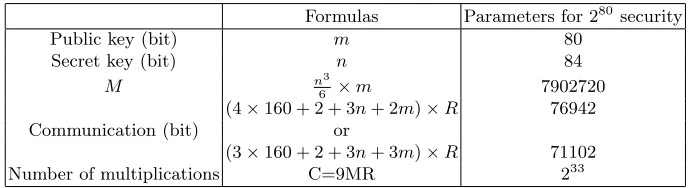
choose n= 84,m= 80, in order to have 80-bit security (cf. [2]). Moreover if we want an impersonation probability less than 2−30, we need to perform at least 73 rounds.R stands for the number of rounds andC for the maximum number of computations that have to be done either by the prover or by the receiver. The values are given in Table 1.
Remark. We may need less computations. It depends on the number of non
Table 1.ZK(3) Scheme
Formulas Parameters for 280 security
Public key (bit) m 80
Secret key (bit) n 84
M n63×m 7902720
(4×160 + 2 + 3n+ 2m)×R 76942
Communication (bit) or
(3×160 + 2 + 3n+ 3m)×R 71102
Number of multiplications C=9MR 233
zero coefficients. This is the case for Brent equations as explain in Section 8.
4.4 5-pass scheme
Here we describe briefly a 5-pass scheme. Proofs are sketched in Appendix A.
1. The Prover picks up at randomr0, r1, t0∈Fnq ande0, f0, h0∈Fmq . Then she computesr2=s−r1−r0. The Prover sends to the Verifier
c0=Com(r1, r2, G(t0, r1, r2)−e0+f0+h0)
c1=Com(r1, t0, e0, f0)
c2=Com(r1, t1, e1, f1)
c3=Com(r2, t0, e0, h0)
c4=Com(r2, t1, e1, h1)
2. The verifier picks α∈RFq and sendsαto the prover. 3. The prover computes:
(t1, e1f1, h1) = (αr0−t0, αF(r0)−e0, αF(r0+r1)−f0, αF(r0+r2)−h0) and sends (t1, e1f1, h1) to the verifier.
4. The verifier picks Q ∈R{0,1,2} and sendsQto the prover.
5. (a) If Q = 0, then the prover sends (r0, r1). The verifier checks if c0 =
Com(r0, r1, αr0−t1, αF(r0)−e1, αF(r0+r1)−f1).
(b) If Q = 1, then the prover sends (r0, r2). The verifier checks if c1 =
Com(r0, r2, αr0−t1, αF(r0)−e1, αF(r0+r2)−h1).
(c) If Q = 2, then the prover sends (r1, r2). The verifier checks if c2 =
As for the 3-pass scheme, we have perfect correctness and the following re-sults:
Theorem 3 The 5-pass protocol is statistically zero knowledge when the com-mitment scheme Comis statistically hiding.
Theorem 4 The 5-pass protocol is proof of zero knowledge with zero knowledge error2/3 + 1/3qwhen the commitment schemeComis computationally binding.
5
The
ZK
˜
(3) Scheme.
In this section, we propose another scheme inspired from [12]. The idea is to transform the cubic system into a quadratic one and the to use the scheme given in [12]. As we will see, the number of computations is smaller, but the number of communication bits is more important.
We investigate the transformation of a system with cubic equations to a sys-tem with quadratic equations. We will introduce new variables. Once we have obtained a system of equations with quadratic polynomials, we can apply the identification scheme of [12]. We will calculate the number of multiplications in this case. In our system, we have F(x) = (f1(x), f2(x), . . . , fm(x)) where
∀`, 1≤`≤m,
f`(x) = X 1≤i≤j≤k≤n
γijk` xixjxk+ X
1≤i≤j≤n
γij`xixj+ X
1≤i≤n
γi`xi
andx= (x1, . . . , xn). We introduce the new variables∀i, j, 1≤i≤j≤n, Xij=
xixj. The number of new variables is n(n2−1), if q= 2, and n(n2+1), ifq 6= 2. In our new system, we have
˜
F = ( ˜f1, . . . ,f˜m,( ˜fij)1≤i≤j≤n)
where for ˜x= (x1, . . . , xn,(Xij)1≤i≤j≤n) and 1≤`≤m,
f`(˜x) = X
1≤i≤j≤k≤n
γijk` Xijxk+ X
1≤i≤j≤n
γij`Xij+ X
1≤i≤n
γ`ixi
and for 1 ≤ i ≤ j ≤ n, fij(˜x) = Xij −xixj. Here the number of variables is ˜n ' n+ n2
2 and the number of equations is ˜m = m+ n2
2 . As before, M denotes the number of multiplications needed to compute F. ˜M denotes the number of multiplications for the computation of ˜F. We choose q = 2. Then
˜
M =M +n(n2−1). Thus ˜M 'M ' n3
6. ˜C stands for the maximum number of computations that have to be done either by the prover or by the receiver. If
˜
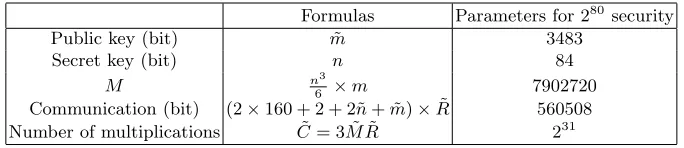
R denotes the number of rounds performed in order to have an impersonation probability less than 2−30, then ˜R= 52 (cf. [12]). The following table gives the characteristics of the ZK˜ (3) Scheme and the values we get when n = 84 and
Table 2.ZK˜ (3) Scheme
Formulas Parameters for 280security
Public key (bit) m˜ 3483
Secret key (bit) n 84
M n3
6 ×m 7902720
Communication (bit) (2×160 + 2 + 2˜n+ ˜m)×R˜ 560508
Number of multiplications C˜= 3 ˜MR˜ 231
6
ZK
(
d
) and
ZK
˜
(
d
) Schemes for any
d
6.1 The ZK(d) Scheme
We will design a 3-pass scheme
We consider the following function of degreedfromFn q to Fmq :
F(x) = (f1(x), f2(x), . . . , fm(x)) where∀`, 1≤`≤m,
f`(x) = X 1≤ii≤...≤id≤n
γi`1...idxi1xi2. . . xid+
X
1≤ii≤...≤id−1≤n
γi`
1...id−1xi1xi2. . . xid−1+. . .+
X
1≤ii≤i2≤n
γ`i
1i2xi1xi2+
X
1≤ii≤n
γi`
1xi1
andx= (x1, . . . , xn). We omit the constant term. Let
G(r0, r1, . . . , rd−1) = d X
i=1
(−1)d−i X
S⊂{0,...,d−1} |S|=i
F(X j∈S
rj)
ThenGisd-linear.
The problem is: GivenF andv∈Fm
q finds∈Fnq such thatF(s) =v The public key is (F, v). The secret is ssuch thatF(s) =v.
1. The Prover picks up at random r0, r1, . . . , rd−2, t0 ∈R Fnq, f0 ∈R Fmq , and
∀p, 1≤p≤d−2, ∀i1, . . . ip, 1≤i1< i2< . . . ip ≤d−1, f i1...ip
0 , ∈RFmq . Then she computes
rd−1=s− Pd−2
i=1 ri
t1 =r0−t0
f1 =F(r0)−f0 and
∀p, 1≤p≤d−2, ∀i1, . . . ip, 1≤i1< i2< . . . ip≤d−1
fi1...ip
1 =F(r0+ri1+. . .+rip)−f
i1...ip
Then the Prover sends to the Verifier
c0←Com
r1, . . . , rd−1, G(t0, r1, . . . , rd−1)+
d−2 X
p=1
(−1)d−pX 1≤i1<...<ip≤d−1
fi1...ip
0 + (−1) df
0
∀i, 1≤i≤d−1
c2i−1←Com
r1, . . . , ri−1, ri+1, . . . , rd−1, t0, f0,
∀p, 1≤p≤d−2, ∀i1, . . . ip, 1≤i1< i2< . . . ip≤d−1, such that∀j, ij 6=i, f
i1...ip
0
c2i←Com
r1, . . . , ri−1, ri+1, . . . , rd−1, t1, f1,
∀p, 1≤p≤d−2, ∀i1, . . . ip, 1≤i1< i2< . . . ip≤d−1, such that∀j ij6=i, f
i1...ip
1
The verifier chooses a queryQ ∈R{0,1, . . . , d}and sendsQ to the prover. 2. (a) If Q= 0, then the Prover sends (r1, r2, . . . , rd−1, t0, f0,
∀p, 1≤p≤d−2, ∀i1, . . . ip, 1≤i1< i2< . . . ip≤d−1, f i1...ip
0 ). The Verifier checks if
c0=Com
r1, . . . , rd−1, G(t0, r1, . . . , rd−1) + d−2 X
p=1
(−1)d−p
X
1≤i1<...<ip≤d−1
fi1...ip
0 + (−1) df
0
and∀i, 1≤i≤d−1,
c2i−1=Com
r1, . . . , ri−1, ri+1, . . . , rd−1, t0, f0,
∀p, 1≤p≤d−2, ∀i1, . . . ip, 1≤i1< i2< . . . ip≤d−1, such that∀j, ij 6=i, f
i1...ip
0
(b) IfQ=d,then the Prover sends (r1, r2, . . . , rd−1, t1, f1,
∀p, 1≤p≤d−2, ∀i1, . . . ip, 1≤i1< i2< . . . ip≤d−1, f i1...ip
1 ).
∀i, 1≤i≤d−1, The Verifier checks if
c0=Com
r1, . . . , rd−1, v−G(t1, r1, . . . , rd−1)− d−2 X
p=1
X
1≤i1<...<ip≤d−1
fi1...ip
1 −
(−1)df1+ d X
i=1
(−1)d−i X
S⊂{1,...,d−1} |S|=i
F(X j∈S
rj)
and∀i, 1≤i≤d−1,
c2i=Com
r1, . . . , ri−1, ri+1, . . . , rd−1, t1, f1,
∀p, 1≤p≤d−2, ∀i1, . . . ip, 1≤i1< i2< . . . ip≤d−1, such that∀j, ij6=i, f
i1...ip
1
(c) if Q=i, then the prover sends (r0, r1, . . . , ri−1, ri+1, . . . , rd−1, t1, f1,
∀p, 1≤p≤d−2, ∀i1, . . . ip, 1≤i1< i2< . . . ip≤d−1, such that∀j, ij6=i, f
i1...ip
1 )
The Verifier checks if
c2i−1=Com
r1, . . . , ri−1, ri+1, . . . , rd−1, r0−t1, F(r0)−f1,
∀p, 1≤p≤d−2, ∀i1, . . . ip, 1≤i1< i2< . . . ip≤d−1, such that∀j, ij6=i, F(r0+ri1+. . .+rip)−f
i1...ip
1
and
c2i=Com
r1, . . . , ri−1, ri+1, . . . , rd−1, t1, f1,
∀p, 1≤p≤d−2, ∀i1, . . . ip, 1≤i1< i2< . . . ip≤d−1, such that∀j, ij 6=i, f
i1...ip
1
As for the the case d = 3, we have perfect correctness and the following results (see Appendix B for details):
Theorem 5 The 3-pass protocolZK(d)is statistically zero knowledge when the commitment scheme Comis statistically hiding.
Theorem 6 The 3-pass protocol is proof of zero knowledge with zero knowledge error d+1d when the commitment scheme Comis computationally binding.
Remark. As for the case d= 3, it is possible to design a 5-pass scheme.
6.2 The ZK˜ (d) Scheme
Here we explain how it is possible to design theZK˜ (d) Scheme. Again there are two functions F and ˜F. If M (resp. ˜M) denotes the number of computations for F (resp. ˜F), then M 'nd/d! and ˜M ' nd
d! +n
dd
2e/dd
2e! 'M. ForZK(d), there arenvariables andmequations. ForZK˜ (d), there are ˜n'n+ndd
2e/dd
2e! variables and ˜m'm+ndd2e/dd
2e! equations. There are more multiplications in
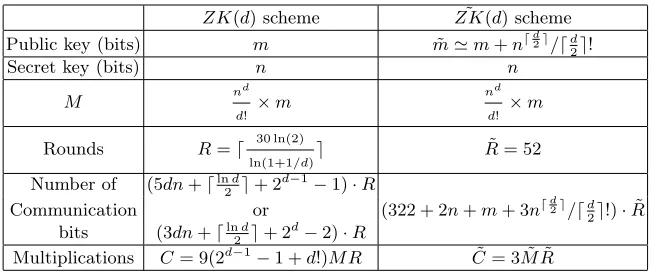
Table 3.ZK(d) andZK˜ (d) Schemes
ZK(d) scheme ZK˜ (d) scheme
Public key (bits) m m˜ 'm+ndd2e/dd
2e!
Secret key (bits) n n
M n
d
d! ×m
nd d! ×m
Rounds R=d 30 ln(2)
ln(1+1/d)e
˜
R= 52
Number of (5dn+dlnd
2 e+ 2
d−1−1)·R
Communication or (322 + 2n+m+ 3ndd2e/dd
2e!)·R˜ bits (3dn+dlnd
2 e+ 2
d−
2)·R
Multiplications C= 9(2d−1−1 +d!)M R C˜= 3 ˜MR˜
6.3 Relations for sparse systems
In the previous computations, we have supposed that we have the maximum number of coefficients. Then we obtained that in both cases, M ' M˜ ' nd
d!. Then the total number of multiplications is a function of M or ˜M and the number of rounds. For sparse systems,M or ˜M will be smaller but we will still have the same relations betweenC,M andR(and similarly ˜C, ˜M and ˜R). Here again, we can see that there are more variables and more communications bits in theZK˜ (d) schemes and more computations in theZK(d) schemes.
7
Relations between the number of computations and the
number of coefficients
We begin with theZK(d) scheme. We have:
f`((x1, x2, . . . , xn) = X
(i1,...,id)∈Sd`
γi`
1...idxi1xi2. . . xid+
X
ii,...,id−1∈Sd`−1
γ`i
1...id−1xi1xi2. . . xid−1
+. . .+ X ii,i2∈S2`
γi`
1i2xi1xi2+
X
ii∈S2`
γi`
1xi1
The number of multiplications forf` is given by
d|Sd`|+ (d−1)|Sd`−1|+ (d−2)|Sd`−2|+. . .+ 2|S2`|+|S1`|
and forF the numberM of multiplications is
M = m X
`=1 h
Moreover, F is computed at most 2d−1−1 times during the process. For g l we have d!(d−1) + 1
|Sd`| multiplications and for G, m X
`=1
d!(d−1) + 1
|Sd`|
multiplications andGis computed one time. Finally, for one round, the number of multiplications is given by
Xm
`=1 h
d(2d−1−1) +d!(d−1) + 1|Sd`|+ (d−1)|Sd`−1|+ (d−2)|Sd`−2|+. . .+
2|S2`|+|S`1|i (])
and then we have to multiply by the number of roundsRto getC. For the ˜ZK(d) scheme, we have ˜M =M+ndd2e/dd
2e!. Then ˜C= 3 ˜MR˜.
8
The particular case of Brent equations
In this section, we introduce the Brent equations. Suppose we want to multiply twoN×N matrices. The naive method will useN2 multiplications. In fact for
N = 2, Strassen’s algorithm ([16]) requires 7 multiplications instead of 8 multi-plications and Laderman showed that whenN = 3 it is possible to use 23 multi-plications instead of 33= 27 ([6]). ForN = 2, 7 is the least number we can obtain. For N = 3, it is not known if 23 is the least number in the non-commutative case. In [1], it is shown that obtaining the product of two matricesN×N can be done usingsmultiplications is equivalent to solve the following system of cubic equations:
s X
k=1
γijkαabkβcdk=δbcδiaδjd a, b, c, d, i, j∈ {1,2, . . . , n}
Here we have n = 3sN2, m = N6. If we use formula (]), we obtain that the number of multiplications is 22×s×N6if we use the ZK(3) scheme. It is also interesting to design an authentication public key cryptographic scheme as close as possible to Brent equations. In order to do this, we choose a system similar to Brent equations but for which we know a particular solution. It is possible to proceed as follows:
1. We consider the finite field Z/2Z
2. We take the Brent equations with s= 22 in order obtain an open problem in the non-commutative case
3. We pick randomly variables α, β, γin Z/2Z 4. We deduce the corresponding constants
9
Morphisms of polynomials and systems of cubic
equations
9.1 The MP Problem
The IP problem (Isomorphism of Polynomials) has been used to construct pubic key schemes (cf [9]). On one hand, this is not a NP-complete problem since it admits an Arthur-Merlin game when the answer is yes and when the answer is no). On the other hand, the MP problem( morphisms of polynomials) where matrices are not supposed to be invertible is proved to be NP-complete ([3, 10]) and thus is much more difficult. So it is interesting to design a public key authentication scheme based on MP. We explain briefly below how it is possible to construct such a scheme by transforming MP very efficiently into a system of equations of degree 3 and then applying ourZK(3) orZK˜ (3) protocols.
9.2 From MP to polynomials of degree 3
We consider the two following systems:
(A) ck =
X
1≤i≤n,1≤j≤n
γijkaiaj+ n X
i=1
µkiai, 1≤k≤u
(B) zt=
X
1≤i≤p,1≤j≤p
αtijxixj+ p X
i=1
βtixi, 1≤t≤v
We want to find 2 matricesM = (mrs)1≤r≤v
1≤s≤u
andH = (hdf)1≤d≤n
1≤f≤p
such that M c1 .. . cu = z1 .. . zv
and H
x1 .. . xp = a1 .. . an
For allt, 1≤t≤v, on one hand, we have:
zt= u X
s=1
mts
X
1≤i≤n
1≤j≤n
γijsaiaj+ n X
i=1
µsiai
zt= u X
s=1
mts
X
1≤i≤n
1≤j≤n
γijs
p X
f=1
hifxf
p X
b=1
hjbxb
+ n X
i=1
µsi
p X
f=1
hifxf
zt = p X f=1 p X b=1 hXu
s=1 X
1≤i≤n
1≤j≤n
γijsmtshifhjb i
xfxb + p X
f=1 hXu
s=1 n X
i=1
µsimtshif i
xf. On the
other hand, we have: zt = X
1≤i≤p
1≤j≤p
αtijxixj + p X
i=1
v, ∀f,1 ≤ f ≤ p, ∀b,1 ≤ b ≤ p, αtf b +βtf = u X
s=1 X
1≤i≤n
1≤j≤n
γijsmtshifhjb +
u X
s=1 n X
i=1
µsimtshif. Thus we obtain vp2 cubic equations andnp+vuunknowns.
10
Conclusion
In [12], a very efficient zero-knowledge proof based on the MQ problem (multi-variate quadratic polynomials) is given. In this paper we proved that this con-struction can be generalized to polynomials of degreedfor anyd≥3. We studied several constructions and we presented here the two most efficient ones denoted by ZK(d) and ZK˜ (d). ZK(d) is quasi optimal in term of communication bits and ZK˜ (d) is quasi optimal in term of number of computations. This result is true for dense or sparse systems. We also presented two important specific prob-lems (Brent equations and morphisms of polynomials) that can be transformed into efficient public key schemes using ZK(d) andZK˜ (d).
References
1. Gregory V. Bard. New Practical Strassen-like Approximate
Matrix-multiplication Algorithms found via solving a system of cubic equations.
http://www.users.math.umd.edu/~bardg/.
2. Come Berbain, Henri Gilbert, and Jacques Patarin. QUAD: A Practical Cipher with Provable Security . In Serge Vaudenay, editor, Advances in Cryptology – EUROCRYPT 2006, volume 4404 of Lecture Notes in Computer Science, pages 109–128. Springer-Verlag, 2006.
3. Michael R. Garey and David S. Johnson. Computers and Intractability; A Guide to the Theory of NP-Completness. W.H. Freeman and Co, 1979.
4. Oded Goldreich, Silvio Micali, and Avi Wigderson. Proofs that yield nothing but their validity or all languages in np have zero-knowledge proof systems. J. ACM, 38:690–728, July 1991.
5. Shai Halevi and Silvio Micali. Practical and Provably-Secure Commitment Schemes from Collision-Free Hashing . In Neal Koblitz, editor, Advances in Cryptology – CRYPTO 1996, volume 1109 ofLecture Notes in Computer Science, pages 201–215. Springer-Verlag, 1996.
6. J.Laderman. A noncomuutative algorithm for multiplying 3 x3 matrices using 23 multiplication. Bulletin of the American Mathematical Society, 82:126–128, 1976. 7. Aviad Kipnis, Jacques Patarin, and Louis Goubin. Unbalanced Oil and Vinegar
Signature Schemes. In Jacques Stern, editor, Advances in Cryptology – EURO-CRYPT 1999, volume 1492 ofLecture Notes in Computer Science, pages 206–222. Springer-Verlag, 1999.
8. Tsutomu Matsumo and Hideki Imai. Public Quadratic polynomial-Tuples for Ef-ficient Signature-Verification and Message-Encryption . In C.G. Gunther, editor,
9. Jacques Patarin. Hidden Fields Equations (HFE) and Isomorphims of Polynomi-als (IP): Two New Families of Asymmetric Algorithms. In Ueli Maurer, editor,
Advances in Cryptology – EUROCRYPT 1996, volume 1070 of Lecture Notes in Computer Science, pages 33–48. Springer-Verlag, 1996.
10. Jacques Patarin and Louis Goubin. Trapdoor one-way permutations and multi-variate polynomials. In Yongfei Han, Tatsuaki Okamoto, and Sihan Qing, editors,
ICICS, volume 1334 of LNCS, pages 356–368. Springer, 1997.
11. David Poincheval. A New Identification Scheme based on the Perceptrons Problem. In Alfredo de Santis, editor,Advances in Cryptology – EUROCRYPT 1995, volume 950 ofLecture Notes in Computer Science, pages 319–328. Springer-Verlag, 1995. 12. Koichi Sakumuto, Taizo Shirai, and Harunaga Hiwatari. Public-Key Identification
Schemes based on Multivariate Quadratic Polynomials. In Philip Rogaway, edi-tor, Advances in Cryptology – CRYPTO 2011, volume 6841 ofLecture Notes in Computer Science, pages 706–723. Springer-Verlag, 2011.
13. Adi Shamir. An Efficient Identification Scheme Based on Permuted Kernels (Extended Abstract). In Gilles Brassard, editor, Advances in Cryptology – CRYPTO 1989, volume 435 ofLNCS, pages 606–609. Springer-Verlag, 1989. 14. Jacques Stern. A New Identification Scheme based on Syndrome Decoding. In
Douglas R. Stinson, editor,Advances in Cryptology – CRYPTO 1993, volume 773 ofLecture Notes in Computer Science, pages 13–21. Springer, 1993.
15. Jacques Stern. Designing Identification Schemes with Keys of Short Size. In Yvo G. Desmedt, editor,Advances in Cryptology – CRYPTO 1994, volume 839 ofLecture Notes in Computer Science, pages 164–173. Springer, 1994.
16. Volker Strassen. Gaussion Elimination is not optimal. Numerische Mathematik, 13(3):354–356, 1969.
A
5-pass scheme for
ZK
(3)
In this appendix, we give sketches of proof for the 5-passes scheme.
1. The Prover picks up at randomr0, r1, t0∈Fnq ande0, f0, h0∈Fmq . Then she computesr2=s−r1−r0. The Prover sends to the Verifier
c0=Com(r1, r2, G(t0, r1, r2)−e0+f0+h0)
c1=Com(r1, t0, e0, f0)
c2=Com(r1, t1, e1, f1)
c3=Com(r2, t0, e0, h0)
c4=Com(r2, t1, e1, h1)
2. The verifier picks α∈RFq and sendsαto the prover. 3. The prover computes:
(t1, e1f1, h1) = (αr0−t0, αF(r0)−e0, αF(r0+r1)−f0, αF(r0+r2)−h0) and sends (t1, e1f1, h1) to the verifier.
4. The verifier picks Q ∈R{0,1,2} and sendsQto the prover.
5. (a) If Q = 0, then the prover sends (r0, r1). The verifier checks if c0 =
(b) If Q = 1, then the prover sends (r0, r2). The verifier checks if c1 =
Com(r0, r2, αr0−t1, αF(r0)−e1, αF(r0+r2)−h1).
(c) If Q = 2, then the prover sends (r1, r2). The verifier checks if c2 =
Com(r1, r2, α(v−F(r1+r2)+F(r1)+F(r2))−G(t1, r1, r2)−f1−h1+e1). As for the 3-pass scheme, we have perfect correctness and the following re-sults(Proofs are sketched in Appendix A:
Theorem 7 The 5-pass protocol is statistically zero knowledge when the com-mitment scheme Comis statistically hiding.
Proof sketch.LetS be a simulator which takesF andvwithout knowings, and interacts with a cheating verifier CV. We show that the simulator can imper-sonate the honest prover with probability 2/3. The simulator randomly chooses a value Ch∗ ∈R {0,1,2} and vectors s0, r00, r01, t00 ∈R Fnq and e00, f00, h00 ∈R Fmq , where Ch∗ is a prediction what value the cheating verifierCV will not choose. Then it computes
r02←s0−(r00+r10)
c00←Com(r00, r10, t00, e00, f00)
c01←Com(r00, r20, t00, e00, h00)
c02←Com(r01, r02, G(t00, r10, r20) +f00+h00−e00)
and sends (c00, c01, c02) toCV. Then receiving a challengeαfromCV, it computes:
t01=αr00 −t00 e01=αF(r00)−e00
Now
ifCh∗= 0 it setsf10 =α(v−F(s0)) +F(r00+r10)−f00, else f10 =αF(r00+r01)−f00
ifCh∗= 1 it setsh01=α(v−F(s0))+F(r00+r20)−h00, else f10 =αF(r00+r02)−h00
Then it sends (t01, e01f10, h01) toCV
Due to the statistically hiding property of Com, a challenge Ch from CV is different fromCh∗with probability 2/3. IfCh6=Ch∗, then (r00, r10), (r00, r02), and (r01, r02) are accepted responses toCh= 0,1 and 2 respectively.
Theorem 8 The 5-pass protocol is proof of zero knowledge with zero knowledge error2/3+1/3qwhen the commitment schemeComis computationnaly binding.
Proof sketch. Let ((c1, c1, c2), αi,(˜t (i) 1 ,e˜
(i) 1 ,f˜
(i) 1 ,˜h
(i)
1 ), Chj, Rsp(i,j)) be six tran-scripts for i∈ {0,1}and j∈ {0,1,2}such that
Dec(F, v,((c1, c1, c2), αi,(˜t (i) 1 ,e˜
(i) 1 ,f˜
(i) 1 ,˜h
(i)
1 ), Chj, Rsp(i,j)p) = 1, α0 6= α1, and
Chj =j. Then, by using the six transcripts, we show that we are able either to break the binding property of Comor extract a solution forv. Consider the situation where the responses are parsed as
Rsp(0,1)= (˜r0(0),˜r2(0))
Rsp(0,2)= (˜r1(0),˜r2(0))
Rsp(1,0)= (˜r0(1),˜r1(1))
Rsp(1,1)= (˜r0(1),˜r2(1))
Rsp(1,2)= (˜r1(1),˜r2(1)) Then we have:
c0=Com(˜r (0) 0 ,r˜
(0) 1 , α0r˜
(0) 0 −˜t
(0) 1 , α0F(˜r
(0) 0 )−˜e
(0) 1 , α0F(˜r
(0) 0 + ˜r
(0) 1 )−f˜
(0) 1 ) =Com(˜r0(1),r˜1(1), α1˜r
(1) 0 −˜t
(1) 1 , α1F(˜r
(1) 0 )−e˜
(1) 1 , α1F(˜r
(1) 0 + ˜r
(1) 1 )−f˜
(1) 1 ) (6)
c1=Com(˜r (0) 0 ,r˜
(0) 2 , α0r˜
(0) 0 −˜t
(0) 1 , α0F(˜r
(0) 0 )−e˜
(0) 1 , α0F(˜r
(0) 0 + ˜r
(0) 2 )−˜h
(0) 1 ) =Com(˜r(1)0 ,˜r2(1), α1˜r
(1) 0 −˜t
(1) 1 , α1F(˜r
(1) 0 )−e˜
(1) 1 , α1F(˜r
(1) 0 + ˜r
(1) 2 )−h˜
(1) 1 ) (7)
c2=Com(˜r (0) 1 ,r˜
(0)
2 , α0(v−F(˜r (0) 1 + ˜r
(0) 2 ) +F(˜r
(0) 1 ) +F(˜r
(0)
2 ))−G(˜t (0) 1 ,r˜
(0) 1 ,r˜
(0) 2 )
−f˜1(0)−˜h(0)1 + ˜e(0)1 ) =Com(˜r1(1),r˜(1)2 , α1(v−F(˜r
(1) 1 + ˜r
(1)
2 ) +F(˜r (1)
1 ) +F(˜r (1)
2 ))−G(˜t (1) 1 ,r˜
(1) 1 ,r˜
(1) 2 )
−f˜1(1)−˜h(1)1 + ˜e(1)1 ) (8)
If two tuples of the arguments of Com are are distinct on either of the above equations, the binding property ofComis broken.
Otherwise, (6) gives:
˜
r(0)0 = ˜r(1)0 , r˜(0)1 = ˜r(1)1
This implies:
(α0−α1)˜r (0) 0 =−˜t
(1) 1 + ˜t
(0) 1 (α0−α1) ˜F(r
(0) 0 ) =−˜e
(1) 1 + ˜e
(0) 1 (α0−α1) ˜F(r
(0) 0 +r
(0) 1 ) =−f˜
(1) 1 + ˜f
(0) 1 If we use (7), we obtain two more equations:
˜
r2(0)= ˜r2(1)and (α0−α1) ˜F(r (0) 0 +r
(0) 2 ) =−˜h
(1) 1 + ˜h
(0) 1 Now (8) gives
α0(v−F(˜r (0) 1 + ˜r
(0) 2 ) +F(˜r
(0)
1 ) +F(˜r (0)
2 ))−G(˜t (0) 1 ,˜r
(0) 1 ,˜r
(0) 2 )−f˜
(0) 1 −˜h
(0) 1 + ˜e
(0) 1 =α1(v−F(˜r
(1) 1 + ˜r
(1) 2 ) +F(˜r
(1) 1 ) +F(˜r
(1)
2 ))−G(˜t (1) 1 ,˜r
(1) 1 ,r˜
(1) 2 )−f˜
(1) 1 −˜h
(1) 1 + ˜e
This implies that (α0−α1)v= (α0−α1)
h
F(˜r(0)1 + ˜r(0)2 )−F(˜r(0)1 )−F(˜r(0)2 ) +G(˜r0(0),r˜1(0),r˜(0)2 )
+F(˜r(0)0 + ˜r(0)1 ) +F(˜r(0)0 + ˜r2(0))−F(˜r(0)0 )i
Thus we obtainv=F(˜r0(0)+˜r1(0)+˜r2(0)). This means that a solution ˜r(0)0 +˜r(0)1 +˜r2(0)
forv is extracted.
B
Proofs for the
ZK
(
d
) Scheme
Theorem 9 The 3-pass protocol is statistically zero knowledge when the com-mitment scheme Comis statistically hiding.
Proof sketch.LetS be a simulator which takesF andvwithout knowings, and interacts with a cheating verifierCV. We show that the simulator can imperson-ate the honest prover with probability d+1d . The simulator randomly chooses a valueCh∗ ∈R {0,1, . . . , d} and vectors s0, r00, r10, . . . , rd0−2, t00 ∈R Fnq, f00 ∈R Fmq , and∀p, 1≤p≤d−2, ∀i1, . . . ip, 1≤i1< i2< . . . ip≤d−1, f
01...i
p
0 , ∈RFmq , where Ch∗ is a prediction what value the cheating verifierCV will not choose.
Then it computes
r0d−1←s0−
d−2 X
i=1
ri0
t01←r00−t00 f10 ←F(r00)−f00
∀p, 1≤p≤d−2, ∀i1, . . . ip, 1≤i1< i2< . . . ip≤d−1,
f
0i
1...ip
1 ←F(r
0
0+r0i1+. . .+r
0
ip)−f
0i
1...ip
0 Moreover it sets:
1. IfCh∗= 0,
c00=v−G(t01, r01, . . . , rd0−1)−Pdp−=12(−1)d−pP
1≤i1<...<ip≤d−1f
0i
1...ip
1 −
(−1)df0
1 Pd
i=1(−1) d−iP
S⊂{1,...,d−1} |S|=i
F(P j∈Sr
0
j), elsec0=G(t00, r01, . . . , r0d−1) +
Pd−2 p=1(−1)
d−pP
1≤i1<...<ip≤d−1f
0i
1...ip
0 + (−1)df0
0
2. IfCh∗=i, 1≤i≤d−1,f012...(i−1)(i+1)...(d−1)
1 =
v−F(s0) +F(r00+r1+. . .+r0i−1+ri+1+. . .+r0d−1)
−f
012...(i
−1)(i+1)...(d−1)
0 ,
elsef
012...(i−1)(i+1)...(d−1)
1 =F(r00 +r1+. . .+ri0−1+ri+1+. . .+r0d−1)
It also computes:
∀i,1≤i≤d−1
c02i−1←Comr10, . . . , r0i−1, r0i+1, . . . , r0d−1, t00, f00,
∀p, 1≤p≤d−2, ∀i1, . . . ip, 1≤i1< i2< . . . ip≤d−1, such that∀j, ij6=i, f
0i
1...ip
0
c2i←Com
r01, . . . , ri0−1, r0i+1, . . . , r0d−1, t01, f10,
∀p, 1≤p≤d−2, ∀i1, . . . ip, 1≤i1< i2< . . . ip≤d−1, such that∀j ij6=i, f
0i
1...ip
1
and sendsc00, c01, c20, . . . , c02d−2 to tCV.
Due to the statistically hiding property ofCom, a challengeCh fromCV is dif-ferent fromCh∗with probability d+1d . IfCh6=Ch∗, then (r1, r2, . . . , rd−1, t0, f0,
∀p, 1 ≤ p ≤ d−2, ∀i1, . . . ip, 1 ≤ i1 < i2 < . . . ip ≤ d−1, f i1...ip
0 ), and ∀i, 1 ≤ i ≤ d−1, (r0, r1, . . . , ri−1, ri+1, . . . , rd−1, t1, f1,∀p, 1 ≤ p ≤
d−2, ∀i1, . . . ip, 1≤i1< i2< . . . ip≤d−1, such that∀j ij 6=i, f i1...ip
1 ) are
accepted responses toCh= 0,1, . . .(d−1).
Theorem 10 The 3-pass protocol is proof of zero knowledge with zero knowledge error d
d+1 when the commitment scheme Comis computationnaly binding. Proof sketch. Let ∀i, 0 ≤i≤ d, let ((c0, c1, c2, . . . , c2d−2), Chi, Rspi) be d+ 1 transcripts such thatChi=iandDec(F, v; (c0, c1, c2, . . . , c2d−2), Chi, Rspi) = 1 fori∈ {0,1,2, . . . , d}. Then, by using the four transcripts, we show that we are able either to break the binding property of Com or extract a solution for v. Consider the situation where the responses are parsed as
Rsp0= (˜r (0) 1 ,r˜
(0) 2 , . . . ,r˜
(0) d−1,˜t
(0) 0 ,f˜
(0) 0 ,
∀p, 1≤p≤d−2, ∀i1, . . . ip, 1≤i1< i2< . . . ip≤d−1, f˜ (0),i1...ip
0 )
∀i, 1≤i≤d−1, Rspi= (˜r
(i) 0 ,r˜
(i) 1 , . . . ,˜r
(i) i−1,r˜
(i) i+1, . . . ,r˜
(i) d−1,˜t
(i) 1 ,f˜
(i) 1 ,
∀p, 1≤p≤d−2, ∀i1, . . . ip, 1≤i1< i2< . . . ip≤d−1, such that∀j, ij6=i, f˜
(i),i1...ip
1 )
Rspd= (˜r (d) 1 ,r˜
(d) 2 , . . . ,˜r
(d) d−1,t˜
(d) 1 ,f˜
(0) 1 ,
∀p, 1≤p≤d−2, ∀i1, . . . ip, 1≤i1< i2< . . . ip≤d−1, f˜ (d),i1...ip
We obtain:
c0=Com
˜
r1(d), . . . ,r˜d(d−)1, v−G(˜t1(d),r˜1(d), . . . ,r˜(dd−)1)−
d−2 X
p=1
(−1)d−p
X
1≤i1<...<ip≤d−1
˜
f(d),i1...ip
1 −
(−1)df˜1(d)+ d X
i=1
(−1)d−i X
S⊂{1,...,d−1} |S|=i
F(X j∈S ˜
r(jd))
=Comr˜(0)1 , . . . ,r˜d(0)−1, G(˜t(0)0 ,˜r1(0), . . . ,r˜(0)d−1) + d−2 X
p=1
(−1)d−p
X
1≤i1<...<ip≤d−1
˜
f(0),i1...ip
0 + (−1) df˜(0)
0
∀i, 1≤i≤d−1, c2i−1=Com
˜
r1(i), . . . ,˜ri(−i)1,r˜i(+1i) , . . . ,r˜d(i−)1,r˜(0i)−˜t(1i), F(˜r0(i))−f˜1(i),
∀p, 1≤p≤d−2, ∀i1, . . . ip, 1≤i1< i2< . . . ip≤d−1, such that∀j, ij6=i, F(˜r
(i) 0 + ˜r
(i)
i1 +. . .+ ˜r
(i) ip)−
˜
f(i),i1...ip
1
=Comr˜1(0), . . . ,r˜(0)i−1,˜ri(0)+1, . . . ,˜rd(0)−1,t˜(0)0 ,f˜0(0),
∀p, 1≤p≤d−2, ∀i1, . . . ip, 1≤i1< i2< . . . ip≤d−1, such that∀j, ij 6=i, f˜
(0),i1...ip
0
c2i=Com
˜
r1(i), . . . ,r˜i(−i)1,r˜(i+1i) , . . . ,r˜(di−)1,˜t1(i),f˜1(i),
∀p, 1≤p≤d−2, ∀i1, . . . ip, 1≤i1< i2< . . . ip≤d−1, such that∀j, ij 6=i, f˜
(i),i1...ip
1
=Comr˜(1d), . . . ,r˜i(−d)1,r˜i(+1d), . . . ,r˜d(d−)1,t˜(1d),f˜1(d),
∀p, 1≤p≤d−2, ∀i1, . . . ip, 1≤i1< i2< . . . ip≤d−1, such that∀j, ij 6=i, f˜
(d),i1...ip
1
If two tuples of the arguments of Com are are distinct on either of the above equations, the binding property ofComis broken.
Otherwise the conditions onc0 give: ˜
v=G(˜t(0)0 + ˜t(1d),r˜(1d), . . . ,˜rd(d−)1) + d−2 X
p=1
(−1)d−p
X
1≤i1<...<ip≤d−1
( ˜f(0),i1...ip
0 + ˜f
(d),i1...ip
1 )
+(−1)d( ˜f0(0)+ ˜f1(d))−
d X
i=1
(−1)d−i X
S⊂{1,...,d−1} |S|=i
F(X j∈S ˜
r(jd))
The conditions onc2i−1 give: ˜
r1(i)= ˜r1(0), . . . ,r˜i(−i)1= ˜r(0)i−1,r˜i(i+1) = ˜ri(0)+1, . . .r˜(di−)1= ˜r(0)d−1
˜
t(0i)= ˜t(0)0
˜
f0(i)= ˜f0(0)
∀p, 1≤p≤d−2, ∀i1, . . . ip, 1≤i1< i2< . . . ip≤d−1, such that∀j, ij6=i, f˜
(i),i1...ip
0 = ˜f
(0),i1...ip
0 The conditions onc2igive:
˜
r1(i)= ˜r1(d), . . . ,r˜i(−i)1= ˜r(i−d)1,r˜(i+1i) = ˜ri(d+1), . . .r˜(di−)1= ˜r(dd−)1
˜
t(1i)= ˜t(1d)
˜
f1(i)= ˜f1(d)
∀p, 1≤p≤d−2, ∀i1, . . . ip, 1≤i1< i2< . . . ip≤d−1, such that∀j, ij6=i, f˜
(i),i1...ip
1 = ˜f
(d),i1...ip
1 We obtain:
˜
t(0)0 + ˜t(1d)= ˜t(1)0 + ˜t(1)1 = ˜r(1)0 F(˜r0(1)) = ˜f0(1)+ ˜f1(1)= ˜f0(0)+ ˜f1(d)
∀i, 1≤i≤d−1, F(˜r0(1)+ ˜ri(d)) =F(˜r0(1)+ ˜ri(1)) = ˜f0(1),i+ ˜f1(1),i= ˜f0(0),i+ ˜f1(d),i
More generally
F(˜r(1)0 + ˜r(id)
1 +. . .+ ˜r
(d)
ip ) =F(˜r
(1) 0 + ˜r
(1)
i1 +. . .+ ˜r
(1) ip ) =
˜
f(1),i1...ip
0 + ˜f
(1),i1...ip
1 = ˜f
(0),i1...ip
0 + ˜f
(d),i1...ip
1 Finally, we obtain
v=F(˜r(1)0 + ˜r1(d)+. . .+ ˜r(dd−)1)