Efficient Packet Forwarding Technique in LEACH
Protocol in Multisink Wireless Sensor Network.
Nikha Sheoran ,Kaushik Ghosh
Dept of computers science and engineering , Mody University of Science & Technology
Lakshmangarh.
Abstract-In the wireless sensor network(WSNs), energy efficiency is an important factor that should be considered when designing a particular protocol. Leach protocol which is the first hierarchical protocol plays an important role. This paper proposes a new protocol which will use the fermat point concept and is intended to balance the energy consumption of entire network and thus extend the lifetime of the network and .The algorithm is implemented in MATLAB, the simulation result shows that energy efficiency of the network are better than that of LEACH protocol.
Keywords- Leach, fermat-point, energy consumption, network lifetime.
INTRODUCTION
A wireless sensor network (WSN) are spatially distributed autonomous sensors which monitors physical or environmental conditions, such as temperature, sound, pressure, etc. and to pass the aggregated data through the network to a main destination.WSN is made up of nodes where each node is connected to the one sensor. The need of wireless sensor network came into existence with the military application which is now used in environmental monitoring , health care applications, security applications etc[1]..Sensors can collect the data about the temperature ,humidity and moving objects which are battery operated and can’t be recharged once deployed. This limitation of sensors lead to failure of the network, when their energy is depleted. In order to use the sensor network for the longer duration, energy consumption becomes important so, the role of data aggregation comes into play, which is implemented in the clustering mechanism. LEACH protocol is the first hierarchical routing protocol that uses the data fusion concept and thus plays a significant role among the clustering protocols. So,to deal with the energy consumption issue in wireless sensor network a new protocol (LEACH-FP) is developed by the modification in LEACH, which uses the concept of fermat point[2] using the fermat point as the aggregation point, thereby reducing the energy consumption and increasing the network lifetime.
LITERATURE REVIEW
A lot of energy efficient techniques have been proposed by the authors in order to get the better lifetime of the network.I.F
efficient inter cluster coordination) protocol which evenly distributes the energy load among the sensor nodes .Analytical model of new protocol is projected and the algorithm is implemented in MATLAB. Moreover, EEICCP has shown remarkable improvement over already existing LEACH and HCR protocols in terms of reliability and stability. Chunyao FU et al [12] proposed a new improved algorithm of LEACH protocol (LEACH-TLCH) that balanced the energy consumption and thus extended the lifetime of the entire network. H. Chen et al [13] investigated the problem of cluster formation by focusing on two aspects:(i) estimate the number of clusters needed for a sensor network, and (ii) choosing the cluster-head among the given clusters to cover the sensor network and developed a new algorithm for cluster head selection and found that by optimizing the cluster head-selection process, energy efficiency of the WSN can be improved. Kewei Sha et al [14] , propose a novel model that define the lifetime of a wireless sensor network on the basis of energy of the entire network, the importance of different sensors based on their positions, the link quality, and the connectivity and coverage of the sensor network. Kaushik Ghosh et al [15], have used data aggregation as a technique for the lifetime enchacement of the wireless sensor network as data aggregation reduces total number of transmissions in a WSN. The proposed method has shown the effect of source selesction, deployment pattern and performance of aggregation of a multisink WSN.
Thus, This paper proposes a new protocol which will use the fermat point concept and is intended to balance the energy consumption of entire network and thus extend the lifetime of the network.
A. Fermat Point
In wireless sensor network, lifetime enchacement is the major issue when the reduction in the energy consumption takes place. Among the several techniques proposed by the researchers, data aggregation is the one technique that have been discussed more[15].Through the data aggregation the no. of transmissions can be reduced thereby reducing the energy consumption and increasing the lifetime of the network. Another mehod to increase the lifetime of the network is the Fermat point-based scheme. The WSN is assumed to be comprised of multiple sinks. Sensor nodes are deployed over a two dimensional plane with n vertices.n-1 sinks are placed at those many vertices of the said polygon. The network uses a Fermat point-based forwarding scheme[3].Fermat point is defined as the point within the triangle or polygon with no internal angle greater than 120 ,such that the sum of the straight lines ̊
from all the vertices to that point is minimum[15]. Firstly the fermat point is formed by taking the source and the sink within the bounds of polygon or triangle. Then, the physical node which is closest to the fermat point s found out. This node is called as Fermat Node (FN). Fig 1 shows the source node, fermat node and sinks.
Fig 1.source node ,fermat node, and sinks.
A source routes a packet to its FN, and then, it is the responsibility of the FN to forward the packet to different sinks. The packet is thus forwarded from source to sinks in two phases: firstly, packet goes to FN and secondly the FN routes the packet to sink. In both stages the packet is assumed to reach the destination in either single or multiple hops.
B. LEACH Protocol
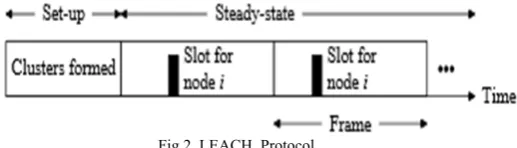
Leach protocol is the first hierarchical routing protocol which uses the clustering technique for data fusion[4]. Many hierarchical routing protocol are improved ones which are based on LEACH protocol [5].This protocol is self adaptive and self-organized. It uses round as unit, where each round is made up of set-up and steady-state stages[6]. The process is shown in figure 2.
Fig 2. LEACH Protocol
In the cluster forming stage, a node randomly picks a number between 0to1,and then it is compared to the threshold values t(n),if the number is less than t(n),then in this round it becomes cluster head, otherwise it becomes a common node. The threshold values t(n) is defined as:
t(n) = {p/1-p*(r mod 1/p) if n G 0 if n ∉ G}
Where, p = percentage of cluster head nodes among all nodes.
r = No. of rounds
rounds. After 1/p-1 round, remaining nodes which have been not elected as head node will be now chosen as head node with the probability 1,when 1/p rounds finished, then all the nodes will go to same starting line.Finally, when the clusters are formed, the nodes starts the transmission of data .Data sent from the other nodes comes to the cluster head which thus sends the data to the destination. The data transmission takes place in the form of frames where nodes send their data to the cluster-head at most once per frame during their allocated transmission slot. To reduce the energy cost, the steady-state stage must be much longer than the set-up stage.
C. First-Order Wireless Transmission Model
The first-order wireless transmission model is shown in fig 3
Fig 3.The wireless communication model
The total consumed is calculated in formula (1) and (2) [7], ETx(L,d) = {LEelec +Lεfs ,d≤ }
{ LEelec +Lεmp ,d> } (1)
ERx(L)=LEelec (2)
Where Eelec represents the energy consumed to transmit or receive 1bit message; εfs is the amplification coefficient of free space signal and εmp is the multi-path fading signal amplification coefficient and their value depend on circuit amplifier model; d is the distance between transmitter and receiver; and L is the bit amount for sending the information.
PROPOSED WORK
Wireless sensor network is energy constrained because of limited battery power of the sensor nodes. Here we use the concept of fermat point data forwarding technique in the LEACH protocol where first fermat point is formed by taking one source and three sinks and the node closest to fermat point becomes the fermat node which works as a intermediate node and sends the data to the sinks in the network. So, the transmission takes place from the source node to fermat node and then from fermat node to all the three sinks. The Election of nodes as cluster heads is chosen based the threshold value d₀ and the energy consumption [8].Longetivity is thus increased by this protocol because here energy consumption is very less. There are many energy efficient algorithms been developed that have proved that clustering is the best method to save energy so this cluster organization is adopted in this protocol. LEACH-FP runs for 2400 rounds ie r(max)=2400 in order
to get the no. of dead nodes and alive nodes from the multiple sink present in the the network. The role of associated cluster heads comes into play when in a particular path the energy of the cluster head is lost or it becomes zero, so it is now, the responsibility of associated cluster head to continue the rest of the transmission[13]. Many of the geocast protocols used in wireless sensor network[5] suffer from the issue of energy efficiency so they have to make the deployment of nodes in such a way that energy consumed is minimum. Since energy depends upon the inter nodes communication ie d^n. So here we consider that if the distance is small then the path loss exponent is taken as d and if the distance is big then the path loss exponent is taken as d [9]
The energy consumption in transmission includes the distance and the data size and the energy consumption in reception includes the data volume [11].The energy loss equations are:
ETX = LEelec +Lεfsd (3) ETX = LEelec +Lεmpd (4) ERX = LEelec (5)
ETX is the energy used in transferring and ERX is the energy consumed in receiving the data. Equation (3) is used when the data transmission takes place at the short distance and Equation (4) is used when the data transmission takes place at the longer distance.
Mathematical model
Lots of the protocols have used the first order radio model as described in[8].Energy is dissipated in transmission and reception of the data and the energy consumption for the small distance is and for the long distance it is d
[9].The following assumptions have been made in LEACH-FP protocol:
1) Base sations are fixed; sensors nodes are deployed randomly.
2) For the longer distance d energy loss is there and for the short distance d energy loss is there[10].
3) There is symmetric communication between two nodes in the network.
4) Transmission of data from the nodes to cluster head takes place in TDMA schedule.
Energy consumption Algorithm
The steps of the algorithm are:
STEP 1.Random node and sink deployment-
100 nodes are randomly deployed with the square area of 100m*100,with three sinks deployed at the three corners of the region with the coordinates of (10,10),(10,90)(90,10)
STEP 2.Finding the fermat point-
Determine the intermediate node using the concept of mid point considering the angle to the source & sink node lesser than 120 degree & minimize the distance of it with all other (sink & source) nodes.
STEP3 Cluster Formation
transmission) using the election probability of nodes.Suppose N nodes are randomly distributed within a square region, assuming that three base sations are located at the three corners of the square region, then the node whose distance d from the base station is less than or equal to the threshold value d₀, and whose energy is also less, that node becomes the cluster head
where d₀= √Efs/Emp
and ETx(L,d) = {LEelec +Lεfs ,d≤ } { LEelec +Lεmp ,d> } STEP 4. Selecting the associated cluster head
If the cluster head’s current energy is less than the average energy among all the nodes in the network then the node with the maximum energy will become the associated cluster head.
STEP 5. Data transferring-
When the clusters are formed and cluster head is defined, then the transmission of the data takes place from the source node to the three sinks using the fermat point as a aggregation point.
SIMULATION
Matlab 7.0 is used as the platform for simulation to emulate the LEACH-FP protocol, the new developed algorithm aims at balancing the total energy consumption of nodes thereby extending the lifetime of the network. The lifetime of the network means the time from the beginning of the simulation to the time when the last node died. Since the energy in WSN is limited so the energy consumption plays a major role in extending the lifetime of the network[12]. The parameters are shown in the table1.
TABLEI
SIMULATIONPARAMETERS
The Assumptions are:
1. Sensor nodes are randomly distributed in a square region. 2. Three sinks are fixed at the three corners of the square region and one source node is present.
3. All the sensor nodes are homogeneous and energy is limited.
4.Intermediate node is found using the concept of mid point considering the angle to the source & sink node lesser than 120 degree
4. Communication by the nodes to the sinks are via multihop.
1) Analysis of Simulation results
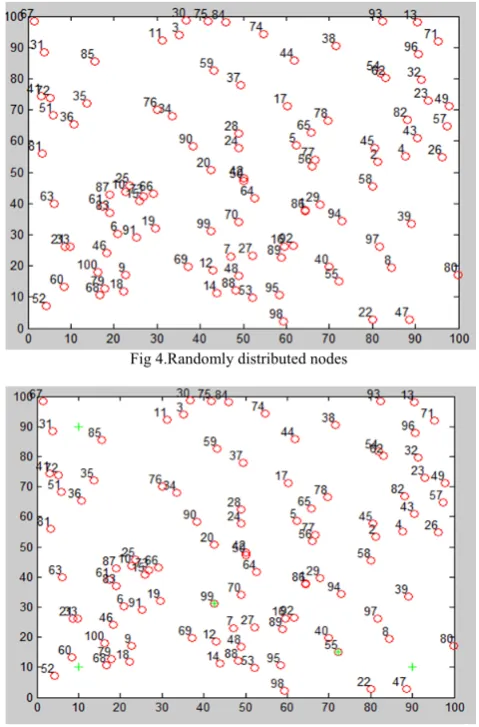
Figure 4 shows that100 nodes are randomly distributed within the square area of 100*100m.Figure 5 shows the source node, the location of three sinks at the corner of the square region and the fermat node. The coordinates of the three sinks are (10,10),(10,90)(90,10).The fermat node is found by concept of fermat point data forwarding technique and is shown in the figure 5.
2) The Network Lifetime
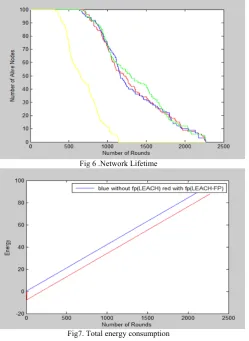
The lifetime of the network can be categorized into stable period and unstable period where the stable period means the time from the beginning of the simulation to the time when first node in the network becomes dead and unstable period means the time from the death of first node to the end of the simulation. More is the stable period, more will be the performance of the network[15].Figure 6 shows the lifetime comparison between LEACH(shown in yellow) and LEACH-FP(shown in blue, green and red). The result indicates that the first node from all the three sinks in LEACH-FP protocol dies at the 800 rounds and first node in LEACH protocol dies at 497 rounds. This indicates that the performance of improved protocol is much better than LEACH protocol.
Fig 4.Randomly distributed nodes
Fig 5. Source node, fermat node and 3sinks
Parameters Parameters
Area 100*100 m Packetsize 6400bits
No. of nodes 100 Rounds 2400
Initial energy 0.5J Eelec 50nJ/bit
Sink location (10,10)(10,90)(90,10) εfs 10pJ/bit/m2
3) The Total Energy Consumption
Figure 7 shows the energy consumption of LEACH protocol and the LEACH-FP protocol with the three sinks. The x-axis is the rounds number, and the y-axis represents the energy consumption. The new developed protocol reduces the energy consumption by using the technique of fermat point data forwarding scheme and using the associated cluster head which continues the further transmission of data in the network.
From the analysis of figure 7, we see that the energy consumption of LEACH-FP is much lower than that of LEACH protocol at the same round of the simulation.
Fig 6 .Network Lifetime
Fig7. Total energy consumption
CONCLUSION
Energy consumption is the major issue in LEACH protocol which thereby affects the lifetime of the network. For this issue, this article purposed a new protocol LEACH-FP protocol and a new Energy consumption algorithm which aims at balancing the energy consumption of the whole network and thus extending the lifetime of the network using the concept of Fermat Point Data Forwarding Technique. Simulations have been carried out in Matlab that helped us to maintain the longetivity of the energy constrained network.
REFERENCES
[1]. Akyildiz LF, Su W, Sankarasubramaniam Y, Cayirci E. A survey on sensor networks. IEEE Communications Magazine, 2002, 40(8): 102~114.Vol.25, No.4: 114-124.
[2]. Lee, S.H., Ko, Y.B.: Geometry-driven scheme for geocast routing in mobile adhoc networks. In: IEEE Conference on Vehicular Technology, 2006. IEEE, pp. 638-642 (2006).
[3]. Ghosh, K., Roy, S., Das, P.K.: An alternative approach to find the Fermat point of a polygonal geographic region for energy efficient geocast routing protocols: global minima scheme. In: First International Conference on Networks and Communications, NetCoM 2009. IEEE, pp. 332–337 (2009).
[4]. R.A.Roseline and Dr.P.Sumathi, Energy Efficient Routing Protocol and Algorithms for Wireless Sensor Networks-A Survey. Global Journal of Computer Science and Technology, vol.11, December 2011.
[5]. Handy. M. J, Haase. M, Timmermann. D. Low Energy Adaptive Clustering Hierarchy with DeterministicCluster-Head Selection. IEEE International Conference on Mobile and Wireless Communications Networks, 2002.
[6]. Meena Malik, Dr. Yudhvir Singh , Anshu Arora, “Analysis of LEACH Protocol in Wireless Sensor Networks,” International Journal of Advanced Research in Computer Science and Software Engineering, Volume 3, Issue 2, February 2013.
[7]. K. Ghosh, S. Roy and P. K. Das , “ I. Min:An Intelli- gent Fermat Point Based efficient Geographic Packet Forwarding Technique for Wireless Sensor and Ad Hoc Networks,” International Journal on Applications of Graph Theory in Wireless Adhoc Networksand Sensor Networks (GRAPH-HOC), Vol. 2, No. 2, 2010, pp. 34-44. [8]. W. Heinzelman, A. Chandrakasan and H. Balakrishnan,“Energy
Efficient Communication Protocol for Wireless Microsensor Networks,” Proceedings of the 33rd Hawaii International Conference on System Sciences, 4-7 January 2000.
[9]. K. Ghosh, P. P. Bhattacharya and P. Das, “Effect of Mul- tipath Fading and Propagation Environment on Performance of a Fermat Point Based Energy Efficient Geocast Routing Protocol,” International Journal of Wireless & Mobile Networks, Vol. 4, No. 1, 2012, pp. 215-224.
[10].T. Rappaport,“Wireless Communications: Principles & Practice. Englewood Cliffs,” Prentice-Hall, Upper Saddle River, 1996. [11].S. Rani, J. Malhotra and R. Talwar, "EEICCP—Energy Efficient
Protocol for Wireless Sensor Networks," Wireless Sensor Network, Vol. 5 No. 7, 2013, pp. 127-136.
[12].Chunyao FU, Zhifang JIANG, Wei WEI, Ang WEI, “An Energy Balanced Algorithm of LEACH Protocol in WSN,” IJCSI International Journal of Computer Science Issues, Vol. 10, Issue 1, No 1, January 2013.
[13].H. Chen and S. Megerian, “Cluster Sizing and Head Selection for Efficient Data Aggregation and Routing in Sensor Networks,” IEEE Wireless Communications and Networking Conference, Las Vegas, 3-6 April 2006, pp. 2318-2323.
[14]. Kewei Sha and Weisong Shi, “Modeling the Lifetime of Wireless Sensor Networks” ,Vol.3, 1–10, American Scientific Publishers 10 April Feb2005.
[15]. Kaushik Ghosh, Pradip K. Das, Sarmistha Neogy, “Effect of Source Selection, Deployment Pattern,and Forwarding Technique on the Lifetime of Data Aggregating Multi-sink Wireless Sensor Network” Applied Computation and Security Systems Advances in Intelligent Systems and Computation Volume 304, Aug 2014.