Optimize the Boiler efficiency by Modification of Cyclon
and minimize the wastage of coal
As hcharya Bans al
Abstract:-Boiler
is a most useful device for any developing industries to process & production. It is necessary to optimized good boiler efficiency. Boiler efficiency can be measured by two method, direct method and indirect method.Both methods give a different result. Direct method did not include any losses for calculating boiler efficiency, while indirect method includes all the heat losses from a system to find boiler efficiency. This paper gives simulating with the various value of the fuel. GCV of fuel indicate the heating value of fuel. As the heating value is high, efficiency is also increased with increased with the higher GCV coal. Compare with the different GCV of coal to find out the proper fuel selection of fuel. There are different parameters regarding to the boiler system which helps to improved boiler efficiency.Keywords:
boiler efficiency, GCV of coal, increase in efficiency, comparison, efficiency improvement opportunity, Unburned Carbon loss minimization. Nomenclatures𝑄0 = Heat output
𝑄i = Heat input
Q = Quantity of steam generated per hour (kg/hr) q = quantity of fuel per hour (kg/hr)
hg = steam enthalpy (kcal/kg) hf = feed water enthalpy (kcal/kg)
GCV of fuel = gross calorific value of fuel (kcal/kg) Cp = specific heat of flue gas (0.23 Kcal/kgoC)
Tf = temperature of flue gas (0C) Ta = ambient temperature (0C) Ts = surface temperature (0C)
m = mass of dry flue gas (kg/kg of fuel)
H2 = percentage of H2 in fuel = kg of H2 in 1kg of fuel
Cp = specific heat of superheated steam (0.45 Kcal/kgoC)
584 = latent heat of water in Kcal/kg
M= % of moisture present in fuel = kg of moisture in 1kg of fuel
Cp= specific heat of super-heated steam (0.45 Kcal/kgoC)
AAR = actual air required (kg/kg of fuel) Mbw = mass of blow down water (Kg/hr)
Hbw = enthalpy of blow down water at drum pressure (Kcal/kg)
Hfw = enthalpy of feed water (Kcal/kg) Ma = mass of total ash generated/kg of fuel SBC = Steffen Boltzmann constant (5.67 * 10-6) emissivity factor of surface
A = total surface area (m2) C = 1.97 for vertical surface
= 1.32 for downward facing surface = 2.30 for horizontal cylindrical surface
I. INTRODUCTION
Boiler is a steam generating device, which produce steam with burning of fuel. Basically coal is used as fuel in boiler. If the fuel has higher gross calorific value, than it is able to produce more heat per kg of fuel. It is directly proportional to the efficiency. Efficiency of the boiler should be calculated by two method, direct method and indirect method. It required various parameters for calculating the efficiency. These parameters are chemical analysis result of coal, feed waters analysis, coal feeding rate, steam pressure, steam generation per hour, flue gas analysis, and weather any heat recovery devices are attach or not, if attach, than its data, fuel consumption rate per hour, humidity factor etc. These all are related to each other and required for calculation. The mathematical model in the Microsoft excel is prepared for the indirect method for finding boiler efficiency,
because these method has a lots of calculation which make us a bore if the same calculation is required for the different value of GCV of coal. By using Microsoft excel the repeated calculations are being quite easy and time saving. Just change the various values and at the last you got the result immediately without any handwritten time consuming paperwork.
Here calculation has been done for the 150TPH FBC boiler used in the Hindalco (Birla Copper), fuel having GCV of 6500 kcal/kg South African Coal coal. Both coals have a different chemical composition and properties.
There are lots of possibilities to improve boiler efficiency by taking necessary steps for different parameters which are directly affected to the boiler efficiency. By considering them it gives an opportunity to improve boiler efficiency.
II. METHODS TO CALCULATE THE BOILER
EFFICIENCY.
There are two methods to find out boiler efficiency.
1. Direct method 2. Indirect method
1. Direct method:-
Boiler efficiency is calculated with this formula Boiler efficiency =(𝐻𝑒𝑎𝑡 𝑜𝑢𝑡𝑝𝑢𝑡/𝐻𝑒𝑎𝑡 𝑖𝑛𝑝𝑢𝑡)*100
Boiler efficiency η =(𝑄𝑜/𝑄𝑖)∗ 100 =(𝑄∗(hg – hf)/𝑞
∗𝐺𝐶𝑉𝑜𝑓𝑓𝑢𝑒𝑙)∗ 100
1. fuel I/P+Air 2. Steam Output 3. Water
4. Flue Gas
BOILER
FUEL+AIR FLUE GAS
S
T
E
A
M
O
/P
O
U
TP
U
T
W
A
T
2. Indirect method
By this method, efficiency could be measured easily by measuring all the losses occurring in the boiler. The following losses were applicable to all the fuel used, weather it is solid, liquid or gas fired boiler. L1 – loss due to dry flue gas
L2 – loss due to hydrogen in fuel L3 – loss due to moisture in fuel L4 – loss due to moisture in air L5 – loss due to CO formation
L6 – loss due to un-burnt fuel in fly ash L7 – loss due to un-burnt fuel in bottom ash
L8 – loss due to radiation and convection (surface loss)
Boiler efficiency η
= 100 − 𝑇𝑜𝑡𝑎𝑙𝑙𝑜𝑠𝑠𝑒𝑠= 100 − (𝐿1 + 𝐿2+𝐿3 + 𝐿4 + 𝐿5 + 𝐿6 + 𝐿7 + 𝐿8)
Measurements Required for Performance Assessment Testing
The following parameters need to be measured, as applicable for the computation of boiler efficiency and performance.
Boi l e r
S
T
E
A
M
O
U
TP
U
T
W
a
te
r
FUEL
AIR FLUE GAS
1.DRY 2.H2 3.MOIST URE IN AIR 4.WATER 5.CO 6.ASH 7.SURFACE
8.BOTTOM ASH LOSS
a) Flue gas analysis
1. Percentage of CO2 or O2 in flue gas 2. Percentage of CO in flue gas 3. Temperature of flue gas Bureau
b) Flow meter measurements for 1. Fuel
2. Steam 3. Feed water 4. Condensate water 5. Combustion air
c) Temperature measurements for 1. Flue gas
2. Steam
3. Makeup water 4. Condensate return 5. Combustion air 6. Fuel
7. Boiler feed water
d) Pressure measurements for 1. Steam
2. Fuel
3. Combustion air, both primary and secondary 4. Draft
e) Water condition
1. Total dissolved solids (TDS) 2. pH
3. Blow down rate and quantity
Ty p ical Instruments used for Boiler Performance Assessment.
Instrument Type Me asurements
Flue gas analyzer Portable or fixed % CO2 , O2 and CO
temperature, boiler surface temperature, steam
temperature
Draft gauge Manometer,
differential pressure
Amount of draft used or available
TDS meter Conductivity Boiler water TDS, feed water
TDS,
Flow meter As applicable Steam flow, water flow, fuel
flow, air flow
Test Conditions and Precautions for Indirect
Method Tes ting
A) The e ffi ci e ncy te st doe s not account for : 1. Standby losses. Efficiency test is to be carried out, when the boiler is operating under a steady load. Therefore, the combustion efficiency test does not reveal standby losses, which occur between firing intervals
2.Blow down loss. The amount of energy wasted by blow down varies over a wide range.
3.Soot blower steam. The amount of steam used by soot blowers is variable that depends on the type of fuel.
4. Auxiliary equipment energy consumption. The combustion efficiency test does not account for the energy usage by auxiliary equipments, such as burners, fans, and pumps.
B) Preparations and pre condi ti ons for te sti ng 1. Burn the specified fuel(s) at the required rate. 2. Do the tests while the boiler is under steady load. Avoid testing during warming up of boilers from a cold condition
3.Obtain the charts /tables for the additional data.
4.Determination of general method of operation 5. Sampling and analysis of fuel and ash.
6. Ensure the accuracy of fuel and ash analysis in the laboratory.
7. Check the type of blow down and method of measurement
8. Ensure proper operation of all instruments. 9. Check for any air infiltration in the combustion zone.
C) Fl ue gas sampl i ng l ocati on
It is suggested that the exit duct of the boiler be probed and traversed to find the location of the zone of maximum temperature. This is likely to coincide with the zone of maximum gas flow and is therefore a good sampling point for both temperature and gas analysis.
D) Options of flue gas analysis
Check the Oxygen Test with the Carbon Dioxide Test
carbon dioxide test does not give the same results as the oxygen test, something is wrong. One (or both) of the tests could be erroneous, perhaps because of stale chemicals or drifting instrument calibration. Another possibility is that outside air isbeing picked up along with the flue gas. This occurs if the combustion gas area operates under negative pressure and there are leaks in the boiler casing.
Carbon Monoxi de Te st
The carbon monoxide content of flue gas is a good indicator of incomplete combustion with all types of fuels, as long as they contain carbon. Carbon monoxide in the flue gas is minimal with ordinary amounts of excess air, but it rises abruptly as soon as fuel combustion starts to be incomplete. E) Pl anni ng for the te sti ng
1. The testing is to be conducted for a duration of 4 to 8 hours in a normal production day.
2.Advanced planning is essential for the resource arrangement of manpower, fuel, water and instrument check etc and the same to be communicated to the boiler Supervisor and Production Department.
3.Sufficient quantity of fuel stock and water storage required for the test duration should be arranged so that a test is not disrupted due to non-availability of fuel and water.
4. Necessary sampling point and instruments are to be made available with working condition. 5. Lab Analysis should be carried out for fuel, flue gas and water in coordination with lab personnel. 6. The steam table, psychometric chart, calculator are to be arranged for computation of boiler efficiency.
III. FORMULA FOR COMPUTATING VARIOUS LOSSES
Step 1. Theoretical (stoichiometric) air requirement
Theoretical air requirement (TA) =(11.6𝐶+34.8 (h2−𝑂2/8)+4.35𝑆)/100 kg/kg of fuel Step 2. % excess air requirement
% excess air requirement (EA) =(𝑂2%/21−𝑂2%)∗ 100 Step 3. Actual air (total air) requirement
Actual air (total air) requirement (AAR) = theoretical air * (1+𝐸𝐴/100) 𝑘𝑔𝑜𝑓𝑎𝑖𝑟𝑘𝑔𝑜𝑓𝑓𝑢𝑒𝑙 Step 4. Find all heat loss
1. Dry flue gas loss
% heat loss due to dry flue gas =𝑚∗𝐶𝑝 (𝑇f –𝑇a)/𝐺𝐶𝑉∗ 100
= mass of CO2 +mass of SO2 + mass of N2 + mass of O2 (water vapor mass is neglected) =(𝐶/100∗44/12) + (𝑆/100∗64/32) + (𝐴𝐴𝑅∗77/100) + [ 𝐴𝐴𝑅 − 𝑇𝑎∗23/100]
=(9∗𝐻2∗[584+𝐶𝑝𝑇𝑓 −𝑇𝑎 ]/𝐺𝐶𝑉)∗ 100
3. Heat loss due to evaporation of moisture in fuel =(𝑀∗[584+𝐶𝑝𝑇𝑓−𝑇𝑎 ]/𝐺𝐶𝑉)∗ 100
4. Heat loss due to moisture in combustion air =𝐴𝐴𝑅∗ �𝑢𝑚𝑖𝑑𝑖𝑡𝑦𝑓𝑎𝑐𝑡𝑜𝑟∗ (𝑇𝑓−𝑇𝑎 )/𝐺𝐶𝑉)∗ 100
Cp = specific heat of super-heated steam (0.45 Kcal/kgoC)
Humidity factor = % of water in dry air=𝑘𝑔𝑜𝑓𝑤𝑎𝑡𝑒𝑟𝑖𝑛𝑑𝑟𝑦𝑎𝑖𝑟/𝑘𝑔𝑜𝑓𝑑𝑟𝑦𝑎𝑖𝑟 5. Heat due to un-burnt in fly ash
=(𝑀𝑎∗𝐺𝐶𝑉𝑜𝑓𝑓𝑙𝑡𝑎𝑠 h/𝐺𝐶𝑉𝑜𝑓𝑓𝑢𝑒𝑙)∗ 100 6. Heat loss due to un-burnt in bottom ash =(𝑀𝑎∗𝐺𝐶𝑉𝑜𝑓𝑏𝑜𝑡𝑡𝑜𝑚𝑎𝑠h/𝐺𝐶𝑉𝑜𝑓𝑓𝑢𝑒𝑙)∗ 100 7. Blow down loss
% blow down loss =𝑀𝑏𝑤∗(h𝑏𝑤 −h𝑓𝑤 )𝐺𝐶𝑉𝑜𝑓𝑓𝑢𝑒𝑙)∗ 100 8. Heat loss due to radiation & convection
= 1 to 2% for smaller capacity boiler = 0.2 to 1.2 for large capacity boiler
% surface heat loss = radiation loss + convection loss
% radiation loss =𝑆𝐵𝐸∗∈∗𝐴∗ (𝑇𝑠4− 𝑇𝑎4) ∗860/𝐺𝐶𝑣𝑜𝑓𝑓𝑢𝑒𝑙∗1000 % convection loss =𝐶∗𝐴∗ (𝑇𝑠−𝑇𝑎)1.25∗860/𝐺𝐶𝑉 𝑜𝑓𝑓𝑢𝑒𝑙∗100
Step 5: find sum of all heat losses % total losses = sum of all heat losses = 1 + 2 + 3 + 4 + 5 + 6 + 7 + 8
I. THE FOLLOWING DATA IS TAKEN FOR FIND OUT BOILER EFFICIENCY OF DIFFERENT
GCV OF COAL.
Efficiency measurement is carried out on the 150TPH FBC boiler at Hindalco (Birla Copper).
Performance test is carried out with semi bituminous coal and then simulate with Indian lignite coal for achieved difference efficiency.
Fu el Type South African Coal
Steam generation rate 40000KG/HR
Operation hours 7200 HR/YEAR
Steam pressure 45 KG/CM2
Steam temperature 4200 C
Coal firing rate 6000 KG/HR
GCV of fuel 6500KCL/KG
Total surface area Surface temperature Wind velocity
Ambient temperature 300 C
Humidity factor .018 KG/KG OF DRY AIR
A. Feed water analysis from laboratory Feed water temperature 1600 C 1600 C TDS 200 ppm 200 ppm pH 7.1 7.1
B. Ultimate analysis of coal from laboratory
C 37% H2 2.9% N2 1.1% O2 4.5% Ash 36% Moisture 17% Sulpher 1.5% C. Flue gas analysis with flue gas analyzer
Flue gas temperature 6000 C % O2 in flue gas 8.12% % CO2 in flue gas 11.6% % CO in flue gas 0.42% D. Ash analysis
I. RESULT FROM CALCULATION
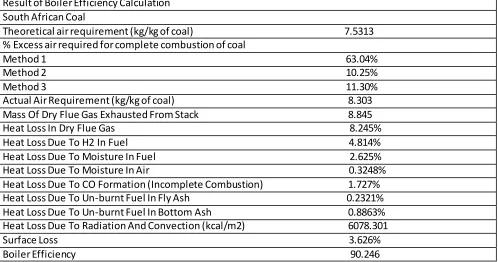
Result derived from the above formulas for the fuel South African Coal with GCV of 6500 kcal/kg . Table No 1
Result of Boiler Efficiency Calculation South African Coal
Theoretical air requirement (kg/kg of coal) 7.5313 % Excess air required for complete combustion of coal
Method 1 63.04% Method 2 10.25% Method 3 11.30% Actual Air Requirement (kg/kg of coal) 8.303 Mass Of Dry Flue Gas Exhausted From Stack 8.845 Heat Loss In Dry Flue Gas 8.245% Heat Loss Due To H2 In Fuel 4.814% Heat Loss Due To Moisture In Fuel 2.625% Heat Loss Due To Moisture In Air 0.3248% Heat Loss Due To CO Formation (Incomplete Combustion) 1.727% Heat Loss Due To Un-burnt Fuel In Fly Ash 0.2321% Heat Loss Due To Un-burnt Fuel In Bottom Ash 0.8863% Heat Loss Due To Radiation And Convection (kcal/m2) 6078.301 Surface Loss 3.626% Boiler Efficiency 90.246
Table No 2.
Efficiency Find Out by Direct and Indirect Method Boiler efficiency South African Coal Indirect method app.86 Direct method app.91
VI. GRAPHICAL ANALYSIS OF RESULT
Figure 1 shows the boiler efficiency with the GCV of the coal. As the coal used with higher GCV, efficiency is
increased. Lignite coal with 4300 kcal/kg gives a 77.51% in this boiler, while semi bituminous coal with 5800 kcal/kg gives 80.20% efficiency in this
boiler. So as the higher grade coal is used, efficiency will be increase.
Fig 2 efficiency with wind velocity
Figure 2 shows that while wind velocity is increased that time surface loss is increased so the efficiency is decreased.
Figure 3 indicate that if fuel is moister, than it is directly affected the combustion of fuel, so increasing in the moisture content in the fuel means decreasing in efficiency.
Fig 4 efficiency with % of moisture in air
Figure 4 shows the effect of moist air on the boiler efficiency. It is called seasonal effect.in the monsoon season air is more humid, and in summer and winter the air is dry. Air has less water particles in the summer and winter. So as the moisture content in air is increased the efficiency of the boiler is decreased.
Fig 5 Efficiency with ash % in fuel
Figure 5 show that the coal has a more ash content; it decreased the efficiency of the boiler. Lignite coal has up to 40% ash content and other high grade coal like semi bituminous and bituminous have less ash content than the other coal. So increasing in % of ash in coal is result in a decreasing of efficiency.
VII. EFFICIENCY IMPROVEMENT OPPORTUNITY IN BOILER SYSTEM
These are the parameters which are useful for improvement of the boiler efficiency.
A. Proper water treatment:
Various forms of contaminations arise with water and they must be removed before feeding to the boiler system by proper water treatment. Otherwise they moves with water and concentrate in the boiler, as a result deposition and scales are form which may reduce the heat transfer, reduce the boiler efficiency, increase the operation & management cost and damage the tubes.
I. TDS control
Total dissolves solids comes with feed water into the boiler, water is heated and converted into the steam bur TDS are remaining in the boiler and concentrated, and eventually reach at a level where their solubility in the water in the water is exceeded and they deposit from the solution. Thus they form scale and reduce heat transfer and also overheat the tubes and puncture those tubes. Thus TDS control is essential by manual blow down or automatic blow down system.
II. pH control
pH is the measure of how acidic or basic the feed water. Feed water must be neutral which save the energy. pH is controlled by either removing impurities or adding other chemicals to neutralized the water or by blow down of water. B. Proper fuel preparation:
Fuel contaminants (dirt, dust, suspended particles, moisture etc.) , they must be removed by proper fuel treatment otherwise, they forms the scales and reduces the heat transfer rate or excessive moisture uses a lot of energy as required to change the phase and this energy carried over with flue gas as loss. A quality feed into the boiler raise the efficiency level of boiler and also reduce the maintenance costs.
C. Fuel selection:
The proper fuel specification can also have a effect on efficiency. In the case of gaseous fuel, the higher the hydrogen content, the more water vapor is formed during combustion, which leads higher heat loss due to evaporation of water form by hydrogen in fuel. To get an accurate efficiency calculation, a fuel specification that represents the job site fuel to be fired must be used.
The heat produced from incomplete combustion of fuel is less compared to complete or good combustion of fuel. It is ultimately a heat loss. The main causes of incomplete combustion are: 1 Excess fuel supply
2 Shortage of combustion air 3 Improper firing of fuel
4 Improper sizing of fuel (in case of solid fuels) 5Poor atomization of fuel (in case of liquid fuel) 6 Poor mixing of fuel and air
A proper selection, operation and good servicing of burner system can reduce the problems of incomplete combustion.
In coal firing system, un-burnt coal found in the bottom ash or carried over with flue gas or fly ash. This un-burnt coal is known as un-burn losses. In pulverized firing system, excessive fines may cause the higher un-burnt loss. In gas fired system, vaporizes light oil contained in the gas can condense, when the gas is expanded in a pressure reducing station. The condensed oil can carbonized in the gas burner and cause poor fuel distribution, which cause incomplete combustion. E. Pre heat the combustion air:
The waste hot flue gas has enough heat to raise the temperature of combustion air before using for the combustion.
Thus waste heat can be recovered from the boiler flue gas. Approximately, 1% thermal efficiency will be increased by raising air temperature by 200 C. Pre heated combustion air is supplied to the burner, which properly mix this air with fuel and fires into the boiler. Most oil & gas burner in the existing boiler system cannot withstand high air
temperature. Which can be raised the combustion efficiency of boiler.
F. Controlling the excess air:
Excess air is the additional air supplied beyond the theoretical air to ensure the complete combustion of fuel, so that C,H, & S of fuel are converted into CO2, H2O, & SO2 respectively. Excess air is supplied to the combustion of fuel because a boiler firing without sufficient air or “fuel-rich” is operating in a potentially dangerous condition. So, excess air is supplied to the burner to provide a safety factor above the actual air required for combustion. A quality design will allow firing at minimum excess air levels of 15% (3% of O2). O2 represents oxygen in the flue gas. Excess air is measured by sampling the O2 in the flue gas. If 15% excess air exits, the oxygen analyzer would measure the O2 in the excess air & shows a 3% measurement.
The optimum excess air level is depending on burner design & type, furnace design, fuel and process variables. It can be estimated by conducting various performance tests with different fuel/air ratios.
G. Boiler load fluctuation:
efficiency will be decreased ls, the fuel & air supply is reducing; hence mass of flue gas will be reduced. The reduction in flow rate of flue gas for some heat transfer area will also reduce the exit flue gas temperature. These all raise th efficiency of boiler.
below 50%, most combustion appliances need more excess air to burn the fuel completely. This increases the sensible heat loss and lowers the boiler efficiency.
Thus, boiler should be operated near to full load for achieving the maximum efficiency.
H. Boiler retrofitting or replacement:
Boiler retrofitting or replacement needs a lot of consideration and should be replaced after detailed energy audit, financial study and feasibility reports. The potential energy saving from replacing a boiler plant depends on the anticipated change in overall efficiency. A change in a boiler plant should be done if existing plant is: 1.Old and inefficient
2.Over or under sized for present requirements 3.Not able to fire cheaper substitute fuel 4.Not design for present load conditions.
5.Excessive operation & management costs and complexity and not justify.
6. Excessive pollution creates from generating unit.
The fuel saving by replacing a boiler of higher efficiency can be estimated as:
Fuel saving = 𝜂𝑛𝑒𝑤 − 𝜂𝑜𝑙𝑑 𝜂𝑛𝑒𝑤
∗𝐸𝑓𝑓𝑖𝑐𝑖𝑒𝑛𝑐𝑦𝑐𝑜𝑛𝑠𝑢𝑚𝑝𝑡𝑖𝑜𝑛
Where,
ηnew = efficiency of new boiler ηold= efficiency of old boiler I. Reduce scale and soot formation:
Formation of deposits (scales and soot) on water sides or gas sides can reduce the heat transfer and increase the flue gas temperature. The deposits are like a thermal insulation on the tubes, they must be cleaned periodically for better heat transfer and better efficiency.
Reduction of scaling on water side:
1.By proper water treatment and blow down 2. Cleaning the tubes at shut down period These deposits are corrosive and may damage to the water tubes in the boiler furnace, economizer, and air preheater or super heater. Thus deposits can reduce the efficiency of all heat exchangers throughout the flue gas path.Reduction of soot on gas sides
used to soot out the deposits from the tube surface and clean the heat transfer surface by utilizing steam at high pressure. Stack temperature should be recorded regularly, when the flue gas temperature increased about 20oC above the normal value, soot blowers are operated and remove the soot deposits.it is advisable to install a dial type thermometer at the stack to monitor the exhaust flue gas temperature.
Periodic off line cleaning of furnace surfaces, tube banks, heat recovery equipment.
J. Reduce surface heat losses:
The boiler surface temperature is higher than surrounding ambient temperature; hence heat is naturally flows from high temperature zone to low temperature zone. Wind velocity also affects these losses.
Surface heat losses are depending on:
1. Difference of the temperature between boiler surface and ambient.
2.Surface area 3.Wind velocity
Surface heat losses are fixed energy losses and do not depend on the boiler loadings. Its value is about 1-5% at full load but be contribute about 6% of total losses at 25% load. These losses can be reduced by installing a proper thermal insulation over the outside surface and good refractory lining inside the boiler furnace.
K. Combustion control system improvements: Conventional combustion control systems are inefficient. Microprocessor based combustion control system is most efficient, reliable and flexible. It have continuous on line sensors that measures and display the gas temperature, oxygen, fuel to air ratio, combustion efficiency etc.
The main components of this system are oxygen sensors, electronic controller and air flow control unit. Oxygen sensors measure the % O2 and appropriately changes the air flow to the boiler furnace, thus maintain optimum excess air level or optimum fuel/air ratio. Major advantages of this system are that, it is flexible and programmable, operator and change the set points by protective programming of the system.
L. VSD for fans, blowers and pumps:
Variable speed drives are available for variety of applications and equipment for better speed control with reduction in power consumption. The power consumption by fan or pump is directly proposal to cube of speed. Hence little speed reduction can reduce significant power consumption.
Boiler system contains fans, blowers, and pumps for various purposes.
Fans - primary air fan, secondary air fan Blowers - air blowers
Pump - feed water pump, condensate pump These all equipment uses an electric motor as a prime mover. VSD can be installed in the existing system to control the speed of electric motor, which is coupled with impeller of fan, blower or pump. There are number of process fans and pumps, a sum of energy saving for each of them by VDS is a big value. Damper control for speed variation is very in efficient method.
VIII. CONCLUSION
REFERENCE:
Dr. Anirudh Gupta2 Bora,M.K., “The comparison with design value and enlisted some of the factors that affect the performance of the boiler”, International Journal of Advanced Research Vol-2 ISSN: 2320-5407 (2014). [5]
Zhou Jijun.,“Improving boiler efficiency modelling based on ambient air temperature”, ESL-HH-02-05-45 (May 2002). [6]
Vakkilainen, E. K., “Modern method to determine recovery boiler efficiency”, PAPEL vol. 72, num. 12, pp. 58 - 65 DEC 2011. [7]
Jain, A. Kumar., “An approach towards efficient operation of boilers”, International Journal of scientific and Engineering research”, Vol-3 ISSN: 2229-5518 (June 2012). [8]