ISSN 2348 – 7968
Design And Implementation Of Mobile Learning Zone For
Universities Of Iraq
Tareq Ali Al-Saadi
1, Ali Mohamed Husein Nasralla
2, Nassir Jabir Al-Khafaji
3,
Nawar Abbood Fadhil
3, Ali Abdulrazzaq Al-Sawad
31
Information Technology Directorate, Ministry of Science and Technology, Baghdad, Iraq
2
College of Sciences, University of Kerbala, Kerbala, Iraq
3
School of Computing, Universiti Utara Malaysia, Kedah, Malaysia
ABSTRACT
Using Mobile technologies in the education sector influences the mobility, motivation, and collaboration of a learner, which is beneficial for learners, teachers, and parents. Mobile learning (M-learning) is viewed as a type of learning model that allows learners to have access to learning materials anytime and anywhere through the Internet and mobile technologies. Because of the special situations that Iraq is facing recently, the use of Mobile devices among university students has increased. This study aims to exploit the widespread use of Mobile devices to design the Mobile Learning System for Universities of Iraq through design prototype system. This system allows students and professors to communicate anytime and anyplace more smoothly and easily. As a result, the difficulties faced by students in the learning process in Iraq due to special circumstances can be overcome. In this study, Rapid Application Development has been used to design the Mobile LearningZone prototype, and this prototype has been evaluated through Technological Acceptance Model (Ease of use and Usefulness). Moreover, thirty participants were involved in the research. The results have shown that approximately all of the respondents are agreeable with the features available in the prototype.
Keywords: Electronic Learning Mobile Learning Universities of Iraq
INTRODUCTION
These days, the education sector is changing (Fiore, Mainetti, Patrono & Vergallo, 2013). The education sector is pressured to adapt to changes brought about by technological shifts, financial boom and crisis, globalisation, demographic pressures, and most especially changing user expectations. As students have become more IT savvy, educators are forced to make use of modern tools in their teaching, which is called electronic learning (Sarrab, Al-Shihi & Rehman, 2013). This exhibits modern advancements to the learning process, which mostly involves the use of ICT tools and technologie (Albirini, 2006). Various organizations such as schools, universities, and organizations can take advantage of electronic learning. The term mobile is referred to as the possibility taking place in multiple locations, across multiple times, and addressing multiple content areas through the use of static or portable equipment such as Personal Digital Assistants (PDAs), smart phones, and wireless laptops (Ogunleye & Van Belle, 2013). These are the fastest developing and growing computing platform with approximately two billion mobile device users across the
globe by 2015 (Malone el at., 2013). Various types of educational usages have been accounted for, including language teaching through short messages (Cavus & Ibrahim, 2009), vocabulary and practice questions (Mcconatha, Praul, & Lynch, 2008), and numerous experiential learning situations informal problem-solving. As computers and the Internet have become very essential tools for education, the modern technologies have also become more easy to use, portable, and more efficient (Sarrab, Elgamel & Aldabbas, 2012). Mobile devices are relatively cheaper than desktop computers and allow for a less expensive Internet access (Pšenáková, 2010). At present, tablets PCs make way for mobile internet access with equal or more functionality than desktop computers.
Similarly, education is revolutionised by wireless technologies (Mayende, 2007), turning the traditional teaching and learning methods into ‘anytime’ and ‘anyplace’ education. A new model of e-learning, mobile learning combines mobile computing and e-learning (Cheung, 2014). Mobile learning, also called M-learning, is referred to as the utilization of mobile and handheld IT devices, such as PDAs, mobile phones, tablet PC technologies and laptops in training, teaching, and learning (AIahad el at., 2012). In terms of learning, desktop computers are considered as the first and second waves, while mobile learning is considered as the third wave.
PROBLEM IDENTIFICATION
The utilization of mobile applications in education institutions differs from one country to another, particularly among developed and developing countries (Keengwe & Bhargava, 2013). Moreover, the number of studies focusing on the use of mobile technologies in unstable or conflict areas such as Iraq is limited. Furthermore, several researchers indicated that mobile devices allow for sharing and transmitting data in a dynamic and unstable environment (Cristescu et al, 2012; Valcourt et al, 2005). The most significant educational challenge of the 21st century is the need to boost access to education. But, with the various useful aspects of mobile technologies that cannot be ignored, incorporating mobile technologies in education is very important. The potential of mobile technologies to deliver education to a great number of citizens is huge (Najafabadi et al, 2011; Mahamad et al, 2008). Currently, educational institutions around the world are considering the use of mobile phone and other mobile technologies as a means to immerse students in the learning process (Ryan, McCarthy, Byrne & Xiong, 2013).
Moreover, Vanderlinde and van Braak (2010) pointed out that educational institutions should focus on incorporating Mobility in education. The abovementioned arguments and the high rate of Internet use through mobile devices among university students in Iraq (Younus, 2014) and also based on a recent study conducted by Google indicated that smart phones in the Middle East such as Iraq are among the highest rates around the world (Hameed, Shukur, Al-khafaji & Al-Farhan, 2014) have motivated the researcher to utilize mobile technologies and Internet to design a learning zone prototype to integrate all the components of the educational process in universities (administration, university professor, and students) anytime and anywhere.
LITERATURE REVIEW
Mobile technologies, especially mobile phones, are becoming an integral part of modern life around the world. Thus, this section focuses on the use of ICT in education, which includes electronic learning (e-learning) and mobile learning (m-learning). This section also discusses the difference between e-learning and m-learning and sheds light on the growth that accompanies the development of mobile phone devices.
Electronic learning
The Internet and its applications in the education sector have greatly influence the way people teach and learn. This occurrence is a result of emerging technologies and consumers’ growing demands for online instruction. A new form of teaching and learning has sprung up amid this environment of rapid growth. Electronic learning (e-learning) is referred to as an appropriate organisation of information and communication technologies for advancing student-oriented, open, collaborative, active, and lifelong teaching-learning processes (Thurab-Nkhosi & Giannini-Gachago, 2005).
The utilization of technology has become an essential part of education, work, communication, and entertainment (Czaja et al., 2006). Connolly and Stansfield (2007) suggested that e-learning has gone through three distinct generations. The first generation occurred from 1994 to 1999, which was characterized by a passive use of the Internet where traditional materials were simply converted to an online format. The second generation occurred from 2000 to 2003, which was characterized by the transition to higher bandwidths, expanded resources, ample streaming media, and the move to make virtual learning environments that integrated access to course materials, student services, and communications. The third generation is at present underway, and it is characterized by the integration of more extensive collaboration, project-based learning, socialization, and reflective practices through the use of such tools as wikis, blogs, e-portfolios, social networking and bookmarking, and online simulations. The third generation is continuously and greatly influenced by developments in mobile computing.
E-learning refers to the combination of computer technology to strengthen learning (Coleman, 2011). This determines the dawn of a new era in educational provision where the challenges of diversity in programmes and
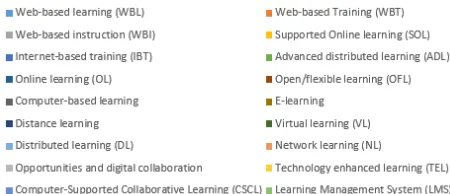
learners are acknowledged. E-learning comes in various terms, although they suggest the same activity. These include (Khan, 2001; Bhattacharya & Sharma, 2007; Naidu, 2003; Takalani, 2008), as depicted in the Figure 1 below.
Figure 1: Electronic learning synonyms
Mobile Technologies
Mobile phones have become an integral part of everyday life, so it is an essential item for every individual (Ejehiohen, 2013). Essential tools for communication, mobile phones have helped in the development of development countries where there is no access to telephone line network (James & Veerstag, 2007). They also play a very important role in the younger generation’s life (Moura & Carvalho, 2008). Mobile phones have features that allow for e-mailing besides the traditional messaging and chatting system (Cathieforuni, 2010). James and Veerstag (2007) further explain the manner in which mobile phones have boosted the GDP growth rate in developing countries.
The growing use of mobile phones in the current economy is sufficient evidence of the importance of the role mobile phones play. Great developments have been seen in the use of mobile phones in Africa in the past few years (Aker & Mbiti, 2010). Mobile devices have bridged the gap between the urban and rural area, which has an impact on communication between individuals and businesses. Aker and Mbiti (2010) report that the mobile phone is the first ICT tool to reach African rural communities. Furthermore, they explain that mobile phones have significantly lowered communication costs, paving the way for individuals to send and receive information cheaply and quickly. As well as, these technologies bring numerous benefits to the students, teachers, and administrators, which have greatly contributed to their increasing popularity in the education sector over the last decade (Kamil, Fadahl, Shukur, Al-khafaji & Azeez, 2014). In Iraq, there are numerous of the studies utilized mobile technologies to provide services to various stakeholders and these technologies proved have good benefits for the citizens and government as well as the business sector. But unfortunately there is scarcity of the studies that focus on the acceptance or the usability and also the factors that effect on the success of failure these applications or services.
The evolution of mobile phones
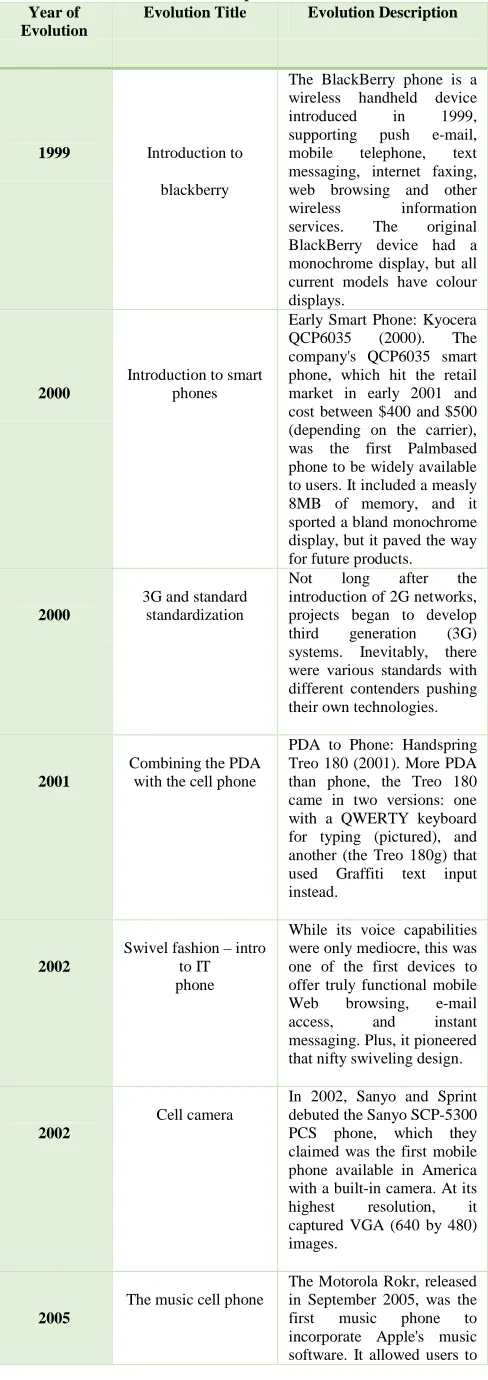
Mobile phones have undergone a remarkable evolution in the last decade. In less than a decade, mobile phones, which started with text messaging and voice services, have turned out to be real multimedia devices. This section shows the evolution of mobile from 1999 till 2013 (Adapted from Ejehiohen, 2013):
Table 1: Evolution of mobile phones from 1999 to 2013 Year of
Evolution
Evolution Title Evolution Description
1999 Introduction to
blackberry
The BlackBerry phone is a wireless handheld device introduced in 1999, supporting push e-mail, mobile telephone, text messaging, internet faxing, web browsing and other wireless information services. The original BlackBerry device had a monochrome display, but all current models have colour displays.
2000
Introduction to smart phones
Early Smart Phone: Kyocera QCP6035 (2000). The company's QCP6035 smart phone, which hit the retail market in early 2001 and cost between $400 and $500 (depending on the carrier), was the first Palmbased phone to be widely available to users. It included a measly 8MB of memory, and it sported a bland monochrome display, but it paved the way for future products.
2000
3G and standard standardization
Not long after the introduction of 2G networks, projects began to develop third generation (3G) systems. Inevitably, there were various standards with different contenders pushing their own technologies.
2001
Combining the PDA with the cell phone
PDA to Phone: Handspring Treo 180 (2001). More PDA than phone, the Treo 180 came in two versions: one with a QWERTY keyboard for typing (pictured), and another (the Treo 180g) that used Graffiti text input instead.
2002
Swivel fashion – intro to IT phone
While its voice capabilities were only mediocre, this was one of the first devices to offer truly functional mobile Web browsing, e-mail access, and instant messaging. Plus, it pioneered that nifty swiveling design.
2002
Cell camera
In 2002, Sanyo and Sprint debuted the Sanyo SCP-5300 PCS phone, which they claimed was the first mobile phone available in America with a built-in camera. At its highest resolution, it captured VGA (640 by 480) images.
2005
The music cell phone
The Motorola Rokr, released in September 2005, was the first music phone to incorporate Apple's music software. It allowed users to
transfer songs purchased from iTunes to the phone for listening on the go.
2006
Cell Phone Design In 2006, the trend for stylish gadgets became very common. Fancy cell phone designs were made. The LG Chocolate was a great example of how cellphone designers are putting style in the forefront of cell phone design.
2007 Apple iphone
In 2007, Apple Inc unveiled the Apple iPhone, which was the world’s first advanced touchscreen smartphone. It is the first phone to have an operating system, the iOS, and by enabling apps to run on the phone, it had allowed cell phones to become the primary mobile device of use. Having an iPhone became a source of pride.
2008 Querty keyboard
In 2008, as dependence on the laptop as a necessary tool for work increases, mobile
phones undergo transformation to become the
device to have with you on-the-go. The HTC G1, which was a slider cell phone that hides a full QWERTY keypad beneath its large screen, runs on the Android OS.
2012
Touchscreen
2011 marked the return of the touchscreen, which dominated the mobile gadget scene with its powerful hardware and sleek looks.
2013
Samsung Galaxy S4 and Blackberry 10
In March, 2013, Samsung announced a new model of Galaxy series named Galaxy S4. They started selling Galaxy S4 in April 2013 worldwide and made a hit of 20 million selling mark within only 2 months. It was the record breaking mark of the history. Blackberry also tried to back in the race with Blackberry 10.
M-learning concept
Mobile learning (m-learning), which is a type of learning model, allows learners to access learning materials anytime and anywhere using mobile technologies and the Internet (Ozdamli & Cavus, 2011). According to Mehdipour and Zerehkafi (2013), mobile learning has various meanings for various communities, and it is a subset of e-learning, educational technology, and distance education that concentrates on learning across contexts and learning through the use of mobile devices. Various terms and definitions are used synonymously with mobile learning, such as m-learning, u-learning, learning while mobile personalized learning, ubiquitous learning, handheld
learning, and anytime and anywhere learning (Wu, Tzeng, Kuo & Tzeng, 2014; Karpicke, 2014; Doolittle & MaRIanO, 2008; Chen, Hsu, Li & Peng, 2006). O'Malley et al. (2003) define mobile learning as any kind of learning that takes place when the learner is not at a fixed, predetermined location, or learning that takes place when the learner takes advantage of the learning opportunities offered by mobile technologies. Moreover, Lehner, Nosekabel and Lehmann (2003) define m-learning as any service or facility that provides a learner with general electronic information and educational content that assists in obtaining knowledge regardless of time and location.
This means that by using mobile devices, learners can learn anytime and anywhere (Chandler & Beedasy, 2014). Mobile learning is deemed as the capability to use mobile devices to assist students and lecturers in unfavorable conditions. Certainly, ‘mobile learning’ is just the juxtaposition of the words ‘mobile’ and ‘learning’; its inherent meaning has always been ‘mobile e-learning’, and its history and evolution need to be understood as both a continuation of ‘conventional’ e-learning and a reaction to this ‘conventional’ e-learning and to its perceived limitations and insufficiencies (Cline & Davis, 2013). What makes mobile learning stand apart from the other forms of learning is the its ‘mobile’ aspect, particularly creating learning experiences that take advantage of the opportunities that ‘mobility’ provide (Banjoko, 2013). Nowadays, students enrolled in higher and further education institutions frequently need information from their respective institutions regarding assessment deadlines, timetable changes, feedback from tutors and other urgent administrative information. The use of mobile telephony is a much more efficient and faster means of communication than email or post contact (Mehdipour & Zerehkafi, 2013). The Figure 2 illustrates the M-learning components for universities:
Figure 2: Mobile Learning Components
M-Learning puts emphasis on the mobility of the learner, interacting with portable devices, and learning that focuses on how society and its institutions can accommodate and assist a growing mobile population (Kihoro, Oyier, Kiula, Wafula & Ibukah, 2013). The reason for this is mobile devices possess features and functionality for supporting learners. An example would be podcasts of lectures that can be downloaded. Learners expect to be able to participate in these learning resources while away from the traditional learning spaces. At University of Lancaster, a
group of researchers probes into the use of SMS as a means of communication between teachers and students (Mitchell, Race, McCaffery, Bryson & Cai, 2006). By integrating the SMS text messaging feature into the existing e-learning management system of the university, they communicated with the undergraduate students on a large scale. The group found that SMS text messaging is a less expensive and faster method to send personalized information to the mobile phones of the learners.
Differentiating E-Learning from Mobile Learning
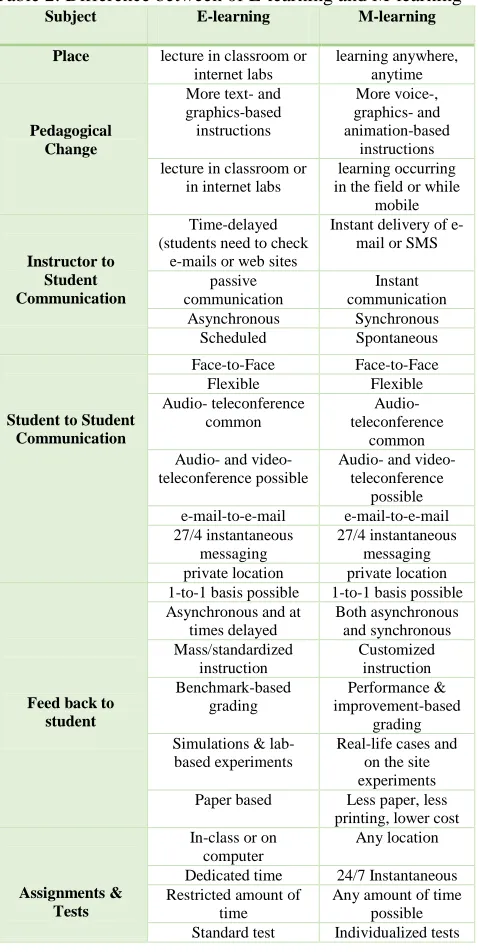
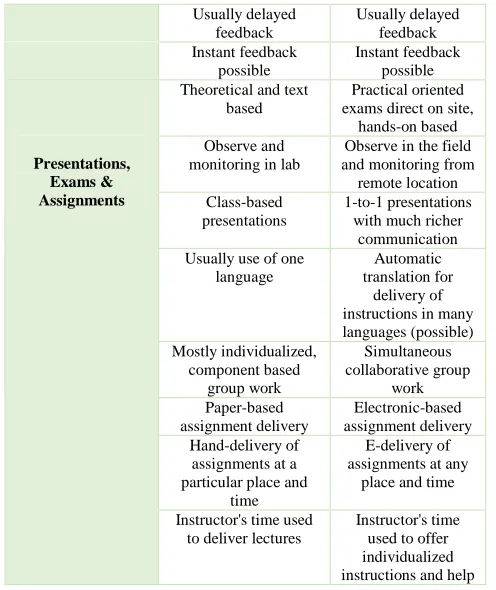
Also known as ‘synchronous’ learning or asynchronous’ learning, e-learning can be real-time or self-paced. Moreover, e-learning is regarded as ‘tethered’ and exhibited in a formal and structured manner (Frazier, 2013). On the contrary, mobile learning is generally self-paced, untethered, and presented in an informal manner (Motiwalla, 2007), see Table 2.
Table 2: Difference between of E-learning and M-learning
Subject E-learning M-learning
Place lecture in classroom or
internet labs
learning anywhere, anytime
Pedagogical Change
More text- and graphics-based instructions
More voice-, graphics- and animation-based
instructions lecture in classroom or
in internet labs
learning occurring in the field or while
mobile
Instructor to Student Communication
Time-delayed (students need to check
e-mails or web sites
Instant delivery of e-mail or SMS
passive communication
Instant communication Asynchronous Synchronous
Scheduled Spontaneous
Student to Student Communication
Face-to-Face Face-to-Face Flexible Flexible Audio- teleconference
common
Audio- teleconference
common Audio- and
video-teleconference possible
Audio- and video-teleconference
possible e-mail-to-e-mail e-mail-to-e-mail 27/4 instantaneous
messaging
27/4 instantaneous messaging private location private location
Feed back to student
1-to-1 basis possible 1-to-1 basis possible Asynchronous and at
times delayed
Both asynchronous and synchronous Mass/standardized
instruction
Customized instruction Benchmark-based
grading
Performance & improvement-based
grading Simulations &
lab-based experiments
Real-life cases and on the site experiments Paper based Less paper, less
printing, lower cost
Assignments & Tests
In-class or on computer
Any location
Dedicated time 24/7 Instantaneous Restricted amount of
time
Any amount of time possible Standard test Individualized tests
Usually delayed feedback
Usually delayed feedback Instant feedback
possible
Instant feedback possible
Presentations, Exams & Assignments
Theoretical and text based
Practical oriented exams direct on site,
hands-on based Observe and
monitoring in lab
Observe in the field and monitoring from
remote location Class-based
presentations
1-to-1 presentations with much richer
communication Usually use of one
language
Automatic translation for
delivery of instructions in many languages (possible) Mostly individualized,
component based group work
Simultaneous collaborative group
work Paper-based
assignment delivery
Electronic-based assignment delivery Hand-delivery of
assignments at a particular place and
time
E-delivery of assignments at any
place and time
Instructor's time used to deliver lectures
Instructor's time used to offer individualized instructions and help
METHODOLOGY
Conducting any type of research needs to be guided by a well-defined research methodology based on scientific principles. Thus, research methodology defines the systematic scientific procedures utilized to arrive at the results and findings for a study against which claims for knowledge are assessed (Saunders, Lewis & Thornhill, 2007). The following Figure 3 illustrates the phases for achieving the objectives of the current research.
Figure 3: Methodology
Phase One: Formulating the problem statement.
The characteristics of mobile learning needs to be organized, and the manner in which they are applied to mobile learning activities, the applications methods and the duration of the application time need to be planned well ahead of time. As such, at this stage, the problem is defined. This section includes the following points:
• Identifying the problem
• Explaining the problem
• Ensure the objectives and scope of the problem
Phase Two: To determine the requirements.
At this stage, the researcher attempts to achieve the first research objective. The literature review (internet, journals, books, thesis, and forums) are the main sources for answering the first research question. This objective can be achieved by discovering the functions of the previous m-learning system from related studies.
Phase Three: Design and implementation the prototype system.
This research deals with the prototype development of a mobile learning application for mobile phones running on Android platform using Java. Android platform provides the tools and packages required for designing the desired m-learningZone for mobile devices in the u-learning environment. A study by Dan Melzer of the Florida State University showed that constructivist learning in online courses has important advantages over traditional classroom-based courses. In a student-centered learning, collaboration and discussion among all participants in the class are required. This allows the students themselves to contribute a new source of knowledge. Android allows developers to create very rich and innovative applications with a rich set of user interfaces and support for broad range audio and video file formats. Because of the platform’s open-source and diverse application development and running capabilities with Java as it programming language, developers and mobile handset manufacturers all over the world have embraced it.
Figure 4: RAD Methodology (James Martin and DuPont, et. 1980)
For phase 3, the RAD model methodology is utilized as a guide and foundation (Ali & Mohamud, 2013). Figure 2 below shows the overall workflow for all phases in RAD methodology. Created by James Martin, the phases in the model are requirements planning, system design, system development, and implementation (Dennis, Wixom & Tegarden, 2005). The following are the phases in a RAD model within the system development:
• Requirements Planning Phase: This is achieved in the stage 2 above.
• Design Phase: In the design of the m-learningZone, user needs and requirements are given priority.
• System Development Phase.
• Implementation Phase: Implementation phase is carried out after the completion of system development phase.
Phase Four: to evaluate the prototype system.
In this stage, the questionnaire on the evaluation of the m-learningZone will be distributed. The target samples for evaluating the prototype are Iraqi students in Dhi-Qar University. This sample chose because of the materials structure and the administration procedures of universities in Iraq are homogeneous. Technology acceptance model is more suitable to use in understanding to what extent the university components (students, lecturers, and university) will accept this technology through its ease of use and usefulness.
ANALYSIS AND DESIGN
Use Case Diagram
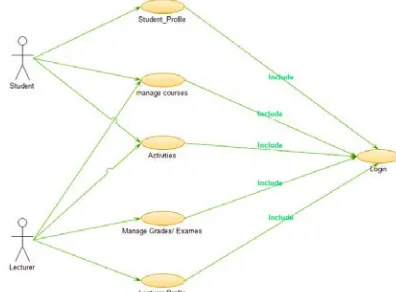
The design of any system or prototype depends mainly on the UML diagrams. The UML diagrams used are case diagram, class diagram, and sequence and activity diagram. This study focuses on Use Case Diagram and Class Diagram because these diagrams shed light on the completion of the system.
Microsoft Viso 2013 is used as the software to draw these diagrams, which are helpful in the development stage. Use case diagram describes the overall interaction between the prototype and its users and how the users will use the prototype. The Figure 5 illustrates this interaction.
Figure 5: Use Case Diagram for M-LearningZone
Class Diagram
This part determines the requirement for the prototype by using class diagram. This diagram includes all the methods and operations needed to investigate this prototype as depicted in Figure 6. This diagram illustrates the relations between boundaries, controllers, and entities in the m-learningZone prototype.
Figure 6: Class Diagram for M-LearningZone
Prototype System Interface
This section describes the interface for the m-learningZone prototype for lecturers and students. Indeed, the users (lecturer and students) cannot access the system features without logging-in successfully.The login page includes user name and password that are entered by the users.
Figure 7: Interface for M-LearningZone
When a student user logs-in successfully, the system displays all the student functions, such as all courses take, announcements, links, and events. Moreover, when a lecturer user logs-in successfully, the system shows the main functions for them, such as course information, announcement management, and links.
EVALUATION PROPOSED PROTOTYPE SYSTEM Evaluation of the system by its end users through the acceptance test is considered as one of the most crucial methods in usability evaluation. As aforementioned, this study utilizes the SPSS v.20 software to analyse raw data collected from the respondents. Moreover, 40 respondents are involved in this survey.
Usefulness
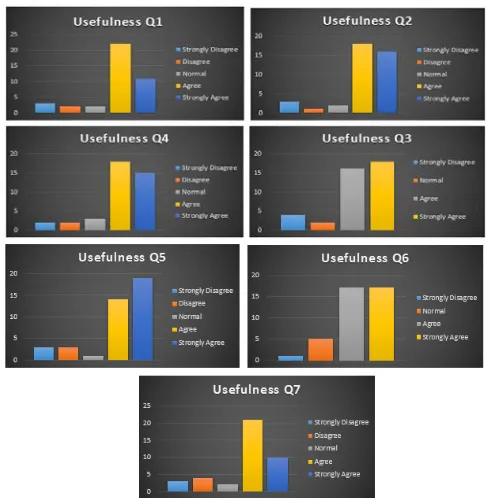
With regard to the usefulness, seven questions related to this factor are posed. Figure 8 illustrates the findings from the respondents. Almost all respondents either
agree or strongly agree with the functions related to the usefulness of the system.
Figure 8: Usefulness Dimension Analysis Ease of Use
Ease of use is deemed as one of the most crucial elements for the acceptance of any new technology. This system seeks to deliver learning to a wide area, particularly those in conflict situations, but the ease of use is also crucial. Thus, this study posed seven questions regarding the ease of use of the system and the features for the students and lecturers. Figure 9 shows the results gathered from these questions, where around 80% of the respondents have agreed that the system has good structure and features and that these functions and features are easy to use.
Figure 8: Ease of use Dimension Analysis
CONCLUSION
The growth of Information and Communication Technologies and its importance in our daily life have aided the educational institutions around the world to harness these technologies and incorporate them in the learning process. In the same context, the use of mobile phone devices has increased dramatically, particularly in developing countries. Iraq, a developing country, has witnessed a significant increase of smartphone and Internet users. However, there are few applications designed for delivering services to the citizens or the customers in the public and private sectors. Moreover, because of the conflict and circumstances that Iraq is currently facing, activation of online services is very important, if not mandatory for the government. Therefore, this study seeks to concentrate on the education sector by designing the prototype for Universities of Iraq.
REFERENCE
AIahad, N., HZ, B., Abdul Rahman, A., Zairah, N., & Rahim, A. (2012). Mobile learning: cell phones and PDAs as educational learning tools for students in tertiary institutions. International Journal of Engineering and Technology, 2(3), 535-540.
Aker, J. C., & Mbiti, I. M. (2010). Mobile phones and economic development in Africa. The Journal of Economic Perspectives, 207-232.
Albirini, A. (2006). Teachers’ attitudes toward information and communication technologies: The case of Syrian EFL teachers. Computers & Education, 47(4), 373-398.
Ali, F. A. B. H., & Mohamud, A. H. S. (2013). Web-Based Learning System with Video Conference Service.
International Journal of Information Technology, 2(1). Banjoko, N. (2013). The use of the Close User Group, CUG, for tutorial delivery and student support services among teachers in Nigeria.
Bhattacharya, I., & Sharma, K. (2007). India in the knowledge economy–an electronic paradigm. International
Journal of Educational Management, 21(6), 543-568.
Cathieforuni. (2010). What Role Do Mobile Phones Play in Society? Discuss the Influence of Technology on Everyday Life: Relationships, Social Movements and Education, from http://www.studymode.com/essays/What-Role-Do-Mobile-Phones-Play-406014.html.
Cavus, N., & Ibrahim, D. (2009). m‐Learning: An experiment in using SMS to support learning new English language words. British Journal of Educational Technology, 40(1), 78-91.
Chandler, T., & Beedasy, J. (2014). mLearning to Enhance Disaster Preparedness Education in K-12 Schools. Tablets in K-12 Education: Integrated Experiences and Implications, 75.
Chen, C.-M., Hsu, S.-H., Li, Y.-L., & Peng, C.-J. (2006).
Personalized intelligent m-learning system for supporting effective English learning. Paper presented at the Systems, Man and Cybernetics, 2006. SMC'06. IEEE International Conference on.
Cheung, S. K. (2014). A survey on the use of mobile devices for learning purposes. International Journal of Innovation and Learning, 16(2), 192-202.
Cline, R. C., & Davis, K. A. (2013). Using Mobile Technology in a Construction Management” Hands-On” Lab-oratory.
Coleman, R. K. N. (2011). Assessing the adoption of e-learning in Ghanaian universities. Masters, Luleå University of Technology), 1-321.
Connolly, T., & Stansfield, M. (2007). Developing constructivist learning environments to enhance e-Learning.
Principles of Effective Online Teaching, 19-38.
Cristescu, M. P. I., Laurentiu, C., & Martin, F. M. (2012). Characteristics of The Mobile Computational Architecture.
Revista Economica(5), 53-58.
Czaja, S. J., Charness, N., Fisk, A. D., Hertzog, C., Nair, S. N., Rogers, W. A., & Sharit, J. (2006). Factors predicting the use of technology: findings from the Center for Research and Education on Aging and Technology Enhancement (CREATE). Psychology and aging, 21(2), 333.
Dennis, A., Wixom, B. H., & Tegarden, D. (2005). System Analysis and Design with UML Version 2.0, Hobokens: NJ: WILEY.
Doolittle, P. E., & MaRIanO, G. J. (2008). Working memory capacity and mobile multimedia learning environments: Individual differences in learning while mobile.
Ejehiohen, I. G. (2013). Improving health delivery in rural communities through the use of mobile phones: a case study in Windhoek.
Fiore, A., Mainetti, L., Patrono, L., & Vergallo, R. (2013).
An EPC-based middleware enabling reusable and flexible mixed reality educational experiences. Paper presented at the Software, Telecommunications and Computer Networks (SoftCOM), 2013 21st International Conference on.
Frazier, S. D. (2013). An Analysis of the Current Use and Future Intentions to Use Mobile Learning Strategies among Full-Time Community College Faculty.
James, J., & Versteeg, M. (2007). Mobile phones in Africa: how much do we really know? Social indicators research, 84(1), 117-126.
Kamil, W. A., Fadahl, Z. A., Shukur, B. S., Al-khafaji, N. J., & Azeez, N. M. H. (2014, 6-8 May 2014). Mobile school: Face-to-face learning interface for Iraqi students in Malaysia. Paper presented at the 2014 Fourth International Conference on Digital Information and Communication Technology and it's Applications (DICTAP).
Karpicke, J. D. (2014). Personalized Learning and the Future of Educational Technology.
Keengwe, J., & Bhargava, M. (2013). Mobile learning and integration of mobile technologies in education. Education and Information Technologies, 1-10.
Khan, B. H. (2001). A framework for web-based learning.
Web-based training, 75-98.
Kihoro, J. M., Oyier, P. A., Kiula, B. M., Wafula, J. M., & Ibukah, R. W. (2013). E-learning eco-system for mobility and effective learning: A case of JKUAT IT students. Paper presented at the IST-Africa Conference and Exhibition (IST-Africa), 2013.
Lehner, F., Nosekabel, H., & Lehmann, H. (2003). Wireless e-learning and communication environment: WELCOME at the University of Regensburg. E-Service Journal, 2(3), 23-41.
Mahamad, S., Ibrahim, M. N., Izzriq, M., Foad, A. M., & Taib, M. (2008). Open source implementation of m-learning for primary school in malaysia.
Mayende, G. (2007). Mobile Technologies to Support Discussion Groups within in Distance Education in Developing Countries.
Mcconatha, D., Praul, M., & Lynch, M. J. (2008). Mobile Learning in Higher Education: An Empirical Assessment of a New Educational Tool. Online Submission, 7(3).
Mehdipour, Y., & Zerehkafi, H. (2013). Mobile Learning for Education: Benefits and Challenges. International Journal of computational Engineering research (IJCER), 3(6), 93.
Mitchell, K., Race, N. J., McCaffery, D., Bryson, M., & Cai, Z. (2006). Unified and personalized messaging to
support E-learning. Paper presented at the 4th IEEE
International Workshop on Wireless, Mobile and Ubiquitous Technology.
Motiwalla, L. F. (2007). Mobile learning: A framework and evaluation. Computers & Education, 49(3), 581-596. Moura, A., & Carvalho, A. A. A. (2008). Mobile learning with cell phones and mobile flickr: one experience in a secondary school.
Naidu, S. (2003). E-learning: A guidebook of principles,
procedures and practices: Commonwealth Educational
Media Centre for Asia (CEMCA).
Najafabadi, M. O., Mirdamadi, S. M., & Najafabadi, A. T. P. (2011). Ordinal Logistic Regression to Design an Efficient Mobile Training System from Iranian Experts' Point of View. International Journal of Advanced Science and Technology, 34, 89-96.
Ogunleye, O., & Van Belle, J. (2013). Enhancement in M-Government and mobile computing in developing countries. O'Malley, C., Vavoula, G., Glew, J., Taylor, J., Sharples, M., Lefrere, P., . . . Waycott, J. (2005). Guidelines for learning/teaching/tutoring in a mobile environment. Mobilearn project deliverable. Available from http://www.mobilearn.org/download/results/guidelines.pdf, last accessed 13th Oct 2014.
Ozdamli, F., & Cavus, N. (2011). Basic elements and characteristics of mobile learning. Procedia-Social and Behavioral Sciences, 28, 937-942.
Pšenáková, I. (2010). M-learning-Mobile Devices in
Education. Paper presented at the 8th International
Conference on Emergencing elearning technologies and Applications ICETA 2010.
Ryan, G., McCarthy, N., Byrne, R., & Xiong, R. (2013). Educating University Students: Can Mobile Technologies Help? Student Usability in Educational Software and
Games: Improving Experiences, 59.
Sarrab, M., Al-Shihi, H., & Rehman, O. H. (2013). Exploring Major Challenges and Benefits of M-learning Adoption. British Journal of Applied Science & Technology, 3(4), 826-839.
Sarrab, M., Elgamel, L., & Aldabbas, H. (2012). Mobile learning (m-learning) and educational environments.
International journal of distributed and parallel systems, 3(4), 31-38.
Saunders, M., Lewis, P., & Thornhill, A. (2007). Research methods for business student (ed.) Prentice Hall. Financial Times.
Takalani, T. (2008). Barriers to e-learning amongst postgraduate black students in higher education in South Africa. Stellenbosch: Stellenbosch University.
Thurab-Nkhosi, D., Lee, M., & Giannini-Gachago, D. (2005). Preparing academic staff for e-learning at the University of Botswana. Innovate Journal of Online Education, 2(1).
Valcourt, E., Robert, J.-M., & Beaulieu, F. (2005).
Investigating mobile payment: supporting technologies,
methods, and use. Paper presented at the Wireless And
Mobile Computing, Networking And Communications, 2005.(WiMob'2005), IEEE International Conference on. Wu, C. H., Tzeng, Y. L., Kuo, B. C., & Tzeng, G. H. (2014). Integration of affective computing techniques and soft computing for developing a human affective recognition system for U–learning systems. International Journal of Mobile Learning and Organisation, 8(1), 50-66.