Available Online atwww.ijcsmc.com
International Journal of Computer Science and Mobile Computing
A Monthly Journal of Computer Science and Information Technology
ISSN 2320–088X
IMPACT FACTOR: 6.017IJCSMC, Vol. 8, Issue. 1, January 2019, pg.91 – 104
Energy Efficient and Load Balancing
Scheme of DSR Protocol (EELB-DSR)
1
Kadry Sayed Mohamed;
2
Sayed Abd El Hady Nouh;
3
Abdelhady M. Naguib
1 2Computers and Systems Department, Faculty of Engineering, Al Azhar University, Cairo, Egypt
1
[email protected], 2 [email protected], 3 [email protected]
Abstract- Mobile ad hoc networks (MANETs) composed of a collection of nodes that are linked in scattered way to enable wireless communications. All nodes are moveable and are dynamically connected in a random manner. MANETs could be used in numerous applications such as: military combats, WSN, in areas where it is tricky to construct wired network. Due to changing topology of MANET, limited power of battery , and limited bandwidth of wireless channels, it became design of routing schemes is one of the main defy in MANET. Commonly, MANETs’ routing protocols are categorized into two types: proactive routing (e.g. DSDV) and reactive routing (e.g. AODV and DSR). A lot of studies manifested that reactive routing protocols are better than proactive protocols. As a result, the offered article attentive with performance improvement of DSR, which is one of the most celebrated reactive routing protocols. The original DSR is multi hop scheme in its nature, where route election between any two communicating nodes is merely based on minimum hops count as a metric, irrespective of another metrics like energy of nodes and traffic load of nodes, that may have passive effect on performance of the original DSR. This essay presents novel version of original DSR, called (EELB-DSR), through modification of route discovery stage, in such a way that minimizes energy consumption of nodes, reduces flooding of control packets and realization of balanced traffic load of nodes, resulting in prolong life time of nodes, thence increase life time of the routes and relative stability of network. In the suggested scheme, route selection is based on three merged metrics: nodes’ energy, traffic load of nodes and received signal strength. Performance evaluation and comparison between proposed scheme (EELB-DSR) and original DSR has been implemented utilizing network imitator (NS2). Results of simulation proved that performance of the proposed protocol outperform original DSR in terms of: packet delivery ratio, end to end delay, normalized overhead and energy consumption of nodes.
Keywords—MANET, DSR, EELB-DSR, RREQ, RREP, NEF, RQF.
1- INTRODUCTION
Now a day, Mobile ad hoc network (MANET) is one of most important recent wireless networks, where it allows to the modern smart mobile nodes (e.g. mobile phones, laptops etc.) to communicate with each other at anytime and anywhere without needing any type of the centralized management [1]. Due to random mobility of nodes, any node has the ability to enter or depart network at any time, resulting in the network topology changes unpredictably and dynamically [2, 3]. Due to limited transmission range of wireless channel, if any node wants to communicate with anther node located outside of its transmission range, it is needed other intermediary nodes to act as routers to prepare a route in hops style between them. For this reason, each node in MANET should act as host and router in same time.
(e.g. DSDV and OLSR), directing information are exchanged among nodes at steady intervals and paths are computed constantly among nodes, regardless paths are required or not. And this leads to many consumed network resources (e.g. energy and bandwidth). Oncontrary, in reactive routing schemes (e.g. AODV and DSR), in lieu of exchanging routing information among nodes at consistent periods, the route is created merely when it is required (i.e. on demand). Hence, reactive routing schemes eschew the cost of routes upkeep which being not in use and also never launch tremendous control packets. Therefore, performance of reactive routing tactics outperform proactive routing methods.
Dynamic Source Routing protocol (DSR) is a valuable reactive routing schema for routing intent [7, 8], it is distributed routing mechanism. Where created routes among nodes take form of multi- hop. DSR is composed of two main stages: route discovery stage and route maintenance stage. For route unearthing, merely two control packets are utilized, called, Route Request (RREQ) packet and Route Reply (RREP) packet. For route creation between any two nodes, RREQ is broadcasted by source node. On receiving RREQ at destination node, it replies by sending RREP to source node to confirm route creation. While, in case of route maintenance, Route Error (RERR) packet is used, to inform source node that current used route during data transmission has been failed.
Although DSR has some advantages like: the route is established merely when it is needed, the nodes use route cache information efficiently to minimize the collision and control packets and route selection is based on minimum hop count. But during route discovery phase, DSR does not take into consideration nodes' energy, nodes' traffic load, and signal strength of exchanged packets. Whereas, all of these factors have a passive effect on performance of the standard DSR. Therefore, this article aims to improve performance of DSR through modification of route discovery mechanism, where the route selection is based on three merged metrics: nodes' energy, nodes' traffic load and signal strength of exchanged packets.
The rest of the paper is organized as follows: Section 2 presents the related works of routing techniques. While brief description of original DSR routing protocol is stated in Section 3. The proposed protocol is presented in Section 4. Simulation environment and parameters have been indicated in Section 5. In Section 6, simulation results and discussion have been presented. Finally, Section 7 concludes the article.
2- RELATED WORK
M. Sharifdeen and Dhavamaniprakash [9] suggested novel version of DSR, called EEDSR. Where, the route discovery scheme has been modified with aim to minimize energy consumption of nodes, thence prolong life time of network. In the suggested schema, selected route consists of minimum number of intermediate nodes having relatively high energy, resulting in more stabilized route for long time and hence decrease repetitions of route discovery mechanism. Simulation results proved that, in small size network, performance of both DSR and EEDSR is nearly identical with respect to energy consumption and throughput. While in moderate and large size network, EEDSR outperform of DSR from point of view of energy consumption and throughput.
Deepti D. and Rajendra S. K. [10] presented modified DSR algorithm, where path selection is based on node energy consumption as metric, for transmitting and receiving single packet instead of minimum hop counts. The article concluded that, performance of proposed algorithm is better than original DSR in terms of improving energy efficiency of nodes. Also the proposed mechanism reduces routing overhead by shun multipath propagation of RREP packets in standard DSR.
Uma R. Bhatt, N. Nema et al [11] introduced new schema, called DSRI, to reduce the flooding of RREQ packets, which cause to rebate energy consumption and network congestion. In suggested algorithm, route has been chosen based on three metrics: node’s speed, remaining energy and strength of receipted signal. These metrics have been chosen to avoid nodes that having low remaining energy, high mobility and low reception signal strength from participating in route creation, resulting in minimization of RREQ packets flooding, minus network congestion, minimum delay time and efficient bandwidth utilization. Results of simulation proved performance of DSRI outperform the original DSR from point of view of throughput, nodes' remaining energy and delay time.
In [12] the authors present a review and categorize the suggested energy conscious routing schemas of MANETs, which minifies either active wasted energy required to transmit and receipt packets or inactive energy consumed when the mobile node stays in idle mode but hears to the channel for any potential communication demands from another nodes.
Shweta S. and Gopal S. [13] proposed new version of DSR, where route maintenance mechanism has been modified to prolong active route life time. The basic idea beyond modification, is to account in advance the time at which active route is about to expire. This will assist to disclose new route before the old route become expired, resulting in saving more time of communication process.
Figure 1 Route Discovery Mechanism of DSR
N1
N1 N5 N2
N3
N4
N6
N7 Source
Connection RREQ RREP
N1
N1
N8 Destination
Krishna D. S. [15] introduced modified version of original DSR, called LS-MDSR. It is an energy- efficient routing algorithm and balanced traffic load sharing, where there is no route becomes heavily loaded or remains idle.
Roy Leung, Jilei Liu, et al [16] present an enhanced version of DSR, named multipath DSR (MP-DSR), with the aim for improving quality of service from point of view of routes reliability among communicating nodes with a minimum routing overhead.
Jijesh J. J and Shivashankar [17] projected a modified version of DSR, with goal of reducing energy consumption of nodes and to make routes more stable. Performance assessment and comparative analysis have been performed among the modified DSR, DADV and AODV, where simulation results indicated that proposed modified DSR outperform the aforementioned routing protocols with respect to: consumed energy, maximum throughput and delay time.
P. Parthiban, et al [18] introduced modified route discovery schema of DSR to magnify network life time, where route selection based on nodes' remaining energy and minimal hops count.
3- DYNAMIC SOURCE ROUTING (DSR)
DSR is entirely a reactive routing protocol. It is source routing scheme, that is mean the exchanged data packets among node contain an tidy list of all addresses of intermediary nodes through which packets should be routed to destination node [5]. In DSR, all nodes enclose a medium storage, called routing cache, to maintain acquired route for any target node in network. DSR schema includes two fundamental phases which are: route discovery and route maintenance. During route discovery phase, only two control packets are used, named route request (RREQ) and route reply (RREP), for path discovery between any two nodes. While, in route maintenance phase merely one control packet, called Route Error (REER) packet, is used.
When a source node intends to connect with destination node, it searches its routing cache to get a route. If no route is found, route discovery mechanism is initiated by broadcasting a RREQ to its neighboring nodes [19]. On receipt RREQ, in case of an intermediary node has a valid path to destination node, it forwards RREP packet containing this route in its header, through reverse path of RREQ packet, to source node [20-22]. Otherwise, it adds its address in route record field of RREQ header and rebroadcasts RREQ packet to neighboring nodes. This process is repeated till RREQ packet arrive to destination node. Because of rebroadcasting transmissions, RREQ itself may be arrive to destination
node, through various paths. On receipt 1st RREQ packet, destination node replies by sending RREP packet, through
reverse path of this RREQ, to source node as illustrated in figure1[23-25]. Whereas, the route selection in DSR depends on minimum hop counts [26, 27], so, the identical RREQ packets that later arrive at destination node will be dropped.
4- PROPOSED EELB-DSR
Although DSR is momentous protocol in MANET, it has many shortcomings like:
DSR is not energy efficient routing, as nodes have a limited- power battery, so routing protocols in MANET must be energy efficient. Therefore, modification of DSR is required to be energy efficient.
Route selection using DSR, among communicating nodes, is not energy efficient. Due to DSR chooses the path based on minimum hop count, which may result in poor route selection.
DSR is unaware scheme with respect to traffic load of the nodes during route creation, which might leading to more routes congestion. Thence, resulting in more data packets loss and longer delay time.
The major aim of proposed EELB-DSR is to remedy the above mentioned shortcomings, by making DSR aware to nodes’ energy and their traffic load during route discovery phase. Resulting in reducing power consumption of nodes, reducing flooding of control packets and realization of balanced traffic load among nodes, hence prolong life time for the selected route as well as increase network life time and relative stability of network. For implementing the suggested EELB-DSR, the following three models are taken into consideration to calculate node's energy factor, node's traffic load factor and signal strength of received RREQ packets for route discovery operation.
Energy Model
Whereas, an energy efficient routing protocol is the main trouble in MANETs. Therefore, the energy factor of nodes has very momentous effect in improvement of route life time and network life time. Node's energy factor (Ef) is
calculated according to the following equations:
( )
( ) ( )
Where
Er: Node's residual energy
Ei: Initial energy of node
Ec: Current energy of node
Etx, Erx: Consumed energy for each transmitted and received packet respectively.
Traffic Load Model
Whereas, the route selection of DSR is multi-hops in its nature. Therefore, the set of intermediate nodes along the selected route should has low traffic load. This is because, heavily loaded nodes resulting in more waiting of packets in transmission buffer and hence increase delay time. Also, heavy loaded nodes lead to network congestion. It easy to compute Traffic Load factor (TLf) of node according to the following equation:
( )
Where
L: Current packets' count in transmitted queue.
Q: Maximum size of transmitted queue.
Energy factor and traffic load factor can be combined into one metric called Node Efficiency Factor (NEF) using the following equation:
( )
Received Signal Strength Model
Suppose that two homogeneous nodes (A, B) are separated by known distance d, each of them has constant transmission power (Pt) and threshold power of received signal (Pthr), to detect signal by the receiving circuit. When
node A transmits signal to node B. According to two- ray ground reflection paradigm [28], node B can calculate power of received signal (Pr) using the following equation:
( )
Where, PRF is the reception power factor.
The above three models could be merged by using the following equation:
µ = NEF/PRF ( )
Where µ is called the link efficiency factor.It is worthwhile to pay our attention that, to get route consists of intermediate nodes of high energy and low traffic load, with relatively minimum hops count. Link efficiency factor µ should be high, that is mean NEF must be high and PRF small. Therefore, by taking µ as a metric for route selection during route discovery operation, the resulted new version (EEBL-DSR) is being able to create a path, between any two communicated nodes, that has relatively long- life time and minimum delay time. In addition, realization of minimizing power consumption of nodes resulting in prolong network's life time.
4.1 Operation of proposed EEBL-DSR Scheme
The suggested schema of DSR is merely concerned with modification of route discovery mechanism, while the route maintenance is the same as that of original DSR. To meet our requirements, humble modification has been made for the format of both RREQ and RREP packet. Where, two fields have been added to RREQ packet; first field uses for broadcasting current coordinates (x, y) of node and second field to record Route Request Factor (RQF). While, only one field has been added to RREP packet, named Route Efficiency Factor (REF). Also it is assumed that all nodes are homogeneous and equipped with GPS device to obtain their (x, y) coordinates.
4.1.1 EELB-DSR Route Discovery Process
The proposed route discovery scheme aims to choice routes contain nodes which have high energy and lightly load of packets. Resulting in minimization of flooding of RREQ packets, reduction of power consumption of nodes. Thence, getting robust routes with high stability, which lead to prolong network life time.
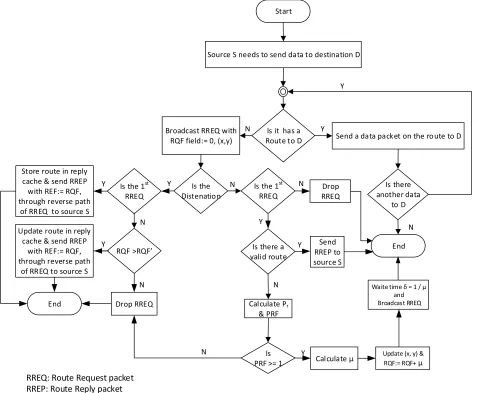
When source node wishes to communicate to destination node, it searches its routing cache to get a route. If no route is found, it initiates route discovery operation through broadcasting RREQ packet, containing source node coordinates (x, y) and field of route request factor (RQF):= 0, to neighboring nodes. On receipt the first RREQ packet, each intermediary node obeys the following rules:
- If intermediary node has a valid route to destination node, it sends RREP packet, containing the full route into route record field, through reverse path of received RREQ packet, to source node. Otherwise,
- The intermediate node computes power factor of received signal (PRF) of RREQ packet, using equations 5 and 6. In case of PRF< 1, intermediate node drops RREQ packet. Else, it calculates Link Efficiency Factor (µ), using equations 1, 3, 4, 6 and 7. Then prepares RREQ packet by updating position field with its coordinates (x, y) and adding its µ in the RQF field. Thence, rebroadcasting RREQ packet after waiting time δ = 1 / µ. Rebroadcasting process is repeated until RREQ packet reaches to destination node.
Figure 2 Action of Node on Receiving RREQ Packet
Start
Is it has a Route to D
Calculate Pr
& PRF
Is
PRF>= 1 Calculate µ
Send a data packet on the route to D
Is there another data
to D
End Source S needs to send data to destination D
Broadcast RREQ with RQF field:= 0, (x,y)
Is the Distenation
Is the 1st RREQ
Is there a valid route
Send RREP to source S
Drop RREQ
Drop RREQ
Y N
Y
Y
Y
Y
Y
N
N N
N
RREQ: Route Request packet RREP: Route Reply packet
RQF: Route Request Factor of the current RREQ RQF’: Route Request Factor of the previous RREQ Pr: Received power
PRF: Received Power Factor
µ: Link Efficiency Factor
REF: Route Efficiency Factor
N Waite time δ = 1 / µ
and Broadcast RREQ
Is the 1st RREQ
RQF >RQF’
Y Y
N
N Store route in reply
cache & send RREP with REF:= RQF, through reverse path
of RREQ to source S
Update route in reply cache & send RREP
with REF:= RQF, through reverse path
of RREQ to source S
End
Y
Update (x, y) & RQF:= RQF+ µ
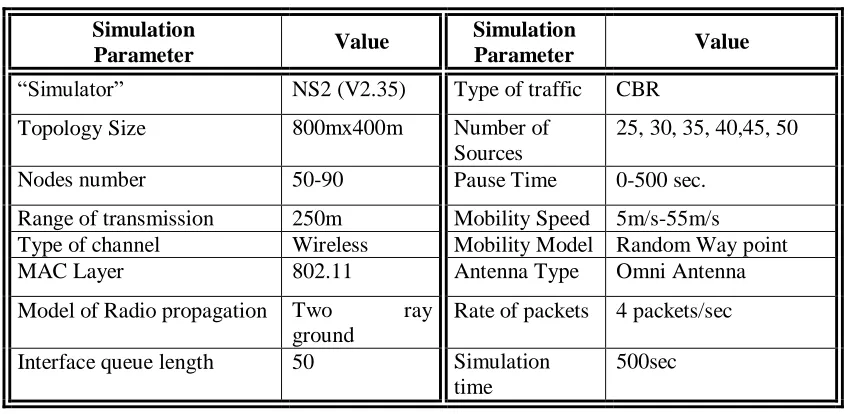
5- SIMULATION ENVIRONMENT AND PARAMETERS
Table 1: Simulation Parameters
Table 2: Simulation Parameters of Scenario 1
Simulation
Parameter Value
Simulation
Parameter Value
“Simulator” NS2 (V2.35) Type of traffic CBR
Topology Size 800mx400m Number of
Sources
25, 30, 35, 40,45, 50
Nodes number 50-90 Pause Time 0-500 sec.
Range of transmission 250m Mobility Speed 5m/s-55m/s
Type of channel Wireless Mobility Model Random Way point
MAC Layer 802.11 Antenna Type Omni Antenna
Model of Radio propagation Two ray
ground
Rate of packets 4 packets/sec
Interface queue length 50 Simulation
time
500sec
6- SIMULATION RESULTS AND DISCUSSION
This section is concerned with performance evaluation and comparison of the EELB-DSR and original DSR, under different scenarios, using aforementioned metrics.
6.1. Scenario 1
This scenario illustrates effect of changing pause time of nodes on performance of the proposed EELB-DSR and DSR from point of view of above mentioned criteria, using the parameters of table 2 and other parameters are mentioned in table 1.
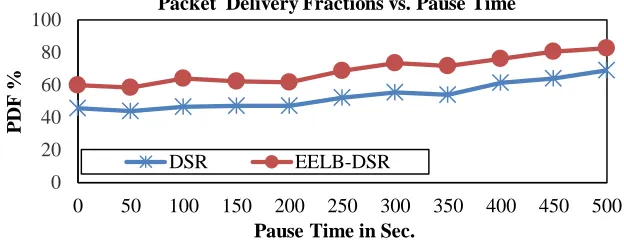
Figure 3 shows packet delivery fraction (PDF) versus pause time of both EELB-DSR and original DSR. It is lucid that, with increasing pause time (i.e. low mobility of nodes), PDF for the two protocols increases. This is due to, stability of routes among communicating nodes. On contrast, with decreasing pause time (i.e. high mobility of nodes), PDF of both protocols decreases. This because of, instability of routes which leads to more loss of data packets. It is noted that, average PDF of EELB-DSR (69%) is higher than counterpart of DSR (53%), with percentage of improvement 29%. This is due to, EELB-DSR scheme chooses routes contain nodes which have high energy and lightly load of packets. Resulting in more stabilization of routes among communication nodes. Thence, low loss of data packets.
Simulation Parameter Value
Number of nodes 50
Simulation time 500 sec.
Simulation area 800m x 400m
Pause time 0 - 500 sec.
Max. mobility speed 5 m/sec.
Figure 4 displays end-to-end delay time against pause time of both EELB-DSR and original DSR. It is noticable that, with increasing pause time of nodes , E2E delay time of both two protocols decreases. This is because, routes stability which leads to minimizing the repetitions of route discovery operation, hence reduction of end-to-end delay time. It obvious that, average delay time of EELB-DSR (2.77 sec.) is lower than counterpart of DSR (4.55 sec.), with percentage of improvement 39%. This is due to, during route discovery procedure, the EELB-DSR mechanism elects routes contain nodes which have light traffic load, resulting in minimization of waiting time in the transmitting buffer. In addition, the EELB-DSR scheme produce more stable routes, that lead to minimize repeation of route discovery mechanism. All of these resulting in reduction of end-to-end delay time among communication nodes.
Figure 5 illustrates normalized overhead versus pause time of both EELB-DSR and original DSR. It is obvious that, with increasing pause time, the normalized overhead of both two protocols decreasing. This is due to, stability of routes leads to reduction of repeating of route discovery process, hence reduction of control packets. As shown from figure, normalized overhead of EELB-DSR (0.7) is lower by far than its counterpart of DSR (1.54), with percentage of improvement 54%. This is due to, EELB-DSR submits more stabilized routes comparing with its counterpart of DSR, resulting in reduction of repeating of route discovery process. In addition, EELD-DSR reduces flooding of RREQ packets during route discovery. All of these leading to reduction of normalized overhead.
0 20 40 60 80 100
0 50 100 150 200 250 300 350 400 450 500
P
D
F
%
Pause Time in Sec.
Packet Delivery Fractions vs. Pause Time
DSR EELB-DSR
Figure 3 Packet Delivery Fraction versus Pause Time
0.00 1.00 2.00 3.00 4.00 5.00 6.00
0 50 100 150 200 250 300 350 400 450 500
E2E
D
e
lay
in
S
e
c
.
Pause Time in Sec. End to End Delay vs. Pause Time
DSR EELB-DSR
Figure 4 End to End Delay versus Pause Time
0 0.5 1 1.5 2 2.5
0 50 100 150 200 250 300 350 400 450 500
N
o
r
m
al
iz
ed
O
v
e
r
h
e
ad
Pause Time in Sec.
Normalized Overhead vs. Pause Time
DSR EELB-DSR
Figure 6 Energy Consumption versus Pause Time
Table 3: Simulation Parameters of Scenario 2
0 20 40 60 80 100
5 10 15 20 25 30 35 40 45 50 55
P
D
F
%
Speed m / Sec.
Packet Delivery Fractions vs. Nodes Speed
DSR EELB-DSR
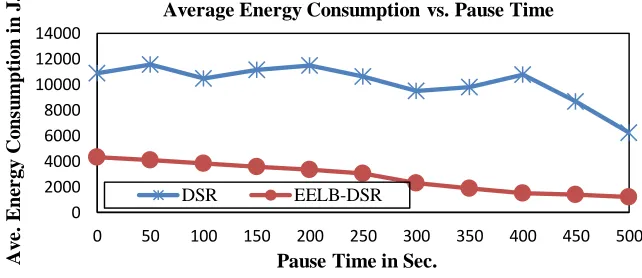
Figure 6 presents average energy consumption versus pause time of both EELB-DSR and original DSR. From figure we note that, with increasing pause time, average energy consumption of both protocols reduces. This is due to, stability of routes resulting in reduction of repeating of route discovery process, hence reduction of control packets which make minimization of energy consumption of nodes. It is lucid that, average energy consumption of EELB-DSR (2773 j) is lower by far than counterpart of DSR (10095 j), with percentage of improvement 73%. This is because, EELB-DSR takes into consideration the traffic load balancing mechanism among nodes. In addition, EELB-DSR reduces flooding of RREQ packets and minimizes probability of route discovery process. All of these resulting in minimizing average energy consumption of nodes.
6.2. Scenario 2
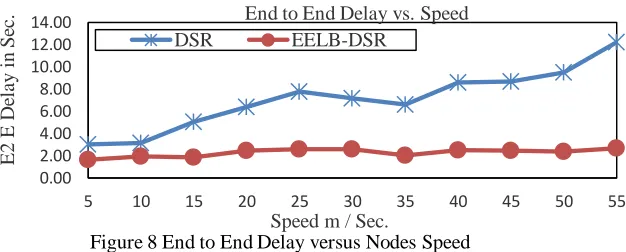
This scenario examines effect of nodes’ speed on performance of suggested EELB-DSR and standard DSR, using the factors of table 3 and other factors are shownin table 1.
Figure 7 illustrates packet delivery fraction (PDF) versus nodes' speed of both EELB-DSR and original DSR. It is noticeable that, with increasing nodes' speed (i.e. high mobility of nodes), PDF of both protocols reduces. This because of, when speed of nodes increases, probability of routes failure increases that leads to more data packets loss. Results of simulation show that, average PDF of EELB-DSR (73.36%) is higher than counterpart of DSR (50.89%), with percentage of improvement 44%. This is due to, EELB-DSR scheme chooses routes contain nodes which have high energy and lightly load of packets. Resulting in more stabilization of routes among communication nodes. Thence, low loss of data packets
Simulation Parameter Value
Number of nodes 50
Simulation time 500 sec.
Simulation area 800m x 400m
Pause time 0 - 500 sec.
Max. mobility speed 5 - 55 m/sec.
Number of sources 25
0 2000 4000 6000 8000 10000 12000 14000
0 50 100 150 200 250 300 350 400 450 500
Pause Time in Sec.
Average Energy Consumption vs. Pause Time
DSR EELB-DSR
A
v
e
.
En
er
gy
C
o
n
su
mp
ti
o
n
i
n
J
0.00 1.00 2.00 3.00 4.00 5.00 6.00 7.00
5 10 15 20 25 30 35 40 45 50 55
N
o
r
m
al
iz
e
d
O
v
e
r
h
e
ad
Speed m / Sec.
Normalized Overhead vs. Nodes Speed
DSR EELB-DSR
0.00 2.00 4.00 6.00 8.00 10.00 12.00 14.00
5 10 15 20 25 30 35 40 45 50 55
E
2
E
D
el
ay
i
n
S
ec
.
Speed m / Sec.
End to End Delay vs. Speed
DSR EELB-DSR
Figure 8 End to End Delay versus Nodes Speed
Figure 8 displays end-to-end delay time against nodes' speed of both EELB-DSR and original DSR. Intuitively, as speed of nodes increases, the delay time of both two protocols increases. This is because, routes instability which leads to increasing the frequency of route discovery operation, hence increas of end-to-end delay time. It is noticable that, average delay time of EELB-DSR (2.28 sec.) is lower than counterpart of DSR (7.1 sec.), with percentage of
improvement 68%. This is due to, during route discovery process, the EELB-DSR schemeelects routes contain nodes
that have light traffic load, resulting in minimization of waiting time in the transmitting buffer. In addition, the EELB-DSR scheme produce more stable routes, that lead to minimize repeation of route discovery mechanism. All of these resulting in reduction of end-to-end delay time among communicating nodes.
Figure 9 illustrates normalized overhead against speed of nodes of both EELB-DSR and standard DSR. It is lucid that, with increasing nodes’ speed, normalized overhead of both two protocols is being increased. This is because, instability of routes which leads to high probability of repetition of route discovery process, thence increase of normalized overhead. As shown from figure, normalized overhead of EELB-DSR (1.68) is lower than its counterpart of DSR (3.68), with percentage of improvement 54%. This is due to, EELB-DSR submits more stabilized routes comparing with its counterpart of DSR, resulting in reduction of repeating of route discovery process. In addition, EELD-DSR reduces flooding of RREQ packets during route discovery. All of these leading to reduction of normalized overhead.
Figure 10 presents average energy consumption versus speed of nodes of both EELB-DSR and original DSR. From figure we note that, as speed of nodes increases, average energy consumption of both protocols is increased. This is due to, instability of routes leads to increase of repeating of route discovery process, thence increase of control packets which make maximization of energy consumption of nodes. It is lucid that, average energy consumption of EELB-DSR (4668.20 j) is lower by far than its counterpart of DSR (14505.04 j), with percentage of improvement 68%. This is because, DSR takes into consideration the traffic load balancing mechanism among nodes. In addition, EELB-DSR reduces flooding of RREQ packets and minimizes probability of route discovery process. All of these resulting in minimizing average energy consumption of nodes.
0 5000 10000 15000 20000
5 10 15 20 25 30 35 40 45 50 55
Speed m / Sec.
Average Energy Consumption vs. Speed
DSR EELB-DSR
A
v
e.
En
er
gy
C
o
n
su
m
p
ti
o
n
i
n
J.
Table 4: Simulation Parameters of Scenario 3 6.3. Scenario 3
This scenario examines effect number of sources connection on performance of the suggested EELB-DSR and standard DSR, using the factors of table 4 and other factors are shown in table 1.
Figure 11 illustrates Packet delivery fraction (PDF) versus number of sources connection. It is noticeable that, when number of coinciding sources connection increases, PDF of both protocols decreases. This is because, increase number of synchronized sources connection leads to high probability for transmitted data packets collision, which results in more data packets loss, thence reduction of PDF. It is obvious that, average PDF of EELB-DSR (59.8%) is higher than its counterpart of DSR (46.01%), with percentage of improvement 30%. This is due to, EELB-DSR scheme chooses routes contain nodes which have high energy and lightly load of packets. Resulting in more stabilization of routes among communication nodes. Thence, low loss of data packets.
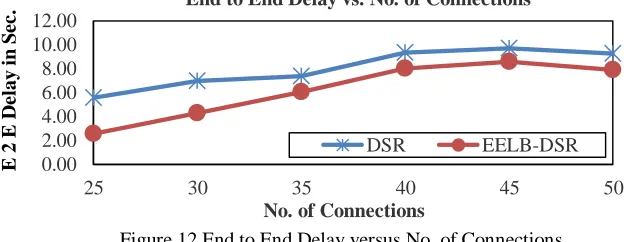
Figure 12 displays end-to-end delay time against number of connection sources of both EELB-DSR and original DSR. Intuitively, as number of connection sources increases, delay time of both two protocols is increase. This is because,
Simulation Parameter Value
Number of nodes 50
Simulation time 500 sec.
Simulation area 800m x 400m
Pause time 15 sec.
Max. mobility speed 15 m/sec.
Number of sources 25 - 50
Figure 10 Energy Consumption versus Nodes Speed
0.00 20.00 40.00 60.00 80.00
25 30 35 40 45 50
P
D
F
%
No. of Connections
Packet Delivery Fractions vs. No. of Connections
DSR EELB-DSR
0.00 2.00 4.00 6.00 8.00 10.00 12.00
25 30 35 40 45 50
E
2
E
D
e
lay
in
S
e
c
.
No. of Connections
End to End Delay vs. No. of Connections
DSR EELB-DSR
Figure 12 End to End Delay versus No. of Connections
0.00 0.50 1.00 1.50 2.00 2.50 3.00
25 30 35 40 45 50
N
o
r
m
al
iz
e
d
O
v
e
r
h
e
ad
No. of Connections
Normalized Overhead vs. No. of Connections
DSR EELB-DSR
Figure 13 Normalized Overhead versus No. of Connections
delay time of EELB-DSR (6.24 sec.) is lower than counterpart of DSR (8.04 sec.), with percentage of improvement 22%. This is due to, during route discovery process, the EELB-DSR scheme elects routes contain nodes that have light traffic load, resulting in minimization of waiting time in the transmitting buffer. In addition, the EELB-DSR scheme produces more stable routes that lead to minimize repetition of route discovery mechanism. All of these resulting in reduction of end-to-end delay time among communicating nodes.
Figure 13 demonstrates normalized overhead versus number of connection sources of both EELB-DSR and original DSR. Axiomaticly, with increasing connection sources, the normalized overhead of both protocols is increased. This is because, increasing connection sources leads to more repetions of route discovery operation, resulting in more generation of control packets. It is clear that, normalized overhead of EELB-DSR (1.85) is lower than its counterpart of DSR (1.25), with percentage of improvement 48%. This is due to, EELB-DSR submits more stabilized routes comparing with its counterpart of DSR, resulting in reduction of repeating of route discovery process. In addition, EELD-DSR reduces flooding of RREQ packets during route discovery. All of these leading to reduction of normalized overhead.
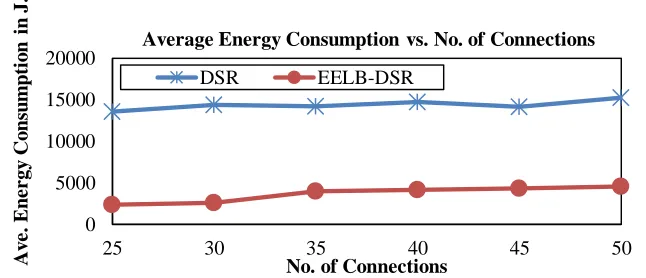
Figure 14 presentsaverage energy consumption versus number of connection sources of both EELB-DSR and original
0 5000 10000 15000 20000
25 30 35 40 45 50
No. of Connections
Average Energy Consumption vs. No. of Connections
DSR EELB-DSR
A
v
e
.
En
e
r
gy
C
o
n
su
m
p
ti
o
n
i
n
J.
7- CONCLUSION
This essay presents improved version of standard DSR, called (EELB-DSR), through modification of route discovery mechanism, in such a way that minimize energy consumption of nodes, reduce flooding of control packets and realization of balanced traffic load among nodes, resulting in prolong life time of nodes, thence increase life time of the routes and relative stability of network. Performance evaluation and comparison between proposed scheme (EELB-DSR) and original DSR has been implemented utilizing network imitator (NS2). Results of simulation proved that performance of the proposed protocol outperform original DSR in terms of: packet delivery ratio, end- to- end delay, normalized overhead.
REFERENCES
[1]. Amandeep Kaur, Jasmeet Kaur and Nishu Kansal, “D-EPAR: Distance –Efficient Power Aware Routing Protocol for MANETs”, 2nd International Conference on Next Generation Computing Technologies (NGCT), 2016. [2] Sanjeev K.S. and Sanjay S.,“ Performance evaluation of routing in MANETs based on QoS parameters”,
International Journal of Modern Computer Science and Applications (IJMCSA), Volume No.-4, Issue No.-1, pp. 49-54, January 2016.
[3] R. G. Sandhya, N. P. Santosh, “Mitigation of energy depletion in wireless ad-hoc sensor networks through path optimization,” International Journal of Computer and Network Applications, Jan-Feb 2015, vol. 2, issue 1, pp. 1-11.
[4] Shaheen Khan, Javed Khan Bhutto and Gautam Pandit,”Reactive and Proactive Routing Protocol Performance Evaluation for Quantitative Analysis in MANET”, International Journal of Scientific Research and Education, Vol. 2, Issue12, pp: 2540-2551, December 2014.
[5] Chandni, Sharad Chauhan and Kamal Kumar Sharma,”Routing Protocol in MANET – A Survey”, International Journal of Recent Research Aspects, Vol.1, Issue 2, pp: 48-52, September 2014.
[6] Rajeshwar Sharma, Tarun Sharma and Aditi Kalia ,”A Comparative Review on Routing Protocols in MANET”, International Journal of Computer Applications, Vol. 133, No.1, January 2016.
[7] Saima Zafar, Hina Tariq, Kanza Manzoor,” Throughput and Delay Analysis of AODV, DSDV and DSR Routing Protocols in Mobile Ad Hoc Networks,” International Journal of Computer Networks and Applications (IJCNA) ,Vol. 3, Issue 2, March – April 2016.
[8] Saima Zafar, Hina Tariq and Kanza Manzoor,” Throughput and Delay Analysis of AODV, DSDV and DSR Routing Protocols in Mobile Ad Hoc Networks”, International Journal of Computer Networks and Applications (IJCNA) Volume 3, Issue 2, March – April (2016).
[9] Mohamed Sharifdeen. and Dhavamaniprakash, “ An Energy Efficient DSR Routing Protocol for Energy Consumption in MANET “ International Journal of Innovative Research in Science, Engineering and Technology Vol. 4, Special Issue 6, May 2015.
[10] Deepti Badal and Rajendra Singh Kushwah, “ Nodes energy aware modified DSR protocol for energy efficiency in MANET” IEEE INDICON 2015 1570201303.
Hoc Network” International Journal of Emerging Technology in Computer Science & Electronics (IJETCSE) ISSN: 0976-1353 Volume 24 Issue 10 – JULY 2017.
[13] Shweta Singh and Gopal Singh, “ Role of Link Expiration Time to Enhance DSR Routing Protocol in MANETs” Advances in Computational Sciences and Technology ISSN 0973-6107 Volume 10, Number 5 (2017) pp. 1049-1056.
[14] Saurab Arora, “ MINIMIZATION OF ENERGY CONSUMPTION USING EPAR-DSR PROTOCOL IN MANET” International Research Journal of Engineering and Technology (IRJET) e-ISSN: 2395 -0056 Volume: 04 Issue: 06 June -2017.
[15] Krishna Dilip Suchak, “ MODIFIED DSR PROTOCOL FOR ENERGY EFFICIENCY IN MANET WITH LOAD SHARING” Vol-4 Issue-1 2018 IJARIIE-ISSN(O)-2395-4396.
[16] Roy Leung, Jilei Liu, Edmond Poon, Ah-Lot Charles Chan and Baochun Li, “ MP-DSR: A QoS-aware Multi-path Dynamic Source Routing Protocol for Wireless Ad-Hoc Networks” Proceedings LCN 2001. 26th Annual IEEE Conference on Local Computer Networks.
[17] Jijesh J. J and Shivashankar, “ ENERGY EFFICIENT ROUTING PROTOCOL BASED ON DSR” International Journal of Ad hoc, Sensor & Ubiquitous Computing (IJASUC) Vol.7, No.5, October 2016.
[18] P. Parthiban, G. Sundararaj, P. Maniiarasan, “ Maximizing the Network Life Time Based on Energy Efficient Routing in Ad Hoc Networks” Wireless Pers Commun (2018) 101:1143–1155 https://doi.org/10.1007/s11277-018-5753-y.
[19] Merlinda Drini and Tarek Saadawi, ”Modeling Wireless Channel for Ad-Hoc Network Routing Protocol”, ISCC Marakech Marocco, pp. 549-555, July 2008.
[20] Rjab Hajlaoui, Sami Touil and Wissemachour,” O-DSR: Optimized DSR Routing Protocol For Mobile Ad Hoc Network”, International Journal of Wireless & Mobile Networks (IJWMN) Vol. 7, No. 4, August 2015.
[21] Rohan Gupta, Harbhajan Singh and Gurpreet Singh,” Performance Evaluation of Routing Protocols for Mobile Adhoc Networks ”, Indian Journal of Science and Technology, Vol 10, No. 31, August 2017.
[22] S. Wu, S. Ni, Y. Tseng, and J. Sheu, “Route Maintenance in a Wireless Mobile Ad Hoc Network”, 33rd Hawaii International Conference on System Sciences, Maui, 2000.
[23] John Novatnack , Lloyd Greenwald and Harpreet Arora, “Evaluating ad hoc routing protocols with respect to quality of service”, Wireless And Mobile Computing, Networking And Communications, Volume 3, pp. 205-212,Aug.2005.
[24] Frank Aune, “Cross-Layer Tutorial”,NTNU 2014.
[25] Zeki Bilgin, Bilal Khan, "A Dynamic Route Optimization Mechanism for AODV in MANETs", Journal of Computer Science, 2014.
[26] H.M. Tsai, N. Wisitpongphan, and O.K. Tonguz, “Link-Quality Aware AODV Protocol”, in Proc. IEEE International Symposium on Wireless Pervasive Computing (ISWPC) 2006, Phuket, Thailand, January 2006. [27] V. RAJESHKUMAR, P.SIVAKUMAR, ”Comparative Study of AODV, DSDV and DSR Routing Protocols in
MANET Using NetworkSimulator-2”, International Journal of Advanced Research in Computer and Communication Engineering Vol. 2, Issue 12, December 2013.
[28] https://www.isi.edu/nsnam/ns/doc/node218.html.