Timing Attacks against the Syndrome Inversion
in Code-based Cryptosystems
Falko Strenzke
1
2 Cryptography and Computeralgebra, Department of Computer Science, Technische Universit¨at Darmstadt, Germany
Abstract. In this work we present the first practical key-aimed timing attack against code-based cryptosystems. It arises from vulnerabilities that are present in the inversion of the error syndrome through the Ex-tended Euclidean Algorithm that is part of the decryption operation of these schemes. Three types of timing vulnerabilities are combined to a successful attack. Each is used to gain information about the secret support, which is part of code-based decryption keys: The first allows recovery of the zero-element, the second is a refinement of a previously described vulnerability yielding linear equations, and the third enables to retrieve cubic equations.
Keywords: side channel attack, timing attack, post quantum crypto-graphy, code-based cryptography
1
Introduction
The McEliece PKC [1] and Niederreiter [2] Cryptosystems, built on error cor-recting codes, are considered immune to quantum computer attacks [3], and thus are of interest as candidates for future cryptosystems in high security applica-tions. Accordingly, they have received growing interested from researchers in the past years and been analyzed with respect to efficiency on various platforms [4–8]. Furthermore, a growing number of works has investigated the side channel security of code-based cryptosystems [9–14].
Side channel security is a very important implementation aspect of any cryp-tographic algorithm. A side channel is given when a physical observable quantity that is measured during the operation of a cryptographic device, allows an at-tacker to gain information about a secret that is involved in the cryptographic operation. The usual observables used in this respect are the duration of the operation (timing attacks [15]), or the power consumption as a function over the time (power analysis attacks[16]).
So far, timing attacks against the decryption operation of the McEliece PKC targeting the plaintext have been developed [12, 10, 14]. In [11], a timing attack
??
is proposed that targets the secret support that is part of the private key in code-based cryptosystems. From the time taken by the solving of the key equation the attacker learns linear equations about the support in this attack. But that work suffers from two major limitations: Neither is the information that is gained in itself sufficient for a practical attack, nor was the attack actually implemented. This work extends on the analysis given in [11] in multiple ways: first of all, we find that a control flow ambiguity causing leakage in terms of the linear equa-tions is manifest already in the syndrome inversion preceding the solving of the key equation in the decryption operation, and consequently the countermeasure proposed in that work is insufficient. We also show that there exists a timing side channel vulnerability in the syndrome inversion that allows the attacker to gain knowledge of the zero-element of the secret support. As an extension resp. generalization of the attack yielding linear equations, we derive a practical timing attack that lets the attacker gain cubic equations.
We then describe how to efficiently use these three vulnerabilities to build a practical attack that recovers the private key entirely. Lastly, we give results for practical executions of the timing attack on a personal computer.
2
Preliminaries
In this work, we give a brief description of the McEliece PKC, and stress those features of the decryption algorithm, that are necessary to understand the tim-ing attack presented in this paper. A more detailed description and security considerations can be found e.g. in [17].
Goppa Codes. Goppa codes [18] are a class of linear error correcting codes. The McEliece PKC makes use of irreducible binary Goppa codes, so we will restrict ourselves to this subclass and to code lengths that are powers of two.
Definition 1. Let the polynomial g(Y) = Pt
i=0giYi ∈ F2m[Y] be monic and
irreducible over F2m[Y], and letm,t be positive integers. Theng(Y)is called a
Goppa polynomial (for an irreducible binary Goppa code).
Then an irreducible binary Goppa code is defined asC(g(Y)) ={c∈Fn
2|Sc(Y) :=
Pn−1
i=0
ci
Y−αi = 0 mod g(Y)}, where n = 2
m, S
c(Y) is the syndrome of c,
Γ = {αi|i = 0, . . . , n−1}, the support of the code, where the αi are pairwise
distinct elements of F2m, andci are the entries of the vectorc.
The code defined in such way has lengthn, dimensionk>n−mt– however we restrict us tok=n−mtin this work – and can correct up toterrors.
As for any linear error correcting code, for a Goppa code there exists a generator matrix G∈Fk2×n and a parity check matrix H ∈F
mt×n
2 [19]. Given
these matrices, a messagem∈Fk2 can be encoded into a codewordcof the code
by computing c=mG, and the syndromes∈Fmt
2 of a (potentially distorted)
Overview of the McEliece PKC. In this section we give a brief overview of the McEliece PKC. The McEliecesecret key consists of the Goppa polynomialg(Y) of degree t and the support Γ = (α0, α1, . . . , αn−1), i.e. a permutation of F2m,
together they define the secret codeC. Thepublic keyis given by the publicn×k generator matrixGp=SGoverF2, whereGis a generator matrix of the secret
code CandS is a non-singulark×kmatrix overF2, the purpose of which is to
bringGpinto reduced row echelon form, i.e.Gp= [I|G2], which results in a more
compact public key [4]. The encryption operation allows messages m ∈Fk2. A
random vectore∈Fn2 with hamming weight wt (e) =thas to be created. Then
the ciphertext is computed asz=mGp+e.
The Decryption is given in Algorithm 1. It makes use of the error correction algorithm, given by the Patterson Algorithm [20], shown in Algorithm 2. In Step 1 of this algorithm, the syndrome vector is computed by multiplying the cipher-text by the parity check matrix, and then turned into the syndrome polynomial S(Y) by interpreting it as anFt
2m element and multiplying it with the vector of
powers ofY. The Patterson Algorithm furthermore uses an algorithm for finding roots in polynomials overF2m (root find()), and the Extended Euclidean
Algo-rithm (EEA) for polynomials with a break condition based on the degree of the remainder, given in Algorithm 3. The root finding can e.g. be implemented as an exhaustive search onF2m. Please note that all polynomials appearing in the
algorithms have coefficients inF2m.
The Niederreiter PKC [2] is a cryptosystem that is slightly different from the McEliece PKC, however there also an error vector is chosen during the encryption and decryption features the syndrome decoding. Since these features are, as we shall see, the preconditions for our attack, it is equally applicable to the Niederreiter PKC.
In the following, we turn to those details, that are relevant for the side channel issues we are going to address in Section 3. Please note that the error locator polynomialσ(Y), which is determined in Step 4 of Algorithm 2, has the following form3:
σ(Y) =σt
Y
j∈E
(Y −αj) = t
X
i=0
σiYi. (1)
whereE is the set of those indexesi, for whichei= 1, i.e. those elements ofF2m
that correspond to the error positions in the error vector. The determination of the error vector in Step 6 of Algorithm 2 makes use of this property. Accordingly, deg (σ(Y)) = wt (e) if wt (e)6tholds.
3 Usually, the error locator polynomial is defined to be monic, i.e σ
Algorithm 1The McEliece Decryption Operation
Require: the McEliece ciphertextz∈Fn2
Ensure: the messagem∈Fk2 1: e←err corr(z, g(Y)) 2: m0←z+e
3: m←the firstkbits ofm0 4: returnm
Algorithm 2 The McEliece error correction with the Patterson Algorithm (err corr(z, g(Y)))
Require: the distorted code word z ∈ Fn2, the secret Goppa polynomial g(Y) and secret supportΓ ={α0, α1, . . . , αn−1}
Ensure: the error vectore∈Fn2 1: S(Y)←zH> Yt−1,· · ·, Y,1> 2: τ(Y)←p
S−1(Y) +Y modg(Y) 3: (a(Y), b(Y))←EEA (τ(Y), g(Y)) 4: σ(Y)←a2(Y) +Y b2(Y)
5: E={E0, . . . , Et−1} ←rootfind(σ(Y)) // ifαiis a root, thenE containsi 6: e←v∈Fn2 withvi= 1 if and only ifi∈ E
7: return e
3
Analysis of Timing Side Channels in the Syndrome
Inversion
We now explain three different vulnerabilities present in the syndrome decoding. To this end, we first explore general properties of the syndrome inversion.
3.1 Properties of the Syndrome Inversion
The syndrome polynomial is defined as
S(Y)≡
w
X
i=1
1 Y ⊕i
≡ Ω(Y)
σ(Y) modg(Y) (2)
Here, wis the Hamming weight of the error vectoreand the{i|i∈ {1, . . . w}} denote the support elements associated with the indexes of those bits in the error vector having value one in arbitrary ordering, i.e. for instance if the bits found at the indexjandkin the error vector have value one, then1=αj,2=αkand so on. The identification of the error locator polynomialσ(Y) in the denominator is simply a result of the form of the common denominator of all sum terms. In the McEliece PKC Decryption, during the error correction, Algorithm 2, Step 2, S−1(Y) is computed by invoking the Algorithm 3 as EEA(g(Y), S(Y),0). But
Algorithm 3The Extended Euclidean Algorithm (EEA(r−1(Y),r0(Y),d)) Require: the polynomialsr−1(Y) andr0(Y), with deg (r0(Y))<deg (r−1(Y))
Ensure: two polynomials rM(Y), bM(Y) satisfying rM(Y) =
bM(Y)r0(Y) modr−1(Y) and deg (r0(Y))6bdeg (r−1)/2c 1: b−1←0
2: b0←1 3: i←0
4: whiledeg (ri(Y))> ddo 5: i←i+ 1
6: (qi(Y), ri(Y))←ri−2(Y)/ri−1(Y) // polynomial division with quotient qi and remainderri
7: bi(Y)←bi−2(Y) +qi(Y)bi−1(Y) 8: end while
9: M←i
10: return (rM(Y),bM(Y))
Then, it returns δσ(Y) =bM(Y) and furthermoreδΩ(Y) = rM(Y), where δ∈ F2m andM is the number of iterations performed by the EEA [21].
Given this form of the S(Y), we can make a statement about the max-imal possible number of iterations in the EEA used to compute S−1(Y) ≡
σ(Y)/Ω(Y) modg(Y). As already mentioned, the actual invocation of the syn-drome inversion is EEA(g(Y), S(Y),0). But the above explained fact that we could stop at deg (ri(Y)) 6(t/2)−1 means that there is one iteration in the EEA whereri(Y) =δΩ(Y) andbi(Y) =δσ(Y), in case ofw6(t/2)−1.
Corollary 1. Assume a Goppa Code defined by g(Y) and Γ. When Alg. 3 is invoked as EEA(g(Y), S(Y),1) with S(Y) ≡ Ωσ((YY)) mod g(Y), and the error vector e corresponding to S(Y) satisfies wt (e) 6(deg (g(Y))/2)−1, then for the number of iterations in Alg. 3 we find:
M 6Mmax= deg (Ω(Y)) + deg (σ(Y))
Proof. Regard the iteration where rj(Y) = δΩ(Y) and bj(Y) = δσ(Y). Since according to Algorithm 3 the degree of bj(Y), starting from zero, increases at least by one in each iteration, we findj6deg (σ(Y)). From here on, the degree of rj(Y) = δΩ(Y) is decreased by at least one in each subsequent iteration down to deg (rM(Y)) = 0, i.e. M−j 6deg (Ω(Y)), givingM =M −j+j 6 deg (Ω(Y)) + deg (σ(Y)).
Because in the following we are only interested in the derivation of equations of the formσi = 0 for a specific value of i, we will ignore the constant δ from here on.
3.2 Linear Equations from w = 4 Error Vectors
In the case ofw= 4 the syndrome polynomial is of the form:
S(Y)≡Ω(Y)
σ(Y) ≡
4
X
i=1
1 Y ⊕i
≡ σ3Y
2⊕σ 1
Y4⊕σ
3Y3⊕σ2Y2⊕σ1Y ⊕σ0
modg(Y), (3)
where i ∈F2m, i∈1, . . . ,4 denote the four elements of the support associated
with the error positions. Furthermore, in the right hand side of Eq. (3), which is found by bringing all four sum terms to their common denominator, we have
σ3=1⊕2⊕3⊕4,
σ2=234⊕134⊕124⊕123,
σ1=12⊕13⊕14⊕23⊕24⊕34,
σ0=1234.
With the aim of finding a timing vulnerability revealing certain coefficients of σ(Y) and thus information about the secret support, we now analyze the connection between the number and of iterations and their complexity on the one hand and the degree ofΩ(Y) on the other. RegardingΩ(Y) for the casew= 4 we find that the coefficient to the highest power ofY is given byσ3=1⊕2⊕3⊕4.
Ifσ3= 0, then the degree ofΩ(Y) is zero, otherwise it is two. This means that
in the case of σ3= 0 the maximal number of iterations in the inversion is four,
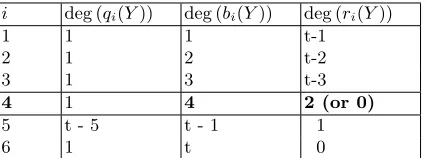
in contrast to six in the general case. Table 1 gives an overview of the individual iterations in the syndrome inversion EEA whenw= 4, where it is assumed that for each iteration deg (qi(Y)) = 1, i.e. the case where the maximal number of iterationsMmaxis executed. In the majority of the casesMmax iterations occur,
i.e. 6 when deg (Ω(Y)) = 2 and 4 when deg (Ω(Y)) = 0. But with probability about 1/n in each iteration a larger degree of the quotient polynomial qi(Y) occurs, accordingly then M < Mmax. With the aim of assessing the reliability
of the differences in running time allowing to identify the case deg (Ω(Y)) = 0, we examine whether M < Mmax might lead to timings for deg (Ω(Y)) = 2 as
low as for deg (Ω(Y)) = 0. We immediately find that the fifth iteration, which is only executed in the former case, features a much more complex multiplication q4(Y)b3(Y) than all the other iterations.
The control flow for the second EEA invocation, i.e. the solving of the key equation, for the casew= 4 has been analyzed in [11], there it is shown that in the case ofσ3= 0 the number of iterationsNis zero, whereas in the caseσ36= 0 it
is one. In that work, a countermeasure is proposed that removes the possibility to exploit the according timing differences in the second EEA invocation. However, due the fact that, as shown in Section 3.2, timing differences reveal σ3 = 0
already in the syndrome inversion EEA, the countermeasure proposed in [11] is insufficient.
σ3=P 4
i=1i= 0. Remember that through the choice of the error vector during encryption, he chooses the indexesji withi= 1, . . . ,4 of the support elements αji=i according to the definition of the i notation for the support elements.
i deg (qi(Y)) deg (bi(Y)) deg (ri(Y))
1 1 1 t-1
2 1 2 t-2
3 1 3 t-3
4 1 4 2 (or 0)
5 t - 5 t - 1 1
6 1 t 0
Table 1: Overview of the Iterations in the syndrome inversion EEA for Hamming weight 4 error vectors. If deg (Ω(Y)) = 2,Mmax, the maximal number of iterations is 6, otherwise, if deg (Ω(Y)) = 0, we haveMmax= 4.
3.3 Cubic Equations from w = 6 Error Vectors
The vulnerability found forw= 4 error vectors can be generalized to any even value ofw. For the attack that is subject of this work, we also employ the case w= 6. There, we find that the syndrome polynomial according to Eq. (2) is of the form
S(Y)≡Ω(Y)
σ(Y) ≡
σ5Y4⊕σ3Y2⊕σ1
Y6⊕σ
5Y5⊕σ4Y4⊕σ3Y3⊕σ2Y2⊕σ1Y +σ0
modg(Y),
where
σ3= 6
X
j=3
j−1
X
k=1
k−1
X
l=1
jkl, (4)
σ5= 6
X
i=1
i. (5)
As in case ofw= 4, deg (Ω(Y)) = 0 implies zero iterations in the key equation EEA. Furthermore, it is again the most complex iteration of the syndrome in-version EEA that is skipped in this case. The difference to w= 4 is that here two coefficients ofσ(Y), i.eσ3 andσ5, have to be zero for this to happen.
Thus from detecting deg (Ω(Y)) = 0 the attacker can learn the equations σ3= 0 and σ5 = 0. However, since from the vulnerability presented in Sec. 3.2
it is already possible for the attacker to learn linear equations about the secret support, the value of the “w= 6” vulnerability lies in the equationσ3= 0, which
Algorithm 4Polynomial Division poly div(n(Y), d(Y))
Require: the polynomialsn(Y), d(Y)) with deg (n(Y))>deg (d(Y))
Ensure: two polynomialss(Y),q(Y) withq(Y)d(Y) +s(Y) =n(Y) and deg (s(Y))<
deg (d(Y)) 1: s−1(Y)←n(Y) 2: s0(Y)←d(Y) 3: q0(Y)←0 4: i←0
5: whiledeg (si(Y))>deg (d(Y))do 6: i←i+ 1
7: ai←si−2,deg(si−2(Y))/si−1,deg(si−1(Y))
8: fi←deg (si−2(Y))−deg (si−1(Y)) 9: qi(Y) =qi−1+aiYfi
10: si←si−2(Y)−aisr−1(Y)Yfi 11: end while
12: return (qi(Y), si(Y))
3.4 The Zero Element of the Support from w = 1 Error Vectors
Forw= 1 the whole control flow in Patterson’s Algorithm is very simple and unambiguous on a high level:
S(Y)≡ 1
Y ⊕1
modg(Y),
S−1(Y) =Y ⊕1,
τ(Y) =√1
a(Y) =τ(Y)
b(Y) = 1
σ(Y) =Y ⊕1
The polynomial inversion is, according to Cor. 1, performed in exactly one it-eration. But there is an ambiguous control flow within the polynomial division given in Alg. 4, that is executed within this EEA iteration: We findq1(Y) =Y
because there is no alternative to deg (S(Y)) =t−1. In Alg. 4,si,j denotes the coefficient toYj in si(Y).
If 1 = 0, then the division has to stop at this point. Otherwise, a second
iteration is performed giving q2(Y) = Y ⊕1. Thus, if the timing difference
resulting from the different number of iterations in the division is detectable, the index ofz of the secret support elementαz= 0 can be found.
4
Combining the “
w
= 1”, “
w
= 4”, and “
w
= 6”
Vulnerabilities to a practical Attack
4.1 Description of the Attack Procedure
Step 1 By performing the respective queries on the decryption device with “w= 4” error vectors, a rank n−m−1 linear equation system is build. The experimental results from [11] already showed that this is the maximal rank that can be achieved from the linear equations. Afterwards, the index of the zero el-ement,αz is determined through the “w= 1” vulnerability. In the majority of the cases, this information increases the rank of the equation system ton−m. In the rare cases when the rank remains atn−m−1, the attack’s on-line and off-line complexity is increased by a factor ofn.
In the following, we assume that we have an equation system of rankn−
m. This is the highest possible rank for a homogeneous linear equation system describing a permutation of F2m, since there must be m linearly independent
basis elements. Accordingly, by bringing the linear equation system into reduced row echelon form, we find the elements associated with themrightmost columns must be a basis{βi}:
α0α1. . . αi. . . αn−m−3αn−m−2β0. . . βm−1
1 0 . . . 0 . . . 0 0 X . . . X ..
.
0 0 . . . 1 . . . 0 0 X . . . X ..
.
0 0 . . . 0 . . . 0 1 X . . . X
Step 2 At this point for each element αi we know the corresponding Bi with αi = Pj∈Bjβi, i.e. its representation in the chosen basis. If the values of all
basis elementsβiwere known, then the values of allαiwould be set as well and the support was recovered. Accordingly, the next step in the attack is to collect cubic equations according to Eq. (4) in a way that allows for efficient guessing resp. solving for the values of the βi. To this end, the first set C1 of “w = 6”
equations is created by the employment of error vectors involving error positions corresponding toi,i= 1, . . . ,6, where the following conditions hold:
1. i ∈ span({βs1, βg1, βg2, βg3}). These are four arbitrarily chosen basis
ele-ments, whereβs1 denotes the one to be solved for in the resulting equation
according to Eq. (4). The reason for this initial set of basis elements having cardinality four is that this is the lowest cardinality allowing to satisfy all the conditions in the following items.
2. P6
i=1i= 0. This qualifies the error vector for the possibility of deg (Ω(Y)) =
N = 0 according to Eq. (5) in the sense thatσ5= 0 is already ensured. As
a result, in contrast to the case of randomw = 6 error vectors that have a probability for deg (Ω(Y)) = N = 0 in the domain of 1/n2, for these candidates this probability is 1/n.
3. Exactly two of thei containβs1. The reason for this constraint is to keep
as possible. Specifically, the twofold occurrence ofβsi leads to a quadratic
equation forβsi.
Candidate error vectorse that meet these conditions are used to build cipher-texts which are input to the decryption device; and from the timing of the decryption, it is inferred whether actually deg (Ω(Y)) =N = 0 occurred. The number of such equations to be collected for one βsi is given by ci, which is a
parameter for the attack.
Afterc1 equations are found forβs1, the second set of equations is build in
the same way as the first, the only differences being that the basis element to be solved for now is βs2 ∈ {/ βs1, βg1, βg2, βg3}, and first condition becomes i ∈
span({βs1, βg1, βg2, βg3, βs2}). In this manner successively sets of cubic equations
form−3 differentβsi are collected until the equations in the last set involve all
βi.
Step 3 In this step the solving resp. guessing is performed. Let those twoithat containβsi according to the third condition in Step 4 always be1and2. From
the conditions given in Step 4, and Eq. (4) we have for each βsi a quadratic
equation
aβs2
i+bβsi+c= 0, (6)
witha=P6
j=3i,b= (1+2)a,c= (1−βsi)(2−βsi)a+(1+2)
P6
j=4
Pj−1
k=3jk+
P6
j=5
Pj−1
k=4
Pk−1
l=3 jkl (for clarity, in these formulas we provide “+” and “−” even though both amount to “⊕” ). Such a quadratic equation has two solutions forβsi.
The solving is performed as follows: enumerate the initial guesses, i.e. all the possible combinations of the values forβg1, βg2, βg3. Here, and for the subsequent
guesses, since we are looking for linearly independentF2m elements, it holds that
βgi ∈/span({βg1, . . . , βgi−1}), (7)
where we imply the conventionβsi=βgi+3.
For each such combination of values forβg1, βg2, βg3the roots of each equation
inC1are potential candidates for the value ofβs1. However, additionally to the
restriction from Eq. (7), those roots that are found only for a subset ofC1 are
discarded. This is wherein the value of a choiceci=|Ci|>1 lies. The larger the ciare chosen, the higher is the on-line effort of the attack (more cubic equations have to be collected), but the off-line effort is reduced as the number possible solutions for eachβsi is decreased.
The remaining roots are iterated over to find the possible solutions forβs2
by solving the equations inC2, which in turn are used to compute the possible
values of βs3, etc. Whenever in such a chain of guesses a solution for all βsi is
4.2 Experimental Results
We conducted the attack with the following measurement setup on an Intel Core 2 Duo x86 platform: from the attack program, the decryption function was called with the attack ciphertexts as input, and the decryption time was measured with the CPU’s cycle counter.
Because the cycle counts measured for a deterministic operation of the du-ration of a code-based decryption vary considerably on such CPUs, a specific strategy has to be used to identify positives, by which we refer to 1 = 0 for
w= 1 and deg (Ω(Y)) = 0 for w= 4 andw = 6, i.e. those cases that yield an equation for the attacker. Specifically, an approximate model for cycle counts on modern x86 CPUs like the Core2 Duo is a hypothetical constant cycle count associated with the operation which is increased by a random delay on every ex-ecution of an operation. Because in all three different attack types the positives, from the algorithmic point of view, are executed faster than the negatives, the following classification strategy can be used: Prior to the attack a training phase is carried out where the maximal cycle counts for positives are determined as well as the minimal cycle counts for negatives (using a different secret key than during the attack). Then the border below which an operation is classified as a positive during the attack is set as the mean of these to values. We refer to the distance between the maximal cycle counts for positives and the minimal cycle counts for negatives as the cycles gap. Clearly, a larger such gap increases the probability for finding positives. Furthermore, the above approximate model for the cycle counts on the employed CPU is lacking other effects that could be observed in our experiments: during the execution of the attack the previously determined maximal and minimal cycle counts for the two classes of operations seem to be subject to an “upwards drift”, i.e. they tend to increase over time.
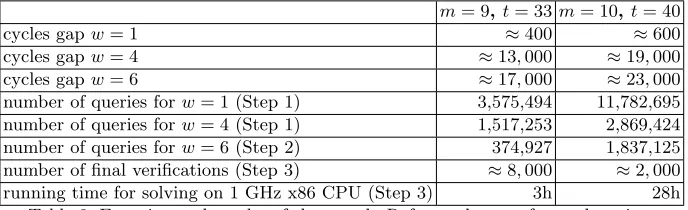
Table 2 summarizes the results for single attack runs with different code parameters. The rows labeled “cycles gap . . . ” indicate the above discussed gaps. We found that gaps of a couple of hundreds cycles that are characteristic for the w= 1 vulnerability tend to cause problems in the detection of positives, i.e. in some runs due to the mentioned drift of the cycle counts the zero support element could not be determined, while the considerably larger gaps for the w= 4 and w= 6 vulnerabilities allow for reliable detection of positives.
The rows labeled “number of queries . . . ” show the number of decryption operations that had to be executed with ciphertexts created with error vectors of the respective weight in the course of the attack.
The time for the solving step is given in the last row. From the theory, one expects an increase of the solving time by a factor of about eight for each increase of m by one. The reason is that the number of initial guesses, i.e. the number of combinations of values that can be chosen for βg1, βg2 and βg3 is roughly
n3, and all
F2m operations, including the solving of the quadratic equations [22]
(Eq. (6)), are done with the help of lookup tables, and thus execute in constant time.
As previously mentioned, in the rare cases where the knowledge about the zero-element of the support does not increase the rank of the equation system, Steps 2 and 3 would have to be repeated about up to n times, for these cases stronger hardware would be needed to keep the solving time in reasonable mar-gins.
m= 9,t= 33m= 10, t= 40
cycles gapw= 1 ≈400 ≈600
cycles gapw= 4 ≈13,000 ≈19,000
cycles gapw= 6 ≈17,000 ≈23,000
number of queries forw= 1 (Step 1) 3,575,494 11,782,695 number of queries forw= 4 (Step 1) 1,517,253 2,869,424 number of queries forw= 6 (Step 2) 374,927 1,837,125 number of final verifications (Step 3) ≈8,000 ≈2,000 running time for solving on 1 GHz x86 CPU (Step 3) 3h 28h
Table 2: Experimental results of the attack. Refer to the text for explanations.
5
Conclusion
The results of this work show that timing attacks based on control flow vulnera-bilities in the syndrome inversion and the key equation EEA are a threat to the confidentiality of the secret key. In the chosen measurement setup, the attack has been proved to be practical. Apart from the recovery of the zero-element of the support, the cycles gaps between the controls flows that have to be dis-tinguished are rather large, and thus remote timing attacks seem feasible too. If the zero-element remains unknown, the on-line and off-line attack complexity can still be managed with appropriate hardware.
The second option would be stronger in this respect: there, we alter the cryp-tosystem’s parameter specification: during the encryption, only t−1 errors are added, and prior to the standard decryption operation, another “bit flip error” is applied, the position of which should be the same for repeated decryptions of a certain ciphertext but otherwise appear as random, and thus should be pseudo-randomly derived from the ciphertext and a constant secret value (for instance a hash value of the secret key). This approach would guarantee a pervasive al-teration of the decryption operation, however it demands an increase of security parameters to compensate for the lower error weight used during encryption.
References
1. R. J. McEliece: A public key cryptosystem based on algebraic coding theory. DSN progress report42–44(1978) 114–116
2. Niederreiter, H.: Knapsack-type cryptosystems and algebraic coding theory. In: Problems Control Inform. Theory. Volume Vol. 15, number 2. (1986) 159–166 3. Bernstein, D.J., Buchmann, J., Dahmen, E.: Post Quantum Cryptography.
Springer Publishing Company, Incorporated (2008)
4. Biswas, B., Sendrier, N.: McEliece Cryptosystem Implementation: Theory and Practice. In: PQCrypto. (2008) 47–62
5. Heyse, S.: Low-Reiter: Niederreiter Encryption Scheme for Embedded Microcon-trollers. In Sendrier, N., ed.: Post-Quantum Cryptography. Volume 6061 of Lecture Notes in Computer Science., Springer Berlin / Heidelberg (2010) 165–181 6. Eisenbarth, T., G¨uneysu, T., Heyse, S., Paar, C.: MicroEliece: McEliece for
Em-bedded Devices. In: CHES ’09: Proceedings of the 11th International Workshop on Cryptographic Hardware and Embedded Systems, Berlin, Heidelberg, Springer-Verlag (2009) 49–64
7. Shoufan, A., Wink, T., Molter, G., Huss, S., Strenzke, F.: A Novel Processor Ar-chitecture for McEliece Cryptosystem and FPGA Platforms. In: ASAP ’09: Pro-ceedings of the 2009 20th IEEE International Conference on Application-specific Systems, Architectures and Processors, Washington, DC, USA, IEEE Computer Society (2009) 98–105
8. Strenzke, F.: A Smart Card Implementation of the McEliece PKC. In: Information Security Theory and Practices. Security and Privacy of Pervasive Systems and Smart Devices. Volume 6033 of Lecture Notes in Computer Science., Springer Berlin / Heidelberg (2010) 47–59
9. Molter, H.G., St¨ottinger, M., Shoufan, A., Strenzke, F.: A Simple Power Analysis Attack on a McEliece Cryptoprocessor. Journal of Cryptographic Engineering (2011)
10. Strenzke, F., Tews, E., Molter, H., Overbeck, R., Shoufan, A.: Side Channels in the McEliece PKC. In Buchmann, J., Ding, J., eds.: Post-Quantum Cryptography. Volume 5299 of Lecture Notes in Computer Science., Springer Berlin / Heidelberg (2008) 216–229
11. Strenzke, F.: A Timing Attack against the secret Permutation in the McEliece PKC. In: The third international Workshop on Post-Quantum Cryptography PQCRYPTO 2010, Lecture Notes in Computer Science
Security and Cryptology - ICISC 2009. Volume 5984 of Lecture Notes in Computer Science., Springer Berlin / Heidelberg (2009) 161–175
13. Heyse, S., Moradi, A., Paar, C.: Practical power analysis attacks on software implementations of mceliece. In Sendrier, N., ed.: PQCrypto. Volume 6061 of Lecture Notes in Computer Science., Springer (2010) 108–125
14. Avanzi, R., Hoerder, S., Page, D., Tunstall, M.: Side-channel attacks on the mceliece and niederreiter public-key cryptosystems. J. Cryptographic Engineer-ing 1(4) (2011) 271–281
15. Kocher, P.: Timing Attacks on Implementations of Diffie-Hellman, RSA, DSS, and Other Systems. Proceedings of the 16th Annual International Cryptology Conference on Advances in Cryptology (1996) 104–113
16. Kocher, P., Jaff, J., Jun, B.: Differential Power Analysis. Advances in Cryptology-CRYPTO’99, 19th Annual International Cryptology Conference, Santa Barbara, California, USA, August 15-19, 1999, Proceedings1666(1999) 388–397
17. Engelbert, D., Overbeck, R., Schmidt, A.: A Summary of McEliece-Type Cryp-tosystems and their Security. Journal of Mathematical Cryptology 1(2) (2006) 151–199
18. Goppa, V.D.: A new class of linear correcting codes. Problems of Information Transmission6(1970) 207–212
19. F. J. MacWilliams and N. J. A. Sloane: The theory of error correcting codes. North Holland (1997)
20. Patterson, N.: Algebraic decoding of Goppa codes. IEEE Trans. Info.Theory 21
(1975) 203–207
21. Sugiyama, Y., Kasahara, M., Hirasawa, S., Namekawa, T.: A method for solving key equation for decoding goppa codes. Information and Control 27(1) (1975) 87–99
22. Biswas, B., Herbert, V.: Efficient Root Finding of Polynomials over Fields of Characteristic 2. WEWoRK (2009)hal.inria.fr/hal-00626997/PDF/tbz.pdf. 23. Mangard, S., Oswald, E., Popp, T.: Power Analysis Attacks: Revealing the Secrets