Security & Indistinguishability in the Presence of Traffic
Analysis
Cristina Onete1 Daniele Venturi2
1Darmstadt University of Technology & CASED, Germany www.minicrypt.de
2SAPIENZA University of Rome, Italy
Abstract. Traffic analysis (TA) is a powerful tool against the security and privacy of cryptographic primitives, permitting an adversary to monitor the frequency and timing characteristics of transmissions in order to distinguish the senders or the receivers of possibly encrypted communication. Briefly, adversaries may leak implementation-specific information even for schemes that are provably secure with respect to a classical model, resulting in a breach of security and/or privacy.
In this work we introduce the notion of indistinguishability in the presence of traffic analysis, enhancing any classical security model such that no adversary can distinguish between two protocol runs (possibly implemented on different machines) with respect to a TA oracle (leaking information about each protocol run). This new notion models an attack where the adversary taps a single node of in- and outgoing communication and tries to relate two sessions of the same protocol, either run by two senders or for two receivers.
Our contributions are threefold: (1) We first define a framework for indistinguishability in the presence of TA, then we (2) fully relate various notions of indistinguishability, depending on the adversary’s goal and the type of TA information it has. Finally we (3) show how to use our framework for the SSH protocol and for a concrete application of RFID authentication.
Keywords. foundations, traffic analysis, provable security, SSH
1
Introduction
Cryptographic protocols aim at securing communication between two or more parties which interact via an inse-cure channel. In classical security models, adversaries may observe communication or interact with honest and dishonest parties in certain, fixed ways. Provable secure in this sense is essential, but not sufficient, particularly due to the increasing popularity and efficiency of side-channel attacks. Many recently proposed attacks, which effectively break “provably secure” schemes, exploit the physical, implementation-specific characteristics of a primitive, e.g. running-time [28, 10], power consumption [29], and electromagnetic radiation [37, 21, 30].
In order to provide for side-channel attacks, one must build primitives that retain provable security even when run on machines prone to (as wide a class as possible of) side-channels. Starting from the seminal works of Micali and Reyzin [32] and Ishai et al. [24], great progress has been made in the area of leakage resilience, where the main idea is to “ease” an adversary A’s task of winning a game against a primitive Π by giving
This paper shows a different approach from leakage resilience. Instead of querying functions f of sk, ad-versaries tap a single in- and outgoing communication node running a primitive. Receivers in communication are called users, associated with some global parameters, and senders are implementations of the primitive. A sender-receiver pair, their parameters, and the interchanged communication defineinstantiations. Receivers can be viewed as parties in a protocol, whereas senders are applications/machines of a single sending party, running the same primitive (e.g. encryption can be used from an SSH terminal sender and an eMail client sender). For each instantiation of the security game, the adversary queries a predefined leakage oracle, not necessarily depending on the secret key. This oracle models traffic analysis of the tapped node, i.e. fingerprinting in- and outgoing communication, timing processing delays, counting the messages received by the node, etc.
Consider the case of a military basis (the tapped communication node) in contact with various military camps (receivers). The basis uses multiple transceivers (senders), either domestic or belonging to incoming, new personnel. An adversary may now want to know which receivers interact with the basis, or whether new personnel (new senders) has arrived to the basis. To achieve this, the adversary may “fingerprint” the communication by detecting transmission-specific characteristics of senders and receivers. If this is achievable, an adversary can accurately distinguish between two senders or between two receivers of a message.
There are three fundamental security notions involved in our framework. We start from classical security games in a special template, called a canonical form. Here, adversaries Asmall attempt to break the appropriate security notion (which could be indistinguishability, pseudo-randomness, privacy, etc.) in a classical way, having access to a number of primitive-specific oracles. This notion is called the classical security of the primitive.
As a first step, classical security can be extended to give Asmall access to a traffic analysis (TA) oracle on top of game-specific oracles. This idea appears for a particular model (IND-CCA security) in [35]. Our general TA oracle models analysing transmission patterns, thus leaking data. Now Asmall attempts to break classical security, but with an additional oracle. The enhanced model, called security in the presence of traffic analysis, covers, though it is not limited to, non-adaptive leakage resilience (see Appendix A).
Finally, the main achievement of this paper is to further enhance security by considering adversaries Abig
that may create instantiations of classical security games (this adversary Abig taps a node’s transmissions in several sender-receiver sessions) and may play these instantiations as in the classical game. However, Abig also
has access to the TA oracle, and it aims to distinguish between two instantiations for different senders (was the transmission sent from the SSH terminal or from the eMail client?), or for different receivers (was the transmission sent to Alice or for Bob?). This new notion is called indistinguishability in the presence of traffic
analysis. Note that by modelling indistinguishability of senders or of receivers, we cover classical traffic analysis
issues, which focus on anonymous routing. We describe in more detail how indistinguishability compares with existing concepts in the literature in Appendix A.
Our notion is used as follows: for a pre-set, non-adaptively chosen traffic analysis oracle Θ and some primitive Π, we consider instantiations of the appropriate classical security notion for Π. An adversary with access to the instantiations and to Θ, must now distinguish between two instantiations. Note that such an adversary will trivially win if it breaks either classical security, or security in the presence of TA. However, the reverse is not true: indistinguishability is a strictly stronger notion, as we show in Section 3 and in Appendix C. In fact, indistinguishability combines two notions, securityand sender/receiver privacy in a single model; this saves us from having to model privacy for each notion, and allows us to write a single proof of both security and indistinguishability. For applications which do not require such strong security, the proofs can be done in the weaker model of security in the presence of TA (if the TA oracle always returns⊥, this is equivalent to classical security); however, high-level security applications in say, the military, should consider attaining the strong indistinguishability notion rather than just classical security.
A Running Example. Although our framework is general, we give an intuition of it by means of a running
Appendix B. This game has a so-called canonical form (see Section 2). We consider two receivers for a PKE scheme, Alice and Bob, both communicating with a common node, Carol, in the presence of an adversary Eve, who taps Carol’s transmissions over an insecure channel. Alice and Bob are associated with tuples (skA,pkA)
and (skB,pkB); Carol uses various senders to encrypt plaintextsmunder eitherpkAorpkB, obtaining ciphertexts
c. Eve intercepts and possibly changes such values of c. In the classical IND-CCA security game, Eve must break the PKE scheme: given ciphertext c, which is the encryption of either messagem0 orm1 (both chosen by Eve) under pk∈ {pkA,pkB}, and givenpk, Eve wants to distinguish which of the two plaintexts was encrypted. Decryption Dec requires the secret key corresponding to pk; Eve does not have the secret key (she just knows
pk), but she may submit non-challenge ciphertexts ci to a decryption oracle, which outputs the corresponding
plaintexts mi. Intuitively, Eve wins against IND-CCA if it learns at least one bit of plaintext-information.
Forindistinguishability in the presence of traffic analysis, Eve does not need to break the encryption scheme,
and she does not have access only to a public key and a decryption oracle. Eve can additionally query a TA oracle, leaking additional information from the tapped channel (e.g. by measuring processing time, Eve could learn a part of the randomness used to encrypt). In our model, Carol sends messages to Alice and Bob in various sessions (determined by the receiver – Alice or Bob – and the sender – Carol’s machine/application). Eve’s new goal is one of the following: either (a) to distinguish, given a ciphertext c generated for a particular public key
pk, which sender Carol used, or (b) to distinguish, given ciphertext c generated for either pkA orpkB, who the receiver was (Alice or Bob).
In the first case, calledsender Indistinguishability in the presence of Traffic Analysis, Eve must learn which application or machine has generated c. To see why this attack is motivated by practice, imagine that Carol encrypts eMails to Alice regarding an auction. Carol eMails Alice for every bid. At the same time, Carol also encrypts information to Alice over SSH for a different purpose. If Eve can distinguish whether Carol’s ciphertexts were encrypted in the eMail client or in SSH, she will know if Carol keeps bidding on the auction (and may try to outbid her, or she may even delay the encrypted eMail ciphertext till the auction is finished). The second notion we consider, calledreceiver Indistinguishability in the presence of Traffic Analysis, models the case where Eve must learn who is the receiver of the ciphertext, i.e. either Alice or to Bob. This is important in our auction scenario if Carol now organises the auction and, at the end of the bidding process, Carol contacts the winner to confirm the purchase. Now Eve should not learn who has won the auction.
1.1 Our Contributions
The Models. In this paper we formalise indistinguishability (in the presence of traffic analysis) between runs of a security game for a cryptographic primitive. Here, traffic analysis is abstractly modelled by an oracle leak-ing some pre-set sender- and receiver-specific information. For cryptographic primitives as defined in Section 2, we consider classical, so-called canonical security games, played between adversaries Asmall and challengers G.
Separate sessions of the classical security game, containing an adversary instance Asmall, a challenger instance
G, and additional parameters (UPar, IPar), are called instantiations. Recall that we call receivers users: the parametersUPar associated with them areglobal (they are run at game setup). Sender-specificlocal parameters
IPar are created after setup, including values used for challenge ciphertexts, pseudorandom output, etc. Two instantiations aresame-user if they share their global parameters, andmixed-user otherwise. In our framework, same-user instantiations model implementations of a cryptographic primitive on different senders e.g. an appli-cation (an SSH-terminal or an eMail client) or a machine (a laptop). A sender is thus simply a set of parameters corresponding to the application or machine.
In the indistinguishability model, adversariesAbig create many instantiations of the security game for a given primitive and must distinguish between two instantiations. In order to do so they either manipulate Asmall in
local input, or on the contrary, it may fully fingerprint either the receiver or the sender of a transmission. The aim of Abig can be either (a) to distinguish between two same-user instantiations (sender indistin-guishability in the presence of traffic analysis – indSenderTA), or (b) to tell apart two mixed-user instantiations (receiver indistinguishability in the presence of traffic analysis, indReceiverTA). The former goal models attacks trying to distinguish the sender (i.e. the implementation running the game), whereas the latter models trying to distinguish the intended receiver. We show how our notion relates to existing work in Appendix A.
Relating the Models. We formally prove that indistinguishability for unrestricted traffic analysis oracles
is strictly stronger than indistinguishability for projections of such oracles; these projections are restricted TA oracles. We also show that indistinguishability in the presence of TA is strictly stronger than security in the presence of the same oracle (see above). Finally, we show that sender and receiver indistinguishability in the presence of TA are independent. In particular, the ability to tell apart two same-user instantiations does not
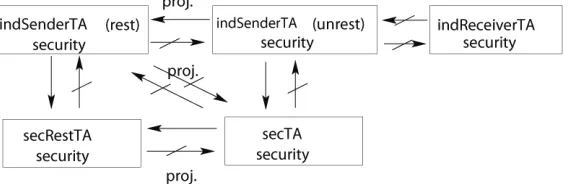
guarantee the ability to distinguish between two mixed-user instantiations (one’s ability to distinguish the latter depends on the TA oracle output). A complete diagram relating these notions appears in Figure 2.
Using our Framework. Besides providing a formal definition for indistinguishability in the presence of
traf-fic analysis, we apply our framework in two different scenarios.
Encode-then-Encrypt & MAC. Recently Paterson et al. [16, 35] have shown that the “provably secure”
SSH-$NPC protocol is vulnerable to implementation-specific information not included in IND-CCA security (i.e. leakage of the length field in an encrypted packet, dependence of the decryption process on the length field, byte-by-byte processing, etc). They extend the security model by explicitly considering all this side-channel information, and prove that the related SSH-CTR protocol achieves this extended notion.
As discussed in more detail in Appendix A, length-leakage is exactly one of the means used in traffic analysis to achieveclassificationof SSH flows. This is consistent with our framework: in Appendix C.4 we show a simple attack against the indSenderTA security of any “Encode-then-Encrypt & MAC” scheme (such as SSH). This is actually a separation proving that indTA is a strictly stronger notion than security in the presence of traffic analysis, secTA (see the proof of Lemma C.8). We also show a theoretical solution to achieve indSenderTA, based on an ideal distribution for the padding length. This solution introduces a large overhead, however, and is hard to implement, as no such ideal distribution is known in practice (though some heuristics, e.g. [31, 23] exist).
RFID authentication. Our second scenario is tag-to-reader authentication for RFID systems, more concretely
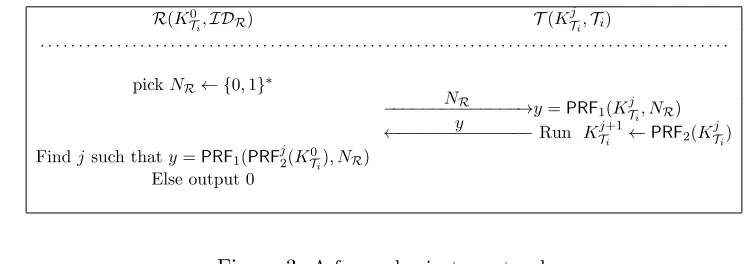
the destructive-private protocol due to Vaudenay [43], where keys are updated by means of a Pseudo-Random Function (PRF). The RFID tag keeps only (a copy of) the current authentication key, whereas the RFID reader keeps the original key and looks for the number i of times that this key has been updated. In this scenario, a (possibly response-time based) traffic analysis oracle may reveal the valuei. An attack against the indSenderTA security of this notion (where security is defined in the Juels and Weiss model [26]) is to output as a challenge a session where both tags have updated keys, and one where both have the original key. By using traffic analysis
Abig will distinguish between the updated or not-updated tag.
2
Preliminaries
2.1 Notation
IfS is a distribution over a setS, thenx←Ssignifies thatx is drawn at random fromS according toS(unless otherwise specified, sets S are associated with the uniform distribution). If S is an algorithm, then y ← S(x) denotes an execution ofSon inputxwith outputy; in particular whenSis probabilistic,yis a random variable.
IfAis an algorithm andO is an oracle queried on some input, we writeAO(·)Q
for an adversary who queries
O a number Q of times (for Q ∈ N). A function in λ is negligible, written negl (λ), if it vanishes faster than the inverse of any polynomial in λ. An algorithm A is probabilistic polynomial time (PPT) if A uses some randomness as part of its logic (i.e. A is probabilistic) and for any input x ∈ {0,1}∗ the computation of A(x) terminates in at most poly(|x|) steps.
2.2 Games in Canonical Form
Cryptographic primitives. Acryptographic primitive Π(P) = (Setup,F) for a player setP ={P1, . . . , Pn}
consists of an initialisation algorithm Setup and a set of PPT algorithms F. We often shorten the notation to just Π. There may be just two players (e.g., the prover and the verifier for authentication, or the signer and the verifier for signature schemes), or possibly n players executing a multiparty protocol (e.g., in an electronic voting scheme). TheSetupalgorithm takes as input parameters (λ,mpar) withλ∈Nandmparcontaining some master parameters (like the description of an underlying prime field, the parameters of a pairing-friendly curve, etc.) and outputs (ppar,spar)←Setup(1λ,mpar) whereppar ∈ {0,1}∗ are public parameters andspar ∈ {0,1}∗
are private (secret) parameters for the primitive Π. The interactive use of algorithms F (by parties Pi ∈ P)
yields a transcript τ ∈ {0,1}∗, containing the public inputs and outputs of the algorithms. If the primitive aborts during its execution,τ ends with⊥.
Classical Security – Hard games. Classical security of cryptographic primitives Π(P) is typically defined
through a game between an adversary Asmall and an honest entity G called the challenger. We assume that Asmall is stateful, i.e. it carries state from one step to another; Asmall and G exchange messages via a shared communication tape, and G runs (a subset of) algorithms in F in a black-box way on Asmall’s input. At some point,Asmall promptsG to issue a challenge, for whichAsmall must output a guess; given the challenge and this
guess, G outputs a decision bitd. If d= 1 we sayAsmall haswon the game, else the game is lost.
Our definitions apply to games in so-calledcanonical form as defined below; this notion is not too restrictive: most definitions in cryptography are canonical – see Appendix B. A canonical game Game is a tuple of PPT algorithms sharing state,Game= (Setup,Learn,ChGen,Match) such that:
Setup. Upon input (λ,mpar) with λ ∈ N, this algorithm runs the algorithm Setup of Π(P) and outputs pub-lic/secret parameters (ppar,spar) ← Setup(1λ,mpar). Here, spar are used by G, and ppar are used by
Asmall. We require thatAsmall is equally successful in breaking the game regardless of which parameters
are output by Setup.
Learn. Upon input a parameter set Qi, the challenger runs Learn, outputting a (partial) transcript τi ∈ {0,1}∗.
ChGen. Upon input a set of parameters Q∗, G runs ChGen outputting a challenge Υ∗. After ChGenhas been
successfully run, any further attempts to run it will output⊥.
Match. On input a guess Γ∗ and a challenge Υ∗,Match outputs a bitd. We say the guess is correct if d= 1.
Experiment ExpGameΠ(P)(Asmall, λ):
1. (ppar,spar)←Setup(1λ,mpar). AdversaryA
small is givenppar.
2. Q∗ ← ALearn(·)Q0
small (ppar).
3. Υ∗ ←ChGen(Q∗).
4. Γ∗ ← ALearn(·)Q
00
small (ppar,Υ∗).
5. The experiment outputsd←Match(Υ∗,Γ∗).
Let Q = Q0 +Q00 be the total number of queries to Learn (both before and after Υ∗ is issued). If
ChGenhas no output, as e.g., in the case of MACs, cf. Appendix B, we set Υ∗to be the empty string.
Def inition 2.1 (Hard games in canonical form) LetGame= (Setup,Learn,ChGen,Match) be the canonical
security game for a primitive Π. We say Π is(t, Q, )-secureif for all PPT adversaries Asmall running in time
at most tand making at most Q queries in the experiment above, we have
Prob
h
ExpGameΠ(P)(Asmall, λ) = 1
i
−δ ≤,
where the probability is taken over the randomness of the challenger G and resp. that of Asmall in a single
execution. The parameter δ (with 0≤δ <1) is the hardness of game G. For any Asmall against Game, we call
Prob
h
ExpGameΠ(P)(Asmall, λ) = 1i−δ
the advantage of Asmall and we denote it Adv Game
Π(P)(Asmall).
As no exact functionality is specified for it, Match may in fact allow for restrictions in Asmall’s use of the
oracles before and after the challenge. In the examples in Appendix B,Matchconditions theAsmall’s success on the challenge input (in our PKE example, Matchoutputs 0 if the challenge messagesm0 and m1 have different bit lengths, as required by IND-CCA). Similarly, we include restrictions on Asmall’s oracle use in Match. For
PKE,Match outputs 0 if the decryption oracle is used on the challenge ciphertext.
Security in the presence of Traffic Analysis. If we additionally giveAsmallaccess to a pre-set, stateful
traffic analysis (TA) oracle Θ, we have security in the presence of TA. Each run of the classical game is now an instantiation, and an adversary Asmall in an instantiation Inst may run Θ on Inst receiving some output (Θ is stateful, thus Asmall gets different output depending on when it queries the oracle). The game for security in the presence of traffic analysis is otherwise the same as that for classical security.1 The goal of Asmall is still
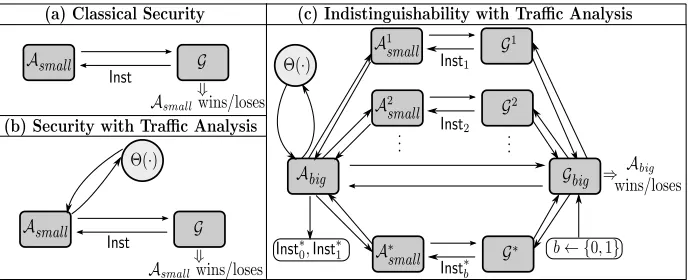
to output Γ∗ such that Match returns 1. We refer the reader to Appendix C for a formalization of this notion. Figure 1 depicts the essential differences between classical security, security in the presence of traffic analysis, and the notion of indistinguishability in the presence of traffic analysis, which we define in what follows.
3
Security Definitions
Classical security models usually take into account neither (a) weaknesses in implementation, nor (b) leakage by traffic analysis. In fact, the set of oracles O which Asmall may query in a (canonical) security game (as defined previously) is primitive- and not machine- or implementation-specific. The implementation of a primitive may, however, leak important information, e.g. parts of the randomness used, or a fingerprint of the machine (sender) running it. We proceed to enhance security models to account for traffic analysis leakage. We first give an intuition of our notion, then proceed to the formal definitions.
1
Informal Intuition. We considerinstantiations of the security game, i.e. each run of the game is assumed to
be dependent on the implementation and the machine running the primitive. The parameters of an instantiation
are global, generated by Setup or local, (sender-specific as in Section 1). In our running example, the global
parameters (pk,sk) are output by Setup =Gen, and pk is given to Asmall. We say that a user is created when
Setup is run to output new parameters.2
Each user may run parallelinstantiations of the game, having their ownlocal parameters, e.g. challenge bits, or preimages. For IND-CCA security, once a user is generated, the public key pk is given to Asmall, who may queryChGenon inputsm0, m1. Then the challengerGpicks a bitb, which is part of its local input. In fact, once
Asmall starts playing Game, we speak of an instantiation (uniquely determined by the oracle queries/replies of Asmall and G and by the local and global parameters), to which there corresponds a transcriptτ. By contrast, users correspond to the global parameters only. Instantiations are subject to traffic analysis (which is modelled by an oracle Θ), yielding information that is either local (the oracle is then restricted) or both local and global (this oracle is unrestricted). The model is non-adaptive in the sense that indTA-security is proved with respect to a pre-defined Θ oracle (e.g. we may choose to prove that encryption is secure in the presence of an oracle yielding half of the randomness used for encrypting ciphertexts).
Two instantiations sharing global parameters are same-user instantiations; instantiations with different global input are mixed-user. Our framework defines the notion of indistinguishability in the presence of traffic analysis, indTA, where the adversary must distinguish between two instantiations (either same- or mixed-user) of the security game. As aforementioned, an adversary that breaches the security (or the security in the presence of traffic analysis) of a protocol will also trivially win against indistinguishability, but this is not the only way to relate sessions. Indeed, fingerprinting an implementation will not necessarily break security, but itwill make an adversary distinguish sessions.
Figure 1: The three flavours of security considered in this paper: (a) Classical security, (b) Security in the presence of traffic analysis and (c) Indistinguishability in the presence of traffic analysis.
Formal Intuition. Concretely, let Π be a primitive with canonical security game Game= (Setup,Learn, ChGen,Match). Adversaries Abig play against a challenger Gbig. Initially an algorithm Init is run on some λ
to output the master parameters; then Abig can create new users (using Setup on input λ and mpar) or new instantiations Instfor a user (see also Figure 1).
A userUser for Π andGameis a set of parametersUPar such that (UPar)←Setup(1λ,mpar) for someλand
mpar. In our running example, Gbig runs Setup to generate keys for users Alice and Bob. The adversary Abig
receives pk for both users and may create instantiation Inst for, say Alice, creating a local Asmall manipulated byAbig and a localGhandled by Gbig. This corresponds toAbig tapping Carol’s transmission to Alice generated
for SSH or eMail.
2
Adversary Abig may either “play” a created Inst (by manipulating Asmall and usingLearn and ChGen with appropriate parameters) or may use Θ on Inst. Running ChGen in an instantiation invalidates it. Formally, an instantiation is a tuple (Asmall,G, τ,UPar,IPar), where: τ is a (potentially partial) transcript including a
validity bit initialized to 1 and flipped to 0 upon successful running of ChGen; UPar are global (user-specific) parameters; and IPar are local parameters. We assume consecutive indexing of instantiations (in the order of their creation). EventuallyAbig picks validInst∗i and Inst
∗
j and forwards them toGbig, with challenge inputs Q∗i,
resp. Q∗j.3 Challenger Gbig runs ChGen for both Insti∗ and Inst∗j and gets Υ∗i and Υ∗j, then picks a bit b, and forwards Υ∗big = (Inst∗,Υ∗) toAbig, where (Inst∗,Υ∗) = (Inst∗i,Υ∗i) ifb= 0 and (Inst∗,Υ∗) = (Inst∗j,Υ∗j) forb= 1.4 Finally, Abig outputs guess Γ∗big for the bit b and wins if Γ∗big =b. This notion is called indistinguishability in the presence of TA, denoted indTA.
We consider two flavours of indTA: sender indistinguishability – indSenderTA – where Inst∗i and Inst∗j are same-user instantiations, and receiver indistinguishability – indReceiverTA – where the chosen instantiations are mixed-user. There are two types of traffic analysis: restricted, denoted Θrest, which outputs only information
about the local parameters IPar; and unrestricted, denoted Θ, yielding bothIPar andUPar information.
indTA as a canonical game. Our definition of indTA is a canonical indistinguishability-based security game Gamebig = (Setupbig = Init,Learnbig,ChGenbig =Challenge,Matchbig). The algorithm Setupbig takes as input a parameterλand outputs master parameters mpar. AdversaryAbig plays gameGamebig against challengerGbig.
The oracleLearnbig consists of the traffic analysis oracle Θ and a set OAbig of oracles (see the next section). The set OAbig includes the setO defined for Game, but also includes oracles to create new users and instantiations, and to play instantiations. The input Q∗big to ChGenbig consists of: valid instantiations Inst∗0 and Inst∗1, and respective challenge inputs Q∗
0 and Q∗1. The algorithm ChGenbig picks a random bit b, runs ChGen for both
instantiations, then outputs Υ∗big = (Inst∗b,Υ∗b). The adversary Abig may play Inst∗b or learn more information,
and finally outputs a guess Γ∗big for the bit b. The algorithmMatchbig takes as input Υ∗big and Γ
∗
big and outputs
1 iff: (1) the bit Γ∗big =b; (2)Inst∗0 and Inst∗1 are both valid; and either (3a) the two instantiations are same-user (for indSenderTA) or (3b) the two instantiations are mixed-user (for indReceiverTA).
3.1 Definitions of Indistinguishability for Traffic Analysis
There are two dimensions to our model: the adversary’s goal and the strength of the TA oracle Θ. We have motivated the use in considering sender and receiver indistinguishability; we now briefly motivate our flavours of Θ before we formalise our definitions.
Restricted and Unrestricted TA. In our framework, we prove protocols indistinguishable in the presence
of certain, pre-set TA oracles Θ. On input an instantiation, Θ outputs information on this instantiation. In practice, Θ models an adversary’s ability to learn information related to a primitive, e.g. a delay in a response could leak information regarding key-update status (see also Appendix D).
We consider two types of traffic analysis, depending on the their output. If Θ yields only local information, we say it is restricted and denote it Θrest; in practice, Θrest models sender-specific flaws for implementations
which protect receiver data well (a sender might take longer to generate a challenge bit, or it may always send a tell-tale header). An oracle leaking both local and global information is called unrestricted. In our framework, indistinguishability for unrestricted oracles is stronger than for restricted oracles. The oracle is pre-set, and it may give more or less information: thus in the running example, a weak restricted oracle may yield a bit of the randomness used to generate the challenge ciphertext; a strong, unrestricted one may leaksk.
3
We say that the adversary forwards the instances to the challenger if it forwards indicesiandj. 4When we say the challenger forwards instantiationInst∗
, we meanAbig may use the handleInst∗ to play it or to use Θ on it,
We relate the two types of oracles by projecting unrestricted onto restricted oracles: Θrest is a projection proj(·) of Θ if: (a) Θrest is restricted, and (b) the output of Θrest =proj(Θ) for any instantiation is included in
the output of Θ for the same instantiation.
Algorithms and Oracles. As aforementioned, Gbig begins the game by querying an oracle Init, which,
on input a security parameter λ, outputs parameters mpar. We require that it is on average equally hard to break instances of the security game for different values of mpar. We now list the oracles that Abig may
query in indTA against a primitive Π with canonical security game Game= (Setup,Learn,ChGen,Match). Here
OAbig = (NewUser,NewInst,Play).
NewUser. On input λand master parameters mpar(output by Init), this oracle runs Setup, outputting UPar=
(ppar,spar) and a user identifier User. The values User, ppar, and spar are added on a new row of (an initially empty) table D. By abusing notation we write User ∈ D iff there exists a row in D containing
User. An (empty) tableIUser is created for each user.
NewInst. On input userUser, if User∈ D, thenNewInst creates an instantiationInst and adds it toIUser and to a listL. Else, NewInstoutputs⊥.
Play. On input an instantiation Inst, an oracle Mode∈ {Learn,ChGen,Match}, and some input state view, this
algorithm forwardsMode to adversaryAsmall inInst, who queries Modeand forwards the output value(s) out. At every query, the values (Mode,view,out) are added to the transcriptτ corresponding to Inst and to the table IUser. Furthermore, ChGenis only run if Instis in the list of valid instantiations L. Once the challenge is issued, Inst is removed fromL.
Challenge. On input instantiationsInst∗0 andInst∗1 and inputQ∗0 resp.Q∗1,Challengechecks instantiation validity, then runs ChGen for both instantiations, removing them from L. Then the algorithm picks a bit b at random and outputs instantiationInst∗b with relevant Υ∗b.
Θ. On input an instantiation Inst, the oracle Θ outputs state information ϑ.
Considering the conditions onInitand Setupwe may assume an uniformity of the instantiations, namely an adversary is about as likely to break the security of two (same-user or mixed-user) instantiations.
Sender Indistinguishability with Traffic Analysis. For sender indistinguishability we consider both
restricted and unrestricted traffic analysis as defined above. We first define the restricted oracle Θrest:
Def inition 3.1 (Restricted Θ oracle) AΘoracle is restrictediff for all mpar output byInitand for all PPT
adversaries Asmall having access only to the NewUser, NewInst, and Θ oracles, for all Inst0 and Inst1 output by
Asmall such that for all j with Userj ∈ D, Inst0 ∈ IUserj implies Inst16∈ IUserj, it holds that:
Θ(Inst0) = Θ(Inst1).
In general, we write Θrest to denote that the Θoracle is restricted.
We now define indSenderTA security. Let Π be a primitive with canonical security gameGame= (Setup,Learn,
ChGen,Match). Consider the following experiment:
Experiment ExpindSenderTAΠ(P),Θ
rest (Abig, λ) 1. mpar←Init(1λ).
2. User←NewUser(1λ,mpar). LetOUser= (NewInst(User),Play(·)). 3. Q∗big = (Inst∗0,Inst∗1,Q0∗,Q∗1)← AOUser,Θrest(·)
4. Υ∗big = (Inst∗b,Υ∗b)←Challenge(Q∗
big) for a random bitb.
5. Γ∗big ← AOUser,Θrest(·)
big (Υ
∗
big).
6. Output 1 iff Γ∗big =band (Inst∗0,Inst∗1)∈ L.
LetQ, resp. QTA denote the number of queries toOUser, resp. Θrest. The adversary’s advantage is:
AdvindSenderTAΠ(P) (Abig,Θrest) =
Prob
h
ExpindSenderTAΠ(P),Θrest (Abig, λ) = 1 i
−12 .
Def inition 3.2 (Restricted indSenderTAsecurity) The primitiveΠis(t, Q, QTA, )-secure against restricted
indSenderTA attacks for restricted oracle Θrest in a (canonical) game Game if for every PPT adversary Abig
running in time at most tand making at most Q, resp. QTA queries it holds that:
AdvindSenderTAΠ(P) (Abig,Θrest)≤.
We also define sender indistinguishability for unrestricted oracles Θ, leaking both local and global information. The adversary must still distinguish between same-user instantiations. We replace Θrest by Θ above to obtain
ExpindSenderTAΠ(P),Θ (Abig, λ).
Def inition 3.3 (Unrestricted indSenderTA security) The primitive Π is(t, Q, QTA, )-secure against
unre-stricted indSenderTA attacks for unrestricted oracleΘ in a (canonical) game Game if for every PPT adversary
Abig running in time at most t, and making at most Q, resp.QTA queries it holds that:
AdvindSenderTAΠ(P) (Abig,Θ)≤.
Receiver Indistinguishability with Traffic Analysis. For indReceiverTA, Θ is unrestricted (in this
sense, indReceiverTA is stronger than indSenderTA, see Section 3.2). We define indReceiverTA analogously to indSenderTA, for the following experiment:
Experiment ExpindReceiverTAΠ(P),Θ (Abig, λ)
1. mpar←Init(1λ). LetOUser= (NewUser(1λ,mpar),NewInst(·),Play(·)). 2. Q∗big = (Inst∗0,Inst∗1,Q0∗,Q∗1)← AOUser,Θrest(·)
big .
3. Υ∗big = (Inst∗b,Υb∗)←Challenge(Q∗big) for a random bitb. 4. Γ∗big ← AOUser,Θ(·)
big (Υ
∗
big).
5. Output 1 iff: (i) Γ∗big =b; (ii)Inst∗0,Inst∗16∈ IUser for any userUser output by NewUser; and (iii)Inst∗0,Inst∗1 ∈ L.
Again,Q, resp. QTA are the number of queries made toOUser, resp. Θ, and the advantage is:
AdvindReceiverTAΠ(P) (Abig,Θ) = Prob
h
ExpindReceiverTAΠ(P),Θ (Abig, λ) = 1i−1 2 .
Def inition 3.4 (indReceiverTA security) The primitive Π is (t, Q, QTA, )-secure against indReceiverTA
at-tacks for unrestricted oracle Θ in a (canonical) gameGame if for every PPT adversaryAbig running in time at
most t, and making at most Q, resp. QTA queries in the experiment above we have:
3.2 Relation between Security Notions
In the previous section we gave three security definitions (cf. Definitions 3.2 – 3.4), i.e. two flavours of indSenderTA, (restricted and unrestricted), and indReceiverTA. Here we state, and give an intuition for, the relations of the notions. Exact statements and the proofs are given in Appendix C.
Firstly, unrestricted indSenderTA is strictly stronger than restricted indSenderTA: the unrestricted Θ gives more data than Θrest =proj(Θ). A trivial separation is to consider Θ leaking Θrest dataand a secret key. Relating
unrestricted indSenderTA and indReceiverTA is more difficult (Θ is the same, but in one case the challenge instantiations are same-user and in the other, mixed-user). In fact, the two notions are independent, and the separation relies on the fact that one can define a TA oracle that isonly useful for sender distinguishability, and not for receiver distinguishability, or viceversa.
We also show that the enhancement from security in the presence of traffic analysis – see Section 2 and Appendix C – toindistinguishability in the presence of traffic analysis is not trivial. In particular we prove that indTA is strictly stronger than secTA: if Π is indTA-secure with respect to Game, then it is also secTA-secure. The reverse is not true: our counterexample is the Encode-then-Encrypt & MAC paradigm with a length-leaking oracle. The adversary can manipulate the challenge input so that the TA oracle allows it to distinguish instantiations without necessarily breaking security.
These relationships are summarized in Figure 2. Formal statements are given in Theorems 3.1 – 3.3 and proved in Appendix C.2 – C.4.
Figure 2: Relationships of the notions: arrows refer to implications, hatched arrows to separations; the notation “proj.” refers to oracle projection, cf. Section 3.1.
Sender vs. Receiver Indistinguishability.
Theorem 3.1 (indSenderTA and indReceiverTA) The following relationships hold:
1. If primitive Π is secure for a canonical game Game and unrestricted indSenderTA-secure for some oracle
Θ, then it is also restricted indSenderTA-secure for anyΘrest s.t. Θrest =proj(Θ).
2. There exists a primitiveΠ secure against a canonical game Game, such that one of the following holds:
(a) Π is restricted indSenderTA-secure for Θrest, but unrestricted indSenderTA-insecure for some Θ
sat-isfying proj(Θ) = Θrest.
(b) Π is indReceiverTA-secure for oracle Θ, but unrestricted indSenderTA-insecure for Θ.
(c) Π is unrestricted indSenderTA-secure for oracle Θ, butindReceiverTA-insecure for Θ.
Security vs. indistinguishability. We consider security in the presence of traffic analysis (see section 2
Theorem 3.2 (Restricted and unrestricted security) The following relationships hold:
1. IfΠ is secure for a canonical game Game andsecTA-secure for unrestrictedΘ, then it is also secRestTA
-secure for any restricted Θrest s.t. proj(Θ) = Θrest.
2. There exists a primitive Π that is: secure for a canonical game Game; secRestTA-secure for restricted
Θrest; butsecTA-insecure for unrestrictedΘ s.t. proj(Θ) = Θrest.
Theorem 3.3 (Security and indistinguishability) The following relationships hold:
1. LetΠ be secure for a canonical game Game:
(a) if Π is restricted indSenderTA-secure for restricted Θrest, then it is also secRestTA-secure for Θrest.
(b) if Π is unrestricted indSenderTA-secure for oracle Θ, then it is alsosecTA-secure for Θ.
2. There exists a primitiveΠ secure for a canonical game Game, such that one of the following holds:
(a) Π is secRestTA-secure for restrictedΘrest, but restricted indSenderTA-insecure for Θrest. (b) Π is secTA-secure for oracle Θ, but unrestricted indSenderTA-insecure for Θ.
(c) Π is restricted indSenderTA-secure for Θrest, butsecTA-insecure for some Θs.t. proj(Θ) = Θrest.
(d) ΠissecTA-secure for oracleΘ, but restrictedindSenderTA-insecure for some oracleΘrest s.t.Θrest = proj(Θ).
4
Case Study: The “Encode-then-Encrypt & MAC” Paradigm
We apply our framework in the context of the Secure Shell (SSH) protocol [5]. SSH is a particular instantiation of the “Encode-then-Encrypt & MAC” paradigm, which we briefly recall below.
Let Π?(Ψ,ΠE,ΠM) = (Gen?,Enc?,Dec?) be a symmetric encryption scheme for encoding scheme Ψ, on
block cipher ΠE = (GenE,Enc,Dec) with input length B (in bytes) and on a message authentication code
ΠM = (GenM,MAC,VRFY). In what follows all lengths |·| are in bytes. The key-generation algorithm Gen?
takes as input the security parameter λand outputs K = (KE, KM) ← Gen?(1λ), where KE ← GenE(1λ) and
KM ←GenM(1λ). A messagem of length |m|=L bytes is encoded into Ψ(m) for random padding uof length
|u|, as follows:
Ψ(m) = (|h|u|, m, ui|,|u|, m, u),
It is crucial that|u|is standardized, chosen such that the length of the padded message is an integer multiple of the block lengthB of the underlying block cipher. Thus,|u| ≤B bytes. In the following, denote by mpad the padded message preceded by the padding length, i.e. mpad=h|u|, m, ui. Note that decoding relies on the fact that the length |mpad|is fixed by the standardization.
The encoded message Ψ(m) is encrypted toc←EncKE(Ψ(m)); since ΠE is a block-cipher, this requires the
use of an operational mode, e.g. CBC. Finally, a tagφ←MACKM(Ψ(m)) of the encoded message is computed
using key KM. The ciphertext is then c?= (c, φ)←Enc?K(m).
Decryption ofc? works as follows. Upon decrypting the first block of c, the length field |m
pad|is recovered; if something goes wrong, a special symbol⊥L is returned. Once the length field is known,c? is parsed as (c, φ).
If parsing fails, a special symbol ⊥P is output. Then c is decrypted, yielding Ψ(m) = DecKE(c); the tag φ is
verified as in VRFYKM(Ψ(m), φ). If verification fails a special symbol⊥M is output.
5
5It is well known that an instantiation of the “Encode-then-Encrypt & MAC” using any CPA-secure encryption scheme Π
E
and any secure MAC ΠM doesnot yield a CCA-secure scheme. There are, however, other combinations of symmetric encryption
The SSH protocol is a concrete example of the above paradigm for which Ψ(m) has standard bounds |u| ≤
Fpad = 1,|mpad| ≤ Fenc = 4; messages m are encoded to reach a length compatible with the length B of the blockcipher, by using an amount |u|of random padding as in:
|u|=B−(|m|+Fenc+FpadmodB) =B−(|m|+ 5 modB).
Security in the Presence of Traffic Analysis. Bellare et al. [4] proved that two variations of the SSH
protocol, namely SSH-$NPC (using CBC mode with explicit random IVs and random padding) and SSH-CTR (using counter mode), achieve IND-CCA security. However, very recently [16] shows a plaintext recovery attack against SSH-$NPC, despite the proof in [4]. This apparent contradiction is due to the fact that [16] exploited several characteristics of SSH implementations that are not modelled by classical IND-CCA, i.e. (1) the ability of adversaries to recover the (otherwise encrypted) packet length field and (2) the fact that decryption is stateful and byte-oriented. On a high level the attack goes as follows: the adversary sends a target ciphertext as the length field in the first block of a new SSH packet, then feeds the SSH connection with random blocks of ciphertext and measures the number of bytes needed before the MAC check fails. Due to CBC standardization, the adversary now knows the decryption of the length field block, i.e. the target.
To model such attacks, Paterson and Watson [35] naturally extend the standard IND-CCA model to allow for stateful decryption in a blockwise manner. Also the adversary may query a length-leaking oracle to get the (otherwise encrypted) packet length. Then [35] proves that SSH-CTR is secure in this model. The model in [35] can be modelled in our framework for secRestTA (cf. Definition C.1) as follows. We enhance IND-CCA security for Π?, with a TA oracle Θlength. Whenever the adversary queries the decryption oracle, Θlength updates
a database with all the ciphertexts submitted by the adversary. When the challenge ciphertext is output in IND-CCA, it is added to the database. Then on input an instantiation Inst, Θlength outputs the lengths|mpad| of all encodings in ciphertexts in the instantiation’s database. Thus Θlength is restricted.
Privacy in the Presence of Traffic Analysis. The attack in [16] is only the tip of the iceberg. Several
traffic analysis methods are known to breach SSH privacy. It is possible to e.g. very accurately classify traffic flows by exploiting length field leaks for SSH packets. This fact fits well in our framework: we prove in Appendix C.4 that “Encode-then-Encrypt & MAC” protocols like SSH are restricted indSenderTA-insecure (cf. Definition 3.2) for Θlength, even if the scheme is secRestTA-secure (cf. Definition C.1) for Θlength. This separates indSenderTA
and secRestTA – cf. claim (2a) in Theorem 3.3 and Lemma C.8. Intuitively, in this attack an adversary Abig
against indSenderTA simply chooses inputsQ∗
0:={m00, m01},Q∗1={m10, m11}in the two instantiationsInst
∗
0,Inst∗1 submitted to Gbig in such a way that the messages in the input-set Q∗0 have different length from those in Q∗1. By using Θlength on the challenge instantiationInst∗b,Abig distinguishes the two instantiations w.p. 1.
This attack can be prevented by ensuring that the padding length is not fixed and “hard to predict” (as aforesaid, the problem with SSH is that the padding length is predictable based on the message length and is always less than 1 block). A na¨ıve solution is to require that all messages are padded until the maximum allowed length is reached: then the information leaked by Θlength is useless. Whereas this guarantees indistinguishability,
it also creates a huge overhead in practice. We show below how to achieve indistinguishability for less, though still a considerable, overhead; our method is a proof of concept rather than a practical solution.
keytk generated at setup. The functionf takes as input the trapdoor and an encoding Ψ(m) of messagemand outputs (|u|,|mpad|) =ftk(Ψ(m)), allowing to retrievem at the receiver side.
Intuitively the distributionU should be such that the length ofpaddedmessages reveals negligible information about the length of original messages. This is not trivial, as shown by the following example. Assume that the adversary has access to two distributions for the plaintexts in the message space: one distribution always outputs very short messages and the other always outputs very long messages. Suppose that we choose U to be the uniform distribution over a space of fixed dimension. In this case an adversary can easily distinguish the encoded version of two arbitrary messages drawn from the two distributions, since the length of the padded messages will not change much: on average the encodings of the messages drawn from the first distribution will still be short, whereas the encodings of the messages drawn from the second distribution will still be long.
We formally consider the following experiment for the encoding scheme Ψ defined above (for distributionU
and functionf with trapdoortk), an adversaryA, and a challenger G. The challenger first chooses f,tk, andU. The adversaryAis given the security parameter and a description off and may submitmtoG. The challenger chooses |u| ← U, computes mpad =h|u|, m, ui where u← {0,1}|u| and forwards |mpad|toA. At some point A chooses arbitrary m0, m1,6 receives Υ∗ =|mpad|b, and must guess the bit b. We say that the distribution U is
ideal – and we denote it byUideal – if no adversary can guessb with probability larger than 1/2.
We show that any distribution U which is indistinguishable from Uideal yields restricted indSenderTA for Θlength.
Proposition 4.1 (Towards security & privacy for SSH) LetΠ?(Ψ,ΠE,ΠM)be(tsmall, Q, QTA, small)-secure
against secRestTA attacks for Θlength. Moreover, let U be a distribution such that U and Uideal are (t, )
-computationally indistinguishable. If the encoding scheme Ψ in Π? uses U, then Π? is (t?, Q, Q
TA, ?)-secure
against restricted indSenderTA attacks, where
t?≈t ? ≤small+.
Proof. The proof uses game hopping. We denote byXi the output of the experiment in theith game.
Game 0. The first game is indSenderTA using Θlength, where the encoding scheme Ψ uses the ideal distribution Uideal. DefineEsmall to be the event that there exists an adversary Asmall able to break the secRestTA security
of Π? using Θlength. Clearly,
Prob[X0 = 1] = Prob[X0 = 1 |Esmall] + Prob
X0= 1 |Esmall
≤Prob[Esmall] + Prob
X0 = 1 |Esmall
(a)
≤ small+ Prob
X0 = 1 |Esmall
(b)
≤small+ 1/2.
Here, (a) follows as Π? is (tsmall, Q, QTA, small)-secure against secRestTA and (b) holds because Ψ is based on
the ideal Uideal.
Game 1. The second game is identical to Game 0, but we replace Uideal by U. We claim that:
|Prob[X1= 1]−Prob[X0 = 1]| ≤.
Assume this is not the case. We build an adversary Bsmall which can distinguishU from Uideal with advantage
> , contradicting the indistinguishability of U and Uideal. Adversary Bsmall has access to an oracle returning
6
samples|u|drawn from eitherU orUideal. IntuitivelyBsmall uses the fact thatAbig can guess with only negligible probability against indSenderTA for Uideal: if Abig wins, Bsmall guesses that the encoding is done using U and
not Uideal.
Adversary Bsmall simulates the environment for Abig as follows: (1) Whenever Abig asks to create a new instantiation of the IND-CCA security game, draw K = (KE, KM,(U, f,tk)) ← Gen?(1λ); (2) When Abig
asks the encryption of a message m, query the oracle. Let |u| be the sample returned by the oracle. Set mpad=h|u|, m, ui whereu ← {0,1}|u|. Answer Abig’s query computingc? using the key K as described in Π?;
(3) When Abig asks the decryption of a ciphertext c?, answer with the message m obtained by decrypting c? using the key K as described in Π?; (4) WhenAbig queries the Θlength oracle with an instantiation Inst, return
the values ϑ = |mpad| corresponding to the chosen instantiation. (5) When Abig outputs Q∗big = (Inst
∗
0,Q∗0 =
{m0
0, m01},Inst
∗
1,Q∗1 ={m10, m11}), query the oracle. For a random bitb, computec?b encrypting a random message
in Q∗b as specified in Π?. Return the challenge Υ∗big = (Instb∗,Υ∗b) for Abig; (6) Given the guess Γ∗big from the
adversary, conclude that the oracle isU iff Γ∗big =b.
Clearly Bsmall runs in time t≈t?. Moreover it is easy to see that when the samples |u|are chosen from U
the view of Abig is distributed like in Game 1, whereas when the samples |u| are chosen from Uideal the view
of Abig is distributed like in Game 0. Thus Bsmall can tell apart U and Uideal with advantage > , against the assumption that U and Uideal are (t, )-computationally indistinguishable. Putting all together we have shown that
?:= Prob[X1= 1]−1/2≤small+,
as desired.
It remains open the problem how to realize the distribution Uideal. To this extent, only heuristic solutions are known. For instance in [23] it is shown how to achieve indistinguishability of padded SSH flows using the optimal overhead, assuming one is given in advance the probability distributions of the packet lengths output by the application. However the overhead introduced is still very high (up to 35% of the transmitted data).
References
[1] 51th Annual IEEE Symposium on Foundations of Computer Science, FOCS 2010, October 23-26, 2010,
Las Vegas, Nevada, USA. IEEE Computer Society, 2010.
[2] Adi Akavia, Shafi Goldwasser, and Vinod Vaikuntanathan. Simultaneous hardcore bits and cryptography against memory attacks. In Omer Reingold, editor, TCC, volume 5444 of Lecture Notes in Computer
Science, pages 474–495. Springer, 2009.
[3] Ehab Al-Shaer, Angelos D. Keromytis, and Vitaly Shmatikov, editors. Proceedings of the 17th ACM
Con-ference on Computer and Communications Security, CCS 2010, Chicago, Illinois, USA, October 4-8, 2010.
ACM, 2010.
[4] Mihir Bellare, Tadayoshi Kohno, and Chanathip Namprempre. Breaking and provably repairing the SSH authenticated encryption scheme: A case study of the Encode-then-Encrypt-and-MAC paradigm. ACM
Trans. Inf. Syst. Secur., 7(2):206–241, 2004.
[5] Mihir Bellare, Tadayoshi Kohno, and Chanathip Namprempre. The secure shell (SSH) transport layer encryption modes. RFC 4344, January 2006. http://www.ietf.org/rfc/rfc4344.txt.
[7] Elette Boyle, Gil Segev, and Daniel Wichs. Fully leakage-resilient signatures. In Kenneth G. Paterson, editor, EUROCRYPT, volume 6632 of Lecture Notes in Computer Science, pages 89–108. Springer, 2011.
[8] Zvika Brakerski and Shafi Goldwasser. Circular and leakage resilient public-key encryption under subgroup indistinguishability - (or: Quadratic residuosity strikes back). In Tal Rabin, editor,CRYPTO, volume 6223
of Lecture Notes in Computer Science, pages 1–20. Springer, 2010.
[9] Zvika Brakerski, Yael Tauman Kalai, Jonathan Katz, and Vinod Vaikuntanathan. Overcoming the hole in the bucket: Public-key cryptography resilient to continual memory leakage. InFOCS [1], pages 501–510.
[10] David Brumley and Dan Boneh. Remote timing attacks are practical. Computer Networks, 48(5):701–716, 2005.
[11] Christian Cachin. An information-theoretic model for steganography. In David Aucsmith, editor,
Informa-tion Hiding, volume 1525 ofLecture Notes in Computer Science, pages 306–318. Springer, 1998.
[12] David Chaum. Untraceable electronic mail, return addresses, and digital pseudonyms. Commun. ACM, 24(2):84–88, 1981.
[13] George Danezis and Richard Clayton. Digital Privacy: Theory, Technologies, and Practices, chapter 5, Introducing Traffic Analysis, pages 96–117. Eds. Auerbach Publications, 2007.
[14] Francesco Dav`ı, Stefan Dziembowski, and Daniele Venturi. Leakage-resilient storage. In Juan A. Garay and Roberto De Prisco, editors, SCN, volume 6280 of Lecture Notes in Computer Science, pages 121–137. Springer, 2010.
[15] Nenad Dedic, Gene Itkis, Leonid Reyzin, and Scott Russell. Upper and lower bounds on black-box steganog-raphy. In Joe Kilian, editor, TCC, volume 3378 of Lecture Notes in Computer Science, pages 227–244. Springer, 2005.
[16] Jean Paul Degabriele and Kenneth G. Paterson. On the (in)security of IPsec in MAC-then-encrypt config-urations. In Al-Shaer et al. [3], pages 493–504.
[17] Yevgeniy Dodis, Shafi Goldwasser, Yael Tauman Kalai, Chris Peikert, and Vinod Vaikuntanathan. Public-key encryption schemes with auxiliary inputs. In Micciancio [33], pages 361–381.
[18] Yevgeniy Dodis, Kristiyan Haralambiev, Adriana L´opez-Alt, and Daniel Wichs. Cryptography against continuous memory attacks. InFOCS [1], pages 511–520.
[19] Stefan Dziembowski and Krzysztof Pietrzak. Leakage-resilient cryptography. In FOCS, pages 293–302. IEEE Computer Society, 2008.
[20] Sebastian Faust, Eike Kiltz, Krzysztof Pietrzak, and Guy N. Rothblum. Leakage-resilient signatures. In Micciancio [33], pages 343–360.
[21] Karine Gandolfi, Christophe Mourtel, and Francis Olivier. Electromagnetic analysis: Concrete results. In C¸ etin Kaya Ko¸c, David Naccache, and Christof Paar, editors, CHES, volume 2162 of Lecture Notes in
Computer Science, pages 251–261. Springer, 2001.
[22] Vipul Goyal and Abhishek Jain. On the round complexity of covert computation. In Leonard J. Schulman, editor, STOC, pages 191–200. ACM, 2010.
[23] Alfonso Iacovazzi and Andrea Baiocchi. Optimum packet length masking. In 22nd International Teletraffic
[24] Yuval Ishai, Amit Sahai, and David Wagner. Private circuits: Securing hardware against probing attacks. In Dan Boneh, editor,CRYPTO, volume 2729 ofLecture Notes in Computer Science, pages 463–481. Springer, 2003.
[25] Antoine Joux, editor. Advances in Cryptology - EUROCRYPT 2009, 28th Annual International Confer-ence on the Theory and Applications of Cryptographic Techniques, Cologne, Germany, April 26-30, 2009.
Proceedings, volume 5479 of Lecture Notes in Computer Science. Springer, 2009.
[26] Ari Juels and Stephen A. Weis. Defining strong privacy for RFID. InInternational Conference on
Perva-sive Computing and Communications - Workshops (PerCom Workshops), pages 342–347. IEEE Computer
Society Press, 2007.
[27] Jonathan Katz and Vinod Vaikuntanathan. Signature schemes with bounded leakage resilience. In Mitsuru Matsui, editor,ASIACRYPT, volume 5912 ofLecture Notes in Computer Science, pages 703–720. Springer, 2009.
[28] Paul C. Kocher. Timing attacks on implementations of Diffie-Hellman, RSA, DSS, and other systems. In Neal Koblitz, editor, CRYPTO, volume 1109 of Lecture Notes in Computer Science, pages 104–113. Springer, 1996.
[29] Paul C. Kocher, Joshua Jaffe, and Benjamin Jun. Differential power analysis. In Michael J. Wiener, editor,
CRYPTO, volume 1666 ofLecture Notes in Computer Science, pages 388–397. Springer, 1999.
[30] Markus G. Kuhn. Compromising emanations: eavesdropping risks of computer displays. PhD thesis, University of Cambridge, 2003. Technical Report UCAM-CL-TR-577.
[31] Marc Liberatore and Brian Neil Levine. Inferring the source of encrypted HTTP connections. In Ari Juels, Rebecca N. Wright, and Sabrina De Capitani di Vimercati, editors, ACM Conference on Computer and
Communications Security, pages 255–263. ACM, 2006.
[32] Silvio Micali and Leonid Reyzin. Physically observable cryptography (extended abstract). In Moni Naor, editor, TCC, volume 2951 ofLecture Notes in Computer Science, pages 278–296. Springer, 2004.
[33] Daniele Micciancio, editor. Theory of Cryptography, 7th Theory of Cryptography Conference, TCC 2010,
Zurich, Switzerland, February 9-11, 2010. Proceedings, volume 5978 ofLecture Notes in Computer Science.
Springer, 2010.
[34] Moni Naor and Gil Segev. Public-key cryptosystems resilient to key leakage. In Shai Halevi, editor,
CRYPTO, volume 5677 ofLecture Notes in Computer Science, pages 18–35. Springer, 2009.
[35] Kenneth G. Paterson and Gaven J. Watson. Plaintext-dependent decryption: A formal security treatment of SSH-CTR. In Henri Gilbert, editor,EUROCRYPT, volume 6110 ofLecture Notes in Computer Science, pages 345–361. Springer, 2010.
[36] Krzysztof Pietrzak. A leakage-resilient mode of operation. In Joux [25], pages 462–482.
[37] Jean-Jacques Quisquater and David Samyde. Electromagnetic analysis (EMA): Measures and counter-measures for smart cards. In Isabelle Attali and Thomas P. Jensen, editors, E-smart, volume 2140 of
Lecture Notes in Computer Science, pages 200–210. Springer, 2001.
[39] Jean-Fran¸cois Raymond. Traffic analysis: protocols, attacks, design issues and open problems. Designing
Privacy Enhancing Technologies, 2009:10–29, 2001.
[40] Ahmad-Reza Sadeghi, Ivan Visconti, and Christian Wachsmann. Anonymizer-enabled security and privacy for RFID. In Advances in Cryptology — Asiacrypt’08, volume 5888 ofLecture Notes in Computer Science, pages 292–299. Springer-Verlag, 2009.
[41] Fran¸cois-Xavier Standaert, Tal Malkin, and Moti Yung. A unified framework for the analysis of side-channel key recovery attacks. In Joux [25], pages 443–461.
[42] Fran¸cois-Xavier Standaert, Oliver Pereira, Yu Yu, Jean-Jacques Quisquater, Moti Yung, and Elisabeth Os-wald. Leakage Resilient Cryptography in Practice, chapter in Towards Hardware Intrinsic Security: Foun-dation and Practice, pages 105–139. Springer, 2010.
[43] Serge Vaudenay. On privacy models for RFID. In Advances in Cryptology — Asiacrypt’07, volume 4883 of
Lecture Notes in Computer Science, pages 68–87. Springer-Verlag, 2007.
[44] Luis von Ahn, Nicholas J. Hopper, and John Langford. Covert two-party computation. In Harold N. Gabow and Ronald Fagin, editors,STOC, pages 513–522. ACM, 2005.
[45] Yu Yu, Fran¸cois-Xavier Standaert, Olivier Pereira, and Moti Yung. Practical leakage-resilient pseudorandom generators. In Al-Shaer et al. [3], pages 141–151.
A
Existent and Future Work
Related Work. We have mentioned key-related leakage resilience as a related field. In fact, key-related
leakage resilience and our notion of indistinguishability in the presence of traffic analysis are non-overlapping. Whereas our notion modelsarbitrary leakage (the TA oracle can yield information wholly unrelated to the secret key), leakage resilience allows the adversary toadaptivelychoose functions that it wishes to evaluate on the secret key (possibly with other adversary-chosen input parameters). This is not possible in our framework, which pre-sets the traffic analysis oracle, and proves indistinguishability in the presence of that particular oracle. Note that a TA oracle can be composite, i.e. it can yield a possibly large (but not infinite) set of outputs, modelling for example a large set of pre-set functions of the secret key that need to be evaluated (but this set is still not adaptively updated). However, as argued by Standaert et al [42, 45], non-adaptivity is enough in many applications of side-channel attacks (and full-adaptivity is in general a too strong requirement).
Further groundwork on privacy for traffic analysis has also been laid (see [39] for a survey and further references). The explicit goal of traffic analysis is usually described as sender-recipient matching (if the sender of a message is known, identify the receiver, and if the receiver is known, identify the sender). This is exactly the notion we attempt to capture by our indistinguishability framework: indReceiverTA-security hides receivers, whereas indSenderTA hides senders. However, previous works on traffic analysis, building on Chaum’s work on anonymous communication [12] and on Rackoff and Simon’s work on anonymous traffic [38], mainly reflects an adversary’s ability to monitor a communication channel and tell whether it is used or not. Usually one extensively elaborates on the topic of routing, arguing that anonymising routing would make it impossible for an adversary to tell the sender of a message even if it knows the recipient, and viceversa. The adversary described in this framework has the ability to manipulate nodes, time routes, and handle messages, but not to leak information from the implementation of a primitive. In fact, this aspect is explicitly outside the scope of [12, 38].
[38] is thorough, it does not reflect an adversary’s ability to use side-channel analysis and fingerprint commu-nication. Here, the authors use techniques from Secure Multiparty Computation (SMC) and Non-Interactive Zero-Knowledge (NIZK) to achieve message “untraceability” in a network of synchronously communicating players.
Berman, Fiat, and Ta-Shma [6] address traffic analysis in the asynchronous case, introducing “obscurant networks” – i.e., networks able to obscure the destination of each particular player – further allowing the adversary to have some a-priori information about the communication patterns (e.g., some players exchange less messages than others). Whereas this is a particular case of our approach here, we consider far more general settings, allowing the adversary to learn further information than just the message load on a line of communication.
In fact, to the best of our knowledge our theoretical framework is the first to extend general provable-security models to account for traffic analysis and prove provable-security and privacy in the presence thereof. We also comprehensively outline the relations between different flavours of traffic analysis.
Limitations of our Model. Classical traffic analysis can have two goals. One is distinguishing the source
of communication. The second is to tell whether communication is taking place at all. In our model, we
address only the first threat. The second notion – known as steganography [11] or covert computation [44] in its generalised form – is, however, much stronger and less practical to achieve [15, 22]. Communication can be hidden by simulating honest interactions on random communication lines, such that the set of honest protocol runs and the set of simulated ones are distributed in a computationally indistinguishable way with respect to time. For infrequently used communication lines, this is impossible to do in practice (here the set of simulated communication would be much larger than the set of honest communication, thus the overhead is overwhelming). A general, frequently used solution to hiding communication is frequency hopping, i.e. the properties of the communication channel are changed in a random fashion such that an adversary monitoring traffic cannot guess in advance which frequency the parties are using. This solution is not always useful, as an adversary may analyse the patterns of frequency hopping, thus distinguishing the randomiser that is being used.
Apart from its scope, our model is also limited by its generality. We try to encompass as many types of security notions and primitives as possible; however, in order to prove and generalise our results, we need to make some assumptions regarding the structure of the security game, something we call a canonical form. This canonical form is not too restrictive: indeed we show that many “classical” security definitions fit our framework. We have thus far considered only game-based security, leaving simulation-based notions for future work.
Finally, in this work we consider two concrete cases of traffic analysis. An interesting and natural extension would be to consider a larger, more abstract class of traffic analysis attacks (in a way similar to the context of leakage-resilient cryptography) for which to assess security. We leave this as an open problem for future research.
Traffic Analysis in Practice. Traffic analysis has its roots in the military context; indeed it has been widely used already during the World War I to learn the intentions and actions of the enemy. It is within the development of wireless communication, however, that TA has become a so powerful means, since radio communications allow to easily deduce information by monitoring patterns in communication. Traffic analysis is not only used for military purposes, but it is also a big concern in computer security, especially over the Internet. In this context several attacks are known to obtain traffic monitoring: traffic classification is possible based on statistical features of packet flows. Among the others features, packet length is one of the most used.
A concrete example is SSH [5], one of the most widely used secure network protocols. Several techniques are known (e.g. [23, 35] and cited references) to learn (otherwise encrypted) message lengths for SSH tunnels. This allows for very accurate traffic monitoring and classification, generating a huge privacy problem. See also [13] for applications of TA over the Internet, in contexts different from SSH.
B
Canonical Games in Cryptography
As stated before, the assumption that security games are canonical is not too strong. In this section we show how various known definitions fit our framework.
Public-key encryption. Let Π(A, B) = (Setup = Gen,Enc,Dec) be a public-key encryption scheme. The
set of players P = (A, B) is made of only two parties, called Alice and Bob. The set F consists of
Enc,Dec. The strongest notion of security is IND-CCA2 security, which is a canonical game with algorithms (Setup,Learn,ChGen,Match) as follows.
On input a security parameterλ, algorithmSetupruns the key-generation algorithmGenon 1λ, outputting
spar = sk and ppar = pk, i.e. a private-public key pair. The algorithm Learn on input any query
Q = (Dec, c) for ciphertexts c, outputs transcripts of the form τ = (Dec, c, m), where m← Decsk(c). For
administrative purposes, this algorithm keeps a database recording the transcripts for all i= 1, . . . , Q = Q0+Q00. Upon input set Q∗ = (m0, m1), the challenge algorithmChGen picks a bitb← {0,1}, then runs Υ∗ ←Encpk(mb). Finally, on inputs a guess Γ∗ ∈ {0,1} and a challenge Υ∗, the algorithmMatchoutputs
d= 1 iff (2) Γ∗=b(i.e. the bit that was chosen by the challenger), (2) the messages inQ∗ have the same length|m0|=|m1|, and (3) there exists noj∈ {Q0+ 1, . . . , Q} such thatQj = (Dec,Υ∗).
For the security of this game, note that the hardness of the game is δ= 1/2.
Message authentication codes. Let Π(A, B) = (Setup =Gen,MAC,VRFY) be a Message Authentication Code
(MAC). The set of players P = (A, B) consists again of only Alice and Bob. The set F consists of
MAC,VRFY. The standard notion of security is universal unforgeability, which is a canonical game with algorithms (Setup,Learn,ChGen,Match) as follows.
On input a security parameterλ, algorithmSetupruns the key-generation algorithmGenon 1λ, outputting
spar = K and ppar = ε, i.e. the public parameters are the empty string ε. The algorithm Learn takes input of two forms. On input queries Q = (MAC, m) for message m, the learning algorithm runs φ ← MACK(m) and outputs transcripts of the form τ = (MAC, m, φ). On input queriesQ= (VRFY, m, φ), the
learning algorithm runs b← VRFYK(m, φ) and outputs transcripts of the form τ = (VRFY, m, φ, b). For
administrative purposes, this algorithm keeps a database recording all query-transcript pairs (Qi, τi) for all
i= 1, . . . , Q=Q0+Q00. The challenge phase is empty, i.e. on any inputQ∗, the algorithmChGenoutputs Υ∗ =ε. On input a guess Γ∗= (m∗, φ∗) for message m∗ and tagφ∗, the algorithmMatchoutputsd= 1 iff (1)VRFYK(m∗, φ∗) = 1 and (2) there exists no entryj∈ {1, . . . , Q} in the database of the learning oracle
such that Qj = (MAC, m∗). For the security of this game, note that the hardness of the game isδ= 0.
Indistinguishability from random. Let Π(P) = (Setup = Gen,PRF) be a Pseudo-Random Function (PRF)
with key space K, domain X and range Y. The set of players P consists of a single party (namely the user of the PRF). The security definition is based on indistinguishability between PRFK(·) (for a
randomly chosenK ← K) and a truly random functionπ(·) (chosen at random from all possible functions with domain X and range Y). The security of the PRF, i.e. pseudorandomness, is a canonical game (Setup,Learn,ChGen,Match) defined as follows.
On input a security parameterλ, algorithmSetupruns the key-generation algorithmGenon 1λ, outputting a randomly chosenspar =K∈ Kandppar =ε. A random bitbis drawn and kept secret by the challenger. The algorithmLearn, on input of the formQ= (PRF, x), returns⊥if Υ∗is undefined. Else, if Υ∗has already been output (see below), if the challenger’s private bit isb= 1, algorithmLearnoutputsy=PRFK(x), or