Attacks on a Lightweight Cipher Based on a
Multiple Recursive Generator
Lu Xiao and Gregory G. Rose
Qualcomm Incorporated
5775 Morehouse Dr, San Diego, CA 92122, USA
{
lxiao, ggr
}
@qualcomm.com
March 18, 2009
Abstract
At IEEE GLOBECOM 2008, a lightweight cipher based on a Multiple Recursive Generator (MRG) was proposed for use in resource limited environment such as sensor nodes and RFID tags. This paper proposes two efficient attacks on this MRG cipher. A distinguishing attack is firstly introduced to identify the use of an MRG cipher that has a modulus suggested by its designers. It requires 218words of ciphertext and the most significant bit of each corresponding plaintext word. Then an efficient known plaintext attack is proposed to construct the cipher’s current state and generate subkeys used for all subsequent encryption. The known plaintext attack, when targeted at the MRG ciphers optimized for efficiency, only requires 2kwords of known plaintext and trivial computation where k is the MRG order. Even the ciphers based on complicated and inefficient MRGs can be attacked with low complexity, e.g., in the magnitude of 212 words of known plaintext for all MRG ciphers with order 47, regardless of which MRG modulus is used. These two attacks indicate that the examined MRG cipher structure is seriously flawed.
1
Introduction
In cryptanalysis, a distinguishing attack aims to identify the use of a specific cipher. Usually it examines the statistical patterns in plaintext and/or ciphertext in order to tell its difference from a random mapping. Although not intending to discover a key, a successful distinguishing attack indicates existence of security weakness in a cipher. The distinguish attack in Section 3 works with 218 ciphertext words and the Most Significant Bits (MSBs) of corresponding plaintext words. These ciphertext words do not have to be encrypted with the same key or computed sequentially. In many applications, a plaintext word’s MSB is much easier to obtain or guess than the whole 32 bit content. For example, if the plaintext is English language text in ASCII, all the MSBs will be zero. The distinguishing attack will still be applicable, with reduced efficiency, if there is any significant bias in these MSBs.
A known plaintext attack assumes that attackers can collect certain amount of plaintext and its corresponding ciphertext encrypted using an unknown key. This attack typically aims to deduce the cipher key with less complexity than a brute force attack. For example, linear cryptanalysis in [8] successfully breaks block cipher DES with 247 known plaintexts while a brute force attack takes 256 key searches. Known plaintext can be obtained through eavesdropping a communication channel and certain inferencing. For example, X.509 digital certificates [1] are supposed to be public information and widely used in IKE [6] and TLS [3]. If a cipher is used by IKE or provides lower layer protection for TLS (e.g., data link layer protection with EAP-TLS [11] as payload), the encrypted words corresponding to these certificates can be collected. Our known plaintext attack on those efficient MRG ciphers actually requires known plaintext less than a regular X.509 certificate.
In this paper, we firstly propose a distinguishing attack to reliably distinguish an MRG cipher using modulus 231−1 [9] from encrypting with random sequence. It requires 218words of ciphertext and each corresponding plaintext word’s MSB. Then a known plaintext attack is proposed on a generic MRG cipher, regardless of which modulus is used. When the MRG is optimized for efficiency, the attack requires only 2k words of sequential plaintext and its corresponding ciphertext, where k is the order of MRG used for this cipher (e.g., k = 47 in the cipher illustrated in [9]). With 48k decryption operations, the encryption system’s state can be restored, the key is recovered, and all subsequent ciphertext can be decrypted. By comparison, a brute force attack needs 232k attempts to searchk initial MRG seeds, 32 bits each. The attack also works on MRG ciphers with maximum number of distinct coefficients. Any MRG cipher with a practical order (k ≤47) can be attacked successfully, with usually no more than 212 words of known plaintext and trivial computation.
2
Summary of the MRG Cipher
As Figure 1 illustrates, the MRG cipher has 4 steps for encryption as the following.
The MRG coefficients α1, . . . , αk, m are publicly known values. Note that the MRG is simply a linear feedback shift register defined over the field GF(m).
• Step 2: key mixture. A 32-bit plaintext word is divided into 4 bytes. Each byte within this word will be added with the corresponding byte in MRG outputXk. The addition is defined as byte wise addition modulo 256. The result is denoted by C. The MRG output Xi (i ≥ k) is called subkey in this paper to distinguish the cipher key seeded to the MRG.
• Step 3: computation of a permutation Π from the MRG output Xk. Denote Xk =
Xk,0||Xk,1||Xk,2||Xk,3 and Π =π0||π1||π2||π3, where “ || ” denotes concatenation. π0 = Xk,0 mod 4; πi = n mod 4, where n is the smallest integer bigger or equal to Xk,i
so that πi ∈ {/ π0, . . . , πi−1}. The permutation Π is dynamically computed for each subsequent subkey Xi (i > k).
• Step 4: output permutation. The permutation Π is used to shuffle bytes within the intermediate value C obtained from Step 2. Eachi-th byte of the ciphertext C comes from the πi-th byte of the intermediate valueC.
Step 3 Seeds:
X0, …, Xk-1
Publicly known coefficients:
α1, …, αk, m MRG
Pseudo-random number generation: Xk
Step 1
4 byte plaintext P
Key Xk Block Cipher
C
πi (0≤i≤3)
Ciphertext C’ Step 2
Step 4 Compute Permutation П
Figure 1: MRG Based Cipher [9]
Although not clearly specified, the MRG designers suggest the use of modulus 231−1 for efficiency improvement in cipher description [9]1: because m = 231−1 and α1 = . . . =
αk < 232 are popular values for the modulo and parameter sizes, respectively, we make the
following restrictions: m <232 and α1, . . . , αk<232.
3
A Distinguishing Attack
When the MRG cipher uses a modulus of 31 bits (i.e.,m = 231−1) as suggested in [9], each subkeyXi (=x30. . . x0) also has 31 bits. The MSB of the intermediate valueC (=c31. . . c0) is possible to change from plaintextP (=p31. . . p0) only if there is a carry bit from its lower bit position: c31 =p31⊕carry-bit30. Although the permutation Π shuffles byte order of the ciphertext C, MSBc31 must be transposed to a shuffled ciphertext byte’s MSB.
Denote Pc(i) as the probability that the i-th bit in a byte ofC has a carry bit out. Since
ci =pi⊕xi⊕carry-biti−1, thei-th bit location has carry out whenpi||xi||carry-biti−1=“011”,
“101” or when pi||xi=“11”. Thus,
Pc(i) = 12Pc(i−1) + 14, . . . , Pc(0) = 14
⇒Pc(i) = 1
2 − 1 2i+2 .
After byte-wise modulo addition, C’s MSB changes from p31 with probability Pc(6) =
1
2 − 2561 . So c31 =p31 with probability 1−Pc(6) = 12 +pb, where pb = 2561 .
The attack is based on the probability bias pb ofC’s MSB. Given a random sequence used for encrypting plaintext in a perfect manner, the MSBs of a ciphertext word’s 4 bytes all match the corresponding plaintext word’s MSB with probability 1/16. Encrypted using this MRG cipher, a ciphertext word has its 4 bytes’ MSBs identical to the MSB of its plaintext word, with probability (1/8)∗(1/2 +pb). The following theorem in [7] is used to estimate the number of sufficient samples to distinguish the MRG cipher:
Theorem 1 (See detailed proof in [7]) Let M, N be distributions, and suppose the event e
happens in M with probability p and in N with probability p(1+q). Then for small p and q,
O(1/pq2) samples suffice to distinguish M from N with a constant probability of success.
In our case, the event eis that the 4 bytes in ciphertext have their MSBs match the MSB of corresponding plaintext word. According to the above theorem:
p= 1
16, p(1 +q) = 1 8(
1 2+pb) then
q= 1
128, 1
pq2 = 218 .
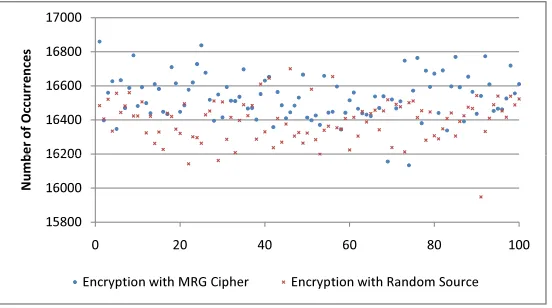
We simulate this attack for 1000 times on 218. Denote Me and Ne as random variables of event e in distributions using random source for encryption and using MRG cipher for encryption, respectively. We use a cryptographic random number generator, CryptGenRan-dom(.) provided by Microsoft CryptoAPI, to emulate a random source. With 218 samples, the mean and standard deviation are 16382 and 121.68 for Me; 16515 and 124.95 for Ne. These results are close to their theoretic values from binomial distribution with t samples:
E[Me] =tp= 218p= 16384, σ[Me] =
tp(1−p) = 123.94,
E[Ne] =tp(1 +q) = 16512, σ[Ne] =
tp(1 +q)(1−p(1 +q)) = 128.47.
Figure 2 illustrates the first 100 experimental tests with 218 samples. It has been sufficient enough to tell the difference between Me and Ne.
16200 16400 16600 16800 17000
be
r o
f O
ccu
rr
en
ces
15800 16000 16200
0 20 40 60 80 100
Num
b
Encryption with MRG Cipher Encryption with Random Source
Figure 2: Distributions with 218 Samples
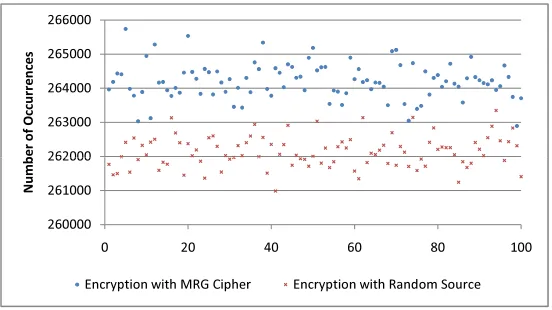
To make the difference more significant, we run the test with 222 samples. As illustrated in Figure 3, with 16 times more samples, we can distinguish an MRG cipher with more confidence.
4
A Known Plaintext Attack
The MRG cipher takes k seeds as its cipher key. An exhaustive key search requires 232k attempts with at least k words of known plaintext and ciphertext.
262000 263000 264000 265000 266000
ber
of
O
ccu
rr
en
ces
260000 261000 262000
0 20 40 60 80 100
Nu
m
b
Encryption with MRG Cipher Encryption with Random Source
Figure 3: Distributions with 222 Samples
each subkey, corresponding to the same plaintext and ciphertext. It makes verification more complicated when many MRG coefficients are nonzero.
This section illustrates an attack much more efficient than these generic attacks.
4.1
General Description
The cipher can be divided into two phases: (I) pseudorandom sequence generation using an MRG; (II) encryption of each 32-bit word using one MRG output wordXi (i≥k) as subkey. We start with subkeyXkguessing. When we have candidates fork+1 sequential subkeys, we can use the following equation to remove wrong candidates through further subkey deducing.
Xi = (α1Xi−1+. . .+αkXi−k) mod m, (i≥2k)
Although the coefficients for multiplication are not specified clearly, performance analysis in [9] indicates that any MRG with order larger than 47 is not practical (even k = 47 is much larger than current secure designs). We first attack the cipher in phase (II) and allow only a small number of candidates to survive from each subkey’s deducing. Then we analyze the complexity to reduce spurious subkeys in phase (I) with different MRG coefficients.
4.2
Deducing Subkey
X
kThe permutation Π, used in MRG cipher, shuffles the 4 bytes within the intermediate result
C to form the ciphertext C. Only 24 (i.e., 4!) permutations are possible for Π. In a known plaintext attack, we can deduce 24 C candidates from the permutations, denoted as Πs (0 ≤ s ≤ 23), and the given ciphertext C. Denote the C candidate derived from the permutation Πs as Cs.
candidate, denoted byXkS, can be computed byte by byte:
XS
k,i= (Cis−Pi) mod 256, 0≤i≤3.
With 24 candidates of C, 24 candidates for Xk can be deduced2. As defined in [9], subkey
Xk determines the permutation Π for current block. Since each candidate Xks is deduced
without the knowledge of how its permutation is computed, deducingXks and computing Πs are independent in this attack unless Xks = Xk. As a result, each candidate other than the right guess has a probability of 1/24 to match Πsassumed previously at the beginning of the attack. Those candidates other thanXk are called spurious subkeys if they can survive from permutation verification. In addition, because Xk comes from MRG modulo operation with
m, only those candidates less than m can survive. Then the expected number of spurious subkeys, denoted as Esp, is computed through binomial distribution, Ysp ∼B(t, p):
Esp =E[Ysp] = tp= (24−1)( 1
24·
m
232) = 23 24 ·
m
232 < 23 24 .
The right candidateXkcertainly matches its permutation. In total, the expected number of Xks to survive permutation verification is:
Esv =Esp+ 1< 4724 .
With each word of known plaintext and ciphertext, we reduce its subkey Xk candidates from 232 to a variable up to 24, with expectation Esv.
The pseudo code in Figure 4 deduces subkeyXkafter examining 24 possible permutations. This procedure can be repeated for sequential words of known plaintext and ciphertext, to deduce subkey candidates forXi (i > k).
As the critical step of this attack, the process of subkey deducing has been implemented. All coefficients for MRG are not clearly specified in [9]. Thus, we assume that MRG outputs are as good as those from a cryptographic random number generator. In each subkey de-ducing process, the plaintext word and subkey Xk are simulated with CryptGenRandom(.) provided by Microsoft CryptoAPI.
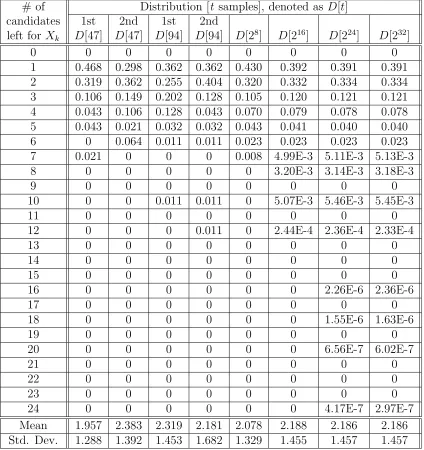
We first assume thatmis a prime close to 232such that the condition (Xk<MRG-modulus) cannot remove any spurious subkey. In total, there are 232m possible combinations of plaintext and subkey. It is costly to exhaustively study their statistics of subkey deduc-ing behaviors. As shown in Table 1, the statistical results become stable as 216 or more plaintext/subkey combinations are generated randomly and tested. The mean of surviv-ing candidate count is about 2.186 and the standard deviation is about 1.457 dursurviv-ing the 232 subkey deducing tests. The real subkey can always be deduced. About 39.1% of per word subkey deducing tests end up with a uniquely deduced subkey. The mean of surviving candidate count is slightly larger than its theoretical value Esv (≈ 47/24). It is caused by unevenly distributed mapping fromXk to the permutation Π. This small difference does not noticeably affect the effectiveness of the attack.
2In this analysis, we ignore the possibility that the 24 candidates may not be unique, as some of the bytes
BYTEpi[24][4] = {
{0, 1, 2, 3}, {0, 1, 3, 2},{0, 2, 1, 3},{0, 2, 3, 1}, {0, 3, 1, 2}, {0, 3, 2, 1},{1, 0, 2, 3},{1, 0, 3, 2}, {1, 2, 0, 3}, {1, 2, 3, 0},{1, 3, 0, 2},{1, 3, 2, 0}, {2, 0, 1, 3}, {2, 0, 3, 1},{2, 1, 0, 3},{2, 1, 3, 0}, {2, 3, 0, 1}, {2, 3, 1, 0},{3, 0, 1, 2},{3, 0, 2, 1}, {3, 1, 0, 2}, {3, 1, 2, 0},{3, 2, 0, 1},{3, 2, 1, 0} }
procedure MRG-Subkey-Deducing(BYTE pt[4], BYTEct[4])
begin
BYTE Xk[4]
INTEGER i, j
for i←0 to 23do
begin
for j ←0 to3 do
begin
Xk[pi[i][j]] ← (ct[j]−pt[pi[i][j]]) mod 256
end
if (pi[i][0. . .3] = Π-Compute(Xk))and (Xk <MRG-modulus)
/∗Π-Compute(.) performs Step 3 in Section 2 ∗/
begin
output Xk as one surviving subkey candidate
end end end
Figure 4: Pseudo Code for Subkey Deducing
When modulusm = 231−1 (as suggested in [9]), the condition (Xk <MRG-modulus) can invalidate about half of subkey candidates. Then the expected number of surviving subkeys
Esv = 2324·2m32+1≈ 2348+1 = 7148. We apply this condition check to the previous tests, assuming that m= 231−1. The mean of surviving subkey count decreases to 1.727 and the standard deviation is 1.083 during the 232 subkey deducing tests. Thus, the attack removes spurious subkeys more effectively, when targeted at those efficient MRGs with modulus m= 231−1.
4.3
Removing Spurious Subkeys
For each key betweenXk andX2k−1 inclusively, we can remove spurious subkey combination by verifying:
Table 1: Experimental Results of Subkey Deducing (when m≈232)
# of Distribution [t samples], denoted as D[t] candidates 1st 2nd 1st 2nd
left for Xk D[47] D[47] D[94] D[94] D[28] D[216] D[224] D[232]
0 0 0 0 0 0 0 0 0
1 0.468 0.298 0.362 0.362 0.430 0.392 0.391 0.391 2 0.319 0.362 0.255 0.404 0.320 0.332 0.334 0.334 3 0.106 0.149 0.202 0.128 0.105 0.120 0.121 0.121 4 0.043 0.106 0.128 0.043 0.070 0.079 0.078 0.078 5 0.043 0.021 0.032 0.032 0.043 0.041 0.040 0.040 6 0 0.064 0.011 0.011 0.023 0.023 0.023 0.023 7 0.021 0 0 0 0.008 4.99E-3 5.11E-3 5.13E-3
8 0 0 0 0 0 3.20E-3 3.14E-3 3.18E-3
9 0 0 0 0 0 0 0 0
10 0 0 0.011 0.011 0 5.07E-3 5.46E-3 5.45E-3
11 0 0 0 0 0 0 0 0
12 0 0 0 0.011 0 2.44E-4 2.36E-4 2.33E-4
13 0 0 0 0 0 0 0 0
14 0 0 0 0 0 0 0 0
15 0 0 0 0 0 0 0 0
16 0 0 0 0 0 0 2.26E-6 2.36E-6
17 0 0 0 0 0 0 0 0
18 0 0 0 0 0 0 1.55E-6 1.63E-6
19 0 0 0 0 0 0 0 0
20 0 0 0 0 0 0 6.56E-7 6.02E-7
21 0 0 0 0 0 0 0 0
22 0 0 0 0 0 0 0 0
23 0 0 0 0 0 0 0 0
24 0 0 0 0 0 0 4.17E-7 2.97E-7
Mean 1.957 2.383 2.319 2.181 2.078 2.188 2.186 2.186 Std. Dev. 1.288 1.392 1.453 1.682 1.329 1.455 1.457 1.457
A candidate for Xi+k is computed for each combination of existing subkey candidates for
Xi, . . . , Xi+k−1. Such a new candidate can survive subkey deducing, with probability close
to Esv/232 assuming m is close to 232. Thus, each combination containing spurious subkeys can be easily invalidated if the number of all combinations are far less than 232/Esv. The total number of these combinations can be estimated by (Esv)n, where n is the number of nonzero coefficients in α1, . . . , αk.
normally are needed to generate one subkey (unless many coefficients are identical).
4.3.1 Attack on MRG Ciphers Optimized for Efficiency
The MRG cipher proposed in [9] may use an efficient MRG with 2 to 4 nonzero coefficients in
(α1, . . . , αk), as analyzed in [2]. For example, an MRG may consist of 2 nonzero coefficients
for multiplication:
Xi = (αtXi−t+αkXi−k) mod m, (i≥k,1≤t < k, αt= 0, αk= 0).
This type of MRG has better performance than those with more nonzero coefficients. It is trivial to verify that (Esv)2 << 232/Esv. For each subkey between Xk and X3k−1 inclusively, spurious subkeys can be removed by verifying:
Xi+k= (αtXi+k−t+αkXi) mod m, (k≤i≤2k−1,1≤t<k, αt= 0, αk= 0).
Once subkeysXk toX2k−1 are uniquely identified, we obtain sufficient information of MRG’s current state. All subsequent subkeys can be easily derived from MRG computation.
Ciphers with those MRGs consisting of 3 or 4 nonzero coefficients for multiplication can be attacked in a similar way because (Esv)3,(Esv)4 <<232/Esv.
4.3.2 Attack on Complicated MRG Ciphers
The most complicated MRGs are perhaps those having maximum number of distinct nonzero values for all coefficients α1, . . . , αk. We assume that its m is close to 232. Such an MRG is extremely inefficient but helpful to estimate the upper bound of the attack’s complexity for all MRG ciphers.
Giveksequential subkeys to deduce, the number of events to uniquely identify a subkey is a random variableY in a binomial distribution: Y ∼B(k, p), wherepis the probability that all 23 spurious subkey maps to wrong permutations. Thus, p= (2324·2m32)23 ≈(2324)23≈0.376. Its experimental value through statistical test is 0.391, as shown in Table 1. Y is not less than a threshold y with probability:
P r(Y ≥y) = 1−
y−1
i=0
k i
pi(1−p)k−i .
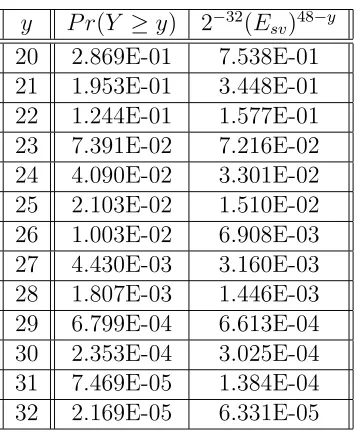
The number of all candidates for tuple [Xi, . . . , Xi+k−1], where i ≥ k, can be estimated by (Esv)k−y. When (Esv)k−y Esv232 = 2−32(Esv)k−y+1 is significantly small, all spurious keys can
Table 2: Probabilities
y P r(Y ≥y) 2−32(Esv)48−y 20 2.869E-01 7.538E-01 21 1.953E-01 3.448E-01 22 1.244E-01 1.577E-01 23 7.391E-02 7.216E-02 24 4.090E-02 3.301E-02 25 2.103E-02 1.510E-02 26 1.003E-02 6.908E-03 27 4.430E-03 3.160E-03 28 1.807E-03 1.446E-03 29 6.799E-04 6.613E-04 30 2.353E-04 3.025E-04 31 7.469E-05 1.384E-04 32 2.169E-05 6.331E-05
4.4
Summary of the Attack’s Complexity
4.4.1 Attack on MRG Ciphers Optimized for Efficiency
The attack requirements for the two phases are:
• Deducing subkeys: 2k sequential words of known plaintext and ciphertext are needed to deduce all surviving subkey candidates for Xk, . . . , X3k−1. Deducing each subkey needs to consider 24 candidates. In total, 24∗2k = 48k decryption operations are needed without MRG computation.
• Removing spurious subkeys: (Esv)3k subkey combinations need to be verified using MRG computation.
Since (Esv)3k < 48k, such an attack requires less than 48k decryption operations and 2k words of sequential known plaintext and ciphertext.
4.4.2 Attack on Complicated MRG Ciphers
As described previously, we need to select a convenient y to trade off between complexity and successful rate. When y satisfies the requirement (Esv)k−y+1 <<232:
• Deducing subkeys: the length of known plaintext can be estimated usingk/P r(Y ≥y). Subkey deducing is required for these known plaintext words.
For example, an MRG cipher with all 47 distinct nonzero coefficients can be successfully attacked with about 212 known plaintext words when y = 26. The workload is about (Esv)k−y = 224 MRG operations plus k/P r(Y ≥ y) = 212 encryptions. Similar attacks on other MRG ciphers with order 47 have less complexity than this worst case.
5
Cipher Performance
Although called block cipher, the MRG cipher works more similarly to a word oriented stream cipher. The MRG cipher is designed for use cases in a resource limited environment. However, even an efficient MRG with two identical nonzero coefficients (thus extremely insecure) takes one 32-bit multiplication and one modulo operation. These two operations are not efficient in either hardware or software. The MRG takes k variables (e.g., 188 bytes when k= 47) in memory.
By comparison, cipher RC4 only takes 258 bytes in memory for keystream generation. Many word oriented stream ciphers (e.g., SNOW[4] and SOBER[5] families of ciphers) take less memory, require no multiplication or modulus operations, and demonstrate good perfor-mance over various platforms. For example, a software implementation of SNOW 2.0 only takes 6.75 cycles/byte [10].
6
Conclusion
Our attacks work on the MRG cipher with manageably low space and time complexity. Therefore, the cipher structure proposed in [9] is seriously flawed. It should not be used for cryptographic applications even in resource restricted systems.
References
[1] D. Cooper, S. Santesson, S. Farrell, S. Boeyen, R. Housley, and W. Polk. RFC 5280: Internet X.509 public key infrastructure certificate and certificate revocation list (CRL) profile, May 2008. Available atwww.ietf.org/rfc/rfc5280.txt.
[2] L. Y. Deng. Efficient and portable multiple recursive generators of large order. InACM Transactions on Modeling and Computer Simulation, volume 15, pages 1–13, 2008.
[3] T. Dierks and C. Allen. RFC 2246: The TLS protocol version 1, January 1999. Available
at www.ietf.org/rfc/rfc2246.txt.
[5] P. Hawkes and G. G. Rose. Primitive specification for SOBER-128. 2003. Available at
eprint.iacr.org/2003/081.
[6] E. C. Kaufman. RFC 4306: Internet key exchange (IKEv2) protocol, 2005. Available
at www.ietf.org/rfc/rfc4306.txt.
[7] I. Mantin and A. Shamir. A practical attack on broadcast RC4. In Proceedings of Fast Software Encryption - FSE 2001, volume 2355 of Lecture Notes in Computer Science, pages 152–164. Springer-Verlag, 2001.
[8] M. Matsui. Linear cryptanalysis method for DES cipher. In Proceedings of Advances in Cryptology - EUROCRYPT’93, volume 765 of Lecture Notes in Computer Science, pages 386–397. Springer-Verlag, 1994.
[9] A. Olteanu, Y. Xiao, F. Hu, and B. Sun. A lightweight block cipher based on a multiple recursive generator. In Proceedings of IEEE GLOBECOM 2008, December 2008.
[10] B. Preneel, B. V. Rompay, S. ¨Ors, A. Biryukov, L. Granboulan, E. Dottax, M. Dichtl, M. Schafheutle, P. Serf, S. Pyka, E. Biham, E. Barkan, Dunkelman, J. Stolin, M. Ciet, J.-J. Quisquater, F. Sica, H. Raddum, and M. Parker. Performance of optimized im-plementations of the NESSIE primitives. Technical report, NESSIE, February 2003. Available at www.cosic.esat.kuleuven.be/nessie/deliverables/D21-v2.pdf.
![Figure 1: MRG Based Cipher [9]](https://thumb-us.123doks.com/thumbv2/123dok_us/1867961.1242950/3.612.183.434.374.606/figure-mrg-based-cipher.webp)