Efficient, Adaptively Secure, and Composable
Oblivious Transfer with a Single, Global CRS
Seung Geol Choi∗ Jonathan Katz† Hoeteck Wee‡ Hong-Sheng Zhou§ May 12, 2014
Abstract
We present a general framework for efficient, universally composable oblivious transfer (OT) protocols in which a single, global, common reference string (CRS) can be used for multiple invocations of oblivious transfer by arbitrary pairs of parties. In addition:
• Our framework is round-efficient. E.g., under the DLIN or SXDH assumptions we achieve round-optimal protocols with static security, or 3-round protocols with adaptive security (assuming erasure).
• Our resulting protocols are more efficient than any known previously, and in particular yield protocols for string OT usingO(1) exponentiations and communicating O(1) group elements.
Our result improves on that of Peikert et al. (Crypto 2008), which uses a CRS whose length depends on the number of parties in the network and achieves only static security. Compared to Garay et al. (Crypto 2009), we achieve adaptive security with better round complexity and efficiency.
∗
Columbia University. Email: [email protected]. Portions of this work were done at the University of Maryland. This work was supported in part by the Intelligence Advanced Research Project Activity (IARPA) via DoI/NBC contract Number D11PC20194. The views and conclusions contained herein are those of the authors and should not be interpreted as necessarily representing the official policies or endorsements, either expressed or implied, of IARPA, DoI/NBC, or the U.S. Government.
†
Dept. of Computer Science, University of Maryland. Email: [email protected]. This work is supported in part by DARPA and by NSF awards #0447075, #1111599, and #1223623.
‡
George Washington University. Email: [email protected]. Supported by NSF CAREER award #1237429.
§
Contents
1 Introduction 4
1.1 Our Results . . . 4
1.2 Organization . . . 6
2 Preliminaries 6 2.1 Ideal Functionalities . . . 6
2.2 Smooth Projective Hash Proof Systems . . . 6
2.3 Dual-Mode NIZK . . . 8
2.4 Labeled CCA-Secure Encryption . . . 9
2.5 Σ-Protocols . . . 10
2.6 Equivocal Commitments . . . 11
2.7 A Family of Collision-Resistant Hash Functions . . . 11
3 A Generic Framework for Two-Round OT (Protocol 1∗) 11 3.1 Proof of Theorem 1 . . . 14
3.1.1 The Simulator . . . 14
3.1.2 Indistinguishability . . . 15
3.2 Proof of Theorem 2 . . . 19
3.2.1 The Simulator . . . 19
3.2.2 Indistinguishability . . . 20
4 Instantiations of Protocol 1∗ 21 4.1 Instantiation from the DLIN Assumption . . . 21
4.1.1 Decision Linear Assumption (DLIN) . . . 21
4.1.2 CCA-Secure Labeled Public-Key Encryption Scheme . . . 21
4.1.3 Smooth Projective Hashing . . . 22
4.1.4 Non-Interactive Dual-Mode Zero-Knowledge Proof System . . . 22
4.1.5 Oblivious Transfer . . . 23
4.2 Instantiation from the SXDH Assumption . . . 24
4.2.1 Symmetric External Diffie-Hellman Assumption (SXDH) . . . 24
4.2.2 CCA-Secure Labeled Public-Key Encryption Scheme . . . 25
4.2.3 Smooth Projective Hashing . . . 25
4.2.4 Dual-Mode Zero-Knowledge Proof System . . . 26
4.2.5 Oblivious Transfer . . . 26
5 A Generic Framework for Four-Round OT 28 5.1 Static Security (Protocol 2) . . . 28
5.2 Adaptive Security (Protocol 2∗) . . . 29
5.3 Proof of Theorem 3 . . . 31
5.3.1 The Simulator . . . 31
5.3.2 Indistinguishability . . . 33
5.4 Proof of Theorem 4 . . . 35
5.4.1 The Simulator . . . 35
5.4.3 Dealing with Corruptions . . . 39
6 Instantiations of Protocol 2 and Protocol 2∗ 40 6.1 Instantiation from the DDH Assumption . . . 40
6.1.1 Decisional Diffie-Hellman Assumption . . . 40
6.1.2 CCA-Secure Labeled Public-Key Encryption Scheme . . . 41
6.1.3 Smooth Projective Hashing . . . 41
6.1.4 Equivocal Commitment . . . 41
6.1.5 Oblivious Transfer . . . 42
6.2 Instantiation from the DCR Assumption . . . 43
6.2.1 Decisional Composite Residuosity Assumption (DCR) . . . 43
6.2.2 CCA-Secure Labeled Public-Key Encryption Scheme . . . 43
6.2.3 Smooth Projective Hashing . . . 44
6.2.4 Equivocal Commitment . . . 44
6.2.5 Oblivious Transfer . . . 44
A Constructions Following the Approach of Garay et al. 49 A.1 DDH-Based Construction . . . 49
1
Introduction
In this work we study the construction of efficient protocols for universally composable (UC) [Can01] oblivious transfer (OT). Our work is motivated by the fact that, although UC commitments are complete for UC multiparty computation [CLOS02], the most efficient multiparty computation protocols (e.g., [LP11, LOP11]) rely on universally composable OT as a building block. Relative to UC commitments (see [Lin11, FLM11] and references therein), however, universally composable OT has received less attention.
There is a long series of work on efficient OT protocols in the stand-alone setting (e.g., [NP01, AIR01, HK12, Lin08]). Lindell [Lin09] (also [IPS08, Appendix A]) gave a generic transformation from static security to adaptive security (assuming erasure) that applied in the semi-honest setting and the stand-alone malicious setting, but not in the UC setting.
Constructions of UC oblivious transfer from general assumptions were given in [CLOS02]; these constructions are relatively inefficient. Garay, MacKenzie, and Yang [GMY04] constructed a constant-round protocol for committed OT under the DDH and strong RSA assumptions. Their protocol yieldsbit OT rather thanstring OT, so results in protocols for string OT with complexity linear in the length of the sender’s inputs. Jarecki and Shmatikov show a four-round protocol for committed string OT under the decisional composite residuosity (DCR) assumption [JS07]. A round-optimal OT protocol appears in [HK07].
The most efficient known protocol for UC oblivious transfer is that of Peikert et al. [PVW08]. Their work, however, has several disadvantages. First, it requires an independent common reference string1 (CRS) forevery party in the network or, equivalently, a single CRS of length linear in the number of parties. (Any pair of parties can then run the protocol of Peikert et al. using the CRS of the receiver.) Their protocols also only achieve security against a static adversary who decides which parties to corrupt before the protocol begins (and even before the CRS is chosen). They do not handle an adaptive adversary who may choose which parties to corrupt during the course of the protocol execution.
Garay et al. [GWZ09] constructed efficient UC oblivious-transfer protocols that address both the above-mentioned drawbacks. In their constructions, the parties run a coin-tossing protocol whose outcome is then used as a common random string for an OT protocol. Since the resulting schemes are not explicitly described in the literature, we do so in Appendix A. This approach is not entirely satisfactory. First, it increases the overall computation, communication, and round complexity; second, it can (in general) only be instantiated with OT protocols that work in the commonrandom string model rather than the more general commonreference string model. Choi et al. [CDMW09b, CDMW09a] showed other approaches for obtaining adaptively secure, constant-round UC oblivious transfer.
1.1 Our Results
Here, we present a new framework for constructing UC oblivious-transfer protocols that require only a single, global CRS.2 We aim for efficient protocols having low round complexity, and incurring onlyconstant computation and communication even when the sender’s inputs are long strings. We are also interested in achieving adaptive security, under the assumption that parties erase portions
1
Some form of setup is known to be necessary for universally composable OT [CF01, CKL06]. 2
reference assumption rounds communication CRS complexity size
[PVW08] DDH 2 6 n
[PVW08]+[GWZ09]+[FLM11] DLIN 4 78 12
Protocol 1∗ (Sec. 4.1) DLIN 2 54 12
[PVW08]+[GWZ09]+[Lin11] DDH 6 38 7
Protocol 2 (Sec. 5.1, Sec. 6.1) DDH 4 32 6
[JS07] DCR 4 35 (ZN2) + 16 (ZN) 10
Protocol 2 (Sec. 5.1, Sec. 6.2) DCR 4 18 (ZN2) + 7 (ZN) 12 Protocols with static security.
reference assumption rounds communication CRS
complexity size
[PVW08]+[GWZ09]+[FLM11] DLIN 4 83 12
Protocol 1∗ (Sec. 4.1) DLIN 3 59 12
[PVW08]+[GWZ09]+[Lin11] DDH 8 51 7
Protocol 2∗ (Sec. 5.2, Sec. 6.1) DDH 4 35 6 Protocol 2∗ (Sec. 5.2, Sec. 6.2) DCR 4 21 (ZN2) + 7 (ZN) 12
Protocols with adaptive security (assuming erasure).
Table 1: Efficient universally composable protocols for string OT. Here,nis the number of parties. Communication complexity and CRS size are measured in terms of group elements, with other values ignored. The numbers for [JS07] include the cost of the pre-processing (off-line) stage.
of their local state that are no longer needed. (Note, however, that the works of [CDMW09b, GWZ09, CDMW09a] do not make this assumption.)
Our framework is fairly general and can be instantiated from several assumptions. Specifically:
• We obtain efficient, round-optimal OT protocols with static security under the decisional linear (DLIN) [BBS04] or symmetric external Diffie-Hellman (SXDH) assumptions [Sco02, BBS04]. These protocols can be modified to achieve adaptive security (assuming erasure) with one additional round and a slight increase in communication and computation.
• We obtain efficient, four-round OT protocols under the decisional Diffie-Hellman (DDH) or DCR [Pai99] assumptions. Our basic constructions achieve static security, and we present variants that are secure against adaptive corruptions (assuming erasure)without any additional rounds, but with a slight increase in communication and computation.
We compare our constructions with previous work in Table 13
Overview of our constructions. The starting point of our approach is the Halevi-Kalai construction [HK12] of 2-round OT based on smooth projective hashing. Their construction only achieves indistinguishability-based security (and not even stand-alone simulation-based security) against a malicious receiver. We show how to overcome this with the following modifications:
1. We require the receiver to commit to its input using CCA-secure encryption.
2. The receiver proves in zero knowledge that it is behaving consistently in the underlying OT protocol (with respect to the input it committed to).
A similar high-level approach was taken in [HK07], but using generic simulation-sound non-interactive zero knowledge [DDO+01]. Here, following recent constructions of efficient UC commitments [Lin11, FLM11], we rely instead on efficient zero-knowledge protocols that admit straight-line simulation in the CRS model. In particular, for our two-round OT protocols we instantiate the underlying zero-knowledge proofs using Groth-Sahai proofs [GS08], as in [FLM11]. For our four-round OT protocols, we rely on Damg˚ard’s three-round zero-knowledge proof system [Dam00].
Achieving adaptive security. To achieve adaptive security, we first modify our protocols so the final message is sent over an adaptively secure channel (cf. functionalityFsmt in [Can01]). The latter can be realized at low cost if erasure is assumed [BH92]. With this modification, security against adaptive corruption of the sender is achieved automatically by simply having the sender erase its local state at appropriate times. In our two-round protocols, security against adaptive corruption of the receiver is similarly achieved. For our 4-round protocols, we use techniques similar to those in [Lin11, FLM11]. Unlike this prior work, however, we do not introduce any additional overhead in communication or round complexity. (We incur a modest increase in computational cost.)
1.2 Organization
We review preliminaries in Section 2. Our general framework and concrete instantiations for two-round OT is described in Sections 3 and 4, and for four-two-round OT in Sections 5 and 6.
2
Preliminaries
Letλbe the security parameter. For a setS, we letx←S denote choosingxuniformly at random from S. For a randomized algorithm A, we let y←A(x) denote running A(x;r) with r chosen uniformly at random.
2.1 Ideal Functionalities
The ideal OT functionalityFMOT described in Figure 1 is a reformulation of the multi-session OT functionality in [Can01].
The CRS functionality in Figure 2 is a reformulation of that in [Can07].
2.2 Smooth Projective Hash Proof Systems
Functionality FMOT
FMOT interacts with partiesP1, . . . , Pn and an adversarySim, and proceeds as follows:
Upon receiving an input (send,hsid,ssid, Pi, Pji,hm0, m1i) fromPi withm0, m1∈ {0,1}`, record
the tuplehssid, Pi, Pj, m0, m1i, and reveal (send,hsid,ssid, Pi, Pji) to the adversary. Ignore further (send, . . .) inputs with the samessidfromPi.
Upon receiving an input (receive,hsid,ssid, Pi, Pji, b) from Pj with b ∈ {0,1}, record the tuple hssid, Pi, Pj, bi, and reveal (receive,hsid,ssid, Pi, Pji) to the adversary. Ignore further (receive, . . .) inputs with the samessidfromPj.
Upon receiving a message (sent,hsid,ssid, Pi, Pji, Pi) from the adversary, ignore the message if
hssid, Pi, Pj, m0, m1iorhssid, Pi, Pj, biis not recorded; Otherwise, return (sent,hsid,ssid, Pi, Pji) toPi; Ignore further (sent,hsid,ssid, Pi, Pji, Pi) messages from the adversary.
Upon receiving a message (received,hsid,ssid, Pi, Pji, Pj) from the adversary, ignore the message if hssid, Pi, Pj, m0, m1i or hssid, Pi, Pj, bi is not recorded; Otherwise, return (received,hsid,ssid, Pi, Pji, mb) toPj; Ignore further (received,hsid,ssid, Pi, Pji, Pj) messages from the adversary.
Figure 1: The idealFMOT functionality for muti-session string-OT.
FunctionalityFCRSP,D
Upon receiving an input (crs,sid) fromP,sid= (P, sid0) wherePis a set of identities, andP ∈ P;
else ignore the input. Next if there is no value crs recorded then choosecrs←D() and record it. Send (crs,sid,crs, P) toS; when receiving (crs-return,sid) fromS, send (crs-return,sid,crs) toP.
• Theparameter-generator HashPG(1λ)→pp.We assume that the security parameterλcan be inferred frompp. Let λ(pp) denote the security parameter corresponding topp.
• A pair of disjoint sets Λyes and Λno are associated to pp corresponding to yes and no
instances respectively. There exists a yes instance-sampler SampYes(pp)→(x, w) where x is uniformly distributed over Λyes and w is the corresponding witness. There also exists a no
instance-sampler SampNo(pp)→x0 where x0 is uniformly distributed over Λno.
• The hash-key generator HashKG(pp)→(hk,pk). Herehk is the primary hashing key andpk
is a projective key.
• The primary hash algorithmHash(hk, x)→y for all x∈Λyes∪Λno.
• Thesecondary (projection) hash algorithm pHash(pk, x, w)→y for all (x, w)←SampYes(pp).
Definition 1 A family H = (HashPG,SampYes,SampNo,HashKG,Hash,pHash) is a smooth projective hash family if for every pp∈support(HashPG), the following holds:
Correctness:
Pr[(hk,pk)←HashKG(pp); (x, w)←SampYes(pp) :pHash(pk, x, w) =Hash(hk, x) ] = 1.
Smoothness: Let (hk,pk)←HashKG(pp). For all x∈ Λno, the distribution of Hash(hk, x) given pk is statistically close to uniform. That is, the statistical difference between the following
two distributions is negligible in λ(pp).
{y←Hash(hk, x) : (pk, y, x)}≡ {s y←Γ : (pk, y, x)}
where Γ denotes the set of possible hash values with parameter pp.
Definition 2 A smooth projective hash familyH= (HashPG,SampYes,SampNo,HashKG,Hash,pHash)
is said to have ahard subset membershipproperty if the following two ensembles are computationally indistinguishable:
- npp←HashPG(1λ); (x, w)←SampYes(pp) : (pp, x) o
λ∈N
- npp←HashPG(1λ); x←SampNo(pp) : (pp, x) o
λ∈N
.
2.3 Dual-Mode NIZK
Groth introduced composable non-interactive zero-knowledge proofs [Gro06]. In this work, we sometimes call these proofs as dual-mode NIZKproofs. In the system, a common reference string
Definition 3 A non-interactive proof system for a language L ∈ N P consists of three algorithms
(K,P,V) where K is a CRS generation algorithm, P and V are a prover and a verifier algorithm respectively. The system is required to satisfy the following properties:
Completeness: For any λ, any x∈L, and any witness w for x, it holds that
Pr[crs←K(1λ); π←P(1λ,crs, x, w) : V(1λ,crs, x, π) = 1] = 1.
Adaptive soundness: For any λand any adversary A, it holds that
Pr[crs←K(1λ); (x, π)←A(1λ,crs) : V(1λ,crs, x, π) = 1 ∧x6∈L] =negl(λ).
Definition 4 A non-interactive proof system (K,P,V) for a language L∈ N P is said to be dual-mode NIZK if there is a pair of efficient algorithms (S1,S2) such that for any λ ∈ N and for all
non-uniform polynomial time adversary A, it holds the following:
Indistinguishability of modes:
Pr[crs←K(1
λ) : A(1λ,crs) = 1]−Pr[(crs, τ)←S
1(1λ) : A(1λ,crs) = 1]
=negl(λ).
Perfect simulation in ZK mode: The following two probabilities are equal.
- Pr[(crs, τ)←S1(1λ); (x, w)←A(1λ,crs, τ); π←P(1λ,crs, x, w) :A(π) = 1]
- Pr[(crs, τ)←S1(1λ); (x, w)←A(1λ,crs, τ); π←S2(τ, x) :A(π) = 1]
Here, A has to generate a valid pair (x, w), i.e., w should be a witness for x.
2.4 Labeled CCA-Secure Encryption
We use the standard notion of chosen-ciphertext security for public-key encryption supporting labels [CS03].
Definition 5 Alabeled public-key encryption schemeconsists of three PPT algorithms(Gen,Enc,Dec)
such that:
• Thekey generation algorithm Gen takes as input a security parameter 1λ returns a public key pk and a secret key sk .
• The encryption algorithm Enctakes as input a public key pk , a label L, and a message m. It returns a ciphertext C←EncLpk(m).
• The decryption algorithm Dec takes as input a secret key sk , a label L, and a ciphertext C. It returns a message m or a distinguished symbol ⊥. We write this as m = DecLsk(C) or
m=Decsk(L, C).
We require that for any label L∈ {0,1}∗ and any m in the message space, it should hold that
Our definition of security against chosen-ciphertext attacks is standard except for our inclusion of labels. In the following, we define a left-or-right encryption oracle LRpk,β(·,·,·) with β∈ {0,1} as follows:
LRpk,β(L, m0, m1) def
:=EncLpk(mβ).
Definition 6 A labeled public-key encryption scheme (Gen,Enc,Dec) is secure against adaptive chosen-ciphertext attacks (CCA-secure) if for any non-uniform PPT algorithms A, it holds that
|2p−1|=negl(λ) where
p= Prh(pk,sk)←Gen(1λ);β←{0,1}:ALRpk,β(·,·,·),Decsk(·,·)(1λ,pk) =β
i
.
Here,A’s queries are restricted as follows: ifAmakes a queryLRpk,β(L, m0, m1)then|m0|=|m1|;
furthermore, if A receives ciphertext C in response to a query with label L, then A cannot later query Decsk(L, C); however, it is allowed to query Decsk(L0, C) with L6=L0.
2.5 Σ-Protocols
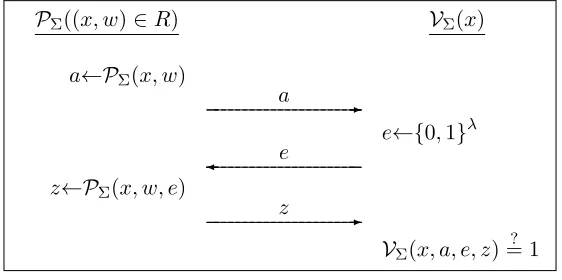
A Σ-protocol is a 3-round honest-verifier zero-knowledge protocol. We denote by (a, e, z) the messages exchanged between the proverPΣ and the verifierVΣ. Please see Figure 3. We say that a transcript (a, e, z) is an accepting transcript forx if the protocol instructsVΣ to accept based on
the values (x, a, e, z). Formally:
PΣ((x, w)∈R) VΣ(x)
a←PΣ(x, w)
a
-e←{0,1}λ
e
z←PΣ(x, w, e)
z
-VΣ(x, a, e, z) ?
= 1
Figure 3: A Σ-protocol (PΣ,VΣ) for relation R.
Definition 7 A protocol is a Σ-protocol for relation R if it is a three-round public-coin protocol and the following requirements hold:
Completeness: If PΣ and VΣ follow the protocol on input x and private input w to PΣ where
(x, w)∈R, then VΣ always accepts.
Special soundness: There exists a polynomial-time algorithm A that given any x and any pair of accepting transcripts(a, e, z), (a, e0, z0) for x where e6=e0, outputs w s.t. (x, w)∈R.
Special honest verifier zero knowledge: There exists a probabilistic polynomial-time simulator
distribution as transcripts between the honestPΣ andVΣ on common input x. Formally, for every x and w such that (x, w)∈R and every e∈support(VΣ(x))it holds that
{SΣ(x, e)}={viewVΣhPΣ(x, w),VΣ(x, e)i}
whereSΣ(x, e)denotes the output of simulator SΣ upon inputx ande, andviewVΣhPΣ(x, w),
VΣ(x, e)i denotes the view of VΣ of an execution between PΣ and VΣ, where PΣ has input
(x, w), VΣ has input x, and VΣ’s random tape (determining its query) equals e.
2.6 Equivocal Commitments
We define equivocal commitment scheme as follows:
Definition 8 Let (Kcom,Com)be a non-interactive commitment scheme with CRS whereKcomis a CRS generation algorithm, andComis a commitment algorithm. The scheme is said to beequivocal
if there exists a tuple of PPT algorithm (Scom1,Scom2,Scom3)that satisfies the following properties:
Computational binding: LetMandRbe the message space and the randomness space implicitly defined by the commitment scheme. For any λ∈ N, and any non-uniform polynomial time
adversaryA the following probability is negligible in λ:
Prhcrs←Kcom(1λ); (m, m0, r, r0)←A(crs) : m6=m0 and Comcrs(m;r) =Comcrs(m0;r0) i
Indistinguishability of modes:
n
crs←Kcom(1λ) : crs
o
λ∈N
c
≈n(crs, t)←Scom1(1λ) : crs o
λ∈N
Equivocality: For any λ ∈ N, any (crs, t) ∈ support(Scom1(1λ)), and any adversary A, the following distributions are identical.
-n
m←A(crs); r←R; c=Comcrs(m;r) : (m, r, c) o
- nm←A(crs); (c, s)←Scom2(t); r←Scom3(s, m) : (m, r, c)o
2.7 A Family of Collision-Resistant Hash Functions
HF =hk :{0,1}∗ → {0,1}`(λ) k∈{0,1}λ with a polynomial `is a family of collision-resistant hash
functions if for any non-uniform PPT algorithm A, it holds that
Pr[k← {0,1}λ:A(k) = (x1, x2) s.t. x1 =6 x2 and hk(x1) =hk(x2)] =negl(λ).
3
A Generic Framework for Two-Round OT (Protocol 1
∗)
Common reference string: Compute pp←HashPG(1λ),(pk,sk)←Gen(1λ), andcrsnizk←K(1λ). The common reference string is crsot= (pp,pk,crsnizk).
Oblivious transfer: The protocol starts by having the receiver, holding selection bitb, send two instances (x0, x1) for the hash proof systemHwithx1−b ano-instance; the receiver sendsEncpk(b)
and a NIZK proof thatx1−b is ano-instance as well. In the second round, forσ ∈ {0,1}the sender generates primary and projection hash keys (hkσ,pkσ) and sends (pkσ,Hash(hkσ, xσ)⊕mσ) to the receiver. The receiver recovers mb in the standard way. In more detail:
• On input a selection bitb, the receiver Pj proceeds as follows:
1. Generate yes and no instances according to the input b, i.e., (xb, w)←SampYes(pp) and x1−b = SampNo(pp;γ) for uniformly random γ. Compute Φ = EncLpk(b;ξ) with
uniformly random ξ, where L = (sid,ssid, Pi, Pj). Generate a proof π←P(crsnizk, (pp,pk, L, x0, x1,Φ),(b, γ, ξ)) for language
L∗=
(pp,pk, L, x0, x1,Φ) : ∃(b, γ, ξ) s.t. x1−b =SampNo(pp;γ),Φ =EncLpk(b;ξ) .
2. Send hx0, x1,Φ, πi.
• On inputm0, m1 ∈ {0,1}`, and after receiving the first-round message hx0, x1,Φ, πi from the
receiver, the sender Pi proceeds as follows:
1. If the proofπ does not verify, abort.
2. Forσ ∈ {0,1} compute (hkσ,pkσ)←HashKG(pp) and Zσ =mσ⊕Hash(hkσ, xσ).
3. Send hpk0, Z0,pk1, Z1i toPj.
• Upon receiving the second-round message hpk0, Z0,pk1, Z1i, the receiver Pj computes the output mb =Zb⊕pHash(pkb, xb, w).
Informally, security against a malicious sender holds because the sender cannot guess the receiver’s selection bit from (x0, x1) due to the hard subset membership property. On the other
hand, a malicious receiver gets no information aboutm1−bifx1−bis ano-instance, and this property is enforced by the NIZK proof.
Theorem 1 Say(Gen,Enc,Dec) is a CCA-secure labeled public-key encryption scheme, (HashPG,
SampYes,SampNo,HashKG,Hash,pHash)is a smooth projective hash proof system with a hard subset membership property, and(K,P,V)is a dual-mode NIZK proof system. Then the protocol described above securely realizes FMOT in the FCRS-hybrid model, for static corruptions.
Here, we give an informal overview of the proof. The simulator works as follows:
• The simulator sets the CRScrsot= (pp,pk,crsnizk). It generatespp honestly. For the public
key pk, it additionally keeps the corresponding secret key sk. For crsnizk, it runs the CRS generation algorithm in the ZK mode rather than in the soundness mode.
• In simulating an honest sender against a malicious receiver, it uses the secret key sk to decrypt the encryption Φ and extract the receiver’s input ˆb (and thereby mˆb from the OT
crsot={pp,pk,crsnizk}
Pi(m0, m1) Pj(b)
L:= (sid,ssid, Pi, Pj) L:= (sid,ssid, Pi, Pj) (xb, w)←SampYes(pp)
x1−b←SampNo(pp;γ)
Φ←EncLpk(b;ξ);X := (x0, x1,Φ)
π← P(crsnizk,(pp,pk, L, X),(b, γ, ξ)) erase all state except (b, w, X, π)
x0, x1,Φ, π
V(crsnizk,(pp,pk, L, X), π)= 1? forσ∈ {0,1}:
(hkσ,pkσ)←HashKG(pp)
Zσ←mσ⊕Hash(hkσ, xσ) erase all state except (m0, m1,pk0, Z0,pk1, Z1)
pk0, Z0,pk1, Z1
Q
mb←Zb⊕pHash(pkb, xb, w) outputmb
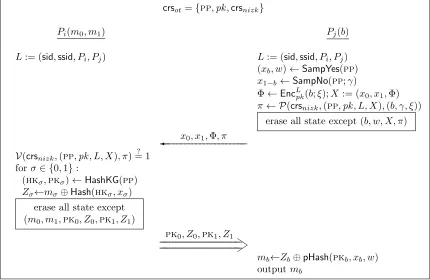
Figure 4: An adaptively secure OT protocol in theFCRS-hybrid model (Protocol 1∗). The second round message is sent over a secure channel (for static security, the message can be simply sent over an authenticated channel).
• In simulating an honest receiver against a malicious sender, it generates (x0, x1) where both
areyes-instances; additionally, Φ =E(0), and π is simulated. Given the sender messages, it
extracts the sender input (m0, m1) using the witnesses for (x0, x1).
Indistinguishability is shown by going over the following hybrids:
• H0: Real execution.
• H1: The simulator sets up the CRS in such a way that it knows the decryption key for
pk. When the receiver is corrupted, the simulator decrypts Φ to obtain ˆb and switches the honest sender’s m1−ˆb to 0`. Indistinguishability follows from the soundness of the proof π
and smoothness of the hash proof system.
• H2: The simulator generatescrsnizk in the ZK mode.
• H3: When interacting with a corrupted sender, the simulator generates a simulated proofπ.
Indistinguishability follows from the zero-knowledge property of the proof system.
• H4: When interacting with a corrupted sender, the simulator sets Φ to an encryption of 0.
• H5: When interacting with a corrupted sender, the simulator generates both (x0, x1) asyes
instances. Indistinguishability follows from the hard subset membership property.
• H6: When interacting with a corrupted sender, the simulator uses witnesses for (x0, x1) to
extract (m0, m1). H5 and H6 are identically distributed.
A full proof of Theorem 1 is given in Section 3.1.
The protocol as described is secure against static corruptions. Interestingly, it achieves adaptive security if the second round message is sent over a secure channel, and parties can erase portions of their local state at the appropriate times. Namely, before sending the message (x0, x1,Φ, π),
the receiver erases all its internal state except the information needed (i.e., the input b and the witnessw forxb as well as (x0, x1,Φ, π)) to later compute the output. Before sending the message
(pk0, Z0,pk1, Z1), the sender erases all its internal state except its input (m0, m1) and the message.
The details are in Figure 4.
Theorem 2 Under the same assumptions as Theorem 1, the protocol described in Figure 4, where the second round message is sent over a secure channel, securely realizes FMOT in the FCRS-hybrid model, for adaptive corruptions (assuming erasure).
The proof appears in Section 3.2.
3.1 Proof of Theorem 1
Let Π denote the OT protocol under consideration. To show the security of the protocol, we need to construct a simulator Sim for any non-uniform ppt environment Z such that execFΠCRS,A,Z ≈
idealFMOT,Sim,Z, where A is the dummy adversary. We first construct a simulator and then argue the indistinguishability between the two ensembles.
Let (S1,S2) be the simulator for the dual-mode NIZK proof system (K,P,V).
3.1.1 The Simulator
Initialization step: The simulatorSim generates the common reference string as follows:
1. Compute pp←HashPG(1λ);
2. Compute (pk,sk)←Gen(1λ); 3. Compute (crsnizk, τnizk)← S1(1λ);
4. Setcrsot= (pp,pk,crsnizk).
Simulating the communication with Z: Upon receiving an input value from Z, the simulator
Simwrites it on A’s input tape (as if coming fromZ); upon obtaining an output value from
A, the simulator Simwrites it onZ’s output tape (as if coming fromA).
Case 1: Simulating honest receiver Pj with honest sender Pi:
1. Upon receiving (receive,hsid,ssid, Pi, Pji) from the functionality FMOT, the simulator deliversAa first round message (sid,ssid, M1) that intends to send fromPj toPi, where
Generate twoyesinstances, i.e, (x0, w0)←SampYes(pp), (x1, w1)←SampYes(pp),
and record (w0, w1). Compute a dummy ciphertext Φ ← Encpk(0), and then
obtain a simulated proofπby using the simulatorS2for the NIZK, i.e., compute
π←S2(τnizk,(pp,pk, L, x0, x1,Φ)), where L= (sid,ssid, Pi, Pj).
2. Upon receiving (send,hsid,ssid, Pi, Pji) from functionality FMOT, and the first round message has been delivered from Pj toPi, the simulator Sim then sets m0 =m1 = 0`,
and computes (hkσ,pkσ) ← HashKG(pp), Zσ = mσ ⊕Hash(hkσ, xσ) for σ ∈ {0,1}, and generates a second round message (sid,ssid, M2) that it intends to send from Pi to Pj, where M2 = (pk0, Z0,pk1, Z1). The second round message (sid,ssid, M2) is then
delivered toA.
Case 2: Simulating honest receiver Pj with corrupted sender Pi:
1. Upon receiving (receive,hsid,ssid, Pi, Pji) from the functionalityFMOT, the simulator deliversAa first round message (sid,ssid, M1) that intends to send fromPj toPi, where
M1= (x0, x1,Φ, π) which is generated as follows:
Generate twoyesinstances, i.e, (x0, w0)←SampYes(pp), (x1, w1)←SampYes(pp),
and record (w0, w1). Compute a dummy ciphertext Φ ← Encpk(0), and then
obtain a simulated proofπby using the simulatorS2for the NIZK, i.e., compute π←S2(τnizk,(pp,pk, L, x0, x1,Φ)), where L= (sid,ssid, Pi, Pj).
2. Upon receiving a second round message (sid,ssid, M2) from the adversaryAthat intends
to send from Pi to Pj, where M2 = (pk0, Z0,pk1, Z1), the simulator use (w0, w1) to
compute ˆm0 =Z0⊕pHash(pk1, x0, w0) and ˆm1 =Z1⊕pHash(pk1, x1, w1). The simulator
Simsends (send,hsid,ssid, Pi, Pji,hmˆ0,mˆ1i) toFMOT.
Case 3: Simulating corrupted receiver Pj with honest sender Pi:
1. Upon receiving a first round message (sid,ssid, M1) fromAthat it intends to send from
Pj to Pi, where M1 = (x0, x1,Φ, π), the simulator Sim first verifies if π is valid. If the
verification fails, then Sim aborts; otherwise, Sim decrypts Φ into ˆb, i.e., ˆb= DecLsk(Φ) withL= (sid,ssid, Pi, Pj). If ˆb6∈ {0,1},Sim aborts.
2. Upon receiving (send,hsid,ssid, Pi, Pji) from functionality FMOT, the simulator Sim then sends (receive,hsid,ssid, Pi, Pji,ˆb) to the ideal functionalityFMOT in the name of dummy receiver and obtains (received,hsid,ssid, Pi, Pji, mˆb). Setm1−ˆb = 0`. Then the
simulator computes (hkσ,pkσ)←HashKG(pp),Zσ =mσ⊕Hash(hkσ, xσ) forσ∈ {0,1}, and sends a second round message (sid,ssid, M2) toAthat it intends to send fromPi to Pj, whereM2 = (pk0, Z0,pk1, Z1).
Case 4: Simulating corrupted receiver Pj with corrupted sender Pi: This is the trivial case. Now the simulator Sim just runs A internally. Note that now A itself generates the messages between the sender and the receiver.
3.1.2 Indistinguishability
those two cases and focus the remaining two difficult cases: honest receiver with corrupted sender, and honest sender with corrupted receiver. Here, We highlight the main features of each hybrid.
• H0: Real execution.
• H1: When simulating honest senders, the simulator decrypts Φ from a corrupted receiver to
obtain ˆband switches the honest sender’s m1−ˆb to 0`.
• H2: Use a simulatedcrsnizk.
• H3: In simulating honest receivers, the simulator generates a simulated proofπ.
• H4: In simulating honest receivers, the simulator sends a dummy encryption Φ =Enc(0).
• H5: In simulating honest receivers, the simulator generates (x0, x1) with bothyesinstances.
• H6: In simulating honest receivers, the simulator uses witnesses for (x0, x1) to extract
(m0, m1) from a dishonest sender.
Hybrid H0: This is execFΠCRS,A,Z.
Hybrid H1: In this hybrid, when the environment feeds inputs,the input of an honest receiver is
magically forwarded to the simulatorSim1. The simulatorSim1generates CRS, and simulates the behavior of all the honest parties. At the end of the protocol execution, the output from
Sim1 (as an honest party) is forwarded to Z.
In simulating the behavior of honest receivers,Sim1executes the protocol Π with the adversary
A, simply following the protocol specification using the magically given input; however, the input to an honest sender will be suppressed as in the ideal world, and more care is necessary.
Simulation of CRS. As in H0. However, the simulator Sim1 stores the secret key sk for the CCA-secure cryptosystem in order to use it later.
Simulating honest receiver Pj with corrupted sender Pi. As inH0.
Simulating honest sender Pi with corrupted receiver Pj. The simulator Sim1 as Pi just follows the protocol description except the following:
• Upon receiving a first round message (sid,ssid, M1) fromA that it intends to send
fromPj toPi, whereM1 = (x0, x1,Φ, π), the simulatorSimfirst verifies ifπ is valid.
If valid,Simdecrypts Φ into ˆb, i.e., ˆb=DecLsk(Φ) with L= (sid,ssid, Pi, Pj).
• Upon receiving (send,hsid,ssid, Pi, Pji) from functionalityFMOT, the simulatorSim then sends (receive,hsid,ssid, Pi, Pji,ˆb) to the ideal functionalityFMOTin the name of dummy receiver and obtains (received,hsid,ssid, Pi, Pji, mˆb). The simulator sets
m1−ˆb = 0` and computes (hkσ,pkσ)←HashKG(pp),Zσ ←mσ⊕Hash(hkσ, xσ) for σ ∈ {0,1}. It sends a second round message (sid,ssid, M2) to A that it intends to
send fromPi toPj, whereM2 = (pk0, Z0,pk1, Z1).
We claim that the hybridsH0 and H1 are statistically indistinguishable. The proof proceeds
Case (I). The proof π is accepting, the ciphertext Φ correctly decrypts to some value ˆb ∈ {0,1}, andx1−bˆis ayesinstance. By adaptive soundness of the proof system (K,P,V),
this happens with negligible probability (overcrsnizk and the coin tosses of Z).
Case (II). The proof π is not accepting. In this case, the sender in both H0 and H1 will
abort, so H0 and H1 are identically distributed.
Case (III). The proofπis accepting andx1−ˆbis anoinstance. In this case, the only difference
between the distributions H0 and H1 is that in H0, Z1−ˆb is honestly generated based
on the real plaintext m1−ˆb, but in H1 it is based on a dummy plaintext 0`; from the
smoothness property of the hash proof system, the two distributions are statistically indistinguishable.
Combining the three cases, we may deduce that the two hybrids H0 and H1 are statistically
indistinguishable.
Hybrid H2: Similar toH1. The simulator Sim2 works as follows:
Simulation of CRS. As in H1 except that now compute (crsnizk, τnizk)← S1(1λ).
Simulating honest receiver Pj with corrupted sender Pi. As inH1.
Simulating honest sender Pi with corrupted receiver Pj. As inH1.
The only difference between the above two hybrids is: in H1, the crsnizk is in the soundness mode while in H2 it is in the ZK mode. Since the CRSs in two modes are computationally
indistinguishable, we conclude thatH1 and H2 are computationally indistinguishable.
Hybrid H3: Similar toH2. The simulator Sim3 works as follows:
Simulation of CRS. As in H2.
Simulating honest receiver Pj with corrupted sender Pi. The simulator Sim3 is the same as in H2 except the following: in M1 = (x0, x1,Φ, π), now use the trapdoor τnizk to simulate the proofπ←S2(τnizk,(pp,pk, L, x0, x1,Φ)).
Simulating honest sender Pi with corrupted receiver Pj. As inH2.
Now the only difference between the above two hybrids is: in H2, π is generated honestly,
while in H3, π is simulated using the trapdoor τnizk. In the ZK mode, the two proofs are statistically close. Therefore, we conclude thatH2 andH3 are statistically indistinguishable.
Hybrid H4: Similar toH3. The simulator Sim4 works as follows:
Simulation of CRS. As in H3.
Simulating honest receiver Pj with corrupted sender Pi. The simulator Sim4 is the same as in H3 except the following: in M1 = (x0, x1,Φ, π), now compute a dummy
ciphertext Φ ← Encpk(0). Note that here we still use the trapdoor τnizk generate a
simulated proof π.
Based on the CCA security of the encryption, we claim H3 and H4 are computationally
indistinguishable. Towards contradiction, assume there exists a distinguisher Z who can distinguish H3 from H4. We next show an adversary B that breaks the CCA-security of
(Gen,Enc,Dec) as follows:
1. Upon receiving pk, B runs pp←HashPG(1λ) and (crsnizk, τnizk)←S1(1λ); then, it sets
crsot= (pp,pk,crsnizk).
2. B then internally simulatesZ as follows:
Simulating honest receiver Pj with corrupted sender Pi. Bworks the same as in H3except the following: inM1= (x0, x1,Φ, π),Bqueries LR-oracleLRwith (L, b,0)
whereL= (sid,ssid, Pi, Pj); in turn it gets back a ciphertext Φ which isEncLpk(b) or
EncLpk(0) from the oracle.
Simulating honest sender Pi with corrupted receiver Pj. As in H3 except that
wheneverZ instructs A(in the name of receiver Pj) to send M1 = (x0, x1,Φ, π) to
sender Pi, B queries its decryption oracle to obtain the plaintext of Φ (instead of using the secret key for pk). Note that since the label (sid,ssid, Pi, Pj) is unique,
B can always use the decryption oracle for the given Φ. Therefore, both of the decryption behaviors are identical.
3. Finally, Boutputs whatever Z outputs.
Let β be the hidden random bit embedded in the LR oracle. We note that when β = 0,
B exactly simulates the hybrid H3 to Z; when β = 1, B simulates exactly the hybrid
H4 to Z. Under the assumption that Z is able to distinguish the two hybrids in
non-negligible probability, then the constructed machine B is successful CCA attacker against (Gen,Enc,Dec), which is a contradiction. Therefore, H3 and H4 are computationally
indistinguishable.
Hybrid H5: Similar toH4. The simulator Sim5 works as follows:
Simulation of CRS. As in H4.
Simulating honest receiver Pj with corrupted sender Pi. As inH4except that now in
M1 = (x0, x1,Φ, π), x0 and x1 are twoyes instance. That is, (x0, w0) ←SampYes(pp),
and (x1, w1)←SampYes(pp).
Simulating honest sender Pi with corrupted receiver Pj. As inH4.
The only difference is the inH4,C1−b is ano instance while inH5 it is ayesinstance. Under
the hard subset membership assumption, the two are computationally indistinguishable. Therefore, H4 and H5 are computationally indistinguishable.
Hybrid H6: Similar to H5 except that in this hybrid, the input b of each honest receiver is not
magically forwarded to the simulator any more. The simulatorSim6 works as follows:
Simulating honest receiver Pj with corrupted sender Pi. The simulator Sim6 is the same as inH5except the following: Upon receiving a second round message (sid,ssid, M2)
from the adversaryAthat intends to send fromPi toPj, whereM2 = (pk0, Z0,pk1, Z1),
the simulator usewσ to compute ˆmσ =Zσ⊕pHash(pkσ, xσ, wσ) for allσ ∈ {0,1}. Sim6 sends (send,hsid,ssid, Pi, Pji,hmˆ0,mˆ1i) to FMOT.
Simulating honest sender Pi with corrupted receiver Pj. As inH5.
Given the fact that the hash proof system is correct,H5 and H6 are identically distributed.
We conclude the proof by observing that Sim=Sim6.
3.2 Proof of Theorem 2
The proof is very similar to that for the static case but with careful treatment of corruptions.
3.2.1 The Simulator
Initialization step: Same as the static case simulator in the proof of Theorem 1.
Simulating the communication with Z: Same as the static case simulator in the proof of Theorem 1.
Case 1: Simulating honest receiver Pj with honest sender Pi:
1. Upon receiving (receive,hsid,ssid, Pi, Pji) from the functionality FMOT, the simulator deliversAa first round message (sid,ssid, M1) that intends to send fromPj toPi, where M1= (x0, x1,Φ, π) which is generated as follows:
Generate twoyesinstances, i.e, (x0, w0)←SampYes(pp), (x1, w1)←SampYes(pp),
and record (w0, w1). Compute a dummy ciphertext Φ ← Encpk(0), and then
obtain a simulated proofπby using the simulatorS2for the NIZK, i.e., compute
π←S2(τnizk,(pp,pk, L, x0, x1,Φ)), where L= (sid,ssid, Pi, Pj).
2. Upon receiving (send,hsid,ssid, Pi, Pji) from functionality FMOT, inform the adverary
Athat a message transfer over the secure channel took place.
Case 2: Simulating honest receiver Pj with corrupted sender Pi: Same as the static case simulator in the proof of Theorem 1.
Case 3: Simulating corrupted receiver Pj with honest sender Pi: Same as the static case simulator in the proof of Theorem 1.
Case 4: Simulating corrupted receiver Pj with corrupted sender Pi: Same as the static case simulator in the proof of Theorem 1.
Dealing with adaptive corruption of sender Pi:
Before the second message. This case is equivalent to static corruption. That is, the simulator receives the original input (m0, m1) and returns it to the adversary.
• If the receiver Pi is already corrupted (Case 3), at this moment, the second round message (pk0, Z0,pk1, Z1) is fixed by the simulator itself. Now the simulator
has to return the internal state of the sender to the adversary, and it returns (m0, m1,pk0, Z0,pk1, Z1).
• Otherwise (Case 1), the simulator has to additionally generate the second round message. The simulator Sim computes (hkσ,pkσ) ← HashKG(pp), Zσ = mσ ⊕ Hash(hkσ, xσ) forσ ∈ {0,1}. Now the simulator has to return the internal state of the sender to the adversary, and it returns (m0, m1,pk0, Z0,pk1, Z1).
Depending on whetherPj is honest, the simulator continues the simulation by following Case 2 (for honestPj) or Case 4 (for corrupted Pj).
Dealing with adaptive corruption of receiver Pj:
Before the first message. This case is equivalent to static corruption. That is, the simulator receives the original inputband returns it to the adversary.
Between the first message and the second. The simulator receives the original input b. It returns (b, wb, X, π) to the adversary AasPj’s internal state.
After the second message The simulator receives the original input b, and it obtains the receiver output mb.
• If the sender Pi is already corrupted (Case 2), at this moment, the second round message (pk0, Z0,pk1, Z1) is fixed either by the adversary A or by the simulator
itself. Now the simulator has to return the internal state of the receiver to the adversary, and it returns (b, w, X, π) and (pk0, Z0,pk1, Z1).
• Otherwise (Case 1), the simulator has to additionally generate the second round message. The simulator Sim sets m1−b = 0`, and computes (hkσ,pkσ) ←
HashKG(pp), Zσ = mσ ⊕Hash(hkσ, xσ) for σ ∈ {0,1}. Now the simulator has to
return the internal state of the receiver to the adversary, and it returns (b, w, X, π) and (pk0, Z0,pk1, Z1).
Note that in either case, it holds thatmb=Zb⊕pHash(pkb, xb, w).
Depending on whetherPi is honest, the simulator continues the simulation by following Case 3 (for honestPi) or Case 4 (for corrupted Pi).
3.2.2 Indistinguishability
The change of simulation (from the static corruption model as to Theorem 1) lies only in the case where both parties are honest. In this case, the simulation is simpler since the protocol now uses a secure channel, and showing static security is easy. Therefore, the simulation shown above achieves static security. With that said, we only need to show that the internal state returned to the adversary upon adaptive corruption is indistinguishable from that in the real-world protocol.
Corrupting the sender. When the simulator returns (m0, m1,pk0, Z0,pk1, Z0), the simulation is
Corrupting the receiver. When the simulator returns (b, wb, X, π) to the adversary A (where X = (x0, x1,Φ)), the simulated internal state is indistinguishable due to the hard subset
membership property for x1−b and CCA security for Φ and zero-knowledge property for π. Even when the simulator additionally returns (pk0, Z0,pk1, Z0) to the adversary A, the
simulation is indistinguishable (as with the sender corruption case).
4
Instantiations of Protocol 1
∗4.1 Instantiation from the DLIN Assumption
We show a CCA-secure labeled public-key encryption scheme, a smooth hash proof system, and a dual-mode NIZK proof system under the DLIN assumption. We then obtain a two-round OT protocol by combining these building blocks.
4.1.1 Decision Linear Assumption (DLIN)
Let Gdlin a randomized algorithm that takes a security parameter λ as input and outputs desc =
(p,G,GT,ˆe, g) such that
1. p is a prime.
2. Gand GT are descriptions of groups of orderp.
3. ˆe:G×G→GT is a bilinear map, i.e.,∀u, v∈G,∀a, b∈Zp :ˆe(ua, vb) =ˆe(u, v)ab.
4. g is a random generator ofG andˆe(g, g) generates GT.
5. Deciding group membership, group operations and the bilinear map are all efficiently computable.
The decisional linear assumption was first introduced by Boneh et al. [BBS04]. The decisional linear problem is to distinguish a linear tuple from a random tuple.
Definition 9 (Decisional Linear Assumption) We say the decisional linear assumption holds for the bilinear group generator Gdlin if for all non-uniform polynomial time adversaries A it holds that|p1−p2| ≤negl(λ), where
p1= Pr[(p,G,GT,ˆe, g)←Gdlin(1λ);x, y←Z∗p;r, s←Zp :A(p,G,GT,ˆe, g, gx, gy, gxr, gys, gr+s) = 1] p2= Pr[(p,G,GT,ˆe, g)←Gdlin(1λ);x, y←Z∗p;r, s, d←Zp :A(p,G,GT,ˆe, g, gx, gy, gxr, gys, gd) = 1].
4.1.2 CCA-Secure Labeled Public-Key Encryption Scheme
Key Generation (pk,sk)←Gen(desc): Choose random generators g1, g2←G and exponents
β1, β2, β3,γ1, γ2, γ3, δ1, δ2, δ3←Zp and compute the following:
c1=gβ11 gβ3, d1 =g1γ1gγ3, h1=g1δ1gδ3, c2 =gβ22 gβ3, d2=g2γ2gγ3, h2=gδ22 gδ3.
Choose a hash function H←HF where HF is a family of collision-resistant hash functions. Now set pk = (g1, g2, g, c1, c2, d1, d2, h1, h2, H) andsk = (β1, β2, β3, γ1, γ2, γ3, δ1, δ2, δ3).
Encryption C ← EncLpk(m;r): Given the message m ∈ G under label L, choose r1, r2←Zp and compute u1 = gr11 , u2 = g2r2, u3 = gr1+r2, e = m · hr11 h
r2
2 . Then compute α =
H(u1, u2, u3, e, L)∈Zpandv= (c1dα1)r1·(c2dα2)r2. Herer = (r1, r2) andC = (u1, u2, u3, e, v).
Decryption DecLsk(C): Parse C = (u1, u2, u3, e, v) and sk = (β1, β2, β3, γ1, γ2, γ3, δ1, δ2, δ3);
compute α←H(u1, u2, u3, e, L) and test if uβ11 +αγ1 ·u
β2+αγ2
2 ·u
β3+αγ3
3
?
= v. If it does not, output reject. Otherwise, outputm=e/(uδ11 uδ22 uδ33 ).
4.1.3 Smooth Projective Hashing
Shacham showed a smooth projective hash proof system based on the DLIN assumption [Sha07].
Parameter generation. Choose g1, g2←G. The parameter ispp= (g1, g2,G).
Instance sampling. To sample ayesinstance, chooset1, t2←Zpand sett3=t1+t2, and compute
z1 = gt11 , z2 = g2t2 and z3 =gt3, and then return x = (z1, z2, z3). To sample a no instance,
choose t1, t2←Zp and sett3 =t1+t2+ 1, and then z1 =gt11 ,z2=g2t2 and z3 =gt3, and then
returnx= (z1, z2, z3).
Hash key generation. Choose θ1, θ2, θ3←Zp and compute f1 = gθ11 gθ3, f2 = g2θ2gθ3. Return hk= (θ1, θ2, θ3) and pk= (f1, f2).
Primary hashing. Givenhk= (θ1, θ2, θ3) and x= (z1, z2, z3), return y=z1θ1z
θ2
2 z
θ3
3 .
Projective hashing. Given a projective hash key pk= (f1, f2), an instance x= (z1, z2, z3), and
its witnessw= (t1, t2) such thatz1=g1t1,z2 =gt22 and z3=gt1+t2, returny =f1t1f
t2
2 .
4.1.4 Non-Interactive Dual-Mode Zero-Knowledge Proof System
We simply note that the Groth-Sahai (GS) proof system [GS08] satisfies the required definition. Here, we briefly outline only the part of the system that we need.
CRS. The common reference string consists of three vectorsg1,g2,g3∈G3, whereg1= (g1,1, g),
g2 = (1, g2, g) for some g1, g2 ∈ G. Let h3 = g3·(1,1, g). In the soundness mode, g3 is set
asg3 =gζ11 ·g
ζ2
2 withζ1, ζ2←Z∗p. In the ZK mode, g3 is set as g3 =g1ζ1 ·g
ζ2
2 ·(1,1, g−1) with
ζ1, ζ2←Z∗p. Under the DLIN assumption, the two kinds of CRS are indistinguishable.
Commit to an exponent. Committing to an exponent x ∈ Zp needs three group elements. In particular, the commitment is computed as C=g1r·g2s·hx3 with r, s←Z∗
[BBS04]. In the ZK mode, it becomesC= (g1r+ζ1x, gs2+ζ2x, gr+s+x(ζ1+ζ2)), and it is a perfectly hiding, since it is a random linear tuple for anyx∈Zp.
Proving equations. Having the variables {xi}n
i=1 with xi ∈ Zp committed using the above
commitment scheme, various equations can be proved. In order to prove a linear equation such as
n
Y
i=1
axi
i =b,
with known constants ai, b∈G, one needs two group elements in G. On the other hand, six
group elements are needed in order to prove a quadratic equation inZp that looks as follows:
n
X
i=1
n
X
j=1
aijxixj+ n
X
i=1
bixi =c,
with known constantsaij, bi, c∈Zp.
4.1.5 Oblivious Transfer
By plugging in these components into the generic framework for two-round OT, we obtain an OT protocol based on the DLIN assumption. Thus, it is only left to show how to concretely generate the proofπ in the receiver side message given crsot.
Protocol detail. Ignoring the descriptiondescfor the bilinear group, the common reference string is crsot = (pp,pk,crsnizk), where pp = (g1, g2, g), pk = (g1, g2, g, c1, c2, d1, d2, h1, h2, H), crsnizk = (g1,g2,g3).Here, g1 = (g1,1, g), g2 = (1, g2, g) and g3 = (g31, g32, g33) for some g31, g32, g33 ∈ G.
Therefore, the CRS can be represented with 12 group elements ofGand one hash function index,
along with the description of the bilinear group.
Letx0= (z01, z02, z03),x1 = (z11, z12, z13), and Φ = (u1, u2, u3, e, v) withα=H(u1, u3, u3, e, L),
with L = (sid,ssid, Pi, Pj). The proof π is a Groth-Sahai proof for the following variables and equations.
Variables: r1, r2, b, t1, t2
u1=g1r1; u2=g2r2; u3=gr1+r2; e=gbhr11 hr22 ; v= (c1d1α)r1·(c2dα2)r2;
b(b−1) = 0; z01b ·z111−b =gt11 ; z02b ·z121−b =gt22 ; z03b ·z131−b =gt1+t2+1
The first five equations requires that Φ is a valid encryption ofgb. From the sixth equation, it should hold that b ∈ {0,1}. When b = 0, the last three equations require that the x1 = (z11, z12, z13) is
a non-linear tuple (i.e., no-instance) with z11 =gt1, z12=gt2, z13 =gt1+t2+1. On the other hand,
when b= 1, x0 should be ano-instance.
Communication complexity. The receiver message (x0, x1,Φ, π) needs 3 + 3 + 5 + 37 = 48
group elements. (In particular, for the proofπ five variables need to be committed (i.e., 15 = 5·3), and there are eight linear equations (i.e., 16 = 8·2) and one quadratic equation (i.e, 6 = 1·6).) The sender message (pk0, Z0,pk1, Z1) needs 2 + 1 + 2 + 1 = 6 group elements. Therefore, the total
Adaptive security: realizing an adaptively secure channel. Note that the non-committing encryp-tion given in [BH92] runs in three rounds and needs one public key and one ciphertext of a semantically secure public key encryption scheme. The first two rounds can be overlapped with the first round of the OT protocol, and thus the final OT protocol runs in three rounds. We can use linear encryption [BBS04], and the communication overhead amounts to 5 group elements (the public key consists of two elements excluding the generator in the CRS, and the ciphertext consists of three elements).
4.2 Instantiation from the SXDH Assumption
We show a CCA-secure labeled public-key encryption scheme, a smooth hash proof system, and a dual-mode NIZK proof system under the SXDH assumption. We then obtain a two-round OT protocol by combining these building blocks.
4.2.1 Symmetric External Diffie-Hellman Assumption (SXDH)
Let Gsxdh be a randomized algorithm that takes a security parameter λ as input and outputs
desc= (p,G1,G2,GT,ˆe, g, g0) such that
1. p is a prime.
2. G1,G2, andGT are descriptions of groups of order p.
3. ˆe:G1×G2→GT is a bilinear map, i.e.,∀u, v∈G,∀a, b∈Zp :ˆe(ua, vb) =ˆe(u, v)ab.
4. g and g0 are random generators ofG1 and G2, andˆe(g, g0) generatesGT.
5. Deciding group membership, group operations and the bilinear map are all efficiently computable.
Under the SXDH assumption [BBS04], the DDH assumption holds in both G1 and G2.
Definition 10 (Symmetric External Diffie-Hellman Assumption) We say the symmetric external Diffie-Hellman assumption holds for the bilinear group generator Gsxdh if for all non-uniform polynomial time adversariesA it holds that|p10−p11|=negl(λ) and|p20−p21|=negl(λ),
where
p10= Pr[desc←Gsxdh(1λ);a, b←Zp:A(desc, ga, gb, gab) = 1] p11= Pr[desc←Gsxdh(1λ);a, b, c←Zp :A(desc, ga, gb, gc) = 1] p20= Pr[desc←Gsxdh(1λ);a, b←Zp:A(desc,(g0)a,(g0)b,(g0)ab) = 1] p21= Pr[desc←Gsxdh(1λ);a, b, c←Zp :A(desc,(g0)a,(g0)b,(g0)c) = 1].
4.2.2 CCA-Secure Labeled Public-Key Encryption Scheme
Since the DDH assumption holds in G1, we can use Cramer-Shoup encryption scheme [CS98]. As
in the case for the DLIN assumption, we slightly change the scheme to support labels, that is, we use collision resistant hash functions instead of UOWHF and apply labels to hash functions when performing encryptions and decryptions. Letdesc←Gsxdh(1λ).
Key Generation (pk,sk)←Gen(desc): Choose random generators g1←G1 and exponents β1, β2,
γ1, γ2, δ1, δ2←Zp and compute the following:
c=gβ11 gβ2 d=gγ11 gγ2 h=gδ11 gδ2
Choose a hash function H←HF where HF is a family of collision-resistant hash functions. Now set pk = (g1, g, c, d, h, H) and sk = (β1, β2, γ1, γ2, δ1, δ2).
Encryption C ← EncLpk(m;r): Given the message m ∈ G under label L, choose r←Zp and compute the following:
u1=g1r, u2 =gr, e=m·hr
Then computeα=H(u1, u2, e, L)∈Zp and v= (cdα)r. The ciphertext is C= (u1, u2, e, v).
Decryption DecLsk(C): Parse C = (u1, u2, e, v) and sk = (β1, β2, γ1, γ2, δ1, δ2); compute
α←H(u1, u2, e, L) and test if the following holds
uβ11 +αγ1 ·uβ22 +αγ2 =? v If it does not, output reject. Otherwise, output
m= e
uδ11 uδ22
4.2.3 Smooth Projective Hashing
We recall the construction of smooth projective hashing based on the DDH assumption [CS98, CS02].
Parameter Generation. Let g1 be randomly chosen elements in G1. Then the parameter is pp= (g1, g,G1).
Instance Sampling. To sample a yes instance, randomly choose t←Zp, and compute z1 = g1t,
z2=gt, and then returnx= (z1, z2).
To sample a no instance, randomly choose t←Zp, and then z1 = g1t, z2 = gt+1, and then
returnx= (z1, z2).
Hash Key Generation. Randomly choose θ1, θ2←Zp and compute f = g1θ1gθ2. Return hk =
(θ1, θ2), andpk=f.
Primary Hashing Given a primary hash key hk = (θ1, θ2) and an instance x = (z1, z2), return
y=z1θ1z2θ2.
Projective Hashing Given a projective hash keypk=f, an instancex= (z1, z2), and its witness
4.2.4 Dual-Mode Zero-Knowledge Proof System
We simply note that the Groth-Sahai (GS) proof system [GS08] is indeed the case. Here, we briefly outline only the part of the system that we need.
CRS. The common reference string consists of two vectors g1,g2 ∈G21, where g1 = (g, gα). Let
h2 =g2·(1, g). In the soundness mode, g2 is set asg2 =gζ1 withζ←Z∗p. In the ZK mode,g2
is set as g2 =gζ1·(1, g−1) withζ←Z∗p. Under the SXDH assumption, the two kinds of CRS are indistinguishable.
For group G2, we can defineg10 and g02 similarly.
Commit to an exponent. Committing to an exponent x ∈ Zp needs two group elements. In particular, the commitment is computed as C=g1r·hx2 withr←Z∗p. In the soundness mode, the commitment becomes C = (gr+ζx, gα(r+ζx)·gx), and it is perfectly binding, since it is an ElGamal encryption of gx, which can be decrypted usingα. In the ZK mode, it becomes C= (gr+ζx, gα(r+ζx)), and it is a perfectly hiding, since it is a random Diffie-Hellman tuple for any x∈Zp.
We can also commit to an exponent usingg10 and g02 inG2.
Proving equations. Having the variables {xi}ni=1 with xi ∈ Zp committed using G1 and the
variables {yj}n0
j=1 with yj ∈ Zp committed using G2 using the above commitment scheme,
various equations can be proved. In order to prove a linear equation that looks as follows
n
Y
i=1
(a0i)xi =b0,
with known constants a0i, b0 ∈ G2, one needs two group elements in G1. Similarly, for the
linear equation
n0
Y
j=1
ayi
j =b,
with known constantsaj, b∈G1, one needs two group elements inG2. On the other hand, two
group elements inG1 and two group elements inG2 are needed in order to prove a quadratic
equation in Zp that looks as follows:
n
X
i=1
n0
X
j=1
aijxiyj + n
X
i=1
bixi+ n0
X
j=1
cjyj =d,
with known constantsaij, bi, cj, d∈Zp.
4.2.5 Oblivious Transfer
CRS. Ignoring the description desc for the bilinear group, the common reference string crsot = (pp,pk,crsnizk) is as follows:
pp= (g1, g)
pk = (g1, g, c, d, h, H)
crsnizk = (g1,g2,g01,g
0
2)
Here, g1 = (g, f1), g2 = (f2, f3) for some f1, f2, f3 ∈G1, and g01 = (g0, f10), g02 = (f20, f30) for some
g0, f10, f20, f30 ∈ G2. Therefore, the CRS can be represented with 8 group elements of G1, 4 group
elements of G2 and one hash function index, along with the description of the bilinear group.
Protocol detail. It suffices to describe how to generate the proof for the receiver’s message M1
given crsot = (pp,pk,crsnizk). Let x0 = (z01, z02), x1 = (z11, z12), and Φ = (u1, u2, e, v) with
α =H(u1, u2, e,(sid,ssid, Pi, Pj)). The proof π is a Groth-Sahai proof for the following variables and equations.
Variables committed using G2: r, b, t
Variables committed using G1: b0
u1 =gr1; u2 =gr; e=gbhr; v= (cdα)r;
b=b0; b(b0−1) = 0; z01b ·z111−b =gt1; z02b ·z121−b=g2t+1;
The first four equations requires that Φ is a valid encryption of gb. From the fifth equation and the sixth, it should hold that b ∈ {0,1}. When b = 0, the last two equations require that the x1 = (z11, z12) is a non-Diffie-Hellman tuple (i.e., no-instance) with z11 = g1t, z12 = gt2+1. On the
other hand, when b= 1,x0 should be a no-instance.
Communication complexity. The receiver message (x0, x1,Φ) needs 2 + 2 + 4 = 8 group
elements in G1. The proof π takes 6 elements in G1 and 22 elements in G2. In particular, three
variables need to be committed using G2 (i.e., 6 = 3·2 in G2), and one variable needs to be
committed using G1 (i.e., 2 = 1·2 in G1). There are six linear equations (i.e., 12 = 6·2 in
G2) and two quadratic equations (i.e, 4 = 2·2 in G1 and 4 = 2·2 in G2). The sender message
(pk0, Z0,pk1, Z1) needs (1,1,1,1) = 4 group elements in G1. Therefore, the total communication
complexity amounts to 18 group elements inG1 and 22 group elements inG2.
crsot={pp,pk,crscom}
Pi(m0, m1) Pj(b)
L:= (sid,ssid, Pi, Pj) L:= (sid,ssid, Pi, Pj) (xb, w)←SampYes(pp)
x1−b←SampNo(pp;γ)
Φ←EncLpk(b;ξ);X := (x0, x1,Φ)
a← PΣ((pp,pk, L, X),(b, γ, ξ))
x0, x1,Φ, c c←Com
crscom(a;r)
e←{0,1}λ
e
-z←PΣ((pp,pk, L, X),(b, γ, ξ), e)
VΣ((pp,pk, L, X), a, e, z) ?
= 1
(a, r), z
Comcrscom(a;r)
?
=c
forσ∈ {0,1}:
(hkσ,pkσ)←HashKG(pp)
Zσ←mσ⊕Hash(hkσ, xσ) pk0, Z0,pk1, Z1- mb←Zb⊕pHash(pkb, xb, w) outputmb
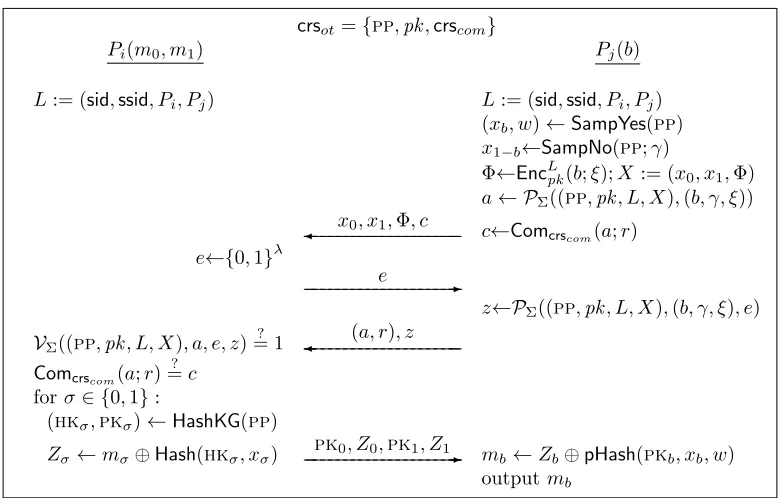
Figure 5: A statically secure OT protocol in theFCRS-hybrid model (Protocol 2).
5
A Generic Framework for Four-Round OT
In this section, we describe a generic framework for constructing four-round OT protocols. We begin by looking at the case of static security, and then show how the ideas can be extended to achieve security against adaptive adversaries.
5.1 Static Security (Protocol 2)
The main idea is to adapt our previous two-round framework by replacing the dual-mode NIZK proof with an interactive equivalent. In particular, the general structure of the protocol is as follows: the protocol starts by having the receiver send two instances (x0, x1) for hash proof
system where x1−b being ano-instance; also, in protection against a malicious behavior, Encpk(b)
and a Sigma protocol (augmented with an equivocal commitment) are attached. Then, the sender generates primary and projective hash keys (hkσ,pkσ) for each instance xσ and sends (pkσ,Hash(hkσ, xσ)⊕mσ) to the receiver. The security can be shown similarly to the two-round OT case.
Here, instead of replicating all the details, we only describe how to combine a Sigma protocol with an equivocal commitment scheme in order to replace the NIZK part. The idea is having the prover commit to the first round message of the Sigma protocol, and reveal it in the third round. Refer to Figure 5 for the overall pictorial description of the protocol.
Replacing NIZK. Recall in the two-round OT case, the receiver generates a NIZK π to prove that (x0, x1,Φ) is valid message, i.e., Φ is an encryption ofb∈ {0,1}for somebandx1−bisno -instance. In this protocol, the receiver proves it by running a Sigma protocol (PΣ,VΣ), along
with an equivocal commitment scheme (Kcom,Com), with respect to the following language:
L∗={(pp,pk, L, x0, x1,Φ) :∃(b, γ, ξ) s.t. x1−b =SampNo(pp;γ),Φ =EncLpk(b;ξ)},
whereL= (sid,ssid, Pi, Pj).
1. The receiver runs a←PΣ((pp,pk, L, x0, x1,Φ),(b, γ, ξ)), and c = Comcrscom(a;r) with r
chosen uniformly at random. It sends (x0, x1,Φ, c).
2. The sender sends the challenge message e←{0,1}λ of the Sigma protocol. 3. Upon receiving the challenge e, the receiver generates an answer by running
z=PΣ((pp,pk, L, x0, x1,Φ),(b, γ, ξ), e).
It sends the sender the answer z along with the opening of the commitment, i.e., ((a, r), z).
4. The sender verifies (a, e, z) is an accepting transcript and (a, r) is a valid opening of c:
VΣ((pp,pk, L, x0, x1,Φ), a, e, z) ?
= 1, Comcrscom(a;r) ?
=c.
The security of the protocol can be proved similarly to the two-round case.
Theorem 3 Say(Gen,Enc,Dec) is a CCA-secure labeled public-key encryption scheme, (HashPG,
SampYes,SampNo,HashKG,Hash,pHash) is a smooth projective hash proof system with hard subset membership property, (PΣ,VΣ) is a Σ-protocol, and (Kcom,Com) is an equivocal commitment scheme. Then the protocol of Figure 5 securely realizesFMOT in the FCRS-hybrid model, for static
corruptions.
The proof appears in Section 5.3.
5.2 Adaptive Security (Protocol 2∗)
As with the 2-round framework, the protocol first needs to be changed so that the last round message is sent over a secure channel. This modification (along with erasing the state appropriately), however, is not sufficient to deal with adaptive corruption in the four-round case. For the NIZK, the receiver can generate π and then erase the unnecessary internal state before sending out (x0, x1,Φ, π). However, if the statement is composed with the interactive Sigma protocol, some
of the internal state cannot be erased until the last move. For example, in the Sigma protocol, the receiver cannot erase the randomness used for generating theno-instancex1−b until it receives the challenge e, since he has to use the randomness as part of the witness in order to finish the proof. However, recall that bothx0 and x1 are yesinstances in simulation; when the adversary corrupts
crsot={pp,pk,crscom}
Pi(m0, m1) Pj(b)
L:= (sid,ssid, Pi, Pj) L:= (sid,ssid, Pi, Pj) (xb, w)←SampYes(pp)
x1−b←SampNo(pp;γ)
Φ←EncLpk(b;ξ);X:= (x0, x1,Φ)
a← PΣ((pp,pk, L, X),(b, γ, ξ))
c←Comcrscom((X, a);r)
c
e←{0,1}λ
e
-z←PΣ((pp,pk, L, X),(b, γ, ξ), e) erase all state except
(b, w, X, a, r, z)
((x0, x1,Φ, a), r), z
VΣ((pp,pk, L, X), a, e, z) ?
= 1
Comcrscom((X, a);r)
?
=c
forσ= 0,1
(hkσ,pkσ)←HashKG(pp)
Zσ←mσ⊕Hash(hkσ, xσ) erase all state except (m0, m1,pk0, Z0,pk1, Z1)
pk0, Z0,pk1, Z1
Q
mb←Zb⊕pHash(pkb, xb, w) outputmb
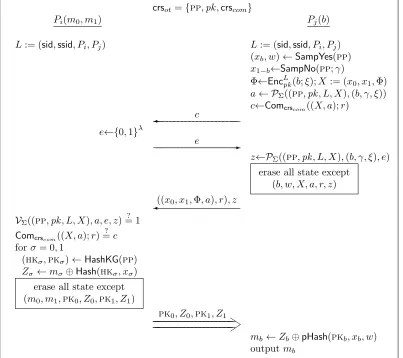
Changing the order of messages. As in the commitment scheme [Lin11], we resolve this issue by switching the order of messages. That is, the message to be committed to is not only the first messageaof the Sigma protocol but also the statement itself (i.e., (x0, x1,Φ)), and they are revealed
at the last move of the Sigma protocol. Now, thanks to the equivocality of the commitment scheme, the protocol can achieve adaptive security. Refer to Figure 6 for the overall pictorial description. Here, we only describe the aforementioned modification in more detail. Recall in the statically secure protocol described in Section 5.1, the receiver sends (x0, x1,Φ) and the commitmentcto the
first message aof the Sigma protocol (PΣ,VΣ) for the language
L∗ ={(pp,pk, L, x0, x1,Φ) :∃(b, γ, ξ) s.t. x1−b=SampNo(pp;γ),Φ =EncLpk(b;ξ)},
whereL= (sid,ssid, Pi, Pj). In this protocol, we change the order of messages as follows:
1. The receiver runs a←PΣ((pp,pk, L, x0, x1,Φ),(b, γ, ξ)), and c←Comcrscom((x0, x1,Φ, a);r)
withr chosen uniformly at random. It sends c.
2. The sender sends the challenge message e←{0,1}λ of the Sigma protocol. 3. Upon receiving the challenge e, the receiver generates an answer by running
z=PΣ((pp,pk, L, x0, x1,Φ),(b, γ, ξ), e).
It sends the sender the answer z along with the opening of the commitment, i.e., ((x0, x1,Φ, a), r, z).
4. The sender verifies (a, e, z) is an accepting transcript and ((x0, x1,Φ, a), r) is a valid opening
of c:
VΣ((pp,pk, L, x0, x1,Φ), a, e, z) ?
= 1, Comcrscom((x0, x1,Φ, a);r) ?
=c.
Theorem 4 Under the same assumptions as Theorem 3, the protocol in Figure 6 securely realizes
FMOT in the FCRS-hybrid model, for adaptive corruptions (assuming erasure).
The proof appears in Section 5.4.
5.3 Proof of Theorem 3
5.3.1 The Simulator
The simulator is very similar to that in the two round case. Let Π denote the OT protocol under consideration. Here we construct a simulator Sim for any non-uniformppt environment Z
such that execFΠCRS,A,Z ≈ idealFMOT,Sim,Z, where A is the dummy adversary. Then we argue the indistinguishability between the two ensembles. Let (Scom1,Scom2,Scom3) be the simulator for the dual-mode equivocal commitment (Kcom,Com), andSΣ is the simulator for the Sigma protocol.
Initialization step: The simulatorSim generates the common reference string as follows:
1. Compute pp←HashPG(1λ);