OPEN SOURCE SOFTWARE FEATURES AND PERFORMANCE OF KENYAN UNIVERSITY LIBRARIES IN NAIROBI METROPOLITAN, KENYA
JARED OKINYI OTIENO D53/OL/26554/2013
RESEARCH PROJECT SUBMITTED IN THE SCHOOL OF BUSINESS OF KENYATTA UNIVERSITY IN PARTIAL FULFILMENT OF THE REQUIREMENTS
FOR THE AWARD OF THE DEGREE OF MASTERS OF BUSINESS
ADMINISTRATION (MANAGEMENT INFORMATION SYSTEMS) OF KENYATTA UNIVERSITY
ii
DECLARATION Declaration by the candidate
This research project is my original work and has not been presented for a degree in any other university.
________________________ ____________________
Jared OkinyiOtieno Date
D53/OL/26554/2013
Declaration by the supervisor
This research project has been submitted for examination with my approval as University Supervisor.
Signature:
... ... Dr. David Nzuki Date
iii
DEDICATION
iv
ACKNOWLEDGEMENT
My first and foremost gratitude is unto the Almighty Father for His unconditional love, favor and grace that have brought me this far even unto the completion of this program. Special acknowledgement goes to my selfless supervisor, Dr. David Nzuki, for his tireless guidance, corrections, approvals, insights and encouragement throughout this research proposal. Equally important are my family members and friends whose support has been very instrumental in bringing this project the far it has come. Lastly, I would like to appreciate my spiritual fathers and brothers whose encouragement and prayers have strengthened me throughout this project. If there are no other words to say, “THANK YOU” are words I won’t get tired of saying to
v
TABLE OF CONTENTS
DECLARATION... ii
DEDICATION... iii
ACKNOWLEDGEMENT ... iv
TABLE OF CONTENTS ... v
LIST OF TABLES ... viii
LIST OF FIGURES ... ix
ABBREVIATIONS AND ACRONYMS ... x
OPERATIONAL DEFINITION OF TERMS ... xi
ABSTRACT ... xii
CHAPTER ONE: INTRODUCTION ... 1
1.1 Background to the Study ... 1
1.1.1 Open Source Software Features ... 2
1.1.2 Open Source Software and Performance of Kenyan University Libraries ... 5
1.1.3 University Libraries in Nairobi Metropolitan ... 6
1.2 Statement of the Problem ... 7
1.3 Objectives of the Study ... 8
1.3.1 General Objectives ... 8
1.3.2 Specific Objectives ... 8
1.5 Research Questions ... 8
1.6 Significance of the Study ... 9
1.7 Scope of the Study... 10
1.8 Limitations of the Study ... 10
1.9 Assumptions of Study ... 10
CHAPTER TWO: LITERATURE REVIEW ... 12
2.1 Introduction ... 12
2.2 Theoretical Review ... 12
2.2.1 Diffusion of Innovation Theory ... 12
2.2.2 DeLone and McLean’s Information Systems Success Model ... 16
vi
2.3.1 Acquisition and Maintenance Costs of Open Source Software ... 18
2.3.2 Usability of Open Source Software in the Management University Libraries ... 21
2.3.3 Reliability of Open Source Software in the Management University Libraries ... 22
2.3.4 Scalability of Open Source Software... 24
2.3.5 Performance of Kenyan University Libraries ... 25
2.4 Summary of the Literature Review and Research Gaps ... 26
2.5 Conceptual Framework ... 27
CHAPTER THREE: RESEARCH METHODOLOGY ... 29
3.1 Introduction ... 29
3.2 Research Design ... 29
3.3 Target Population ... 29
3.4 Sampling Technique and Sample Size ... 30
3.5 Data Collection Instruments and Procedures ... 31
3.6 Data Collection Procedures ... 32
3.6.1 Pilot study ... 32
3.6.2 Validity of the research Instruments ... 32
3.6.3 Reliability of the research Instruments ... 33
3.7 Data Analysis and Presentation ... 34
3.7.1 Descriptive Statistics ... 34
3.7.2 Inferential Data Analysis ... 35
3.9 Ethical Considerations... 37
CHAPTER FOUR: DATA ANALYSIS AND PRESENTATION... 38
4.1 Introduction ... 38
4.2 Sample Characteristics ... 38
4.2.1 Respondents Composition ... 38
4.2.2 Library Staff Respondents by Specialization ... 39
4.2.3 Open Source Software Usage ... 40
4.2.4 Period of Open Source Software Usage ... 42
4.2.5 Major Library Services Frequently Used by Library Users ... 42
vii
4.3.1 Types of Open Source Software Currently Being Used in Kenya University Libraries
... 43
4.3.2 Cost-effectiveness of Open Source Software ... 44
4.3.3 Usability of Open Source Software ... 45
4.3.4 Reliability of Open Source Software ... 48
4.3.5 Scalability of Open Source Software... 50
4.4 Level of Library user Satisfaction With their Library Services ... 51
4.5 Regression Analysis ... 53
4.5.1 Regression Model ... 54
4.5.2 ANOVA ... 54
4.5.3 Coefficients of Independent Variables ... 55
CHAPTER FIVE: SUMMARY, CONCLUSION AND RECOMMENDATIONS ... 57
5.1 Introduction ... 58
5.2 Summary of the Study ... 58
5.2.1 Background Information... 58
5.2.2 Cost of OSS and performance of Kenyan university libraries ... 58
5.2.3 OSS Usability and performance of Kenyan university libraries ... 59
5.2.4 Reliability of OSS and performance of Kenyan university libraries ... 59
5.2.5 OSS Scalability and performance of Kenyan university libraries ... 59
5.3 Conclusion ... 60
5.4 Recommendations ... 61
5.5 Suggestions for further research ... 62
REFERENCES ... 64
APPENDICES ... 67
Appendix I: Letter to Respondents... 67
Appendix II: Questionnaire to Library Users ... 68
Appendix III: Questionnaire to Library Staff ... 71
Appendix IV: Research Approval Letter ... 75
viii
LIST OF TABLES
Table 2.1: Cost Categories within Software Life Cycle……….. 19
Table 3.1: The target population………... 31
Table 3.2: Reliability Statistics ……….. 33
Table 3.3 Metrics for the predictor variables……… 35
Table 4.1: Respondents Composition ……….. 38
Table 4.2: Level of user satisfaction ………. 51
Table 4.3: Model Summary………... 53
Table 4.4: ANOVA…..……….. 54
Table 4.5:Coefficients of Independent Variables………. 55
ix
LIST OF FIGURES
Figure 2.1 Information Systems Success Model ………. 17
Figure 2.2 Conceptual framework ………. 28
Figure 3.1 Histogram Residual………. 36
Figure 3.2 Normal Probability plot of Residual……… 36
Figure 4.1 Respondents Composition ……… 39
Figure 4.2: Library Staff Respondents by Specialization………. 40
Figure 4.3: OSS Usage……….. 41
Figure 4.4 Period of Library services usage ………. 42
Figure 4.5: Major Library Services frequented by library users……… 43
Figure 4.6: OSS Usage in Kenyan University Libraries ……….. 44
Figure 4.7: OSS is Easy to Use ……… 46
Figure 4.8: Ease of Using Library Systems………. 47
Figure 4.9: User-friendliness of the current library systems ……….. 47
Figure 4.10: Reliability of current library management systems……….. 48
Figure 4.11: Reliability of current library management systems………. 49
Figure 4.12: Change in Libraries’ Services Delivery……… 50
Figure 4.13: Increase in Information Materials………. 50
x
ABBREVIATIONS AND ACRONYMS CUE - Commission for University Education
FTP - File Transfer Protocol
FOSS – Freed Open Source Software FLOSS – Free/Libre Open Source Software ILMS–Integrated Library Management System
IS – Information System
MIT - Massachusetts Institute of Technology OSS – Open Source Software
xi
OPERATIONAL DEFINITION OF TERMS
Acquisition Cost – Initial financial expenses incurred by university library to acquire Open Source software.
Digital library – A collection of electronic information materials maintained and managed through various library management systems.
DSpace – An open source software used by most university libraries in Kenya to manage their digital libraries or institutional repositories.
Free Software Foundation– a non-profit making organization founded by Richard Stallman to support development and maintenance of open source software products.
Koha- An open source Integrated Library Management System used by some of university libraries in Kenya to automate their library functions.
Maintenance cost - Financial expenses that a university library would annually incur to ensure proper functioning of the library system.
Open Source Initiative -An organization founded by Eric S. Raymond and Bruce Perens to promote open source software.
Open source Software – Computer application whose source code is freely made available to the public with a provision to modify and redistribute both the original
application and a modified version of the same.
Performance – Quality of services provided by the Kenyan university libraries.
Scalability – Ability of Open Source Software to be enlarged in a manner that facilitates growth of University libraries.
Software – Computer program used to perform specific tasks.
OSS features – Unique characteristics of open source software that facilitate their usage in university libraries.
Systems Librarian – Librarian responsible for the management and maintenance of ICT services within a library.
University Library – An academic library established within a university for the purpose of supporting academic programs offered by the university.
xii ABSTRACT
1
CHAPTER ONE:INTRODUCTION
1.1 Background to the Study
Libraries worldwide are in a relentless move to adopt Information Technology in their daily operations through adoption of various Integrated Library Management Systems (ILMS). This aggressive move is slow but surely bringing into reality the concept of libraries without walls, commonly referred to as digital libraries. In Kenya, University libraries are leading the path into this new information management paradigm by incorporating open source software and systems such as Linux operating systems, Linux Servers, Koha, Greenstone, OPALS, Evergreen, Eprint and DSpace into their routine operations. An intriguing observation is that majority of the adopted software are based on open source licenses.
Open source software is a computer program whose source code is freely made available to the public with the freedom to modify and distribute at will. Open source software license guarantees its users access to the programming language and codes used in compiling the software. This access allows libraries of different sizes and types to modify the software as per their need. Lochhaas and Moore (2010) described Open Source software as a brain-child of Richard Stallman, a former programmer at Massachusetts Institute of Technology’s (MIT)
2
However, the communal existence of this software community was short-lived by eventual upgrading of MIT Artificial Intelligence Lab computers to use a proprietary operating system. This change of operating system, coupled with his beliefs in computer programming freedom propelled Stallman into forming the Free Software Foundation in 1985 (Randhawa, 2008).
In order to do away with ambiguity in Stallman’s description of “Free Software”, the term “Open Source Software” was born in 1998. According to Lochhaas and Moore (2010), the term open source came from Palo Alto, California conference sparked by Netscape’s release of its web browser’s source code. An attendee of the Palo Alto conference, Eric Raymond founded the
Open Source Initiative. It is this initiative that has continuously promoted worldwide education on open source, community building and creating awareness on the open source software benefits (Tramboo, 2012).The increasing popularity of OSS has caught attention of librarians to the extent of adopting it in the management of library resources. Koha is recorded as the first open source software to be used in library automation. The koha integrated library management system was created in 1999 and made available to online users in the year 2000 (Giri, 2012).
1.1.1 Open Source Software Features
As highlighted in the introductory section above, Open source software applications are computer programs that are freely available for users with an option of modifying the source code to suit the user’s unique needs. Besides the freedom feature of this category of softwares,
3
According to Ikram, Butt, and Afzal (2015), any management decisions in regard to adoption of a computer software should be based on the aforementioned features since they are they technological determinants of software’s quality and functionality.
Raghunathan et al. (2005) observed that reliability of open source softwares is assured by their openness. For instance, users’ free access to the software’s source code facilitates multiple
testing of the code thus timely identification and fixation of possible bugs. In the same way, users and contributors to an open source development promotes enhancements of the software as opposed to proprietary software in which access to source code is limited to the commercial developers. Additionally, the provision for peer reviews in OSS developments provides favorable platform upon which development insights and improvements are cultivated with proper documentation.
While evaluating performance of Open Source Operating system (Linux) against proprietary Operating System (Windows NT), Bloor Online Research revealed that Linux operating system outperformed Windows NT on three critical metrics; user satisfaction, availability, and delivery of value for the consumer’s money. The two sets of software performed equally on functionality
and interoperability metrics. The proprietary operating system was superior just on the dimension of application availability. These statistics point to the favorable features of OSS in regard to their adoption in an organizational setting.
4
quality should supersede demand for lower costs when they are faced with decision between a software’s cost-effectiveness and quality of the same. The authors observed that unless OSS is of
the required standard, its free nature may be of little or no benefit to the consumer since the consumer would derive negligible value from its usage.
In their research based on the use of open software in libraries, Singh and Sanaman (2012) noted that “libraries are always concerned about the cost as they often have more demands than
resources and they are funded by their parent organizations with a responsibility to manage public funds wisely”. The implication in this statement is that libraries have little or no means of
generating their own income. As such, they depend on their parent institutions to fund their projects. Being a non-income generating unit, libraries are likely to experience difficulty when pushing for costly projects to be financed by the institution. This financial difficulty complicates the task of managing libraries since librarians are expected to continuously deliver quality services. Managers of these libraries are therefore forced to establish the most cost-effective means of serving their patrons. The cost-free acquisition of open source software seems to be a favorable avenue to meet the patrons’ needs at a lower cost compared to proprietary software
(Singh &Sanaman, 2012). However, there is need to ascertain the total cost of the software ownership by the library managers. The software can be acquired freely but other costs such as its installation, user training, documentation, system support, and maintenance might be equally high.
5
the OSS supports such functions. Bibliographic database management and library transactions are noted as the functions supported by higher percentage of library OSSs. Other functions include, acquisition, serial control, local and external bibliographic databases searching by end-users online, and library portals. Other OSSs allow importation of bibliographic records from world’s recognized libraries such as the Library of Congress and Oxford University library. This
importation is made possible through the use of Z39.50 protocol. Since libraries worldwide are seeking to offer uniform services and also conform to international standards, Z39.50 facility has been made a necessary feature of any library-usable OSS (Dhamdhere, n.d).
1.1.2 Open Source Software and Performance of Kenyan University Libraries
According to University Libraries Standards and Guidelines developed by Kenyan Commission for Higher Education (2012), performance of university libraries should be measured with respect to the degree of their contribution to the achievement of university’s vision, mission,
values and goals. It is therefore imperative that any project that these libraries engage in should be geared towards achievement of the overall goal of Kenyan universities. One common goal in every institution of higher learning is to develop all-round and self-reliant citizens capable of being productive with minimal external help. That is to say, every library management system should allow its users some degree of freedom and ease to independently search the library database for individualized information needs. A library user would be more concerned about the ease with which he or she acquires the needed information rather than the cost of acquiring the software used in the library system. Since a great percentage of library success or performance is determined by the level of users’ satisfaction, the effects of open software usage in these libraries
6
Singh &Sanaman (2012) described OSS as software revolution that liberates libraries from being locked in software products that might not meet their full needs. By providing for direct participation of libraries in software development, OSS allows innovation in libraries and development of computer-based systems and services that are consistent with librarianship values (Singh &Sanaman, 2012).
According to Singh and Sanaman (2012), open source software provides its users with the opportunity to continuously improve its quality through peer reviews. The reliability of open source software can therefore be assured. Additionally, libraries that are using open source software have got unlimited opportunity to directly participate in the development of their systems. Libraries can therefore undertake innovative projects in line with the established principles of librarianship rather than being restricted by any single software developer (Singh &Sanaman, 2012).
1.1.3 University Libraries in Nairobi Metropolitan
7
and Strathmore University among others. The fair representation of Kenyan university within Nairobi Metropolitan makes it a suitable location for the study.
1.2 Statement of the Problem
From general observations byMakori (2016), every Kenyan University library is using at least one open source software products in its daily operations. Whereas other universities libraries such as Kenyatta University library, Strathmore University, Technical University of Kenya, and MasindeMuliro University among several others are using koha, other universities are actively exploiting the freely available DSpace for the development of their digital repositories (Wasike, 2015). The degree to which Open Source Software products have and are continuing to permeate Kenyan university libraries begs for an empirical evaluation on specific features of OSS and their contributions to the performance of these institutions.
8 1.3 Objectives of the Study
1.3.1 General Objectives
The general objective of this study was to establish the contributions of open source software features on the performance of Kenyan university libraries.
1.3.2 Specific Objectives
In order to achieve this end, the following specific objectives were used to guide the researcher; a) To establish the extent to which OSS’ acquisition and maintenance costs contribute to the
performance of Kenyan university libraries.
b) To establish how usability of OSS contributes to the overall performance of Kenyan University libraries.
c) To establish how reliability of OSS contributes to the performance of Kenyan University libraries.
d) To establish the contributions of OSS’ scalability on the performance of Kenyan University libraries.
1.5 Research Questions
In order to effectively achieve the set objectives of this study, the following questions guided the entire research process.
1. To what extent does OSS’ acquisition and maintenance costs contribute to the performance of Kenyan university libraries?
9
3. How does theOSS reliability contribute to the overall performance of Kenyan university libraries?
4. How does the scalability of OSS contribute to the performance of Kenyan University libraries?
1.6 Significance of the Study
The study of great significance to three groups of users; Managers of University libraries, developers of open source software, and academicians in the field of Library Management Systems. To the managers of University Libraries in Kenya, the study provides empirically established contributions of functional features on the performance of their respective libraries. As such, library managers and policy makers sound basis upon which decisions of OSS adoption can be made. Equally important is that university librarians can use the findings of this study in order to identify specific features of OSS whose improvement can positively or negatively influence overall performance of their libraries. Hence, the study has laid sound foundation upon which software-related decisions can be made to optimize utilization of the scarce resources in Kenyan University libraries.
10
The study has incredible academic significance as it fills the knowledge gap on the contributions of Open Source Software on the performance of Kenyan University libraries. It is apparent that most of Management Information Systems studies have been focused on the corporate world. Academic application of such systems such as in academic libraries is yet to be receive substantial attention. This study therefore calls attention of management scientists to the unexplored pool of knowledge in the library application of Open Source Software.
1.7 Scope of the Study
The study focused on features of Open Source Software such as their cost-effectiveness, usability, scalability, and reliability in terms of their quantitative and qualitative contributions on the performance of Kenyan University libraries. Six university libraries located within Nairobi Metropolitan area were sampled for the study.
1.8 Limitations of the Study
The study is limited to six (6) University libraries located within the Nairobi metropolitan area due to time and cost constraints of conducting the same in over 60 university libraries that are currently operational in Kenya. However, the high concentration of University campuses and libraries within Nairobi Metropolitan makes the sampled libraries adequately representative ofall the university libraries in Kenya.
1.9 Assumptions of Study
11
12
CHAPTER TWO:LITERATURE REVIEW
2.1 Introduction
In order to effectively understand the implications and effects of Open source Software usage in the Kenyan University Libraries, it is important that we consider previous studies that have been done in regard to Open Source Software development and their applications in various types of institutions. This chapter provides a systematic of various literatures relevant to the research topic presented in the following subsections.
2.2 Theoretical Review
In order to understand the rational and process by which Open Source Software packages have been adopted in the Kenyan University libraries and even beyond, it is important for us to look at some of the proposals by dependable theorists.
2.2.1 Diffusion of Innovation Theory
Understanding the effects of open source software usage in Kenyan university libraries may not be possible without looking at the adoption trends of the same in these libraries. It is true that not all Kenyan university libraries which are currently using different kinds OSS started spontaneously. The move to use OSS in libraries might have started from a single source from which the influenced diffused to other libraries as suggested by Gabriel Tarde’s theory of
13
simultaneously by all individuals in a social system but they are in a time sequence depending on some characteristics of the innovation. Innovation in this theory is described as an idea, object, or practice which has been perceived as new by an individual or organization. For instance, the use of Open Source software in libraries qualifies to be an innovation to the Kenyan university libraries since it is practice that is hardly a decade old. This statement is justified by Rogers’s
emphasis that the newness of the innovation must not only be in term of new knowledge but it can also refer to the new point of view regarding the innovation (Rogers & Everett, 2003). For instance, open Source software products such as Linux operating system and koha library management software have been around for long a while but it is until recently that some Kenya university libraries are adopting them in their system. It is not uncommon to get some librarians still asking for assistance on how to install these programs. It therefore means that the OSS concept is still new our universities.
The definition of Diffusion of Innovation theory given above suggested some outstanding characteristics of innovations that drive their diffusion. Some of these characteristics include relative advantage, compatibility with other existing subsystems, and complexity of the innovation.Even though this theory has other three components such as communication channels, time and the social system, this paper will concentrate on the innovation components since the other three components are not directly link to the paper’s research objective. Review of the
14 2.2.1.1 Relative Advantage of OSS
For a new idea, practice or product to diffuse steadily within a social system, it should have some relative advantage over the previously existing idea, practice or product. Robinson (2012) defined an innovation’s relative advantage as the degree to which it is perceived to be better than
the idea, practice or product it replaces. Hence, the increased adoption of OSS in the Kenyan libraries would theoretically mean that OSS products are better than their proprietary counter parts. As such, their usage in these libraries should have some measurable effects. According to Rogers and Everett (2003), an innovation’s relative advantage can be measured in different
dimensions such as; economic effects, social prestige, user satisfaction, and convenience. The researcher, therefore, employed these four dimensions of an innovation’s relative advantage as sound metrics gauge the contributions of OSS features on the performance of Kenyan university libraries.
Economic effects of OSS usage in the Kenyan university libraries should be ascertained quantitatively from multiple angles. One angle can be in terms of cost reduction in the system acquisition and the system’s maintenance costs. Another economic angle upon which OSS usage
15
2.2.1.2 Compatibility of OSS with the Existing System
Besides being beneficial, an innovation needs to be compatible with the existing systems for it to diffuse steadily within the society. Theoretically, most of the OSS products that are being used in the Kenyan university libraries are assumed to be compatible with the existing library and university management systems. For instance, koha library management system, Linux operating system, and DSpace document management system should be compatible with both the hardware and software components of the previously existing system. As a theoretical requirement, every OSS product that is being used in Kenyan university library should increase the intra-compatibility of the entire university library system. Hence, intra-compatibility is a feature of OSS whose contributions to the performance of Kenyan university libraries should be considered.
2.2.1.3 Complexity of the Innovation
16
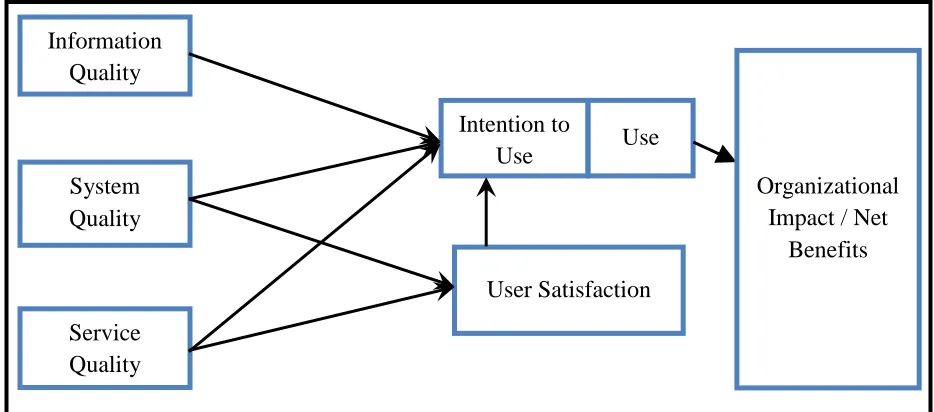
2.2.2 DeLone and McLean’s Information Systems Success Model
According to this multidimensional model, the overall organizational impact (net benefits) of an information system is a function of three independent variables. Delone and Mclean (2003) explained the three independent variables to include; Quality of information provided by the system, Quality of the system, and the Quality of service provided through the system.
The overall organizational impact of the Information System is a compound of “Use” and “User satisfaction” variables, both of which are functions of the three aforementioned independent variables. On the other hand, the “Use” variable measures the individual functions for which the
system is used. For instance, open source software in a library can be used to automate the technical services such as cataloguing, classification, material acquisition, and circulation (Kumar, 2014). The other functions may include digitization of library materials or management of institutional repositories. All these functions will dependent on the quality of the open source software determined by its embedded features such as usability, reliability, and scalability.
User satisfaction was gauged in two dimensions; first, the researcher focused on library staff as the technical users of the open source software. Satisfaction of this kind of users was assessed on the understandability of the open source software’s technical aspects depending on the quality of
17
It is also important to note that libraries’ intention to use any specific kind of software or system
depends on the perceived quality of the system and its service enhancement. The initial intention to use the software is a function of the quality of information available about the software. This perceived quality was ascertained in this research by interrogating the initial source of software’s information to the systems librarians. In order to validate the perceived quality of the system (open source software in this case), Delone& McLean IS Model demands that it be put into actual use. The net benefits or the overall organizational effects of the system (open source software) will then be assessed depending on the users’ experience while using it.
Adapted from DeLone& McLean’s IS Success Model (2003)
Figure 2.1: Information Systems Success Model
Intention to Use Information
Quality
System Quality
Service Quality
User Satisfaction Use
Organizational Impact / Net
18 2.3 Empirical Review
2.3.1 Acquisition and Maintenance Costs of Open Source Software
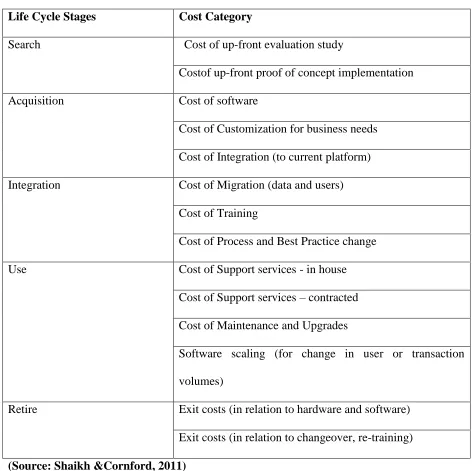
On their report on Open Source Software’s total cost of ownership, Shaikh andCornford (2011)
pointed out that open source software provides a cost-effective way through which inadequately founded institutions can acquire new and usable information systems within a constrained budget. They also argued that adoption of OSS within organizations can facilitate great savings on the organizations’ operational cost. Shaikh andCornford used Lerner and Schankerman’s
19
Table 2.1 Cost Categories within Software Life Cycle Life Cycle Stages Cost Category
Search Cost of up-front evaluation study
Costof up-front proof of concept implementation Acquisition Cost of software
Cost of Customization for business needs Cost of Integration (to current platform) Integration Cost of Migration (data and users)
Cost of Training
Cost of Process and Best Practice change Use Cost of Support services - in house
Cost of Support services – contracted Cost of Maintenance and Upgrades
Software scaling (for change in user or transaction volumes)
Retire Exit costs (in relation to hardware and software) Exit costs (in relation to changeover, re-training) (Source: Shaikh &Cornford, 2011)
Acquisition cost of software is largely made up of the software’s license fee paid to the
20
advantages of Open Source solutions. Randhawa (2008) confirmed this notion of lower acquisition cost of OSS since such applications demands no licensing fee from the interested users. Kenyan University libraries can therefore take advantage of this financial favor. Additionally, open source solutions such as Linux operating systems and servers are relatively compact and portable as compared to their proprietary counterparts. As such these OSS require hardware with less power which can be acquired at lower cost. The benefits of this cost-cutting ability of the OSS are that they can accomplish the same tasks as the costly commercial solutions.
In their research based on the use of open software in libraries, Sanaman (2012) noted that “libraries are always concerned about the cost as they often have more demands than resources
and they are funded by their parent organizations with a responsibility to manage public funds wisely”. The implication in this statement is that libraries have little or no means of generating
their own income. As such, they depend on their parent institutions to fund their projects. Being a non-income generating unit, libraries are likely to experience difficulty when pushing for costly projects to be financed by the institution. This financial difficulty complicates the task of managing libraries since librarians are expected to continuously deliver quality services. Managers of these libraries are therefore forced to establish the most cost-effective means of serving their patrons. The cost-free acquisition of open source software seems to be a favorable avenue to meet the patrons’ needs at a lower cost compared to proprietary software (Sanaman,
21
2.3.2 Usability of Open Source Software in the Management University Libraries
In their analysis of industry users’ perception of open source software usability factors, Raza,
Capretz and Ahmed (2011) observed that user-centered designs are currently being popularized in the development of Open Source Software products. The study interviewed 105 industry users of open source software. The authors also reported that OSS has more potential to realize greater software quality in comparison to their proprietary counterparts. The study was based a multiple regression analysis of four usability components and their effects on industry users’ perspective on the OSS usability. The model, presented below, revealed that users’ opinion on the usability
of a software is greatly influenced by its attractiveness, operability, learnability, and understandability by the users.
𝑂𝑆𝑆 𝑈𝑠𝑎𝑏𝑖𝑙𝑖𝑡𝑦 = 𝑓0+ 𝑓1𝑣1 + 𝑓2𝑣2+ 𝑓3𝑣3+ 𝑓4𝑣4
The𝑓0, 𝑓1, 𝑓2, 𝑓3, 𝑎𝑛𝑑 𝑓4 in the above model represented the coefficients while𝑣1, 𝑣2, 𝑣3, and 𝑣4 represent the four usability factors of OSS.
However, the researchers noted that the voluntary nature of OSS development may impair usability features of the software. Volunteer developers of OSS may concentrate on specific areas that are of interest to them thus leaving out features demanded by novice users. This risk is quite possible in cases where the demands of novice users are not within the areas of developers’
22
characteristics. These characteristics include ease of learning, memorability, and users’
subjective satisfaction, efficiency of use, error frequency and severity.
University Libraries Standards and Guidelines developed by Kenyan Commission for Higher Education (2012) also alluded to this description of software usability in their measurement of university performance. The commission posed that performance of university libraries should be measured with respect to the degree of their contribution to the achievement of university’s
vision, mission, values and goals. It is therefore imperative that any project that these libraries engage in should be geared towards achievement of the overall goal of Kenyan universities. One common goal in every institution of higher learning is to develop all-round and self-reliant citizens capable of being productive with minimal external help. That is to say, every library management system should allow its users some degree of freedom and ease to independently search the library database for individualized information needs (Odongo, 2012). A library user would be more concerned about the ease with which he or she acquires the needed information rather than the cost of acquiring the software used in the library system. Since a great percentage of library success or performance is determined by the level of users’ satisfaction, the effects of
open software usage in these libraries should also be gauged on their friendliness to the end-users (library patrons in this case).
2.3.3 Reliability of Open Source Software in the Management University Libraries
Ullah and Morisio (2013)defined software reliability as the probability of failure free operation of a computer program in a specified environment for a specific period of time. This definition is
23
demand for reliable service delivery among Kenyan University Libraries dictates that their services should be supported by failure-free systems. As such, maximum efforts should be directed at establishing whether Open Source Software that are currently being used in these libraries meet the reliability requirements of a suitable Library Management System.
Ullah and Morisio (2013)took an experimental approach in analyzing usability of five open source software projects. The five OSS included in the study’s sample were Appache HTTP
Server, Mplayer OS X, Eclipse software development environment,ClamWin Free antivirus,and Firefox internet browser. A 3-step approach was employed to gather, filter, and analyze bugs resulting from the sampled applications. The research also sought to ensure consistency across multiple versions of the applications. This was achieved by analyzing reliability of multiple release versions of each software.Software reliability models of “time between failures” and “fault count” techniques were used to measure the reliability patterns of the software. According
to Ullah and Morisio (2013), intervals of successful operations of a system is useful parameter in determining the software’s reliability. Another useful parameter in the measurement of software reliability is the number of faults encountered by the system in a given period of time. For instance, users of library management systems can estimate reliability of their system by enumerating the number of the system’s breakdown in a weekly, monthly, quarterly,
semi-annually, or on annually. The magnitude of such incidences can then be compared by the performance of an identical system.
24 2.3.4 Scalability of Open Source Software
Outside the library setting, scalability of open source software can best be illustrated by the ever growing content of Facebook website. According to an online research on the bulging size of Facebook servers, researchers revealed that the social media giant is leveraging on open source systems to its massive scalability (Thusoo et al., 2010). The three open source software applications that have been instrumental in fostering scalability at Facebook are Hadoop, Scribe, and Hive. The research on Facebook’s data warehousing and analytics infrastructure points out
to the great scalability potential of properly nit open source software products. If open source software products are capable of handling up to 60 terra bytes of new data being loaded everyday on Facebook servers then no amount of library resources can be exhaust the scalability of open source systems. Even though one can argue from Ranganathan’s point of view that library is a growing organism, the growth of library electronic resources cannot grow at the same rate as social media platforms. Contributors of library resources are relatively few compared to the entire world’s population who are continuously posting multimedia contents on their Facebook
pages.
25
Zebra a powerful indexing tool embedded in koha to make it more viable and scalable to suit the needs of libraries of all classes. Bash (2015) reported that the Zebra feature has given scalable ability to holds huge bibliographic records totaling to tens of millions. Scalability of open sources software products seems to be assured by the increasing support coming from individuals and corporate entities.
2.3.5 Performance of Kenyan University Libraries
University libraries play significant role in the facilitation of higher education in Kenya as well as ensuring life-long learning among Kenyan. Besides promoting the realization of academic goals of their mother institutions, university libraries have opened their doors to the general public in the dissemination of knowledge and fostering research. The adoption of Open Source Software such as DSpace has enabled a number of Kenyan University libraries to limitlessly avail their institutional repository the community of researchers, both locally and internationally. Besides these impressive developments, a clear guideline on how to measure performance of these libraries is still missing. In his study on the practices and performance of university libraries in Kenya, Kavulya (2003) considered university libraries’ performance on availability
of resources. He pointed out that inadequacy in terms of funds, information materials, equipment, and staff are key determinants of library performance.
26
organization. In this regard, performance of university libraries can be measured in terms of users' satisfaction with overall library services such as access and dissemination of the library information materials. Hence, a library that provides easy access to large volume of materials portrays superior performance than libraries whose collections are hardly accessible. On dissemination, university libraries need to install sound systems through which information materials can be disseminated to users in an efficient and convenient manner.
2.4 Summary of the Literature Review and Research Gaps
Theoretically, adoption of OSS among Kenyan university libraries might have been influenced by some expected positive effects of the same on the performance of the libraries. According to Tarde’s diffusion of innovation theory, the aggressive adoption of OSS products by Kenyan
university libraries might have been propelled by factors such as perceived relative advantage of the OSS over their proprietary counterparts, their compatibility with the previously existing systems, and degree of complexity of the OSS to the library users (Rogers & Everett, 2003). Even though these factors seems viable enough to drive the software revolution in the management of Kenyan university libraries, their certainty needs to be established by looking at the effects this revolution has made on the performance of these libraries.
Delone and McLean’s Information Systems Success Model provides a sound foundation upon
costs-27
effective, user-friendly, and scalable. Randhawa (2008), for instance, contended that OSS products such as Linux operating system and databases are both cost-effective and scalable enough to support daily activities of various institutions, including libraries. However, his proposal was lacking empirical backing. A study by Sanaman also missed out on the data to establish the true cost of OSS products. The researcher only made a general observation on the need for cost-effective library management system since majority of libraries are financially deprived (Sanaman, 2012). The glaring lack of empirical information on actual effects of OSS usage, especially in the Kenyan University Libraries makes it important for this study to be carried out to bridge the current knowledge gap.
Even though a great deal of studies has been done concerning OSS products and their adoption in business organizations, there is a glaring lack of information regarding the contributions of OSS features in university libraries. The Kenyan scenario is especially wanting given that most of the available literatures are foreign to our situation. Kenya is a developing country and is bound to have unique technological needs as opposed to European countries where majority of these researches are based (Amollo, 2013). As much as these sources have tried to narrate the adoption of open source software products, library-related products have not been covered. For instance, one can hardly find information in the use of Debain server while the software has been used in the hosting of koha integrated library system (Alves, Reais, & Alves, 2012). Therefore, there is need for more research and publications giving undivided attention to these library-related open source software products.
28
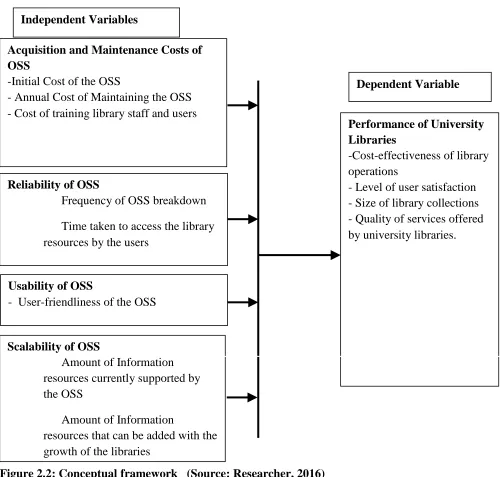
Contributions of OSS features on the performance of University libraries were measured by four main features of good software. The features include acquisition and maintenance costs, usability, reliability and scalability of the software. Since daily operations of Kenyan University libraries are currently based on Open source software, these four features of the software interact to holistically impact on the overall performance of the libraries under study.
: Researcher
Acquisition and Maintenance Costs of OSS
-Initial Cost of the OSS
- Annual Cost of Maintaining the OSS - Cost of training library staff and users
Usability of OSS
- User-friendliness of the OSS Reliability of OSS
Frequency of OSS breakdown Time taken to access the library resources by the users
Performance of University Libraries
-Cost-effectiveness of library operations
- Level of user satisfaction - Size of library collections - Quality of services offered by university libraries.
Dependent Variable Independent Variables
Scalability of OSS
Amount of Information resources currently supported by the OSS
Amount of Information
resources that can be added with the growth of the libraries
(Source: Researcher)
29
CHAPTER THREE:RESEARCH METHODOLOGY 3.1 Introduction
Methodology refers to the techniques that shall be used in conducting the research. This chapter there outlines the kind of research techniques that were employed plus the detailed outline of all the processes that were taken from the identification of study scope to the analysis of data.
3.2 Research Design
Survey research design was used to undertake this project. Since the study required answering series of questions of “how” and “why” descriptive survey was most appropriate. The study
involved administration of questionnaires and interviewing of three groups of stakeholders of Kenyan university libraries within Nairobi metropolitan. The centrality of Nairobi Metropolitan has been it an attractive location for major University in Kenya. Majority of these Universities have functional campuses and libraries within the Nairobi Metropolitan. Therefore, survey on OSS features and performance of Kenyan University libraries could be effectively accomplished within the said location.
3.3 Target Population
The researcher’s target population consisted of six (6) university libraries located within Nairobi
30
University of Nairobi, Daystar, KeMU, KCA, and United States International University libraries.
3.4 Sampling Technique and Sample Size
31
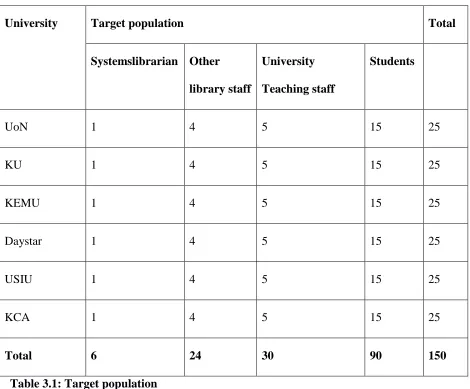
University Target population Total
Systemslibrarian Other library staff
University Teaching staff
Students
UoN 1 4 5 15 25
KU 1 4 5 15 25
KEMU 1 4 5 15 25
Daystar 1 4 5 15 25
USIU 1 4 5 15 25
KCA 1 4 5 15 25
Total 6 24 30 90 150
Table 3.1: Target population
(Source: Researcher, 2016)
3.5 Data Collection Instruments and Procedures
32 3.6 Data Collection Procedures
The researcher will interview one systems librarian from each of the sampled library. This gave a total of 6 respondents who were interviewed. The researcher then administered semi-structure questionnaires to the rest of the respondents.
3.6.1 Pilot study
A preliminary study was carried out to ascertain the feasibility of the final study. The feasibility study also focused on discovering and correcting possible bottlenecks that might hinder successful completion of the main study. Kenyatta University’s Kitui Campus library was selected for the piloting since it is one of the top Kenyan university libraries and the researcher is a staff member in the said library. Hence, carrying out a pilot Kenyatta university library was both convenient and somewhat representative of the target population.The researcher interviewed Kenyan University’s Systems Librarian before administering semi-structure
questionnaires to three (3) other members of the library staff, five (5) members of the university’s teaching staff, and ten students in the same university. Data from the pilot study was
then analyzed using descriptive and inferential statistics to assist researcher in assessing the efficacy of his variables and data collection tools.
3.6.2 Validity of the research Instruments
33
Irrelevant components were discarded in the final research instruments. Consultations and discussions with supervisor was also done to reinforcethe data collection tool’s validity. Finally, face validity was undertaken to confirm clarity and unambiguity of the questions.
3.6.3 Reliability of the research Instruments
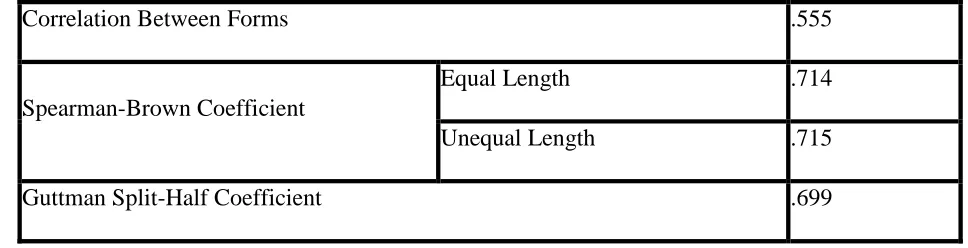
According to Kimberlin&Winterstein (2008), reliability of a research instrument refers to the ability of the concerned instrument to give consistent measurements of the research problem. In this study, Cronbach’s alpha (also known as reliability coefficient) was used to objectively ascertain the reliability of the formulated questionnaires. A reliability coefficient of 0.626 (presented in Table 3.2 below) was acceptable in assessing reliability for multi-item scales as recommended by Best &Kahn (2005). According to Best &Kahn (2005), a reliability coefficient of 0.6 and above is sufficient for an instrument. Since the reliability coefficients of 0.626 and 0.718 (presented in Table 3.2 below) falls within the permissible range, the researcher considered the instrument adequately reliable for the study.
Reliability Statistics
Cronbach's Alpha
Part 1
Value .626
N of Items 6a
Part 2
Value .718
N of Items 5b
34
Correlation Between Forms .555
Spearman-Brown Coefficient
Equal Length .714
Unequal Length .715
Guttman Split-Half Coefficient .699
Table 3.2: Reliability Statistics (Source: Researcher, 2016)
3.7 Data Analysis and Presentation
Data analysis refers to a process of editing, coding classification and tabulation of collected data (Kothari, 2004).Both the quantitative and qualitative data were analyzed by the use descriptive and inferential statistics to establish the correlations between OSS features and performance of University Libraries in Kenya.
3.7.1 Descriptive Statistics
35 3.7.2 Inferential Data Analysis
Multiple linear regression analysis was employed to facilitate analysis and manipulation of inferential statistics of the study. A regression model below, was constructed to illustrate the statistical relationships between the dependent and independent variables;
𝑌 = 𝑓0+ 𝑓1𝑥1+ 𝑓2𝑥2+ 𝑓3𝑥3+ 𝑓4𝑥4
Where;
Y represents Performance of Kenyan University libraries, 𝑓0, 𝑓1, 𝑓2, 𝑓3, and 𝑓4 represent coefficients of OSS features represented by 𝑥1, 𝑥2, 𝑥3, and 𝑥4. The researcher used multiple
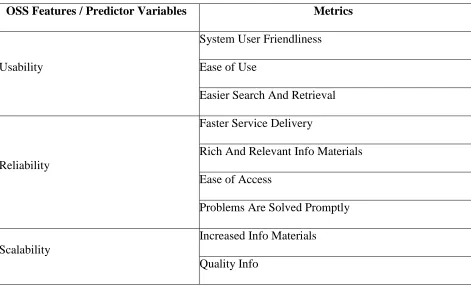
responses from the questionnaires to compute composite indices for the four features of Open Source Software shown in Table 3.3 below;
OSS Features / Predictor Variables Metrics
Usability
System User Friendliness Ease of Use
Easier Search And Retrieval
Reliability
Faster Service Delivery
Rich And Relevant Info Materials Ease of Access
Problems Are Solved Promptly
Scalability
Increased Info Materials Quality Info
36 3.7.2.1 Regression Diagnostics
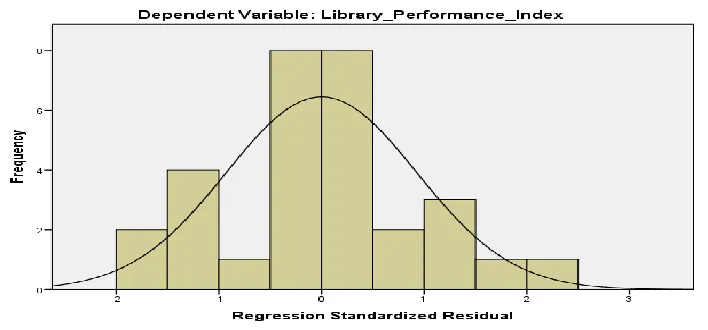
Regression model constructed above was taken through two diagnostic procedures in order to ascertain its linearity and does not violate significant statistical principles. The first procedure involved plotting a histogram residual shown in Figure 3.1 below.
Figure 3.1 Histogram Residual (Source: Researcher, 2016)
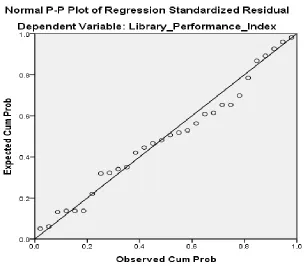
A normal probability plot of the residual was then used to confirm uniformity of the model’s
37
Figure 3.2Normal Probability plot of Residual (Source: Researcher, 2016) 3.9 Ethical Considerations
38
CHAPTER FOUR:DATA ANALYSIS AND PRESENTATION 4.1 Introduction
This chapter presents results and analysis of data on perceived contributions of Open Source Software features on the performances of the six university libraries that were sampled for the study. The data were collected by the use of structured questionnaires and interview schedule. A combination of tables, graphs, and frequency distribution tables are used to present the findings. 4.2Sample Characteristics
4.2.1 Respondents Composition
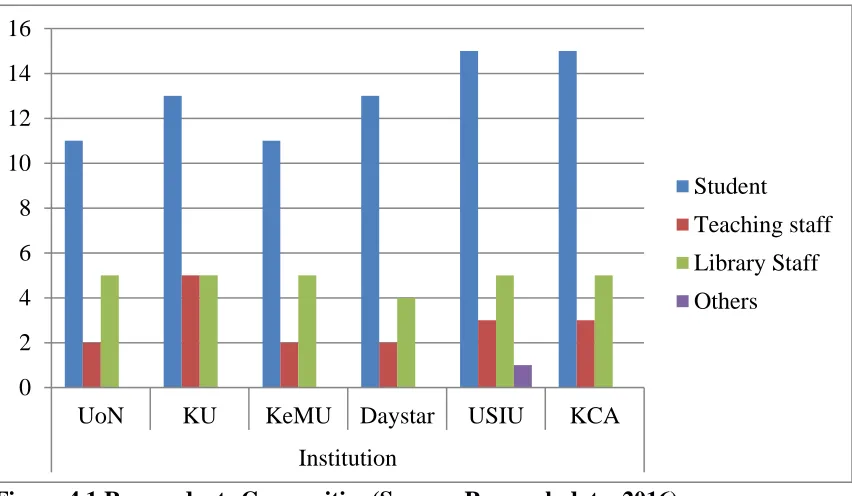
The study focused on two broad categories of respondents. The first group included library users and library staff members formed the second group of the respondents as shown in Table 4.1.
Student Teaching
staff
Library Staff
Total
Institution
UoN 11 2 5 18
KU 13 5 5 23
KeMU 11 2 5 18
Daystar 13 2 4 19
USIU 15 4 5 24
KCA 15 3 5 23
Total 78 18 29 125
Table 4.1: Respondents Composition (Source: Research data, 2016)
39
Table 3.1. Graphical presentation of the respondents’ composition is presented in Figure 4.1
below.
Figure 4.1 Respondents Composition(Source: Research data, 2016)
From the Figure 4.1 above, student users of university libraries were the majority of the research respondents. Response from members of library staff was also impressive compared to the teaching staffs’ response rate.
4.2.2 Library Staff Respondents by Specialization
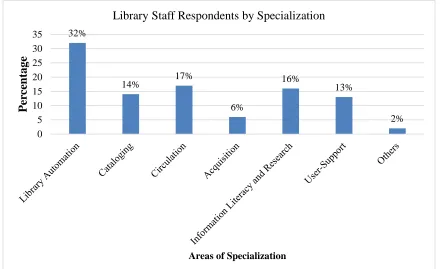
Most of library staff respondents were specialists in library automation by 32% followed circulation (Figure 4.2, below). 17% of the members of the library staff interviewed indicated circulation as their area of specialization. A number of library staff members have specialized in Information Literacy Training and Research, Cataloging, and User-Support services of the library. According to Samuels and Griffy (2012), the fact that majority of these respondents had
0 2 4 6 8 10 12 14 16
UoN KU KeMU Daystar USIU KCA Institution
40
knowledge in library automation indicates that they had adequate information and expert view of the software that were in use in their respective.
Figure 4.2: Library Staff Respondents by Specialization (Source: Research data, 2016) It is also important to note that the other areas of specialization such as cataloging, circulation, acquisition, information literacy and research, and user support also offered the respondents opportunity to interact with their respective library systems (Macharia, 1994). Generally, library staff respondents were adequately informed to give credible information on the contribution of open source software in the performance of their university libraries.
4.2.3 Open Source Software Usage
As reported by Makori and Mauti (2016), many information management institutions (including university libraries across the globe) have adopted open source source systems such as koha and
32%
14% 17%
6%
16%
13%
2%
0 5 10 15 20 25 30 35
P
er
ce
n
tage
Areas of Specialization
41
Dspace as strategic knowledge management assets. For instance, koha and Dspace have gained popularity worldwide as premium library automation and tools for integrating information management services. Additional free and open source products such as Evergreen, Openbiblio, and Emilda are being used to automate and integrate information management by various Kenyan University libraries. Whereas Dspace is being used in all for the sampled university libraries, only three of the libraries (Kenyatta University, KCA, and KeMU libraries) are currently using koha. University of Nairobi and USIU libraries are using V-Smart and SirsiDynix systems respectively for the integration of the Information Management practices (Makori and Mauti, 2016).
Figure 4.3: OSS Usage (Source: Research data, 2016)
An average of 17% of respondents from each of the sampled universities acknowledged that their libraries use open source software. Daystar university library stands out to have minimal usage
0 2 4 6 8 10 12 14 16 18 20
42
of open source software. In fact, about 3% of the respondents from the institution pointed out that they do not use any open source software while about 10% of the respondents acknowledged usage of OSS within the university’s library. Over 95% of all respondents acknowledged the use
of OSS within their university libraries.
4.2.4 Period of Open Source Software Usage
Figure 4.4 Period of Library services usage (Source: Research data, 2016)
Majority of the respondents had used different library services for a period of between 1 year and 5 years as shown in Figure 4.4 above.
4.2.5 Major Library Services Frequently Used by Library Users
Three out the several libraries services supported by different open source softwares, only are significantly used by patrons in Kenyan university libraries as shown in Figure 4.5 below. In the order of their major use, these services include Open Public Access Catalog (OPAC),
17% 32% 32% 14% 5% 0 5 10 15 20 25 30 35
Less than 1 year
Less than 2 years
Less than 5 years
Less than 10 years
More than 10 years Period Of Library Usage
P
er
ce
n
43
Institutional Repositories (IR), and Electronic Resources (E-resources). OPAC is used by about 27% of the respondents, while IR and E-resources are used by 13% and 23% of the patrons respectively.
Figure 4.5: Major Library Services frequented by library users (Source: Research data, 2016)
The above findings are in agreement with Ndakalu's observation on the relative popularity of OPAC, Electronic resources, and institutional repositories among users of Kenyan University libraries (Ndakalu, 2014). It is worth noting that Institutional repository is sometimes referred to as digital libraries in some of the sampled university libraries such as in the University of Nairobi library.
4.3 Descriptive Findings
4.3.1 Types of Open Source Software Currently Being Used in Kenya University Libraries
According to Figure 4.6 below, only three kinds of Open Source Software are currently being used in the management and deliver major library services.The three include DSpace, Koha, and
26% 7% 13% 21% 22% 11% 0 5 10 15 20 25 30
Yes No Yes No Yes No
OPAC IR Eresources
44
Evergreen, in the order of their use. 18.62% of the respondents acknowledged that their university libraries use DSpace to manage contents of their digital libraries while 14.48% and 1.38% acknowledged that their libraries use Koha and Evergreen respectively.
Figure 4.6: OSS Usage in Kenyan University Libraries (Source: Research data, 2016)
These findings are consistent with high popularity of Koha and DSpace over other open source software products in Kenyan university libraries (Amollo, 2013). However, it is worth noting that other open source software such as Ubuntu Linux operating system and Servers are being used to host these major Library Management Systems. For instance, an interview with System Librarians from University of Nairobi, Kenyatta University and USIU revealed that Linux Operating Systems and Servers are being to host their digital libraries or institutional repositories.
4.3.2 Cost-effectiveness of Open Source Software
The cost effect of Open Source Software in the university libraries was entirely investigated through face-to-face interviews with system librarians from the sampled university libraries.
14.48
5.52 18.62
1.38 1.38
18.62
0.00 20.00
0.00 20.00
0.00 5.00 10.00 15.00 20.00 25.00
Yes No Yes No Yes No Yes No Yes No
Koha DSpace Evergreen OPALS Openbiblio
45
System librarians in University of Nairobi, USIU, and Daystar reported that their libraries use a mixture of commercial and open source systems in the management of their mainstream library functions and digital libraries. Whereas all the three aforementioned university libraries reported substantial annual subscription costs of their main library management systems, the other three university libraries (Kenyatta University, KeMU, and KCA) reported a near-zero financial spending in the installation and maintenance of their library management systems. Kenyatta University, KeMU, and KCA libraries all use Open Source Software (Koha) to manage their mainstream functions such as Cataloging, circulation, acquisition and management of print resources.
According to system librarians interviewed, there is no other form of costs associated with Open Source Software besides occasional but minimal costs incurred during in-house training sessions conducted for the library staff and users. This view is line with Randhawa’s observation that open source software products have negligible cost issues since no initial costs are involved in their acquisition (Randhawa, 2008). It is important to note that all the six university libraries use DSpace (an Open Source Software) in the management of their digital libraries.
4.3.3 Usability of Open Source Software
46
university libraries use open source software (DSpace) to facilitate their digital libraries. Additionally, half of the libraries use Koha to facilitate their OPAC with an exception of UoN, USIU, and Daystar university libraries that use proprietary software for their OPAC. It is therefore scientifically acceptable to gauge usability of OSS in Kenyan University libraries based on their expressed ease of access and retrieval of information materials from these libraries. Figure 4.7 shows that 56% of the respondents acknowledged that OSSs in their respective libraries are easier to use.
Figure 4.7: OSS is Easy to Use (Source: Research data, 2016)
From Figure 4.8, USIU library had the highest number of users who could use their library system with ease at 18% while only 6% of users at Daystar university library found their library system easy to use. It is important to note that number of users who expressed difficulty in the use of Daystar university library system were higher than those who could easily use the system. Majority of users from the other five university libraries could easily their library system. Users’
56% 44%
47
confessed ease with major library open source systems confirms the usability of open source software as reported in Giri (2012).
Figure 4.8: Ease of Using Library Systems (Source: Research data, 2016)
In terms of user-friendliness of the library systems currently used in the sampled university libraries, about 36% of the respondents described their library systems as very user-friendly while 45% of the respondents rated the same as averagely user-friendly. None of the respondents found their library system unfriendly. See Figures 4.12 and 4.13 below.
8% 10% 8% 6% 18% 10% 4% 8% 5% 7% 14% 10% 0 2 4 6 8 10 12 14 16 18 20
UoN KU KeMU Daystar USIU KCA
Q2_UserInstitution
Yes
48
Figure 4.9: User-friendliness of the current library systems(Source: Research data, 2016)
4.3.4 Reliability of Open Source Software
Reliability of OSS was measured on the basis of the perceived prompt resolution of library systems breakdown. 69% of the library staff questioned acknowledged that breakdowns of their library systems were resolved promptly while 31% of the users indicated slackness in the resolution of their library systems’ breakdown.
7%
36%
45%
10%
1% 0%
0 5 10 15 20 25 30 35 40 45 50
P
er
ce
nta
g
49
Figure 4.10: Reliability of current library management systems (Source: Research data, 2016)
Figure 4.11: Reliability of current library management systems (Source: Research data, 2016)
31% 69% No Yes 20% 0% 60% 0% 20% 20% 80% 100% 40% 100% 80% 80% 0 20 40 60 80 100 120