© 2015, IJCSMC All Rights Reserved 345 Available Online atwww.ijcsmc.com
International Journal of Computer Science and Mobile Computing
A Monthly Journal of Computer Science and Information Technology
ISSN 2320–088X
IJCSMC, Vol. 4, Issue. 9, September 2015, pg.345 – 349
REVIEW ARTICLE
Review: Moving Object Detection Techniques
Amandeep
1, Er. Monica Goyal
2¹Computer Science and Engineering, Guru Kashi University, India ²Computer Science and Engineering, Guru Kashi University, India
1
[email protected]; 2 [email protected]
Abstract— Now a day, Moving Object detection is becoming very popular, yet challenging vision task. It is a critical part in many applications such as image search, image auto-annotation and scene understanding. . The vision systems that include image processing methods are widely implemented in many areas as traffic control, video surveillance of unattended outdoor environments, video surveillance of objects, etc. Background subtraction techniques are very useful, simple and efficient techniques. This paper includes the various techniques existing for Moving Object detection and their comparison.
Keywords - Background subtraction, Frame differencing, Mixture of Gaussian, Moving object detection.
I. INTRODUCTION
The detection of an object in a video camera scene is a relatively new research area in computer science and, because of its broad applicability in real life this has been growing more and more. The CCTV is one of the main reasons for the growing interest and use of video in security systems. Moving object detection in a video stream is an essential step in video surveillance applications. In some algorithms, the moving objects may become part of the scene when they come to a stop. Also the scene maybe affected by changes in the light, leaves swaying, cameras shaking, etc. Many algorithms for moving object detection have been proposed in recent years. These involve background subtraction, optical flow, temporal difference and many other algorithms for detecting moving objects. From these, the most widely used algorithm is background subtraction which has many algorithms such as frame difference, approximate median, Gaussian mixture.
II. MOVING OBJECT DETECTION TECHNIQUE
© 2015, IJCSMC All Rights Reserved 346 Different Moving object detection methods are described as follows:
A. Temporal Differencing
This method uses the two adjacent frames based on time series image to subtract and gets difference images, its working is very similar to background subtraction method [6]. After the subtraction of image it gives moving target information through the threshold value. This method is simple and easy to implement. This is very adaptive to dynamic scene changes, however, it generally fails in detecting whole relevant pixels of some types of moving objects. Additional methods need to be adopted in order to detect stopped objects for success of higher levels are computationally complex and cannot be used real-time without specialized hardware.
B. Background subtraction method
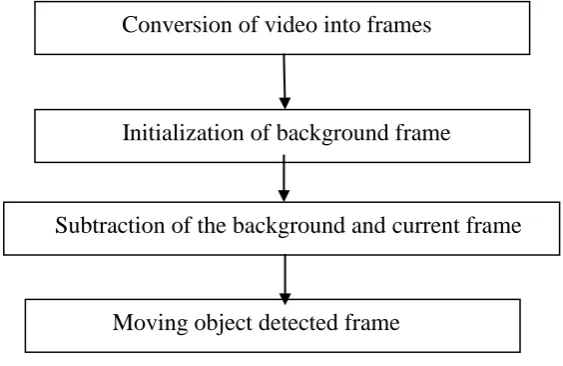
It is particularly a commonly used technique for object detection in static images [6][7][8]. It will detect moving regions by subtracting the current image pixel-by-pixel from a reference background image that is created by averaging images over time in an initialization period. The basic idea of background subtraction method is to initialize a background firstly, then by subtracting current frame in which the moving object present that current frame is subtracted with background frame to detect moving object. This method is simple and easy to realize, and accurately extracts the characteristics of target data, but it is sensitive to the change of external environment, so it is applicable to the condition that the background is known.
C. Optical flow
The optical flow method uses the motion target of the vector characteristics which changed with time to detect moving area in video [6]. It gives better performance under moving camera, but this algorithm is very complex and complicated computation and also it needs special hardware support, so it is difficult to meet the requirements of real-time video processing.
III.BACKGROUNDSUBTRACTIONMETHOD
Moving Object detection and extraction from the fixed background in the analysed scene is mostly done by simple subtracting the current image and background image. This method is known as Background Subtraction method. The applied subtracting operation finds an absolute difference for each pixel, thus detecting objects (that have brighter or darker gray value), which usually differ from the background. If the difference is below a certain threshold, there is no change in the scene and the observed pixel is regarded as if it belongs to the background. Otherwise, there has been a change and the pixel belongs to the object.
© 2015, IJCSMC All Rights Reserved 347 Figure 1: Brief of Background Subtraction Method
A. Frame Difference Method
The frame difference method is the simplest form of background subtraction [7][8]. In this method, the current frame is simply subtracted from the background frame. If the difference in pixel values for every pixel is greater than the threshold, then the pixel is considered part of the foreground otherwise it is consider as background. The Frame Difference method for background subtraction used for static camera.
B. Approximate Median Method
In this method, the median filtering buffers the previous N frames of the video [7]. Then, the background frame is calculated from the median of the buffered frame and the background is subtracted from the current frame to give the foreground pixel. The Approximate Median method checks whether the pixel in the current frame has a value that is larger than the corresponding background pixel. If that is the case, the background pixel is incremented by one. However, if the pixel in the current frame has a value that is smaller than the corresponding background pixel, the background pixel is decremented by one.
C. Mixture of Gaussian
This method uses a Gaussian probability density function to evaluate the pixel intensity value [8]. It finds the difference of the current pixel’s intensity value and cumulative average of the previous values. So it keeps a cumulative average (μt) of the recent pixel values. If the difference of the current image’s pixel value and the cumulative pixel value is greater than the product of a constant value and standard deviation then it is classified as foreground |I -μ | > k holds; otherwise, it can be considered as background, where k is a constant and is standard deviation.
IV.COMPARISONO FE X I S T I N G MOVINGOBJECTDETECTIONTECHNIQUE
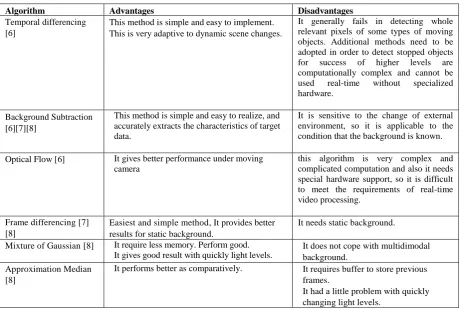
Below table show the comparative study of different Moving Object Detection Methods. Difference made on bass of techniques that are used in respective algorithms, advantages and disadvantages.
Conversion of video into frames
Initialization of background frame
Subtraction of the background and current frame
© 2015, IJCSMC All Rights Reserved 348
TABLE 1: COMPARISONS OF DIFFERENT MOVING OBJECT ALGORITHMS
Algorithm Advantages Disadvantages
Temporal differencing [6]
This method is simple and easy to implement. This is very adaptive to dynamic scene changes.
It generally fails in detecting whole relevant pixels of some types of moving objects. Additional methods need to be adopted in order to detect stopped objects
for success of higher levels are
computationally complex and cannot be
used real-time without specialized
hardware.
Background Subtraction [6][7][8]
This method is simple and easy to realize, and accurately extracts the characteristics of target data.
It is sensitive to the change of external environment, so it is applicable to the condition that the background is known.
Optical Flow [6] It gives better performance under moving
camera
this algorithm is very complex and complicated computation and also it needs special hardware support, so it is difficult to meet the requirements of real-time video processing.
Frame differencing [7] [8]
Easiest and simple method, It provides better results for static background.
It needs static background.
Mixture of Gaussian [8] It require less memory. Perform good.
It gives good result with quickly light levels.
It does not cope with multidimodal background.
Approximation Median [8]
It performs better as comparatively. It requires buffer to store previous
frames.
It had a little problem with quickly changing light levels.
V. CONCLUSIONANDFUTUREWORK
Moving object detection has widely been adopted by the industry or organization because of its broad applicability in real life this has been growing more and more. There are many existing methods like temporal differencing, background subtraction, optical flow etc. All having some merits and demerits. Central to these algorithms is the background subtraction method (including frame differencing, mixture of Gaussian and approximation median) is simple, easy and used in real-time applications and no need of using special hardware. But it is required to give better results to achieve a high accuracy.
In this paper, numerous proposed moving object detection algorithms have been compared on the basis of their advantages. But still some work need to be done to improve accuracy. In the next phase of our work, we will try to develop an algorithm which gives better results for moving object detection and we will compare their results with the existing algorithms.
REFERENCES
[1] Vinay D R, N Lohitesh Kumar, “ Object Tracking Using Background Subtraction Algorithm” in International Journal of Engineering Research and General Science Volume 3, Issue 1, January-February, 2015.
[2] Rohan K. Naik, “ A Robust Background Subtraction Technique for Object Detection” in the International Journal of Advanced Research in Computer Engineering & Technology (IJARCET) Volume 4 Issue 2, February 2015.
[3] Niranjil Kumar A and Suresh kumar, “Background Subtraction in Dynamic Environment based on Modified Adaptive GMM with TTD for Moving Object Detection” in the J Electr Eng Technol.2015;10(1): 372-378
http://dx.doi.org/10.5370/JEET.2015.
© 2015, IJCSMC All Rights Reserved 349
[5] Rohan K. Naik, “ A Robust Background Subtraction Technique for Object Detection” in the International Journal of Advanced Research in Computer Engineering & Technology (IJARCET) Volume 4 Issue 2, February 2015.
[6] Mahamuni P.D, R.P Patil and H.S.Thakar, “Moving Object Detection Using Background Subtraction Algorithm using simulink” in IJERT Volume 3, Issue 6, in june 2014.
[7] Asim R. Aldhheri and Eran A. Edirisinghe, “Detection and classisification of a moving object in a video stream” in ACIT 2014.
[8] Mahmoud Abdulwahab Alawi, Othman O. Khalifa, “Performance Comparison of Background Estimation Algorithms for Detecting Moving Vehicle” in the World Applied Sciences Journal 21 (Mathematical Applications in Engineering): 109-114, 2013.
[9] Songlin Wan 1 , Haodong Liang, “Moving Target Detection Algorithm Research Based on Background Subtraction Method” in the School of Optoelectronic Information, University of Electronic Science and Technology of China, Chengdu Sichuan 610054, China-2013.
[10] Dr. Dheeraj Agrawal, Nitin Meena, “Performance Comparison of Moving Object Detection Techniques in Video Surveillance System” in the The International Journal of Engineering And Science (IJES), 2013.
[11] Vrunda A. Mahamuni, Madhuri Khambete, “Background Subtraction Techniques for Moving Object Detection in Video Frames” in the International Journal of Engineering and Advanced Technology (IJEAT), Volume-3, Issue-1, October 2013. [12] M.Sankari and C. Meena, “ Estimation of Dynamic Background and Object Detection in Noisy Visual Surveillance” in the International Journal of Advanced Computer Science and Applications, Vol. 2, No. 6, 2011.
[13] S.L. Toral and Federico Barrero, “An Enhanced Background Estimation Algorithm for Vehicle Detection in UrbanTraffic Scenes” in the IEEE TRANSACTIONS ON VEHICULAR TECHNOLOGY, VOL. 59, NO. 8, OCTOBER 2010.
[14] Saeed Vahabi Mashak, Behnam Hosseini, “Background Subtraction for Object Detection Under Varying Environments” in the proc of IEEE, 2010.
[15] Rita Cucchiara, Costantino Grana, “Detecting Moving Objects, Ghosts and Shadows in Video Streams” in the proc of IEEE2007.
[16] GL Foresti and S Gentili, “A vision based system for object detection in underwater images,” International Journal of Pattern Recognition and Artificial Intelligence (IJPRAI), 2010.
[17] B. Armstrong and S. PuthanVeettil, “Soft synchronization: Synchronization for network-connected machine vision systems,” IEEE Trans. Ind. Informat., vol. 3, no. 4, pp. 263–274, Nov. 2007.
[18] Sunil K. Sinha and Paul W. Fieguth, “Automated detection of cracks in buried concrete pipe images” Elsevier B.V, 2005. [19] S. S. Huang, L. C. Fu, and P. Y. Hsiao, “A region level motion-based background modeling and subtraction using MRFs,” IEEE Int. Conf. Robotics and Automation, 2005.
[20] A. Mittal and N. Paragios, “Motion-based background subtraction using adaptive kernel density estimation,” in Proc. IEEE Conf. Comput. Vis. Pattern Recognit., 2004, pp. 302–309.
[21] M. Seki, T. Wada, H. Fujiwara, and K. Sumi, “Background subtraction based on cooccurrence of image variations,” in Proc. IEEE Conf. Comput. Vis. Pattern Recognit., 2003, vol. 2, pp. 65–72.
[22] S. S. Huang, L. C. Fu, and P. Y. Hsiao, “A regionbased background modeling and subtraction using partial directed Hausdorff distance,” IEEE Int. Conf. Robotics and Automation, 2004.
[23] Makito Seki, Toshikazu Wada, Hideto Fujiwara, Kazuhiko Sumi, “Background Subtraction based on Cooccurrence of Image Variations” Computer Society Conference on Computer Vision and Pattern Recognition (CVPR’03) , IEEE, 2003. [24] S. Gupte, O. Masoud, R. F. K. Martin, and N. P. Papanikolopoulos, “Detection and classification of vehicles,” IEEE Transactions on Intelligent Transportation Systems, vol. 3, no. 1, pp. 37-47, Mar. 2002.
[25] L. Bruzzone and D. F. Prieto, “An adaptive semiparametric and context-based approach to unsupervised change detection in multitemporal remote-sensing images,” IEEE Trans. Image Processing, Apr. 2002, vol. 11, no. 4, pp. 452–466.
[26] S.Y. Chien, S.Y. Ma, and L.G. Chen, “Efficient moving object segmentation algorithm using background registration technique,” IEEE Transactions on Cir-cuits and Systems for Video Technology, vol. 12, no. 7, pp. 577-586, Jul.2002.
[27] I. Haritaoglu, D. Harwood, L. S. Davis, “A Fast Background Scene Modeling and Maintenance for Outdoor Surveillance,” Proc. of ICPR, 2000, Vol.4, pp.179-183.
[28] M. Seki, H. Fujiwara, K. Sumi, “A Robust Background Subtraction Method for Changing Background,” Proc. of IEEE Workshop on Applications of Computer Vision, 2000, pp.207-213.
[29] I. Haritaoglu, D. Harwood, and L. S. Davis, “W4: Real-time surveillance of people and their activities,” IEEE Transactions on Pattern Analysis and Machine Intelligence, vol. 22, no. 8, pp. 809-830, August 2000.