Available Online at www.ijcsmc.com
International Journal of Computer Science and Mobile Computing
A Monthly Journal of Computer Science and Information Technology
ISSN 2320–088X
IJCSMC, Vol. 4, Issue. 11, November 2015, pg.40 – 47
RESEARCH ARTICLE
FAST AND SECURE TRANSMISSION OF
INFORMATION AMONG GROUPS USING
A KEY MANAGEMENT SCHEME
R.Kumar, S.Lokesh
Abstract: Fast and Secure Transmission of Information among Groups Using a Key Management Scheme (FSTIG) is a technology which allows the information to be transmitted securely and also efficiently among groups by managing the keys used for encryption and decryption. This scheme efficiently overcomes the limitations like limited communication from the group and sender, the unavailability of a fully trusted key generation center, and dynamics of the sender. Also this scheme facilitates the addition and deletion of members from a particular group and accordingly the key will be recalculated. It is the key management scheme in which every user is provided with a public/secret key pair. Whenever a group or cluster is formed, secret key and the public key will be generated for all members of that group. Public keys of all groups will be stored in the certification authority to which every group will have a local connection.
Whenever a sender of a particular group wants to communicate with other group, the sender will request the public key of the destination group from the certification authority. Then the data to be transmitted will be encrypted with public key of the source group and the encrypted data will be sent along with the public key of the destination group. If a new member joins a group or if a member leaves a group, public keys and secret keys of those particular groups will be recalculated. The proposed method is algorithmically simple but more secure and applicable for real time implementation and application.
1. Introduction
In many newly emerging networks, there is a need to broadcast to remote cooperative groups using encrypted transmission. This Group communication is used in networks like wireless mesh networks (WMNs), mobile ad hoc networks (MANETs), and vehicular ad hoc networks (VANETs). Various data such as military data and commercial information are transmitted among groups. Though it provides ease for transmission of data among groups, it brings some problems that we could not be sure that the information we get from senders are trustable or not. The data may be illegally accessed and tampered by unknown users. Therefore, information security has become an important issue in recent years. The keys used for encrypting the contents have to be securely transferred to the receiver. The number of keys increases as the number of users is increased and the key has to be calculated again when the users of group changes in order to ensure security which makes the key management difficult. To deal with the security of the data transmitted, various schemes have been developed. Fast and secure transmission of information among groups using a key management scheme (FSTIG) has been proposed to provide an efficient and secure data transmission among groups by providing a key management which ensures security against collusion and various hacking techniques.
2. Related work
Basic Group key management system is a cryptosystem is based on the management of group keys. In this approach group keys are generated immediately after the clustering of members into groups. These group public keys which are created will be stored in the certification authority and given to the sender of a particular group based on request.
3. Proposed system
Figure.1 represents the system model functioning of the proposed system and the proposed system is mainly organized into 3major modules. In First module, the nodes are created and organized into clusters. In the second module, the keys are generated for the members of each cluster and the file that is to be transferred is encrypted using the key got from the certification authority and it is broadcasted to the destination. The third module consists of decryption and rekeying. Decryption involves decrypting the encrypted data in the destination using the secret key of the concerned group. Rekeying refers to the change of members. If a new member is added to or deleted from a particular group, the keys will be recalculated accordingly to that group.
Figure 1: System model functioning
4. Implementation Details
The implementation methodology of Fast and Secure Transmission Of information Among Groups using a key management scheme is done using java, Net beans IDE and MySQL to store its database. Initially nodes are generated and clustered according to the region where they are located. Figure 2 shows the clustering of the members in
Sender of the source group
Destination group Certification Authority
(Storage of group public keys) 2.public key of
destination group Encrypted data Encryption Using source publickey Original data decryption
2.public key of destination group
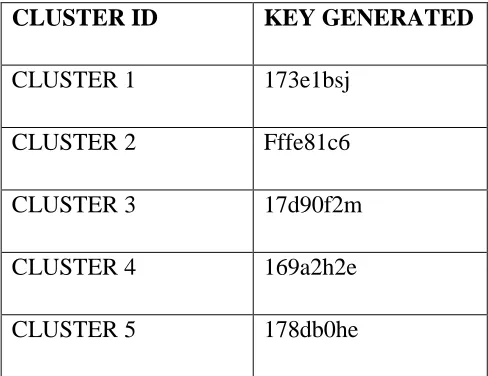
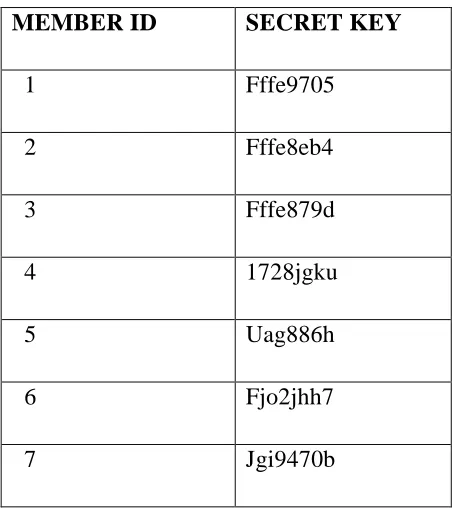
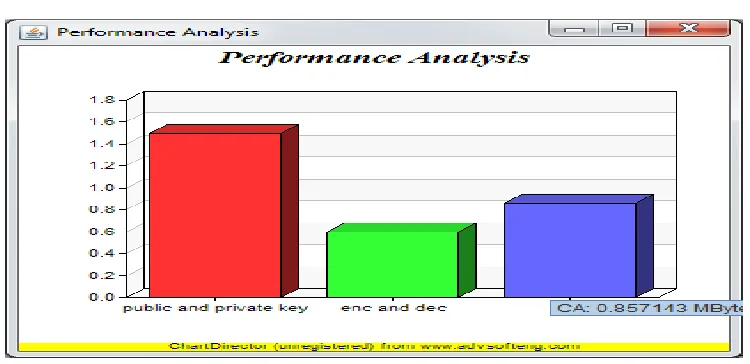
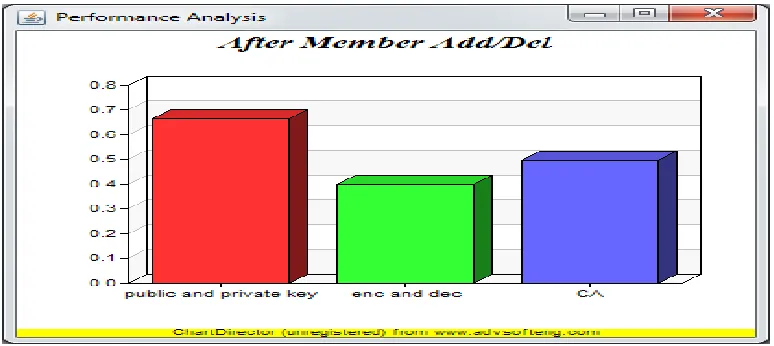
certification authority and given to the members to the members on request. Table 1 shows the public keys generated for the clusters and Table 2 shows the secret keys generated for all group members. Keys for group are generated using DIFFIE– HELLMAN ALGORITHM. Then the sender will request the public key of the destination to the certification authority and then encrypts the file to be transferred using the public key of the source group. Encryption and decryption is done using RSA ALGORITHM. Table 3 shows the key got from certification authority. File transmitted from the source is broadcasted to the destination along with its destination public key. Figure 3 shows the encryption of the file to be transmitted. Figure 4 shows the decrypted content of the file encrypted. The file after received by the cluster head is then distributed to the members of the group and which in turn decrypted by them using their secret keys. If a new member is added to a cluster or removed from a cluster, the keys are recalculated again. Table 4 represents comparison of tree based and chain based scheme.
Figure 2.Creation and clustering of nodes in a network
CLUSTER ID KEY GENERATED
CLUSTER 1 173e1bsj
CLUSTER 2 Fffe81c6
CLUSTER 3 17d90f2m
CLUSTER 4 169a2h2e
CLUSTER 6 17346jsr
CLUSTER 7 Fffe838e
CLUSTER 8 17fa63gs
Table 1. Public keys generated and stored in CA
MEMBER ID SECRET KEY
1 Fffe9705
2 Fffe8eb4
3 Fffe879d
4 1728jgku
5 Uag886h
6 Fjo2jhh7
7 Jgi9470b
Table 2. Secret keys generated for cluster3
DESTINATION
CLUSTER
KEY FROM CA
CLUSTER 6 8sj2mb8u
Figure 3. The encrypted file jsr.txt
Figure 4. Decrypted content of the file.
Figure 6. Performance analysis for the overall processes after rekeying
Method used
Time taken for
generation of public
and private
keys(ms)
Time taken for
encryption and
decryption(ms)
Time taken to get
the key from
CA(ms)
Tree based scheme 1.5 0.5 0.9
Chain base scheme 0.8 0.4 0.5
Table 4. Comparison of tree based and chain based scheme
5. CONCLUSION
References
1. Qianhong Wu, Member, IEEE, Bo Qin, Lei Zhang, Josep Domingo-Ferrer, Fellow, IEEE, and Jesús A. Manjón, ” Fast Transmission to Remote Cooperative Groups:A New Key Management Paradigm,” IEEE/ACM TRANSACTIONS ON NETWORKING, VOL. 21, NO. 2, APRIL 2013.
2. L. Zhang, Q. Wu, A. Solanas, and J. Domingo-Ferrer,“A scalable robust
authentication protocol for secure vehicular communications,”IEEE Trans. Veh. Technol., vol. 59, no. 4, pp. 1606–1617, May 2010.
3. Y. Kim, A. Perrig, and G. Tsudik, “Tree-based group key agreement,”Trans. Inf.
Syst. Security, vol. 7, no. 1, pp. 60–96, Feb. 2004.
4. C. K. Wong, M. Gouda, and S. Lam, “Secure group communications using key
graphs,” IEEE/ACM Trans. Netw., vol. 8, no. 1, pp. 16–30,Feb. 2000.
5. Y.Piao,et al.,” Polynomial-base key management for secure intra-group and inter-group communication” ,Computers and Mathematics with application(2012).
6. M. Burmester and Y. Desmedt, “A secure and efficient conference key
distribution system,” Adv. Cryptol., vol. 950, EUROCRYPT’94,LNCS, pp. 275– 286, 1995.
7. M. Steiner, G. Tsudik, and M. Waidner, “Key agreement in dynamic peer
groups,” IEEE Trans. Parallel Distrib. Syst., vol. 11, no. 8, pp.769–780,
Aug. 2000.
8. A. Sherman and D. McGrew, “Key establishment in large dynamic groups
using one-way function trees,” IEEE Trans. Softw. Eng., vol.29, no. 5, pp. 444– 458, May 2003.