Traitor-Tracing on Binary Strings
Michael J. Collins Sandia National Laboratories⋆
Albuquerque, NM USA 87185 [email protected]
Abstract. Codes with theIdentifiable Parent Property(IPP) have been studied in the context of traitor tracing; such codes can be used to enable a data supplier to determine the origin of pirated data. We consider an analogous property for a set of binary strings S: if a new string τ is formed by concatenating substrings of members ofS, we should be able to identify at least one original string which must have been used to generateτ. We prove upper and lower bounds for the size of sets which satisfy this property.
Keywords: Traitor Tracing, Identifiable Parent Property, Strings, Water-marking
1
Introduction
Codes with the Identifiable Parent Property (IPP) were introduced in [3] (and generalized in [4]) with the motivation of detecting piracy when users combine several watermarked versions of a single document to produce a pirated version of the same document. We consider a related problem in which users generate new derivative documents by cutting and pasting from multiple watermarked documents. First we recall the definition of IPP codes:
Definition 1. LetC be a code of lengthnover alphabet Σ, and letT ⊂ C. Then
d= (d1, d2· · ·dn)∈Σn is a descendantof T and T is a parent setof dif, for
each 1≤i≤n, there exists(t1, t2· · ·tn)∈T with di =ti.
Ifd∈Σn has a parent set of size≤c, thendis ac-descendant ofC; a parent
set of size ≤c is ac-parent set.
Definition 2. Let C be a code of lengthnover alphabet Σ. ThenC isc-IPP if, for any dwhich is ac-descendant of C, the intersection of all c-parent sets ofd
is nonempty.
The idea is that the documentD to be protected is divided intonsegments, where each segment can be watermarked by embedding an element of Σ, and each legitimate document owner has a copy watermarked by a different code-word. Thenc or fewer owners may collude to produce an unauthorized copyD′
ofDby combining portions of their copies. It is possible to identify at least one individual who must have contributed toD′ by finding a parent of the vector of
watermarks inD′ [2]. This is a special case of the more general notion oftraitor
tracing [1].
1.1 c-IPP Sets of Strings
Denote concatenation of stringsσandτbyστ. The length of a stringσis denoted by |σ|. Let σj denote thejth bit of σ, and define σ[s: t] = σsσs+1· · ·σt. If s andt are not integers, thenσ[s:t] =σ[⌈s⌉:⌊t⌋].
A (sub)string of lengthk will be called a k-(sub)string. We write σ≺τ to denote σis a substring ofτ. Ifσis a substring of some member of a set T, we writes≺T.
We have a setU of “users”, with each user having a local copy of a collection of documents (i.e. binary strings)D. Associated to each user i ∈ U there is a distinct string σi of lengthn. For each original document d ∈D, user i has a watermarked version di of lengthm. The watermark string σi is embedded in
di in such a way that, given a substring ofdi, we can extract the corresponding substring ofσi; i.e. there is an extraction functionE such that
E(di[j:k]) =σi
h
jn m :k
n m
i
.
Without loss of generality we can assume that all watermarked documents inD
are of the same lengthm.
Now suppose one or more users create a new c-derivative document d′ of
length at least m by “cutting and pasting”, i.e. by concatenating at most c
substrings of their various watermarked documents; we have
d′=dt1
i1[j1:k1]· · ·d tc
ic[jc :kc]
where eachdt
i is a copy of document dt watermarked with σi. From d′ we can then extract a string τ of length at least n which is the concatenation of the corresponding substrings of theσi, i.e.
E(d′) =σii
h
j1
n m :k1
n m
i
· · ·σic
h
jc
n m :kc
n m
i
.
Note that the extraction function E must be able to extract this derivative watermark even though is is only givend′, without any indication of where the
boundaries between its constituent substrings are.
Given a bound onc, we would like to use the extracted derivative watermark
τ to identify (i.e. “trace”) at least one user who must have contributed to d′.
Definition 3. Let S be a set of binary strings of length n (i.e. S ⊂ {0,1}n),
and let τ be a string of length n. Then C ⊂S is a c-parent set of τ if we can writeτ =τ1τ2· · ·τc where each τi ≺C. We say that τ is ac-descendantofC. Note that we allow use of repeated and overlapping substrings.
Definition 4. The set S ⊂ {0,1}n has the c-Identifiable Parent Property (c
-IPP) if, for every c-descendant τ of S, the intersection of all c-parent sets of τ
is nonempty.
Thus any member of this intersection can be identified as a parent ofτ. The following definition is useful:
Definition 5. If σ ∈S and τ ≺σ, then τ is unique with respect to Sif it is not a substring of any other member ofS. WhenS is clear from context, we just say that τ is unique.
2
Bounds for
c
-IPP Sets
2.1 Necessary Conditions
In order forSto bec-IPP, members ofS must be sufficiently different from one another, which means that members ofSmust contain sufficiently short unique substrings. We have the following
Lemma 1. If S is c-IPP then there exists σ ∈ S such that no ⌈1+⌊nc/2⌋⌉ -substring ofσ is a⌈c/2⌉-descendant ofS\{σ}.
Proof. Suppose on the contrary that every σ ∈ S has a substring of length
⌈ n
1+⌊c/2⌋⌉which is a⌈c/2⌉-descendant ofS\{σ}. Then take 1 +⌊c/2⌋such
sub-strings from 1 +⌊c/2⌋users and concatenate them to produceτ. None of these users can be identified as a parent of τ, since each one can be removed and replaced by the ⌈c/2⌉other users who cover its contribution.
Now supposeσis the string whose existence is guaranteed by lemma 1. Then it follows immediately that σmust have a unique substring of length
&
⌈ n
1+⌊c/2⌋⌉
⌊c/2⌋
'
=
n
⌊c2/4⌋+⌈c/2⌉
which gives
Theorem 1. If S⊂ {0,1}n isc-IPP then|S| ≤2⌈n/(⌊c2/4⌋+⌈c/2⌉)⌉ .
Proof. If we removeσ from S, the remaining set is still c-IPP, so by lemma 1 this smaller set also contains a unique substring of length l⌊c2/4⌋n+⌈c/2⌉
m
For small values ofcwe can obtain better results than theorem 1:
Theorem 2. If there are no unique⌈n/3⌉-substrings inS, thenSis not 2-IPP; therefore ifS is 2-IPP, |S| ≤2n/3.
If there are no unique ⌈n/5⌉-substrings in S then S is not 3-IPP; therefore if S is 3-IPP, |S| ≤2n/5.
Proof. Suppose there are no unique⌈n/3⌉-substrings in S. TakeX ∈S and let
σbe the middle third ofX. LetY 6=X containσ; without loss of generalityY
containsστY where |τY| ≥n/3 and τY ≺ZY 6=Y (see Fig. 1). LetτX be left third ofX and letτX ≺ZX6=X.
Now τXστY is a descendant of both {ZX, Y} and {ZY, X}; it may be the case that ZX =ZY, butτXστY is also a descendant of {X, Y}. ThereforeS is not 2-IPP.
τY
X τX σ
ZX τX
Y σ τY
ZY
Fig. 1.Upper bound for 2-IPP
ρ2
X
Y ρ1
σ λ2
λ1
σ X1 λ1
Y2
λ2
X2
ρ2
Y1 ρ1
Fig. 2.Upper bound for 3-IPP
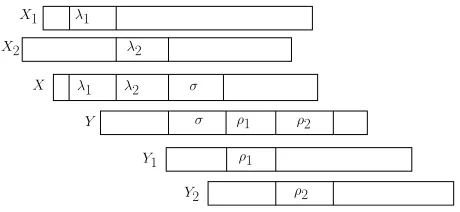
Similarly, suppose there are no unique⌈n/5⌉-substrings inS. GivenX ∈Slet
There also exist X1, X2 6= X such that λi ≺Xi and Y1, Y2 6=Y such that
ρi≺Yi. Thusλ1λ2σρ1ρ2 is a descendant of{X, Y}and of{X1, X2, , Y} and of
{X, Y1, Y2}. ThusS is not 3-IPP (see Fig. 2).
2.2 Sufficient Conditions
Theorem 3. If every ⌈n/3⌉-substring of every member ofS is unique, then S
is 2-IPP. If every ⌈n/5⌉-substring of every member of S is unique, then S is 3-IPP.
Proof. SupposeSis not 2-IPP; we show that there must be a non-unique⌈n/3⌉ -substring. Letsbe a string which is a 2-descendant ofS, but for which a parent cannot be identified. Then we can write s = ab where a, b are substrings of
A, B∈S. Without loss of generality let|a| ≥n
2. SinceAcannot be identified as a parent, it must be possible to writes=cdwithc≺C=6 A. If|c| ≥ ⌈n/3⌉then
c is a non-unique substring shared by A and C. Otherwise,|d| ≥ ⌈2n/3⌉. Now
d≺D∈S, and (sinceDcannot be identified as a parent), we havecd=ef with
e, f ≺E, F 6=D: then at least one ofE, F has a non-unique ⌈n/3⌉-substring shared withD.
Similarly, supposeS is not 3-IPP; we show that there must be a non-unique ⌈n/5⌉-substring. Let s be a 3-descendant of S for which a parent cannot be identified. As above, let a, b, c, d· · · denote substrings of A, B, C, D· · · ∈ S. If we can writes=abcwith max(|a|,|b|,|c|)≥ ⌈3n/5⌉, then we immediately have a non-unique⌈n/5⌉-substring: alignabcwith a representation ofsthat does not useX, whereX∈ {A, B, C}is the user contributing the longest ofa, b, c. Then
X’s contribution to s is split at no more than two points, yielding (at most) three non-unique substrings one of which must have length at least⌈n/5⌉.
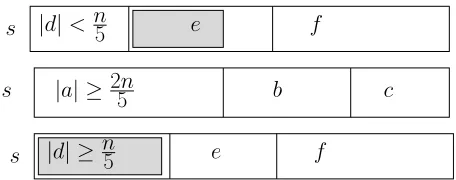
Otherwise let s = abc and (with no loss of generality) let |a| ≥ |c|. Now suppose ⌈2n/5⌉ ≤ |a| < ⌈3n/5⌉, and let abc = def with A 6= D, E, F. If max(|d|,|e|) ≥ ⌈n/5⌉, then either D or E has a non-unique ⌈n/5⌉-substring shared withA(see Fig. 3). Otherwise|f| ≥ ⌈3n/5⌉.
Now suppose⌈n/5⌉ ≤ |a|<⌈2n/5⌉, and letabc=def withA6=D, E, F. If |d| ≥ ⌈n/5⌉thenDhas a non-unique⌈n/5⌉-substring shared withA. Otherwise max(|e|,|f|)≥ ⌈2n/5⌉. If|f| ≥ ⌈2n/5⌉we have essentially the same situation as Fig. 3 (withf in place ofa).
So suppose |e| ≥ ⌈2n/5⌉, f < ⌈2n/5⌉, d < ⌈n/5⌉ and let def = ghi with
E6=G, H, I. If max(|g|,|i|)≥ ⌈2n/5⌉we are again in the same situation as Fig. 3 (with g or iin place of a). Otherwise we have|h| ≥ ⌈n/5⌉. Now this implies thatE must have a non-unique substring; eitherh≺e, or the alignment ofdef
withghisplitseat only one point.
Finally, if|a|<⌈n/5⌉then|b| ≥ ⌈3n/5⌉(since|a| ≥ |c|).
3
c
-Traceability
e
s
|
a
| ≥
2
5
n
b
c
s
|
d
|
< n
5
e
f
s
|
d
| ≥
n
5
f
Fig. 3.Shaded region is non-unique substring of length≥ ⌈n/5⌉
like to have an efficient algorithm for actually identifying at least one of the parents whose existence is guaranteed. It is natural to consider theσ∈S which has the longest common substring withτ, but such aσneed not be a parent of
τ in general. Given stringsa, bletℓ(a, b) denote the length of a longest common substring.
Definition 6. Let S ⊂ {0,1}n be c-IPP. S has the c-traceability property (c
-TA) if, for every c-descendant τ of S, the intersection of all c-parent sets of τ
includes allσ∈S which maximizeℓ(σ, τ).
We have the following
Theorem 4. If every substring inS⊂ {0,1}n of length 4n
(c+ 3)2
is unique, thenS is c-TA.
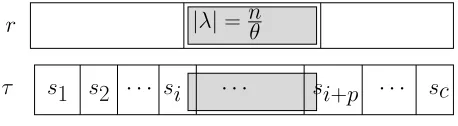
Proof. Letτ be a c-descendant of S, soτ =s1s2· · ·sc where |τ| =n and each
si is a substring of a member of T ⊂S. SupposeS is not c-TA, so there exists
r ∈ S\T such that ℓ(r, τ) ≥ |si| for all i. Let λ be such a longest common substring with|λ|= nθ andλ≺sisi+1· · ·si+p. Then (see Fig. 4)
|s1· · ·sisi+p· · ·sc| ≥nθ−1
θ
which implies there is somesj such that
|sj| ≥ n θ−1
θ
c−p+ 1 . But|sj| ≤ nθ which requires
p≤c+ 2−θ .
Now one of si,· · ·si+p must contain a non-unique substring of length at least n
θ(p+1), i.e. at least
The denominator is maximized atθ= (c+ 3)/2, giving a non-unique substring of length at least
4n
(c+ 3)2 .
τ
r
|
λ
|
=
n
θ
s
1
s
2
· · ·
si
· · ·
si
+
p
· · ·
sc
Fig. 4.Proof of Theorem 4
4
Inclusion of Extraneous Substrings
We now consider the possibility that, when users combine portions of water-marked documents, some portions of non-watermaked documents may be in-cluded. If the amount of such extraneous content is limited, we can still trace parents. We will assume that the watermark extraction algorithm E, when ap-plied to unmarked input, produces essentially random results; thus any sequence of bits can appear in the extraneous portion of the watermark.
Suppose that the total length of the extraneous watermark is≤αn. A deriva-tive watermark τ is produced by concatenation of no more thanc substrings, some of which now may be extraneous. Now a (c, α)−descendantofSis a string
τ =s1· · ·sc with|τ|=nsuch that
X
i:si6≺S
|si| ≤αn
We say thatSis (c, α)-TA if it is still the case that anyσimaximizingℓ(σi, t) must be a parent oft.
Theorem 5. Let α < c+31 . Then S ⊂ {0,1}n is (c, α)-TA if all substrings of
length
1 +β
c+ 3
2
n
are unique, whereβ =p1−α(c+ 3)
Proof. Using the same notation and argument as in the proof of theorem 4, we now have that the non-extraneous members of the set{si,· · ·si+p}must include a non-unique substring length at least n/θp+1−αn, i.e. at least
n(1−αθ)
This is minimized at
θ= 1−
p
1−α(c+ 3)
α .
We have defined β such that α= 1c−+3β2. Then the lower bound is minimized at
θ= c+3
1+β, so we have a non-unique substring of length at least
1 +β
c+ 3
2
n .
5
Lower Bound
For any k < n we can construct a set of strings of length n in which everyk -substring is unique as follows. Divide{0,1}k into equivalence classes, where the equivalence class ofr=r1r2· · ·rk consists of all rotations ofr, i.e. all strings of the formrtrt+1· · ·rkr1· · ·rt−1. There are at least⌈2k/k⌉such classes. Select a representativeri from each class, and formσi by concatenating⌊n/k⌋copies of
ri, followed by the firstn−k⌊n/k⌋bits of ri to get |σi|=n. Thus we have
Theorem 6. For anyc, n there existsS⊂ {0,1}n which isc-TA such that
|S| ≥ 2
⌈4n/(c+3)2⌉
⌈4n/(c+ 3)2⌉ .
For any nthere existsS⊂ {0,1}n which is 2-IPP such that
|S| ≥ 2
⌈n/3⌉
⌈n/3⌉ .
For any nthere existsS⊂ {0,1}n which is 3-IPP such that
|S| ≥ 2
⌈n/5⌉
⌈n/5⌉ .
References
1. Benny Chor, Amos Fiat, Moni Naor, and Benny Pinkas. Tracing traitors. IEEE Transactions on Information Theory, 46(3):893–910, 2000.
2. Amos Fiat and Tamir Tassa. Dynamic traitor tracing. Proceedings of Crypto ’99, LNCS, 1666:354–371, 1999.
3. Henk D. L. Hollmann, Jack H. van Lint, Jean-Paul Linnartz, and Ludo M. G. M. Tolhuizen. On codes with the identifiable parent property.J. Combinatorial Theory, Series A, 82(2):121–133, 1998.