Agreement from Pairings
Shengbao Wang
New Star Institute of Applied Technology, China
Abstract. This paper studies the relationships between the traditional Diffie-Hellman key agreement protocol and the identity-based (ID-based) key agreement protocol from pairings. For the Sakai-Ohgishi-Kasahara (SOK) ID-based key construction, we show that identical to the Diffie-Hellman protocol, the SOK key agreement protocol also has three variants, namely ephemeral,semi-staticandstaticversions. Upon this, we build solid relations between authenti-cated Diffie-Hellman (Auth-DH) protocols and ID-based authentiauthenti-cated key agreement (IB-AK) protocols, whereby we present twosubstitution rulesfor this two types of protocols. The rules en-able a conversion between the two types of protocols. In particular, we obtain thereal ID-based version of the well-known MQV (and HMQV) protocol.
Similarly, for the Sakai-Kasahara (SK) key construction, we show that the key transport proto-col underlining the SK ID-based encryption scheme (which we call the “SK protoproto-col”) has its non-ID counterpart, namely the Hughes protocol. Based on this observation, we establish rela-tions between corresponding ID-based and non-ID-based protocols. In particular, we propose a highly enhanced version of the McCullagh-Barreto protocol.
Key words.Authenticated Diffie-Hellman, SOK protocol, ID-based key agreement, ID-MQV, eMB
1
Introduction
In 2005, Boyd and Choo [7] and Wang et al. [35] noticed that there are some similarities between (pairing-based) ID-based and non-ID-based authenticated key agreement (AK) protocols. This study further investigate this observation. Interestingly, we discover much more than those researchers pre-viously might imagined.
1.1 Proposed Novel Protocols
We discover some important substitution rules (see Table 3, 4) between the two different types of protocols. The rules enable a useful conversion between the authenticated version of the two types of protocols. By applying these rules, we present three novel protocols (namely, the protocols which are highlighted in bold in Table 1 and 2) which possesses remarkable performance and security.
1. The real ID-based version of the MQV (and, HMQV) protocol —ID-MQV. (See Fig. 12.) 2. The enhanced MB (McCullagh–Barreto) ID-based protocol —eMB. (See Fig. 16.) 3. The non-ID-based version of the SYL protocol —nID-SYL(See Appendix A, Fig. 18 ).
Table 1. Corresponding Protocols (non-ID-Basedvs.ID-Based)
Protocol Type Prot. Message Auth. DH Protocols ⇔ ID-Based Protocols
A0 TA=xP MTI/A0 ⇔ Smart [31]
Enhanced A0 (H)MQV ⇔ ID-MQV(See Fig. 12)
A1 TA=xQA MTI/A1 ⇔ Chen–Kudla [11]
Enhanced A1 (H)MQV-1 ⇔Wang [33], Chow–Choo [10]
C0 TA=xQB MTI/C0 ⇔ MB-1 [20]
Enhanced C0 ECKE-1N [37] ⇔ eMB(See Fig. 16)
B0 MTI/B0 ⇔ MB-2 [21]
C1 TA=xFAB MTI/C1 ⇔ Scott [26]
Enhanced C1 Enhanced MTI/C1 (See Fig. 19)⇔ Open Problem!
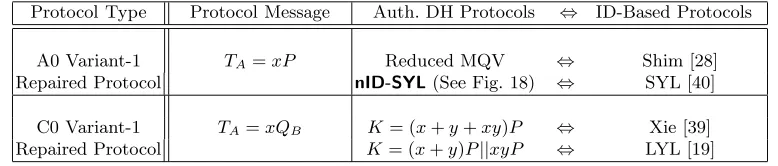
Table 2.Corresponding Protocols (Broken and Repaired Ones)
Protocol Type Protocol Message Auth. DH Protocols ⇔ ID-Based Protocols
A0 Variant-1 TA=xP Reduced MQV ⇔ Shim [28] Repaired Protocol nID-SYL(See Fig. 18) ⇔ SYL [40]
C0 Variant-1 TA=xQB K= (x+y+xy)P ⇔ Xie [39] Repaired Protocol K= (x+y)P||xyP ⇔ LYL [19]
2
Preliminaries
2.1 Bilinear Pairings
LetG1 denotes an additive group of prime orderqandG2 a multiplicative group of the same order. We letP denote a generator ofG1. For us, an admissible pairing is a mape:G1×G1→G2with the following properties:
1. The mapeis bilinear: givenQ, R∈G1 anda, b∈Zq∗, we havee(aQ, bR) =e(Q, R)ab. 2. The mapeis non-degenerate:e(P, P)= 1G2.
3. The mapeis efficiently computable.
Typically, the mapewill be derived from either the Weil or Tate pairing on an elliptic curve over a finite field.
3
Three Versions of the SOK Protocol and the Substitution Rules
We first focus on the SOK ID-based key setting [32]. We show that thestatic SOK protocol from [32] has two more variants,i.e., thesemi-static andephemeral SOK protocols.
3.1 Static DH and the SOK-NIKD Protocols
As observed by Boyd, Mao and Paterson [4] and Ryuet al.[25], the twonon-interactivelyshared static secret from the Diffie-Hellman protocol [12] and the SOK non-interactive ID-based key distribution (SOK-NIKD) protocol [32] areFDH=abP andFSOK =e(QA, QB)s, respectively.
Alice Bob
long-term private/public key pair: long-term private/public key pair:
a, QA=aP b, QB=bP
certA
certB
FDH =aQB=abP FDH =bQA=abP
Fig. 1. The Static DH Protocol [12]
Alice Bob
long-term private/public key pair: long-term private/public key pair:
SA=sQA, QA=H(IDA) SB=sQB, QB =H(IDB)
IDA
IDB
FSOK=e(SA,QB) =e(QA, QB)s FSOK=e(SB,QA) =e(QA, QB)s
Fig. 2.The SOK-NIKD Protocol [32] — Static SOK
Important observation#1:aQB−→e(SA, QB).
3.2 Semi-Static and Ephemeral SOK Protocols
In the rest of the paper, P0 stands for the public key of the private key generator (PKG), with
P0=sP andsbeing the master private key of the PKG.
Alice Bob
long-term private/public key pair: (Alice has no static keys.) SB =sQB, QB =H(IDB)
x∈RZq∗
TA=xP
TA
−−−−−−−→
IDB
FsSOK=e(P0, xQB) FsSOK=e(SB, TA)
Fig. 3.The Semi-Static SOK Protocol
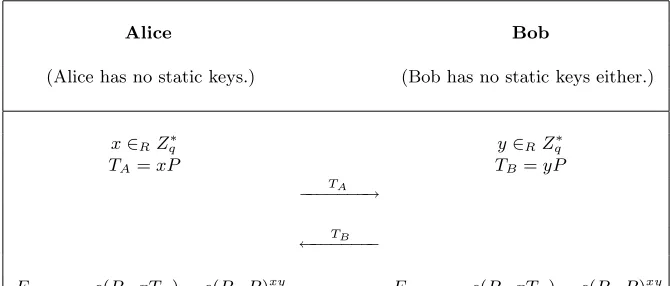
The Ephemeral SOK Protocol The protocol is presented in Fig. 4.
Alice Bob
(Alice has no static keys.) (Bob has no static keys either.)
x∈RZq∗ y∈RZq∗
TA=xP TB=yP
TA
−−−−−−−→
TB
←−−−−−−−
FeSOK=e(P0, xTB) =e(P0, P)xy FeSOK=e(P0, xTA) =e(P0, P)xy
Fig. 4. Ephemeral SOK Protocol
3.3 The UM and the RYY Protocols
The RYY protocol [25] is build upon the UM protocol [1, 15]1. The two session secrets of the two protocols areK=FDH||xyP andK=FSOK||xyP, respectively. A common weakness of them is that they do not possess K-CI resilience [7, 35].
1 Later, however, we will see that in the exact ID-based version of the UM protocol,xyP should be replaced
Alice Bob
long-term private/public key pair: long-term private/public key pair:
a, QA=aP b, QB=bP
x∈RZq∗ y∈RZq∗
TA=xP TB=yP
TA
−−−−−−−→
TB
←−−−−−−−
FDH =aQB=abP FDH =bQA=abP
k=xTB=xyP k=yTA=xyP sk=H2(A||B||FDH||k) sk=H2(A||B||FDH||k)
Fig. 5.The UM Protocol [1]
Alice Bob
long-term private/public key pair: long-term private/public key pair:
SA=sQA, QA=H(IDA) SB =sQB, QB=H(IDB)
x∈RZ∗q y∈RZq∗
TA=xP TB=yP
TA
−−−−−−−→
TB
←−−−−−−−
FSOK=e(SA,QB) =e(QA, QB)s FSOK=e(SB,QA) =e(QA, QB)s k=xTB =xyP k=yTA=xyP
sk=H2(A||B||FSOK||k) sk=H2(A||B||FSOK||k)
Fig. 6.The RYY Protocol [25]
3.4 The MTI/A0 and the Smart Protocols
Alice Bob
long-term private/public key pair: long-term private/public key pair:
a, QA=aP b, QB=bP
x∈RZq∗ y∈RZq∗
TA=xP TB=yP
TA
−−−−−−−→
TB
←−−−−−−−
K=aTB+xQB= (ay+bx)P K=bTA+yQA= (ay+bx)P sk=H2(A||B||K) sk=H2(A||B||K)
Fig. 7.The MTI/A0 Protocol [23]
Alice Bob
long-term private/public key pair: long-term private/public key pair:
SA=sQA, QA=H(IDA) SB=sQB, QB=H(IDB)
x∈RZq∗ y∈RZq∗
TA=xP TB=yP
TA
−−−−−−−→
TB
←−−−−−−−
K=e(SA, TB)e(sP,xQB) K=e(SB, TA)e(sP, yQA) sk=H2(A||B||K) sk=H2(A||B||K)
Fig. 8.The Smart Protocol [31]
From our first observation,aTB should be changed toe(SA, TB). Here we further notice thatxQB is changed toe(sP, xQB), with the help of the master public-keyP0 (P0=sP) 2. Therefore, we get our second observation. HereQi (i={1,2}) are any publicly computable elements in groupG1, such asQA+QB, QA+TB, withQA,QB being public keys andTB being the protocol message sent out by Bob.
Important observation#2:aQ1+xQ2−→e(SA, Q1)e(P0, xQ2).
2 In [34], it was shown that under the SOK key setting, IBE also exists if the master public-key of the PKG
We summarize the above two observations with the following two substitution rules in Table 3.
Table 3.Substitution Rules for the SOK Key Construction
Auth. DH ID-Based Protocols
Static Private-key: a Static Private-key:SA=sQA
Notations Static Public-key:QA=aP Static Public-key:QA=H(IDA) Ephemeral Private-key: x Ephemeral Private-key:x
Publicly-computable group element: Publicly-computable group element: Q, Q1, Q2 Q, Q1, Q2
Two Rules Rule 1.K=aQ ⇔ K=e(SA, Q)
Rule 2.K=aQ1+xQ2 ⇔ K=e(SA, Q1)e(P0, xQ2)
4
Relations between Pairs of Existing Protocols
Applying the above two important substitution rules, we discover some unpublished relations between some pairs of existing protocols.
4.1 The MTI/A1 and the Chen–Kudla Protocols
The Chen–Kudla protocol [11] can be obtained by directly applying the above two substitution rules. In MTI/A1, the session secret isK=aTB+axQB. Therefore in its ID-based counterpart, the session secret isK=e(SA, TB)e(SA, xQB) =e(SA, TB+xQB). This is exactly the Chen–Kudla [11] protocol!
Alice Bob
long-term private/public key pair: long-term private/public key pair:
a, QA=aP b, QB=bP
x∈RZq∗ y∈RZq∗
TA=xQA TB=yQB
TA
−−−−−−−→
TB
←−−−−−−−
K=aTB+axQB =a(TB+xQB) K=bTA+byQA=b(TA+yQA) sk=H2(A||B||K) sk=H2(A||B||K)
Alice Bob
long-term private/public key pair: long-term private/public key pair:
SA=sQA, QA=H(IDA) SB=sQB, QB=H(IDB)
x∈RZq∗ y∈RZq∗
TA=xQA TB=yQB
TA
−−−−−−−→
TB
←−−−−−−−
K=e(SA,TB+xQB) K=e(SB, TA+yQA) sk=H2(A||B||TA||TB||K) sk=H2(A||B||TA||TB||K)
Fig. 10.The Chen–Kudla Protocol [11]
4.2 The MQV-1 and Wang’s Protocols
Wang’s protocol [33] can be obtained from the so-called MQV-1 protocol by directly applying the above two rules.
We first review the famous MQV [18] protocol. Note that the HMQV protocol [17] is a hashed variant of the MQV protocol.
Alice Bob
long-term private/public key pair: long-term private/public key pair:
a, QA=aP b, QB=bP
x∈RZq∗ y∈RZq∗
TA=xP TB=yP
TA
−−−−−−−→
TB
←−−−−−−−
hA=H1(QB, TA) hB=H1(QA, TB)
hB=H1(QA, TB) hA=H1(QB, TA) K= (x+ahA)(TB+hBQB) K= (y+bhB)(TA+hAQA)
sk=H2(A||B||TA||TB||K) sk=H2(A||B||TA||TB||K)
Fig. 11.The (H)MQV Protocol [18, 17]
The MQV-1 protocol can be obtained by simply changing the protocol message TA =xP to be
TA = xQA, and then adjust the protocol accordingly. The session secret of the MQV-1 protocol is K = (x+hA)a(TB+hBQB). Therefore in its ID-based counterpart, the session secret is K =
5
Obtaining the Real ID-Based MQV Protocol
5.1 OurID-MQV Protocol
The session secret in (H)MQV is as follows:
K= (x+hAa)(TB+hBQB) =x(TB+hBQB) +hAa(TB+hBQB).
We letQ1=TB+hBQB andQ2=hA(TB+hBQB) =hAQ1, then
K=xQ1+aQ2,
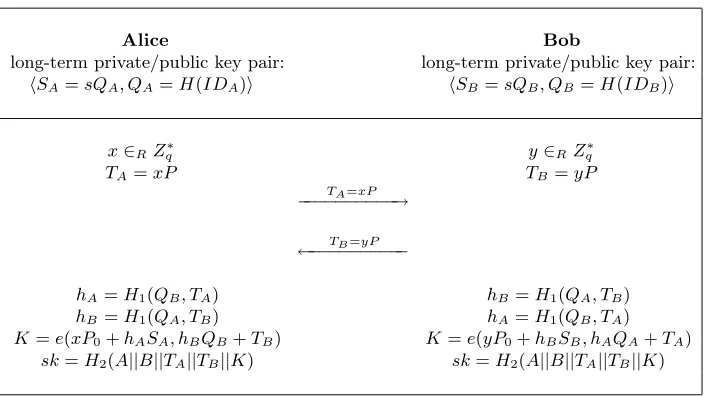
Applying Rule #2, we obtain the ID-based version of this protocol —ID-MQV, its session secret K is as follows:
K=e(P0, xQ1)e(SA, Q2) =e(xP0, Q1)e(hASA, Q1) =e(xP0+hASA, Q1),
recall thatQ1=TB+hBQB, thus we have
K=e(xP0+hASA, TB+hBQB).
Alice Bob
long-term private/public key pair: long-term private/public key pair:
SA=sQA, QA=H(IDA) SB=sQB, QB =H(IDB)
x∈RZq∗ y∈RZq∗
TA=xP TB=yP
TA=xP
−−−−−−−−−−→
TB=yP
←−−−−−−−−−−
hA=H1(QB, TA) hB=H1(QA, TB) hB =H1(QA, TB) hA=H1(QB, TA) K=e(xP0+hASA, hBQB+TB) K=e(yP0+hBSB, hAQA+TA)
sk=H2(A||B||TA||TB||K) sk=H2(A||B||TA||TB||K)
Fig. 12.ID-MQV: ID-Based (H)MQV Protocol
Alice Bob
long-term private/public key pair: long-term private/public key pair:
SA=sQA, QA=H(IDA) SB=sQB, QB=H(IDB)
x∈RZq∗ y∈RZq∗
TA=xP TB=yP
TA
−−−−−−−→
TB
←−−−−−−−
K=e(xP0+SA, QB+TB) K=e(yP0+SB, QA+TA) sk=H2(A||B||K) sk=H2(A||B||K)
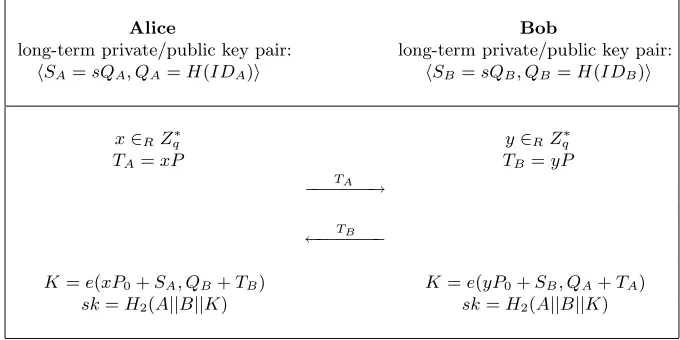
Fig. 13.The Shim Protocol [28]
5.2 Remarks on theID-MQV Protocol
Alice Bob
long-term private/public key pair: long-term private/public key pair:
SA=sQA, QA=H(IDA) SB =sQB, QB=H(IDB)
x∈RZq∗ y∈RZq∗
TA=xP TB=yP
TA
−−−−−−−→
TB
←−−−−−−−
hA=H1(QB, TA) hB =H1(QA, TB) hB=H1(QA, TB) hA=H1(QB, TA) K1=e(xP0+hASA, hBQB+TB) K1=e(yP0+hBSB, hAQA+TA)
K2=xTB=xyP K2=yTA=xyP
sk=H2(A||B||TA||TB||K1||K2) sk=H2(A||B||TA||TB||K1||K2)
Fig. 14.EscrowlessID-MQV: ID-Based (H)MQV Protocol with PKG-FS
OurID-MQVprotocol has remarkable superiorities over all the existing ID-based key agreement pro-tocols (from pairings).
1. From the format of the protocol messages, we argue that ourID-MQVis the real ID-based version of the famous (H)MQV protocol. As mentioned above, the Chow–Choo and Wang protocols are ID-based version of the so-called (H)MQV-1 protocols, which have different protocol messages.
and Barreto [20]) key escrow is a requirement or even, a must. However, if we removeK1=abP from the SYL protocol [40] to open escrow, then it become totally insecure (which is exactly Shim’s protocol [28]), let alone PFS. Our new protocol can be securely used in escrowed model (i.e., w/o
xyP), providing PFS. WhenxyP is added, the protocol becomes escrowless (and achieves PKG-FS, see Fig. 14). In a word, xyP separates clearly PFS from PKG-FS, and our new protocol (ID-MQV) can be used with or without escrow.
3. Compared with Wang’s protocol [33] (and the Chow-Choo protocol [10]), our protocol does not need extra message exchange to close escrow, while the latter requires a party to send out an extra point. At the same time, brings extra computation for the party.
4. The new protocol can be further strengthened to achieve stronger security, i.e., to be secure in the extended Canetti–Krawczyk (eCK) model which allowsephemeral secret key reveal. (Using the same idea from [6].)
6
Beyond the SOK ID-Based Key Construction
Now we look at the SK key setting. For details on the key setting, please refer to [30] and [20, 38]. Here we note that the master private and public key pair of the PKG iss, P0=sP.uis part of a user’s static public key and for AliceuA=H(IDA)∈Z∗q.
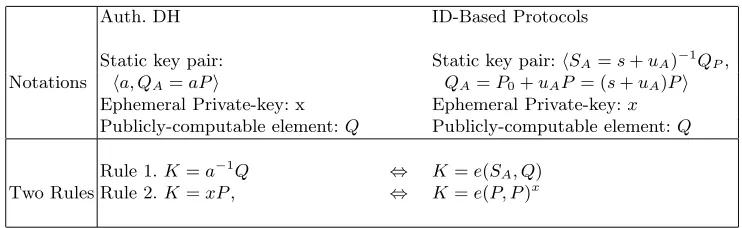
We discover that the key transport protocol behind the SK-IBE [30] is simply the ID-based version of the Hughes protocol [16]. This is mainly because the static private key of the receivers in the two protocols are both inversion-based. The substitution rules are listed in Table 4.
Table 4.Substitution Rules for the SK Key Construction
Auth. DH ID-Based Protocols
Static key pair: Static key pair:SA=s+uA)−1QP,
Notations a, QA=aP QA=P0+uAP= (s+uA)P Ephemeral Private-key: x Ephemeral Private-key:x Publicly-computable element:Q Publicly-computable element:Q
Rule 1.K=a−1Q ⇔ K=e(SA, Q)
Two Rules Rule 2.K=xP, ⇔ K=e(P, P)x
Using the above rules, we can establish the relations between the MB protocols [20, 21] and the MTI/C0 and MTI/B0 [23] protocols (c.f. Table 1), the details are omitted here. Next, based on the enhanced MTI/C0 protocol (i.e.the ECKE-1N protocol), we propose a highly efficient ID-based protocol —eMB.
6.1 Review of the ECKE-1N Protocol
Alice Bob
long-term private/public key pair: long-term private/public key pair:
a, QA=aP b, QB=bP
x∈RZq∗ y∈RZq∗
TA=xQB TB=yQA
TA
−−−−−−−→
TB
←−−−−−−−
hA=H1(QB, TA) hB=H1(QA, TB)
hB=H1(QA, TB) hA=H1(QB, TA) K=a−1(x+hA)(TB+hBQA) K=b−1(y+hB)(TA+hAQB)
= (x+hA)(y+hB)P = (x+hA)(y+hB)P
sk=H2(A||B||TA||TB||K) sk=H2(A||B||TA||TB||K)
Fig. 15.The Enhanced MTI/C0 Protocol — ECKE-1N
6.2 The eMB Protocol
Applying the substitution rules from Table 4, we converse our ECKE-1N into an ID-based authenti-cated key agreement protocol which is the enhanced version of the McCullagh-Barreto protocol [20, 21] —eMB.
Alice Bob
long-term private/public key pair: long-term private/public key pair:
SA= (s+uA)−1P , SB= (s+uB)−1P, QA=P0+uAP = (s+uA)P QB=P0+uBP= (s+uB)P
x∈RZ∗q y∈RZq∗
QB=P0+uBP = (s+uB)P QA=P0+uAP = (s+uA)P
TA=xQB TB=yQA
TA
−−−−−−−→
TB
←−−−−−−−
hA=H(QB, TA) hB=H(QA, TB) hB=H(QA, TB) hA=H(QB, TA)
K=e((x+hA)SA, TB+hBQA) K=e((y+hB)SB, TA+hAQB) =e(P, P)(x+hA)(y+hB) =e(P, P)(x+hA)(y+hB)
sk=H2(A||B||TA||TB||K) sk=H2(A||B||TA||TB||K)
We remark that the substitution rules in the SK ID-based key setting can also be applied to the SK variants, e.g. Gentry’s key setting [14] and the second Boneh-Boyen (BB2) scheme [2].
Acknowledgements
The author wishes to thank Liqun Chen, Zhaohui Cheng, Kenny Paterson and Yongge Wang for comments on the first version of this paper.
References
1. R. Ankney, D. Johnson, M. Matyas. The Unified Model. contribution to X9F1, October 1995. [4, 5] 2. D. Boneh and X. Boyen. Efficient selective-ID secure identity based encryption without random oracles.
Advances in Cryptology C EUROCRYPT’04, LNCS vol. 3027, pp.223C238, Springer-Verlag. [13]
3. D. Boneh, M. Franklin. Identity-based encryption from the Weil pairing. InProc. of CRYPTO 2001, LNCS vol. 2139, pp. 213-229, Springer-Verlag, 2001. [3, 5]
4. C. Boyd, W. Mao, and K. Paterson. Key agreement using statically keyed authenticators. InProc. of ACNS 2004, LNCS vol. 3089, pp. 248-262. Springer-Verlag,, 2004 [3]
5. L. Chen, Z. Cheng, and N. P. Smart. Identity-based key agreement protocols from pairings. Cryptology ePrint Archive, Report 2006/199. [9]
6. B. LaMacchia, K. Lauter and A. Mityagin. Stronger Security of Authenticated Key Exchange. Cryptology ePrint Archive: Report 2006/073 [11]
7. C. Boyd and K.-K. R. Choo. Security of two-party identity-based key agreement. InProc. of MYCRYPT 2005, LNCS vol. 3715, pp. 229-243, Springer-Verlag, New York, 2005. [1, 4]
8. S. Blake-Wilson, C. Johnson and A. Menezes. Key Agreement Protocols and their Security Analysis. In Proc. of the sixth IMA International Conference on Cryptography and Coding, LNCS vol. 1355, New York, Springer-Verlag, 1997, pp. 30-45. [5]
9. S. Blake-Wilson, A. Menezes. Authenticated Diffie-Hellman key agreement protocols. InProc. of SAC 1998, LNCS vol. 1556, New York, Springer-Verlag, 1999, pp. 339-361. [5]
10. S. S.-M. Chow, K.-K.R. Choo, Strongly-secure identity-based key agreement and anonymous extension, in: Proc. ISC’07, LNCS vol. 4779, 2005, pp. 203-220. [2, 8, 11]
11. L. Chen, C. Kudla. Identity based key agreement protocols from pairings. In Proc. of the 16th IEEE Computer Security Foundations Workshop, IEEE Computer Society, 2002, pp. 219-213. See also Cryptology ePrint Archive, Report 2002/184. [2, 7, 8]
12. W. Diffie, M. Hellman. New directions in cryptography.IEEE Trans. Inf. Theory 22(6): 644 - 654, 1976. [3]
13. T. ElGamal. A public key cryptosystem and signature scheme based on discrete logarithms.IEEE Trans. Inf. Theory 31(4): 469-472, 1985. [3]
14. C. Gentry. Practical identity-based encryption without random oracles. Advances in Cryptology C EU-ROCRYPT’06, LNCS, Springer-Verlag, 2006. [13]
15. K. C. Goss. Cryptographic method and apparatus for public key exchange with authentication. US Patent 4,956,863, September 1990. [4]
16. E. Hughes. An encrypted key transmission protocol. Presented at the rump session of CRYPTO’94, Aug 1994. [11]
17. H. Krawczyk. HMQV: A high performance secure Diffie-Hellman protocol. InProc. of Crypto’05, LNCS 3621, pp. 546-566, Springer-Verlag, New York, 2005. [8]
18. L. Law, A. Menezes, M. Qu, J. Solinas and S. A. Vanstone, “An efficient protocol for authenticated key agreement,”Des. Codes Cryptography, vol.28, no.2, pp. 119-134, 2003. [8]
19. S. Li, Q. Yuan and J. Li. Towards security two-part authenticated key agreement protocols. Cryptology ePrint Archive, Report 2005/300, 2005. Available at http://eprint.iacr.org/2005/300. [2]
20. N. McCullagh, P.S.L.M. Barreto. A new two-party identity-based authenticated key agreement. InProc. of CT-RSA 2005, LNCS vol. 3376, pp. 262-274, Springer-Verlag, New York, 2005. [2, 11, 12, 13]
22. A. Menezes, P. van Oorschot and S. Vanstone. Handbook of Applied Cryptography, CRC Press, 1997. [3, 5]
23. T. Matsumoto, Y. Takashima and H. Imai. On seeking smart public-key distribution systems. Trans. IECE of Japan, E69, pp.99-106, 1986. [6, 7, 11, 15]
24. K. G. Paterson and S. Srinivasan. On the relations between non-interactive key distribution, identity-based encryption and trapdoor discrete log groups. Cryptology ePrint Archive, Report 2007/453, 2007. Available at http://eprint.iacr.org/2007/453. [3]
25. E.K. Ryu, E.J. Yoon, and K.Y. Yoo. An efficient ID-based authenticated key agreement protocol from pairings. InProc. of NETWORKING 2004, LNCS vol. 3042, pp. 1458-1463. Springer-Verlag, 2004. [3, 4, 5]
26. M. Scott. Authenticated ID-based key exchange and remote log-in with insecure token and PIN number. http://eprint.iacr.org/2002/164.pdf [2]
27. A. Shamir. Identity-based cryptosystems and signature schemes. InProc. of CRYPTO 1984, LNCS vol.196, Springer-Verlag, New York, 1984, pp. 47-53. [3]
28. K. Shim. Efficient ID-based authenticated key agreement protocol based on Weil pairing.Electron. Lett., 39(8), pp. 653-654, 2003. [2, 9, 10, 11]
29. H. Sun, B. Hsieh. Security analysis of Shim’s authenticated key agreement protocols from pairings. Cryp-tology ePrint Archive, Report 2003/113, 2003. Available at http://eprint.iacr.org/2003/113. [9]
30. R. Sakai and M. Kasahara. ID based cryptosystems with pairing on elliptic curve. Cryptology ePrint Archive, Report 2003/054. [11]
31. N.P. Smart. An identity based authenticated key agreement protocol based on the Weil pairing.Electron. Lett.,38(13), 2002, pp. 630-632. [2, 5, 6]
32. R. Sakai, K. Ohgishi and M. Kasahara. Cryptosystems based on pairing. InProc. of the 2000 Symposium on Cryptography and Information Security, Okinawa, Japan, 2000. [2, 3]
33. Y. Wang. Efficient identity-based and authenticated key agreement protocol. ePrint Achive. Available at http://eprint.iacr.org/2005/108. [2, 8, 11]
34. S. Wang. Practical Identity-Based Encryption (IBE) in Multiple PKG Environments. Available at http://arxiv.org/abs/cs/0703106 (Updated version available at Cryptology ePrint Archive, Report 2007/100.) [6]
35. S. Wang, Z. Cao and H. Bao. Security of an efficient ID-based authenticated key agreement protocol from pairings. InProc. of ISPA’05 Workshops, LNCS vol. 3759, pp. 342-349. Springer-Verlag, New York, 2005. [1, 4]
36. S. Wang, Z. Cao and K-K. R. Choo. Provably secure identity-based authenticated key agreement protocols without random oracles, 2006 (Preprint, available at Cryptology ePrint Archive, Report 2006/446) [5] 37. S. Wang, Z. Cao, M. Strangio and L. Wang. Cryptanalysis and improvement of an elliptic Ccurve
Diffie-Hellman key agreement protocol. to appear inIEEE Communications Letters. (Also available at Cryptology ePrint Archive, Report 2007/026) [2, 11]
38. G. Xie. Cryptanalysis of Noel McCullagh and Paulo S. L. M.Barreto’s two-party identity-based key agree-ment. Cryptology ePrint Archive, Report 2004/308, 2004. Available at http://eprint.iacr.org/2004/308. [11]
39. G. Xie. An ID-based key agreement scheme from pairing. Cryptology ePrint Archive, Report 2005/093, 2005. Available at http://eprint.iacr.org/2005/093. [2]
40. Q. Yuan and S. Li. A new efficient ID-based authenticated key agreement protocol. Cryptology ePrint Archive, Report 2005/309, 2005. Available at http://eprint.iacr.org/2005/309. [2, 9, 11, 15]
A
Obtaining an Authenticated DH Protocol from the SYL Protocol
Alice Bob
long-term private/public key pair: long-term private/public key pair:
SA=sQA, QA=H(IDA) SB=sQB, QB =H(IDB)
x∈RZq∗ y∈RZq∗
TA=xP TB=yP
TA=xP
−−−−−−−−−−→
TB=yP
←−−−−−−−−−−
K1=xTB=xyP K1=yTA=xyP
K2=e(xP0+SA, QB+TB) K2=e(yP0+SB, QA+TA) sk=H2(A||B||TA||TB||K1||K2) sk=H2(A||B||TA||TB||K1||K2)
Fig. 17.The SYL Protocol [40]
Alice Bob
long-term private/public key pair: long-term private/public key pair:
a, QA=aP b, QB=bP
x∈RZq∗ y∈RZq∗
TA=xP TB=yP
TA=xP
−−−−−−−−−−→
TB=yp
←−−−−−−−−−
K1=xTB=xyP K1=yTA=xyP K2 = (x+a)(QB+TB) K2= (y+b)(QA+TA)
= (x+a)(y+b)P = (x+a)(y+b)P sk=H2(A||B||TA||TB||K1||K2) sk=H2(A||B||TA||TB||K1||K2)
Fig. 18.nID-SYL: A New Authenticated Diffie-Hellman Protocol
B
Enhanced MTI/C1 Protocol
Alice Bob
long-term private/public key pair: long-term private/public key pair:
a, QA=aP b, QB=bP
x∈RZq∗ y∈RZq∗
TA=xaQB=xFDH TB=ybQA=yFDH TA=xabP
−−−−−−−−−−−→
TB=yabP
←−−−−−−−−−−−
hA=H1(QB, TA) hB=H1(QA, TB) hB=H1(QA, TB) hA=H1(QB, TA) K= (x+a−1hA)(TB+hBQA) K= (y+b−1hB)(TA+hAQB)
= (ax+hA)(yb+hB)P = (by+hB)(xa+hA)P sk=H2(A||B||TA||TB||K) sk=H2(A||B||TA||TB||K)
![Fig. 1. The Static DH Protocol [12]](https://thumb-us.123doks.com/thumbv2/123dok_us/1865061.1242470/3.612.125.488.121.255/fig-the-static-dh-protocol.webp)
![Fig. 5. The UM Protocol [1]](https://thumb-us.123doks.com/thumbv2/123dok_us/1865061.1242470/5.612.133.479.45.480/fig-the-um-protocol.webp)
![Fig. 7. The MTI/A0 Protocol [23]](https://thumb-us.123doks.com/thumbv2/123dok_us/1865061.1242470/6.612.138.474.46.216/fig-the-mti-a-protocol.webp)
![Fig. 9. The MTI/A1 Protocol [23]](https://thumb-us.123doks.com/thumbv2/123dok_us/1865061.1242470/7.612.115.497.100.229/fig-the-mti-a-protocol.webp)
![Fig. 11. The (H)MQV Protocol [18, 17]](https://thumb-us.123doks.com/thumbv2/123dok_us/1865061.1242470/8.612.136.478.46.216/fig-the-h-mqv-protocol.webp)