99
Strategic approach: a step towards sustainable solid waste management in developing
economies
Divya Singh Jamwala
Saurabh b
aResearch Scholar; School of Business, Shri Mata Vaishno Devi University, Katra, J&K, India
b Associate Professor; School of Business, Shri Mata Vaishno Devi University, Katra, J&K, India
[email protected] (Corresponding author)
A R T I C L E H I S T O R Y :
Received: 15-Mar-2019
Accepted: 20-May-2019
Online available: 17-Jun-2019
Keywords:
Strategic approach, Solid waste management, Sustainable development, Urban local bodies
A B S T R A C T
The present study is based upon the prevailing issue of Solid Waste Management (SWM) faced by developing economies all over the world. The quantum and composition of waste generation pose a series of complexities regarding surrounding institutions’ plans in dealing with it. In India, the responsibility of handling solid waste primarily falls to municipal authorities or Urban Local Bodies (ULBs). These ULBs are the main functional units that plan, implement and control the actions as well as resources used for SWM within their jurisdiction. This study explores a strategic approach of these ULBs towards the management of solid waste at the functional level across 10 districts in J&K, a state of India. The study advocates for the inclusion of strategic interventions in the field of SWM based on a survey conducted which establishes the gap in strategic implementation. The strategic approach in this study is related to understanding dimensions such as strategy formulation, implementation and evaluation that contributes to various aspects of SWM for theorists, policy makers and practitioners.
Contribution/ Originality
The present study provides valuable insights to the policymakers working in the field of solid waste management (SWM) in the developing economies. The study advocates the inclusion of functional strategy that calls for a defined process of strategy i.e. planning, implementation and evaluation, supported by the environmental engagement and proper allocation of resources. It calls for the setting up of long-term objectives and having a perspective for complementing these with the resources.
DOI: 10.18488/journal.1007/2019.9.4/1007.4.99.110 ISSN (P): 2306-983X, ISSN (E): 2224-4425
How to cite: Divya Singh Jamwal and Saurabh (2019). Strategic approach: a step towards sustainable solid waste management in developing economies. Asian Journal of Empirical Research, 9(1), 99-110. © 2019 Asian Economic and Social Society. All rights reserved
Asian Journal of Empirical Research
Volume 9, Issue 4 (2019): 99-110100
1. INTRODUCTION
The never-ending challenge of solid waste management (SWM) is rooted in the development of the nation and its increase in business-related activities. The industrial development and postmodern social consumption patterns bring forth the challenges related to urban waste management in developing countries (Sangle, 2010). With the expansion of infrastructure and growth opportunities, urban areas see a growth in population - resulting in increasing consumption and disposal patterns.
The developing economies focus more on infrastructure development and, henceforth, the issues of unmatched requirements of the population. Specifically, SWM is at the lowest priority. This causes challenges in institutionalizing the plan for the effective and responsive collection and disposal of solid waste. It requires a strategy towards managing the solid waste that corroborates with growth requirements, emerging patterns, resource maximization along with maintaining an ecological balance
(Fuss et al., 2018; Preuss, 2007).
SWM is a planned system for effectively controlling the generation, storage, collection, transportation, and disposal of solid waste in an aesthetically acceptable and economical manner. The institutions responsible for the SWM often run into difficulties dealing with solid waste with consistent aberration. However, there is a requirement for sustainable waste management that can be attained through fiscal benefits, economically feasible technologies, public-private partnerships, and strategic interventions
(Elbanna et al., 2016; Quan et al., 2018).
In India, SWM is primarily the responsibility of municipalities, but unfortunately, it is a poorly rendered service (Ferronato et al., 2018). However, the strategic intent for the effective management of solid waste is reflected by the Government of India through the introduction of municipal solid waste (MSW) (Management and Handling) Rules, 2000 revised in 2016. Yet at the functional level, there is a prerequisite for a defined strategic approach towards SWM.
Municipal bodies across the regions focus on issues based upon contemporary, futuristic, ecological and geographical patterns (Rodrigues et al., 2018). The municipal bodies act as a strategic unit. They have a defined role in the management of solid waste. However, it is often found in developing regions that these strategic units struggle to deliver as per their role. They lack an innovative approach to deal with these issues. The study has explored the selected ULBs in the Jammu region of India as a case to understand their strategic approach in reference to the strategy formulation, implementation and evaluation. Based upon the exploratory design, the study contributes towards the strategic perspective for the effective management of solid waste in the strategic functional units.
2. LITERATURE REVIEW
The role of strengthening and empowering municipal and local bodies in providing amenities in the urban area was advocated by Kundu et al. (1999). The authors deliberated upon the poor database status of ULBs and advocated for the strategic empowerment of the local bodies. The requirement for the alignment of the financial and non-financial resources and strengthening the role of ULBs for delivering sustainable SWM has been endorsed by (Baud et al., 2001; Zurbrugg, 2002; Srivastava et
al., 2005; and Sandra, 2017).
Kum et al. (2005) illustrated that strategic approach can improve the effectiveness of solid waste
101
Inglezakis and Moustakas (2015) described that effective SWM called for the promotion of shared
knowledge and awareness regarding the risks of various waste collection methods and disposal amongst stakeholders. It has been emphasized by the researchers that the approach of SWM should be based on the long-term goals of serving local needs effectively by the 3R approach, i.e. reduce, reuse and recycle. It should be made effective with stakeholders’ participation, accompanied by proper financial and human resource management (Elbanna et al., 2016; Finlayson et al., 2012).
The study of Anbarasan and Sushil (2018) endorsed the idea that the sustainability of an organization depends upon the inclusivity of social, economic, ecological and the elements of good governance in its strategy and functions to have a positive outcome. It involves the active involvement of the various stakeholders, ecologists, environmental thinkers and community in general.
The study conducted by Rodriguez-Melo and Mansouri (2011) also endorsed the variables of social, economic and environmental aspects as the new paradigm to be taken into consideration by the strategists. Chen et al. (2010) emphasized that an integrated framework would contribute to the improvement of overall eco-efficiency for municipal SWM. Baud et al. (2001) suggested the concept of partnership and a wider range of feasible alliances in order to achieve an effective urban basic service i.e. SWM. The strategic outlook for creating an alliance between local authorities, NGO’s community-based organizations and other enterprises contributes towards the financial viability and effective reuse and recycling of solid waste (Ikhlayel, 2018).
Over the period of the literature in the field of SWM, most publications have discussed the importance of the effective delivery and performance of the municipal bodies (Sharholy et al., 2008; Xiao et al.,
2018; Joshi and Ahmed, 2016). Though, there have not been any attempt to explain the municipal
bodies as the strategic functional units and they’re essentially having a strategic approach.
The literature in the field of strategic management has confirmed that a strategic approach has a positive relationship with performance (Miller and Cardinal, 1994). A strategic approach is based on the critical elements of formulation, implementation, and control (Hahn, 2012). It provides for defining the action plan at the functional level for effective performance. Strategic management theory indicates that there is a positive association between strategic planning and company performance with the direction of causation from strategic planning to performance (Glaister and Falshaw, 1999). Over the close observation of literature in the field of SWM and the strategic management, one can conclude that the deliberations of the strategic approach adopted by the concerned institutions with respect to SWM are one of the significant gaps. The strategic approach of ULBs and their readiness towards implementation of sustainable SWM in terms of practices, procedures and definitive results need to be bridged. Therefore, the primary question that is whether or not the municipal bodies, under the observation, had a strategic approach or not?
3. RESEARCH METHODOLOGY
The analysis of strategic approach in the ULBs required an in-depth investigation at various levels. With ULBs as the strategic units, it was required to understand their approach and confirm if they are aligned with a strategy. The functional level strategy and its implementation is related to the efficient deployment of strategic guidelines as directed at the organizational and strategic level (MSW management and Handling Rules 2016, MOEF, GOI in this case). Hence to map this strategic approach, an exploratory design was used in this study.
102
per annum. This is more important in light of the gap in literature; since there are hardly any significant studies found that have been comprehensively reviewed regarding institutions responsible for addressing the issues of SWM in developing areas such as J&K or even in other parts of emerging economies.
Based upon the 2016 MSW Handling Rules, and the review of literature, a schedule was prepared to collect information on the practices of collection, transportation and disposal of solid waste and the strategies thereafter. In the preliminary survey, it was found that (as per the status of ULBs in developing regions) those ULBs are not maintaining the consistent data suitable for reaching to any conclusion. Hence, the challenge to prove that the ULBs have a strategic approach became interesting. Thereafter, the study adopted a design based on primary survey and qualitative tools. A specific instrument for identification of a strategic approach based on 20 statements with respect to strategy formulation, implementation and control evaluation has been used. The first hypothesis H01 of the study was framed as:
Ho1: The ULBs do not have a strategic approach towards a sustainable SWM program.
The presence of a strategic approach was further confirmed with the interviews of top management i.e. Executive Officers of the ULBs over the statements for the key responsible areas of a ULB i.e. collection, transportation and distribution (Zhang et al., 2010). The responses were taken on a 5-point Likert scale over 19 statements, identified based on literature. Out of 19 statements: 9 were regarding the collection, 5 regarding transportation, and 5 were regarding the disposal practices of solid waste. The responses of the Executive officers were confirmed with at least two officials in the respective ULB. To understand the status of collection, transportation and disposal of solid waste in the ULB, the mean, covariance and standard deviation tools were applied. Furthermore, in order to confirm the above hypothesis, another hypothesis was established for defining the relationship between the strategic approach with the components of collective transportation and disposal of solid waste i.e. H02: There is no relationship between strategic approach and the services provided towards collection,
transportation & disposal of solid waste.
4. ANALYSIS AND DISCUSSION
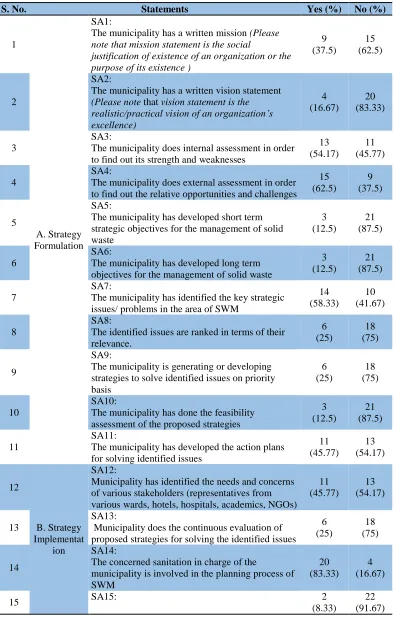
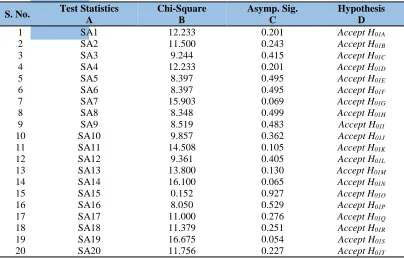
In order to conclude whether or not the selected ULBs are following the strategic approach for the management of solid waste, a set of 20 statements over the components of strategy formulation, implementation and control/evaluation was distributed (ref. Table 1). Furthermore, to test the statistical significance of the indicators that are used to define the strategic approach in the present contribution, the non-parametric test, namely, Kruskal Wallis, has been applied on the data in order to prove the hypothesis (Ho1) stating that the ULBs do not have a strategic approach towards the efficient SWM program. Usually, these tests are also done when the assumptions about the one-way ANOVA are not attained (Weaver et al., 2017). To verify the distribution of response towards the indicators of strategic approach provided in table 1, the hypothesis has been formulated - signifying that the distribution of Strategic Approach (SA) remains the same across the surveyed municipal bodies.
103
Table 1: Status of variables of strategic approach in ULBs in J&K
S. No. Statements Yes (%) No (%)
1
A. Strategy Formulation
SA1:
The municipality has a written mission (Please note that mission statement is the social
justification of existence of an organization or the purpose of its existence )
9 (37.5) 15 (62.5) 2 SA2:
The municipality has a written vision statement (Please note that vision statement is the realistic/practical vision of an organization’s excellence) 4 (16.67) 20 (83.33) 3 SA3:
The municipality does internal assessment in order to find out its strength and weaknesses
13 (54.17) 11 (45.77) 4 SA4:
The municipality does external assessment in order to find out the relative opportunities and challenges
15 (62.5) 9 (37.5) 5 SA5:
The municipality has developed short term strategic objectives for the management of solid waste 3 (12.5) 21 (87.5) 6 SA6:
The municipality has developed long term objectives for the management of solid waste
3 (12.5) 21 (87.5) 7 SA7:
The municipality has identified the key strategic issues/ problems in the area of SWM
14 (58.33) 10 (41.67) 8 SA8:
The identified issues are ranked in terms of their relevance. 6 (25) 18 (75) 9 SA9:
The municipality is generating or developing strategies to solve identified issues on priority basis 6 (25) 18 (75) 10 SA10:
The municipality has done the feasibility assessment of the proposed strategies
3 (12.5) 21 (87.5) 11 SA11:
The municipality has developed the action plans for solving identified issues
11 (45.77) 13 (54.17) 12 B. Strategy Implementat ion SA12:
Municipality has identified the needs and concerns of various stakeholders (representatives from various wards, hotels, hospitals, academics, NGOs)
11 (45.77) 13 (54.17) 13 SA13:
Municipality does the continuous evaluation of proposed strategies for solving the identified issues
6 (25) 18 (75) 14 SA14:
The concerned sanitation in charge of the
municipality is involved in the planning process of SWM
20 (83.33)
4 (16.67)
15 SA15: 2
(8.33)
104
Representatives from the private agencies working in the field of SWM are involved in the planning process of SWM
16
SA16:
Representatives from NGOs are involved in the process of SWM
4 (16.67)
20 (83.33)
17
SA17:
Representatives from academics/research area are involved in the process of SWM
1 (4.17)
23 (95.83)
18
SA18:
Representatives from hotels/restaurants are involved in the process of SWM
5 (20.83)
19 (79.17)
19
SA19:
Representatives from various wards are involved in the process of SWM
16 (66.67)
8 (33.33)
20 C. Strategy Evaluation
SA20:
The performance of municipal body is monitored according to the service level benchmarks provided specifically for municipalities
6 (25)
18 (75)
Source: Authors’ own elaborations based on primary data
Note: SAn: Codes for the statements; figures in the parenthesis are the percentages
Table 2: Hypothesis testing of the variables of strategic approach across the ULBs of J&K
S. No. Test Statistics Chi-Square Asymp. Sig. Hypothesis
A B C D
1 SA1 12.233 0.201 Accept H01A
2 SA2 11.500 0.243 Accept H01B
3 SA3 9.244 0.415 Accept H01C
4 SA4 12.233 0.201 Accept H01D
5 SA5 8.397 0.495 Accept H01E
6 SA6 8.397 0.495 Accept H01F
7 SA7 15.903 0.069 Accept H01G
8 SA8 8.348 0.499 Accept H01H
9 SA9 8.519 0.483 Accept H01I
10 SA10 9.857 0.362 Accept H01J
11 SA11 14.508 0.105 Accept H01K
12 SA12 9.361 0.405 Accept H01L
13 SA13 13.800 0.130 Accept H01M
14 SA14 16.100 0.065 Accept H01N
15 SA15 0.152 0.927 Accept H01O
16 SA16 8.050 0.529 Accept H01P
17 SA17 11.000 0.276 Accept H01Q
18 SA18 11.379 0.251 Accept H01R
19 SA19 16.675 0.054 Accept H01S
20 SA20 11.756 0.227 Accept H01T
Source: Authors’ own elaborations based on primary data
105
qualitative responses received under the component a mean value, an aggregate score of each component was obtained. The statistics from Table 3 reflect the average response of 24 ULBs for collection, transportation, and disposal of solid waste generated in their area.
The results conclude that all of the 24 ULB are collecting solid waste from the different places of solid waste generation including, markets, households, hotels, etc., but on the other hand, the requirements for proving the robust transportation facility are not fulfilled. It was found that the transportation vehicles and transfer stations of solid waste are uncovered and are rarely emptied before overflowing. It was also found that across the ULBs they have uncovered transfer stations and transportation facility and absence of a GIS-based system for optimal routing. Moreover, the service of solid waste disposal is found to be poor as most of the collected waste are dumped in the waste disposal facilities without segregation and recovery of biodegradable waste, recyclables, segregation of biomedical waste, etc. Table 3: Descriptive statistics of ULBs for collection, transportation and disposal of solid waste
Collection Transportation Disposal
Mean 2.93 1.83 1.70
SD 0.81 0.57 0.48
CV 0.27 0.31 0.28
Source: Authors’ own elaborations based on primary data
Table 4: Descriptive statistics of sampled ULBs across the J&K for the collection, transportation and disposal of solid waste
S.
No. ULBs
Collection Transportation Disposal Mean SD CV Mean SD CV Mean SD CV 1 MC Jammu 2.75 0.75 0.27 1.50 0.98 0.65 1.00 0.00 0.00 2 Mct. Akhnoor 3.50 0.07 0.02 2.75 1.06 0.39 1.80 1.79 0.99 3 Mct. Bishnah 2.63 1.00 0.38 1.50 1.00 0.67 1.00 0.00 0.00 4 Mct. Arnia 3.13 0.89 0.28 2.00 1.03 0.52 1.00 0.00 0.00 5 Mct. R.S. Pura 3.88 0.46 0.12 2.50 0.73 0.29 1.40 0.89 0.64 6 Mct. Bari-brahmna 3.50 0.60 0.17 2.00 2.00 1.00 1.80 1.79 0.99 7 Vijaypur 2.00 0.41 0.21 2.75 0.06 0.02 1.80 0.79 0.99 8 Mct. Samba 1.63 0.19 0.12 2.00 2.00 1.00 1.80 1.79 0.99 9 Mcl. Kathua 3.00 0.14 0.05 1.75 1.50 0.86 1.80 0.79 0.99 10 Mct. Hiranagar 2.13 1.81 0.85 1.00 0.00 0.00 1.40 0.89 0.64 11 Mct. Lakhanpur 3.50 0.07 0.02 2.00 0.79 0.40 1.80 1.79 0.99 12 Mct. Sunderbani 1.00 0.00 0.00 3.00 0.83 0.28 2.80 0.05 0.73 13 Mct. Kalakote 2.63 0.77 0.29 1.00 0.00 0.00 1.80 1.79 0.99 14 Mct. Nowshera 3.25 0.98 0.30 2.00 0.99 0.49 1.00 0.00 0.00 15 Mct. Kishtwar 2.88 1.81 0.63 2.25 0.50 0.22 1.80 1.79 0.99 16 Mcl. Udhampur 4.00 0.85 0.21 1.75 1.50 0.86 1.80 1.79 0.99 17 Mct. Chenani 3.75 1.75 0.47 2.00 2.00 1.00 1.00 0.00 0.00 18 Mct. Reasi 4.50 0.41 0.09 1.25 0.50 0.40 1.80 1.79 0.99 19 Mct. Katra 2.00 1.85 0.93 1.25 0.50 0.40 2.60 2.19 0.84 20 Mct. Doda 2.75 0.98 0.36 1.75 1.50 0.86 1.80 1.79 0.99 21 Mct. Bhaderwah 3.25 1.49 0.46 2.25 1.50 0.67 2.40 1.52 0.63 22 Mct. Ramban 3.25 1.49 0.46 1.00 0.00 0.00 1.80 1.79 0.99 23 Mct. Batote 3.13 1.36 0.43 1.50 1.00 0.67 1.80 1.79 0.99 24 Mcl. Poonch 2.38 0.92 0.39 1.25 0.50 0.40 1.80 1.30 0.72
Source: Authors’ own elaborations based on primary data
106
The collection, transportation and disposal of solid waste from each ULB were further studied individually. It was noted that (ref. Table 4) Reasi municipal committee, followed by Udhampur Municipal council and R.S. Pura municipal committee, was performing better than others in the process of collecting solid waste. On the other hand, municipal committee Sunderbani, Akhnoor, and Vijaypur were found performing comparatively better in following the various practices of transporting solid waste in their area of operation. Also, municipal committee Sunderbani, Katra and Bhaderwah is found to be performing better among the 24 ULBs of J&K for solid waste disposal.
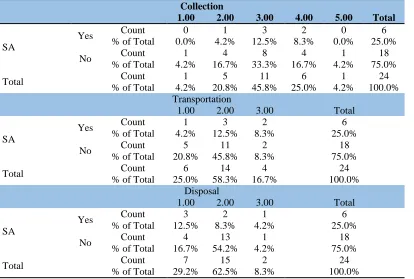
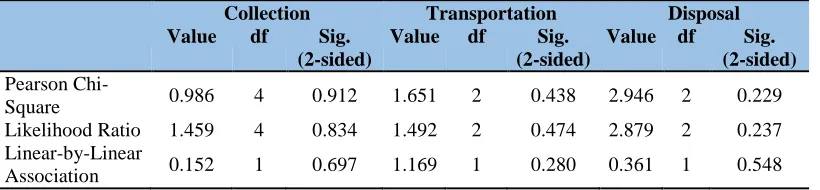
Values of each indicator was tested separately, for collection (x = 0.986; p = 0.912) where, p > 0.05, transportation (x = 1.651; p = 0.458) where, p > 0.05 and disposal (x = 2.946; p = 0.229) where, p > 0.05 (McHugh, 2012), signifies the acceptance of null hypothesis in all the three components of SWM. The study also applied the standard deviation and coefficient of variation to explore the normal distribution for the responses provided by respondents in various municipal committees. To determine the influence of strategic approach (SA) upon collection, transportation, and disposal (CTD), the study used crosstab analysis (Table 5) and identified the statistical significance of SA on CTD using the Chi-square test. The non-parametric test has been applied to finding out the significant relationships between the two.
The results of the crosstab analysis indicate that there is no strategic approach undertaken by the ULBs in Jammu region in order to provide efficient collection, transportation, and disposal of solid waste services. It is also inferred that the ULBs are least focused upon proving the services towards SWM and are not futuristic in their approach in dealing with the issue of solid waste in J&K. In order to confirm the findings, a non-parametric test was applied to the second hypothesis. (Ref. Table 6). Table 5: Crosstab analysis for collection, transportation and disposal of solid waste and strategic approach in the ULBs of J&K
Collection
1.00 2.00 3.00 4.00 5.00 Total
SA
Yes Count 0 1 3 2 0 6
% of Total 0.0% 4.2% 12.5% 8.3% 0.0% 25.0%
No Count 1 4 8 4 1 18
% of Total 4.2% 16.7% 33.3% 16.7% 4.2% 75.0%
Total Count 1 5 11 6 1 24
% of Total 4.2% 20.8% 45.8% 25.0% 4.2% 100.0% Transportation
1.00 2.00 3.00 Total
SA
Yes Count 1 3 2 6
% of Total 4.2% 12.5% 8.3% 25.0%
No Count 5 11 2 18
% of Total 20.8% 45.8% 8.3% 75.0%
Total Count 6 14 4 24
% of Total 25.0% 58.3% 16.7% 100.0%
Disposal
1.00 2.00 3.00 Total
SA
Yes Count 3 2 1 6
% of Total 12.5% 8.3% 4.2% 25.0%
No Count 4 13 1 18
% of Total 16.7% 54.2% 4.2% 75.0%
Total Count 7 15 2 24
% of Total 29.2% 62.5% 8.3% 100.0%
107
Table 6: Chi-square tests of the collection, transportation and disposal of solid waste in the ULBs of the J&K
Collection Transportation Disposal
Value df Sig. (2-sided)
Value df Sig. (2-sided)
Value df Sig. (2-sided) Pearson
Chi-Square 0.986 4 0.912 1.651 2 0.438 2.946 2 0.229
Likelihood Ratio 1.459 4 0.834 1.492 2 0.474 2.879 2 0.237 Linear-by-Linear
Association 0.152 1 0.697 1.169 1 0.280 0.361 1 0.548
Source:Authors’ own elaborations based on primary data
It was found that, in all the cases, the null hypotheses (H02) is stating that there is no relationship between strategic approach (SA) of selected institutions and selected components of SWM like collection, transportation & disposal (CTD) of solid waste can be accepted, as the p-value appears to be greater than 0.05 (McHugh,2012). The results confirm that the ULBs in the Jammu region do not have a strategic approach and that there is no strategic approach to the collection, transportation and disposal of waste material. Therefore, the survey establishes that the ULBs in J&K are required to improve their performance and efficiency based upon a well-defined strategic approach of a functional unit in order to have a sustainable SWM in the region.
5. DISCUSSION
It is established that the ULBs under the study in the region of Jammu in India do not have a strategic approach and hence the collection, transportation and the disposal of solid waste are not done as the benchmark requires (MSW rules 2016). The ULBs across the Jammu region have no vision and mission statements. Clear vision and mission statements in the respective ULBs will guide the workforce to put their efforts in the right direction. Along with the departmental work, the people involved in executing the day-to-day work of an organization must be aware of the final objective of the institution (ULB). Thus, the ULBs of the region can develop a practical and constructive vision and mission statements, unique to their organization. The ULBs of the region can supplement the vision and mission statements with the formulation of short term and long-term objectives.
Furthermore, the identified key issues or problem areas that are crucial for SWM can be ranked according to its relevance by the ULBs. In the context of the issue of SWM, the ULBs of the region are found to lack consistent assessment of their internal and external environment, as a part of the strategic process. With the assessment of the internal and external environment, the ULBs of the region can achieve clarity about its strengths and opportunities along with the identification of its weaknesses and the challenges they face. The ULBs of the region are primarily responsible for the collection, transportation and disposal of solid waste. The exploration of the status of this responsibility revealed a wretched state of SWM in the region. The strategic approach would provide for a mechanism of manpower as well as an audit and identification of deficiencies for the ULBs in providing the service towards SWM.
108
A proactive action plan is needed to face the challenge well in time. The strategic approach can provide insight towards encouraging the budding entrepreneurs under the startup program initiative by the Government of India to strengthen the standard of municipal SWM workers and set up some micro-enterprises which can deal with the problem of waste generated in the region. Also, some new rule, regulations, and acts should be enacted that will crest the awareness among the community of the state and promote the effective functioning of the municipal SWM program. The basic requirement of a strategic approach is maintaining an empirical data related to the efficiency indicators of SWM to induce transparency in their day to day operations. A reliable mechanism of data maintenance at the ULBs level is required in the region. Maintaining the data at the ULB level can help policymakers to monitor the ULBs in order to find out the problem areas. The well-maintained empirical data also reflect the efficiency of the management and the workforce of a ULB. Policymakers may link the allocation of funds to the ULBs based upon the high level of benchmarks related to maintenance of data. Reliable data shall also help in the predictive analysis for effective strategic planning.
The primary objective of an urban local body (ULB) is to reduce the volume of solid waste disposed on the land, by the recovery of materials and energy from solid waste in a cost-effective and environmentally friendly manner as per the 2016 MSW (Management and Handling) Rules. Policymakers must focus on the key areas and frame specific policies that will try improve efficient SWM programs. Moreover, the focus must be on sustainable waste management, as per the sustainable development goals (SDGs). It can be attained through strategic planning, fiscal benefits, economic & feasible technologies and adoption of models of public-private partnerships, etc.
6. CONCLUSION
The present study explores the status of a strategic approach towards the SWM in the selected institutions, i.e. ULBs or the municipal bodies in the Jammu region of India. In view of the significance of effective solid waste management, it is imperative to determine the efforts and action plans with the availability of suitable resources. The functional strategy calls for a defined process of strategy i.e. planning, implementation and evaluation, supported by the environmental engagement and proper allocation of resources. It calls for the setting up of long-term objectives and having a perspective for complementing these with the resources.
The results provide an insight to the policymakers at the functional level, specifically the ULBs in the developing regions. It indicates that while the 2016 MSW (Management and Handling) rule has given the guidelines, unless the functional units i.e. the municipal bodies/ ULBs do not have a strategic approach, the solid waste shall continue to be a disastrous spree. Hence, it is recommended that they conduct an audit for the benchmark implementation of the MSW (Management and Handling) Rules and take suitable steps for developing a strategic plan for providing professional services towards solid waste management by each and every ULB in the region. Advocacy for the strategic approach to the ULB’s will enable them to provide services based on the efficient data-based waste utilization for sustainable development in the region.
Funding: This study received no specific financial support.
Competing Interests: The authors declared that they have no conflict of interests.
Contributors/Acknowledgement: All authors participated equally in designing and estimation of current research.
109
References
Anbarasan, P., & Sushil. (2018). Stakeholders engagement in sustainable enterprise: evolving a conceptual framework, and a case study of ITC. Business Strategy and Environment, 27, 282-299. doi:10.1002/bse.1999.
Baud, I., Grafakos, S., Hordijk, M., & Post, J. (2001). Quality of life and alliances in solid waste management: contribution to urban sustainable development. Journal of Cities, 18(1), 3-12. doi:10.1016/S0264-2751(00)00049-4.
Chen, X., Geng, Y., & Fujita, T. (2010). An overview of municipal solid waste management in China. Waste Management, 30(4), 716-724.doi:10.1016/j.wasman.2009.10.011.
Elbanna, S., Andrews, R., & Pollanen, R. (2016). Strategic planning and implementation success in public service organization: evidence from Canada. Public Management Review, 18(7), 1017-1042. doi:10.1080/14719037.2015.1051576.
Ferronato, N., Portillo, M. G., Lizarazu, E. G., Torretta, V., Bezzi, M., & Ragazzi, M. (2018). The municipal solid waste management of La Paz (Bolivia): Challenges and opportunities for a sustainable development. Waste Management & Research, 36(3), 288-299. doi:10.1177/0734242X18755893.
Finlayson, B., Menthonnex, S., Thomas, F., Brimble, P., Doung, P., Dumon, J., & Huang, E. (2012). Assessment of public–private partnerships in Cambodia- constraints and opportunities. Philippines: Asian Development Bank. Retrieved March 16, 2015, from
https://www.adb.org/sites/default/files/publication/29921/assessment-ppp-cambodia.pdf.
Fuss, M., Barros, R. T., & Poganietz, W. R. (2018). Designing a framework for municipal solid waste management towards sustainability in emerging economy countries - An application to a case study in Belo Horizonte (Brazil). Journal of Cleaner Production, 178, 655-664. doi:10.1016/j.jclepro.2018.01.051.
Glaister, K., & Falshaw, R. J. (1999). Strategic planning: still going strong? Long Range Planning, 32(1), 107-116. doi:10.1016/S0024-6301(98)00131-9.
Hahn, R. (2012). ISO 26000 and the standardization of strategic management processes for sustainability and corporate social responsibility. Business Strategy and the Environment, 22(7), 442-455. doi:10.1002/bse.1751.
Ikhlayel, M. (2018). Development of management systems for sustainable municipal solid waste in developing countries: a systematic life cycle thinking approach. Journal of Cleaner Production, 180, 571-586. doi:10.1016/j.jclepro.2018.01.057.
Inglezakis, V. J., & Moustakas, K. (2015). Household hazardous waste management: a review. Journal of Environmental Management, 150, 310-321. doi:10.1016/j.jenvman.2014.11.021.
Joshi, R., & Ahmed, S. (2016). Status and challenges of municipal solid waste management in India: A review. Cogent Environmental Science, 2(1), 1-18. doi:10.1080/23311843.2016.1139434. Kum, V., Sharp, A., & Harnpornchai, N. (2005). Improving the solid waste management in Phnom
Penh city: a strategic approach. Journal of Waste Management, 25(1), 101-109. https://doi.org/10.1016/j.wasman.2004.09.004.
Kundu, A., Bagchi, S., & Kundu, D. (1999). Regional distribution of infrastructure and basic amenities in urban India: issues concerning empowerment of local bodies. Economic and Political
Weekly, 34(28), 1893-1906. Retrieved March 15, 2015, from
https://www.jstor.org/stable/4408183.
McHugh, M. L. (2012). The Chi-square test of independence. Biochemia Medica, 23(2), 143-149. Retrieved January 12, 2015, retrieved from
http://www.biochemia-medica.com/en/journal/23/2/10.11613/BM.2013.018.
Miller, C. C., & Cardinal, L. B. (1994). Strategic planning and firm performance: a synthesis of more than two decades of research. Journal of Academy of Management, 37(6), 1649-1665. doi:10.2307/256804.
Morrissey, A. J., & Browne, J. (2004). Waste management models and their applications to sustainable waste management. Waste Management, 24, 297-308. doi:10.1016/j.wasman.2003.09.005. Preuss, L. (2007). Buying into our future: sustainability initiatives in local government procurement.
110
Quan, Y., Wu, H., Li, S., & Ying, S. X. (2018). Firm sustainable development and stakeholder engagement: The role of government support. Business Strategy and the Environment, 27(8), 1145-1158. doi:10.1002/bse.2057.
Rodrigues, A. P., Fernandes, M. L., Rodrigues, M. F., Bortoluzzi, S. C., Gouvea da Costa, S. E., & Pinheiro de Lima, E. (2018). Developing criteria for performance assessment in municipal solid waste management. Journal of Cleaner Production, 186, 748-757. doi:10.1016/j.jclepro.2018.03.067.
Rodriguez‐Melo, A., & Mansouri, S. A. (2011). Stakeholder engagement: defining strategic advantage for sustainable construction. Business Strategy and the Environment, 20(8), 539-552.
Sandra, A. (2017). Approaches to formalization of the informal waste sector into municipal solid waste management systems in low- and middle-income countries: Review of barriers and success factors. Waste Management, 61, 593-607. doi:10.1016/j.wasman.2016.12.028.
Sangle, S. (2010). Empirical analysis of determinants of adoption of proactive environmental strategies in India. Business Strategy and the Environment, 19, 51-63. doi:10.1002/bse.651. Sharholy, M., Ahmad, K., Mahmood, G., & Trivedi, R. C. (2008). Municipal solid waste management
in Indian cities - A review. Waste Management, 28(2), 459-467. doi:10.1016/j.wasman.2007.02.008.
Srivastava, P. K., Kulshreshtha, K., Mohanty, C. S., Pushpangadan, P., & Singh, A. (2005). Stakeholder-based SWOT analysis for Successful Municipal Solid Waste Management in Lucknow, India. Waste Management, 25, 531-537. doi:10.1016/j.wasman.2004.08.010. Thi Kim Oanh, L., Bloemhof-Ruwaard, J. M., Joost, B. C., Jack, V. G., & Rulkens, W. H. (2015).
Modelling and evaluating municipal solid waste management strategies in a mega city: the case of ho chi minh city. Waste Management and Research, 33(4), 370-380. doi:10.1177/0734242x15572177.
Weaver, F. K., Morales, V. C., Dunn, S. L., Godde, K., & Weaver, P. F. (2017). An introduction to statistical analysis in research: with applications in the biological and life sciences. Hoboken, USA: John Wiley & Sons. doi:10.1002/9781119454205.ch8.
Xiao, S., Dong, H., Genga, Y., & Brander, M. (2018). An overview of China’s recyclable waste recycling and recommendations for integrated solutions. Resources, Conservation and Recycling, 134, 112-120. doi:10.1016/j.resconrec.2018.02.032.
Zhang, D. Q., Tan, S. K., & Gersberg, R. M. (2010). Municipal solid waste management in China: Status, problems and challenges. Journal of Environmental Management, 91(8), 1623-1633. doi:10.1016/j.jenvman.2010.03.012.