Fault Node Discovery and Efficient Route
Repairing Algorithm for Wireless Sensor Network
Vibha Paradkar #1, Gajendra Singh Chandel*2 ,Kailash Patidar #3
#
PG Scholar, Dept of CSE, Shree Satya Sai Institute of Science & Technology, Sehore(M.P.), India *
Professor, Dept of CSE, Shree Satya Sai Institute of Science & Technology,Sehore(M.P.), India #
Asst. Professor, Dept of CSE, Shree Satya Sai Institute of Science & Technology,Sehore(M.P.), India
Abstract
—
Wireless sensor network is one of most essential network technology which is widely adopted and applied in recent monitoring and control applications. With this network the wireless nodes are communicating using multi-HOP options. In this network the key issues are targeted the life time and fault node discovery and recovery technique is investigated and a new feasible and efficient solution is developed. The presented work is motivated from an article in [1]. Where the grad diffusion and a genetic algorithm is applied to find the lost node information and repair the route using the proposed routing technique. The proposed routing technique involves a new technique to discover and recover the routing path efficiently. There for a new routing technique with master and slave technique is provided in this study. Keywords—
WSN(
wireless sensor network), grad diffusion algorithm, genetic algorithm, master and slave technique.I. INTRODUCTION
The Wireless sensor network is a collection of sensors that are spread over large geographic regions. As the sensors are hugely spread and enormous in numbers, the possible occurrences of faults in the network are also much more as a fault surface increased. So, to detect the faulty node and to replace the faulty node an efficient algorithm is proposed. Besides the sensors have many issues related to energy, routing, security, coverage, etc., and so the proposed efficient detection and replacement algorithm take these issues into account and performs the fault detection and recovery mechanisms.
Failures are unavoidable in Wireless Sensor Networks due to the lack of monitoring and unattended deployment. There are many issues related to energy, memory and computational ability of a sensor node. The occurrences of faults are mostly due to the presence of faulty sensor nodes [1]. To identify a faulty node and to replace it, many techniques are proposed.
A wireless sensor network operates in a critical environment, and also with limited computing and sensing capabilities capable of sensing, computing and wirelessly communicating. The wireless ad hoc networks such as mobile ad hoc network and wireless sensor networks are frequently uses the on
demand kind of protocols. The main advantage of these routing protocols, these are establishing the routing path when it desired. Therefore, it is lightweight and efficient in working, due to less information stored in routers and they preserve the battery or other computational resources due to
less periodic updating processes. Therefore, Most of the ad hoc on demand routing protocols is working on two different phases, in first phase using the control message exchange the route discovery is performed. Using this discovery a number of paths between source and destination is obtained by routing protocols.
After that the routing protocol decided the most appropriate route and uses the selected path for transmitting data. During mobility the nodes move independently in random manner and in any direction. Thus, if the existing route of communication is abandoned due to mobility and less energy, the routing protocols are tries to recover this path using route maintenance. If the route is recoverable than routers repair the previous route and enable the communication and if it is not, then route discovery process is again initiated for new route discovery. Therefore, it is required to improve the performance during the path break conditions and recovery of both options.
In Wireless Sensor Network all sensor nodes have the equivalent probability to fail and accordingly the data delivery in sensor networks is inherently faulty and unpredictable. Most of the sensor network applications need solid data delivery to sink instead of point-to-point unwavering quality. Subsequently, it is basic to give fault tolerant techniques to distributed sensor network applications. Failures are unavoidable in Wireless Sensor Networks because of the absence of monitoring and unattended arrangement. There are numerous issues identified with energy, memory and computational capacity of a sensor node. The occurrences of faults are mostly due the presence of faulty sensor nodes .[6] To distinguish a fault node and to supplant it, numerous techniques are proposed. The main test in wireless sensor network is to enhance the fault tolerance of every node furthermore give an energy productive fast data routing service. Fault management for WSNs is not the same as traditional networks. Late research has built up several schemes and techniques that arrangement with distinctive types of faults at diverse layers of the network.
II. BACKGROUND
Routing Protocols in WSNs
Many routing algorithms were developed for wireless networks in general.
One of the main challenges in the design of routing protocols for WSNs is energy efficiency due to the scarce energy resources of sensors. The ultimate objective behind the routing protocol design is to keep the sensors operating for as long as possible, thus extending the network lifetime. The energy consumption of the sensors is dominated by data transmission and reception. Therefore, routing protocols designed for WSNs should be as energy efficient as possible to prolong the lifetime of individual sensors, and hence the network lifetime.[7]
Due to the deficiencies of the previous strategies, routing protocols become necessary in wireless sensor networks. Nevertheless, the inclusion of a routing protocol in a wireless sensor network is not a trivial task. One of the main limitations is the identification of nodes. Since wireless sensor networks are formed by a significant number of nodes, the manual assignation of unique identifiers becomes infeasible. The use of potentially unique identifier such as the MAC (Medium Access Control) address or the GPS coordinates is not recommended as it forces a significant payload in the messages.
However, this drawback is easily overcome in wireless sensor networks since an IP address is not required to identify the destination node of a specific packet. In fact, attribute-based addressing fits better with the specificities of wireless sensor networks. In this case, an attribute such as node location and sensor type is used to identify the final destination. Once nodes are identified, routing protocols are in charge of constructing and maintaining routes between distant nodes. The different ways in which routing protocols operate make them appropriate for certain applications. Concerning the routing protocols, the reduced energy resources, the scalability and the resilience arise as the main limitations in wireless sensor networks.[8]
An ad-hoc network is the agreeable engagement of a collection of mobile nodes without the obliged intervention of any brought together access point or existing infrastructure. In this paper, we studied Ad-hoc On Demand Distance Vector Routing (AODV), a novel algorithm for the operation of such ad-hoc networks. Every Mobile Host works as a particular router, and routes are obtained as required (i.e., on-demand) with almost no dependence on occasional advertisements. Our new routing algorithm is very suitable for an element beginning toward oneself network, as needed by clients wishing to use ad-hoc networks. AODV gives loop-free routes even while repairing broken links.
Ad-hoc On Demand Distance Vector Routing (AODV):
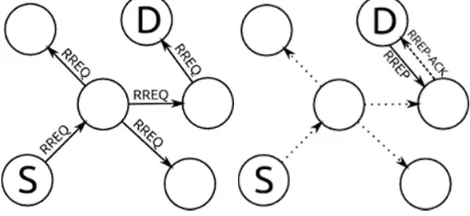
AODV is an on-demand dynamic routing protocol that uses routing tables with one entry per destination. When a source node needs a route to a destination node, it starts a route discovery process to locate the destination node in the network. The source node floods a query packet requesting a route to be set up to the destination node. As acknowledgment a reply is sent back directly to the source
node in the network either by the destination itself or any other intermediate node that has a current route to the destination. On receiving a route request (RREQ), intermediate nodes update their routing table for a reverse route to the source. Similarly, the forward route to the destination is updated on receiving a route reply (RREP) packet as shown in fig. 1. AODV uses sequence numbers to determine the timeliness of each packet, and to prevent loops. Expiry timers are used to keep the route entries fresh. Since the convention does not require global intermittent routing advertisements, the demand on the general bandwidth access to the mobile nodes is considerably not as much as in those protocols that do require such advertisements. In any case we can even now maintain the vast majority of the advantages of fundamental distance-vector routing components. We demonstrate that our algorithm scales to vast populations of mobile nodes wishing to structure ad-hoc networks. We additionally include an evaluation philosophy and simulation results to check the operation of our algorithm.
Fig. 1 showing Ad-hoc On Demand Distance Vector Routing (AODV).
Our basic approach can be known as an unadulterated on-demand route acquisition system_ nodes that don't lie on active paths not maintain any routing information or take part in any occasional routing table exchanges. Further, a hub does not need to discover and maintain a route to an alternate hub until the two need to communicate, unless the previous hub is ordering its services as an intermediate forwarding station to maintain connectivity between two different nodes.
At the point when the local connectivity of the mobile hub is of interest, every mobile hub can get to be aware of alternate nodes in its neighborhood by the use of several techniques, including local (not expanded) broadcasts known as "Hello" messages in the network. The routing tables of the nodes within the neighborhood are sorted out to enhance response time to local movements and give fast response time to requests for establishment of new routes. The algorithm's essential objectives are:
To broadcast discovery packets in the network only
when it's really necessary and needed.
To differentiate between local connectivity
management policy (neighborhood detection) and general topology maintenance strategy.
To isolate information about changes in local.
AODV uses a broadcast route discovery mechanism, as is also used (with modifications) in the Dynamic Source Routing (DSR) algorithm. Instead of source routing, however, AODV relies on alertly establishing route table entries at intermediate nodes. This distinction pays off in networks with numerous nodes, where a bigger overhead is incurred via are carrying source routes in every data packet. To maintain the most late routing information between nodes, we get the concept of destination sequence numbers from DSDV. Not at all like in DSDV, however, every ad-hoc hub maintains a monotonically increasing sequence number counter which is used to supersede stale cached routes that are already discovered. Use of a combination of these techniques, outcomes an algorithm that uses bandwidth efficiently (by minimizing the network load for control and data movement), is responsive to modifications in the topology of the network, and assure loop-free routing in the network.
Routing tables:
Routing tables Every routing table entry contains the following information as destination, next hop, number of hops, destination sequence number, and active neighbors for this route and expiration time for this route table entry. Expiration time, also called lifetime, is reset every time the route has been used in the network. now, the new updated expiration time is the summation of the current time and a parameter called active route timeout. The parameter timeout, also termed as route caching timeout, is the time after which the route is considered as invalid in the network, and so as a result the nodes not lying on the route determined by RREPs erase their reverse entries. In the event that active route timeout is enormous enough route repairs will maintain routes.
Route discovery in AODV :
The route discovery process starts when a source node does not have routing information for a node to be communicated with. Route discovery is initiated by broadcasting a RREQ(Route Request) message. The route is established when a RREP(Routing Reply) message is received. A source node may get various RREP messages with diverse routes. It is then overhauled its routing entries if and only if the RREP has a more noteworthy sequence number, i.e. fresh information.
Route maintenance in AODV :
When a broadcast RREQ packet arrives at a node having a route to the destination, the reverse path will be used for sending a RREP message. While transmitting this RREP message the forward path is set up. One can say that this forward path is a reverse of the reverse path. As soon as the forward path is assembled the data transmission can be started. Data packets waiting to be transmitted are buffered locally and transmitted in a FIFO-queue when a route is set up. After a RREP was forwarded by a node, it can receive another RREP. This new RREP will be either discarded or forwarded, depending on its destination sequence number: if the new RREP has a more noteworthy destination sequence number, then the route should be updated, and
RREP is forwarded, if the destination sequence numbers in old and new RREPs are the same, yet the new RREP has a smaller hop count, this new RREP should be favored and forwarded, and, otherwise all later arriving RREPs will be discarded.
Benefits of AODV:
The AODV routing protocol does not need any central administrative system to control the routing process. Reactive protocols like AODV tend to reduce the control traffic messages overhead at the cost of increased latency in finding new routes.
AODV reacts moderately fast to the topological
changes in the network and updates only the nodes influenced by these changes.
The HELLO messages supporting the route
maintenance are range-limited, so they don't cause unnecessary overhead in the network.
The AODV routing protocol saves storage place as
well as energy. The destination node replies only once to the first request and ignores the rest. The routing table maintains at most one entry every destination. In the event that a node has to choose between two routes, the up to date route with a more noteworthy destination sequence number is always chosen. If the routing table entry is not used recently, the entry is lapsed. A not substantial route is erased: the lapse packets reach all nodes using a failed link on its route to any destination.
III. LITERATURE REVIEW
In this section of paper, we provide the basic literature survey and related technologies used to design proposed application.
Fault node recovery (FNR)
Algorithm[1] to enhance the lifetime of a wireless sensor network (WSN) when some of the sensor nodes shut down, either because they no longer have battery energy or they have reached their operational threshold. The algorithm is based on the grade diffusion algorithm combined with the genetic algorithm. Using the FNR algorithm can result in fewer replacements of sensor nodes and more reused routing paths. Thus, the algorithm not only enhances the WSN lifetime, but also reduces the cost of replacing the sensor nodes.
Ladder diffusion and ACO
An algorithm based on ladder diffusion and ACO(Ant colony optimization)[3] is proposed to solve the major pointing issues of power consumption and transmission routing problems in wireless sensor network scenarios. The defined ladder diffusion algorithm is employed to route paths for data relay and trans- mission majorly in wireless sensor networks, also with a tendency to reduce both power consumption and time required for processing to create and maintain the routing tables and also avoiding the generation of circle routes in parallel. Another advantage is, to ensure the safety and reliability of data transmission in WSN, their algorithm also provides backup routes to avoid wasted power consumptions and processing time when rebuilding and maintain the routing table in case part of sensor nodes are missing. According to the experimental results, the proposed algorithm not only reduces power consumption by 52.36%, but also increases data forwarding efficiency by 61.11% as compared to the directed diffusion algorithm. This decrease is because the algorithm properly assigns the transmission routes to balance the load on every sensor node .
Directed Diffusion
Directed Diffusion for Wireless Sensor Networking Advances in processor, memory, and radio technology will enable small and cheap nodes capable of sensing, communication, and computation[4]. Networks of such nodes can coordinate to perform the work of distributive sensing of environmental phenomena and situations. In this work[4], they explored the directed-diffusion paradigm for such coordination scheme. Directed diffusion is data centric in that all communication is for naming data. The method ensures that nodes in a directed-diffusion-based network is application aware, that basically results in enabled diffusion to achieve energy savings by selecting empirically good paths by caching and processing data in-network (e.g., data aggregation) of sensors. They explored and evaluated the use of direct diffusion in a simple case of remote-surveillance sensor network analytically and experimentally efficient. Their evaluation outcome is that directed diffusion can achieve significant energy savings and can outperform idealized traditional schemas (e.g., omniscient multicast) under the investigated scenarios.
Reduce Identical Event Transmission Algorithm (RIET)
A Reduce Identical Event Transmission Algorithm for Wireless Sensor Networks This paper proposed a Reduce Identical Event Transmission Algorithm (RIET). The algorithm can decide that which sensor nodes could send the event to sink node when sensor nodes sense a same even. Moreover, other nodes can save power because they didn’t send the same event. In our simulation, the RIET algorithm can enhance sensor nodes life time about 12.9 times and saving power consumption about 52.43% than traditional algorithms [5].
IV. PROBLEM INDENTIFICATION
The main reason behind the losses is a basically deficiency of traditional routing protocol. During communication with the source and destination are communicating using their routing techniques multi-hop configuration. Due to this when a source node wants to send data to any other sensor node the path discovery is required. In this context after path discovery the routing algorithm decides the optimum route first and start transmission of desired data. If any intermediate node leaves their place, then a path break condition is occurring and communication is interrupted. This interrupted communication repaired using route maintenance options in traditional routing protocols.
Therefore, continuous mobility, connectivity and availability is a major issue in such networks, due to this additional control message is exchanged and network bandwidth is consumed, in addition of that packet delivery ratio of the network is also degraded during transmission. If the existing route is repaired then the performance is preserved. Thus required to enhance the route repair technique and the new path is recovered in less amount of time. This will result in efficient route recovery, reducing routing overhead.
Nodes in WSNs are prone to failure due to energy depletion, hardware failure, communication link errors, malicious attack, and so on. The Fault Node Recovery algorithm detects a faulty node whenever some of the sensor nodes shut down, either because they no longer have battery energy or they have reached their operational threshold, but it fails to detect a malicious node or unauthorized node. The presence of these malicious nodes may lead to data size, malfunction of the sensor, depletion of battery, etc. Further Grade Diffusion algorithm selects a particular group of sensors to form a routing table and hence there is a chance for the unauthorized or malicious node to get included in the routing path. In the presence of malicious node, the Fault Node Recovery algorithm fails to effectively detect and replace fault node.
V. PROPOSED APPROACH
To find an optimum outcome required to control the issues using the following strategy.
1. Discover a two nearer path between source and destination: during initiation of communication the route discovery processed is initiated first, during this source node broadcast the RREQ packets in network and using chain reaction technique the destination node is discovered. When the destination node finds the request packet, then it replays with the RREP packets. The first arrived route reply is considered as the shortest path and data is transmitted. Here's a new concept is added to make enhancement, during the route selection, two routes with nearest distance is selected for constructing the repair methodology. 2. The first path is denoted as the primary and second
secondary. The slave path is a supporting part this supporting path is preserved for use in critical conditions such as used during path break conditions as a backup route.
3. The primary path is divided into segments: in this phase the routing algorithm has two different and nearer path for a single source and destination. These paths are segmented into smaller parts. The segmentation of these path helps in finding the compromised router and immediate the path break condition is discovered.
4. Each segment includes additional information to their next hop: during segmentation of routing path the additional routing information is added to the next hop of the router. That is basically a flag value which is set when the next hop of router is un-reachable. Thus the previous host gets or discover the braked segment of the network segment.
5. When a path break occurred, then determines which segment is failed during communication: in this process the segment is detected which is broken during communication using the flag value of the router. 6. Find the secondary path for that segment: as the router
is detected where the path break occurred, the secondary path is utilized for appending with the primary path. This may help in recovering the current path which is damaged due to mobility.
7. And continue with data transfer: and finally the braked path is recovered and data transmission is carried out as previously worked.
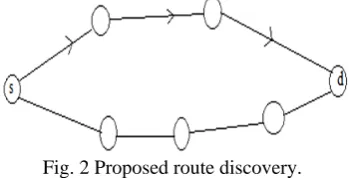
That can be understood by the following communication scenario, suppose in the network there are two nodes want to communicate and for that purpose the source route sinitiate the route discovery.
Fig. 2 Proposed route discovery.
In this situation the source node waits for route reply message, now the source routing table having some entries for communication, these entries are basically the possible path between source and destination. Therefore if the N snumber of path is routing table exist then only two paths P1 and P2 is selected which are top two entries in routing table. Suppose path P1 contains h1 hop in path and P2 contains h2 hops in path. Than for each hop source router segment the routing path in h1 and h2 segments. In addition of that each router contains a flag value which is by default set to 0, if the nodes next hop is not in radio range or not responding then the concerned router updates their flag to 1. When a source router detects the routing path contains a flag set value to 1 then it consumes the secondary path for continuous flow of communication. As given in figure 1 the source and destination having two
routes, and for communication the first route is selected which is represented using the arrow heads.
Due to mobility the intermediate route leave their place and move to other direction and path break occurred. When the existing path is broken and the path recovered using the second route which is nearer to the existing path.
VI. EXPECTED OUTCOMES
The above mentioned approach will likely to bring many of the significant outcomes as it tries to recover and repair the fault nodes in the path. There are below mentioned outcomes that we are trying to get from the approach, they are :
Our work is targeting major issues in wireless sensor network that is fault node detection and recovery using , Grad Diffusionand genetic algorithm, the techniques are appliedto find lost node information and repair the routes using proposed routing technique to discover the routing can give an optimum answer to that questions.
This proposed routing technique involves a new technique to discover and recover the route path efficiently.There for a new routing technique with master and slave technique is proposed in the above study to produce better outcomes.
CONCLUSION
With this above work we tried to build efficient fault detection and recovery algorithm will not only identify a faulty node at the same time trying to find the alternative path in the network. Sensor networks are always suffering from issues like to target the life time and fault node discovery and recovery. Techniques are already investigated and a new feasible and efficient solution is developed. Our work is based on fault node recovery alogirthm which uses grade diffusion with genetic algorithm to find the faulty node and to replace them with active node. The proposed routing technique involves a new technique master and slave to discover and recover the routing path efficiently. As this technique make use of primary,secondary path and data segementation only few sensor nodes have to be replaced in the whole network. Results to be reflected that the proposed system will efficiently find all possible faults and repair route compared to existing fault tolerant techniques in WSN.
REFERENCES
[1] Hong-Chi Shih, Jiun-Huei Ho, Bin-Yih Liao, and Jeng-Shyang Pan “Fault node recovery algorithm for wireless sensor networking” IEEE SENSORS JOURNAL, VOL. 13, NO. 7, JULY 2013 . [2] Rajiv Misra, and Chittaranjan Mandal, “Ant-aggregation: Ant Colony
Algorithm for optimal data aggregation in Wireless Sensor Networks” 1-4244-0340-5/06/2006 IEEE
[3] J. H. Ho, H. C. Shih, B. Y. Liao, and S. C. Chu, “A ladder diffusion algorithm using ant colony optimization for wireless sensor networks,” Inf. Sci., vol. 192, pp. 204–212, Jun. 2012.
[4] ] C. Intanagonwiwat, R. Govindan, D. Estrin, J. Heidemann, and F. Silva, “Directed diffusion for wireless sensor networking,” IEEE/ACM Trans. Netw., vol. 11, no. 1, pp. 2–16, Feb. 2003. [5] H. C. Shih, S. C. Chu, J. Roddick, J. H. Ho, B. Y. Liao, and J. S. Pan,
“A reduce identical event transmission algorithm for wireless sensor networks,” in Proc. 3rd Int. Conf. Intell. Human Comput. Interact., 2011, pp. 147–154.
[6] Luis Javier García Villalba , Ana Lucila Sandoval Orozco, Alicia Triviño Cabrera and Cláudia Jacy Barenco Abbas “Review Routing Protocols in Wireless Sensor Networks” published in Sensors 2009, 9,
[7] Prashant Kumar Maurya, Gaurav Sharma, Vaishali Sahu, Ashish Roberts,Mahendra Srivastava “An Overview of AODV Routing Protocol” published in International Journal of Modern Engineering Research (IJMER) Vol.2, Issue.3, May-June 2012 pp-728-732 ISSN: 2249-6645.