
Article
Post Synthetic Defect Engineering of UiO-66
Metal-Organic Framework with Iridium(III)-HEDTA
Complex and Application in Catalysis for Water
Oxydation
Giordano Gatto1, Alceo Macchioni1*, Roberto Bondi1, Fabio Marmottini1 and Ferdinando Costantino1,*
1 Department of Chemistry, Biology and Biotechnology, Università di Perugia and CIRCC, Via Elce di Sotto,
8, I-06123, Perugia, Italy
* Correspondence: [email protected];[email protected].: +39-075-585-5579 (A. M.); +39-075-585-5563 (F. C.)
Abstract: Clean production of renewable fuels is a great challenge of our scientific community. Iridium complexes have demonstrated a superior catalytic activity in the water oxidation (WO) reaction, which is a crucial step in water splitting process. Herein we have used a defective zirconium MOF with UiO-66 structure as support of a highly active Ir complex based on EDTA with formula [Ir(HEDTA)Cl]Na. The defects are induced by the partial substitution of tereftalic acid with smaller formiate groups. Anchoring of the complex occurs through a post-synthetic exchange of formiate anions, coordinated at the zirconium clusters of the MOF, with the free carboxylate group
of the [Ir(HEDTA)Cl]-complex. The modified material was tested as heterogenous catalyst for the
WO reaction by using Cerium Ammonium Nitrate as sacrificial agent. Although TOF and TON values are comparable to those of other iridium heterogenized catalysts, the MOF exhibits iridium leaching not limited at the first catalytic run, as usually observed, suggesting a lack of stability of the hybrid system under strong oxidative conditions.
Keywords: Metal-Organic Framework; Post-Synthetic Modification; Iridium Catalysis; Water Oxidation; Water Splitting
.
1. Introduction
Water oxidation (WO) to molecular oxygen is considered the ideal reaction to provide electrons
and protons for the generation of renewable fuels.[1–3]In addition to be thermodynamically disfavored,
WO is also an extremely complicated, multi-electrons and multi-protons,reaction from the kinetic
point of view, asking for an efficient and robust catalyst (C).[4] WOCs based on iridium are among the
most efficient reported in the literature so far, having, however, in the little abundance and, consequently, high cost of iridium their “Achille's heel”.[5–7] A possible strategy to alleviate this
problem stems in the minimization of the amount of noble-metal exploited in the catalytic process, according to the noble-metal atom economy principle.[5] This can be accomplished by utilizing i)
extremely active molecular catalysts at very low concentration,[8–15] ii) layered heterogeneous catalyst
in which almost all active sites are reachable by the substrate[16] and iii) heterogenized hybrid
materials derived from the anchoring a well-defined molecular catalyst on a suitable support.[17][18]
The latter strategy should guarantee a very high percentage of active sites (potentially 100%), increased robustness of catalyst, mainly due to the inhibition of associative deactivation processes, and possible beneficial cooperation between the anchored catalyst and support. Many hybrid
heterogenized catalysts have reported in the literature[17,19–23] and, among them, those using MOF as
support, pioneered by Lin and co-workers,[24,25] have been particularly successful.[26]MOFs are a class
of porous crystalline compounds constituted of the ordered connection of metal-clusters and organic linkers, forming accessible pores and channels potentially useful for a plethora of applications.[27–29]
Some of them are rapidly approaching the industrial world.[30]Zr-MOFs are particularly interesting
for their chemical and thermal stability and low production cost. The archetype structure is that of UiO-66 which is constituted of hexanuclear clusters of formula Zr6O4(OH)4(BDC)612+(BDC=
1,4-benzenedicarboxylic acid) in a cubic framework with fcu topology.[31] This MOF possess the exotic
feature to be defective when it is crystallized in the presence of a mono carboxylic modulator such as
formic, acetic or benzoic acid, which act as substituent of bdc linker attached to the Zr6 cluster thus
inducing missing linker defects into the structure. These defects can be considered as an opportunity to be employed for imparting targeted functionality to the MOFs by means the so called
Post-Synthetic Defect Exchange (PSDE) of the monocarboxylic groups with other carboxylic linkers.[32,33]
Herein we report on the synthesis of formic acid (FA) modulated UiO-66 with a high concentration of defects and its use a support foranchoring, by means of PSDE, an Ir(III) WOC
complex based on EDTA (EDTA = N,N,N’N’-Ethylenediaminotetracetic acid). The complex, of formula [Ir(HEDTA)Cl]Na (see fig. 1) was already reported in literature as an efficient and durable
homogeneous WOC under chemical oxidation with cerium ammonium nitrate as sacrificial agent.[34]
The molecular structure of the complex clearly shows that it possess a free carboxylic group which could be employed as ananchoring functionality for its deposition onto solid surface. Our approach
here consists in a PSDE of the FA-UiO-66 MOF with the [Ir(HEDTA)Cl]-complex dissolved in water.
The anchoring occurred trough a topotactic exchange of the coordinated FA with the carboxylic group of the IrCl-EDTA complex. The hybrid material (IrEDTA@UiO-66) was characterized by means of surface area and porosity studies, ICP analysis, NMR spectroscopy and tested for WO reaction by using CAN as sacrificial agent. The hybrid exhibited WO activity with TOF and TON values comparable to those of the best performing materials. However, a significant Ir leaching was observed not only during the first catalytic run, as usually observed, suggesting that strong oxidative
conditions with Ce4+leads to a rapid decomposition of the hybrid material.
Figure 1. Molecular structure of [Ir(HEDTA)Cl]Na complex
2. Results and discussion
2.1. Synthesisand characterization
2.1.1. Synthesis of FA-modulated UiO-66
FA-modulated UiO-66 was prepared according to the paper of Taddei et al.[23] The use of large
amount of formic acid as modulator (100 eq. respect to Zr) induced the formation of a highly defective
phase respect to the defective free UiO-structure, which can be obtained following other synthetic
strategies present in literature.[35]FA acts as monocarboxylic modulator with the Zr clusters inducing
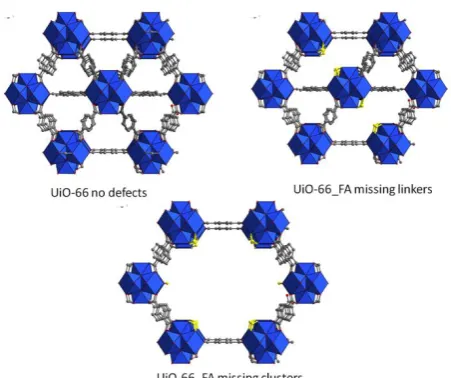
Figure 2. Structure of non-defective (a), missing linker defective (b) and missing cluster defective (c) UIO-66 phase. Formic acid is evidenced in yellow.
It is knownthat the materials obtained with FA as modulator possesses most likely missing cluster
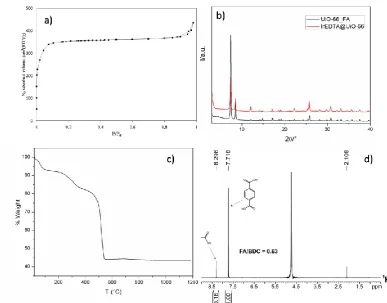
defects.[33]Nitrogen adsorption and desorption analysis at 77K was performed on FA-UiO-66
compound after activation at 120 °C overnight. The N2adsorption/desorption isotherm is reported in
figure 3a and the BET value is 1450 m2/g with a total micropore volume of 0.57 cm3/g . These values,
quite higher than the normal surface area and micropore volume of a defect-free UiO-66 (about 1100
m2/g and 0.4 cm3/g),confirm the highly defective nature of the obtained material. XRPD pattern of
FA_UiO-66 (fig. 3b)shows the peaks at 7.3 and 8.2 °of 2θ belonging to the (111) and (200) of the fcu
UiO-66 phase, and a remarkable crystallinity degree.1H-NMR spectra on thehydrolyzed compound
(fig.3b) confirm the presence of a considerable amount of FA, as can be seen in figure 3d. Integration
of 1H-NMR signals belonging to formic acid (8.3ppm) and terepthalic acid (7.8 ppm) gives a FA/BDC
ratio equal to 0.63. The obtained solution after the hydrolysis of the sample with NaOH was analysed
by ion chromatography resulting the following BDC and FA contents in the starting solid: BDC = 2.78
mmol/g and FA = 1.72 mmol/g.
Given these results, the ratio FA/BDC = 0.63 is in very good agreement with the results of NMR
experiments. Since FA is a monocarboxylic acid, the following equation can be used in order to determine the formula of the defective MOF:
𝐹𝐴
𝐵𝐷𝐶
=
2𝑥
6 − 𝑥
= 0,62
Resulting in Zr6O4(OH)4(BDC)4.58(FA)2.74.Thermogravimetric analysis (fig.3c) shows three different
weight losses at 100 °C (7.5%), 330 °C (11%) and 540 °C (38%) due to the loss of water molecules and
decomposition of the organic part of the MOF. If the plateau in the 550 °C to 1200 °C temperature range is assumed to be 6 ZrO2 (MW = 123 g/mol), we can use this value as reference (100 %) for
extrapolating the theoretical formula from the analysis. The normalized weight at 100 °C is therefore 213%. The experimental formula weight from TGA analysis at 100 °C is therefore 1572 g/mol. Being the mass of the defective, desolvated MOF of formula Zr6O4(OH)4(BDC)4.58(FA)2.74= 1555 g/mol, this is
Figure 3. N2 adsorption and desorption isotherm (a). XRPD patterns of FA_UiO-66 (black) and
Ir-EDTA@UiO-66(1) (red) (b). TGA curve for FA_UiO-66 (c) and 1H-NMR spectrum for hydrolyzed
FA_UiO-66 MOF (NaOD/D2O, 298 K).
2.1.2 Synthesis of IrEDTA@UiO-66
The PSE process for anchoring the Ir-EDTA complex onto the cluster surface is shown in figure 4. After soaking the evacuated MOF into a water solution containing the dissolved complex (0.02 M) and heating at 80°C for 24 h, the partial exchange of FA with the free carboxylic group of the complex occurred.
Figure 4. PSDE of FA with Ir-EDTA complex
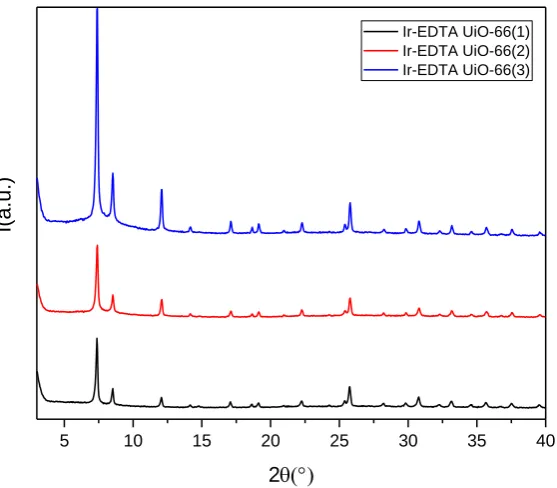
ICP-OES analysis for the determination of Ir content gave the following results: IrEDTA@UiO-66(1) = 256 µmol/g; IrEDTA@UiO-66(2) = 226 µmol/g and IrETA@UiO-66(3) =170 µmol/g). The XRPD patterns of the three samples are shown in figure 5. Anchoring Ir-EDTA onto the cluster surface did not affect the structure of the MOF since the characteristic peaks remained unaltered.
Figure 5. XRPD pattern of Ir-EDTA@UiO66(1), black, (2) red and (3) blue.
Figure 6 shows the 1H-NMR spectrum of the hydrolyzed Ir@UiO-66(1) sample. The peak at 8.3 ppm
attributed to FA exhibits a reduced intensity and the integration with that of BDC gave as result FA/BDC = 0.10. This value is about 6 times lower than the unmodified defective MOF (FA/BDC = 0.63) meaning that the most part of FA was successfully exchanged by Ir-EDTA complex. Peaks belonging Ir-EDTA complex are clearly visible at 3 and 2.2 ppm. With this new ratio the calculated formula becomes Zr6O4(OH)4(BDC)4.58(FA)0.5(Ir-EDTA)2.24
Figure 6. 1H-NMR spectrum of hydrolized Ir@UiO-66(1) sample [NaOD/D2O, 298 K; * denote
impurities present in the solvent, likely acetone (ca 2 ppm) and TMS (slightly lower than 0 ppm)].
2.3 Water oxidation catalytic activity of IrEDTA@UiO-66
5 10 15 20 25 30 35 40
Ir-EDTA UiO-66(1) Ir-EDTA UiO-66(2) Ir-EDTA UiO-66(3)
I(a
.u.
)
Herein, the catalytic activity of IrEDTA@UiO-66 hybrid materials toward water oxidation to
molecular oxygen(Eq. 1) is described. Catalytic tests were carried out by using Ce4+ (added as CAN)
as a sacrificial oxidant, dispersing the proper amount of catalyst in acidic water (pH 1, 0.1 M HNO3)
at 25 °C.
4Ce4+ + 2H2O → 4Ce3+ + 4H+ + O2 (1)
The evolved gas, according to Eq. 1, was quantified by differential manometry (Experimental Section). In a first series of experiments, a consecutive triple addition (100 l, 150 l and 500 l) of a
1.25 M solution of CAN to 4.9 ml of a 51.5 M IrEDTA@UiO-66 suspension was executed (Table 1,
entries 1-3; Figure 7). IrEDTA@UiO-66 was found to be a competent catalyst for water oxidation and
exhibited a TOF of ca.5 min-1and TON values included between 62 and 308 with (yields = 30-50 %).
A second series of measurements was performed with the aim of evaluating possible leaching of the molecular catalyst from the MOF support. Particularly, a catalytic run was executed by using 73.12
µM IrEDTA@UiO-66 and 75 mM CAN (Table 1, entry 4). At the end of O2 evolution IrEDTA@UiO-66
was recovered by filtration and the supernatant solution tested by the addition of another aliquot of 75 mM CAN (Table 1, entry 5). Also the recovered solid was tested under the same conditions (Table 1, entry 6). At the end of the reaction the solid catalyst was again recovered by filtration and the
second supernatant tested (Table 1, entry 7). The measured TOF (4 min-1) and TON(108, yield = 42 %)
values of the starting IrEDTA@UiO-66 are nicely consistent with those observed in the first series of
experiments. Also the recovered solid IrEDTA@UiO-66 exhibits similar TOF (6 min-1) and TOF (180,
yield = 67 %) values. Nevertheless, the two supernatants are active, with even higher TOF (10 min-1
and 13min-1) but comparable TON (363, yield = 44% and 1013, yield = 46 %) values, evidencing some
leaching of iridium in solution. ICP-OES measurements indicate that 30.98 % and 30.75 % of iridium leached out from IrEDTA@UiO-66 after the first and second catalytic run, respectively.
The catalytic activity of IrEDTA@UiO-66 well compare with those of the molecular precursor[34]
and hybrid material IrEDTA@TiO2,[20] tested under similar conditions, in terms of TOF (Table 1,
entries 8-10 and 12).The TON values are clearly lower than those observed for the molecular
precursor, which provide 100 % yield, and somewhat smaller also than those of IrEDTA@TiO2(Table
1, entries 8-10 and 12). Nevertheless, the main criticality of IrEDTA@UiO-66 seems to be the leaching
of iridium, occurring also after the second catalytic run, contrary to what observed for IrEDTA@TiO2
(Table 1, entries 11 and 13) and other heterogenized iridium catalysts reported before.[20],[17] Several
explanations might be provided for such a phenomenon. It can be hypothesized some Ce4+ might
undergo an exchange with the Zr4+ ions of MOF, becoming not anymore available for driving the
oxidative splitting of water. Alternatively, it might be hypothesized that the oxidative potential of iridium inIrEDTA@UiO-66 is slightly higher than in the molecular precursor and hybrid material
IrEDTA@TiO2, thus asking for a higher Ce4+/Ce3+ratio in order to reach the appropriate “Nernstian”
potential for WO.[36] Both the explanations are consistent with the observation that the addition of a
second aliquot of CAN restores the catalytic activity.
A catalytic run with a large amount of IrEDTA@UiO-66 (50 mg, 2.61 mM; CAN = 75 mM) was
performed in order to recover and analyse IrEDTA@UiO-66 post-catalysis. The 1H NMR spectrum of
the recovered solid digested in NaOD is significantly different than that before catalysis (Figure 8). In particular, the typical resonances of the –CH2 protons of EDTA in the 2.0 – 3.2 ppm are not anymore
visible in the post-catalysis sample, suggesting a complete degradation of the ligand framework.[37]
Because the recovered solid is still active in WO, it might be hypothesized that after EDTA-degradation some iridium remains attached at the MOF structure, possibly through the formation of
Zr–O–Ir oxo bridges, as observed in heterogenized WOCs prepared by anchoring an Ir-Kläui
molecular precursor onto BiVO4 nanopyramids.[17]
Entry [Ir] [CAN] d[O2]/dt TOF TON yield
M mM mM/min min
-1
%
IrEDTA@UiO-66
1 Run I 50 25 0.23 5 67 54
2 Run II 49 38 0.19 4 32 33
3 Run III 45 126 0.29 6 382 55
4 Run I 73 75 0.31 4 108 42
5 Sur I 23 75 0.22 10 363 44
6 Run II 70 75 0.41 6 180 67
7 Sur II 9 75 0.11 13 1013 46
IrEDTA[34]
8 Run I 5 80 7 4000 100
9 Run II 5 20 7 1000 100
IrEDTA@TiO2[20]
10 Run I 35 9 4 46 70
11 Sur I 10 9 7 141 59
12 Run II 25 9 4 78 83
13 Sur II 0 10 – – –
Figure 7. [O2] (bottom )and d[O2]/dt (up)versus time trends for a WO triple CAN addition experiment
Figure 8.1H NMR spectra(NaOD/D2O, 298K) before (bottom) and after (up) a catalytic run, showing
the disappearance of the aliphatic resonance of the EDTA ligand at 2.0 – 3.2 ppm.
Experimental Section
4. Materials and Methods
4.1 Synthetic procedures
All reagents were used as received without further purification: ZrCl4, Cerium Ammonium Nitrate
(CAN), Formic acid (FA), Tereftalic acid (BDC) and N,N-Dimethylformamide (DMF) was purchased from Sigma Aldrich (St. Louis, MO, USA). [Ir(HEDTA)Cl]Na was prepared according to ref [34].
Synthesis of FA-UiO-66
ZrCl4(0.60 g,2.5mmol) was dissolved in DMF(40 mL). Then, water (0.135 mL,7.5mmol), FA (9.4 mL,
250 mmol) and bdc (0.435 g, 2,5 mmol) were added to the solution. The mixture was sonicated until complete dissolution and divided in 4 vials (10 ml each)and heated into an oven at 120 °C for 16h. After the reaction, the solid was recovered for centrifugation and wahsed with DMF (one time after 2h soaking), water (2h soaking) and acetone (one time after 10 min soaking). At the end, the solid was dried in an oven at 80 °C for 2h.
Synthesis of IrEDTA@UiO-66 via PSDE
4.2 Analytical and instrumental procedures.
Powder X-Ray Diffraction (PXRD). PXRD patterns were collected in reflection geometry in the
4-40° 2θ range, with a 40 s step-1 counting time and with a step size of 0.016°on a PANalytical X’PERT
PRO diffractometer(Malvern Panalytical Ltd., Malvern,UK), PW3050 goniometer, (Malvern
Panalytical Ltd., Malvern,UK)equipped with an X’Celerator detector(Malvern Panalytical Ltd.,
Malvern,UK) by using the Cu Kα radiation.The long fine focus (LFF) ceramic tube operated at 40 kV
and 40 mA.
Thermogravimetric analysis (TGA). TGA was performed using a Netzsch STA490C
thermoanalyzer(NETZSCH Group, Selb, Germany)under a 20 mL min-1 air flux with a heating rate
of 10 °C min-1.
Nitrogen adsorption and desorption isotherms. N2 adsorption/desorption isotherms were performed
using a Micromeritics ASAP 2010 analyser (Micromeritics, Norcross, GA, USA). Prior of the analysis, the samples were degased overnight under vacuum at 120 °C. B.E.T. analysis and t-plot analysis of the adsorption data were used to calculate specific surface area and micropore volume respectively. Harksin and Jura equation was used as reference for the statistical thickness calculation.
Ion-Chromatography Analysis.Ion chromatography was made using a Dionex 500 (Dionex Corp. Sunnyvale, USA) apparatus with a CD20 suppressed conductivity module. Sample analysis was performed as follow: About 30 mg of sample was dispersed in 40mL of NaOH 0.0125 M and refluxed for 2 hours. After reflux, the solution was diluted to 100mL by water. The resulting solution was analysed by ion chromatography using a Dionex AS11column and eluted with a flux of 1.5 mL/min with NaOH 6mM in the case of BDC analysis or NaOH 0.1mM in the case of FA analysis.
ICP-OES Analysis.The ICP-OES analysis was carried out using a Varian 700-ES series (Agilent Technologies, Santa Clara, USA) with a standard (2,5,7,10 mg/L respectively) of Iridium solution.
WO catalytic experiments. Catalytic experiments were performed using two homemade jacketed glass reactors coupled to a Testo 521-1 manometer. In a typical catalytic run, IrEDTA@UiO-66
suspended in a 0.1 M HNO3 solution was loaded into the first reaction vessel (working cell), whereas
an equal amount of neat water was loaded into the second one (reference cell). Both reactors were sealed with a rubber septum, connected to the manometer, kept at a constant temperature of 25 °C and placed under stirring for 20 minutes. Acquisition was started. When a steady baseline was achieved, an equal volume of a solution of CAN and neat water were injected into the working cell and reference cell, respectively, to reach a final volume of 5 mL in each reactor. The concentration of the stock solution of CAN was adjusted, depending on the final concentration desired, in order to
have a maximum injection volume of 500L. The total gas evolved was estimated by measuring the
differential pressure between the working and reference cell.
Fitting methodology and kinetic data analyses. All trends of[O2] evolution versus time were fitted by
a composite mathematical function developed by Peters and Baskin (PB) for distinguishing sigmoidal and bilinear growth profiles of plant roots.[38]The derivative of the PB fits provided reaction rate (v =
d[O2]/dt) trends as function of time.Reaction rate over catalyst concentration led to TOF (= v/[Ir]),
which was plotted versus the factor conversion X (= 4[O2]/[CAN]0).[9]
5. Conclusions
In this paper a catalytic active Ir complex based on EDTA was successfully anchored onto a defective Zr-MOF with UiO-66 structure. The post-synthetic modification of defective MOF for designing a new heterogenous catalyst was here validated for the first time demonstrating that substitution of small formiate anions linked to zirconium clusters with larger carboxylate-bearing
complex is possible. The material was employed for water oxidation reaction using Ce4+ as sacrificial
agent. The catalyst showed a good catalytic activity, comparable to that observed for other heterogenized catalysts. However, Ir-leaching occurs not only during the first catalytic run, as usually observed,but also for the successive ones. This fact suggests that the material is not stable under the
strong oxidative conditions due to the high redox potential of Ce4+. Furthermore, the WO reaction
yield is somewhat lower than that observed for other heterogenized iridium WOCs, indicating a
potential. Despite those drawbacks, the results reported in this paper suggest that anchoring a molecular WOC onto a defective MOF is a viable strategy to assemble hybrid material to be integrated into a device for the generation of renewable fuels.
References
[1] J. H. Alstrum-Acevedo, M. K. Brennaman, T. J. Meyer, Inorg. Chem.2005, 44, 6802–6827. [2] N. S. Lewis, D. G. Nocera, Proc. Natl. Acad. Sci.2006, 103, 15729 LP – 15735.
[3] V. Balzani, A. Credi, M. Venturi, ChemSusChem2008, 1, 26–58.
[4] A. Llobet, Molecular Water Oxidation Catalysis: A Key Topic for New Sustainable Energy Conversion Schemes,
Wiley-Interscience: New York, 2014.
[5] A. Macchioni, Eur. J. Inorg. Chem.2019, 2019, 7–17.
[6] I. Corbucci, A. Macchioni, M. Albrecht, in Iridium Optoelectron. Photonics Appl., John Wiley & Sons Ltd.,
2017, pp. 617–654.
[7] J. M. Thomsen, D. L. Huang, R. H. Crabtree, G. W. Brudvig, Dalt. Trans.2015, 44, 12452–12472.
[8] G. Menendez Rodriguez, A. Bucci, R. Hutchinson, G. Bellachioma, C. Zuccaccia, S. Giovagnoli, H. Idriss,
A. Macchioni, ACS Energy Lett.2017, 2, 105–110.
[9] A. Macchioni, G. Menendez Rodriguez, G. Gatto, C. Zuccaccia, ChemSusChem2017, 4503–4509.
[10] T. K. Michaelos, D. Y. Shopov, S. B. Sinha, L. S. Sharninghausen, K. J. Fisher, H. M. C. Lant, R. H.
Crabtree, G. W. Brudvig, Acc. Chem. Res.2017, 50, 952–959.
[11] K. R. Yang, A. J. Matula, G. Kwon, J. Hong, S. W. Sheehan, J. M. Thomsen, G. W. Brudvig, R. H. Crabtree,
D. M. Tiede, L. X. Chen, et al., J. Am. Chem. Soc.2016, 138, 5511–5514.
[12] J. A. Woods, R. Lalrempuia, A. Petronilho, N. D. McDaniel, H. Muller-Bunz, M. Albrecht, S. Bernhard,
Energy Environ. Sci.2014, 7, 2316–2328.
[13] A. Venturini, A. Barbieri, J. N. H. Reek, D. G. H. Hetterscheid, Chem. - A Eur. J.2014, 20, 5358–5368. [14] N. D. McDaniel, F. J. Coughlin, L. L. Tinker, S. Bernhard, J. Am. Chem. Soc.2008, 130, 210–217. [15] M. Li, K. Takada, J. I. Goldsmith, S. Bernhard, Inorg. Chem.2016, 55, 518–526.
[16] L. Fagiolari, A. Scafuri, F. Costantino, R. Vivani, M. Nocchetti, A. Macchioni, Chempluschem2016, 81, 1060–1063.
[17] X. Wan, L. Wang, C.-L. Dong, G. Menendez Rodriguez, Y.-C. Huang, A. Macchioni, S. Shen, ACS Energy
Lett.2018, 3, 1613–1619.
[18] S. W. Sheehan, J. M. Thomsen, U. Hintermair, R. H. Crabtree, G. W. Brudvig, C. A. Schmuttenmaer, Nat.
Commun.2015, 6, DOI 10.1038/ncomms7469.
[19] Z. Chen, J. J. Concepcion, X. Hu, W. Yang, P. G. Hoertz, T. J. Meyer, Proc. Natl. Acad. Sci. U. S. A.2010, 107, 7225–7229.
[20] A. Savini, A. Bucci, M. Nocchetti, R. Vivani, H. Idriss, A. Macchioni, ACS Catal.2015, 5, 264–271. [21] G. Pastori, K. Wahab, A. Bucci, G. Bellachioma, C. Zuccaccia, J. Llorca, H. Idriss, A. Macchioni, Chem. –
A Eur. J.2016, 22, 13459–13463.
[22] K. L. Materna, B. Rudshteyn, B. J. Brennan, M. H. Kane, A. J. Bloomfield, D. L. Huang, D. Y. Shopov, V.
S. Batista, R. H. Crabtree, G. W. Brudvig, ACS Catal.2016, 6, 5371–5377.
[23] K. L. Materna, R. H. Crabtree, G. W. Brudvig, Chem. Soc. Rev.2017, 46, 6099–6110. [24] C. Wang, Z. Xie, K. E. DeKrafft, W. Lin, J. Am. Chem. Soc.2011, 133, 13445–13454. [25] C. Wang, J. L. Wang, W. Lin, J. Am. Chem. Soc.2012, 134, 19895–19908.
[27] K. Adil, Y. Belmabkhout, R. S. Pillai, A. Cadiau, P. M. Bhatt, A. H. Assen, G. Maurin, M. Eddaoudi, Chem.
Soc. Rev.2017, 46, 3402–3430.
[28] Z. Chen, K. Adil, Ł. J. Weseliński, Y. Belmabkhout, M. Eddaoudi, J. Mater. Chem. A2015, 3, 6276–6281. [29] J. Escorihuela, R. Narducci, V. Compañ, F. Costantino, Adv. Mater. Interfaces2019, 6, 1801146.
[30] P. Silva, S. M. F. Vilela, J. P. C. Tomé, F. A. Almeida Paz, Chem. Soc. Rev.2015, 44, 6774–6803.
[31] J. H. Cavka, S. Jakobsen, U. Olsbye, N. Guillou, C. Lamberti, S. Bordiga, K. P. Lillerud, J. Am. Chem.
Soc.2008, 130, 13850–13851.
[32] M. Taddei, Coord. Chem. Rev.2017, 343, 1–24.
[33] M. Taddei, R. J. Wakeham, A. Koutsianos, E. Andreoli, A. R. Barron, Angew. Chemie Int. Ed.2018, 57, 11706–11710.
[34] A. Savini, G. Bellachioma, S. Bolaño, L. Rocchigiani, C. Zuccaccia, D. Zuccaccia, A. Macchioni,
ChemSusChem2012, 5, 1415–1419.
[35] M. R. DeStefano, T. Islamoglu, S. J. Garibay, J. T. Hupp, O. K. Farha, Chem. Mater.2017, 29, 1357–1361. [36] Z. Codolà, I. Gamba, F. Acuña-Parés, C. Casadevall, M. Clémancey, J.-M. Latour, J. M. Luis, J.
Lloret-Fillol, M. Costas, J. Am. Chem. Soc.2019, 141, 323–333.
[37] C. Zuccaccia, G. Bellachioma, O. Bortolini, A. Bucci, A. Savini, A. Macchioni, Chem. - A Eur. J.2014, 20, 3446–3456.
[38] W. S. Peters, T. I. Baskin, Plant Methods2006, 2, 11.
Author Contributions: conceptualization, F.C and A.M.; methodology, F.C. F.M. A.M.; formal analysis, G.G., R.B. and F.M.; data curation, G.G. F.M. and F.C.; writing—original draft preparation, F.C. and A.M.; writing— review and editing, F.C. and A.M.
Funding: This research was funded by PRIN 2015 (20154X9ATP_004) and University of Perugia and MIUR (AMIS, “Dipartimenti di Eccellenza - 2018-2022” program).G. G. thanks Regione Umbria - "Umbria A.R.C.O." for a post-doc grant. Authors also thanks Forndo Ricerca di Base 2017 (FRB2017) University of Perugia for the financial support.
![Figure 1. Molecular structure of [Ir(HEDTA)Cl]Na complex](https://thumb-us.123doks.com/thumbv2/123dok_us/7900295.1311442/2.595.98.233.436.566/figure-molecular-structure-ir-hedta-cl-na-complex.webp)
![Figure 7. [O2] (bottom )and d[O2]/dt (up)versus time trends for a WO triple CAN addition experiment (Table 1, entries 1-3)](https://thumb-us.123doks.com/thumbv2/123dok_us/7900295.1311442/7.595.127.468.59.726/figure-versus-trends-triple-addition-experiment-table-entries.webp)

