Reserved Self-training: A Semi-supervised Sentiment Classification
Method for Chinese Microblogs
Zhiguang Liu Xishuang Dong Yi Guan∗ Jinfeng Yang School of Computer Science and Technology
Harbin Institute of Technology, Harbin, China
{triggerliu, dongxishuang, yangjinfeng2010}@gmail.com [email protected]
Abstract
The imbalanced sentiment distribution of microblogs induces bad performance of binary classifiers on the minority class. To address this problem, we present a semi-supervised method for sentiment classi-fication of Chinese microblogs. This method is similar to self-training, except that, a set of labeled samples is reserved for a confidence scores computing pro-cess through which samples that are less than a predefined confidence score thresh-old are incorporated into training set for retraining. By doing this, the classifier is able to boost the performance on the mi-nority class samples. Experiments on the NLP&CC2012 Chinese microblog evalu-ation data set demonstrated that reserved self-training outperforms the best run by 2.06% macro-averaged and 2.30% micro-averaged F-measure, respectively.
1 Introduction
Sentiment classification aims to label peoples opinions as different categories such as positive and negative from a given piece of text (Pang et al., 2002). Currently, related research on tradi-tional online media, such as blogs, forums, and online reviews, has made great progress (Baner-jee and Agarwal, 2012; Liu et al., 2005). Howev-er, sentiment classification of microblogs is hard to process due to some unique characteristics of microblogs, for example, short length of update messages and language variations. Moreover, top-ic based mtop-icroblogs are related with peoples daily lives and people are more likely to post some neg-ative messages to show their unsatisfactoriness, which may partially result in imbalanced senti-ment class distributions. For example, the
num-∗
Corresponding author: [email protected]
ber of negative tweets is far more than that of pos-itive in some topics, which is different from the previous work on sentiment classification that as-sumes the balance between positive and negative samples (Chawla et al., 2002; Yen and Lee, 2009). While supervised techniques have been wide-ly used in sentiment classification (Pang et al., 2002), the main problem that supervised method-s method-suffered imethod-s that they rely on labeled data method- sole-ly. Semi-supervised methods, which make use of both labeled and unlabeled data, are ideal for sen-timent classification, since the cost of labeling da-ta is high whereas unlabeled dada-ta are often readily available or easily obtained (Ortigosa-Hern´andez et al., 2012). However, there are some drawback-s of drawback-semi-drawback-supervidrawback-sed approachedrawback-s drawback-such adrawback-s modrawback-st of the work assume that the positive and negative samples in both labeled and unlabeled data set are balanced, otherwise models often bias towards the majority class (Chawla et al., 2002; Yen and Lee, 2009). In addition, most existing studies on imbal-anced classification focus on supervised learning methods, with few on semi-supervised approach-es (Li et al., 2011).
In this study, we propose a reserved self-training method for binary sentiment classification inspired by active learning strategies (Ryan, 2011). Active learning systems interact with domain experts who are responsible for annotating unlabeled samples, and aim to achieve better performance with less training data (Wu and Ostendorf, 2013). The key to active learning is to find an appropriate query strategy such as the classifier poses queries to de-cide which samples are most informative. We ran-domly reserved a portion of labeled samples be-fore training. Reserved self-training is the pro-cess of simulating active learning that repeatedly queries our reserved samples and then incorpo-rates the labeled samples about which the classi-fier is least certain into training corpus for retrain-ing, thus the retrained classifier is able to improve
the performance of classification on the minority class.
The remainder of this paper is organized as follows. The next section reviews some related work on semi-supervised sentiment classification as well as imbalanced classification briefly. We formally define the task in section 3. Section 4 presents our approach of reserved self-training al-gorithm for imbalanced sentiment classification. Section 5 provides experimental results on a da-ta set of 20 topics. Finally, section 6 summarizes the work, draws some conclusions, and suggests related future work.
2 Related Work
Sentiment classification ranges from the documen-t level, documen-to documen-the sendocumen-tence and phrase level, and we concentrate on sentence level classification. Sen-tence level sentiment classification methods can be categorized into three types: supervised (Pang et al., 2002) unsupervised (Turney, 2002), and semi-supervised learning methods (Singh et al., 2008) among which semi-supervised approaches are more appropriate for sentiment classification of microblogs due to their capability of making use of both labeled and unlabeled data. Anoth-er related work is imbalanced classification stems from several unique characteristics possessed by microblogs (A detailed study can be found in sec-tion 3.2).
2.1 Related Semi-supervised Sentiment Classification Works
Semi-supervised learning approaches make good use of a small portion of labeled and a large amount of unlabeled data to build a better clas-sifier. One of the bottlenecks in applying super-vised learning is that it needs to label many sam-ples by domain experts. To save the work of man-ual annotation, Riloff et al. (2003) introduced a bootstrapping method which was able to automat-ically label training samples. They started on a few seeds for training, subsequently, incorporated five highest scores unlabeled samples into training corpus to retrain the model iteratively. Chang et al. (2007) added some restrictions to self-training, making it possible to produce better feedback in-formation in the learning process. For a given clas-sification task, one of the problems of adopting co-training is that it assumes two conditionally inde-pendent feature sets could be extracted (Blum and
Mitchell, 1998). Although further studies loosed this strong assumption (Balcan et al., 2004), t-wo classifiers must be different enough to achieve complementation. Li et al. (2011) proposed a ran-dom subspace generation algorithm for co-training applied to imbalanced sentiment classification, but its corpus limited to English product reviews.
2.2 Related Imbalanced Classification Works
Imbalanced classification, as an appealing task, has been extensively studied in many research areas such as pattern recognition (Barandela et al., 2003) and data mining (Chawla et al., 2004). We pay special attention to resampling and cost-sensitive methods, since they are widely ap-plied in imbalanced classification. Other methods such as induction technique and boosting (Weiss, 2004) are beyond the scope of this paper.
Resampling is a process in which the size of training samples is changed to modify the over-all size and distribution of a corpus, among these methods downsampling and oversampling are t-wo widely used resampling techniques. Down-sampling (Barandela et al., 2003) takes a sub-set of majority classes samples whereas oversam-pling (Chawla et al., 2002) randomly repeats mi-nority classes samples to keep balance between different classes. Downsampling needs shorter training time, at the expense of disregarding poten-tially useful samples. Oversampling increases the size of training data set that leads to a longer train-ing time. Moreover, oversampltrain-ing may cause over fitting due to minority class samples are random-ly duplicated (Chawla et al., 2002; Drummond et al., 2003). In addition to the basic downsampling and oversampling techniques, there are some oth-er sampling methods working in a more compli-cated fashion. SMOTE (Chawla et al., 2002) cre-ated some synthetic minority class examples and then performed a combination of oversampling and downsampling, which achieved better perfor-mance than only applying downsampling. Some other methods integrated different sampling strate-gies to obtain further improvement(Batista et al., 2004).
classifier into an equivalent cost-sensitive via a wrapper approach, or taking the cost of missification into consideration when training a clas-sifier by labeled samples.
3 Task Definition
We first give a formal definition of our task, and then analyze the unique characters of Chinese mi-croblogs compared to traditional online media, such as forums and blogs.
3.1 The Task
Our study involves classifying opinions of Chi-nese microblogs as either positive or negative. We perform sentence level sentiment classification for a given message of microblogs. We first conduc-t some preprocessing such as word segmenconduc-taconduc-tion and noisy symbols filtering. Subsequently, fea-tures for the classifier are extracted from each mes-sage. Finally, reserved self-training is employed to predict unlabeled data. Although we restrict the s-cope of study on Chinese microblogs, the method proposed in this study can be straightly extended in support of other languages such as English.
Here is an instance of illustrating our task. For a message “#50‡<)7 ‘/# p•¢ • §ò5˜½ wwœ@oX” (#The 50 places you must see# The Great Wall of China is amazing, I will visit it someday in future@ Lei Li, a Chinese name). The words between the # sym-bol refers to a relevant topic and the symsym-bol @ means a mention or reply. This message is expect-ed to be parsexpect-ed into a triple: (Topic: The 50 places you must see), (Content: The Great Wall of China is amazing, I will visit it someday in future), (Po-larity: Positive). Here, -Topic.is a key word people interested; -Content.refers to the con-tent of a posted message;-Polarity.denotes the predicted polarity produced by our model, and the possible values for it could be positive and nega-tive.
3.2 Characteristics of Sentiment
Classification of Chinese Microblogs
Compared with traditional media such as blog and product reviews, detecting sentiment from mi-croblogs is much harder due to the following chal-lenges posed by microblogs. First, different from English, each written Chinese sentence need to be split into a sequence of words, however, the fre-quent use of informal and irregular words in
mi-croblogs may hinder the accuracy of segmenta-tion. Second, the short length of messages and language variation contribute to the data sparsi-ty problem. Third, different from previous work which concentrated on specific domain such as digital product reviews, sentiment classification of microblogs involves multi-domain information, thus, the model trained on one domain may per-form badly when shift to another one. Lastly, the dynamic updates feature of microblogs means that sentiment class distributions may vary over time, in which case we need to handle imbalanced sen-timent classification.
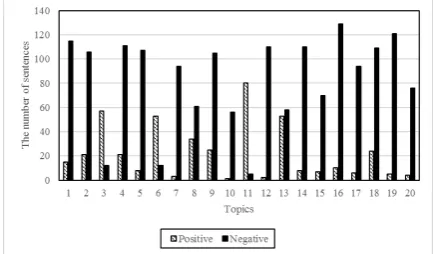
The NLP&CC20121evaluation data set consist-s of 20 topicconsist-s collected from Tencent Microblog2, involving multiple domains such as political, en-vironmental, and health issues. Illustrated in Fig-ure 1, it can be observed that all the classes of training corpus are biased. In particular, positive sentences account for the majority class in topic 3, 6, and 11, which is different from the other topics.
Figure 1: Class distributions of positive and nega-tive samples in 20 topics
4 Reserved Self-Training for Imbalanced Classification
In this study, we incorporate a learning strategy into self-training, inspired by active learning, to tackle the imbalanced binary classification prob-lems.
4.1 Self-training
Self-training is a common method of semi-supervised learning which makes use of both the labeled and unlabeled data as training corpus. As shown in Algorithm 1, Self-training is a wrap-per algorithm that iteratively applies suwrap-pervised
1
Algorithm 1The self-training algorithm Input:
Labeled dataL
Unlabeled dataU. Procedure:
1. Apply supervised method to train a classi-fierCwithL.
2. Make predictions on unlabeled dataUwith
C.
3. Incorporate the most confidently predicted unlabeled dataMinUalong with each predict-ed label intoL=L∪M.
4. Loop for S iterations. Output:
New labeled sample setLand classifierC.
method inside. It starts training on labeled da-ta only, after each iteration, the most confident-ly predicted unlabeled samples would be incorpo-rated as additional labeled data, decided by con-fidence scores calculation function. However, ap-plying self-training to sentiment classification of Chinese microblogs in both subjectivity detection and sentiment classification performed not as well as expected, and the prediction results often bias towards the majority class. Comparing with ful-ly supervised methods, the performance of self-training is even worse especially on the minority class(A detailed comparative study can be found in Section 5.2). It is not economical to revise the supervised classifier inside self-training, how-ever, we may improve the data selection strategy to boost the performance of self-training on the minority class samples. Reserved self-training is such a technique that applies selection strategy in both labeled and unlabeled data during the learn-ing process.
4.2 Reserved Self-training Classification Algorithm
In some cases, it seems unclearly what self-training is really doing, and which theory it corre-sponds to (Chapelle et al., 2006). Intuitively, it is almost definite to label high confidence samples, namely with little effect on the model. Howev-er, the discriminative ability of the model could be significantly improved if we try to label those samples about which the classifier is least certain. Similar to self-training, the idea behind reserved self-training is quite simple except that we first
re-Algorithm 2 The algorithm of reserved self-training for imbalanced sentiment classification Input:
Labeled dataLconsisting of positive exam-plesP and negative examplesN, where|N| > |P|.
Unlabeled dataU that is also imbalanced. Procedure:
Initialization:
1. Reserve a random portionRofL, and the remaining setL0=L−Ris used for training. 2. Loop forM iterations
3. Train the classifierCwithL0.
4. Make predictions on unlabeled dataUwith C.
5. Predict the reserved portion of labeled data Rby classifierC.
6. Incorporate the most confidently predicted unlabeled data inU along with each predicted label intoL0.
7. Incorporate the least confidently predicted labeled samples inRintoL0.
Output:
New labeled sample setL0and classifierC.
serve a portionRof the training setLbefore train-ing the initial classifier. As depicted in Algorithm 2, we apply the classifier to predict the unlabeled dataUand the reserved dataR, then we add those most confident unlabeled data and those least con-fident reserved data into training setT0. By adding training samples in this way, the classifier could increase the coverage of its decision space while not adding too many majority class samples. We use training setT0 to train the modelCiteratively until stopping criterion is met. Finally, assessing the performance of classifier C0 on a labeled data set.
4.3 Labeled Data Selection
similarity. By choosing seed in this manner, we aim to build a diversified data set to cover the fea-ture space properly.
4.4 Confidence Scores Calculation
For binary classification, we employ probabilistic model to determine the confidence to which class a given sentence belongs, in that case the classifier queries the samples whose posterior probability of being positive or negative is nearest to pre-defined threshold. In this study, we employ MaxEnt and SVM as basic polarity classification. Normally, we could obtain the predicted label along with their confidence scores by MaxEnt. SVM adop-t linear model adop-to classify new examples, because of which we could use distances between samples and separating hyperplane to represent confidence scores (Pang and Lee, 2004). The output di of SVM is a signed distance (negative = negative ori-entation) from hyperplane, we convert di to non-negative by equation (1).
Pneg(s) =
This section details the experimental setup, includ-ing the corpora and lexicons we used, and the achieved results.
5.1 Experimental Setup
Benchmark Datasets:Our experiments are based on the Chinese Microblogs Sentiment Analysis E-valuation benchmark, China Computer Federation Conference on Natural Language Processing & Chinese Computer (NLP&CC2012). The evalu-ation is part of the NLP&CC2012, consisting 20 topics provided by Tencent Microblog , and there are 2207 subjective, 407 positive, and 1766 nega-tive sentences.
Sentiment Lexicon: In our experiments, we in-tegrate the following resources to construct a sen-timent lexicon: (1) Sensen-timent lexicon provided by HowNet3which consists of 836 positive sentiment words and 1254 negative sentiment words; (2) N-TU Sentiment Dictionary4 from National Taiwan University. It contains 2,812 positive words and 8,276 negative words; (3) WI sentiment analysis
3
http://www.keenage.com 4http://nlg18.csie.ntu.edu.tw
lexicon5 constructed by Harbin Institute of Tech-nology which consists of 1,428 sentiment words with sentiment scores.
Feature selection As described in section 3.2, microblogging services is different from tradition-al media such as blog and product reviews. Spe-cial features should be explored according to the characteristics of microblogs, the main features we used can be found in table.1.
Table 1: The main features for polarity classifica-tion of opinion sentences
NO. Feature description Example
1 sentiment words good, bad
2 strength of senti-ment words
strength of pleasure, anger, sorrow, fear 3 rhetorical structure question 4 emoticons ˆ ˆ 5 preposition it, he, she 6 slang ‰å(geli)6
7 repeated
punctuation !!!, ???
8
condition operator relates to a senti-ment statesenti-ment
despite, however, negative operator
5.2 Experimental Results
Supervised Learning for Imbalanced Senti-ment Classification of Chinese Microblogs
In this section, we perform SVM and MaxEnt as our basic polarity classifier for sentiment clas-sification of Chinese microblogs. Downsampling and oversampling are two widely used resampling technique for imbalanced classification, thus for thorough comparison, we apply SVM and Max-Ent model based on full training, downsampling, and oversampling method, depicted as follows. 1) Full-training: using the entire labeled corpora for training.
2) Downsampling: drop some of the majority class samples at random to obtain a balanced data set. 3) Oversampling: randomly duplicate the minority class samples to keep balance between the major-ity class and minormajor-ity class.
5
http://wi.hit.edu.cn
Table 2: Performances of different methods for imbalanced sentiment classification
Approach
Evaluation metrics
Micro-average Macro-average
Precision Recall F-Measure Precision Recall F-Measure
SVM
full-training 0.8542 0.6364 0.7294 0.8581 0.6312 0.7246 oversampling 0.8006 0.5965 0.6836 0.8007 0.5881 0.6754 downsampling 0.8393 0.6253 0.7166 0.8432 0.6195 0.7116
Maximum Entropy
full-training 0.8899 0.6630 0.7598 0.8887 0.6527 0.7497 oversampling 0.8869 0.6608 0.7573 0.8770 0.6461 0.7411 downsampling 0.8452 0.6297 0.7217 0.8363 0.6231 0.7141
Self-training
full-training 0.8958 0.6674 0.7649 0.8938 0.6571 0.7544 oversampling 0.8929 0.6652 0.7624 0.8877 0.6533 0.7497 downsampling 0.8631 0.6430 0.7370 0.8542 0.6292 0.7217 CRFs (baseline) 0.8332 0.7172 0.7709 0.8296 0.7152 0.7682 Reserved self-training 0.9194 0.6829 0.7837 0.9134 0.6785 0.7786
Reserved self-training
with min. cuts 0.9313 0.6918 0.7939 0.9254 0.6874 0.7888
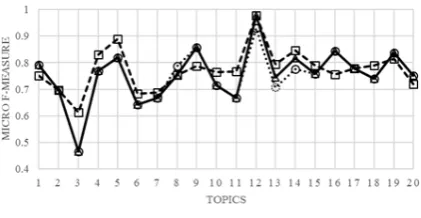
Figure 2 shows the performance of supervised polarity classifiers for 20 topics based on differ-ent imbalanced classification methods. We em-ployed MaxEnt for both self-training and reserved self-training in our subsequent experiments be-cause MaxEnt performed better than SVM. Con-trary to the results of Li et al. (2011) in which downsampling approach performed best, in our s-tudy, full-training performs at least not bad than downsampling and oversampling. We speculate that these 20 microblog topics involve multiple do-mains such as political, environmental, and health issues, it would lose some potentially useful infor-mation if downsampling method is applied, which induced a bad performance of downsampling. In addition, all the methods perform badly on topic 3, 6 and 11 in which positive sentences accoun-t for accoun-the major class as shown in Li eaccoun-t al. (2011). There are two possible reasons for these results: (1) training data set of the NLP&CC2012 is im-balanced, the number of negative sentences is 4 times that of positive one, which results in model-s biamodel-s towardmodel-s the majority clamodel-smodel-s, namely negative sentences; (2) topic 3, 6 and 11 contain much more positive sentences than the others.
Reserved Self-training for Imbalanced Senti-ment Classification of Chinese Microblogs
In this subsection, we report the performance of reserved self-training on imbalanced sentimen-t classificasentimen-tion of Chinese microblogs. We re-implemented a model that achieved the best run in
the NLP&CC2012 for comparison. It employed Conditional Random Fields(CRFs) to predict un-labeled data, and we treated this model as our e-valuation baseline in our experiments.
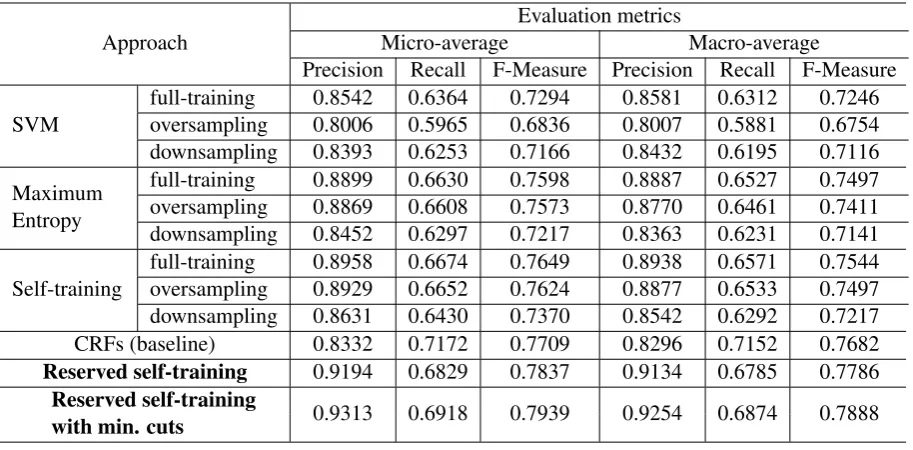
The entire labeled training corpora is divided in-to three groups, a labeled training corpus, an unla-beled data set that is actually annotated in order to facilitate the experiments, and a reserved labeled sample set. We perform fivefold cross-validation and use the averaged results as our final estima-tion. In Figure 3, we can see that reserved self-training performed better than the other methods, especially on topic 3, 6, and 11 in which positive sentences accounted for the major class. A detail comparison of different methods can be found in Table 2. It is worth mentioning that incorporat-ing context information by minimum cuts is able to enhance the performance of our results.
6 Conclusions and Future work
Figure 2: Performances of supervised polarity classifiers for different topics
Figure 3: Comparison of different approaches with reserved self-training on imbalanced data
reserved self-training incorporate both the most confident unlabeled samples, together with their predicted labels, and the least confident labeled samples into training set. The classification error can be reduced because the least confident labeled samples would help the model better discriminate different classes. Thus, the selection strategy of re-served self-training can be applied to resolve other problems involving imbalanced binary classifica-tion, and not restricted to sentiment classification of microblogs. In the future, we will try to ex-tend this method to address multi-label classifica-tion problems.
Acknowledgments
This work was supported by National Natural Science Foundation of China (NSFC) via grant 90924015.
References
Maria-Florina Balcan, Avrim Blum, and Ke Yang. 2004. Co-training and expansion: Towards bridging theory and practice. InAdvances in neural informa-tion processing systems, pages 89–96.
Soumya Banerjee and Nitin Agarwal. 2012.
Ana-lyzing collective behavior from blogs using swarm intelligence. Knowledge and information systems, 33(3):523–547.
Ricardo Barandela, Jos´e Salvador S´anchez, Vicente Garcıa, and Edgar Rangel. 2003. Strategies for learning in class imbalance problems. Pattern Recognition, 36(3):849–851.
Gustavo EAPA Batista, Ronaldo C Prati, and Mari-a CMari-arolinMari-a MonMari-ard. 2004. A study of the behMari-avior of several methods for balancing machine learning training data. ACM SIGKDD Explorations Newslet-ter, 6(1):20–29.
Avrim Blum and Tom Mitchell. 1998. Combining la-beled and unlala-beled data with co-training. In Pro-ceedings of the eleventh annual conference on Com-putational learning theory, pages 92–100. ACM.
Ming-Wei Chang, Lev Ratinov, and Dan Roth. 2007. Guiding semi-supervision with constraint-driven learning.Urbana, 51:61801.
Olivier Chapelle, Bernhard Sch¨olkopf, Alexander Zien, et al. 2006. Semi-supervised learning, volume 2. MIT press Cambridge.
Nitesh V. Chawla, Kevin W. Bowyer, Lawrence O. Hal-l, and W. Philip Kegelmeyer. 2002. Smote: synthet-ic minority over-sampling technique. J. Artif. Int. Res., 16(1):321–357, June.
Nitesh V Chawla, Nathalie Japkowicz, and Aleksander Kotcz. 2004. Editorial: special issue on learning from imbalanced data sets. ACM SIGKDD Explo-rations Newsletter, 6(1):1–6.
Chris Drummond, Robert C Holte, et al. 2003. C4. 5, class imbalance, and cost sensitivity: why under-sampling beats over-under-sampling. In Workshop on Learning from Imbalanced Datasets II, volume 11. Citeseer.
Shoushan Li, Zhongqing Wang, Guodong Zhou, and Sophia Yat Mei Lee. 2011. Semi-supervised learn-ing for imbalanced sentiment classification. In Pro-ceedings of the Twenty-Second international joint conference on Artificial Intelligence-Volume Volume Three, pages 1826–1831. AAAI Press.
Charles X Ling, Qiang Yang, Jianning Wang, and Shichao Zhang. 2004. Decision trees with minimal costs. InProceedings of the twenty-first internation-al conference on Machine learning, page 69. ACM.
Bing Liu, Minqing Hu, and Junsheng Cheng. 2005. Opinion observer: analyzing and comparing opin-ions on the web. InProceedings of the 14th interna-tional conference on World Wide Web, pages 342– 351. ACM.
Jonathan Ortigosa-Hern´andez, Juan Diego Rodr´ıguez, Leandro Alzate, Manuel Lucania, I˜naki Inza, and Jose A Lozano. 2012. Approaching sentiment analysis by using semi-supervised learning of multi-dimensional classifiers. Neurocomputing, 92:98– 115.
Bo Pang and Lillian Lee. 2004. A sentimental educa-tion: Sentiment analysis using subjectivity summa-rization based on minimum cuts. InProceedings of the 42nd annual meeting on Association for Compu-tational Linguistics, page 271. Association for Com-putational Linguistics.
Bo Pang, Lillian Lee, and Shivakumar Vaithyanathan. 2002. Thumbs up?: sentiment classification using machine learning techniques. InProceedings of the ACL-02 conference on Empirical methods in natural language processing-Volume 10, pages 79–86. As-sociation for Computational Linguistics.
Ellen Riloff, Janyce Wiebe, and Theresa Wilson. 2003. Learning subjective nouns using extraction pattern bootstrapping. InProceedings of the seventh confer-ence on Natural language learning at HLT-NAACL 2003-Volume 4, pages 25–32. Association for Com-putational Linguistics.
Russell J Ryan. 2011. Groundtruth budgeting: a novel approach to semi-supervised relation extraction in medical language. Ph.D. thesis, Massachusetts In-stitute of Technology.
Aarti Singh, Robert Nowak, and Xiaojin Zhu. 2008. Unlabeled data: Now it helps, now it doesn’t. In Ad-vances in Neural Information Processing Systems, pages 1513–1520.
Peter D Turney. 2002. Thumbs up or thumbs down?: semantic orientation applied to unsupervised classi-fication of reviews. InProceedings of the 40th annu-al meeting on association for computationannu-al linguis-tics, pages 417–424. Association for Computational Linguistics.
Gary M Weiss. 2004. Mining with rarity: a unifying framework. ACM SIGKDD Explorations Newslet-ter, 6(1):7–19.
Wei Wu and Mari Ostendorf. 2013. Graph-based query strategies for active learning.
Show-Jane Yen and Yue-Shi Lee. 2009. Cluster-based under-sampling approaches for imbalanced data distributions.Expert Systems with Application-s, 36(3):5718–5727.