Identity Deception Detection
Ver´onica P´erez-Rosas1, Quincy Davenport1, Anna Mengdan Dai1, Mohamed Aboulenien2 and Rada Mihalcea1
1Computer Science and Electrical Engineering. University of Michigan 2Computer and Information Science. University of Michigan, Dearborn {vrncapr,quincyd,annadai,zmohamed,mihalcea}@umich.edu
Abstract
This paper addresses the task of detecting identity deception in language. Using a novel identity deception dataset, consist-ing of real and portrayed identities from 600 individuals, we show that we can build accurate identity detectors targeting both age and gender, with accuracies of up to 88%. We also perform an analysis of the linguistic patterns used in identity decep-tion, which lead to interesting insights into identity portrayers.
1 Introduction
With the ever growing usage of social media and other online interactions, cyber-crimes such as identity thief, fraud, and sexual predation have be-come increasingly common. The availability of a wide variety of social platforms and apps fur-ther facilitates these kind of crimes, which are often characterized by the ease of deception and concealment of one’s real identity. Moreover, the increased sense of security due to the spatial and temporal “distanciation” involved with online communications leads to a growing number of oc-currences of identity deception.
Identity deception is defined as “pretending to be someone you are not” (Rowe,2009). The inten-tions of identity deceivers differ between achiev-ing monetary benefits, committachiev-ing fraud, sexual predating, appearing more attractive in online dat-ing, and so on. The risk is further increased with the massive number of children and teens using social media as well as the elderly who get in-volved in online interactions that they assume to be trustworthy by default due to their lack of ex-perience. Multiple stories of teenagers who be-came victims of these activities, as well as elderly who lost hundreds of thousands of dollars are now
often encountered in the news. For instance, a re-cent study reported that 92% of teens go online on daily basis including 24% who are online “almost constantly”.1 The study additionally reported that
females tend to use social media more than males. Hence, due to the financial, social, physical, and psychological damages associated with cyber-crimes, there is a growing need to learn more about the patterns and behaviors of identity deceivers, in order to develop computational approaches that can aid in preventing such crimes.
In this work, we seek to identify linguistic dif-ferences in individuals’ self-presentation when en-gaging in identity deception behaviors. We target the two most common behaviors related with on-line identity deception i.e., individuals portraying themselves as either younger and older, and indi-viduals lying about their gender –also known as gender switching (Macwan and inz. Grzegorz Fil-cek,2017;Herring and Martinson,2004) .
We perform a set of experiments to explore three main research questions. First, given a de-ceptive corpus consisting of written samples of gender switching, can we build fake identity detec-tors that predict gender deception? Second, given a deceptive corpus consisting of written samples of age deception, can we build fake identity detec-tors that predict age deception? Lastly, are there linguistic differences associated with individuals’ gender and age in identity deception?
2 Related Work
Several approaches have been developed to de-tect and prevent identity deception (Tsikerdekis
and Zeadally, 2015). Integration of latent
tex-tual features with spatial and temporal features has been suggested using probabilistic generative
1
http://www.pewinternet.org/2015/04/09/teens-social-media-technology-2015/
modelling to detect identity thieves (Wang et al.,
2017). Another study analyzed the connection be-tween time traces of stolen accounts and compared them to that of the original users using support vector machines (Villar-Rodrguez et al.,2016).
As linguistic patterns represent the main method for detecting identity theft, previous work used text mining techniques by extracting semi-structured information from online news stories and reports on the topic of identity theft, and iden-tified behavioral and temporal patterns and re-sources used by identity thieves (Zaeem et al.,
2017). An analysis of thieves’ behavior in the Massive Multiuser Online Role Playing Game suggested a detection model based on specific se-quences including item production, item sales, and acquisition of game money (Kim et al.,2015).
Focusing specifically on the patterns associated with impersonating the opposite gender, a research study using the Turing Game identified stereotyp-ical content performed by the deceivers as well as stylistic cues to their real gender (Herring and
Martinson, 2004). The study additionally
sug-gested that linguistic cues referring to gender seem to be unconsciously generated.
One of the common practices of identity thieves is online sexual predation. To identify such be-havior, word patterns and search engine query de-tection were suggested as means for detecting pe-dophilic activity (Macwan and inz. Grzegorz Fil-cek, 2017). Examples include the detection of predators using lexical and behavioral features and calculating the predator-hood score as a func-tion of features weights (Dhouioui and Akaichi,
2016). A method was developed to identify sexual predation using phrase-matching and rule-based systems and reported the usefulness of statement lengths in chat lines for improving the identifica-tion process (Mcghee et al.,2011). A study (
Bog-danova et al., 2012) analyzing a corpus of chats
for detecting cyberpedophilia found that character n-grams are capable of discriminating pedophiles’ chats. However, higher-level features that mod-eled behavior and emotion were required to detect conversations with cyberpedophiles from cybersex chat logs (Bogdanova et al.,2014).
An analysis of twenty chat rooms to detect sex offenders indicated eight recurrent themes, includ-ing ’implicit and explicit content of discourse’, ’on-line solicitation’, ’fixated discourse’, ’use of colloquialisms’, ’conscience’, ’acknowledging
il-legal/immoral behavior’, ’risk minimization’, and ’preparing to meet offline’ (Egan et al., 2011). Other work used automatic text categorization techniques with a support vector machine and dis-tance weighted k-NN classifiers to distinguish be-tween a sexual predator and a pseudo victim using data collected from volunteers posing as underage victims (Pendar, 2007). A language processing module was developed in order to successfully dif-ferentiate between porn titles and titles of ency-clopedia articles using support vector machine and linear regression (Panchenko et al.,2012).
More recently, a conversational agent was de-veloped by mimicking the behavior of a teenager and inferring its conversational rules from a real dialogue corpus in order to detect cyberpe-dophilia (Callejas-Rodr´ıguez, 2016). The study reported a successful approach using a combina-tion of the least frequent word and the most fre-quent bigram.
In summary, most of the previous work has fo-cused on specific topics and in particular sexual predation and gaming, and relied primarily on lim-ited text mining approaches. Instead, our approach uses a novel dataset where the participants are not restricted from discussing any topics, and hence we can identify general patterns of identity decep-tion related to both gender and age. Moreover, an advantage of our dataset is the knowledge of the real identity and demographic information of the participants. Furthermore, we conduct multi-ple experiments using a wide variety of linguistic features in order to explore and analyze the textual clues that identify identity deceivers.
3 Data Collection
FAKEIDENTITY REALIDENTITY
I’m Ashley, and I’m currently enrolled in a freshman in the nursing program at my university. My family is very im-portant to me. I have two sisters, both of whom are younger than me. I do volunteer work in my free time through my church I enjoy hanging out with my friends, traveling (I get a lot of chances to do this through mission trips I go on). I want a husband and family, but my career comes first. I’m excited to see what new opportunities will appear on life’s path.
I am a guy in his mid-30’s. I have a cat and live with two roommates. I am self employed, selling various items on eBay as well as doing my Mechanical Turk work. I love music (alt and indie rock, electronica, and 80’s especially), concerts, karaoke, video games, DC Comics, technology, reading, streaming TV and movies, camping and hiking, exploring the city, and good food and coffee. I’m currently involved in various projects to improve my life.
I am a male, aged 65 years old. I have a wife who is 59 years old and two grown children ages 30 and 32, both boys. I worked for Boeing making airplanes for thirty years before I was injured and needed shoulder surgery. I retired just recently and teach an after school class about airplanes and how they are built. I check the mail at 3 pm each day and go to the grocery store four times a week, my wife picks me up a 6 pack of Ice House nightly ...
I am a 35 year old female with bleached blonde hair and hazel eyes. I am a graduate in Public Admin and I enjoy bodybuilding. I have four children and a husband and we live in Seattle. I like to take hikes outside in the moun-tains but not when it is too hot outside. I am from Maine originally but lived in florida for ten years and hated it. The weather is too hot and there are too many snakes and lizards crawling all over your yard.
Table 1: Sample responses from our dataset. Top row: 35-year-old male acting as an 18-year-old female; bottom row: 35-year-old female acting as a 65-year-old male
Female Male
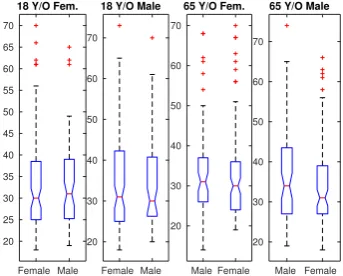
Figure 1: Participants’ age clustered by gender when assuming four fake identities
distribution of Internet users, and this can allow us to explore deceptive behaviors in individuals por-traying themselves as being younger or older than they actually are.
We designed four surveys using the Qualtrics survey software and distributed them via Mechan-ical Turk. In each survey, participants were asked to respond to the following prompt:
1. Describe yourself.
2. Discuss any topic that comes to your mind.
3. Imagine you are trying to convince someone that you are a 18 | 65 year old male | female. Briefly describe yourself, pretend-ing you are a 18 | 65 year old male | female.
4. Imagine you are trying to convince someone
that you are a 18 | 65 year old male | female. Discuss any topic that comes to your mind as if pretending you are a18 |65
year oldmale|female.
Note that the participants are asked to respond to two open-ended questions when presenting themselves with their real and fake identity: one asking for a self-description, and another one ask-ing for an essay on a topic of choice. Our mo-tivation for this setup is to avoid stereotypical responses for each target identity, i.e., descrip-tions focusing on physical appearance and activ-ities frequently associated to the target gender and age. Two sample responses (self-description only) from individuals posing as female and male are shown in Table1.
We also collect demographic data from partici-pants, including their gender, age, education, pri-mary language, ethnicity, country of origin, and country of residence. During the data collection, participants self-reported their gender, using the male/female options. In the future, with larger-scale data collections, we will be able to work with an extended set of gender options. Also, note that individual’s true identity is self-reported so we as-sume workers to provide accurate information – previous studies analyzing Mechanical Turk as a participant’s pool show that this is often the case (Paolacci and Chandler,2014).
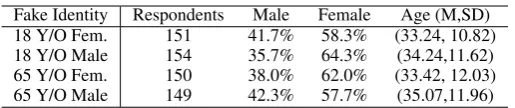
Fake Identity Respondents Male Female Age (M,SD) 18 Y/O Fem. 151 41.7% 58.3% (33.24, 10.82) 18 Y/O Male 154 35.7% 64.3% (34.24,11.62) 65 Y/O Fem. 150 38.0% 62.0% (33.42, 12.03) 65 Y/O Male 149 42.3% 57.7% (35.07,11.96)
Table 2: Gender distribution and age statistics for four fake identities.
manually check for coherence and relevance to the prompt. We reject contributions that failed to fol-low the provided guidelines and did not pass the manual verification.
After this filtering, we obtained a total of 604 completed surveys, each of them containing de-scriptions of participants’ real and fake identities, as well as their corresponding demographic data. The data statistics are shown in Table2.
Figure 1 shows the participants real age, clus-tered by gender, when assuming different fake identities. We observe that the average age of the respondents ranges between 33-35 year-old, thus suggesting a reasonable distance between their ac-tual and fake age. In addition, the graph suggests differences in how deceivers portray themselves given their actual gender, which we further explore in section5.
4 Features
In this section, we describe the sets of features ex-tracted, which are used to build our classifiers.
Unigrams We extract unigrams and bigrams de-rived from the bag of words representation of each identity response.
POS These features consist of part-of-speech (POS) tags obtained with the Stanford Parser
(Chen and Manning,2014).
Semantic LIWC These features include the 74 semantic classes present in the LIWC lexicon 2015 (Pennebaker et al.,2015). Each feature represents the number of words in a response belonging to a specific semantic class, nor-malized with respect to the length of the re-sponse.
Semantic Word2Vec To obtain these features, we use the word2vec (Mikolov et al.,2013) implementation available in the Gensim toolkit (ˇReh˚uˇrek and Sojka, 2010) to obtain word vectors with dimension 300 for each word in the responses. The final identity tor is calculated by adding all the word vec-tors in the response.
Lexical diversity This set includes four lexical diversity metrics, including type/token ra-tio (McCarthy and Jarvis, 2010), mean word frequency, and the Yule’s I and K in-dexes (Oakes,2000).
Readability We also extract features that indicate text understandability. These include read-ability metrics such as the Flesch-Kincaid, Flesch Reading Ease, Gunning Fog, and the Automatic Readability Index (ARI) (Kincaid et al.,1975;Senter and Smith,1967)
5 Experimental Results
We conduct several experiments to answer the re-search questions formulated at the beginning of this paper. During our experiments, we perform the evaluations at individual level, by merging the two open-ended questions asked during the survey (i.e., the self-description and topic-of-choice es-say), for both the real and the fake identities. Also, given the contributors’ age distribution shown in Figure1, we opted to cluster the participants age into into two groups: young (≤30 years) and old (>30 years).
The classifiers are built using the SVM algo-rithm2 and the different sets of features described
in section 4. We perform leave-one-out cross-validation in all our experiments. In all cases, we use the majority class baseline as a reference value.
5.1 Classification of Real and Fake Identities
Before focusing on our main research questions, we seek to evaluate whether deception detection can be conducted using our fake identity dataset. Thus, we focus on two main classification tasks. First, using our entire dataset, we explore whether we can discriminate between the portrayed iden-tities and the real ideniden-tities. Second, we once again attempt to discriminate between real and fake identities, but this time filtering by either age or gender.
2As implemented in the LIBLINEAR library, using (L2)
Features All Identities FemaleGenderMale YoungAgeOld Baseline 50.12 49.93 50.21 49.90 50.14
Ngrams 86.67 86.59 84.25 85.35 84.31
POS 66.61 68.39 68.93 68.97 67.30
LIWC 63.28 64.70 64.89 60.69 66.56
Word2Vec 77.51 77.70 72.34 77.26 75.51
LexDiv 49.45 50.47 46.38 46.62 48.09
Readability 54.55 52.25 51.16 51.55 54.45 All features 85.76 87.50 85.10 85.74 85.48
Table 3: Classification results for deception detection regardless of gender or age (All Identities); for people with a certain gender, according to their real identity (Gender); and people with a certain age according to their real identity (Age).
Identity Fake Real Total Gender MaleFemale 234355 236366 470721 Age OldYoung 340259 342260 682519 All identities 599 602 1201
Table 4: Class distribution for all identities, fil-tered by gender, and filfil-tered by age.
To perform these experiments, we start by cre-ating five subsets from all the data. The first one consists of all the real and fake identities that we collected; the second and third one consist of re-sponses filtered by the individuals’ actual gender, i.e., male and female; and the last two consist of responses filtered by the individuals’ actual age, i.e., old and young. During this process, we dis-card those instances where the fake identity over-laps with the actual identity. The class distribution of the resulting subsets is shown in Table4.
We then build classification models that attempt to discriminate between the real and fake identi-ties under the following scenarios: a) having no previous knowledge of the actual individual’s age or gender, i.e., all data; b) knowing that the indi-vidual’s actual gender is female; c) knowing that the individual’s actual gender is male; d) know-ing that the individual’s actual age is 30 years and under; and e) knowing that the individual’s actual age is over 30 years.
Classification results and the corresponding ma-jority class baselines are shown in Table 3. For most of the prediction tasks, except for the first one, the best performing feature set is the combi-nation of all features (All features), followed by Ngrams. The remaining sets of features achieve accuracy values ranging from 63% to 77%, which still represent a noticeable improvement over the majority class baseline (the only exception is the
Real Identity MaleFake IdentityFemale
Male 185 181
Female 116 120
Total 301 301
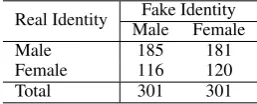
Table 5: Class distribution for gender deceivers
lexical diversity feature set).
While the overall results are largely similar across the five experiments, note that the size of the datasets used in the gender and age-filtered ex-periments is much smaller than the one used in the All Identities experiment. This suggests that the gender (or age) of the writer plays an important role in this classification, and the gender (or age) characteristics can make up for the smaller data size.
5.2 Classification of Gender Deceivers
Motivated by our previous findings, we investi-gate our first research question. Can we build fake identity detectors that predict gender deception? This question focuses on the scenario in which we are interested in knowing if a text whose author claims to be of a certain gender is indeed authored by that particular gender. E.g., if the author claims to be a female, is the writer indeed a female or a male? This can be useful in the verification of user profiles in dating websites, where gender switch-ing is a common form of deception.
For this classification task, we use only the data from the portrayed identities. That is, we use the responses from the 16 Y/O male, 65 Y/O male, 16 Y/O female, and 65 Y/O female identities. While we could have potentially also used the real identi-ties, we chose to focus only on the portrayed ones so that we obtain a more consistent dataset. The distribution for this subsets is shown in Table5.
Features Female+MaleFake IdentityFemale Male
Baseline 50.00 60.00 61.00
Ngrams 86.20 82.72 87.04
LIWC 70.40 66.11 73.08
Word2Vec 75.90 63.78 65.11
POS 67.40 64.45 66.77
LexDiv 54.30 57.14 54.15
Readability 61.29 54.48 71.42 All features 86.04 83.05 87.70
Table 6: Classification results for gender de-ceivers, overall (Female+Male column) and bro-ken down by portrayed gender.
20 40 60 80 100
0.4 0.6 0.8
Fraction of the data %
Accurac
y
LIWC Ngrams Word2vec
Figure 2: Learning curves on gender deceivers classification using three feature sets
predict the real gender. Classification accuracies for the resulting models are shown in Table6. This table also shows the results of the models built us-ing the portrayed male and female responses sep-arately. In these experiments, theNgramsfeatures outperform all the other feature sets. The second best performing features are the ones based on the LIWC lexicon, followed by the part-of-speech fea-tures POS. Overall, the results suggest that it is easier to identify females portraying themselves as males (Maleidentity column) than males portray-ing themselves as females (Female identity col-umn).
As an additional experiment, we investigate whether larger amounts of training data can im-prove the identification of gender deceivers. We plot the learning curves of the best performing sets of features using incremental amounts of data as shown in Figure 2. In this graph, the learning trends for theLIWC and Word2Vec features sug-gest that larger amounts of training data could im-prove the classification performance.
Real Identity YoungFake IdentityOld
Young 168 174
Old 137 123
Total 305 297
Table 7: Class distribution for age deceivers
Features Fake Identity Young+Old Young Old Baseline 51.00 55.00 58.00
Ngrams 83.38 86.22 83.83
LIWC 71.26 73.11 67.67
Word2Vec 77.24 73.77 65.99
POS 69.76 63.27 64.30
LexDiv 49.66 50.16 56.90
Readability 60.32 60.54 53.87 All features 82.72 87.21 81.81
Table 8: Classification results for age deceivers overall, and broken down by portrayed age.
20 40 60 80 100
0.4 0.6 0.8
Fraction of the data %
Accurac
y
LIWC Ngrams Word2vec
Figure 3: Learning curves on age deceivers classi-fication using three feature sets
5.3 Classification of Age Deceivers
Next, we focus our attention on identifying age deceivers to answer our second research question: can we build fake identity detectors that predict age deception? This time we focus on the sce-nario where the author of a text claims to be ei-ther young or old (using our earlier definition of young/old), and we want to determine if the real age of the writer is indeed corresponding to their claims. This can be particularly useful in the iden-tification of sexual predators who target younger people, or scammers who target elderly people.
For this classification task, we once again use only the data from the portrayed identities, i.e., we use only the responses corresponding to the por-trayed 16 Y/O male, 65 Y/O male, 16 Y/O female, and 65 Y/O female identities. The distribution for this dataset is shown in Table7.
Clas-Female as a Male Real Female Male as a Female Real Male
SWEAR 2.35 SEXUAL 2.03 FILLER 4.07 ACHIEV 1.57
FILLER 2.35 ANX 1.48 FEMALE 3.16 MONEY 1.51
ASSENT 2.15 INGEST 1.44 SWEAR 2.29 WORK 1.50
FRIEND 1.96 BIO 1.36 FAMILY 1.96 SEXUAL 1.36
INFORMAL 1.81 RISK 1.31 BODY 1.94 DEATH 1.34
YOU 1.75 HEALTH 1.28 NETSPEAK 1.91 RISK 1.29
DEATH 1.70 NUMBER 1.20 FRIEND 1.81 RELIG 1.27
NETSPEAK 1.61 RELIG 1.19 YOU 1.67 CAUSE 1.24
MOTION 1.50 INSIGHT 1.18 MALE 1.63 INSIGHT 1.23
FOCUSFUTURE 1.43 ADJ 1.17 INFORMAL 1.60 IPRON 1.18
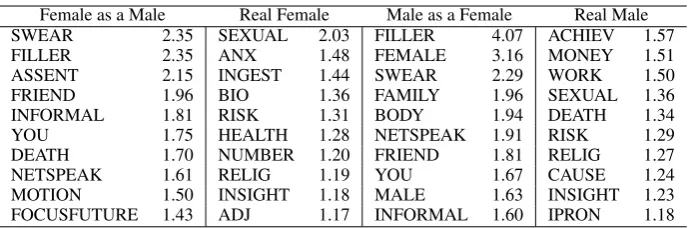
Table 9: Top ranked semantic classes from the LIWC lexicon associated to gender impersonators and actual gender.
Younger as Older Real Young Older as Younger Real Old
YOU 2.02 ASSENT 1.76 NETSPEAK 5.43 RELIG 2.71
FAMILY 2.00 ANX 1.63 FILLER 4.48 INGEST 1.92
DEATH 1.86 ACHIEV 1.56 SWEAR 4.05 HEALTH 1.84
FILLER 1.79 NETSPEAK 1.47 FRIEND 3.05 SEXUAL 1.75
FEMALE 1.72 WORK 1.34 INFORMAL 2.82 RISK 1.73
THEY 1.66 HEAR 1.34 ASSENT 2.32 NUMBER 1.59
FOCUSPAST 1.63 LEISURE 1.25 FOCUSFUTURE 1.84 DEATH 1.56
TIME 1.42 ANGER 1.25 YOU 1.62 SAD 1.48
SEXUAL 1.39 NEGEMO 1.23 MOTION 1.51 BIO 1.48
HEALTH 1.33 POSEMO 1.18 HEAR 1.42 ANX 1.26
Table 10: Top ranked semantic classes from the LIWC lexicon associated to age impersonators and actual age.
sification accuracies for the resulting models are shown in Table 8. This table also shows the re-sults of models built using the portrayed young or portrayed old responses separately. In these exper-iments, the Ngrams features also outperform all the other feature sets. The second best perform-ing features are the ones based on the semantic vector obtained withWord2vec, followed byLIWC and part-of-speechPOSfeatures. Overall, the re-sults suggest that it is easier to identify older in-dividuals portraying themselves as being younger (Youngidentity column) than younger individuals portraying themselves as being older (Oldidentity column).
To explore whether more training data would be beneficial to improve classifiers performance, we plot the learning curves of the bests sets of fea-tures using incremental amounts of data as shown in Figure3. As observed, all feature sets show a positive learning trend suggesting that more train-ing data might improve the performance in the age deception task.
5.4 Analysis of Linguistic Differences Associated to Gender and Age Deceivers
Seeking to answer our third research question: are there linguistic differences associated to individu-als’ gender and age in identity deception? we
an-alyze differences in word usage that might reveal the real identity of age and gender impersonators.
From the gender-based analysis, we use re-sponses from actual females writing as males and responses from actual males writing as females as well as their truthful self-descriptions. Simi-larly, in the age-based analysis, we consider the responses from younger respondents writing as older and older respondents writing as younger as well as their truthful self-descriptions.
Our analyses are based on the semantic word classes from the LIWC lexicon and the seman-tic word-class scoring by (Mihalcea and Pulman,
2009). Tables9 and10 show the top classes for each deception group and their real identities.
Real Female Male as Female Real Male Female as Male
Real Female 1
Male as Female 0.670∗∗ 1
Real Male 0.663∗∗ 0.994∗∗ 1
Female as Male 0.668∗∗ 0.999∗∗ 0.995∗∗ 1
Table 11: Correlation of LIWC classes across real and fake gender identities.∗∗Correlation is significant
at 0.001 level (2-tailed)
Real Young Old as Young Real Old Young as Old
Real Young 1
Old as Young 0.973∗∗ 1
Real Old 0.975∗∗ 0.996∗∗ 1
Young as Old 0.976∗∗ 0.997∗∗ 0.994∗∗ 1
Table 12: Correlation of LIWC clases across real and fake age identities. ∗∗Correlation is significant at
0.001 level (2-tailed)
more ‘you’, ‘family’, ‘death’ and ‘filler’ words. In contrast, older individuals who portray them-selves as younger use more internet slang ‘net-speak’, ‘fillers’, and ‘swear’ words. Similar to the gender findings, age deception seems to be af-fected by stereotypes.
For further insights into the linguistic differ-ences between gender and age impersonators, we also calculate the Pearson correlation of the LIWC class counts across actual and corresponding fake identities. We use word class counts normalized by the number of words in the sentence.
The correlation betweenReal Female and Real Male shown in Table 5.3 present an estimate of how similar the actual male and female writings are. We observe a positive mid-strength correla-tion as compared with the other correlacorrela-tion pairs. TheReal Male vs Female as Malecorrelation sug-gests that females are good at emulating males’ writing. In contrast, the analysis shows that males are not as good emulating female language (see correlation ofReal Female vs Male).
Surprisingly, the analysis of age deceivers in Ta-ble 5.3 shows a strong correlation trend between the different age-based identities. In particular, the correlation betweenReal Old and Youngsuggests high language similarity between the two groups. Furthermore, the correlation between theReal Old vs Old as YoungandReal Young vs Young as Old indicates that in general, older people are good at imitating younger people and vice versa.
6 Conclusions
In this paper, we addressed the task of identity de-ception detection. We collected a novel identity deception dataset, consisting of individuals
por-traying themselves with four fake identities, tar-geting different ages and genders.
Through several experiments, we showed that we can build accurate identity detectors. Specifi-cally, we focused on the prediction of gender and age impersonators. We were able to identify iden-tity deceivers with accuracies up to 88%. Our main findings showed that it is easier to identity females posing as males and similarly, it is eas-ier to identify older individuals posing as younger individuals.
Furthermore, we presented a statistical analy-sis of linguistic patterns that differentiate between fake and real identities based on age and gender.
The datasets introduced in this paper are publicly available under http://lit.eecs.
umich.edu/downloads.html.
Acknowledgments
References
Dasha Bogdanova, Paolo Rosso, and Thamar Solorio. 2012. On the impact of sentiment and emotion based features in detecting online sexual predators. In Proceedings of the 3rd Workshop in Compu-tational Approaches to Subjectivity and Sentiment Analysis. Association for Computational Linguis-tics, Stroudsburg, PA, USA, WASSA ’12, pages 110–118.
Dasha Bogdanova, Paolo Rosso, and Thamar Solorio. 2014. Exploring high-level features for detecting
cyberpedophilia. Computer Speech & Language
28(1):108 – 120.
´Angeland Villatoro-Tello Esa´uand Meza Ivanand Ram´ırez-de-la-Rosa Gabriela Callejas-Rodr´ıguez.
2016. From Dialogue Corpora to Dialogue
Sys-tems: Generating a Chatbot with Teenager Person-ality for Preventing Cyber-Pedophilia, Springer In-ternational Publishing, Cham, pages 531–539.
Danqi Chen and Christopher D Manning. 2014. A fast and accurate dependency parser using neural
net-works. InEmnlp. pages 740–750.
Zeineb Dhouioui and Jalel Akaichi. 2016.
Pri-vacy protection protocol in social networks based on sexual predators detection. In Proceed-ings of the International Conference on Inter-net of Things and Cloud Computing. ACM, New York, NY, USA, ICC ’16, pages 63:1–63:6.
https://doi.org/10.1145/2896387.2896448.
V. Egan, J. Hoskinson, and D. Shewan. 2011.
Per-verted justice: a content analysis of the language used by offenders detected attempting to solicit chil-dren for sex, Nova Science Publishers, Inc, pages 273–297.
Susan C. Herring and Anna Martinson. 2004.
Assessing gender authenticity in computer-mediated language use. Journal of Lan-guage and Social Psychology 23(4):424–446.
https://doi.org/10.1177/0261927X04269586.
Hana Kim, Byung Il Kwak, and Huy Kang Kim. 2015. A study on the identity theft detection model in
mmorpgs. Journal of the Korea Institute of
Infor-mation Security and Cryptology25(3):627–637.
J Peter Kincaid, Robert P Fishburne Jr, Richard L Rogers, and Brad S Chissom. 1975. Derivation of new readability formulas (automated readability in-dex, fog count and flesch reading ease formula) for navy enlisted personnel. Technical report, Naval Technical Training Command Millington TN Re-search Branch.
Shweta Macwan and Dr. inz. Grzegorz Filcek. 2017.
Web mining against pedophilia. International
Edu-cation and Research Journal3(5).
Philip M McCarthy and Scott Jarvis. 2010. Mtld, vocd-d, and hd-d: A validation study of sophisticated
ap-proaches to lexical diversity assessment. Behavior
research methods42(2):381–392.
India Mcghee, Jennifer Bayzick, April Kontostathis, Lynne Edwards, Alexandra Mcbride, and Emma
Jakubowski. 2011. Learning to identify
in-ternet sexual predation. International Jour-nal on Electronic Commerce 15(3):103–122.
https://doi.org/10.2753/JEC1086-4415150305.
Rada Mihalcea and Stephen Pulman. 2009. Linguistic ethnography: Identifying dominant word classes in
text. In Computational Linguistics and Intelligent
Text Processing, Springer, pages 594–602.
Tomas Mikolov, Kai Chen, Greg Corrado, and
Jef-frey Dean. 2013. Efficient estimation of word
representations in vector space. arXiv preprint
arXiv:1301.3781.
Michael P. Oakes. 2000. Statistics for corpus
linguis-tics. International Journal of Applied Linguistics
10(2):269–274.
Alexander Panchenko, Richard Beaufort, and C´edrick Fairon. 2012. Detection of Child Sexual Abuse Me-dia on P2P Networks: Normalization and Classifica-tion of Associated Filenames. In Zygmunt Vetulani
and Edouard Geoffrois, editors, Proceedings of the
Language Resources for Public Security Workshop 2012 (LRPS 2012) at LREC 2012. Instanbul, Turkey, pages 27–31.
Gabriele Paolacci and Jesse Chandler. 2014.
Inside the turk. Current Directions in Psychological Science 23(3):184–188.
https://doi.org/10.1177/0963721414531598.
Nick Pendar. 2007. Toward spotting the pedophile
telling victim from predator in text chats. In Pro-ceedings of the International Conference on Se-mantic Computing. IEEE Computer Society, Wash-ington, DC, USA, ICSC ’07, pages 235–241.
https://doi.org/10.1109/ICSC.2007.102.
James W Pennebaker, Ryan L Boyd, Kayla Jordan, and Kate Blackburn. 2015. The development and psy-chometric properties of liwc2015. Technical report.
Radim ˇReh˚uˇrek and Petr Sojka. 2010. Software Frame-work for Topic Modelling with Large Corpora. In Proceedings of the LREC 2010 Workshop on New Challenges for NLP Frameworks. ELRA, Valletta, Malta, pages 45–50.
Neil C Rowe. 2009. The Ethics of Deception in
Cy-berspace, IGI Global, pages 529–541.
Michael Tsikerdekis and Sherali Zeadally.
2015. Detecting and preventing online
identity deception in social networking ser-vices. IEEE Internet Computing 19(3):41–49.
https://doi.org/10.1109/MIC.2015.21.
Esther Villar-Rodrguez, Javier Del Ser, Ana I. Torre-Bastida, Miren N. Bilbao, and Sancho
Salcedo-Sanz. 2016. A novel machine learning approach
to the detection of identity theft in social net-works based on emulated attack instances and sup-port vector machines. Concurrency and Compu-tation: Practice and Experience 28(4):1385–1395. Cpe.3633. https://doi.org/10.1002/cpe.3633. Chen Wang, Bo Yang, and Jing Luo. 2017.
Iden-tity theft detection in mobile social networks using
behavioral semantics. In 2017 IEEE International
Conference on Smart Computing (SMARTCOMP). pages 1–3.