On the Effectiveness of Using Sentence Compression
Models for Query-Focused Multi-Document Summarization
Y llias Chali Sadid A
.
Hasan
University of Lethbridge, Lethbridge, AB, Canada
❝❤❛❧✐❅❝s✳✉❧❡t❤✳❝❛✱ ❤❛s❛♥❅❝s✳✉❧❡t❤✳❝❛
A
BSTRACTThis paper applies sentence compression models for the task of query-focused multi-document summarization in order to investigate if sentence compression improves the overall summariza-tion performance. Both compression and summarizasummariza-tion are considered as global optimizasummariza-tion problems and solved using integer linear programming (ILP). Three different models are built
depending on the order in which compression and summarization are performed: 1)ComFirst
(where compression is performed first), 2)SumFirst(where important sentence extraction is
performed first), and 3)Combined(where compression and extraction are performed jointly
via optimizing a combined objective function). Sentence compression models include lexical, syntactic and semantic constraints while summarization models include relevance, redundancy and length constraints. A comprehensive set of query-related and importance-oriented measures are used to define the relevance constraint whereas four alternative redundancy constraints are employed based on different sentence similarity measures using a) cosine similarity, b) syntactic similarity, c) semantic similarity, and d) extended string subsequence kernel (ESSK). Empirical evaluation on the DUC benchmark datasets demonstrates that the overall summary quality can be improved significantly using global optimization with semantically motivated models.
1 Introduction and Related Work
Text summarization is a good way to compress large amount of information into a concise form by selecting the most important information and discarding redundant information (Mani and Maybury, 1999). Query-focused multi-document summarization aims to create a summary from the available source documents that can answer the requested information need (Chali and Hasan, 2012). Extraction-based automatic summarization has been a common practice over the years for its simplicity (Edmundson, 1969; Kupiec et al., 1995; Carbonell and Goldstein, 1998; Lin, 2003; Martins and Smith, 2009; Berg-Kirkpatrick et al., 2011). Extraction of the most important sentences to form a summary can degrade the summary quality if there exists a longer sentence with partly relevant information to prevent inclusion of other important sentences (due to summary length constraint) (Martins and Smith, 2009). Sentence compression can be a good remedy for this problem where the task can be viewed as a single-sentence summarization (Jing,
2000; Clarke and Lapata, 2008). Sentence compression1aims to retain the most important
information of a sentence in the shortest form whilst being grammatical at the same time (Knight and Marcu, 2000, 2002; Lin, 2003). Previous researches have shown that sentence compression can be used effectively in automatic summarization systems to produce more informative summaries by reducing the redundancy in the summary sentences (Jing, 2000; Knight and Marcu, 2002; Lin, 2003; Daumé III and Marcu, 2005; Zajic et al., 2007; Madnani et al., 2007; Martins and Smith, 2009; Berg-Kirkpatrick et al., 2011). However, most of these researches either focused on the task of single document summarization and generic summarization or did not consider global properties of the sentence compression problem (Clarke and Lapata, 2008). Due to the vast increase in both the amount of online data and the demand for access to different types of information in recent years, attention has shifted from single document
and generic summarization2 toward query-based multi-document summarization. On the
other hand, sentence compression can achieve superior performance if it can be treated as an optimization problem and solved using integer linear programming (ILP) to infer globally optimal compressions (Gillick and Favre, 2009; Clarke and Lapata, 2008). ILP has recently attracted much attention in the natural language processing (NLP) community (Roth and Yih, 2004; Clarke and Lapata, 2008; Punyakanok et al., 2004; Riedel and Clarke, 2006; Denis and Baldridge, 2007). Gillick and Favre (2009) proposed to extend their ILP formulation for a concept-based model of summarization by incorporating additional constraints for sentence compression. However, to the best of our knowledge, there has not been a single research that deeply investigates the potential of using ILP-based sentence compression models for the task of query-focused multi-document summarization. In this paper, we accomplish this task by considering both compression and summarization as global optimization problems.
The sentence compression models used in the existing automatic summarization systems mostly exploit various lexical and syntactic properties of the sentences (Knight and Marcu, 2002; Mcdonald, 2006; Clarke and Lapata, 2008; Cohn and Lapata, 2008; Galanis and Androutsopou-los, 2010). A recent work has shown that discourse segmentation could be incorporated in a sentence compression system which can aid automatic summarization (Molina et al., 2011).
1Although most of the works on sentence compression are mainly related to the English language, researchers have also worked on sentence compression related to languages other than English (Molina et al., 2011; Filippova, 2010; Bouayad-Agha et al., 2006). Our work is applied to the English language. However, we believe that the proposed techniques can be applicable to other languages provided that the lexical, syntactical and semantic properties of the corresponding language are considered.
Lin (2003) showed that pure syntactic-based compression does not improve a generic summa-rization system. A most recent work has shown that sentence compression can achieve better performance if semantic role information can be incorporated into the model (Yoshikawa et al., 2012). Inspired by their work, we recast their formulation as an ILP for sentence compression with semantic role constraints. We build three different ILP-based sentence compression models: 1) a bigram language model with lexical and syntactic constraints (derived from Clarke and Lapata (2008)), 2) the bigram language model with a topic signature modeling function (Lin and Hovy, 2000), and 3) the bigram language model with semantic role constraints (Yoshikawa et al., 2012). We choose to build them since the variation of these models were shown to achieve better results comparable to the state-of-the-art techniques (Clarke and Lapata, 2008; Yoshikawa et al., 2012). We perform a rigorous study to analyze the effectiveness of using these sentence compression models to generate query-focused summaries. For this study, we compose three different models depending on the order to perform sentence compression and extraction: 1)ComFirst, 2)SumFirst, and 3)Combined. The main motivation behind building these models is that we intend to study if the order of performing compression and extraction can affect the overall performance of the query-focused multi-document summarization. Martins and Smith
(2009) argued that the two-step “pipeline” approaches such asComFirstandSumFirstmight
often fail to select global optimal summaries.
Query-focused extractive multi-document summarization generally needs three essential criteria to be satisfied (McDonald, 2007): 1) Relevance: to contain informative sentences relevant to the given query, 2) Redundancy: to not contain multiple similar sentences, and 3) Length: should follow a fixed length constraint. We define a global optimization model that uses ILP to infer optimal summaries. The existing ILP formulations to the summarization task mostly rely on relevance and redundancy functions (such as word-level cosine similarity measure, word bigrams) that are primitive in nature (McDonald, 2007; Gillick and Favre, 2009; Martins and Smith, 2009). The major limitation of these approaches is that they do not consider the sequence of words (i.e. word ordering). They ignore the syntactic and semantic structure of the sentences and thus, cannot distinguish between “The police shot the gunman” and “The gunman shot the police”. The researchers speculate that the better the relevance and redundancy functions could be, the more the solutions would be efficient (Gillick and Favre, 2009). In the proposed optimization framework, we incorporate a comprehensive set of query-related and importance-oriented measures to define the relevance function. We employ four alternative redundancy constraints based on different sentence similarity measures using a) cosine similarity, b) syntactic similarity, c) semantic similarity, and d) extended string subsequence kernel (ESSK). We propose the use of syntactic tree kernel (Moschitti and Basili, 2006), shallow semantic tree kernel (Moschitti et al., 2007), and a variation of the extended string subsequence kernel (ESSK) (Hirao et al., 2003) to accomplish the task. Our empirical evaluation on the DUC benchmark datasets demonstrate the effectiveness of applying sentence compression for the task of query-focused multi-document summarization. The results also show that the quality of the generated summaries vary based on the use of alternative redundancy constraints in the optimization framework.
2 ILP-based Sentence Compression Models
derived from the work of Knight and Marcu (2002); Clarke and Lapata (2008). Our second model is close in spirit rather different in content to Clarke and Lapata (2008). In this model, we combine the bigram language model with a corpus-based topic signature modeling approach of Lin and Hovy (2000). Our first two models include various lexical and syntactical constraints based on the work of Clarke and Lapata (2008). In the third model, we add a set of semantically motivated constraints into the bigram language model based on the work of Yoshikawa et al. (2012).
2.1 Bigram Language Model
According to Clarke and Lapata (2008), the sentence compression problem can be formally
defined as follows. LetS=w1,w2,· · ·,wnis an original sentence in a document. To represent
the words to be included in the compressed version of this sentence, we define a set of indicator
variablesδithat are set to 1 ifi-th word is selected into the compression, and 0 otherwise. To
make decisions based on word sequences (rather than individual words), we define additional
indicator variablesai(that are set to 1 ifi-th word starts the compression, and 0 otherwise),bi
(that are set to 1 ifi-th word ends the compression, and 0 otherwise), andci j(that are set to
1 if sequencewi,wjis present in the compression, and 0 otherwise). Now the inference task
is solved by maximizing the following objective function (that includes the overall sum of the decision variables multiplied by their log-transformed corpus bigram probabilities) (Clarke and Lapata, 2008):
M aximizeX
i
ai·P(wi|star t) +
n−1
X
i=1
n X
j=i+1
ci j·P(wj|wi) +X
i
bi·P(end|wi) (1)
such that∀i,j∈ {1· · ·n}:
δi,ai,bi,ci j∈ {0, 1} (2) X
i
ai=1 (3)
δj−aj− j X
i=1
ci j=0 (4)
δi− n X
j=i+1
ci j−bi=0 (5)
X
i
bi=1 (6)
X
i
δi≥l (7)
X
i:wi∈ver bs
δi≥1 (8)
δi=1 (9)
∀i:wi∈personal pronouns
δi=0 (10)
∀i:wi∈words in parentheses
δi−δj=0 (11) ∀i,j:wj∈possessive mods o f wi
The objective function in Equation 1 is maximized to find the optimal target compression where
various constraints. The first constraint states that the variables are binary. The later constraints are defined to disallow invalid bigram sequences in the compression. Constraint 3 states that exactly one word can start a compression. Constraint 4 and Constraint 5 are responsible to ensure correct bigram sequences, whereas Constraint 6 denotes that exactly one word can end
the compression. On the other hand, Constraint 7 forces the compression to have at leastl
words. We add some additional constraints (Constraint 8 to Constraint 11) from Clarke and Lapata (2008) to ensure that the target compressions are lexically and syntactically acceptable.
To accomplish this purpose, we use the Oak system3(Sekine, 2002) and the Charniak parser4
(Charniak, 1999) to obtain information regarding parts-of-speech and grammatical relations in a sentence.
2.2 Topic Signature Model
We use a topic signature modeling approach (Lin and Hovy, 2000) to identify the important content words from the original source sentence. The important words are considered to have significantly greater probability of occurring in a given text compared to that in a large background corpus. We incorporate this importance score into the objective function of the bigram language model (Section 2.1) to ensure that the target compression prefers to keep
important content words. We use a topic signature computation tool5for this purpose. The
background corpus that is used in this tool contains 5000 documents from the English GigaWord Corpus. Our modified objective function becomes:
M aximizeX
i
δi·I(wi) +X
i
ai·P(wi|star t) +
n−1
X
i=1
n X
j=i+1
ci j·P(wj|wi) +X
i
bi·P(end|wi) (12)
whereI(wi)denotes the importance score of thei-th word.
2.3 Bigram Language Model with Semantic Constraints
Yoshikawa et al. (2012) have proposed a set of formulas called Markov Logic Network (MLN) to build a semantically motivated sentence compression model and showed that their model achieves improved performance. We recast their formulas as constraints of our ILP model and incorporate them into the bigram language model. The main idea is to utilize the predicate-argument relations of a sentence and define constraints based on semantic roles to improve the weaknesses of the lexical and syntactical constraints. In this manner, we can ensure that the target compression contains meaningful information. For this purpose, we parse the source sentence semantically using a Semantic Role Labeling (SRL) system (Kingsbury and Palmer,
2002; Hacioglu et al., 2003), ASSERT6. When presented with a sentence, ASSERT performs a
full syntactic analysis of the sentence, automatically identifies all the verb predicates in that sentence, extracts features for all constituents in the parse tree relative to the predicate, and identifies and tags the constituents with the appropriate semantic arguments. We add the following additional constraints as the semantic constraints to our bigram language model (Section 2.1):
δi=1 (13)
∀i:wiis a predicate
3http://nlp.cs.nyu.edu/oak/
4Available at ftp://ftp.cs.brown.edu/pub/nlparser/ 5Available at http:
//www.cis.upenn.edu/lannie/topicS.html 6Available at http:
δi−δj=0 (14) ∀i,j:wjis an ar gument o f predicate wi
δi=1 (15)
∀i:wi∈[ARG0...ARG5]
δi=0 (16)
∀i:wi∈optional ar guments
Here, Constraint 13 guarantees that if a word is a predicate, it is included in the compression. Constraint 14 states that if a predicate is in compression, then its argument is also kept in the compression. In Constraint 15, we define that if a word denotes any of the possible
semantic roles (i.e.[ARG0...ARG5]which are calledmandatory arguments), it is included in
the compression. On the other hand, we use Constraint 16 to restrict the inclusion of optional
arguments7in the compression.
3 ILP for Query-focused Multi-document Summarization
The query-focused multi-document summarization inference problem can be formulated in terms of ILP. To represent the sentences included in the summary we define a set of indicator
variablesαithat are set to 1 ifi-th sentence is selected into the summary, and 0 otherwise. Let
Rel(i)be the relevance function that returns the relevance score of thei-th sentence. The score
of a summary is the sum of the relevance scores of the sentences present in the summary. The inference task is solved by maximizing the overall score of a summary:
M aximizeX
i
Rel(i)∗αi
such that∀i,j:
αi∈ {0, 1} (17)
Sim(i,j)∗αi+αj≤K (18)
X
i
Len(i)∗αi≤L (19)
We incorporate three constraints into our formulation. The first constraint states that the variables are binary. The second constraint is the redundancy constraint that ensures that
only one of the two similar sentences is chosen into the summary.Sim(i,j)function returns
a similarity score between thei-th and j-th sentences. Higher scores correspond to higher
similarity between a pair of sentences. We assume a thresholdK, that sets a tolerance limit to
the acceptable similarity score between any two sentences. This value is empirically determined during experiments. The third constraint controls the length of the summary up to a maximum
limit,L.Len(i)denotes the length of thei-th sentence in words.
3.1
Rel
(
i
)
Function
For each sentence, theRel(i)function returns a relevance score by combining a set of
longest common subsequence (LCS), weighted LCS, skip-bigram, exact word, synonym,
hy-pernym/hyponym, gloss and basic elements (BE) overlap (Lin, 2004; Zhou et al., 2005) using
WordNet (Fellbaum, 1998), and syntactic similarity (Collins and Duffy, 2001; Moschitti and Basili, 2006). To measure the importance of a sentence, we consider its position, length, similarity with topic title, and presence of certain named entities and cue words. The mean of these scores denote the relevance of a sentence.
3.1.1 Query-related Measures
n-gram Overlap n–gram overlap measures the overlapping word sequences between the candidate document sentence and the query sentence (Lin, 2004).
LCS Given two sequencesS1and S2, the longest common subsequence (LCS) ofS1and S2 is
a common subsequence with maximum length. We use this feature to calculate the longest common subsequence between a candidate sentence and the query.
WLCS Weighted Longest Common Subsequence (WLCS) improves the basic LCS method by
remembering the length of consecutive matches encountered so far. Given two sentences X and Y, the WLCS score of X and Y can be computed using the similar dynamic programming procedure as stated in Lin (2004).
Skip-Bigram Skip-bigram measures the overlap of skip-bigrams between a candidate sentence and a query sentence. Skip-bigram counts all in-order matching word pairs while LCS only counts one longest common subsequence.
Exact-word Overlap This is a measure that counts the number of words matching exactly between the candidate sentence and the query sentence.
Synonym Overlap This is the overlap between the list of synonyms of the content words (i.e.
nouns, verbs and adjectives) extracted from the candidate sentence andquery related words8.
Hypernym/Hyponym Overlap This is the overlap between the list of hypernyms (up to depth 2 in WordNet’s hierarchy) and hyponyms (depth 3) of the nouns extracted from the sentence in
consideration andquery related words.
Gloss Overlap This is the overlap between the list of content words that are extracted from
the gloss definition of the nouns in the sentence in consideration andquery related words.
Syntactic Feature The syntactic similarity between thequeryand thesentenceis calculated using a similar procedure discussed in Section 3.2.2, which gives the similarity score based on syntactic structures.
Basic Element (BE) Overlap We extract BEs (Hovy et al., 2006) for the sentences (or query)
by using the BE package distributed by ISI9. We compute the Likelihood Ratio (LR) for each BE
according to Zhou et al. (2005). We sort the BEs based on LR scores to produce a BE-ranked list. The ranked list contains important BEs at the top which may or may not be relevant to the 8To establish the query related words, we took a query and created a set of related queries by replacing its content words by their first-sense synonyms using WordNet.
9BE website:http:
complex question. We filter out the BEs that are not related to the query and get the BE overlap score.
3.1.2 Importance-oriented Measures
Position of Sentences Sentences that reside at the start and at the end of a document often
tend to include the most valuable information. We manually inspected10the given document
collection and found that the first and the last 3 sentences of a document often qualify to be considered for this feature. We assign the score 1 to them and 0 to the rest.
Length of Sentences Longer sentences contain more words and have a greater probability of containing valuable information. Therefore, a longer sentence has a better chance of inclusion
in a summary11. We give the score 1 to a longer sentence and assign the score 0 otherwise.
We manually investigated the document collection and set a threshold that a longer sentence should contain at least 11 words.
Title Match If we find a match such as exact word overlap, synonym overlap and hyponym overlap between the title and a sentence, we give it the score 1, otherwise 0.
Named Entity The score 1 is given to a sentence that contains a Named Entity class among: PERSON, LOCATION, ORGANIZATION, GPE (Geo-Political Entity), FACILITY, DATE, MONEY, PERCENT, TIME. We believe that the presence of a Named Entity increases the importance of a
sentence. For example, the sentence“Washington, D.C. is the capital of the United States”has
two named entities (i.e. locations) which denote that the sentence is important. We use the
OAKSystem (Sekine, 2002), from New York University for Named Entity recognition.
Cue Word Match The probable relevance of a sentence is affected by the presence of pragmatic words such as “significant”, “impossible”, “in conclusion”, “finally” etc. We use a cue word list of 228 words. We give the score 1 to a sentence having any of the cue words and 0 otherwise.
3.2
Sim
(
i
,
j
)
Function
We employ four alternative redundancy constraints based on different sentence similarity
functions (i.e.Sim(i,j)) using a) cosine similarity, b) syntactic similarity, c) semantic similarity,
and d) extended string subsequence kernel (ESSK).
3.2.1 Cosine Similarity Measure (COS)
The cosine similarity between the respective pair of sentences can be calculated by representing each sentence as a vector of term specific weights (Erkan and Radev, 2004). The term specific weights in the sentence vectors are products of local and global parameters. This is known as
term frequency-inverse document frequency (tf-idf) model. The weight vector for a sentences
is~vs= [w1,s,w2,s, . . . ,wN,s]T, where,
wt,s=t ft×log|{t|S|∈s}|
10We randomly investigated few newspaper articles and observed that sentences that reside at the start and at the end of a document often tend to include the most valuable information. The “Position of sentences” feature could be tuned to fit other genres of texts as well.
Here,t ftis the term frequency (tf) of the termtin a sentences(a local parameter). log|{t|S∈|s}|is
the inverse document frequency (idf) (a global parameter).|S|is the total number of sentences
in the corpus, and|{t∈s}|is the number of sentences containing the termt.
3.2.2 Syntactic Similarity Measure (SYN)
Pasca and Harabagiu (2001) demonstrated that with the syntactic form one can see which
words depend on other words. Syntactic features have been used successfully so far inquestion
answering(Zhang and Lee, 2003; Moschitti et al., 2007; Moschitti and Basili, 2006). Inspired by the potential significance of using syntactic measures for finding similar texts, we get a strong motivation to use it as a redundancy measure in our optimization framework. The first step to calculate the syntactic similarity between two sentences is to parse the corresponding sentences into syntactic trees using the Charniak parser (Charniak, 1999). Once we build the syntactic trees, our next task is to measure the similarity between the trees. For this, every
treeTis represented by anmdimensional vectorv(T) = v1(T),v2(T),· · ·vm(T), where the
i-th elementvi(T)is the number of occurrences of the i-th tree fragment in treeT. The tree
fragments of a tree are all of its sub-trees which include at least one production with the restriction that no production rules can be broken into incomplete parts. The tree kernel of two
treesT1andT2is actually the inner product ofv(T1)andv(T2)(Collins and Duffy, 2001):
T K(T1,T2) =v(T1).v(T2) (20)
We define the indicator functionIi(n)to be 1 if the sub-treeiis seen rooted at nodenand 0
otherwise. It follows:
vi(T1) = X
n1∈N1 Ii(n1)
vi(T2) = X
n2∈N2 Ii(n2)
where,N1andN2are the set of nodes inT1andT2respectively. TheTK(tree kernel) function
gives the similarity score between a pair of sentences based on the syntactic structure.
3.2.3 Semantic Similarity Measure (SEM)
Shallow semantic representations can prevent the sparseness of deep structural approaches and the weakness of cosine similarity based models (Moschitti et al., 2007). As an example, PropBank (PB) (Kingsbury and Palmer, 2002) made it possible to design accurate automatic Semantic Role Labeling (SRL) systems (Hacioglu et al., 2003). Therefore, we get the feeling that an application of SRL as a redundancy measure might suit well, since the textual similarity between a pair of sentences relies on a deep understanding of the semantics of both. So, applying
semantic similarity measurement as aSim(i,j)function is another noticeable contribution
children as an effective ST representation would require, Moschitti et al. (2007) solved this problem by designing the Shallow Semantic Tree Kernel (SSTK) which allows to match portions of a ST. The SSTK function yields the similarity score between a pair of sentences based on their semantic structures.
3.2.4 Extended String Subsequence Kernel (ESSK)
The ESSK is a simple extension of the Word Sequence Kernel (WSK) (Cancedda et al., 2003) and String Subsequence Kernel (SSK) (Lodhi et al., 2002) that can incorporate semantic information with the use of word senses. In original ESSK, each “alphabet” in SSK is replaced by a disjunction of an “alphabet” and its alternative (word senses) (Hirao et al., 2003). Here, all possible senses of a word are used as the alternatives. However, in our ESSK formulation, we consider each word in a sentence as an “alphabet”, and the alternative as its disambiguated sense found through a dictionary based disambiguation approach. We use WordNet to find the semantic
relations among the words in a text. We calculate the similarity score Sim(Ti,Uj) using ESSK
whereTiandUjare the two sentences. Formally, ESSK is defined as follows12:
Kessk(T,U) =
d X
m=1
X
ti∈T
X
uj∈U
Km(ti,uj)
Km(ti,uj) = ¨
val(ti,uj) ifm=1 Km′−1(ti,uj)·val(ti,uj)
Here,K′
m(ti,uj)is defined below.tiandujare the nodes ofTandU, respectively. The function
val(t,u)returns the number of attributes (i.e. words) common to the given nodestandu.
Km′(ti,uj) = ¨
0 ifj=1
λKm′(ti,uj−1) +Km′′(ti,uj−1)
Hereλis the decay parameter for the number of skipped words. We chooseλ=0.5 for this
research.K′′
m(ti,uj)is defined as: K′′m(ti,uj) =
¨ 0 ifi
=1 λK′′
m(ti−1,uj) +Km(ti−1,uj)
Finally, the similarity measure is defined after normalization as below:
simessk(T,U) =
Kessk(T,U) p
Kessk(T,T)Kessk(U,U)
4 Experiments
4.1 Task Description
We consider the query-focused multi-document summarization task defined in the Document
Understanding Conference (DUC13), 2007. The task is:“Given a complex question and a collection
of relevant documents, the task is to synthesize a fluent, well-organized 250-word summary of the documents that answers the question(s) in the topic”. We generate 250-word extract summaries for the topics of DUC-2007 using different combinations of sentence compression models (defined in Section 2) and alternative redundancy constraints (Section 3.2). DUC-2007 provided 45 document clusters each containing 25 news articles that came from the 12The formulae denotes a dynamic programming technique to compute the ESSK similarity score (Hirao et al., 2004) wheredis the vector space dimension i.e. the number of all possible subsequences of up to lengthd.
13http:
AQUAINT corpus, which is comprised of newswire articles from the Associated Press and New York Times (1998-2000) and Xinhua News Agency (1996-2000). As we intend to study if the order of performing compression and extraction can affect the overall performance of the query-focused multi-document summarization, we compose three different models depending
on the order to perform sentence compression and extraction:(1) ComFirst:In this approach,
document sentences are compressed first (using different models as described in Section 2) and then the most relevant compressions are selected to form the summaries (according to
Section 3),(2) SumFirst:In this approach, we extract the most important sentences first from
the source documents (according to Section 3) and then compress them (using different models
as described in Section 2) to form the summaries, and(3) Combined: Here, we perform
compression and extraction jointly by combining the objective functions of Section 2 and Section 3 according to Martins and Smith (2009). Then we optimize the combined objective function to select a small number of most important sentences (from the source documents) whose compressions should be used to form a summary.
4.2 Solving the ILPs
To solve the proposed ILP formulations, we uselp_solve14, a widely used Integer Linear
Pro-gramming solver that implements Branch-and-Bound algorithm. For summarization, we solve an ILP for each topic in consideration and generate the corresponding query-focused summary. For a document cluster of average size (approximately 510 sentences), the solving process takes under 20 seconds on an Intel Pentium 4, 3.20 GHz desktop machine. For a larger document
cluster (of size around 1000 sentences), it takes 90−120 seconds to solve the ILP. For a smaller
document set, the ILP is solved in a few seconds. For compression, we solve an ILP for each sentence in consideration. The solving process takes less than a second per sentence on average for all the compression models. For the joint extraction and compression model, we solve an ILP for each topic in consideration. The solving process is generally slower than solving the ILPs
for only sentence extraction or compression as it takes 300−1200 seconds depending on the
document cluster size.
4.3 Evaluation Results and Discussion
4.3.1 Automatic Evaluation
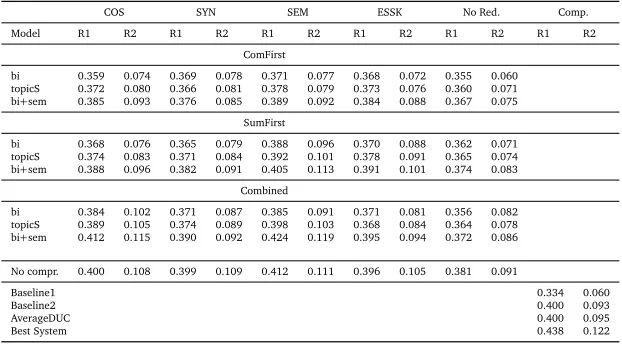
The multiple “reference summaries” given by DUC-2007 are used in the evaluation of our summary content. We carried out the automatic evaluation of our summaries using the ROUGE (Lin, 2004) toolkit. Among different scores reported by ROUGE, unigram-based ROUGE score (ROUGE-1) has been shown to agree with human judgment most (Lin, 2003). We report the widely adopted important ROUGE metrics in the results: ROUGE-1 (unigram),and ROUGE-2 (bigram). The comparison between the systems in terms of their F-scores is given in Table 1. We also include the results of the official baseline systems, the best system (Pingali et al., 2007), and the average ROUGE scores of all the participating systems of DUC-2007. Baseline-1 returns all the leading sentences (up to 250 words) of the most recent document whereas baseline-2’s
main idea is to ignore the topic narrative while generating summaries using an HMM model15.
The columns in Table 1 denote the use of alternative redundancy constraints in the optimization
14http://lpsolve.sourceforge.net/5.5/ 15http:
COS SYN SEM ESSK No Red. Comp.
Model R1 R2 R1 R2 R1 R2 R1 R2 R1 R2 R1 R2
ComFirst
bi 0.359 0.074 0.369 0.078 0.371 0.077 0.368 0.072 0.355 0.060 topicS 0.372 0.080 0.366 0.081 0.378 0.079 0.373 0.076 0.360 0.071 bi+sem 0.385 0.093 0.376 0.085 0.389 0.092 0.384 0.088 0.367 0.075
SumFirst
bi 0.368 0.076 0.365 0.079 0.388 0.096 0.370 0.088 0.362 0.071 topicS 0.374 0.083 0.371 0.084 0.392 0.101 0.378 0.091 0.365 0.074 bi+sem 0.388 0.096 0.382 0.091 0.405 0.113 0.391 0.101 0.374 0.083
Combined
bi 0.384 0.102 0.371 0.087 0.385 0.091 0.371 0.081 0.356 0.082 topicS 0.389 0.105 0.374 0.089 0.398 0.103 0.368 0.084 0.364 0.078 bi+sem 0.412 0.115 0.390 0.092 0.424 0.119 0.395 0.094 0.372 0.086
No compr. 0.400 0.108 0.399 0.109 0.412 0.111 0.396 0.105 0.381 0.091
Baseline1 0.334 0.060
Baseline2 0.400 0.093
AverageDUC 0.400 0.095
[image:12.420.48.359.71.243.2]Best System 0.438 0.122
Table 1: Automatic Evaluation Results: Average ROUGE F-scores
framework whereas the rows stand for the use of different compression models16. From these
results, we can clearly see the impact of using different sentence compression models on the
overall summarization performance. In theComFirstapproach, we can see that the bigram
model with semantic constraints outperforms all the other alternative models by a clear margin. We can also see the impact of different redundancy constraints on the overall performance. We observe that the use of semantic measure as the redundancy constraint yields the best performance. On the other hand, we see a clear improvement in almost all the scores when
we follow theSumFirstapproach. This phenomenon suggests that compressing the document
sentences at the beginning often tend to reduce relevant information in the sentences for which we get lesser similarity matching when we calculate the relevance scores according to
Section 3.1. In theCombinedapproach, we achieve better summarization performance than
the other two approaches which denotes that the overall summary quality can be improved if a global optimization framework is utilized having a joint compression and extraction model. Again, we see that the bigram language model with semantic constraints along with the semantic redundancy constraint (used in the summarization model) yields the best performance. We
also report the results of a“No compression”and a“No redundancy”baseline. Comparisons
with these baselines also suggest that our bigram compression model with semantic constraints
can improve the overall summarization performance if aCombinedoptimization framework is
used in presence ofCOSorSEMredundancy constraints. These results also demonstrate that
the absence of a redundancy constraint in the ILP framework for summarization really hurts the overall quality of the summaries. We also compare the scores of our model with the state-of-the-art systems of DUC-2007. From the results, we see that our semantically motivated models can
mostly outperform theDUC baselinesand theAverageDUCscores to show a clear improvement
in the overall summarization performance while achieving a comparable performance with respect to the DUC-2007 best system. The differences between the models are computed
to be statistically significant atp<0.05 (using Student’s t-test) except for the differences
betweentopicSig+SYNandbigram+SYN, andtopicSig+ESSKandbigram+ESSKin all the
three approaches, betweentopicSig+COSandbigram+COSin theCombinedapproach, and
between“bigram+sem”+SEMandDUC Best Systemin theCombinedapproach.
4.3.2 Manual Evaluation
One of the important demerits of using sentence compression models is that they can degrade the linguistic quality of a summary by showing poor compression performance. ROUGE is not reliable to some researchers as there might be some linguistically bad summaries that get state-of-the-art ROUGE scores (Sjöbergh, 2007). So, we conduct an extensive manual evaluation in order to analyze the effectiveness of our approaches. Two self reported native English-speaking university graduate students judge the summaries for linguistic quality and overall
responsiveness according to the DUC-2007 evaluation guidelines17. The given linguistic quality
score is an integer between 1 (very poor) and 5 (very good) and is guided by consideration of the following factors: 1. Grammaticality, 2. Non-redundancy, 3. Referential clarity, 4. Focus, and 5. Structure and Coherence. The responsiveness score is also an integer between 1 (very poor) and 5 (very good) and is based on the amount of information in the summary that helps to satisfy the information need. The carried out user evaluation was subjective in nature specially while judging referential clarity, focus, coherence and overall responsiveness
of the summaries. The inter-annotator agreement of Cohen’sκ=0.43 (Cohen, 1960) was
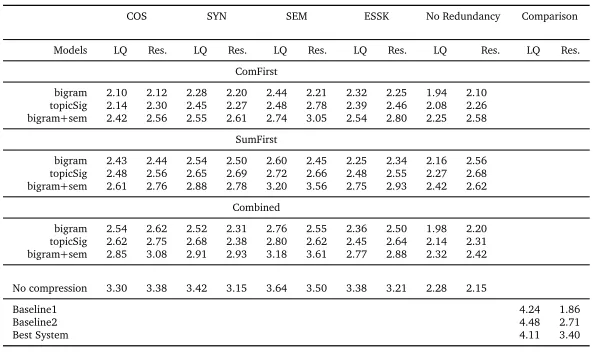
computed that denotes a moderate degree of agreement (Landis and Koch, 1977) between the raters. Table 2 presents the average linguistic quality and overall responsive scores of all the systems. From these results, we can see that the use of different sentence compression models has a negative impact on the overall linguistic quality of the summaries. The reason behind this is that our bigram compression models were less aware of the underlying context in a sentence and hence, some word deletions resulted a loss in focus and coherence of the overall summaries. However, we observe that the semantically motivated models are showing an improved summarization performance; also, their overall responsiveness scores are comparable to the state-of-the-art systems. This suggests that the manual evaluation results are corresponding well to the automatic evaluation results. Considering the work of Gillick and Favre (2009) for a relative comparison, we find that both our automatic and manual evaluation
results are corresponding fairly well to their results obtained on the TAC18-2008 data. Their ILP
model with additional constraints to include sentence compression achieved an improvement in ROUGE-2 score over the “no compression” alternative while having reductions in manual evaluation scores. We perform a statistical significance test on our manual evaluation results at
p<0.05 using Student’s t-test. The differences between the models are statistically significant
except for the differences betweentopicSig+COSandbigram+COS, andtopicSig+SYNand
bigram+SYNin all the three approaches. The manual evaluation results also demonstrate that the use of different redundancy constraints certainly affects the overall performance of
the proposed optimization framework for summarization19. From these experiments we can
conclude that the semantic similarity measure can be used effectively as theSim(i,j)function
to improve the performance of the traditional cosine similarity based approaches. We plan to make our created resources available to the scientific community.
17http:
//www-nlpir.nist.gov/projects/duc/duc2007/quality-questions.txt 18Text Analysis Conference, http://www.nist.gov/tac/
COS SYN SEM ESSK No Redundancy Comparison
Models LQ Res. LQ Res. LQ Res. LQ Res. LQ Res. LQ Res. ComFirst
bigram 2.10 2.12 2.28 2.20 2.44 2.21 2.32 2.25 1.94 2.10 topicSig 2.14 2.30 2.45 2.27 2.48 2.78 2.39 2.46 2.08 2.26 bigram+sem 2.42 2.56 2.55 2.61 2.74 3.05 2.54 2.80 2.25 2.58
SumFirst
bigram 2.43 2.44 2.54 2.50 2.60 2.45 2.25 2.34 2.16 2.56 topicSig 2.48 2.56 2.65 2.69 2.72 2.66 2.48 2.55 2.27 2.68 bigram+sem 2.61 2.76 2.88 2.78 3.20 3.56 2.75 2.93 2.42 2.62
Combined
bigram 2.54 2.62 2.52 2.31 2.76 2.55 2.36 2.50 1.98 2.20 topicSig 2.62 2.75 2.68 2.38 2.80 2.62 2.45 2.64 2.14 2.31 bigram+sem 2.85 3.08 2.91 2.93 3.18 3.61 2.77 2.88 2.32 2.42
No compression 3.30 3.38 3.42 3.15 3.64 3.50 3.38 3.21 2.28 2.15
Baseline1 4.24 1.86
Baseline2 4.48 2.71
[image:14.420.55.352.69.246.2]Best System 4.11 3.40
Table 2: Average linguistic quality (LQ) and responsiveness scores (Res.)
Conclusion and Future Work
We have analyzed the effectiveness of using different ILP-based sentence compression mod-els for the task of query-focused multi-document summarization. Our empirical evaluation suggested that the semantically motivated sentence compression models can enhance the overall summarization performance in presence of the semantic redundancy constraint in the summarization model and this can be achieved irrespective of the compression and extraction order followed during the process. Our results also demonstrated that a combined optimization framework of compression and extraction can achieve better performance than the other two
considered approaches effectively. We also found that theSumFirstapproach shows superior
performance to that of theComFirstapproach suggesting the fact that extracting the most
important sentences before compression is a more effective way of summarization. We have also used different textual similarity measurement techniques as the redundancy constraints of the ILP-based summarization framework and performed an extensive experimental evaluation to show their impact on the overall summarization performance. Experimental results showed that
the use of semantic similarity measure as theSim(i,j)function in the redundancy constraint
yields the best performance. Overall, our global optimization frameworks showed promising performance with respect to the state-of-the-art systems. We look forward to apply our approach to other available datasets of DUC-2005 and DUC-2006. The findings should hold for these datasets as well as for other genres of datasets since we believe that our ILP-based compression and summarization models could be tuned to fit them. We also plan to use other automatic measures (Saggion et al., 2010; Pitler et al., 2010) to evaluate our approach.
Acknowledgments
References
Berg-Kirkpatrick, T., Gillick, D., and Klein, D. (2011). Jointly Learning to Extract and Compress. InProceedings of the 49th Annual Meeting of the Association for Computational Linguistics: Human Language Technologies - Volume 1, HLT ’11, pages 481–490. ACL.
Bouayad-Agha, N., Gil, A., Valentin, O., and Pascual, V. (2006). A Sentence Compression
Module for Machine-Assisted Subtitling. InComputational Linguistics and Intelligent Text
Processing, pages 490–501. Springer Berlin Heidelberg.
Cancedda, N., Gaussier, E., Goutte, C., and Renders, J. M. (2003). Word Sequence Kernels.
Journal of Machine Learning Research, 3:1059–1082.
Carbonell, J. and Goldstein, J. (1998). The Use of MMR, Diversity-based Reranking for
Re-ordering Documents and Producing Summaries. InProceedings of the 21st Annual International
ACM SIGIR Conference on Research and Development in Information Retrieval (SIGIR 1998), pages 335–336, Melbourne, Australia.
Chali, Y. and Hasan, S. A. (2012). Query-focused Multi-document Summarization:
Auto-matic Data Annotations and Supervised Learning Approaches.Natural Language Engineering,
18(1):109–145.
Charniak, E. (1999). A Maximum-Entropy-Inspired Parser. InTechnical Report CS-99-12,
Brown University, Computer Science Department.
Clarke, J. and Lapata, M. (2008). Global Inference for Sentence Compression An Integer
Linear Programming Approach.Journal of Artificial Intelligence Research, 31(1):399–429.
Cohen, J. (1960). A Coefficient of Agreement for Nominal Scales.Educational and Psychological
Measurement, 20(1):37–46.
Cohn, T. and Lapata, M. (2008). Sentence Compression Beyond Word Deletion. InProceedings
of the 22nd International Conference on Computational Linguistics (Coling 2008), pages 137–144, Manchester, UK.
Collins, M. and Duffy, N. (2001). Convolution Kernels for Natural Language. InProceedings of
Neural Information Processing Systems, pages 625–632, Vancouver, Canada.
Daumé III, H. and Marcu, D. (2005). Bayesian Multi-Document Summarization at MSE. In
Proceedings of the Workshop on Multilingual Summarization Evaluation (MSE).
Denis, P. and Baldridge, J. (2007). Joint Determination of Anaphoricity and Coreference
Resolution using Integer Programming. InHuman Language Technologies 2007: The Conference
of the North American Chapter of the Association for Computational Linguistics;, pages 236–243. ACL.
Edmundson, H. P. (1969). New Methods in Automatic Extracting.Journal of the Association
for Computing Machinery (ACM), 16(2):264–285.
Erkan, G. and Radev, D. R. (2004). LexRank: Graph-based Lexical Centrality as Salience in
Text Summarization.Journal of Artificial Intelligence Research, 22:457–479.
Filippova, K. (2010). Multi-Sentence Compression: Finding Shortest Paths in Word Graphs. In
Proceedings of the 23rd International Conference on Computational Linguistics, pages 322–330. ACL.
Galanis, D. and Androutsopoulos, I. (2010). An Extractive Supervised Two-Stage Method
for Sentence Compression. InHuman Language Technologies: The 2010 Annual Conference of
the North American Chapter of the Association for Computational Linguistics, HLT ’10, pages 885–893. ACL.
Gillick, D. and Favre, B. (2009). A Scalable Global Model for Summarization. InProceedings of
the Workshop on Integer Linear Programming for Natural Langauge Processing, ILP ’09, pages 10–18. ACL.
Goldstein, J., Kantrowitz, M., Mittal, V., and Carbonell, J. (1999). Summarizing Text
Docu-ments: Sentence Selection and Evaluation Metrics. InProceedings of the 22nd International
ACM Conference on Research and Development in Information Retrieval, SIGIR, pages 121–128, Berkeley, CA.
Hacioglu, K., Pradhan, S., Ward, W., Martin, J. H., and Jurafsky, D. (2003). Shallow Semantic
Parsing Using Support Vector Machines. InTechnical Report TR-CSLR-2003-03, University of
Colorado.
Hirao, T., , Suzuki, J., Isozaki, H., and Maeda, E. (2004). Dependency-based Sentence
Alignment for Multiple Document Summarization. InProceedings of COLING 2004, pages
446–452, Geneva, Switzerland. COLING.
Hirao, T., Suzuki, J., Isozaki, H., and Maeda, E. (2003). NTT’s Multiple Document
Summariza-tion System for DUC2003. InProceedings of the Document Understanding Conference.
Hovy, E., Lin, C. Y., Zhou, L., and Fukumoto, J. (2006). Automated Summarization Evaluation
with Basic Elements. InProceedings of the Fifth Conference on Language Resources and Evaluation,
Genoa, Italy.
Jing, H. (2000). Sentence Reduction for Automatic Text Summarization. InProceedings of the
Sixth Conference on Applied Natural Language Processing, pages 310–315. ACL.
Kingsbury, P. and Palmer, M. (2002). From Treebank to PropBank. InProceedings of the
International Conference on Language Resources and Evaluation, Las Palmas, Spain.
Knight, K. and Marcu, D. (2000). Statistics-Based Summarization - Step One: Sentence
Compression. InProceedings of the Seventeenth National Conference on Artificial Intelligence
and Twelfth Conference on Innovative Applications of Artificial Intelligence, pages 703–710. AAAI Press.
Knight, K. and Marcu, D. (2002). Summarization Beyond Sentence Extraction: A Probabilistic
Approach to Sentence Compression.Artificial Intelligence, 139(1):91–107.
Kupiec, J., Pedersen, J., and Chen, F. (1995). A Trainable Document Summarizer. InProceedings
Landis, J. R. and Koch, G. G. (1977). The Measurement of Observer Agreement for Categorical
Data.Biometrics, 33(1):159–174.
Lin, C. Y. (2003). Improving Summarization Performance by Sentence compression: A Pilot
Study. InProceedings of the sixth international workshop on Information retrieval with Asian
languages - Volume 11, pages 1–8. ACL.
Lin, C. Y. (2004). ROUGE: A Package for Automatic Evaluation of Summaries. InProceedings
of Workshop on Text Summarization Branches Out, Post-Conference Workshop of Association for Computational Linguistics, pages 74–81, Barcelona, Spain.
Lin, C.-Y. and Hovy, E. H. (2000). The Automated Acquisition of Topic Signatures for Text
Summarization. InProceedings of the 18th conference on Computational linguistics, pages
495–501.
Lodhi, H., Saunders, C., Shawe-Taylor, J., Cristianini, N., and Watkins, C. (2002). Text
Classification using String Kernels.Journal of Machine Learning Research, 2:419–444.
Madnani, N., Zajic, D., Dorr, B., Ayan, N. F., and Lin, J. (2007). Multiple Alternative Sentence
Compressions for Automatic Text Summarization. InIn Proceedings of the 2007 Document
Understanding Conference (DUC-2007) at NLT/NAACL 2007.
Mani, I. and Maybury, M. (1999).Advances in Automatic Text Summarization. MIT Press.
Martins, A. F. T. and Smith, N. A. (2009). Summarization with a Joint Model for Sentence
Extraction and Compression. InProceedings of the Workshop on Integer Linear Programming for
Natural Langauge Processing, ILP ’09, pages 1–9. ACL.
Mcdonald, R. (2006). Discriminative Sentence Compression with Soft Syntactic Constraints. InIn Proceedings of the 11th Conference of the EACL.
McDonald, R. (2007). A Study of Global Inference Algorithms in Multi-document
Summariza-tion. InProceedings of the 29th European conference on IR research, ECIR’07, pages 557–564.
Springer-Verlag.
Molina, A., Torres-Moreno, J., SanJuan, E., da Cunha, I., Sierra, G., and Velázquez-Morales, P.
(2011). Discourse Segmentation for Sentence Compression. InProceedings of the 10th Mexican
international conference on Advances in Artificial Intelligence - Volume Part I, pages 316–327. Springer-Verlag.
Moschitti, A. and Basili, R. (2006). A Tree Kernel Approach to Question and Answer
Classifi-cation in Question Answering Systems. InProceedings of the 5th International Conference on
Language Resources and Evaluation, Genoa, Italy.
Moschitti, A., Quarteroni, S., Basili, R., and Manandhar, S. (2007). Exploiting Syntactic and
Shallow Semantic Kernels for Question/Answer Classificaion. InProceedings of the 45th Annual
Meeting of the Association of Computational Linguistics, pages 776–783, Prague, Czech Republic. ACL.
Palmer, M., Gildea, D., and Kingsbury, P. (2005). The Proposition Bank: An Annotated Corpus
Pasca, M. and Harabagiu, S. M. (2001). Answer Mining from On-Line Documents. In
Proceedings of the Association for Computational Linguistics 39th Annual Meeting and 10th Conference of the European Chapter Workshop on Open-Domain Question Answering, pages 38–45, Toulouse, France.
Pingali, P., K., R., and Varma, V. (2007). IIIT Hyderabad at DUC 2007. InProceedings of the
Document Understanding Conference, Rochester. NIST.
Pitler, E., Louis, A., and Nenkova, A. (2010). Automatic Evaluation of Linguistic Quality in
Multi-document Summarization. InProceedings of the 48th Annual Meeting of the Association
for Computational Linguistics, pages 544–554. ACL.
Punyakanok, V., Roth, D., Yih, W., and Zimak, D. (2004). Semantic Role Labeling via
In-teger Linear Programming Inference. InProceedings of the 20th international conference on
Computational Linguistics, COLING ’04. ACL.
Riedel, S. and Clarke, J. (2006). Incremental Integer Linear Programming for Non-projective
Dependency Parsing. InIn EMNLP, pages 129–137.
Roth, D. and Yih, W. (2004). A Linear Programming Formulation for Global Inference in
Natural Language Tasks. InIn Proceedings of CoNLL-2004, pages 1–8.
Saggion, H., Torres-Moreno, J., Cunha, I., and SanJuan, E. (2010). Multilingual Summarization
Evaluation without Human Models. InProceedings of the 23rd International Conference on
Computational Linguistics: Posters, pages 1059–1067. ACL.
Sekine, S. (2002). Proteus Project OAK System (English Sentence Analyzer),
http://nlp.nyu.edu/oak.
Sekine, S. and Nobata, C. A. (2001). Sentence Extraction with Information Extraction
Technique. InProceedings of the Document Understanding Conference (DUC 2001), New Orleans,
Louisiana, USA.
Sjöbergh, J. (2007). Older Versions of the ROUGEeval Summarization Evaluation System Were
Easier to Fool.Information Processing and Management, 43:1500–1505.
Yoshikawa, K., Iida, R., Hirao, T., and Okumura, M. (2012). Sentence Compression with
Semantic Role Constraints. InProceedings of the 50th Annual Meeting of the Association for
Computational Linguistics (Volume 2: Short Papers), pages 349–353, Jeju Island, Korea. ACL.
Zajic, D., Dorr, B. J., Lin, J., and Schwartz, R. (2007). Multi-candidate Reduction: Sentence
Compression as a Tool for Document Summarization Tasks. Information Processing and
Management, 43(6):1549–1570.
Zhang, A. and Lee, W. (2003). Question Classification using Support Vector Machines. In
Proceedings of the Special Interest Group on Information Retrieval, pages 26–32, Toronto, Canada. ACM.
Zhou, L., Lin, C. Y., and Hovy, E. (2005). A BE-based Multi-dccument Summarizer with Query