Question-Answering Based on Virtually Integrated Lexical
Knowledge Base
Key-Sun Choi KAIST,Korterm
Daejeon 305-701 Korea [email protected] ist.ac.kr
Jae-Ho Kim KAIST,Korterm
Daejeon 305-701 Korea jjaeh@world.
kaist.ac.kr
Masaru Miyazaki NHK STRL Tokyo 157-8510
Japan [email protected]
Jun Goto NHK STRL Human Science Tokyo 157-8510
Japan [email protected]
Yeun-Bae Kim NHK STRL Human Science Tokyo 157-8510
Japan [email protected]
Abstract
This paper proposes an algorithm for cau-sality inference based on a set of lexical knowledge bases that contain information about such items as event role, is-a hier-archy, relevant relation, antonymy, and other features. These lexical knowledge bases have mainly made use of lexical features and symbols in HowNet. Several types of questions are experimented to test the effectiveness of the algorithm here proposed. Particularly in this paper, the question form of “why” is dealt with to show how causality inference works.
1 Introduction
A virtually linked knowledge base is designed to utilize a pre-constructed knowledge base in a dy-namic mode when it is in actual use.
An open-domain question answering architec-ture must consist of various components and processes (Pasça, 2001) that include WordNet-like resources, part of speech tagging, parsing, named entity recognition, question processing, passage retrieval, answer extraction, and answer justification. Consider a question like the follow-ing: “Why do doctors cure patients?”
The answer may be obtained by commonsense knowledge as follows:
1. A patient suffered from a disease.
2. A doctor cures the disease. 3. The doctor cures at
hospi-tal.
4. Doctor is an occupation. 5. So the doctor cures the
patient.
These sentences are transformed into proposi-tional forms, as illustrated below:
6. sufferFrom(patient,disease) 7. cure(doctor,disease)
8. cure(doctor,at-hospital) 9. occupation(doctor)
10.cure(doctor,patient)
Linguistic knowledge bases like WordNet (Miller, 1995), EDR dictionary (Yokoi, 1995) and HowNet (Dong, 1999) have been used to interpret these sentences.
Moldovan et al. (2002) generated lexical chains from WordNet in order to trace these topically re-lated paths and thereby to search for causal expla-nations. A conceptual word Cj inside of a gloss
under a synset Ci is linked to the synset Cj.
HowNet (Dong et al. 1999) is a linguistic knowledge base that is designed to have the defini-tion of words and concepts as well as event role and role-filling entities. Commonsense knowledge like naive physics is also built up through event role relation like the relation of sufferFrom requir-ing cure.
HowNet is modularized into separate knowl-edge spaces for entity hierarchy, event hierarchy, antonymy, syntax, attributes, etc. Relations be-tween various concepts (e.g., part-of, relevance, location) are defined implicitly in the definition of each concept.
patient doctor occupation money
$cure *cure earn $earn
#occupation
converse
agent=patient possession=money target=?
agent=?
possession=money source=patient entity
syn
event
*pay $pay
give take
(1)
(2)
(3)
(4)
(5) (6) (7)
(8)
(9)
patient doctor occupation money
$cure *cure earn $earn
#occupation
converse
agent=patient possession=money target=?
agent=?
possession=money source=patient entity
syn
event
*pay $pay
give take
(1)
(2)
(3)
(4)
(5) (6) (7)
(8)
[image:2.595.72.292.108.256.2](9)
Figure 1: A Snapshot of a virtually integrated knowledge base for the question: “Why do patients pay money to doctors?”
In the following sections, issues on the virtual in-tegration of knowledge bases, their algorithms and experimentations are presented.
2 Underlined Knowledge Bases and Vir-tual Integration
In Figure 1, each marked numbering has the fol-lowing meaning:
(1) Entity hierarchy: entity is the top node in the hierarchy of entities.
(2) entity is the hypernym of patient, doctor,
occupation, and money in the line (3). (3) Concepts or word entries are listed in this
line. All concepts and word entries repre-sent their definition by a list of concepts and marked pointers.
(4) A concept (or word) in (3) features defini-tional relations to a list of concepts. For example, a doctor definition is composed of two concepts and their marking point-ers: #occupation and *cure. Pointers in HowNet represent relations between two concepts or word entries, e.g., “#” means “relevant” and “*” does “agent”.
(5) syn refers to the syntactic relation in the question “Why do patients pay money to doctors?”
(6) converse refers to the converse relation be-tween events, e.g., give and take.
(7) Event hierarchy: For example, the hy-pernym for pay is give and the hypernym of give is event.
(8) Event role: Now, event roles are partially filled with entities, e.g., patient and
money.
(9) Event role shift: The agent of give is equalized to the source of take.
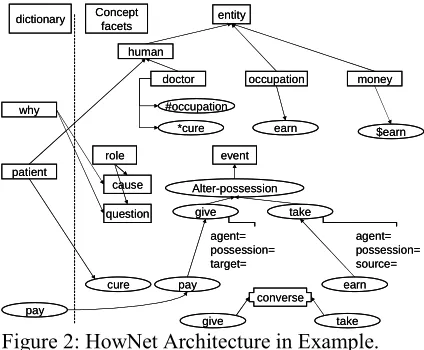
An overview of each component of the knowl-edge base is in Figure 2, where three word entries
why, patient, and money are in the dictionary. The four concept facets of entity, role, event, and converse are described in this example, mainly as part of linguistic knowledge.
pay
give take agent= possession= target=
agent= possession= source= Alter-possession
patient
doctor occupation money
cure
*cure earn $earn #occupation
entity
give take converse event
earn human
pay why
role
question cause dictionary Concept
facets
pay
give take agent= possession= target=
agent= possession= source= Alter-possession
patient
doctor occupation money
cure
*cure earn $earn #occupation
entity
give take converse event
earn human
pay why
role
question cause dictionary Concept
facets
Figure 2: HowNet Architecture in Example.
Some issues on ontology integration have been discussed from various points of view. Pinto et al. (1999) classified the notions of ontology integra-tion into three types: integration, merging and
use/application. The term virtually integrated
means the view of ontology-based use/application. This paper presents issues on and arguments for linguistic knowledge base and commonsense knowledge in (Lenat, Miller and Yokoi, 1995). One of the arguments was whether linguistic knowledge could be separated from commonsense knowledge, but it was agreed that both types of knowledge were essentially required for natural language processing.
[image:2.595.304.516.306.481.2]3 Interpretation of Lexical Knowledge
Consider the following three sentences:
11.Doctors cure patients. 12.Doctors earn money. 13.Patients pay money.
One major concern is finding connectability
among words and concepts. As shown in Figure 2, the following facts are derived:
14.Doctor is relevant to oc-cupation.
15.Occupation allows you to earn money.
Because there exists a converse relation be-tween give and take, their hyponyms earn and pay
also fall under converse relation. It is something like the following social commonsense as shown in Figure 2: “If someone X pays money to the other Y, Y earns money from X.”
We humans now understand the reason for “why patients pay money.” The answer is that “doctors cure patients as their occupation allowing them to earn money.”
The following is a valid syllogism where Y is being instantiated to doctor:
If “X pays money to Y” is equivalent to “Y earns money from X”1, and “a doctor earns money from X”, then “X pays money to the doctor”.
Consider the next syllogism: If “a doctor cures X” and “doctor is an occupa-tion” and Axiom 1, then “the doc-tor earns money from X”.
Axiom 1 is needed to make such a syllogism that “If Y cures X and Y is an occu-pation, then Y earns money from X.” Then our challenge is to find out this Axiom 1 from the lexical knowledge bases. It is a com-monsense and thus there is a gap in the lexical knowledge base.
The following is a list of questions derived from the three sentences of 11, 12 and 13 which are designed to discover such axioms (or rules) from a set of lexical knowledge bases: “Why do
1 It is a converse relation.
doctors cure patient?”, “Why do doctors earn money?”, and “Why do patients pay money to doc-tors?”
4 Connectability: Similarity Measure
Consider the query “Why do doctors cure pa-tients?” Tracing Figure 2 back through Figure 1 leads to obtaining logical forms from 6 through 10. The best connectable path is planned from the first word of the question.
For each pair of words, the function called "similar(*,*)" will be estimated to choose the next best tracing concepts (or words). similar's mis-sions are summarized as (1) checking the connect-ability between two nodes2, (2) selecting the best sense of the node,3 (3) selecting the best tracing candidate node in the next step. Finally, following the guidance by similar allows us to explain the question.
4.1 Observation and Evidence of Topical Re-latedness
Let's try to follow the steps 6-10 given in the logi-cal forms. In the question “Why do doctors cure patient?” that focuses on three words doctor, cure, and patient, we can trace some key words given in example sentences as follows: patient ~ disease ~ cure ~ doctor ~ occupation ~ earn ~ pay ~ pa-tient.
What kind of lexical relations are relevant to each pair of words or concepts? Their observation can be summarized as follows:
A) The relation between patient ~ disease is a role relation of “sufferFrom(patient, dis-ease)”.
B) A sequence of cure ~ doctor ~ occupation ~ earn lets us infer the relation among
cure ~ earn, which are closely linked by their relevance relation to occupation. Furthermore, earn and cure shares a common subject of these two events.
C) The sequence of earn ~ pay is the result of a converse event relation between earn
and pay.
D) pay ~ patient: The agent of pay is a ge-neric human. In other words, pay is a
ponym for the act of human, one of whose hyponym is patient.
Consider again the match between the tracing sequences of concepts and the knowledge base. Going into more details, notations with footnotes will be given to each example. At this point, we will give names and formalization based on the observed characteristics.
A) Feature comparison: To find the role re-lation among patient ~ disease, search the definition of entities (referring to patient
and disease) in ways that two entities share the same event concept (referring to
cure):4
patient ⊃ human∧$cure ∧*sufferFrom. disease ⊃ medical∧$cure ∧ undesired. B) Interrelation: To find the event
interrela-tion among cure ~ earn, two possible paths are presented as follows.
• First, inverse interrelation: Two event's role entities can be found by searching all of entities using *earn ~ *cure that share the same subject, and using *earn ~ $cure
where the subject of earn is the object of
cure.
• Second, sister interrelation: The following logical form can be derived from Figure 2:5
doctor ⊃ *cure ∧ #occupation. occupation ⊃ earn.
Because cure and occupation is in the defi-nition of doctor, a probable logical implica-tion can be derived as follows:6
*cure ⊃ ~#occupation.
C) Converse/antonymy: earn and pay have their respective hypernyms take and give. There exists a converse relation between these two hypernyms.
4 According to HowNet convention, “$” represents patient, target, possession, or content of an event, and “*” represents agent, experiencer, or instrument. “⊃” means implies or has features.
5 “#” means “relevant”. 6 “~” means “very probable”.
D) Inheritance: The relation among pay ~ patient is represented as follows:7
human patient
act human
act pay
p p
* ⊃
4.2 Rationale of Connectability
In the former section, we summarized four charac-teristics8 of causality (relatedness)-based path find-ing: feature comparison, interrelation, converse/antonymy in their hypernym’s level, and inheritance. Among search spaces available, it is necessary to find out a measure of guiding the op-timal9 path tracing.
We will call such a measure similar which will be defined according to the four characteristics just mentioned. Further details about the calculation formula will be presented again later.
A) For “feature comparison”, the measure fea-ture similar(X,Y) defines the notion of similarity between the features in X and Y. B) There are two interrelations in the last
sec-tion.
• For “inverse interrelation”', inverse simi-lar(X,Y) calculates how much similarity ex-ists between Xθ and Yθ in a manner that Xθ
= {Z | Z ⊂ θX}, where θX is an abstraction of role-marked concepts like *X, $X, #X, etc. Thus inverse similar(X,Y) = simi-lar(Xθ,Yθ).
• For “sister interrelation”, the measure sister similar(X,Y) means the following two situa-tions: First, X and Y are features to define one concept (say, W). Second, one of them, say, Y's definitional feature concepts (refer-ring to Z) are similar with X such that X and Z are similar if W ⊃ X ∧Y and Y ⊃ Z. C) Converse or antonymy: The converse
re-lation converse(X,Y) can be found by the measure feature similar. converse(X,Y) is formulated by X ⊂ θY and Y ⊂ θX where
θ = converse.
D) Using inheritance property in the concept hierarchy, relations between hypernym of concepts X and Y are inherited to X and Y in a way that X and Y is similar if there exist X’ and Z such that X p X', Z⊃θX’, and YpZ where θ is a pointer or null.
This inheritance tracing can be determined by how much similar X and Y are in terms of their path upward based on the relation of hypernym. We will define path similar. But tracing the path upward following hy-pernym links is to be described later ac-cording to the algorithm.
A measure called similar will be defined based on the discussion in this section. Then an algorithm is introduced through this measure with an exam-ple.
5 Measures
In the last section, we discussed four kinds of the measure similar.
• path similar, • feature similar, • inverse similar, • sister similar.
For feature, inverse, and sister similar func-tions, path similar is used as a basis of calculation. They are different with respect to both their search method and the depth of expanding features. fea-ture similar finds similar features by using path similar. inverse similar(X,Y) searches for entries that contain X and Y as features and then use the
path similar. In the same way, sister similar finds sister concepts, expands them, and finally meas-ures using the path similar.
Since path similar plays a key role in all these search and measure processes, its role will be ex-plained in the next subsection. Other measures are only dealt with as part of the algorithm.
5.1 Similarity Based on Hierarchy and Fea-ture
The mission of the measuring function simi-lar(X,Y) is to calculate their relevancy between two concepts or words whether they are of type entity, event, or of some other type.
If X and Y belong to different types of knowl-edge plane (e.g., entity and event), it is hard to compare their hypernym path upward to the top concept. However, if different types of concepts have any relevance to (connect) causality, we will use feature similar or inverse similar after find-ing the same type of concepts to calculate the path similar. Now we will explain the above by using two pairs of concept type: entity and entity-event, without loss of generality.
First, pathsimilar(entity X, entity Y) is de-fined as follows:
) ( )
(
) ( )
( 2
) , (
Y path X
path
Y path X
path Y X r pathsimila
+ +
+ +
+ ∩ ×
=
where path+(X) is the ordered list of hypernym for X by descending order from the top concept. For example,
path+(doctor)
= [entity...animate...human.doctor] path+(patient)
= [entity...animate...human.patient]
Because |path+(X)| counts the number of nodes on the path, pathsimilar(doctor,patient) = 2×
6/(7+7)=0.857.
Second, pathsimilar(entity N, event V) is de-fined as follows:
pathsimilar(N,V)
= Max pathsimilar(N.feature,V)
where N.feature means the feature list in the defi-nition of N. The following is an illustrative exam-ple for the definition:
money ⊃ $earn,*buy,#sell, $setAside, it is equivalent to the following:
money.feature=[$earn,*buy,#sell,$setAside]. So pathsimilar(money,earn)=pathsimilar(earn,earn) =1. According to this Max function, the selection priorities for the path can be specified.
Third, pathsimilar(event V, entity N) is de-fined by inverse similar as follows: pathsimi-lar(V,N) = Max pathsimilar(V.inverse, N). For example, pathsimilar(cure, doctor) = Max path-similar(cure.inverse, doctor) = Max pathsimi-lar({doctor, medical worker, medicine, patient}, doctor).
en-tity Y) shown before. But, we can give another
inverse pathsimilar(event X, event Y) = Max pathsimilar(X.inverse, Y.inverse).
5.2 Logical Implication and Expansion Depth
All of the relations in Figure 2 are translated into logical form (see below). As shown in “Interpreta-tion as Abduc“Interpreta-tion” (Hobbs et al. 1988), “abductive inference is inference to the best explanation”. These relations showed “the interpretation of a text is the minimal explanation of why the text would be true” based on the abductive inference. By the same token, “the interpretation of a question is the minimal explanation of why the question would be true” based on a set of lexical knowledge bases.
Before proceeding to our algorithm, an example will be applied to abductive inference briefly as a set of logical forms as well as a diagram in Figure 3.
16.doctor ⊃ human, #occupation, *cure, medical.
17.medicine ⊃*cure. 18.disease ⊃ $cure. 19.cure ⊃ medical,
{agent,patient,content}. 20.medical ⊃ #cure.
21.converse(pay,earn) ⊃ agent=source, target=agent.
22.patient ⊃ human,$cure.
23.occupation ⊃ affairs, earn. 24.cause(cure,sufferFrom) ⊃
patient=experiencer, content=content.
25.possibleConsequence(cure, beRecovered) ⊃
patient=experiencer, content=stateIni.
While pursuing the path tracing enabling mini-mal explanation, now we are going to propose a connectability measure similar such as “weighted abduction” (Hobbs et al. 1988). As “likelihood estimation” is useful to consider a “bounded conditioning” (Russell & Norvig, 1995) in a belief network, the “expansion depth” of simi-lar will be useful for the explanation path tracing for the purpose of the minimal explanation of the question.
commercial $earn *buy #sell $setAside
patient pay money
why human *sufferFrom $cure
agent content source payer*
money advanced$
doctor give
hypernym
take hypernym
occupation
affirs earn human
#occupation *cure medical
inverse
converse
commercial $earn *buy #sell $setAside
patient pay money
why human *sufferFrom $cure
agent content source payer*
money advanced$
doctor give
hypernym
take hypernym
occupation
affirs earn human
#occupation *cure medical human #occupation *cure medical
inverse
[image:6.595.305.525.102.265.2]converse
Figure 3: Virtual Linking for Causality
The “expansion depth level” of similar has two kinds of utilities: one is to find the minimal expla-nation, and the other is to be dynamically adapt-able to the level of interaction. This level of similar is defined as a function simi-lar(Level)(X,Y) for X and Y, concepts or words in the following manner:
• similar(0)=pathsimilar: they use only them-selves and their hypernym path from X and Y.
• similar(1)=feature_similar: they use their features that are expanded one more than similar(0).
• similar(2)=inverse_similar • similar(3)=sister_similar
=inverse_similar×feature_similar.
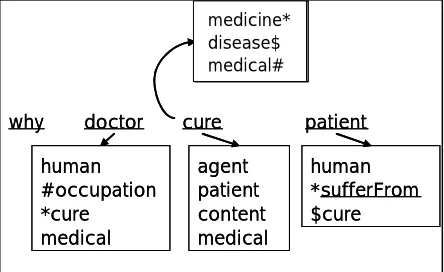
Depending on what level of similar is chosen, the search paths may be changed. A snapshot up to similar(2) is given in Figure 4.
Figure 4: Snapshot for similar(2).
human * sufferFrom $cure doctor cure patient why
human #occupation *cure medical
agent patient content medical
medicine* disease& medical#
human * sufferFrom $cure doctor cure patient why
human #occupation *cure medical
agent patient content medical
medicine*
[image:6.595.306.528.568.704.2]6 Tracing Algorithms
6.1 Algorithm Crossover
The overall algorithm10 flow depends on simi-lar(Level)as in the next program.
Algorithm Crossover
For Level=0...N until stopping condition is satisfied:
Expand the trace
by similar(Level)
For example, when Level=1, the algorithm cross-over finds a very primitive answer to the question “Why do doctors cure patients?” We will expand other features of doctor except for cure because
cure has a syntactic relation between doctor and
patient.
As shown in the logical forms (16~24) intro-duced in the previous section, this algorithm in Level=1 can find the following concepts as a re-sult: medical, human, cure ($cure, *cure).
When Level=2, the algorithm crossover will seek higher-order relations (like the hypothesis) from the concept (by inverse_similar), con-verse/antonymy relations (by feature_similar), and event relations (if any, for use in knowing the cause or consequence relation). Consider again our example "Why do doctors cure patients?" by using the previous section's logical forms. The re-sults are as follows:
*cure = {doctor, medicine} $cure = {patient, disease} *sufferFrom = {patient} $sufferFrom = {disease}
Its generated meaning may be “If a doctor cures a patient, the patient is recovered from disease. Because patients suffer from diseases, doctors cure the patients. Patients are recovered after getting cured.”
6.2 Stopping Condition
Stopping conditions for the algorithm crossover
are as follows:
(1) Event roles are filled up.
(2) If no event is found in the feature defini-tion, increase similar level.
10 This algorithm will be called “crossover”.
(3) [weak stopping condition] When there is no event, one of the other features is com-monly shared between two concepts. For example, medical is a common feature be-tween doctor and cure.
6.3 Hypernym Climbing
In section 4.2, inheritance was discussed for the purpose of finding a relation among pay ~ patient. After trying to make Level=2 in section 5.2, we have been motivated to find the interrelation be-tween hypernyms. The algorithm crossover is up-dated.
Algorithm Crossover+
For Level=0..N until stopping condition is satisfied:
Expand the trace
by similar(Level) If Level >= 2, then repeat climb up hypernym until it matches with
the higher relation.
6.4 Algorithm Crossover++
Consider again the question "Why do patients pay money to doctors?" As shown in Figure 1, the best trace is $cure ~ *cure ~ *earn ~ $pay. It provides an explanation for the statement that “patients are cured by doctors ~ doctors earn money ~ patients pay money to doctors”. This minimal explanation is observed by switching over the role pointers θ
whenever tracing is performed. For example,
$cure was switched over to *cure. This extended version of algorithm is called Crossover++.
7 Evaluation
By the algorithm Crossover’s, the behavior of “why”-type questions are investigated by extract-ing the answer paths as follows.
Q: Why does patient pay money?
Path: patient ~ $cure ~ doctor ~ #occupation ~ $earn ~ money
Q: Why does researcher read textbook?
Path: researcher ~ #knowledge ~ #information ~ readings ~ textbook
1 and Table 2 show examples of the number of paths as a function of path size.
Reached concepts path size Source
concept 1 2 3
cure 275 593 24854 eat 268 605 24903
study 276 358 23172
food 532 650 18066 human 6713 3686 51171
money 328 1312 19827
Table 1: Examples of destination concepts reached starting from one source concept
Paths number length Concept1 Concept2
1 2 3 cure human 0 78 26
pay money 0 7 3
human money 0 3 7
food human 0 0 28 read write 0 4 6 earn pay 0 0 7
Table 2: The number of paths between pairs of concepts
8 Discussion
HowNet (Dong et al. 1999-2003) has already de-fined the words and concepts using the features of concepts. Each event role is also defined under the notion of feature. On the other hand, WordNet (Miller, 1995) consists of synsets and their glosses. Moldovan et al. (2002) showed a lexical chain to use words in glosses in order to trace the topically related paths.
Their search boundary is restricted to the shapes: V, W, VW, and WW. In this paper, cross-over* is shown to be flexible and search for a more probable explanation.
9 Conclusion
In this paper, we have attempted to show how to link pre-existing lexical knowledge bases to one another. The major issue was to generate a path to give explanation paths for answering the “why”-type question. While observing the causality path behavior, we proposed the measure similar and also the algorithm crossover. It is compared with the “weighted abduction” (Hobbs et al. 1988) and “lexical chain” (Moldovan et al. 2002).
With the ability to provide explanations de-pending on the level of the measure similar, our proposed algorithm adapts itself to the user knowl-edge level and well as to the type of interactive questions to enable more detailed level of ques-tion-answering.
References
Zhen Dong and Q. Dong. 1999-2003. Hownet, http://www.keenage.com/
Jerry R. Hobbs, Mark Stickel, Douglas Appelt and Paul Martin. 1988. Interpretation as Abduction, Proceedings of the Conference on 26th Annual Meeting of the Assocation for Computational Lin-guistics.
Doug Lenat, George Miller, and Toshio Yokoi. 1995. CYC, WordNet, and EDR: Critiques and Re-sponses, Communications of the ACM, 38(11):45-48.
Bernardo Magnini and Manuela Speranza. 2002. Merging Global and Specialized Linguistic On-tologies, Proceedings of Ontolex 2002 (Workshop held in conjunction with LREC-2002), Las Palmas. George Miller. 1995. WordNet: a lexical database.
Communications of the ACM, 38(11):39-41. Dan Moldovan and Adrian Novischi. 2002. Lexical
Chains for Question Answering, Proceedings of COLING 2002, Taipei.
Takanoa Ogino and Masahiro Kobayashi. 2000. Verb Patterns extracted from EDR Concept Description, IPSJ SIGNotes Natural Language Abstract, No.138 – 006:39-46.
Alexandru Marius Pasça. 2001. High-Performance, Open-Domain Question Answering from Large Text Collections. Ph.D Dissertation, Southern Methodist University.
H. Sofia Pinto, Asunción Gómez-Pérez and João P. Martins. 1999. Some Issues on Ontology Integra-tion, Proceedings of the IJCAI-99 workshop on Ontologies and Problem-Solving Methods (KRR5), Stockholm.
Stuart Russell and Peter Norvig. 1995. Artificial Intelligence: A Modern Approach. Prentice-Hall. Toshio Yokoi. 1995. The EDR Electronic Dictionary.