International Journal of Research in Advent Technology, Special Issue, NCRCEST 2019
E-ISSN: 2321-9637
Available online at www.ijrat.org
301
Genetic Algorithm for Search Optimization in Machine
Learning
D Subba Rao1, Mantena Leela pavithra2, Reddy Lakshmi prasanna3
Department of Computer Science1,2,3 ,Hyderabad Institute of Technology and Management, Medchal, Telangana 1,2,3
Email: [email protected]1 ,[email protected]2, [email protected]3
Abstract—This paper introduces genetic algorithms (GA) which is a technology using for difficult search optimization problems evolve in machine learning, deep learning, and neural networks. This paper explains“How” and “Why” GA is used as an optimization tool and also deals with advantages, disadvantages, and limitations of a GA.
Index Terms—Genetic Algorithm, Search Optimization, Machine Learning, GA, ML
1. INTRODUCTION
Genetic Algorithm (GA) is a pursuit based improvement method used to discover ideal or close ideal arrangements or solutions dependent on the standards of Genetics and Natural Selection. This calculation is much of the time utilized for troublesome issues or the issues which set aside longer effort to determine them. The fundamental use of the GA is to tackle inquiry advancement issues or optimization problems, in AI, ML.[5]
1.1 Introduction to Optimization
Optimization is the way toward making something completely successful. Optimization can be characterized as the investigation of deciding the 'best' answers for scientifically characterized issues which are frequently models of physical reality. It is a procedure of discovering answers for issues that fulfill given requirements and accomplish the target of ideal esteem. The crude important of an Optimization calculation is to "look for an ideal state". The fundamental point of enhancement is effective portion of alarm assets. Optimization goes for proficient portion of rare assets. There are no strategies which can take care of all Optimization issues. Streamlining is difficult yet finding the worldwide ideal is a lot harder. Enhancement calculation either limits or boosts the estimation of the target work contingent on specific criteria. It streamlines certain properties of a framework by appropriately picking the framework parameters. Optimization is likewise a procedure of modifying the sources of info(inputs) or qualities of a gadget, numerical procedure or analysis to locate the base or most extreme yield or result. The information comprises of variables. Here the procedure or function is known as cost function or objective function or fitness function and the yield is known as cost or fitness. Optimization differs the contribution to accomplish wanted yield. The procedure of Optimization is appeared in Figure 1.1[4].
Input or Output or
variables cost Fig 1.1: Process of Optimization
1.2 What are Genetic Algorithms?
Genetic Algorithms (GAs) with respect to the ideas of natural selection and genetics are search based algorithms. Evolution is the essential standard of life. Evolutionary Computation is the super set of GA. John Holland, his
understudies and partners created GA at the University of Michigan, most prominently David E. Goldberg additionally had attempted on different improvement issues with a high level of accomplishment. In GAs, we have different conceivable answers for the given issue. Like natural genetic qualities these arrangements will experience recombination and transformation, creating new children, and the procedure is rehashed over different generations. The arrangement which is acquired is relegated with a fitness value dependent on its fitness function value and fitter people are given higher opportunity to mate and yield increasingly "fitter" people. This was given by Darwinian Theory of "Survival of the Fittest". Similarly people or arrangements are advancing over ages, till we achieve a halting model. Normally GAs are randomized in nature, yet they perform much superior to arbitrary nearby search, as they exploit recorded data also.
1.3 Motivation
Coming up next are the reasons why genetic algorithm is required:
1.3.1 Solving Difficult Problems: In software
engineering, there is an expansive arrangement of issues, which are NP-Hard. This implies even the most dominant processing frameworks take an exceptionally lengthy timespan (even years) to take care of that issue. In this sort of circumstances, GAs turn out to be an effective apparatus to give usable close ideal arrangements in a short measure of time.
302
1.3.2 Failure of Gradient Based Methods:
Traditional strategy work by beginning sooner or later and by moving toward the inclination, till we achieve the highest point of the slope. This method works productively for single-peaked objective functions like the cost function in linear regression. In the event of
genuine circumstances, we have an extremely
unpredictable issue called as landscapes, which are made of numerous pinnacles and numerous valleys, which makes such strategies fall flat, in light of the fact that experience the ill effects of an innate propensity of stalling out at the nearby optima as appeared in the below figure[4].
1.3.3 Getting a Good Solution Fast: Some issues like the shortest path problem or Traveling Salesperson Problem (TSP), have real-world applications like way finding and VLSI Design. Presently envision that you are utilizing your GPS Navigation framework, and it takes a couple of minutes (or even a couple of hours) to figure the "optimal" path from the source to goal. Postponement in true applications isn't worthy, a "sufficient" arrangement, which is conveyed "quick" is what is required.
Fig 1.2 Gradient Based Method
2. FUNDAMENTALS
This area acquaints the essential phrasing required to understand GAs. Additionally, a generic structure of GAs is displayed in both pseudo-code and graphical structures. [4]
2.1 Essential Terminology
2.1.1 Population – It is a set of chromosomes or
conceivable answers for the given issue. The population for a GA is undifferentiated from the population for individuals with the exception of that we have applicant arrangements rather than people.
2.1.2 Chromosomes– A chromosome is the answer for
the given issue.
2.1.3 Gene – A component in a chromosome is called as
gene.
2.1.4 Allele – Value of gene is known as allele.
[image:2.595.307.555.89.236.2]
Fig 2.1: Terminology
2.1.5 Genotype – Genotype is the population in
the calculation space. In the calculation space, the arrangements are represented in an effective manner and controlled utilizing a computation framework.
2.1.6 Phenotype - Phenotype is the real arrangement space i.e, the population in the real world arrangement space in which arrangements are represented in a manner they are represented in real world circumstances.
2.1.7 Decoding and Encoding - The
phenotype and genotype spaces are the equivalent for straightforward issues. Be that as it may, in the greater part of the cases, the phenotype and genotype spaces are unique. Procedure of changing an answer from genotype to phenotype space is called Decoding, while a procedure of changing from the phenotype to genotype space is called Encoding. Decoding is completed over and over in a GA during the fitness value calculation so it ought to be quick.
Fig: 2.2 Phenotype and Genotype
2.2 Basic Structure
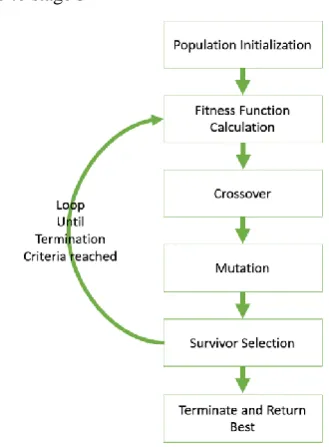
The following representation characterizes the fundamental structure of a GA –
[image:2.595.47.274.366.508.2]303 supplant the current people in the population and the
procedure rehashes.[4]
Steps in Genetic Algorithm:
(1)[Start]
As per the issue definition characterize the fitness or objective function f(x).
(2)[Initialize]
Instate the fitness function or objective function for population of n chromosomes – every chromosome is the potential arrangement.
(3) [Fitness]
Decide the fitness function f(x) of every chromosome x in the population.
(4)Repeat the accompanying strides to make the new population of chromosomes:
a.[Selection] To frame a mating pool select some parent chromosomes from a population as per their fitness value.
b.[Crossover] according to the given crossover
probability mate the chose chromosomes to frame new off-springs.
c.[Mutation] according to given mutation probability transform new chromosomes.
d.[Replace] The old population of chromosomes are supplanted with the new population.
(5)[Convergence check]
Choice of best arrangement, on the off chance that the greatest number of ages is achieved, at that point stop, and return the best arrangement.
(6) [Loop]
Go to stage 3
Fig 2.3 Working Model
3. GENOTYPE REPRESENTATION
This area deals with the most regularly utilized representations of genetic algorithms.
3.1 Binary Representation
[image:3.595.311.541.226.275.2]One of the easiest and most broadly utilized representation in GAs is Binary Representation. In this, the genotype comprises of bit strings. For the issues with the arrangement space of Boolean choice factors – yes or no, utilizes the paired portrayal – 0 or 1, for instance the 0/1 Knapsack Problem. For the issues, which manage numbers, we speak to the numbers with their binary representation.
Fig 3.1 Binary Representation
B.Integer Representation
We can't generally constrain the arrangement space to binary 'yes' or 'no' for discrete esteemed qualities. For instance, the four headings – North, South, East and West, can be encoded as {0,1,2,3}. In such
[image:3.595.69.234.504.728.2]cases, integer representation is utilized.
Fig 3.2 Integer Representation
C.Permutation Representation
Permutation Representation is utilized in issues
whose arrangement is represented by an order of
components. A case of this portrayal is the travelling salesman problem (TSP). In this issue the man needs to travel every one of the urban areas, visiting every city precisely once and return to the beginning city. Answer
for this TSP is to arrange every one of the urban areas and apply the permutation representation.
Fig 3.3 Permutation Representation
4. POPULATION
Population is a lot of chromosomes or a subset of arrangements. While managing GA population, a few things are to be remembered −
(1) To keep away from untimely combination the decent variety of population ought to be kept up.
304 The population is characterized as a two
dimensional cluster of – population size and chromosome measure.
4.1 Population Initialization
There are two essential strategies to introduce a population in a GA. They are −
(a)Random Initialization − Populate the underlying population with totally random arrangements.
(b)Heuristic Initialization − Populate the underlying population utilizing a known heuristic for the issue.
To stay away from the population result with comparable arrangements and next to no assorted variety, it is seen that the whole population ought not be instated utilizing a heuristic introduction. It is seen that arbitrary arrangements lead to ideal population. In this manner, the population is seeded with couple of great arrangements with heuristic initialization and the rest are loaded up with random arrangements.
4.2 Population Models
The most broadly utilized population models are −
(a)Steady State
In steady state GA, we create a couple of off-springs in every cycle and they supplant a couple of people from the population. It is additionally known as Incremental GA.
(b)Generational
In a generational model, we produce 'n' off-springs, where n is the population measure, and the whole population is supplanted by the upgraded one toward the finish of the cycle.
5. FITNESS FUNCTION
A capacity which takes a candidate answer for the issue as information and delivers how "fit" or how "great" the arrangement is as for the issue in thought as yield.
Figuring of fitness value should be adequately quick as it is done over and over in a GA. A moderate calculation of the fitness value can influence a GA and make it incredibly moderate.
In the majority of the cases objective function and fitness function are same as the goal is to either boost or limit the given objective function. For progressively complex issues an Algorithm Designer may pick diverse fitness function.
Coming up next are the qualities a fitness function ought to have −
(1)The fitness function ought to be adequately quick to register.
(2)It should quantitatively gauge how fit a given arrangement is or how fit individuals can be delivered from the given arrangement.
In some cases, figuring the fitness function
straightforwardly probably won't be conceivable because of the characteristic complexities of the current issue. In such cases, we do fitness guess to suit our necessities.
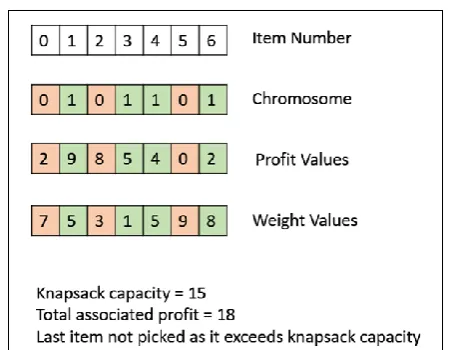
The accompanying picture demonstrates the fitness count of the 0/1 Knapsack problem. It is a straightforward wellness work which wholes the benefit esteems as for their chromosome numbers(1) until the knapsack is full (here the most extreme knapsack limit is 18).[4]
[image:4.595.317.542.182.357.2]
Fig 5 Fitness count of 0/1 knapsack problem
6. PARENT SELECTION
Parent Selection is the way toward choosing
guardians which mate and recombine to make off-springs for the people to come. Parent determination is vital to the intermingling rate of the GA as great guardians drive people to a superior and fitter arrangements.
In any case, care ought to be taken to avoid one amazingly fit arrangement from assuming control over the whole populace in a couple of ages, as this prompts the arrangements being near each other in the arrangement space in this manner prompting lost diversity. Maintaining great diversity in the populace is very significant for the accomplishment of a GA. Premature convergence means taking up the whole populace by one very fit arrangement and is an unwanted condition in a GA.
6.1 Fitness Proportionate Selection
Fitness Proportionate Selection is the most
prevalent methods for parent choice. In this each individual can turn into a parent with a likelihood which
is relative to its fitness. Hence, fitter people have a higher possibility of mating and engendering their highlights to the people to come. In this way, such a choice technique applies a determination weight to the more fit people in population, advancing better people after some time.
305
Two executions of fitness proportionate
determination are conceivable −
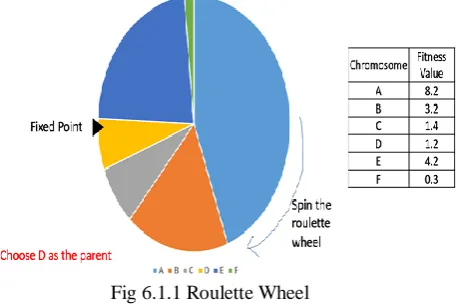
6.1.1 Roulette Wheel Selection
[image:5.595.62.293.179.331.2]In a roulette wheel choice, the round wheel is partitioned as depicted previously. A fixed point is picked on the wheel periphery as appeared and the wheel is pivoted. The district of the wheel which comes before the fixed point is picked as the parent. For the second parent, a similar procedure is rehashed. [4]
Fig 6.1.1 Roulette Wheel
Plainly a fitter individual has a more noteworthy pie on the haggle a more prominent shot of arriving before the fixed moment that the wheel is turned. Accordingly, the likelihood of picking an individual depends straightforwardly on its fitness.
Usage astute, we utilize the accompanying advances −
I.Calculate S = the aggregate of a finesses.
II.Generate an irregular number among 0 and S.
III.Continue adding the finesses to the incomplete aggregate P ,starting from the highest point of the population, till P<S.
IV.The individual for which P surpasses S is the picked person.
6.1.2 Stochastic Universal Sampling (SUS)
SUS is like Roulette wheel determination, anyway as it is opposed to having only one fixed point, we have numerous fixed focuses as appeared in the accompanying picture. Accordingly, every one of the guardians are picked in only one turn of the wheel. Additionally, such a setup energizes the exceedingly fit people to be picked in any event once. [4]
Fig 6.1.2 SUS Roulette Wheel
It is to be noticed that fitness proportionate determination strategies don't work for situations where the fitness can take a negative esteem.
6.2 Tournament Selection
In K-Way Tournament selection, we select K people from the population aimlessly and select the best out of these to turn into a parent. A similar procedure is
rehashed for choosing the following guardian.
Tournament selection is likewise incredibly
prevalent in writing as it can even work with
negative fitness esteems. [4]
Fig 6.2 Tournament selection
6.3 Rank Selection
[image:5.595.45.281.632.745.2]Rank Selection likewise works with negative fitness esteems and is for the most part utilized when the people in the population have exceptionally close fitness esteems (this happens as a rule toward the finish of the run). This prompts every individual having a practically equivalent offer of the pie (like if there should be an occurrence of fitness proportionate determination) as appeared in the accompanying picture and consequently every individual regardless of how fit in respect to one another has an around same likelihood of getting chose as a parent. This thus prompts a misfortune in the choice weight towards fitter people, making the GA to make poor parent determinations in such circumstances. [4]
Fig 6.3 Rank selection
306
6.4 Random Selection
In this methodology we haphazardly select guardians from the current population. There is no choice of weight towards fitter people and hence this system is normally maintained as a strategic distance from.
7.CROSSOVER
7.1 Introduction to Crossover
The hybrid administrator is undifferentiated from generation and organic hybrid. In this more than one parent is chosen and at least one off-springs are delivered utilizing the genetic material of the guardians. Hybrid is normally connected in a GA with a high likelihood –
p
c .[4]7.2 Crossover Operators
It is to be noticed that these hybrid administrators are nonexclusive and the GA Designer may execute an issue explicit hybrid administrator too. [4]
7.1.1 One point crossover
To create new off-springs, swapping is done at the tails of two parents by selecting random crossover point
Fig 7.1.1 One point crossover
7.1.2 Multi Point Crossover
This is a speculation of the one-point hybrid wherein substituting fragments are swapped to get new off-springs.
Fig 7.1.2 Multi point crossover
7.1.3 Uniform Crossover
In uniform hybrid, we don't partition the chromosome into fragments, rather we treat every quality independently. In this, we basically flip a coin for every chromosome to choose whether or not it'll be incorporated into the off-spring. We can likewise predisposition the coin to one parent, to have progressively hereditary material in the kid from that parent.
Fig 7.1.3 Uniform crossover
8. MUTATION
8.1 Introduction to Mutation
In basic terms, transformation might be
characterized as a little irregular change in the chromosome, to get another arrangement. It is used to keep up and present assorted variety in the Genetic population and is normally connected with a low likelihood – pm. In this if the probability is extremely high, the GA gets diminished to an irregular hunt.
Transformation is the piece of the GA which is identified with the "investigation" of the pursuit space. It has been seen that transformation is fundamental to the assembly of the GA while crossover isn't. [4]
8.2 Mutation Operators
8.2.1 Bit Flip Mutation
In bit flip change, we select at least one irregular bits and flip them. This is utilized for double encoded GAs.
Fig 8.2.1 Bit Flip Mutation
8.2.2 Random Resetting
Random Resetting is an augmentation of the bit flip for the number portrayal. In this, an arbitrary incentive from the arrangement of admissible qualities is allotted to a haphazardly picked quality.
8.2.3 Swap Mutation
In swap mutation, we select two positions on the chromosome aimlessly, and trade the qualities. This is normal in stage based encodings.
Fig 8.2.3 Swap Mutation
8.2.4 Scramble Mutation
Scramble mutation is likewise well known with
stage portrayals. In this, from the whole chromosome, a subset of qualities is picked and their qualities are mixed
or rearranged arbitrarily.
Fig 8.2.4 Scramble Mutation
8.2.5 Inversion Mutation
In reversal transformation, we select a subset of qualities like in scramble change, however as opposed to rearranging the subset, we simply modify the whole string in the subset.
Fig 8.2.5 Inverse Mutation
307
9. SURVIVOR SELECTION
The Survivor Selection Policy figures out which people are to be kicked out and which are to be kept in the people to come. It is significant as it ought to guarantee that the fitter people are not kicked out of the population, while in the meantime assorted variety ought to be kept up in the population.
9.1 Age Based Selection
In this, we don't have an idea of a fitness. It will depends on the reason that every individual is permitted in the population for a limited age where it is permitted to imitate, from that point onward, it is kicked out of the population regardless of how great its fitness is.
[image:7.595.324.548.55.187.2]For example, in the accompanying precedent, the age is the quantity of for which the individual ages has been in the population. The most established individuals from the population for example P4 and P7 are kicked out of the population and the periods of the remainder of the individuals are increased by one. [4]
Fig 9.1 Age Based Selection
9.2 Fitness Based Selection
In this fitness based choice, the kids will in general supplant the least fit people in the population. The determination of the least fit people might be finished utilizing a variety of any of the choice strategies portrayed previously – competition choice, fitness proportionate choice, and so on.
[image:7.595.60.284.345.461.2]For instance, in the accompanying picture, the kids supplant the least fit people P1 and P10 of the population. It is to be noticed that since P1 and P9 have a similar fitness esteem, the choice to expel which individual from the population is discretionary.
Fig 9.2 Fitness Based Selection
10.TERMINATION CONDITION
vances exceptionally quick with better
arrangements coming in each couple of emphasess, yet this will in general immerse in the later stages where the upgrades are extremely little. We generally need an end condition with the end goal that our answer is near the ideal, toward the finish of the run.
Generally, we keep one of the accompanying end conditions −
(i) When there has been no improvement in the population for X cycles.
(ii) When we achieve a flat out number of ages.
(iii) When the target work esteem has come to a certain pre-characterized esteem.
For instance, in genetic calculation will keep a counter which monitors the ages for which there has been no improvement in the population. At first, we set this counter to zero. Each time we don't create off-springs which are superior to the people in the population, we increase the counter.
In the event that the fitness any of the off-springs is better, at that point we reset the counter to zero. The calculation ends when the counter achieves a foreordained esteem.
Like different parameters of a GA, the end condition is likewise exceptionally issue explicit and the GA originator should experiment with different choices to perceive what suits his specific issue the best.
11.ADVANTAGES, LIMITATIONS AND
APPLICATIONS
11.1 ADVANTAGES
(a) Does not require any subsidiary data (which may not be accessible for some certifiable issues).
(b) Is quicker and progressively productive when contrasted with the conventional techniques.
(c) Has generally excellent parallel abilities.
308 (e) Provides a rundown of "good" arrangements and not
only a solitary arrangement.
(f) Always finds a solution to the issue, which shows signs of improvement over the time.
(g) Useful when the pursuit space is exceptionally substantial and there are an extensive number of parameters included.
11.2 LIMITATIONS
a. GAs are not appropriate for all issues, particularly issues which are straightforward and for which subordinate data is accessible.
b. Fitness esteem is determined more than once which may be computationally costly for certain issues.
c. Being stochastic, there are no certifications on the optimality or the nature of the arrangement.
d. If not actualized legitimately, the GA may not meet to the ideal arrangement.
11.3 APPLICATIONS
(a) Optimization − Genetic Algorithms are most regularly utilized in enhancement issues wherein we need to boost or limit a given target work an incentive under a given arrangement of requirements. The way to deal with take care of Optimization issues has been featured all through the instructional exercise.
(b) Economics − GAs are additionally used to portray different financial models like the web demonstrate, diversion hypothesis harmony goals, resource evaluating, and so on.
(c) Neural Networks − GAs are likewise used to prepare neural systems, especially intermittent neural systems. (d) Image Processing − GAs are utilized for different advanced picture preparing (DIP) assignments also like thick pixel coordinating.
(e) Vehicle steering problems − With various delicate time windows, different warehouses and a heterogeneous armada.
(f) Scheduling applications − GAs are utilized to tackle different planning issues too, especially the time postponing issue.
(g) Machine Learning − as of now examined, hereditary qualities based AI (GBML) is a specialty zone in AI. (h) Robot Trajectory Generation − GAs have been
utilized to design the way which a robot arm takes
by moving starting with one point then onto the next.
(i) Parametric Design of Aircraft − GAs have been utilized to configuration air creates by shifting the parameters and advancing better arrangements.
(j) DNA Analysis − GAs have been utilized to decide the structure of DNA utilizing spectrometric information about the example.
(k) Multimodal Optimization − GAs are clearly generally excellent methodologies for multimodal advancement in which we need to locate different ideal arrangements.
(l) Travelling sales rep issue and its applications − GAs have been utilized to illuminate the TSP, which is a notable combinatorial issue utilizing novel hybrid and pressing techniques.
REFRENCES
[1] Genetic Algorithms in Search, Optimization and Machine Learning by David E. Goldberg.
[2] Practical Genetic Algorithms by Randy L.
Haupt and Sue Ellen Haupt.
[3] https://towardsdatascience.com
[4] All figures - https://www.tutorialspoint.com
[5] https://ieeexplore.ieee.org
[6] Genetic Algorithms + Data Structures = Evolutionary