Towards a Unified Approach to Simultaneous Single-Document and
Multi-Document Summarizations
Xiaojun Wan
Institute of Compute Science and Technology
The MOE Key Laboratory of Computational Linguistics
Peking University
[email protected]
Abstract
Single-document summarization and multi-document summarization are very closely re-lated tasks and they have been widely investi-gated independently. This paper examines the mutual influences between the two tasks and proposes a novel unified approach to si-multaneous single-document and multi-document summarizations. The mutual influ-ences between the two tasks are incorporated into a graph model and the ranking scores of a sentence for the two tasks can be obtained in a unified ranking process. Experimental re-sults on the benchmark DUC datasets demon-strate the effectiveness of the proposed ap-proach for both single-document and multi-document summarizations.
1
Introduction
Single-document summarization aims to pro-duce a concise and fluent summary for a single document, and multi-document summarization aims to produce a concise and fluent summary for a document set consisting of multiple related documents. The two tasks are very closely re-lated in both task definition and solution method. Moreover, both of them are very important in many information systems and applications. For example, given a cluster of news articles, a multi-document summary can be used to help users to understand the whole cluster, and a sin-gle summary for each article can be used to help users to know the content of the specified article.
To date, single-document and multi-document summarizations have been investigated exten-sively and independently in the NLP and IR fields. A series of special conferences or work-shops on automatic text summarization (e.g.
SUMMAC, DUC, NTCIR and TAC) have ad-vanced the technology and produced a couple of experimental online systems. However, the two summarization tasks have not yet been simulta-neously investigated in a unified framework.
Inspired by the fact that the two tasks are very closely related and they can be used simultane-ously in many applications, we believe that the two tasks may have mutual influences on each other. In this study, we propose a unified ap-proach to simultaneous single-document and multi-document summarizations. The mutual influences between the two tasks are incorpo-rated into a graph-based model. The ranking scores of sentences for single-document summa-rization and the ranking scores of sentences for multi-document summarization can boost each other, and they can be obtained simultaneously in a unified graph-based ranking process. To the best of our knowledge, this study is the first at-tempt for simultaneously addressing the two summarization tasks in a unified graph-based framework. Moreover, the proposed approach can be easily adapted for topic-focused summa-rizations.
Experiments have been performed on both the single-document and multi-document summari-zation tasks of DUC2001 and DUC2002. The results demonstrate that the proposed approach can outperform baseline independent methods for both the two summarization tasks. The two tasks are validated to have mutual influences on each other.
2
Related Work
Document summarization methods can be either extraction-based or abstraction-based. In this section, we focus on extraction-based methods.
Extraction-based methods for single-document summarization usually assign a sali-ency score to each sentence in a document and then rank and select the sentences. The score is usually computed based on a combination of statistical and linguistic features, such as term frequency, sentence position, cue words and stigma words (Luhn, 1969; Edmundson, 1969; Hovy and Lin, 1997). Machine learning tech-niques have also been used for sentence extrac-tion (Kupiec et al., 1995; Conroy and O’Leary, 2001; Shen et al., 2007; Li et al., 2009). The mutual reinforcement principle has been ex-ploited to iteratively extract key phrases and sentences from a document (Zha, 2002; Wan et al, 2007a). Wan et al. (2007b) propose the Col-labSum algorithm to use additional knowledge in a cluster of documents to improve single document summarization in the cluster.
In recent years, graph-based ranking methods have been investigated for document summari-zation, such as TextRank (Mihalcea and Tarau, 2004; Mihalcea and Tarau, 2005) and LexPag-eRank (ErKan and Radev, 2004). Similar to PageRank (Page et al., 1998), these methods first build a graph based on the similarity rela-tionships between the sentences in a document and then the saliency of a sentence is determined by making use of the global information on the graph recursively. The basic idea underlying the graph-based ranking algorithm is that of “vot-ing” or “recommendation” between sentences.
Similar methods have been used for generic multi-document summarization. A typical method is the centroid-based method (Radev et al., 2004). For each sentence, the method com-putes a score based on each single feature (e.g. cluster centroids, position and TFIDF) and then linearly combines all the scores into an overall sentence score. Topic signature is used as a novel feature for selecting important content in NeATS (Lin and Hovy, 2002). Various sentence features have been combined by using machine learning techniques (Wong et al., 2008). A popular way for removing redundancy between summary sentences is the MMR algorithm (Car-bonell and Goldstein, 1998). Themes (or topics,
clusters) in documents have been discovered and used for sentence selection (Harabagiu and La-catusu, 2005). Hachey (2009) investigates the effect of various source document representa-tions on the accuracy of the sentence extraction phase of a multi-document summarization task. Graph-based methods have also been used to rank sentences in a document set. The methods first construct a graph to reflect sentence rela-tionships at different granularities, and then compute sentence scores based on graph-based learning algorithms. For example, Wan (2008) proposes to use only cross-document relation-ships for graph building and sentence ranking. Cluster-level information has been incorporated in the graph model to better evaluate sentences (Wan and Yang, 2008).
For topic-focused multi-document summari-zation, many methods are extensions of generic summarization methods by incorporating the information of the given topic or query into ge-neric summarizers. In recent years, a few novel methods have been proposed for topic-focused summarization (Daumé and Marcu, 2006; Wan et al., 2007c; Nastase 2008; Li et al., 2008; Schilder and Kondadadi, 2008; Wei et al., 2008).
The above previous graph-based summariza-tion methods aim to address either single-document summarization or multi-single-document summarization, and the two summarization tasks have not yet been addressed in a unified graph-based framework.
3
The Unified Summarization
Ap-proach
3.1 Overview
Given a document set, in which the whole docu-ment set and each single docudocu-ment in the set are required to be summarized, we use local sali-ency to indicate the importance of a sentence in a particular document, and use global saliency
to indicate the importance of a sentence in the whole document set.
In previous work, the following two assump-tions are widely made for graph-based summari-zation models:
Assumption 2: A sentence is globally impor-tant in the document set if it is heavily linked with many globally important sentences in the document set.
The above assumptions are the basis for Pag-eRank-like algorithms for single document summarization and multi-document summariza-tion, respectively. In addition to the above two assumptions, we make the following two as-sumptions to consider the mutual influences be-tween the two summarization tasks:
Assumption 3: A sentence is locally impor-tant in a particular document, if it is heavily linked with many globally important sentences in the document set.
The above assumption is reasonable because the documents in the set are relevant and the globally important information in the document set will be expressed in many single documents. Therefore, if a sentence is salient in the whole document set, the sentence may be salient in a particular document in the set.
Assumption 4: A sentence is globally impor-tant in the document set, if it is heavily linked with many locally important sentences.
The above assumption is reasonable because the documents in the set are relevant and the globally important information in the whole set is the aggregation of the locally important in-formation in each single document. Therefore, if a sentence is salient in a particular document, the sentence has the potential to be salient in the whole document set.
In brief, the local saliency and global saliency of a sentence can mutually influence and boost each other: high local saliency will lead to high global saliency, and high global saliency will lead to high local saliency.
Based on the above assumptions, our pro-posed approach first builds affinity graphs (each graph is represented by an affinity matrix) to reflect the different kinds of relationships be-tween sentences, respectively, and then itera-tively computes the local saliency scores and the global saliency scores of the sentences based on the graphs. Finally, the algorithm converges and the local saliency score and global saliency score of each sentence are obtained. The sen-tences with high local saliency scores in a par-ticular document are chosen into the summary of the single document, and the sentences with
high global saliency scores in the set are chosen into the summary of the document set.
Note that for both summarization tasks, after the saliency scores of sentences have been ob-tained, the greedy algorithm used in (Wan et al., 2007c) is applied to remove redundancy and finally choose both informative and novel sen-tences into the summary.
3.2 Algorithm Details
Formally, the given document set is denoted as
D={di|1≤i≤m}, and the whole sentence set is
denoted as S={si|1≤i≤n}. We let Infosingle(si)
denote the local saliency score of sentence si in a
particular document d(si)∈D, and it is used to
select summary sentences for the single docu-ment d(si). And we let Infomulti(si) denote the
global saliency score of sentence si in the whole
document set D, and it is used to select sum-mary sentences for the document set D.
The four assumptions in Section 3.1 can be rendered as follows:
∑
∝ j A ji gle j
i
gle s W Info s
Infosin ( ) ( ) sin ( ) (1)
∑
∝ j B ji multi j i
multi s W Info s
Info ( ) ( ) ( ) (2)
∑
∝ j C ji multi j i
gle s W Info s
Infosin ( ) ( ) ( ) (3)
∑
∝ j D ji gle j
i
multi s W Info s
Info ( ) ( ) sin ( ) (4)
where WA, WB, WC, WD are n×n affinity matrices
reflecting the different kinds of relationships between sentences in the document set, where n
is the number of all sentences in the document set. The detailed derivation of the matrices will be presented later.
After fusing the above equations, we can ob-tain the following unified forms:
∑
∑
− +
=
j C ji multi j j A ji gle j i
gle
s Info W
s Info W s
Info
) ( )
( ) 1 (
) ( )
( )
( sin
sin
µ µ
(5)
∑
∑
− +=
j D ji gle j j B ji multi j i
multi
s Info W
s Info W s
Info
) ( )
( ) 1 (
) ( )
( )
(
sin µ
µ
(6)
However, the above summarization method ignores the feature of sentence position, which has been validated to be very important for document summarizations. In order to incorpo-rate this important feature, we add one prior score to each computation as follows:
) ( )
( )
(
) ( )
( ) (
sin sin sin
i gle j C ji multi j
j A ji gle j i
gle
s prior s
Info W
s Info W s
Info
⋅ + +
=
∑
∑
γ β
α
) ( ) ( ) ( ) ( ) ( ) (
sin multi i j D ji gle j
j B ji multi j i multi s prior s Info W s Info W s Info ⋅ + + =
∑
∑
γ β α (8)where α, β, γ∈[0,1] specify the relative contri-butions to the final saliency scores from the dif-ferent factors, and we have α+β+γ=1. pri-orsingle(si) is the prior score for the local saliency
of sentence si, and here priorsingle(si) is
com-puted based on sentence position of si in the
par-ticular document d(si). priormulti(si) is the prior
score for the global saliency of sentence si, and
we also compute priormulti(si) based on sentence
position of si.
We use two column vectors ur =[Infosingle(si)]n×1 and vr =[Infomulti(si)]n×1 to
denote the local and global saliency scores of all the sentences in the set, respectively. And the matrix forms of the above equations are as fol-lows:
gle T
T β γ
αWAu WCv psin
ur= r+ r+ r (9)
multi T
T β γ
αWBv WDu p
vr= r+ r+ r (10)
where prsingle =[priorsingle(si)]n×1 and
1 )] (
[ ×
= multi i n multi prior s
pr are the prior column
vec-tors.
The above matrices and prior vectors are con-structed as follows, respectively:
WA: This affinity matrix aims to reflect the
local relationships between sentences in each single document, which is defined as follows:
Otherwise 0, j i and ) d( ) d( if ), , ( ) ( cos ⎪ ⎩ ⎪ ⎨ ⎧ ≠ = = j i j i ine ij A s s s s sim W (11)
where d(si) refers to the document containing
sentence si. simcosine(si,sj) is the cosine similarity
between sentences si and sj.
j i j i j i ine s s s s s s
sim r r
r r × ⋅ = ) , ( cos (12)
where sri and srjare the corresponding term
vec-tors of si and sj. Note that we have (WA)ij = (WA)ji,
and we have (WA)ii =0 to avoid self loops.
We can see that the matrix contains only the within-document relationships between sen-tences.
WB: This affinity matrix aims to reflect the
global relationships between sentences in the document set, which is defined as follows:
Otherwise 0, ) d( ) d( if ), , ( ) ( cos ⎩ ⎨ ⎧ ≠
= ine i j i j
ij B s s s s sim W (13)
We can see that the matrix contains only the cross-document relationships between sentences. We do not include the within-document sen-tence relationships in the matrix because it has been shown that the cross-document relation-ships are more appropriate to reflect the global mutual influences between sentences than the within-document relationships in (Wan, 2008).
WC: This affinity matrix aims to reflect the
cross-document relationships between sentences in the document set. However, the relationships in this matrix are used for carrying the influ-ences of the sentinflu-ences in other documents on the local saliency of the sentences in a particular document. If we directly use Equation (13) to compute the matrix, the mutual influences would be overly used. Because other documents might not be sampled from the same generative model as the specified document, we probably do not want to trust them so much as the speci-fied document. Thus a confidence value is used to reflect out belief that the document is sampled from the same underlying model as the specified document. Heuristically, we use the cosine simi-larity between documents as the confidence value. And we use the confidence value as the decay factor in the matrix computation as fol-lows: Otherwise 0, ) d( ) d( if )), ( ), ( ( ) , ( ) ( cos cos ⎪ ⎩ ⎪ ⎨ ⎧ ≠ ×
= i j
j i ine j i ine ij
c s s
s d s d sim s s sim W (14)
WD: This affinity matrix aims to reflect the
within-document relationships between sen-tences. Thus we have WD=WA, which means that
the global saliency score of a sentence is influ-enced only by the local saliency scores of the sentences in the same document, without con-sidering the sentences in other documents.
Note that the above four matrices are symmet-ric and we can replace
W
AT,W
BT,W
CTandW
DT by WA, WB, WC and WD in Equations (9) and(10), respectively.
priorsingle(si): It is computed under the
as-sumption that the first sentences in a document are usually more important than other sentences.
1 ) ( 1 5 . 0 ) ( sin + + = i i
gle s position s
prior
(15) where position(si) returns the position number of
si is the first sentence in its document, position(si)
is 1.
The prior weight is then normalized by:
∑
=
i gle i i gle i
gle prior s
s prior s
prior
) (
) ( )
(
sin sin
sin (16)
priormulti(si): We also let the prior weight
re-flect the influence of sentence position. ) ( )
( i single i
multi s prior s
prior = (17)
And then the prior weight is normalized in the same way.
The above definitions are for generic docu-ment summarizations and the above algorithm can be easily adapted for topic-focused summa-rizations. Given a topic q, the only change for the above computation is priormulti(si). The topic
relevance is incorporated into the prior weight as follows:
) , ( )
(s simcos s q
priormulti i = ine i (18)
∑
=
i multi i
i multi i
multi
s prior
s prior s
prior
) (
) ( )
( (19)
In order to solve the iterative problem defined in Equations (9) and (10), we let rr=[urT vrT]T,
T
]
[ T
multi T
single p p
p r r
r = γ γ ,
⎥ ⎥ ⎦ ⎤ ⎢
⎢ ⎣ ⎡
= T
B T D
T C T A
W W
W W W
α β
β α
, and
then the iterative equations correspond to the following linear system:
p r W
rr= r+r (20)
p r W I− )r=r
( (21)
To guarantee the solution of the above linear system, W is normalized by columns. If all the elements of a column are zero, we replace the elements with 1/(2n), where 2n equals to the element number of the column. We then multi-ply W by a decay factor θ(0<θ<1) to scale down each element in W, but remain the meaning of
W. Here, θ is empirically set to 0.61. Finally,
Equation (21) is rewritten as follows: p
r W I− ⋅ )r= r
( θ (22)
Thus, the matrix (I-θW) is a strictly diago-nally dominant matrix and the solution of the linear system exists and we can apply the Gauss-Seidel method used in (Li et al., 2008) to solve the linear system. The GS method is a well-know method for numeric computation in
1 In our pilot study, we can observe good performance when θis in a wide range of [0.4, 0.8].
mathematics and the details of the method is omitted here.
4
Empirical Evaluation
4.1 Dataset and Evaluation Metric
Generic single-document and multi-document summarizations have been the fundamental tasks in DUC 2001 and DUC 2002 (i.e. tasks 1 and 2 in DUC 2001 and tasks 1 and 2 in DUC 2002), and we used the two datasets for evaluation. DUC2001 provided 309 articles, which were grouped into 30 document sets. Generic sum-mary of each article was required to be created for task 1, and generic summary of each docu-ment set was required to be created for task 2. The summary length was 100 words or less. DUC 2002 provided 59 document sets consist-ing of 567 articles (D088 is excluded from the original 60 document sets by NIST) and generic summaries for each article and each document set with a length of approximately 100 words were required to be created. The sentences in each article have been separated and the sen-tence information has been stored into files. The summary of the two datasets are shown in Table 1.
DUC 2001 DUC 2002 Task Tasks 1, 2 Tasks 1, 2 Number of documents 309 567 Number of clusters 30 59 Data source TREC-9 TREC-9 summary length 100 words 100 words
Table 1. Summary of datasets
We used the ROUGE toolkit2 (Lin and Hovy,
2003) for evaluation, which has been widely adopted by DUC for automatic summarization evaluation. It measured summary quality by counting overlapping units such as the n-gram, word sequences and word pairs between the candidate summary and the reference summary.
The ROUGE toolkit reported separate recall-oriented scores for 1, 2, 3 and 4-gram, and also for longest common subsequence co-occurrences. We showed three of the ROUGE metrics in the experimental results: ROUGE-1 (unigram-based), ROUGE-2 (bigram-based), and ROUGE-W (based on weighted longest common subsequence, weight=1.2). In order to truncate summaries longer than the length limit,
we used the “-l 100” option in ROUGE toolkit. We also used the “-m” option for word stem-ming.
4.2 Evaluation Results
4.2.1 System Comparison
In the experiments, the combination weight γfor the prior score is fixed at 0.15, as in the PageR-ank algorithm. Therefore, we have α+β=0.85. Here, we use α/(α+β) to indicate the relative contributions of the first two parts in Equations (9) and (10). We empirically set α/(α+β)=0.4 in the experiments. The proposed unified approach (i.e. UnifiedRank) is compared with a few base-line approaches and the top three participating systems.
The graph-based baselines for single-document summarization are described as fol-lows:
BasicRank: This baseline approach adopts the basic PageRank algorithm to rank sentences based on all sentence relationships in a single document, similar to previous work (Mihalcea and Tarau, 2004).
PositionRank: This baseline approach im-proves the basic PageRank algorithm by using the position weight of a sentence as the prior score for the sentence. The position weight of a sentence is computed by using Equation (15).
CollabRank1: This baseline approach is the “UniformLink(Gold)” approach proposed in (Wan et al. 2007b). It uses a cluster of multiple documents to improve single document summa-rization by constructing a global affinity graph. CollabRank2: This baseline approach is the “UnionLink(Gold)” approach proposed in (Wan et al. 2007b).
The graph-based baselines for multi-document summarization are described as fol-lows:
BasicRank: This baseline approach adopts the basic PageRank algorithm to rank sentences based on all sentence relationships in document set. Both within-document and cross-document sentence relationships are used for constructing the affinity graph.
PositionRank: Similarly, this baseline ap-proach improves the basic PageRank algorithm by using the position weight of a sentence as the prior score for the sentence.
TwoStageRank: This baseline approach lev-erages the results of single document summari-zation for multi-document summarisummari-zation. It first computes the score of each sentence within each single document by using the PositionRank method, and then computes the final score of each sentence within the document set by con-sidering the document-level sentence score as the prior score in the improved PageRank algo-rithm.
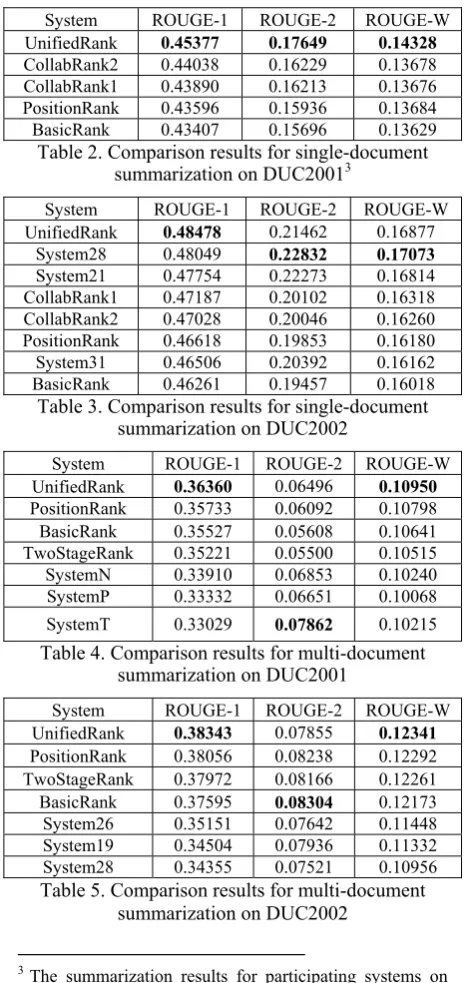
The top three systems are the systems with highest ROUGE scores, chosen from the partici-pating systems on each task, respectively. Ta-bles 2 and 3 show the comparison results for single-document summarization on DUC2001 and DUC2002, respectively. Tables 4 and 5 show the comparison results for multi-document summarization on DUC2001 and DUC2002, respectively. In the tables, SystemX (e.g. Sys-tem28, SystemN) represents one of the top per-forming systems. The systems are sorted by de-creasing order of the ROUGE-1 scores.
For single-document summarization, the pro-posed UnifiedRank approach always outper-forms the four graph-based baselines over all three metrics on both two datasets. The per-formance differences are all statistically signifi-cant by using t-test (p-value<0.05). The ROUGE-1 score of UnifiedRank is higher than that of the best participating systems and the ROUGE-2 and ROUGE-W scores of Unifie-dRank are comparable to that of the best partici-pating systems.
For multi-document summarization, the pro-posed UnifiedRank approach outperforms all the three graph-based baselines over all three met-rics on the DUC2001 dataset, and it outperforms the three baselines over ROUGE-1 and ROUGE-W on the DUC2002 dataset. In particu-lar, UnifiedRank can significantly outperform BasicRank and TwoStageRank over all three metrics on the DUC2001 dataset (t-test, p-value<0.05). Moreover, the ROUGE-1 and ROUGE-W scores of UnifiedRank are higher than that of the best participating systems and the ROUGE-2 score of UnifiedRank is compa-rable to that of the best participating systems.
global saliency of the sentences. Overall, the proposed unified graph-based approach is effec-tive for both single document summarization and multi-document summarization. However, the performance improvement for single-document summarization is more significant than that for multi-document summarization, which shows that the global information in a document set is very beneficial to summariza-tion of each single document in the document set.
[image:7.595.65.302.220.712.2]System ROUGE-1 ROUGE-2 ROUGE-W UnifiedRank 0.45377 0.17649 0.14328 CollabRank2 0.44038 0.16229 0.13678 CollabRank1 0.43890 0.16213 0.13676 PositionRank 0.43596 0.15936 0.13684 BasicRank 0.43407 0.15696 0.13629
Table 2. Comparison results for single-document summarization on DUC20013
System ROUGE-1 ROUGE-2 ROUGE-W UnifiedRank 0.48478 0.21462 0.16877
System28 0.48049 0.22832 0.17073 System21 0.47754 0.22273 0.16814 CollabRank1 0.47187 0.20102 0.16318 CollabRank2 0.47028 0.20046 0.16260 PositionRank 0.46618 0.19853 0.16180 System31 0.46506 0.20392 0.16162 BasicRank 0.46261 0.19457 0.16018
Table 3. Comparison results for single-document summarization on DUC2002
System ROUGE-1 ROUGE-2 ROUGE-W UnifiedRank 0.36360 0.06496 0.10950 PositionRank 0.35733 0.06092 0.10798
BasicRank 0.35527 0.05608 0.10641 TwoStageRank 0.35221 0.05500 0.10515
SystemN 0.33910 0.06853 0.10240 SystemP 0.33332 0.06651 0.10068 SystemT 0.33029 0.07862 0.10215 Table 4. Comparison results for multi-document
summarization on DUC2001
System ROUGE-1 ROUGE-2 ROUGE-W UnifiedRank 0.38343 0.07855 0.12341 PositionRank 0.38056 0.08238 0.12292 TwoStageRank 0.37972 0.08166 0.12261
BasicRank 0.37595 0.08304 0.12173 System26 0.35151 0.07642 0.11448 System19 0.34504 0.07936 0.11332 System28 0.34355 0.07521 0.10956 Table 5. Comparison results for multi-document
summarization on DUC2002
3 The summarization results for participating systems on DUC2001 are incomplete.
4.2.2 Influences of Combination Weight
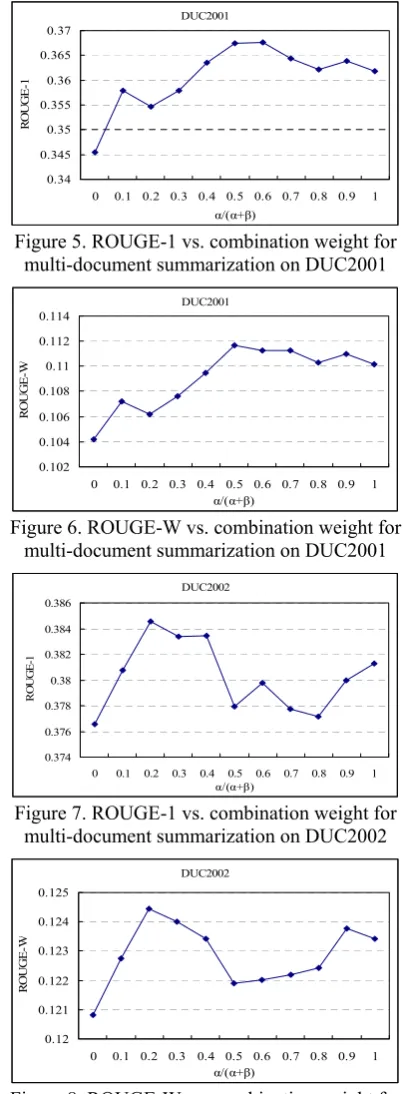
In the above experiments, the relative contribu-tions from the first two parts in Equacontribu-tions (9) and (10) are empirically set as α/(α+β)=0.4. In this section, we investigate how the relative con-tributions influence the summarization perform-ance by varying α/(α+β) from 0 to 1. A small value of α/(α+β) indicates that the contribution from the same kind of saliency scores of the sen-tences is less important than the contribution from the different kind of saliency scores of the sentences, and vice versa. Figures 1-8 show the ROUGE-1 and ROUGE-W curves for single-document summarization and multi-single-document summarization on DUC2001 and DUC2002, respectively.
For single document summarization, very small value or very large value for α/(α+β) will lower the summarization performance values on the two datasets. The results demonstrate that both the two kinds of contributions are impor-tant to the final performance of single document summarization.
For multi-document summarization, a rela-tively large value (≥0.4) for α/(α+β) will lead to relatively high performance values on the DUC2001 dataset, but a very large value for
α/(α+β) will decrease the performance values. On the DUC2002 dataset, a relatively small value (≤0.4) will lead to relatively high per-formance values, but a very small value for
α/(α+β) will decrease the performance values. Though the trends of the curves on the DUC2001 and DUC2002 datasets are not very consistent with each other, the results show that both the two kinds of contributions are benefi-cial to the final performance of multi-document summarization.
5
Conclusion and Future Work
In this study, we propose a novel unified ap-proach to simultaneous single-document and multi-document summarization by making using of the mutual influences between the two tasks. Experimental results on the benchmark DUC datasets show the effectiveness of the proposed approach.
summarizations to show the robustness of the proposed approach.
DUC2001
0.444 0.446 0.448 0.45 0.452 0.454 0.456 0.458
0 0.1 0.2 0.3 0.4 0.5 0.6 0.7 0.8 0.9 1 α/(α+β)
RO
U
G
E
-1
Figure 1. ROUGE-1 vs. combination weight for sin-gle-document summarization on DUC2001
DUC2001
0.14 0.1405 0.141 0.1415 0.142 0.1425 0.143 0.1435 0.144 0.1445
0 0.1 0.2 0.3 0.4 0.5 0.6 0.7 0.8 0.9 1 α/(α+β)
RO
U
G
E
-W
Figure 2. ROUGE-W vs. combination weight for single-document summarization on DUC2001
DUC2002
0.474 0.476 0.478 0.48 0.482 0.484 0.486
0 0.1 0.2 0.3 0.4 0.5 0.6 0.7 0.8 0.9 1
α/(α+β)
R
OUGE
-1
Figure 3. ROUGE-1 vs. combination weight for sin-gle-document summarization on DUC2002
DUC2002
0.164 0.165 0.166 0.167 0.168 0.169 0.17
0 0.1 0.2 0.3 0.4 0.5 0.6 0.7 0.8 0.9 1
α/(α+β)
RO
U
G
E
[image:8.595.311.513.73.621.2]-W
Figure 4. ROUGE-W vs. combination weight for single-document summarization on DUC2002
DUC2001
0.34 0.345 0.35 0.355 0.36 0.365 0.37
0 0.1 0.2 0.3 0.4 0.5 0.6 0.7 0.8 0.9 1
α/(α+β)
RO
U
G
E
[image:8.595.314.512.77.213.2]-1
Figure 5. ROUGE-1 vs. combination weight for multi-document summarization on DUC2001
DUC2001
0.102 0.104 0.106 0.108 0.11 0.112 0.114
0 0.1 0.2 0.3 0.4 0.5 0.6 0.7 0.8 0.9 1 α/(α+β)
R
OUGE
-W
Figure 6. ROUGE-W vs. combination weight for multi-document summarization on DUC2001
DUC2002
0.374 0.376 0.378 0.38 0.382 0.384 0.386
0 0.1 0.2 0.3 0.4 0.5 0.6 0.7 0.8 0.9 1
α/(α+β)
RO
U
G
E
-1
Figure 7. ROUGE-1 vs. combination weight for multi-document summarization on DUC2002
DUC2002
0.12 0.121 0.122 0.123 0.124 0.125
0 0.1 0.2 0.3 0.4 0.5 0.6 0.7 0.8 0.9 1 α/(α+β)
RO
U
G
E
-W
Figure 8. ROUGE-W vs. combination weight for multi-document summarization on DUC2002
Acknowledgments
[image:8.595.80.284.107.321.2]References
J. Carbonell, J. Goldstein. 1998. The Use of MMR, Diversity-based Reranking for Reordering Docu-ments and Producing Summaries. In Proceedings of SIGIR1998, 335-336.
J. M. Conroy, D. P. O’Leary. 2001. Text Summariza-tion via Hidden Markov Models. In Proceedings of SIGIR2001, 406-407.
H. Daumé and D. Marcu. 2006. Bayesian query-focused summarization. In Proceedings of ACL-06.
H. P. Edmundson. 1969. New Methods in Automatic Abstracting. Journal of the Association for com-puting Machinery, 16(2): 264-285.
G. ErKan, D. R. Radev. 2004. LexPageRank: Pres-tige in Multi-Document Text Summarization. In
Proceedings of EMNLP2004.
B. Hachey. 2009. Multi-document summarisation using generic relation extraction. In Proceedings of EMNLP2009.
S. Harabagiu and F. Lacatusu. 2005. Topic themes for multi-document summarization. In Proceed-ings of SIGIR-05.
E. Hovy, C. Y. Lin. 1997. Automated Text Summari-zation in SUMMARIST. In Proceeding of ACL’1997/EACL’1997 Worshop on Intelligent Scalable Text Summarization.
J. Kupiec, J. Pedersen, F. Chen. 1995. A.Trainable Document Summarizer. In Proceedings of SIGIR1995, 68-73.
W. Li, F. Wei, Q. Lu and Y. He. 2008. PNR2: rank-ing sentences with positive and negative rein-forcement for query-oriented update summariza-tion. In Proceedings of COLING-08.
L. Li, K. Zhou, G.-R. Xue, H. Zha, Y. Yu. 2009. Enhancing diversity, coverage and balance for summarization through structure learning. In Pro-ceedings of WWW-09.
C..-Y. Lin and E.. H. Hovy. 2002. From Single to Multi-document Summarization: A Prototype System and its Evaluation. In Proceedings of ACL-02.
C.-Y. Lin and E.H. Hovy. 2003. Automatic Evalua-tion of Summaries Using N-gram Co-occurrence Statistics. In Proceedings of HLT-NAACL -03. H. P. Luhn. 1969. The Automatic Creation of
litera-ture Abstracts. IBM Journal of Research and De-velopment, 2(2).
R. Mihalcea, P. Tarau. 2004. TextRank: Bringing Order into Texts. In Proceedings of EMNLP2004. R. Mihalcea and P. Tarau. 2005. A language inde-pendent algorithm for single and multiple
docu-ment summarization. In Proceedings of IJCNLP-05.
V. Nastase. 2008. Topic-driven multi-document summarization with encyclopedic knowledge and spreading activation. In Proceedings of EMNLP-08.
L. Page, S. Brin, R. Motwani, and T. Winograd. 1998. The pagerank citation ranking: Bringing order to the web. Technical report, Stanford Digital Librar-ies.
D. R. Radev, H. Y. Jing, M. Stys and D. Tam. 2004. Centroid-based summarization of multiple docu-ments. Information Processing and Management, 40: 919-938.
F. Schilder and R. Kondadadi. 2008. FastSum: fast and accurate query-based multi-document sum-marization. In Proceedings of ACL-08: HLT. D. Shen, J.-T. Sun, H. Li, Q. Yang, and Z. Chen.
2007. Document Summarization using Condi-tional Random Fields. In Proceedings of IJCAI2007.
X. Wan. 2008. Using Only Cross-Document Rela-tionships for Both Generic and Topic-Focused Multi-Document Summarizations. Information Retrieval, 11(1): 25-49.
X. Wan and J. Yang. 2008. Multi-document summa-rization using cluster-based link analysis. In Pro-ceedings of SIGIR-08.
X. Wan, J. Yang and J. Xiao. 2007a. Towards an Iterative Reinforcement Approach for Simultane-ous Document Summarization and Keyword Ex-traction. In Proceedings of ACL2007.
X. Wan, J. Yang and J. Xiao. 2007b. CollabSum: Exploiting Multiple Document Clustering for Col-laborative Single Document Summarizations. In
Proceedings of SIGIR2007.
X. Wan, J. Yang and J. Xiao. 2007c. Manifold-ranking based topic-focused multi-document summarization. In Proceedings of IJCAI-07. F. Wei, W. Li, Q. Lu and Y. He. 2008.
Query-sensitive mutual reinforcement chain and its ap-plication in query-oriented multi-document sum-marization. In Proceedings of SIGIR-08.
K.-F. Wong, M. Wu and W. Li. 2008. Extractive summarization using supervised and semi-supervised learning. In Proceedings of COLING-08.