Learning Effective Surface Text Patterns
for Information Extraction
Gijs Geleijnse and Jan Korst Philips Research Laboratories
Prof. Holstlaan 4, 5656 AA Eindhoven, The Netherlands {gijs.geleijnse,jan.korst}@philips.com
Abstract
We present a novel method to identify ef-fective surface text patterns using an inter-net search engine. Precision is only one of the criteria to identify the most effec-tive patterns among the candidates found. Another aspect is frequency of occurrence. Also, a pattern has to relate diverse in-stances if it expresses a non-functional re-lation. The learned surface text patterns are applied in an ontology population al-gorithm, which not only learns new in-stances of classes but also new instance-pairs of relations. We present some £rst experiments with these methods.
1 Introduction
Ravichandran and Hovy (2002) present a method to automatically learn surface text patterns ex-pressing relations between instances of classes us-ing a search engine. Their method, based on a training set, identi£es natural language surface text patterns that express some relation between two instances. For example, “was born in” proved to be a precise pattern expressing the relation be-tween instances Mozart (of class ‘person’) and 1756 (of class ‘year’).
We address the issue of learning surface text patterns, since we observed two drawbacks of Ravichandran and Hovy’s work with respect to the application of such patterns in a general informa-tion extracinforma-tion setting.
The £rst drawback is that Ravichandran and Hovy focus on the use of such surface text patterns to answer so-called factoid questions (Voorhees, 2004). They use the assumption that each instance is related by R to exactly one other instance of
some class. In a general information extraction setting, we cannot assume that all relations are functional.
The second drawback is that the criterion for se-lecting patterns, precision, is not the only issue for a pattern to be effective. We call a pattern effec-tive, if it links many different instance-pairs in the excerpts found with a search engine.
We use an ontology to model the information domain we are interested in. Our goal is to pop-ulate an ontology with the information extracted. In an ontology, instances of one class can be re-lated by some relationRto multiple instances of some other class. For example, we can identify the classes ‘movie’ and ‘actor’ and the ‘acts in’-relation, which is a many-to-many relation. In general, multiple actors star in a single movie and a single actor stars in multiple movies.
In this paper we present a domain-independent method to learn effective surface text patterns rep-resenting relations. Since not all patterns found are highly usable, we formulate criteria to select the most effective ones. We show how such pat-terns can be used to populate an ontology.
The identi£cation of effective patterns is impor-tant, since we want to perform as few queries to a search engine as possible to limit the use of its services.
2 Problem description
We consider two classescq andca and the
corre-sponding non-empty sets of instances Iq and Ia.
Elements in the setsIq andIaare instances of cq
andca respectively, and are known to us
before-hand. However, the setsI do not have to be com-plete, i.e. not all possible instances of the corre-sponding class have to be in the setI.
Moreover, we consider some
rela-tion R between these classes and give a non-empty training set of instance-pairs TR = {(x, y) | x ∈ Iq ∧ y ∈ Ia}, which
are instance-pairs that are known to beR-related.
Problem: Given the classescq andca, the sets
of instances Iq and Ia, a relation R and a set
of R-related instance-pairs TR, learn effective
surface text patterns that express the relationR.
Say, for example, we consider the classes ‘au-thor’ and ‘book title’ and the relation ‘has written’. We assume that we know some related instance-pairs , e.g. (‘Leo Tolstoy’, ‘War and Peace’) and (‘G¨unter Grass’, ‘Die Blechtrommel’). We then want to £nd natural language phrases that relate authors to the titles of the books they wrote. Thus, if we query a pattern in combination with the name of an author (e.g. ‘Umberto Eco wrote’), we want the search results of this query to contain the books by this author.
The population of an ontology can be seen as a generalization of a question-answering setting. Unlike question-answering, we are interested in £nding all possible instance-pairs, not only the pairs with one £xed instance (e.g. all ‘author’-‘book’ pairs instead of only the pairs containing a £xed author). Functional relations in an ontol-ogy correspond to factoid questions, e.g. the pop-ulation of the classes ‘person’ and ‘country’ and the ‘was born in’-relation. Non-functional rela-tions can be used to identify answers to list ques-tions, for example “name all books written by Louis-Ferdinand C´eline” or “which countries bor-der Germany?”.
3 Related work
Brin identi£es the use of patterns in the discovery of relations on the web (Brin, 1998). He describes a website-dependent approach to identify hyper-text patterns that express some relation. For each web site, such patterns are learned and explored
to identify instances that are similarly related. In (Agichtein and Gravano, 2000), such a system is combined with a named-entity recognizer.
In (Craven et al., 2000) an ontology is popu-lated by crawling a website. Based on tagged web pages from other sites, rules are learned to extract information from the website.
Research on named-entity recognition was ad-dressed in the nineties at the Message Understand-ing Conferences (Chinchor, 1998) and is contin-ued for example in (Zhou and Su, 2002).
Automated part of speech tagging (Brill, 1992) is a useful technique in term extraction (Frantzi et al., 2000), a domain closely related to named-entity recognition. Here, terms are extracted with a prede£ned part-of-speech structure, e.g. an adjective-noun combination. In (Nenadi´c et al., 2002), methods are discussed to extract informa-tion from natural language texts with the use of both part of speech tags and hyponym patterns.
As referred to in the introduction, Ravichandran and Hovy (2002) present a method to identify sur-face text patterns using a web search engine. They extract patterns expressing functional relations in a factoid question answering setting. Selection of the extracted patterns is based on the precision of the patterns. For example, if the pattern ‘was born in’ is identi£ed as a pattern for the pair (‘Mozart’, ‘Salzburg’), they compute precision as the num-ber of excerpts containing ‘Mozart was born in Salzburg’ divided by the number of excerpts with ‘Mozart was born in’.
Information extraction and ontologies creation are two closely related £elds. For reliable informa-tion extracinforma-tion, we need background informainforma-tion, e.g. an ontology. On the other hand, we need in-formation extraction to generate broad and highly usable ontologies. An overview on ontology learn-ing from text can be found in (Buitelaar et al., 2005).
patterns for instances of some class to identify and extract named-entities. Moreover, it uses adaptive wrapper algorithms (Crescenzi and Mecca, 2004) to extract information from html markup such as tables.
Cimiano and Staab descibe a method to use a search engine to verify a hypothesis relation (2004). For example, if we are interested in the ‘is a’ or hyponym relation and we have a candidate in-stance pair (‘river’, ‘Nile’) for this relation, we can use a search engine to query phrases expressing this relation (e.g. ‘rivers such as the Nile’). The number of hits to such queries can then be used as a measure to determine the validity of the hypoth-esis.
In (Geleijnse and Korst, 2005), a method is de-scribed to populate an ontology with the use of queried text patterns. The algorithm presented ex-tracts instances from search results after having submitted a combination of an instance and a pat-tern as a query to a search engine. The extracted instances from the retrieved excerpts can there-after be used to formulate new queries – and thus identify and extract other instances.
4 The algorithm
We present an algorithm to learn surface text pat-terns for relations. We use GoogleTM to retrieve
such patterns.
The algorithm makes use of a training set TR
of instance-pairs that areR-related. This training set should be chosen such the instance-pairs are typical for relationR.
We £rst discover how relation R is expressed in natural language texts on the web (Section 4.1). In Section 4.2 we address the problem of select-ingeffectivepatterns from the total set of patterns found.
4.1 Identifying relation patterns
We £rst generate a list of surface text patterns with the use of the following algorithm. For evaluation purposes, we also compute the frequency of each pattern found.
- Step 1:Formulate queries using an instance-pair(x, y) ∈ TR. Since we are interested in phrases within sentences rather than in key-words or expressions in telegram style that often appear in titles of webpages, we use theallintext:option. This gives us only search results with the queried expression in
the bodies of the documents rather than in the titles. We query both allintext:" x * y " and allintext:" y * x ". The * is a regular expression operator accepted by Google. It is a placeholder for zero or more words.
- Step 2: Send the queries to Google and col-lect the excerpts of the at most 1,000 pages it returns for each query.
- Step 3: Extract all phrases matching the queried expressions and replace bothx and yby the names of their classes.
- Step 4: Remove all phrases that are not within one sentence.
- Step 5: Normalize all phrases by removing all mark-up that is ignored by Google. Since Google is case-insensitive and ignores punc-tuation, double spaces and the like, we trans-late all phrases found to a normal form: the simplest expression that we can query that leads to the document retrieved.
- Step 6:Update the frequencies of all normal-ized phrases found.
- Step 7: Repeat the procedure for any un-queried pair(x, y)∈TR.
We now have generated a list with relation pat-terns and their frequencies within the retrieved Google excerpts.
4.2 Selecting relation patterns
From the list of relation patterns found, we are in-terested in the most effective ones.
Taking these observations into account, we for-mulate three criteria for selecting effective relation patterns.
1. The patterns should frequently occur on the web, to increase the probability of getting any results when querying the pattern in combi-nation with an instance.
2. The pattern should be precise. When we query a pattern in combination with an in-stance in Iq, we want to have many search
results containing instances fromca.
3. If relation R is not functional, the pattern should bewide-spread, i.e. among the search results when querying a combination of the pattern and an instance inIqthere must be as
many distinctR-related instances fromcaas
possible.
To measure these criteria, we use the following scoring functions for relation patternss.
1. ffreq(s) = “number of occurrences of s in the excerpts as found by the algorithm de-scribed in the previous subsection”
2. fprec(s) =
x∈I
qP(s,x)
|I
q| , where
for instancesx ∈ Iq,Iq ⊆ Iq , we calculate
P(s, x)as follows.
P(s, x) = FFI(s,x)
O(s,x)
and
FI(s, x) = the number of Google excerpts
after querying s in combination with x containing instances ofca.
FO(s, x) = the total number of excerpts
found (at most 1,000).
3. fspr(s) =x∈I
qB(s, x), where
B(s, x) = the number of distinct instances of classca found after querying patternsin
combination withx.
The larger we choose the testset, the subset Iq ofIq, the more reliable the measures for
pre-cision and spreading. However, the number of Google queries increases with the number of pat-terns found for each instance we add toIq.
We £nally calculate the score of the patterns by multiplying the individual scores:
score(s) =ffreq(s)·fprec(s)·fspr(s)
For ef£ciency reasons, we only compute the scores of the patterns with the highest frequencies. The problem remains how to recognize a (pos-sible multi-word) instance in the Google excerpts. For an ontology alignment setting – where the sets IaandIqare not to be expanded – these problems
are trivial: we determine whethert∈Iais
accom-panied by the queried expression. For a setting where the instances ofca are not all known (e.g.
it is not likely that we have a complete list of all books written in the world), we solve this problem in two stages. First we identify rules per class to extract candidate instances. Thereafter we use an additional Google query to verify if a candidate is indeed an instance of classca.
Identifying a candidate instance
The identi£cation of multi-word terms is an is-sue of research on its own. However, in this setting we can allow ourselves to use less elaborate tech-niques to identify candidate instances. We can do so, since we additionally perform a check on each extracted term. So, per class we create rules to identify candidate instances with a focus on high recall. In our current experiments we thus use very simple term recognition rules, based on regular ex-pressions. For example, we identify a candidate instance of class ‘person’ if the queried expression is accompanied by two or three capitalized words.
Identifying an instance-class relation
We are interested in the question whether some extracted termtis an instance of classca. For
ex-ample, given the term ‘The Godfather’, does this term belong to the class ‘movie’? The instance-class relation can be viewed of as a hyponym re-lation. We therefore verify the hypothesis oft be-ing an instance ofcaby Googling hyponym
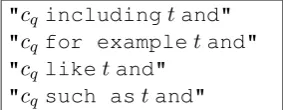
rela-tion patterns. We use a £xed set H of common patterns expressing the hyponym relation (Hearst, 1992; Cimiano and Staab, 2004), see Table 1. For the class names, we use plurals.
We use these patterns in the following accep-tance function
acceptcq(t) := (
p∈H
"cqincludingtand"
"cqfor exampletand"
"cqliketand"
[image:5.595.110.252.63.118.2]"cqsuch astand"
Table 1: Hearst patterns for instance-class relation.
whereh(p, cq, t)is the number of Google hits for
query with patternpcombined with termtand the plural form of the class name cq. The threshold
nhas to be chosen beforehand. We can do so, by calculating the sum of Google hits for queries with known instances of the class. Based on these £g-ures, a threshold can be chosen e.g. the minimum of these sums.
Note that termtis both preceded and followed by a £xed phrase in the queries. We do so, to guarantee thattis indeed the full term we are in-terested in. For example, if we had extracted the term ‘Los’ instead of ‘Los Angeles’ as a Califor-nian City, we would falsely identify ‘Los’ as a Cal-ifornian City, when we do not let ‘Los’ follow by the £xed expressionand. The number of Google hits for some expression xis at least the number of Google hits when querying the same expression followed by some expressiony.
If we identify a term tas being an instance of classca, we can add this term to the setIa.
How-ever, we cannot relatetto an instance inIq, since
the pattern used to £ndthas not proven to be effec-tive yet (e.g. the pattern could express a different relation between one of the instance-pairs in the training set).
We reduce the amount of Google queries by us-ing a list of terms found that do not belong toca.
Terms that occur multiple times in the excerpts can then be checked only once. Moreover, we use the OR-clause to combine the individual queries into one. We then check if the number of hits to this query exceeds the threshold. The amount of Google queries in this phase thus equals the amount of distinct terms extracted.
5 The use of surface text patterns in information extraction
Having a method to identify relation patterns, we now focus on utilizing these patterns in informa-tion extracinforma-tion from texts found by a search en-gine. We use an ontology to represent the infor-mation extracted.
Suppose we have an ontology O with classes
(c1, c2, ...) and corresponding instance sets
(I1, I2, ..). On these classes, relations R(i,j)1
are de£ned, with i and j the index number of the classes. The non-empty sets T(i,j) contain the training set of instance-pairs of the relations
R(i,j).
Per instance, we maintain a list of expressions that already have been used as a query. Initially, these are empty.
The £rst step of the algorithm is to learn surface text patterns for each relation inO.
The following steps of the algorithm are per-formed until either some stop criterion is reached, or no more new instances and instance-pairs can be found.
- Step 1: Select a relation R(i,j), and an
in-stancev from eitherIi orIj such that there
exists at least one pattern expressing R(i,j)
we have not yet queried in combination with v.
- Step 2: Construct queries using the patterns withvand send these queries to Google.
- Step 3:Extract instances from the excerpts.
- Step 4: Add the newly found instances to the corresponding instance set and add the instance-pairs found (thus withv) toT(i,j).
- Step 5:If there exists an instance that we can use to formulate new queries, then repeat the procedure.
Else, learn new patterns using the extracted instance-pairs and then repeat the procedure.
Note that instances of classcxlearned using the
algorithm applied on relation R(x,y) can be used as input for the algorithm applied to some relation
R(x,z)to populate the setsIzandT(x,z).
6 Experiments
In this section, we discuss two experiments that we have conducted. The £rst experiment involves the identi£cation of effective hyponym patterns. The second experiment is an illustration of the applica-tion of learned surface text patterns in informaapplica-tion extraction.
1
Assuming one relation per pair of classes. We can use another indexkinR(i,j,k)to distinct multiple relations
6.1 Learning effective hyponym patterns
We are interested whether the effective surface text patterns are indeed intuitive formulations of some relationR. As a test-case, we compute the most effective patterns for the hyponym relation using a test set with names of all countries.
Our experiment was set up as follows. We col-lected the complete list of countries in the world from the CIA World Factbook2. LetI
qbe this set
of countries, and let Ia be the set { ‘countries’,
‘country’ }. The setTR consists of all pairs (a, ‘countries’) and(a, ‘country’) , fora ∈ Ia. We
apply the surface text pattern learning algorithm on this setTR.
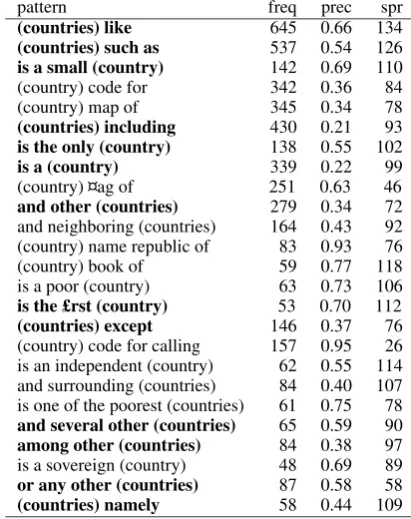
The algorithm identi£ed almost 40,000 patterns. We computedfspr and fprec for the 1,000 most frequently found patterns. In table 2, we give the 25 most effective patterns found by the algorithm. We consider the patterns in boldface true hyponym patterns. Focussing on these patterns, we observe two groups: ‘is a’ and Hearst-like patterns.
pattern freq prec spr
(countries) like 645 0.66 134 (countries) such as 537 0.54 126 is a small (country) 142 0.69 110
(country) code for 342 0.36 84
(country) map of 345 0.34 78
(countries) including 430 0.21 93 is the only (country) 138 0.55 102 is a (country) 339 0.22 99
(country) ¤ag of 251 0.63 46
and other (countries) 279 0.34 72 and neighboring (countries) 164 0.43 92 (country) name republic of 83 0.93 76
(country) book of 59 0.77 118
is a poor (country) 63 0.73 106
is the £rst (country) 53 0.70 112 (countries) except 146 0.37 76 (country) code for calling 157 0.95 26 is an independent (country) 62 0.55 114 and surrounding (countries) 84 0.40 107 is one of the poorest (countries) 61 0.75 78 and several other (countries) 65 0.59 90 among other (countries) 84 0.38 97 is a sovereign (country) 48 0.69 89 or any other (countries) 87 0.58 58 (countries) namely 58 0.44 109
Table 2: Learned hyponym patterns and their scores.
The Hearst-patterns ‘like’ and ‘such as’ show to be the most effective. This observation is useful, when we want to minimize the amount of queries for hyponym patterns.
Expressions of properties that hold for each
2
http://www.cia.gov/cia/publications/factbook
country and only for countries, for example the ex-istence of a country code for dialing, are not triv-ially identi£ed manually but are useful and reliable patterns.
The combination of ‘is a’, ‘is an’ or ‘is the’ with an adjective is a common pattern, occurring 2,400 times in the list. In future work, we plan to identify such adjectives in Google excerpts using a Part of Speech tagger (Brill, 1992).
6.2 Applying learned patterns in information extraction
The Text Retrieval Conference (TREC) question answering track in 2004 contains list question, for example ‘Who are Nirvana’s band members?’ (Voorhees, 2004). We illustrate the use of our on-tology population algorithm in the context of such list-question answering with a small case-study. Note that we do not consider the processing of the question itself in this research.
Inspired by one of the questions (‘What coun-tries is Burger King located in?’), we are interested in populating an ontology with restaurants and the countries in which they operate. We identify the classes ‘country’ and ‘restaurant’ and the relation ‘located in’ between the classes.
We hand the algorithm the instances of ‘coun-try’, as well as two instances of ‘restaurant’: ‘Mc-Donald’s’ and ‘KFC’. Moreover, we add three instance-pairs of the relation to the algorithm. We use these pairs and a subset Icountry of size eight
to compute a ranked list of the patterns. We ex-tract terms consisting of one up to four capital-ized words. In this test we set the threshold for the number of Google results for the queries with the extracted terms to 50. After a small test with names of international restaurant branches, this seemed an appropriate threshold.
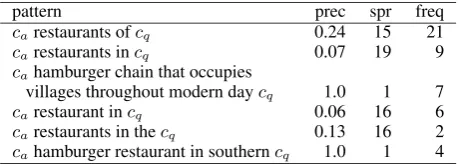
The algorithm learned, besides a ranked list of 170 surface text patterns (Table 3), a list of 54 stances of restaurant (Table 4). Among these in-stances are indeed the names of large international chains, Burger King being one of them. Less expected are the names of geographic locations and names of famous cuisines such as ‘Chinese’ and ‘French’. The last category of false instances found that have not be £ltered out, are a number of very common words (e.g. ‘It’ and ‘There’).
[image:6.595.76.282.367.627.2]pattern prec spr freq
carestaurants ofcq 0.24 15 21
carestaurants incq 0.07 19 9
cahamburger chain that occupies
villages throughout modern daycq 1.0 1 7
carestaurant incq 0.06 16 6
[image:7.595.72.302.75.158.2]carestaurants in thecq 0.13 16 2 cahamburger restaurant in southerncq 1.0 1 4
Table 3: Top learned patterns for the restaurant-country (ca-cq) relation.
Chinese Bank Outback Steakhouse Denny’s Pizza Hut Kentucky Fried Chicken Subway Taco Bell Continental
Holywood Wendy’s Long John Silver’s HOTEL OR This Burger King Japanese West Keg Steakhouse
You BP Outback
World Brazil San Francisco
Leo Victoria New York
These Lyons Starbucks
FELIX Roy California Pizza Kitchen
Marks Cities Emperor
Friendly Harvest Friday New York Vienna Montana Louis XV Greens Red Lobster
Good It There
That Mark Dunkin Donuts
Italia French Tim Hortons
Table 4: Learned instances for restaurant.
The algorithm returned 69 instance-pairs with countries related to ‘Burger King’. On the Burger King website3 a list of the 65 countries can be found in which the hamburger chain operates. Of these 65 countries, we identi£ed 55. This implies that our results have a precision of 5569 = 80%and recall of 5565 = 85%. Many of the falsely related countries – mostly in eastern Europe – are loca-tions where Burger King is said to have plans to expand its empire.
7 Conclusions
We have presented a novel approach to identify useful surface text patterns for information extrac-tion using an internet search engine. We argued that the selection of patterns has to be based on effectiveness: a pattern has to occur frequently, it has to be precise and has to be wide-spread if it represents a non-functional relation.
These criteria are combined in a scoring func-tion which we use to select the most effective pat-terns.
3
http://www.whopper.com
The method presented can be used for arbitrary relations, thus also relations that link an instance to multiple other instances. These patterns can be used in information extraction. We combine pat-terns with an instance and offer such an expression as a query to a search engine. From the excerpts retrieved, we extract instances and simultaneously instance-pairs.
Learning surface text patterns is ef£cient with respect to the number of queries if we know all instances of the classes concerned. The £rst part of the algorithm is linear to the size of the training set. Furthermore, we select the n most frequent patterns and perform |Iq| ·nqueries to compute the score of thesenpatterns.
However, for a setting where Ia is incomplete, we have to perform a check for each unique term identi£ed as a candidate instance in the excerpts found by the |Iq| · n queries. The number of queries, one for each extracted unique candidate instance, thus fully depends on the rules that are used to identify a candidate instance.
We apply the learned patterns in an ontology population algorithm. We combine the learned high quality relation patterns with an instance in a query. In this way we can perform a range of ef-fective queries to £nd instances of some class and simultaneously £nd instance-pairs of the relation.
A £rst experiment, the identi£cation of hy-ponym patterns, showed that the patterns identi-£ed indeed intuitively re¤ect the relation consid-ered. Moreover, we have generated a ranked list of hyponym patterns. The experiment with the restaurant ontology illustrated that a small train-ing set suf£ces to learn effective patterns and pop-ulate an ontology with good precision and recall. The algorithm performs well with respect to re-call of the instances found: many big international restaurant branches were found. The identi£cation of the instances however is open to improvement, since the additional check does not £lter out all falsely identi£ed candidate instances.
8 Future work
instance-pairs are added to our ontology. We thus need some post-processing to remove falsely found instance-pairs. When we know that a re-lation is functional, we can select the most fre-quently occurring instance-pair.
Moreover, the process of identifying an instance in a text needs further research especially since the method to identify instance-class relations by querying hyponym patterns is not ¤awless.
The challenge thus lies in the area of improving the precision of the output of the ontology pop-ulation algorithm. With additional £ltering niques and more elaborated identi£cation tech-niques we expect to be able to improve the pre-cision of the output. We plan to research check functions based on enumerations of candidate in-stances with known inin-stances of the class. For ex-ample, the enumeration ‘KFC, Chinese and Mc-Donald’s’ is not found by Google, where ‘KFC, Burger King and McDonald’s’ gives 31 hits.
Our experiment with the extraction of hyponym patterns, suggests a ranking of Hearst-patterns based on the effectiveness. Knowledge on the ef-fectiveness of each of the Hearst-patterns can be utilized to minimize the amount of queries.
Finally we will investigate ways to compare our methods with other systems in a TREC like setting with the web as a corpus.
Acknowledgments
We thank our colleagues Bart Bakker and Dragan Sekulovski and the anonymous reviewers for their useful comments on earlier versions of this paper.
References
E. Agichtein and L. Gravano. 2000. Snowball: Ex-tracting relations from large plain-text collections. InProceedings of the Fifth ACM International Con-ference on Digital Libraries.
E. Brill. 1992. A simple rule-based part-of-speech tagger. In Proceedings of the third Conference on Applied Natural Language Processing (ANLP’92), pages 152–155, Trento, Italy.
S. Brin. 1998. Extracting patterns and relations from the world wide web. InWebDB Workshop at sixth International Conference on Extending Database Technology (EDBT’98).
P. Buitelaar, P. Cimiano, and B. Magnini, editors. 2005. Ontology Learning from Text: Methods, Eval-uation and Applications, volume 123 ofFrontiers in Arti£cial Intelligence and Applications. IOS Press.
N. A. Chinchor, editor. 1998. Proceedings of the Sev-enth Message Understanding Conference (MUC-7). Morgan Kaufmann, Fairfax, Virginia.
P. Cimiano and S. Staab. 2004. Learning by googling.
SIGKDD Explorations Newsletter, 6(2):24–33.
M. Craven, D. DiPasquo, D. Freitag, A. McCallum, T. Mitchell, K. Nigam, and S. Slattery. 2000. Learn-ing to construct knowledge bases from the World Wide Web. Arti£cial Intelligence, 118:69–113.
V. Crescenzi and G. Mecca. 2004. Automatic infor-mation extraction from large websites. Journal of the ACM, 51(5):731–779.
O. Etzioni, M. J. Cafarella, D., A. Popescu, T. Shaked, S. Soderland, D. S. Weld, and A. Yates. 2005. Un-supervised named-entity extraction from the web: An experimental study. Arti£cial Intelligence, 165(1):91–134.
K. Frantzi, S. Ananiado, and H. Mima. 2000. Au-tomatic recognition of multi-word terms: the c-value/nc-value method. International Journal on Digital Libraries, 3:115–130.
G. Geleijnse and J. Korst. 2005. Automatic ontology population by googling. InProceedings of the Sev-enteenth Belgium-Netherlands Conference on Arti-£cial Intelligence (BNAIC 2005), pages 120 – 126, Brussels, Belgium.
M. Hearst. 1992. Automatic acquisition of hyponyms from large text corpora. In Proceedings of the 14th conference on Computational linguistics, pages 539–545, Morristown, NJ, USA.
M. Hearst. 1998. Automated discovery of wordnet relations. In Christiane Fellbaum, editor, WordNet: An Electronic Lexical Database. MIT Press, Cam-bridge, MA.
G. Nenadi´c, I. Spasi´c, and S. Ananiadou. 2002. Au-tomatic discovery of term similarities using pattern mining. InProceedings of the second international workshop on Computational Terminology (CompuT-erm’02), Taipei, Taiwan.
D. Ravichandran and E. Hovy. 2002. Learning surface text patterns for a question answering system. In
Proceedings of the 40th Annual Meeting of the Asso-ciation for Computational Linguistics (ACL 2002), pages 41–47, Philadelphia, PA.
E. Voorhees. 2004. Overview of the trec 2004 ques-tion answering track. In Proceedings of the 13th Text Retrieval Conference (TREC 2004), Gaithers-burg, Maryland.