CCG Chart Realization from Disjunctive Inputs
Michael White
Department of Linguistics The Ohio State University Columbus, OH 43210 USA
http://www.ling.ohio-state.edu/∼mwhite/
Abstract
This paper presents a novel algorithm for efficiently generating paraphrases from disjunctive logical forms. The algorithm is couched in the framework of Combina-tory Categorial Grammar (CCG) and has been implemented as an extension to the OpenCCG surface realizer. The algorithm makes use of packed representations sim-ilar to those initially proposed by Shem-tov (1997), generalizing the approach in a more straightforward way than in the algo-rithm ultimately adopted therein.
1 Introduction
In recent years, the generate-and-select paradigm of natural language generation has attracted in-creasing attention, particularly for the task of sur-face realization. In this paradigm, symbolic meth-ods are used to generate a space of possible phras-ings, and statistical methods are used to select one or more outputs from this space. To spec-ify the desired paraphrase space, one may either provide an input logical form that underspecifies certain realization choices, or includeexplicit dis-junctions in the input LF (or both). Our experi-ence suggests that disjunctive LFs are an impor-tant capability, especially as one seeks to make grammars reusable across applications, and to em-ploy domain-specific, sentence-level paraphrases (Barzilay and Lee, 2003).
Prominent examples of surface realizers in the generate-and-select paradigm include Nitro-gen/Halogen (Langkilde, 2000; Langkilde-Geary, 2002) and Fergus (Bangalore and Rambow, 2000). More recently, generate-and-select realizers in the
chart realization tradition (Kay, 1996) have ap-peared, including the OpenCCG (White, 2004)
and LinGO (Carroll and Oepen, 2005) realizers. Chart realizers make it possible to use the same reversible grammar for both parsing and realiza-tion, and employ well-defined methods of seman-tic composition to construct semanseman-tic representa-tions that can properly represent the scope of log-ical operators.
In the chart realization tradition, previous work has not generally supported disjunctive logical forms, with (Shemtov, 1997) as the only published exception (to the author’s knowledge). Arguably, part of the reason that disjunctive LFs have not yet been embraced more broadly by those work-ing on chart realization is that Shemtov’s solution, while ingenious, is dauntingly complex. Look-ing beyond chart realizers, both Nitrogen/Halogen and Fergus support some forms of disjunctive in-put; however, in comparison to Shemtov’s inputs, theirs are less expressive, in that they do not al-low disjunctions across different levels of the input structure.
As an alternative to Shemtov’s method, this pa-per presents a chart realization algorithm for gen-erating paraphrases from disjunctive logical forms that is more straightforward to implement, to-gether with an initial case study of the algorithm’s efficiency. As discussed in Section 5, the algo-rithm makes use of packed representations similar to those initially proposed by Shemtov, generaliz-ing the approach in a way that avoids the prob-lems that led Shemtov to reject his preliminary method. The algorithm is couched in the frame-work of Steedman’s (2000) Combinatory Catego-rial Grammar (CCG) and has been implemented as an extension to the OpenCCG surface realizer. Though the algorithm is well suited to CCG, it is expected to be applicable to other constraint-based grammatical frameworks as well.
be<TENSE>pres,<MOOD>dcl
e
<ARG> <PROP>
based_on
<DET>the,<NUM>sgdesign d p
<SOURCE> <ARTIFACT>
collection<DET>the,<NUM>sg
c
<HASPROP> <CREATOR>
Funny_Day f v Villeroy_and_Boch
(a) Semantic dependency graph for The design (is|’s) based on the Funny Day collection by Villeroy and Boch.
be<TENSE>pres,<MOOD>dcl
e
<ARG> <PROP>
based_on <DET>the,<NUM>sgdesign d p
<SOURCE> <ARTIFACT>
series<NUM>sg
c
<HASPROP> <GENOWNER>
Funny_Day f v Villeroy_and_Boch
(b) Semantic dependency graph for The design (is|’s) based on Villeroy and Boch’s Funny Day series.
be<TENSE>pres,<MOOD>dcl e
<ARG> <PROP>
based_on
<DET>the,<NUM>sgdesign d p
<SOURCE> <ARTIFACT>
collection|series(<DET>the)?,<NUM>sg c
<HASPROP> <GENOWNER>
Funny_Day f v Villeroy_and_Boch
<CREATOR>
(c) Disjunctive semantic dependency graph covering (a)-(b), i.e.The design (is|’s) based on (the Funny Day
(collection|series) by Villeroy and Boch|Villeroy and
[image:2.595.72.287.305.429.2]Boch’s Funny Day (collection|series)).
Figure 1: Example semantic dependency graphs from the COMIC dialogue system.
@e(be∧ hTENSEipres∧ hMOODidcl∧
hARGi(d∧design∧ hDETithe∧ hNUMisg)∧ hPROPi(p∧based on∧
hARTIFACTid∧
hSOURCEi(c∧collection∧ hDETithe∧ hNUMisg∧ hHASPROPi(f∧Funny Day)∧ hCREATORi(v∧V&B))))
(a) .. .
@e(be∧ hTENSEipres∧ hMOODidcl∧
hARGi(d∧design∧ hDETithe∧ hNUMisg)∧ hPROPi(p∧based on∧
hARTIFACTid∧
hSOURCEi(c∧ hNUMisg∧(hDETithe)?∧
(collection∨series)∧
hHASPROPi(f∧Funny Day)∧
(hCREATORiv∨ hGENOWNERiv))))
∧@v(Villeroy and Boch)
(c)
Figure 2: HLDS for examples in Figure 1.
2 Disjunctive Logical Forms
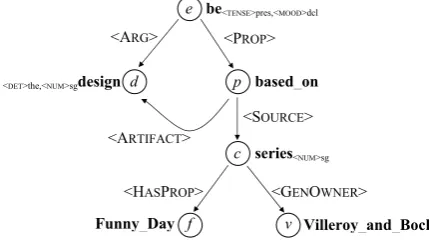
As an illustration of disjunctive logical forms, consider the semantic dependency graphs in Fig-ure 1, which are taken from the COMIC1 mul-timodal dialogue system.2 Graphs such as these constitute the input to the OpenCCG realizer. Each node has a lexical predication (e.g.design) and a set of semantic features (e.g. hNUMisg); nodes are connected via dependency relations (e.g. hARTIFACTi).
Given the lexical categories in the COMIC grammar, the graphs in Figure 1(a) and (b) fully specify their respective realizations, with the ex-ception of the choice of the full or contracted form of the copula. To generalize over these al-ternatives, the disjunctive graph in (c) may be employed. This graph allows a free choice be-tween the domain synonyms collection and se-ries, as indicated by the vertical bar between their respective predications. The graph also al-lows a free choice between the hCREATORi and hGENOWNERi relations—lexicalized via by and the possessive, respectively—connecting the head
c(collectionorseries) with the dependent v (for
1
http://www.hcrc.ed.ac.uk/comic/
2To simplify the exposition, the features specifying
[image:2.595.75.291.491.629.2]@e(see∧ hARG0i(m∧man)∧ hARG1i(g∧girl)∧
@o(on∧ hARG1i(h∧hill))∧@w(with∧ hARG1i(t∧telescope))∧
((hMODio∧@h(hMODiw))∨
(@g(hMODio)∧(@g(hMODiw)∨@h(hMODiw)))∨
(hMODiw∧(hMODio∨@g(hMODio)))))
Figure 3: Disjunctive LF for 5-way ambiguity in
A man saw a girl on the hill with a telescope.
Villeroy and Boch); this choice is indicated by an arc between the two dependency relations. Finally, the determiner feature (hDETithe) oncis indicated as optional, via the question mark.
It is worth pausing at this point to observe that in designing the COMIC grammar, the differ-ences between (a) and (b) could perhaps have been collapsed. However, such a move would make it more difficult to reuse the grammar in other applications—and indeed, the core of the gram-mar is shared with the FLIGHTS system (Moore et al., 2004)—as it would presuppose that these para-phrases should always available in the same con-texts. An example of asentence-levelparaphrase, whose context of applicability is more clearly lim-ited, appears in (1):
(1) (This design|This one|This) (is|’s) (clas-sic | in the classic style) |Here we have a (classic design | design in the classic style).
This example shows some of the phrasings that may be used in COMIC to describe the style of a design that has not been discussed previously. The example includes a top-level disjunction be-tween the use of a deictic NPthis design|this one
|this(with an accompanying pointing gesture) fol-lowed by the copula, or the use of the phrasehere we have to introduce the design. While these al-ternatives can function as paraphrases in this con-text, it is difficult to see how one might specify them in a single underspecified (and application-neutral) logical form.
Graphs such as those in Figure 1 are repre-sented internally using Hybrid Logic Dependency Semantics (HLDS), as in Figure 2. HLDS is a dependency-based approach to representing lin-guistic meaning developed by Baldridge and Krui-jff (2002). In HLDS, hybrid logic (Blackburn, 2000) terms3 are used to describe dependency
3Hybrid logic extends modal logic with
nominals, a new
sort of basic formula that explicitly names states/nodes. Like propositions, nominals are first-class citizens of the object
graphs. These graphs have been suggested as rep-resentations for discourse structure, and have their own underlying semantics (White, 2006).
In HLDS, as can be seen in Figure 2(a), each semantic head is associated with a nominal that identifies its discourse referent, and heads are con-nected to their dependents via dependency re-lations, which are modeled as modal relations. Modal relations are also used to represent seman-tic features. In (c), two new operators are in-troduced to represent periphrastic alternatives and optional parts of the meaning, namely ∨ and(·)?, for exclusive-or and optionality, respectively. To indicate that a nominal represents a reference to a node that is considered a shared part of multiple alternatives, the nominal is annotated with a box, as exemplified by v. As will be discussed in Sec-tion 3.1, this noSec-tion of shared references is needed during the logical form flattening stage of the al-gorithm in order to determine which elementary predications are part of each alternative.
As mentioned earlier, disjunctive LFs may con-tain alternations that are not at the same level. To illustrate, Figure 3 shows the representation (minus semantic features) for the 5-way ambigu-ity in A man saw a girl on the hill with a tele-scope (Shemtov, 1997, p. 45); in the figure, the nominal o (foron) can be a dependent of e (for
see) org(forgirl), for example. As Shemtov ex-plains, such packed representations can be useful in machine translation for generating ambiguity-preserving target language sentences. In a straight generation context, disjunctions that span levels enable one to compactly represent alternatives that differ in their head-dependent assumptions; for in-stance, to express contrast, one might employ the coordinate conjunction but as the sentence head, or the subordinate conjunction although as a de-pendent of the main clause head.
3 The Algorithm
As with the other chart realizers cited in the in-troduction, the OpenCCG realizer makes use of a chart and an agenda to perform a bottom-up dy-namic programming search for signs whose LFs
language, and thus formulas can be formed using propo-sitions, nominals, and standard boolean operators. They may also employ thesatisfaction operator, @. A formula @i(p∧hFi(j∧q))indicates that the formulaspandhFi(j∧q)
hold at the state named byi, and that the state j, whereq
holds, is reachable via the modal relation F; equivalently, it states that nodeiis labeled byp, and that nodej, labeled by
completely cover the elementary predications in the input logical form. The search for complete realizations proceeds in one of two modes, any-time or two-stage packing/unpacking. This sec-tion focuses on how the two-stage mode has been extended to efficiently generate paraphrases from disjunctive logical forms.
3.1 LF Flattening
In a preprocessing stage, the input logical form is flattened to an array of elementary predications (EPs), one for each lexical predication, semantic feature or dependency relation. When the input LF contains no exclusive-or or optionality oper-ators, the list of EPs, when conjoined, yields a graph description that is equivalent to the origi-nal one. With disjunctive logical forms, however, more needs to be said. Our strategy is to keep track of the elementary predications that make up the al-ternatives and optional parts of the LF, as specified by the exclusive-or or optionality operators, and use these to enforce constraints on the elementary predications that may appear in any given realiza-tion. These constraints ensure that only combina-tions of EPs that describe a graph that is also de-scribed by the original LF are allowed.
To illustrate, the results of flattening the LF in Figure 2(c) are given below:
(2) 0 : @e(be),1 : @e(hTENSEipres),
2 : @e(hMOODidcl), 3 : @e(hARGid),
4 : @d(design),5 : @d(hDETithe),
6 : @d(hNUMisg),
7 : @e(hPROPip),8 : @p(based on),
9 : @p(hARTIFACTid),10 : @p(hSOURCEic),
11 : @c(hNUMisg),12 : @c(hDETithe),
13 : @c(collection),14 : @c(series),
15 : @c(hHASPROPif), 16 : @f(Funny Day),
17 : @c(hCREATORiv),18 : @c(hGENOWNERiv),
19 : @v(Villeroy and Boch)
(3) alt0,0={13};alt0,1={14}
alt1,0={17,19};alt1,1={18,19}
opt0={12}
In (2), the EPs are shown together with their array positions. Since the EPs are tracked positionally, it is possible to use bit vectors to represent the alter-natives and optional parts of the LF. In (3), the first line shows the bit vectors4for the choice between
collection(EP 13) andseries(EP 14), as
alterna-tives 0 and 1 in alternative group 0. On the
sec-4Only the positive bits are shown, via their indices.
ond line, the bit vectors for the hCREATORi (EP 17) and hGENOWNERi (EP 18) alternatives ap-pear; note that both of these options also involve the shared EP 19. The bit vector for the optional determiner (EP 12) is shown on the third line.
The constraint associated with each group of al-ternatives is that in order to be valid, a collection of EPs must not intersect with the non-overlapping parts of more than one alternative. For example, for the second group of alternatives in (3), a valid collection could include EPs 17 and 19, or EPs 18 and 19, but it could not include EPs 17 and 18 to-gether.
Flattening an LF to obtain the array of EPs, as in (2), just requires a relatively straightforward traversal of the HLDS formula. Obtaining the al-ternatives and optional parts of the LF is a bit more involved. To do so, during the traversal, the exclusive-or and optionality operators are han-dled by introducing a new alternative group or op-tional part, and then keeping track of which ele-mentary predications fall under each alternative or under the optional part. Subsequently, the alterna-tives and optional parts are recursively propagated through any nominals marked as shared, collecting any further EPs that turn up along the way.5 For example, with the second alternative group (sec-ond line) of (3), the initial traversal creates EPs 17 and 18 under altsalt1,0andalt1,1, respectively.
Since EPs 17 and 18 both include a nominal de-pendent v marked as shared in Figure 2(c), both alternatives are propagated through this reference, and thus EP 19 ends up as part of bothalt1,0 and
alt1,1. Determining which EPs have shared
mem-bership in multiple alternatives is essential for ac-curately tracking an edge’s coverage of the input LF, a topic which will be considered next.
3.2 Edges
In the OpenCCG realizer, anedgeis a data struc-ture that wraps a CCG sign, which itself consists of a word sequence paired with a category (syn-tactic category plus logical form). An edge has bit vectors to record its coverage of the input LF and its indices, i.e. syntactically available nomi-nals. In packing mode, arepresentativeedge also maintains a list of alternative edges whose signs have equivalent categories (but different word se-quences), so that a representative edge may
effec-5Though space precludes discussion, it is worth noting
tively stand in for the others during chart construc-tion.
To handle disjunctive inputs, an edge addition-ally maintains a list of active (i.e., partiaddition-ally com-pleted) LF alternatives. It also makes use of a revised notion of input coverage and a revised equivalence relation. As in Shemtov’s (1997, Sec-tion 3.3.2) preliminary algorithm, an edge is con-sidered to cover an entire disjunction (alternative group) if it covers all the EPs of one of its alter-natives. With optional parts of an LF, an edge that does not cover any EPs in the optional part can be extended to a new edge (using the same sign) that is additionally considered to cover all the EPs in the optional part. In this way, an edge can be de-fined to becomplete with respect to the input LF if it covers all its EPs. For example, an edge for the sentence in Figure 1(b) would be considered complete, since (i) it would cover all the EPs in (2) except for 12, 13 and 17; (ii) 12 is optional; (iii) 14 completesalt0,1, and thus counts as
cover-ing 13, the other EP in the group; and (iv) 18 and 19 completealt1,1, and thus count as covering EP
17.
As Shemtov points out, this extended notion of input coverage provides an appropriate way to form edge equivalence classes, as it can gather edges together that realize different alternatives in the same group. Thus, in OpenCCG, edge equiva-lence classes have been modified to include edges with the same syntactic category and coverage bit vector, but different word sequences and/or logical forms (as the latter varies according to which al-ternative is realized). The appropriate equivalence checks are efficiently carried out using a hash map with a custom hash function and equals method.
3.3 Lexical Instantiation
Once the input LF has been flattened, and the alter-natives and optional parts have been identified, the next step is to access and instantiate lexical items. For each elementary predication, all lexical items indexed by the EP’s lexical predicate or relation are retrieved from the lexicon.6 Each such lexi-cal item is then instantiated against the input EPs, starting with the one that triggered its retrieval, and incrementally extending successful instantia-tions until all the lexical item’s EPs have been in-stantiated (otherwise failing). The lexical
instanti-6See (White, 2004; White, 2006) for discussion of how
semantically null lexical items and unary type changing rules are handled.
ation routine returns all instantiations that satisfy the alternative exclusion constraints. Associated with each instantiation is a bit vector that encodes the coverage of the input EPs. From each bit vec-tor, the active (partially completed) LF alternatives are determined, and the bit vector is updated to in-clude the EPs in any completed disjunctions. Fi-nally, edges are created for the instantiated lexical items, which include the active alternatives and the updated coverage vector.
Continuing with example (2)-(3), the selected lexical edges in (4) below illustrate how lexical in-stantiation interacts with disjunctions:
(4) a. {11,13,14} collection`nc: @c(collection)∧@c(hNUMisg) b. {11,13,14} series`nc:
@c(series)∧@c(hNUMisg)
c. {17} alt1,0 by`nc\nc/npv:
@c(hCREATORiv)
d. {18} alt1,1 ’s`npc/nc\npv:
@c(hGENOWNERiv)
e. {19} alt1,0;alt1,1 Villeroy and Boch`npv
:@v(V&B)
The nouns in (a) and (b) completealt0,0andalt0,1,
respectively, and thus they each count as cover-ing EPs 11, 13 and 14. In (c) and (d), by and’s
partially cover alt1,0 andalt1,1, respectively, and
thus these alternatives are active for their respec-tive edges. In (e),V&Bpartially covers bothalt1,0
andalt1,1, and thus both alternatives are active.
3.4 Derivation
Following lexical instantiation, the lexical edges are added to the agenda, as is usual practice with chart algorithms, and the main loop is initiated. During each iteration of the main loop, an edge is moved from the agenda to the chart. If the edge is in the same equivalence class as an edge already in the chart, it is added as an alternative to the ex-isting representative edge. Otherwise, it is com-bined with all applicable edges in the chart (via the grammar’s combinatory rules), as well as with the grammar’s unary rules, where any newly created edges are added to the agenda. The loop termi-nates when no edges remain on the agenda.
1. {8-10} based on ` sp\npd/npc
2. {12}the ` npc/nc
3. {15,16} Funny Day ` nc/nc
4. {11,13,14}collection ` nc {11,13,14}series ` nc
5. {17}alt1,0 by ` nc\nc/npv
6. {18}alt1,1 ’s ` npc/nc\npv
7. {19}alt1,0;alt1,1 Villeroy and Boch ` npv
8. {11,13-16}FD [collection] ` nc (3 4>)
9. {17-19} by V&B ` nc\nc (5 7>)
10. {17-19} V&B ’s ` npc/nc (7 6<)
11. {11,13-19}FD [coll.] by V&B ` nc (8 9<)
12. {11,13-19}V&B ’s FD [coll.] ` npc (10 8>)
13. {11-19} the FD [coll.] by V&B ` npc (2 11>) {11-19} V&B ’s FD [coll.] ` npc (12optC)
14. {8-19} b. on [the FD [coll.] . . . ] ` sp\npd (1 13>)
Figure 4: Part of realization chart for Figure 1(c).
exclusion constraints for the disjunction continue to be enforced. Thus, for example, no attempt will be made to combine the edges forcollectionand
seriesin (4a) and (4b), since they both express EP 11 and since they contribute to different alterna-tives in group 0.
To enforce the constraints associated with active alternatives, a compatibility check is made to en-sure that if the input edges have active alternatives in the same group, the intersection of these alter-natives is non-empty. To illustrate, consider the edges forbyand the possessive’sin (4c) and (4d). Since these edges have different alternatives active within group 1, the compatibility check fails, and thus their combination is not attempted. By con-trast, the edge for Villeroy and Bochin (4e) will pass the compatibility check with both (4c) and (4d), as it shares an active alternative in common with each of these. When two edges succeed in combining, a new edge is constructed from the re-sulting sign by taking the union of the coverage bit vectors, determining the active alternatives, and updating the coverage vector to include the EPs in any completed disjunctions.
When the grammar’s unary rules are applied to an edge, an operation is also invoked for creat-ing an edge (for the same sign) with one or more optional parts marked as completed. This oper-ation is invoked when it would complete the
in-put LF, complete an alternative, or complete an LF chunk.7 A constraint on its application is that the optional parts must be wholly missing from the in-put edge; additionally, in the case of completing an alternative or LF chunk, the optional parts must be part of the alternative or chunk in question.
Figure 4 demonstrates how the lexical edges in (4) are combined in the chart.8 These lexical edges appear on lines 4-7. Note that the edge forseries
is added as an alternative edge to the one for col-lection, which acts as a representative for both; to highlight its role as a representative,collectionis shown in square brackets from line 8 onwards. At the end of each line, the derivation of each (non-lexical) edge is shown in parentheses, in terms of its input edges and combinatory rule. On line 13, observe that the NP using the possessive is added as an alternative to the one using the by-phrase; the possessive version becomes part of the same equivalence class when the optional determiner is marked as covered, via the optional part comple-tion operacomple-tion.
3.5 Unpacking
Once chart construction has finished, the complete realizations are recursively unpacked bottom-up in a way that generalizes the approach of (Langkilde, 2000). Unpacking proceeds by multiplying out the alternative edges stored with the representative in-put edges; filtering out any duplicate edges result-ing from spurious ambiguities; scorresult-ing the new edges with the scoring method configured via the API; and pruning the results with the configured pruning strategy. Note that since there is no need for checking grammatical or other constraints dur-ing the unpackdur-ing stage, new edges can be quickly and cheaply constructed using structure sharing.
To briefly illustrate the process, consider how the Funny Day collection edge in line 8 of Fig-ure 4 is unpacked. While the Funny Day input edge has no alternative edges, thecollectioninput edge has theseriesedge as an alternative, and thus a newFunny Day seriesedge will be created and scored; as long as the pruning strategy keeps more than the single-best option, this edge will be added as an alternative, and both combinations will be propagated upwards through the edges in lines 11
7LF chunks serve to avoid propagating semantically
in-complete phrases; see (White, 2006) for discussion.
8To save space, the figure only shows part of the normal
10-best two-stage 1-best anytime
time edges time edges
disjunctive 1.1 602 0.5 281
[image:7.595.84.276.63.104.2]sequential 5.6 3550 4.1 2854
Table 1: Comparison of average run times (in sec-onds) and edges created vs. sequential realization
and 12.
4 Case Study
To examine the potential of the algorithm to effi-ciently generate paraphrases, this section presents a case study of its run times versus sequential real-ization of the equivalent top-level LF alternatives in disjunctive normal form. The study used the COMIC grammar, a small but not trivial grammar that suffices for the purposes of the system. In this grammar, there are relatively few categories per lexeme on average, but the boundary tone cat-egories engender a great deal of non-determinism. With other grammars, run times can be expected to vary.
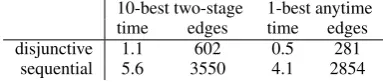
In anticipation of the present work, Foster and White (2004) generated disjunctive logical forms during sentence planning, then (as a stopgap mea-sure) multiplied out the disjunctions and sequen-tially realized the top-level alternatives until an overall time limit was reached. Taking the pre-vious logical forms as a starting point, 104 sen-tences from the evaluation in (Foster and White, 2005) were selected, and their LFs were manu-ally augmented to cover a greater range of para-phrases allowed by the grammar.9 To obtain the corresponding top-level LF alternatives, 100-best realization was performed, and the unique LFs appearing in the top 100 realizations were gath-ered; on average, there were 29 such unique LFs. We then compared the present algorithm’s per-formance against sequential realization in produc-ing 10-best outputs and sproduc-ingle-best outputs. In the 10-best case, we used the two-stage pack-ing/unpacking mode; for the single-best case, we used the anytime mode with 3-best pruning. With both cases, the run times include scoring with a trigram language model, and were measured on a 2.8GHz Linux PC. Realization quality was not as-sessed as part of the study, though manual inspec-tion indicated that it was very high.
Table 1 shows the results of the comparison.
9Extending the COMIC sentence planner to produce these
augmented LFs is left for future work.
The average run times of the present algorithm, with disjunctive LFs as input, appear on the first line, along with the average number of edges cre-ated; on the second line are the average aggregate run times and num. edges created of sequentially realizing the top-level alternatives (not including the time taken to produce these alternatives). As can be seen, realization from disjunctive inputs yields a 5-fold and 8-fold speedup over the se-quential approach in the two cases, with corre-sponding reductions in the number of edges cre-ated. Additionally, the run times appear to be ad-equate for use in interactive dialogue systems (es-pecially in the anytime, single-best case).
5 Comparison to Shemtov (1997)
The present approach differs from Shemtov’s in two main ways. First, since Shemtov developed his approach with the task of ambiguity preserv-ing translation in mind, he framed the problem as one of generating fromambiguoussemantic rep-resentations, such as one might find in a parse chart with unresolved ambiguities. Consequently, he devised a method for converting the meanings in a packed parse chart into an encoding where each fact (here, EP) appears exactly once, together with an indication of the meaning alternatives it belongs to, expressed as propositional formulas. While thiscontexted factsencoding may be suit-able for MT, it is not very convenient as an input representation for systems which generate from non-linguistic data, as the formulas representing the contexts only make sense in reference to a parse chart. By contrast, the present approach takes as input disjunctive logical forms that should be reasonably intuitive to construct in dialogue systems or other NLG applications, since they are straightforwardly related to their non-disjunctive counterparts.
combinations were committed to. By contrast, the present approach does not suffer from this defect, because it checks the alternative exclusion con-straints on all of a lexical edge’s EPs at once (us-ing bit vectors for both edge coverage and alter-native membership), and also ensures that the ac-tive alternaac-tives are compatible before combining edges during derivations. Shemtov does not ap-pear to have considered a solution along the lines proposed here; instead, he went on to develop a sound but considerably more complex algorithm (his Section 3.4), where an edge’s coverage bit vector is replaced with a contexted coverage array (an array of boolean conditions). With these ar-rays, it is no longer easy to group edges into equiv-alence classes, and thus during chart construc-tion Shemtov is forced to group together edges which are not derivationally equivalent. Conse-quently, to prevent overgeneration, his algorithm has to solve during the enumeration phase a sys-tem of constraints (potentially exponential in size) formed from the conditions in the contexted cov-erage arrays—a process which is far from straight-forward.
6 Conclusions
This paper has presented a new chart realization algorithm for efficiently generating surface real-izations from disjunctive logical forms, and has argued that the approach represents an improve-ment over that of (Shemtov, 1997) in terms of both usability and simplicity. The algorithm has been implemented as an extension to the OpenCCG hy-brid symbolic/statistical realizer, and has recently been employed to generate n-best realization lists for reranking according to their predicted synthe-sis quality (Nakatsu and White, 2006), as well as to generate dialogues exhibiting individuality and alignment(Brockmann et al., 2005; Isard et al., 2005). An initial case study has shown that the algorithm works many times faster than sequential realization, with run times suitable for use in dia-logue systems; a more comprehensive study of the algorithm’s efficiency is planned for future work.
Acknowledgements
The author thanks Mary Ellen Foster, Amy Isard, Johanna Moore, Mark Steedman and the anony-mous reviewers for helpful feedback and discus-sion, and the University of Edinburgh’s Institute for Communicating and Collaborative Systems for
partially supporting this work.
References
Jason Baldridge and Geert-Jan Kruijff. 2002. Coupling CCG and Hybrid Logic Dependency Semantics. InProc. ACL-02.
Srinivas Bangalore and Owen Rambow. 2000. Exploiting a probabilistic hierarchical model for generation. InProc.
COLING-00.
Regina Barzilay and Lillian Lee. 2003. Learning to paraphrase: An unsupervised approach using multiple-sequence alignment. InProc. of NAACL-HLT.
Patrick Blackburn. 2000. Representation, reasoning, and re-lational structures: a hybrid logic manifesto. Logic
Jour-nal of the IGPL, 8(3):339–625.
Carsten Brockmann, Amy Isard, Jon Oberlander, and Michael White. 2005. Modelling alignment for affec-tive dialogue. InProc. UM-05 Workshop on Adapting the
Interaction Style to Affective Factors.
John Carroll and Stefan Oepen. 2005. High efficiency real-ization for a wide-coverage unification grammar. InProc.
IJCNLP-05.
Mary Ellen Foster and Michael White. 2004. Techniques for Text Planning with XSLT. InProc. 4th NLPXML
Work-shop.
Mary Ellen Foster and Michael White. 2005. Assessing the impact of adaptive generation in the COMIC multimodal dialogue system. InProc. IJCAI-05 Workshop on
Knowl-edge and Representation in Practical Dialogue Systems.
Amy Isard, Carsten Brockmann, and Jon Oberlander. 2005. Individuality and alignment in generated dialogues. In
Proc. INLG-06. To appear.
Martin Kay. 1996. Chart generation. InProc. ACL-96.
Irene Langkilde-Geary. 2002. An empirical verification of coverage and correctness for a general-purpose sentence generator. InProc. INLG-02.
Irene Langkilde. 2000. Forest-based statistical sentence gen-eration. InProc. NAACL-00.
Johanna Moore, Mary Ellen Foster, Oliver Lemon, and Michael White. 2004. Generating tailored, comparative descriptions in spoken dialogue. InProc. FLAIRS-04.
Crystal Nakatsu and Michael White. 2006. Learning to say it well: Reranking realizations by predicted synthesis qual-ity. InProc. of COLING-ACL-06. To appear.
Hadar Shemtov. 1997. Ambiguity Management in Natural
Language Generation. Ph.D. thesis, Stanford University.
Mark Steedman. 2000.The Syntactic Process. MIT Press.
Michael White. 2004. Reining in CCG Chart Realization. In
Proc. INLG-04.
Michael White. 2006. Efficient Realization of Coordinate Structures in Combinatory Categorial Grammar.Research